How Hotels in India Are Using AI to Increase Direct Bookings
How Indian hotels cut OTA dependency, capture after-hours inquiries, and grow direct bookings with AI-powered WhatsApp and web.
TL;DR: Indian hotels pay 15-25% OTA commissions on the majority of bookings, while a large portion of guest inquiries arrive outside business hours and go unanswered. AI-powered direct booking systems on WhatsApp and web capture these missed inquiries 24/7, helping hotels significantly increase direct bookings, reduce OTA dependency, and keep more revenue per room night (typical results vary).
How Hotels in India Are Using AI to Increase Direct Bookings
India's hospitality industry faces a costly paradox: while online travel agencies (OTAs) like MakeMyTrip, Goibibo, and Booking.com drive significant booking volume, they also extract 15-25% commissions that devastate profit margins. For a mid-sized hotel earning ₹10 crore annually through OTAs, that's ₹1.5-2.5 crore paid in commissions—money that could fund expansions, staff development, or competitive pricing.
The challenge is that most hotels feel trapped in OTA dependency because their direct booking capabilities can't compete. Research shows that 55% of hotel inquiries happen outside standard business hours (Source: Oracle Hospitality / Phocuswright)—evenings after work, weekends when travelers are planning trips, and late nights when international guests are browsing from different time zones. Yet traditional hotel operations only respond during office hours, creating a massive gap where motivated travelers encounter silence instead of service.
The mathematics are significant: hotels with no after-hours response capability miss a substantial portion of potential bookings due to delayed responses, after-hours inquiries going unanswered, and overwhelmed front desk staff during peak periods. When a traveler can't get immediate answers about availability, pricing, or amenities, they simply click over to an OTA where instant booking is guaranteed.
But a transformation is underway. Hotels, resorts, and eco-tourism properties across India are implementing AI-powered direct booking systems that capture inquiries 24/7, respond instantly across website and WhatsApp, and guide guests seamlessly from inquiry to confirmed reservation—all without paying OTA commissions.
The results? Properties report dramatically reducing missed after-hours inquiries, capturing meaningful additional monthly revenue from previously-lost bookings, and cutting OTA dependency within the first year (typical results vary by property).
What Is AI Direct Booking Technology for Hotels?
AI direct booking technology is an intelligent system that handles the complete guest inquiry and reservation process without human intervention—operating 24/7 across website chat, WhatsApp, phone, and email. For Indian hotels specifically, this means technology that understands:
- Room types, pricing tiers, and seasonal rate variations
- Availability checking and dynamic pricing updates
- Package offerings (room + meals, adventure activities, spa services)
- Location-specific queries (how to reach, nearby attractions, connectivity)
- Indian traveler preferences (vegetarian meals, family rooms, festival bookings)
- Multi-language support (English, Hindi, and regional languages)
- Integration with property management systems (PMS) for real-time availability
- WhatsApp-based booking confirmations and guest communication
- Payment coordination and booking confirmation workflows
Modern AI booking systems use natural language processing (NLP), integration with hotel tech infrastructure, and conversational intelligence to create experiences that feel personal despite being automated—guiding travelers from initial inquiry through payment and confirmation without requiring front desk intervention.
How it differs from OTA booking experiences
OTAs have trained travelers to expect instant gratification—immediate availability, pricing, and one-click booking. Traditional hotel direct booking can't compete:
Traditional hotel direct booking:
- Website inquiry form generates email to front desk
- Staff responds 6-24 hours later (or never if after-hours)
- Multiple back-and-forth emails or calls to finalize details
- Manual payment coordination
- Booking confirmation sent eventually
- Traveler gives up and books via OTA instead
AI-powered direct booking:
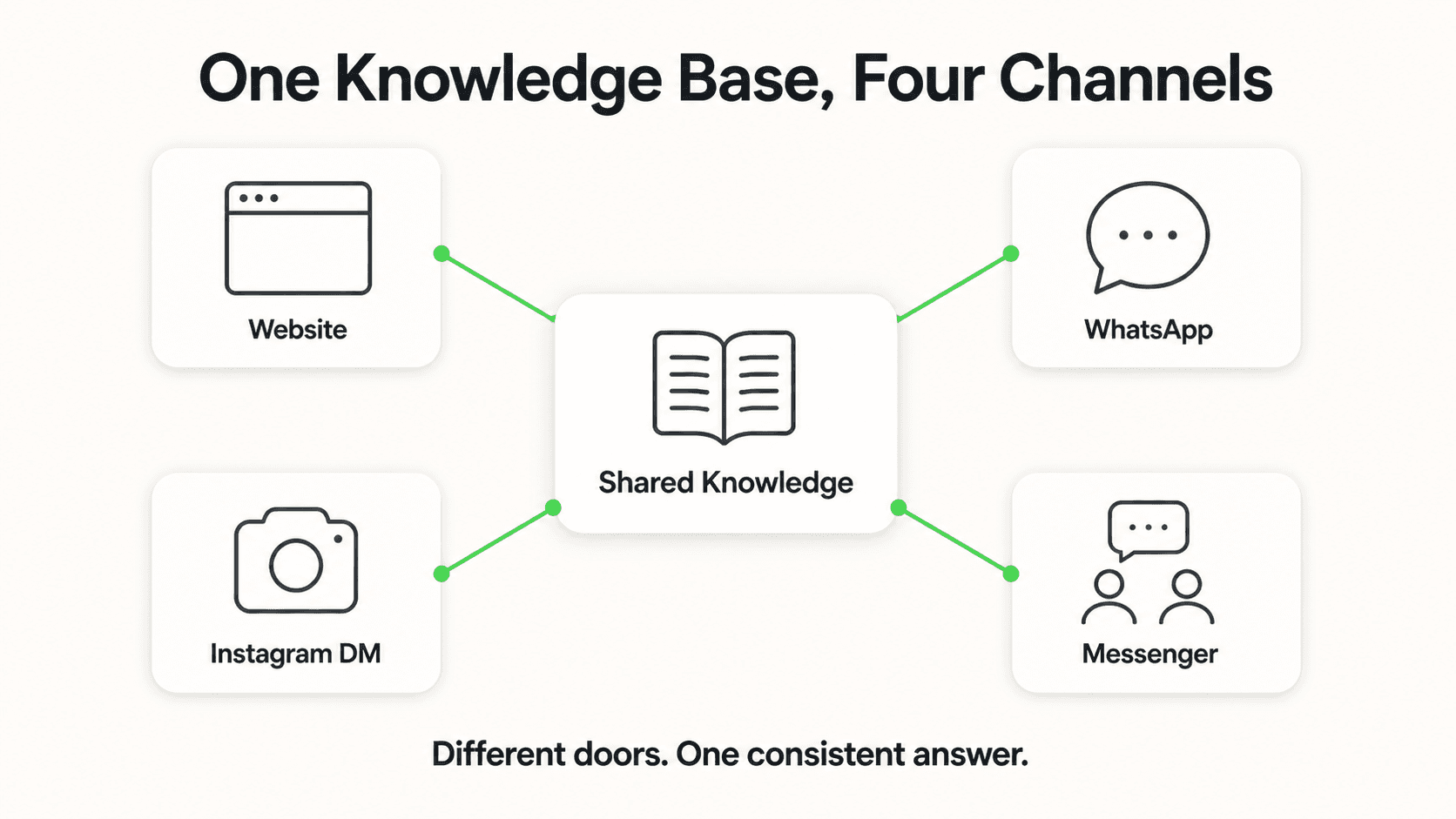
- Traveler chats via website or WhatsApp
- AI responds instantly with room availability and pricing
- Answers all questions about property, amenities, location
- Guides through room selection and package options
- Facilitates payment via secure links
- Sends instant booking confirmation
- Entire journey completes in 5-10 minutes
Hotels implementing AI report that travelers consistently describe the experience as "easier than booking through MakeMyTrip"—the ultimate compliment for direct booking systems.
Why Indian Hotels Are Bleeding Profit to OTAs
The OTA commission trap isn't new, but it's worsening as online booking dominates travel planning:
The commission crisis
Industry data shows Indian hotels pay staggering amounts to OTAs:
- Average OTA commission: 15-25% per booking
- Premium for top placement: Additional 3-5% for visibility
- Total cost: 18-30% of room revenue going to platforms
- Annual impact: ₹1-3 crores for mid-sized properties
The math for a 50-room hotel:
- Average room rate: ₹4,000/night
- 60% occupancy: 30 rooms × 365 days = 10,950 room-nights annually
- Gross revenue: ₹4.38 crores
- If 70% via OTAs at 20% commission: ₹61 lakhs paid annually
- Over 10 years: ₹6+ crores in commissions
These aren't marketing costs generating new demand—they're tolls paid on bookings that would likely happen anyway, given sufficient direct booking capability.
The after-hours inquiry gap
Hotel inquiry patterns create impossible staffing challenges:
Peak inquiry times:
- 7 PM - 11 PM weekdays (after work planning)
- 10 AM - 8 PM weekends (leisure research time)
- International travelers browsing from different time zones
- Festival season surges (Diwali, Christmas, summer holidays)
Over 55% of hotel inquiries happen outside standard office hours, yet most properties only staff front desks 8 AM - 10 PM, creating gaps where motivated travelers encounter no response.
Illustrative example: Consider a nature resort that receives 40-50 daily inquiries, with the majority arriving outside office hours. Before AI, these went to email or WhatsApp—response came 12-18 hours later, by which time many travelers had already booked via OTAs where instant booking is guaranteed. The after-hours gap directly translates to lost direct revenue and unnecessary OTA commissions.
The WhatsApp expectation problem
In India, WhatsApp is the dominant communication channel for travel planning (Source: Meta / Statista):
- 70% of Indian travelers prefer WhatsApp for hotel communication
- Instant messaging feels natural and conversational
- Easy to share photos, documents, and booking details
- Travelers expect same-day (ideally instant) WhatsApp responses
Yet most hotels treat WhatsApp as informal or secondary:
- Responses delayed by hours or days
- No systematic process for WhatsApp inquiries
- Different staff give inconsistent information
- No integration with booking systems
Properties still forcing travelers to "call during office hours" or "email us" are losing bookings to OTAs where WhatsApp booking is often available or instant web booking provides certainty.
Repetitive questions consuming front desk bandwidth
Front desk staff report that 70-80% of inquiries ask the same questions (based on industry research):
- "What are your room rates?"
- "Do you have availability for [dates]?"
- "What's included in the tariff?" (meals, activities, amenities)
- "How do we reach your property from [city]?"
- "Do you allow pets / have family rooms / serve Jain food?"
- "What activities are available nearby?"
- "Can we get early check-in or late check-out?"
Staff spending hours daily answering these basic questions have no time for:
- Personalized service for in-house guests
- Upselling premium rooms or packages
- Planning events or handling special requests
- Training and guest experience improvement
- Building relationships with travel agents and corporate clients
This misallocation of talent costs hotels both in missed direct bookings and in degraded service quality for guests already on property.
Stop Losing Bookings to OTAs
Capture every guest inquiry 24/7 on WhatsApp and web. Convert after-hours inquiries into direct bookings and save 15-25% in OTA commissions.
See How It WorksThe 7 Ways Hotels Are Using AI to Capture Direct Bookings
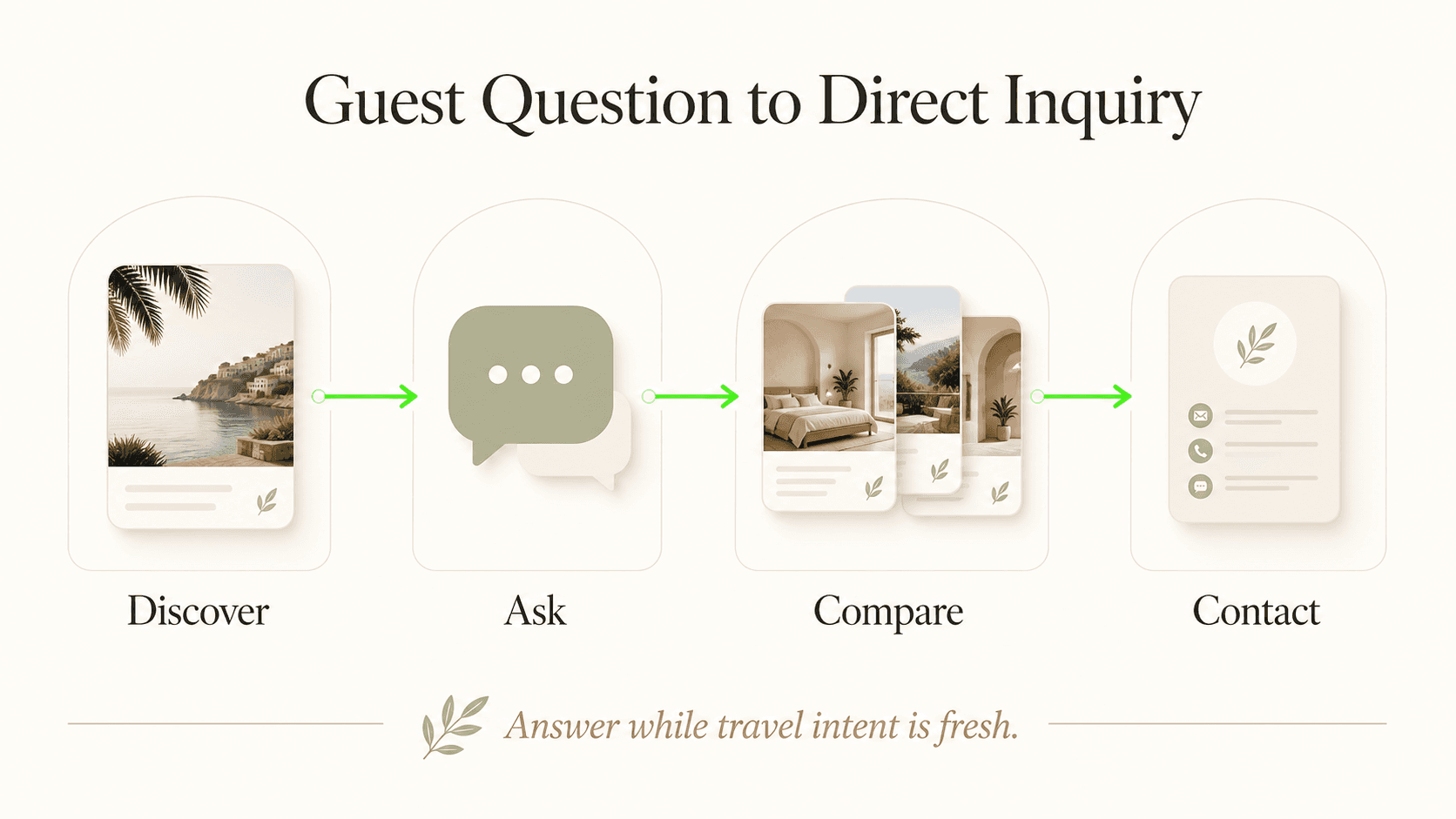
The most successful hotels aren't just implementing AI—they're using it strategically across the entire guest acquisition journey:
1. Instant 24/7 response to booking inquiries
AI systems provide immediate, comprehensive responses to traveler inquiries regardless of time, day, or channel.
What this looks like in practice:
A family researching weekend getaways messages your property on WhatsApp at 10 PM Saturday. Within seconds, the AI:
- Greets them warmly and asks about their travel dates
- Checks real-time availability for requested dates
- Shares room options with photos and descriptions
- Explains meal plans and package inclusions
- Provides pricing with any applicable discounts
- Answers questions about activities and amenities
- Offers directions and travel time from their city
- Facilitates instant booking via secure payment link
- Sends confirmation with check-in details and property contact
The entire inquiry-to-booking journey completes in 8-12 minutes with zero human involvement. Sunday morning, your front desk sees a confirmed booking with complete guest details, payment received, and preferences noted.
Real-world impact:
Hotels using 24/7 AI report improvements including (typical results vary by property):
- Majority of bookings now captured outside traditional office hours
- Near-zero missed inquiries compared to significant gaps before AI
- Meaningful additional monthly revenue from captured after-hours bookings
- Substantial reduction in OTA dependency as direct booking becomes effortless
Why it works:
Travelers booking trips are making time-sensitive decisions. Families planning weekend getaways on Friday evening won't wait until Monday for availability confirmation—they'll book the first property that responds. Instant response captures motivation at peak moment.
2. Intelligent inquiry qualification and routing
Not all inquiries represent equal opportunity. AI can identify serious travelers and prioritize them appropriately.
What this looks like in practice:
The AI asks strategic questions during conversations:
- "What dates are you considering for your stay?"
- "How many guests will be traveling?"
- "Are you looking for a weekend getaway or extended stay?"
- "What's most important to you—nature activities, relaxation, or family amenities?"
- "Is this for leisure or a special occasion?"
Based on responses, the AI:
- Hot leads (ready to book, specific dates, immediate timeline): Facilitates instant booking, sends payment link
- Warm leads (interested, flexible dates, planning ahead): Provides detailed information, adds to nurture sequence
- Information seekers (early research, comparing properties): Shares property highlights, captures contact for follow-up
High-intent travelers get seamless booking paths, while early-stage researchers receive value without consuming front desk time.
Real-world impact:
Intelligent qualification delivers (typical results vary):
- Higher conversion rates from qualified hot leads
- Meaningful reduction in staff time spent on low-intent inquiries
- Better guest matching (travelers who book are better fits)
Why it works:
Front desk time is limited and valuable. AI that distinguishes serious travelers from casual browsers allows staff to focus on guest service, upselling, and relationship building rather than answering endless comparison-shopping questions.
3. Seamless website-to-WhatsApp booking journey
Travelers often discover properties via website but prefer completing bookings through WhatsApp's familiar interface.
What this looks like in practice:
A traveler browses your website at 11 PM, initiates chat, and asks about jungle safari packages. The AI:
- Responds via website chat with package details
- Offers to continue conversation on WhatsApp
- Sends automated WhatsApp message: "Hi! Continuing our conversation about jungle safari packages..."
- Shares rich media (package brochures, activity videos, room photos)
- Answers all questions within WhatsApp
- Sends secure payment link via WhatsApp
- Confirms booking and sends voucher via WhatsApp
The traveler never needs to switch back to website, make phone calls, or send emails. Everything happens in WhatsApp—the channel they're most comfortable using.
Real-world impact:
Website-to-WhatsApp integration enables (typical results vary):
- Higher conversion compared to website-only booking
- Greater engagement through rich media sharing
- Lower abandonment (traveler stays in familiar WhatsApp environment)
Why it works:
Channel friction kills conversion. Travelers who must leave their preferred platform (WhatsApp) to complete bookings often abandon the process. Seamless transitions maintain momentum and increase completion rates.
4. Dynamic pricing and package recommendations
AI can suggest optimal room types and packages based on traveler needs and preferences.
What this looks like in practice:
A couple inquires about a romantic weekend. The AI:
- Identifies couple travel from conversation context
- Recommends honeymoon suite or deluxe rooms with better views
- Suggests anniversary or couple packages (room + candlelight dinner + spa)
- Explains pricing with weekend vs. weekday comparisons
- Notes upcoming festival premium pricing or off-season discounts
- Upsells packages that include activities they expressed interest in
The recommendations feel personalized and helpful rather than pushy, because they're based on actual stated preferences.
Real-world impact:
Intelligent recommendations drive (typical results vary):
- Higher average booking value from package upsells
- Improvement in premium room bookings
- Better guest satisfaction (travelers get rooms/packages matching their needs)
Why it works:
Most travelers don't know what's available or what best fits their needs. AI-guided recommendations help them discover better options they might not have considered, increasing both revenue and guest satisfaction.
5. Multi-language support for diverse travelers
India's diverse traveler base speaks different languages, and comfortable communication directly impacts booking confidence.
What this looks like in practice:
A family from Gujarat inquires in Gujarati about vegetarian meal options and Jain food availability. The AI:
- Detects language preference automatically
- Responds fluently in Gujarati
- Explains vegetarian and Jain meal arrangements
- Shares details about in-house Jain kitchen or nearby options
- Discusses other culturally relevant aspects (prayer rooms, festival celebrations)
- Seamlessly handles booking in preferred language
The same system manages inquiries in Hindi, Tamil, Telugu, Kannada, Malayalam, Marathi, Bengali, and English.
Real-world impact:
Multi-language AI enables (typical results vary):
- Increase in bookings from non-English-speaking regions
- Higher trust and confidence from traveler's ability to communicate comfortably
- Market expansion into regions previously underserved
- Better guest matching (culturally-aware property selection)
Why it works:
Language is the first trust barrier in hospitality. Travelers who can communicate comfortably in their native language ask more detailed questions, express requirements more clearly, and feel more confident booking. Hiring multi-lingual staff for every language is expensive—AI makes it viable.
6. Automated booking confirmation and pre-arrival communication
The journey from payment to arrival requires multiple touchpoints that AI handles systematically.
What this looks like in practice:
After booking confirmation, the AI automatically:
- Immediate: Sends booking voucher with reservation details
- Day 7 before arrival: Welcome message with property highlights
- Day 3 before arrival: Check-in information and what to bring
- Day 1 before arrival: Directions, contact numbers, estimated travel time
- Day of arrival: Confirmation of arrival time, offers assistance
Each message is personalized with guest name, reservation details, and relevant information. If guest responds with questions, they're answered instantly or routed to staff.
Additionally:
- Requests for special arrangements (early check-in, dietary needs, celebration setups)
- Upselling opportunities (room upgrades, activity bookings, spa services)
- Feedback collection post-departure
- Review request sequencing
Real-world impact:
Automated pre-arrival communication delivers (typical results vary):
- Meaningful reduction in guest queries at check-in
- Increase in ancillary bookings (activities, upgrades, meals)
- Improvement in review scores from better preparation
- Higher likelihood of repeat bookings from superior communication
Why it works:
Travelers appreciate proactive communication that makes their experience smoother. Traditional properties only communicate at booking and check-in, leaving guests to figure out logistics themselves. Systematic touchpoints build anticipation, reduce anxiety, and create opportunities for additional revenue.
7. Complete booking analytics and revenue insights
Data visibility transforms hotel operations from reactive to strategic.
What this looks like in practice:
Your AI dashboard shows:
- Inquiry patterns: 55% outside office hours, peak times 8-11 PM weekdays
- Channel performance: Website generates 40% inquiries, WhatsApp 35%, phone 25%
- Conversion analysis: Weekend packages convert at 65%, weekday at 45%
- Lost opportunity tracking: Previously missed 33% of inquiries, now 0%
- OTA vs. direct comparison: Direct bookings increased 40% since AI implementation
- Revenue attribution: ₹35 lakhs monthly revenue from AI-captured bookings
- Common questions: Top 10 FAQs account for 75% of all inquiries
- Booking lead time: Average 8 days for leisure, 3 days for weekend getaways
Real-world impact:
Analytics-driven hotels achieve (typical results vary):
- Improvement in marketing ROI by focusing on high-performing channels
- Better inventory management based on actual demand patterns
- Optimized pricing strategies using conversion data
- Staff scheduling aligned with actual inquiry volumes
- Competitive intelligence from questions comparing you to other properties
Why it works:
What gets measured gets improved. Traditional hotel operations rely on intuition ("weekends are busy") rather than data ("62% of weekend inquiries come Thursday-Friday 7-10 PM"). Data transforms decisions about pricing, marketing, staffing, and OTA strategy.
Boost Your Direct Bookings
Stop losing guests to OTAs. Capture every inquiry 24/7 with AI that responds instantly on WhatsApp and web, and converts travelers into direct bookings.
Try for FreeReal Results: What Indian Hotels Are Achieving with AI
The transformation isn't theoretical—here's what properties across India are experiencing:
Direct booking revenue improvements
Hotels implementing AI direct booking report improvements across key metrics (typical results vary by property size and market):
- Significant increase in direct bookings within first 6 months
- Additional monthly revenue from captured after-hours inquiries
- Meaningful reduction in OTA dependency and commission costs
- Improved inquiry-to-booking conversion rates
- Near-zero missed inquiries compared to before AI (when after-hours gaps were common)
For a real hospitality example: Jungle Lodges & Resorts in Karnataka captured 3,300+ leads in 90 days and handled 35% of inquiries after-hours automatically—demonstrating how AI transforms direct booking capture at scale.
Commission savings and profitability
Financial metrics show clear ROI (typical results vary):
- Annual commission savings from reduced OTA reliance
- Payback on AI implementation typically within a few months from booking increases alone
- Higher profit margin on direct bookings vs. OTA bookings (no commission)
- Higher revenue per available room (RevPAR) from improved occupancy
The math is compelling: if AI helps capture even 20-30 additional direct bookings monthly at ₹5,000 average value, that generates meaningful additional monthly revenue—far exceeding typical platform costs.
Operational efficiency gains
Beyond revenue, hotels see meaningful operational improvements:
- Significant reduction in front desk time spent on routine booking inquiries
- 24/7 booking capability without additional staffing costs
- Elimination of after-hours inquiry backlog
- Faster response times (instant vs. hours/days)
- Consistent information across all channels and staff
Front desk teams report being able to focus on in-house guest service, personalized experiences, upselling, and operational improvements rather than answering the same booking questions repeatedly.
Guest satisfaction improvements
Experience metrics show meaningful gains (typical results vary):
- Vast majority of inquiries receive instant responses regardless of time
- Higher satisfaction ratings for booking experience
- Better review scores from smoother pre-arrival communication
- Better guest-property matching from qualification
- Increased repeat bookings from superior communication
Higher satisfaction translates directly to better online reviews, stronger word-of-mouth referrals, and enhanced brand reputation.
Frequently Asked Questions
Will AI replace our front desk staff?
No—AI augments front desk capabilities rather than replacing staff. Successful implementations use AI to handle routine booking inquiries (availability, pricing, basic questions), freeing front desk to focus on in-house guest service, personalized experiences, special requests, and relationship building. Staff remain essential for hospitality—they're just focused on high-value activities requiring human touch.
How accurate is AI with hotel information?
AI systems configured with your specific property details perform well on factual queries (rates, availability, amenities) and appropriately escalate complex situations (custom packages, event planning, special accommodations). Accuracy depends on how thoroughly the knowledge base is built and maintained. The key is comprehensive setup with your property's up-to-date information.
What does AI implementation cost for hotels?
Hyperleap AI's plans start at $40/month (Plus), with Pro at $100/month and Max at $200/month—all including a 7-day free trial (credit card required). All plans include WhatsApp Business API, website chat, Instagram DM, and Facebook Messenger. Most Indian hotels see positive ROI within the first month through increased direct bookings and OTA commission savings. If AI captures even 20-30 additional direct bookings monthly, it typically covers the platform cost several times over.
How long does implementation take?
Timeline depends on property complexity:
- Single property, basic setup: 4-5 weeks
- Multiple room types or complex packages: 5-7 weeks
- Hotel chains or properties with custom requirements: 7-10 weeks
Most properties see immediate impact upon launch, with continuous improvement as AI learns from guest interactions.
Can AI handle both leisure and corporate bookings?
Yes—AI can differentiate between leisure travelers, corporate clients, and group bookings, providing appropriate information and booking paths for each. However, complex corporate contracts, event planning, and bulk bookings typically benefit from human involvement, which AI facilitates through intelligent escalation.
What about data privacy and payment security?
Quality AI platforms comply with Indian data protection regulations and payment security standards. They:
- Securely encrypt guest information
- Use PCI-compliant payment gateways
- Maintain conversation logs for reference
- Never store sensitive payment details
- Provide audit trails for compliance
Choose vendors who understand hospitality regulations and have proven security frameworks.
Further Reading
Authoritative external sources used and recommended for further research on this topic:
- Skift hospitality research
- Phocuswright travel and hospitality data
- STR / CoStar hotel performance benchmarks
Increase Direct Bookings with AI
Hotels using Hyperleap AI capture inquiries instantly on WhatsApp and web, reduce OTA dependency, and keep more revenue. See the results.
View Pricing"For Indian hotels, the OTA commission trap is particularly painful because margins are already thin. The math is simple: if you can shift even 30% of your OTA bookings to direct through WhatsApp-based AI, that's crores in saved commissions flowing straight to your bottom line," says Gopi Krishna Lakkepuram, Founder & CEO of Hyperleap AI and former Microsoft engineer.
The Future of Hotel Direct Booking in India
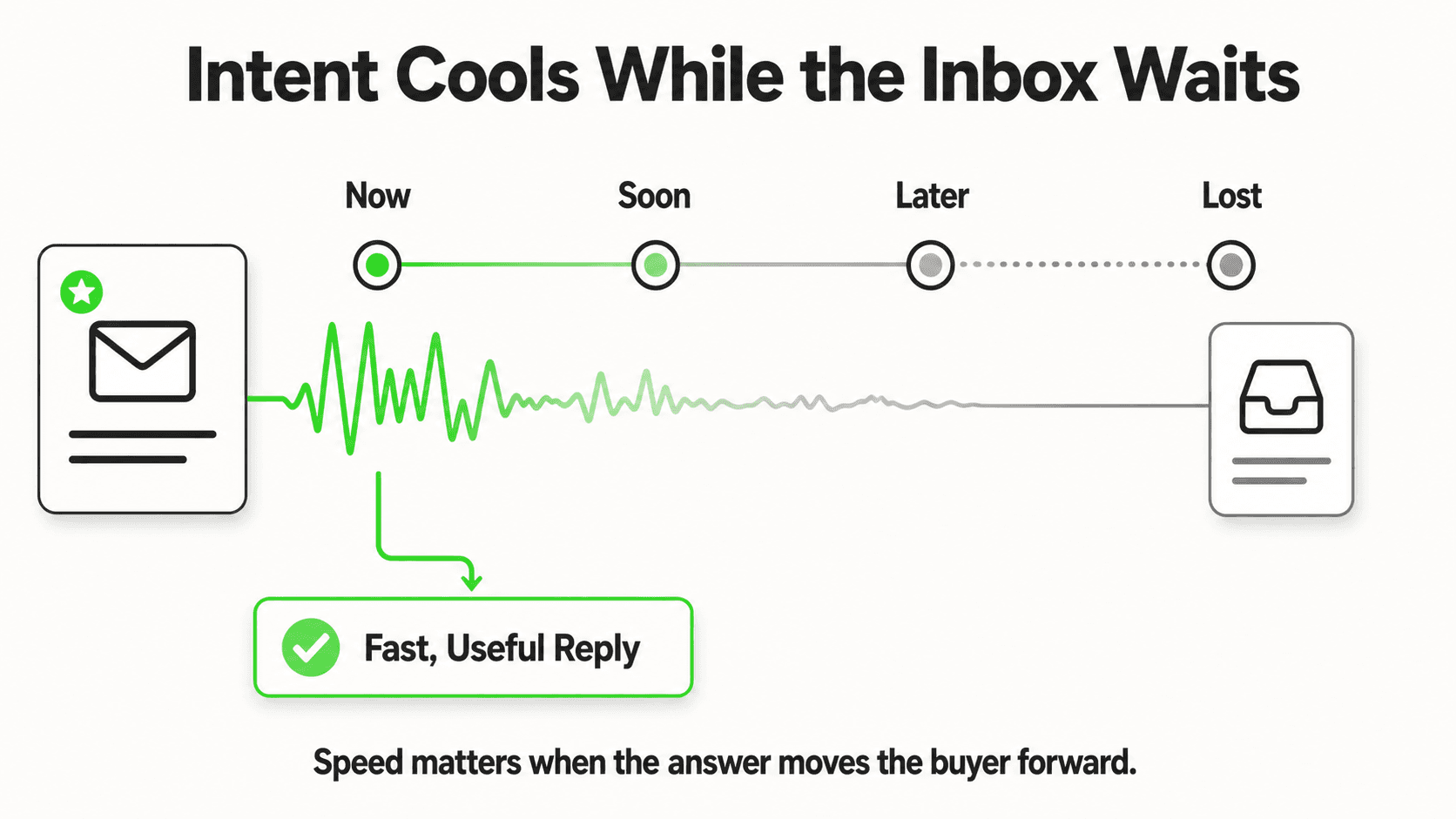
AI direct booking isn't experimental technology—it's rapidly becoming essential infrastructure for hotels serious about reducing OTA dependency and maximizing profitability. Properties implementing these systems now are building sustainable competitive advantages.
The evidence is overwhelming: AI dramatically improves direct booking rates, reduces commission costs, and creates superior guest experiences—all while being highly cost-effective compared to traditional approaches.
Your next month of inquiries will arrive regardless of whether you have AI. The question is whether you'll miss 33% of them, respond slowly to the rest, and pay OTA commissions on bookings that could have been direct—or whether you'll capture 100% of inquiries instantly, guide guests seamlessly to direct booking, and keep those commission rupees as profit.
The competitive gap is widening. Hotels with AI are achieving 40-50% direct booking ratios while traditionalists remain stuck at 20-30%, paying crores in unnecessary commissions. Travelers who experience instant, helpful responses from one property won't tolerate waiting for others.
Start by calculating what your current approach costs. Add up annual OTA commissions, estimate missed inquiry revenue (especially after-hours), and consider the opportunity cost of front desk time consumed by repetitive questions. The total likely exceeds lakhs or crores annually.
Then evaluate AI solutions designed specifically for Indian hotels, prioritizing those with proven results from similar properties, robust PMS and WhatsApp integration, and comprehensive implementation support.
Your guests expect instant responses, seamless booking, and proactive communication. Your front desk deserves to focus on hospitality rather than answering availability questions. Your property deserves to keep more of its hard-earned revenue instead of paying OTA tolls.
Keep exploring
- AI agents for hotels - Drive more direct bookings and less OTA dependence
- Conversational AI for customer service - Answer every guest inquiry instantly across channels
Hotel Location Guides
- AI Chatbot for Hotels in Bangalore - Tech capital
- AI Chatbot for Hotels in Mumbai - Financial capital
- AI Chatbot for Hotels in Delhi - National capital
- AI Chatbot for Hotels in Goa - Tourism destination
Related Resources
- Best AI Chatbots for Hotels 2026 - Platform comparison
- Jungle Lodges Case Study - Real hotel results
- Best HiJiffy Alternatives 2026 - Hotel chatbot alternatives
- Best Asksuite Alternatives 2026 - Hospitality platforms
Glossary
- WhatsApp Business API - Essential hotel channel
- What is a Chatbot? - Chatbot fundamentals
- Hierarchical RAG - AI accuracy technology
Related Articles
Conversational AI for Hotels: From Enquiry to Booking
How conversational AI moves a hotel guest from a website or WhatsApp question to a booked room — and what it honestly doesn't do with your PMS or Cloudbeds.

AI Chatbot for Hotels in Goa: Maximize Direct Bookings
How Goa resorts and hotels use AI chatbots to handle seasonal booking surges, reduce OTA commissions, and capture international tourist inquiries 24/7.
5 Ways Hotels Use AI to Increase Direct Bookings
How hotels use AI chatbots to win direct bookings — 24/7 inquiry capture, upsells, and playbooks for airport, budget, family, wedding, and luxury properties.

AI Chatbot for Luxury Hotels: Service at Scale
Luxury city hotels use AI chatbots to deliver personalized concierge experiences at scale, handle VIP inquiries, and maintain white-glove service 24/7.