Product
White-Label Chatbots That Disappear Into Your Website
Why generic chatbot widgets kill conversions—and how fully branded AI assistants become an invisible extension of your business.

Gopi Krishna Lakkepuram · Founder & CEO
· Updated · 18 min read
TL;DR: Generic chatbot widgets with third-party branding can undercut trust at the moment a customer asks for help. A chatbot that matches your brand's colors, fonts, voice, and personality feels like part of your business, not a bolted-on tool. At Hyperleap AI, you set colors, fonts, logo, and avatar in the Branding tab, and white-label on Pro and Max removes the "Powered by Hyperleap AI" badge.
White-Label Chatbots That Disappear Into Your Website
Plan Availability
White-label — removing the "Powered by Hyperleap AI" badge from the chatbot — is available on Pro ($100/mo) and Max ($200/mo) plans only. Plus plan chatbots display the badge. Colors, fonts, logo, and avatar are Branding settings, separate from white-label.
The moment a visitor spots a generic chatbot widget, trust can take a hit. That floating bubble with someone else's logo screaming "Powered by XYZ" tells your customers one thing: you've bolted on an afterthought, not built a seamless experience.
Your brand spent years cultivating a specific look, voice, and personality. Why let a chatbot vendor hijack that relationship with their branding plastered across your customer interactions?
The best chatbots don't announce themselves—they disappear into your website, becoming an invisible extension of your brand that customers assume you built from scratch.
The Problem With Generic Chatbot Widgets
Brand Dilution in Action
Walk through a typical customer journey with a generic chatbot:
- Customer lands on your beautifully designed website
- They notice a chatbot bubble—with someone else's branding
- The chat window opens in colors that clash with your palette
- The chatbot introduces itself with a generic name and avatar
- Every response feels disconnected from your brand voice
- A "Powered by [Competitor]" badge reminds them this isn't really your assistant
The result? Your customer's mental model shifts from "talking to this company" to "talking to some third-party tool this company uses."
The Trust Tax
Generic chatbots create what we call the "trust tax"—invisible friction that degrades every interaction:
| Factor | Impact | Business Cost |
|---|---|---|
| Third-party branding visible | Lower trust | Higher bounce rates |
| Mismatched visual design | Feels like "something's off" | Reduced engagement |
| Generic bot personality | Experience feels impersonal | Lower conversion rates |
| "Powered by" badges | Raises questions about who holds the data | Lost sales to competitors |
The Branding Disconnect
67% of customers say consistent branding across all touchpoints influences their purchasing decisions (Source: Salesforce). A mismatched chatbot breaks that consistency at the exact moment customers need help.
Why Competitors Can't Hide Their Branding
Most chatbot platforms have a business model problem: they need your customers to see their brand. Every "Powered by" badge is free advertising. Every generic widget is a billboard on your website for their company.
Even platforms that claim "white-label" often mean:
- Remove the logo (for an extra fee)
- Change the primary color (but not the rest)
- Customize the greeting (but not the personality)
- Use your name (but their avatar style)
True white-label means your chatbot is indistinguishable from a custom-built solution.
What "Disappearing Into Your Website" Actually Means
Complete Visual Customization
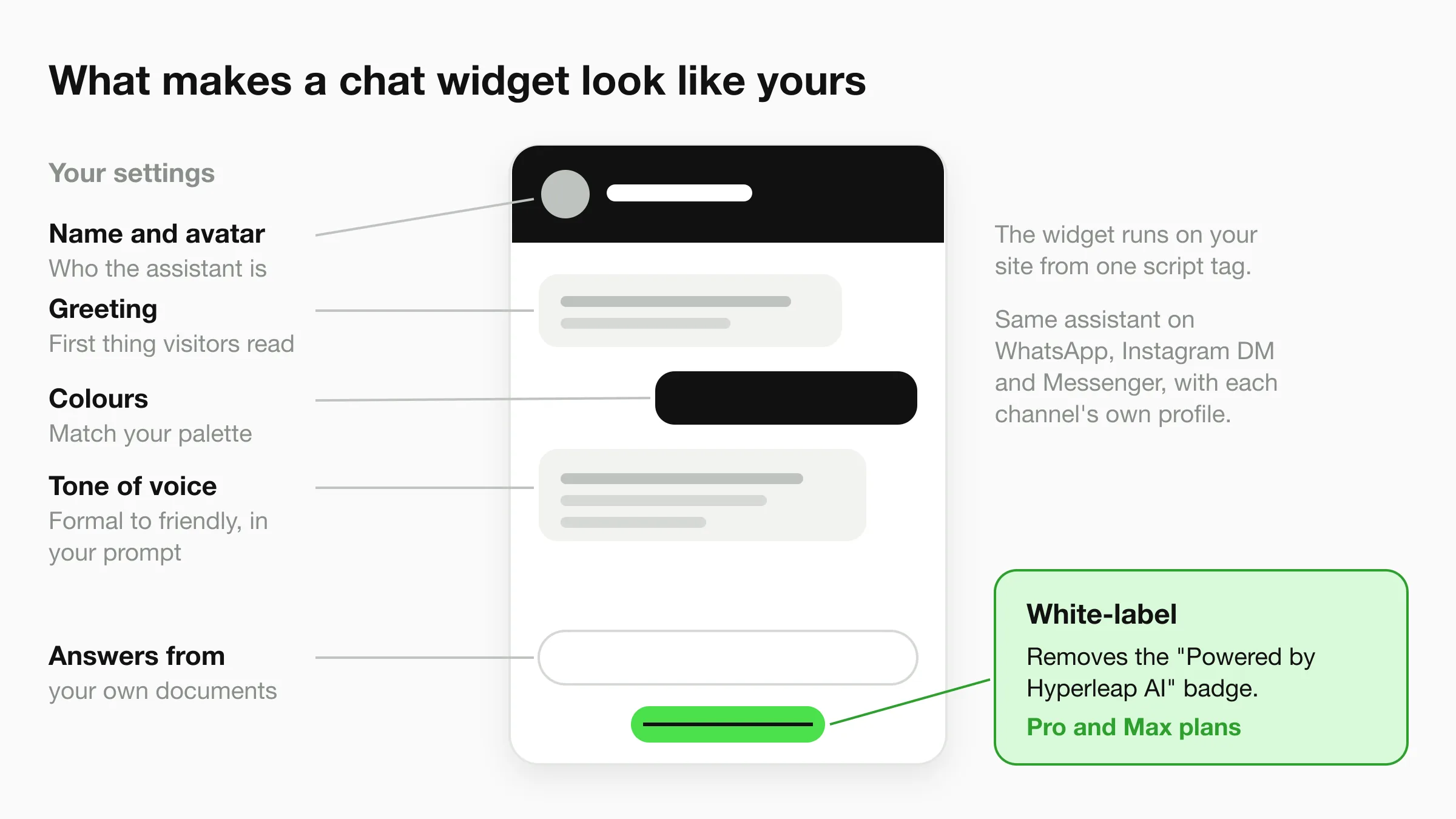
Your chatbot should be a pixel-perfect extension of your design system — the same HTML chat widget you embed with one script tag takes its colors, fonts, and logo from your Branding settings:
Every Element, Customizable
// Complete control over every visual aspect
const brandedChatbot = {
  // Colors
  colors: {
    primary: '#your-brand-color',
    secondary: '#your-accent-color',
    background: '#your-bg-color',
    text: '#your-text-color',
    userBubble: '#customer-message-bg',
    botBubble: '#assistant-message-bg'
  },

  // Typography
  fonts: {
    family: 'Your-Brand-Font, sans-serif',
    sizes: {
      header: '18px',
      body: '14px',
      small: '12px'
    }
  },

  // Shape and style
  appearance: {
    borderRadius: '12px', // or '0px' for sharp, '24px' for pill
    shadow: '0 4px 12px rgba(0,0,0,0.15)',
    avatarStyle: 'custom', // upload your own
    buttonStyle: 'filled' // or 'outlined', 'ghost'
  },

  // Positioning
  position: {
    placement: 'bottom-right', // or 'bottom-left', 'inline', 'full-page'
    offsetX: '20px',
    offsetY: '20px'
  }
};
Brand Voice and Personality
Visual design is only half the equation. Your chatbot's personality should be indistinguishable from your best team member:
Configurable Personality Traits
| Trait | Spectrum | Your Choice |
|---|---|---|
| Formality | Casual ↔ Formal | Match your brand voice guidelines |
| Warmth | Professional ↔ Friendly | Align with customer expectations |
| Verbosity | Concise ↔ Detailed | Based on your industry norms |
| Humor | Serious ↔ Playful | Appropriate for your audience |
| Empathy | Efficient ↔ Caring | Critical for service contexts |
Custom Avatar and Identity
Your chatbot deserves its own identity—one that fits your brand:
Options for chatbot identity:
- Upload your own avatar or mascot
- Use your logo as the chat icon
Seamless Integration Points
A truly branded chatbot extends beyond the chat window:
See a Fully Branded AI Chatbot in Action
Set your colors, fonts, logo, avatar, and voice. On Pro and Max, white-label removes the Powered by Hyperleap AI badge.
See How It WorksThe Business Case for Invisible Chatbots
Conversion Impact
A chatbot that looks and sounds like your business removes a reason to hesitate. The metrics worth comparing before and after you brand it:
- Chat engagement rate: how many visitors open a conversation
- Conversation completion: how many conversations reach an answer
- Lead capture rate: how many share contact details
- Customer satisfaction: post-chat ratings
- Conversion to sale: purchases or bookings from chat users
Trust and Credibility
When customers perceive the chatbot as "yours", they are more comfortable sharing information, more likely to describe the experience as professional, and more likely to come back.
Brand Consistency ROI
Consistent branding across all touchpoints (including chatbots):
- Increases revenue by up to 23% (Source: Lucidpress Brand Consistency Report)
- Improves brand recognition by 80% (Source: Demand Metric)
The Compound Effect
A branded chatbot handles thousands of conversations monthly. Each one either reinforces your brand—or dilutes it. Over 12 months, a well-branded chatbot delivers the equivalent brand exposure of a significant advertising campaign.
Real Examples: Chatbots That Disappear
Luxury Hospitality
Design choices:
- Muted color palette matching website elegance
- Serif typography reflecting luxury positioning
- Formal, attentive personality ("How may I assist you this evening?")
- Concierge-style avatar
- Understated animations and transitions
Modern E-commerce
Design choices:
- Vibrant accent colors from product photography
- Clean, modern sans-serif fonts
- Friendly personality ("Hey! Looking for something specific?")
- Brand mascot or illustrated avatar
- Quick-action buttons matching site CTAs
Professional Services
Design choices:
- Conservative palette conveying trust and stability
- Professional, readable typography
- Knowledgeable personality ("I'd be happy to help you understand our process.")
- Headshot-style avatar or professional icon
- Clear CTAs for scheduling consultations
Healthcare Provider
Design choices:
- Calming colors that reduce anxiety
- Highly readable, accessible fonts
- Warm, empathetic personality ("I understand. Let me help you get the care you need.")
- Friendly, non-intimidating avatar
- Clear privacy messaging (see how HIPAA applies to AI chatbots)
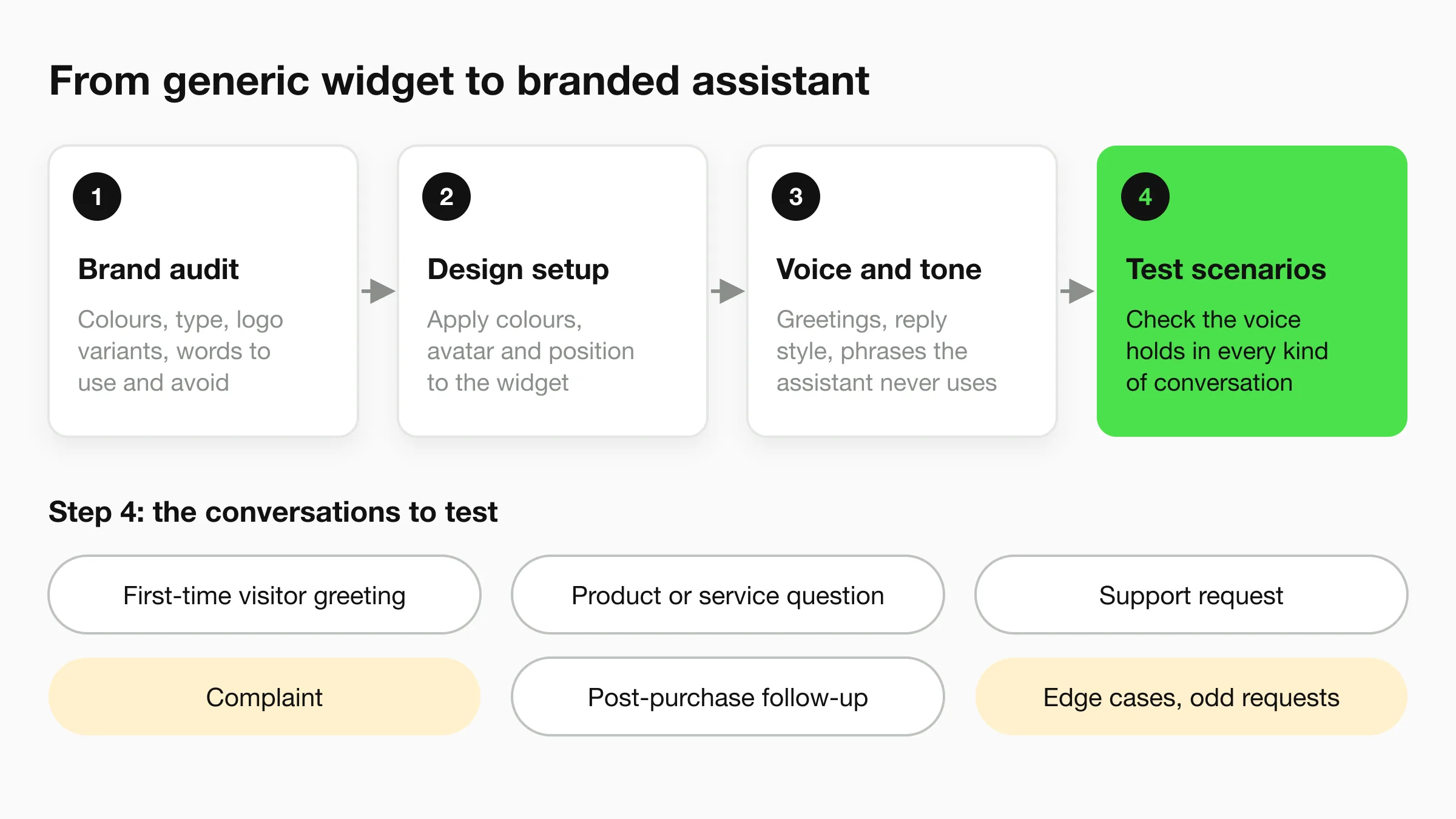
Implementation: From Generic to Branded
Step 1: Brand Audit
Before customizing, document your brand standards:
const brandAudit = {
  // Visual identity
  visual: {
    primaryColors: ['#hex1', '#hex2', '#hex3'],
    typography: {
      headings: 'Font-Name',
      body: 'Font-Name',
      weights: ['400', '600', '700']
    },
    logoVariations: ['full', 'icon', 'wordmark'],
    iconStyle: 'outlined' // or 'filled', 'duotone'
  },

  // Voice and tone
  voice: {
    personality: ['professional', 'approachable', 'knowledgeable'],
    avoidWords: ['cheap', 'deal', 'ASAP'],
    preferredTerms: {
      'buy': 'invest in',
      'cheap': 'affordable',
      'problem': 'challenge'
    },
    sampleResponses: [
      'Here's how I can help...',
      'Great question! Let me explain...'
    ]
  },

  // Customer expectations
  context: {
    industry: 'your-industry',
    audienceType: 'B2B' // or 'B2C', 'mixed'
    formalityLevel: 7 // 1-10 scale
  }
};
Step 2: Design Configuration
Apply your brand to every element:
Step 3: Personality Training
Configure response style to match your voice:
const personalityConfig = {
  // Greeting variations
  greetings: [
    "Welcome to [Brand]! How can I help you today?",
    "Hi there! I'm here to assist with any questions about [Brand].",
    "Hello! Ready to help you find exactly what you need."
  ],

  // Response templates aligned with brand voice
  responseStyle: {
    acknowledgment: "I understand completely.",
    transition: "Let me help you with that.",
    clarification: "Just to make sure I assist you properly...",
    closing: "Is there anything else I can help you with?"
  },

  // Personality guardrails
  guardrails: {
    neverSay: ['I don't know', 'That's not my job', 'You're wrong'],
    alwaysInclude: ['empathy', 'solution-focus', 'brand-name']
  }
};
Step 4: Test Across Scenarios
Validate brand consistency across all interaction types:
- First-time visitor greetings
- Product/service inquiries
- Support requests
- Complaint handling
- Post-purchase follow-up
- Edge cases and unusual requests
Competitive Comparison: Branding Capabilities
| Feature | Generic Platforms | Limited White-Label | True White-Label |
|---|---|---|---|
| Remove vendor logo | Paid add-on | Included | Included |
| Custom colors | Primary only | Limited palette | Full control |
| Custom fonts | No | System fonts only | Any web font |
| Custom avatar | No | Templates only | Full upload |
| Branded domain | No | Subdomain | Your domain |
| Custom personality | Basic | Moderate | Complete control |
| "Powered by" removal | Extra cost | Included | Never shown |
| Custom CSS injection | No | Limited | Full access |
| API response branding | No | No | Yes |
| White-label mobile SDK | No | No | Yes |
On Hyperleap AI, white-label on Pro and Max removes the "Powered by Hyperleap AI" badge; colors, fonts, logo, and avatar are Branding settings. It does not include a custom domain, a rebranded dashboard, or a reseller portal.
The True Test
Ask your chatbot vendor: "Can a customer tell your platform is involved?" If the answer involves caveats, conditions, or extra fees—they're not truly white-label.
Get Your Branded Chatbot Live in Under 5 Minutes
Your colors, fonts, logo, and brand voice across website, WhatsApp, Instagram, and Messenger. White-label on Pro and Max removes the Powered by badge.
View PricingBeyond the Chat Window: Omnichannel Branding
Consistent Experience Everywhere
Your brand should remain consistent across all channels:
Channel-Specific Adaptations
| Channel | Visual Branding | Personality Adaptation |
|---|---|---|
| Website | Full customization | Complete brand voice |
| Profile photo, status | Slightly more casual | |
| Instagram DM | Profile integration | Platform-appropriate |
| Facebook Messenger | Page integration | Platform-appropriate |
Measuring Brand Impact
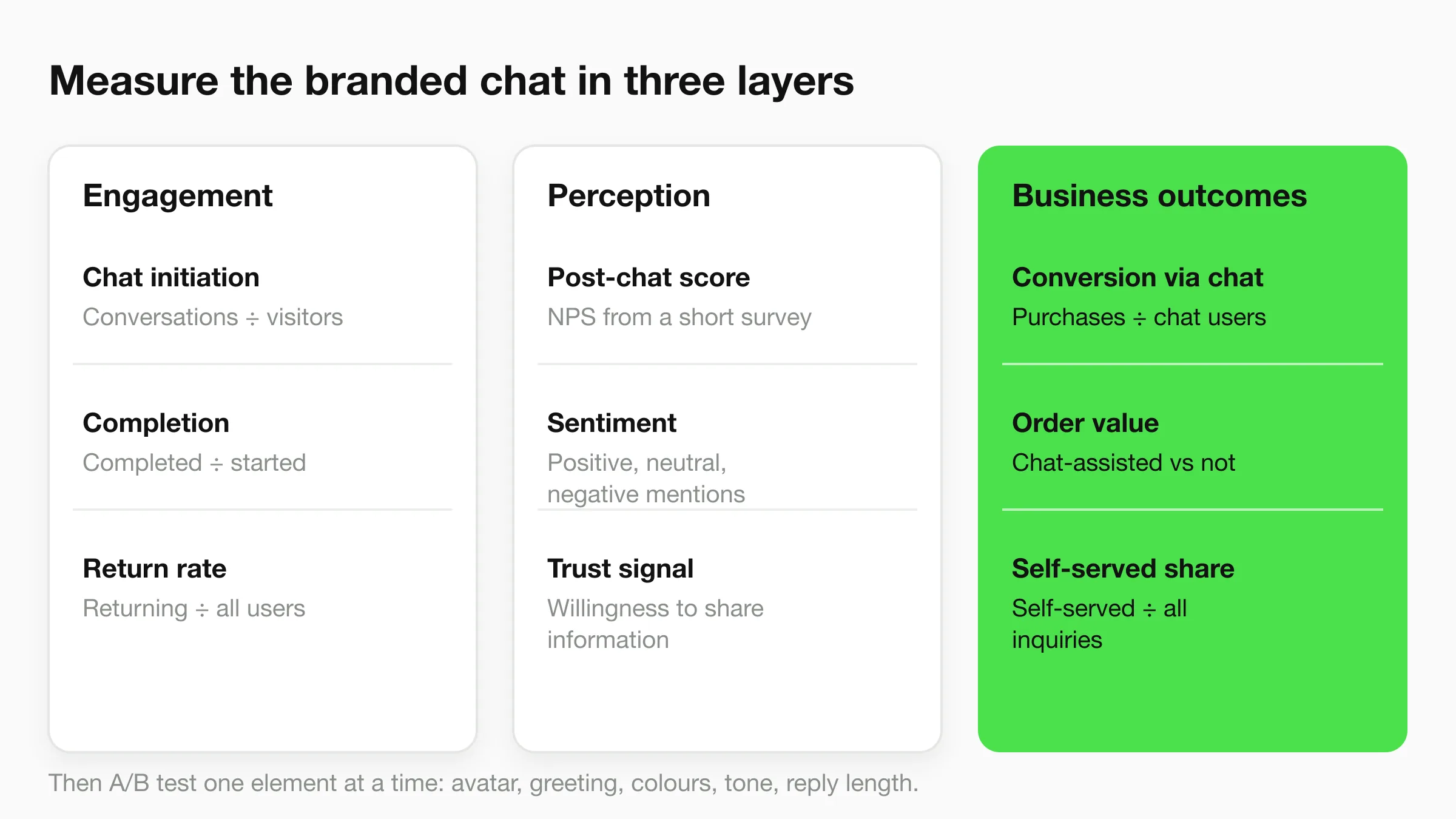
Key Metrics to Track
const brandMetrics = {
  // Direct engagement
  engagement: {
    chatInitiationRate: 'conversations / visitors',
    completionRate: 'completed / started',
    returnRate: 'returning users / total users'
  },

  // Brand perception
  perception: {
    npsScore: 'post-chat survey',
    brandMentionSentiment: 'positive / neutral / negative',
    trustIndicators: 'information sharing willingness'
  },

  // Business outcomes
  outcomes: {
    conversionRate: 'purchases via chat / chat users',
    averageOrderValue: 'chat-assisted vs non-assisted',
    supportDeflection: 'self-served / total inquiries'
  }
};
A/B Testing Brand Elements
Continuously optimize your branded experience:
- Avatar variations: Test different styles for engagement
- Greeting messages: Find what resonates with your audience
- Color schemes: Measure impact on trust and conversion
- Personality tone: Identify the right formality level
- Response length: Optimize for your customer preferences
Optimize Your Website SEO
While optimizing your chatbot branding, don't forget your website's search visibility. Use our free growth tools to add structured data markup that helps search engines understand your business.
Further Reading
Authoritative external sources used and recommended for further research on this topic:
- Anthropic research and product documentation
- Google Search Central documentation
- Gartner customer service research
Make Your Chatbot Disappear Into Your Brand
Match your colors, fonts, logo, and voice. On Pro and Max, white-label removes the Powered by Hyperleap AI badge.
Try for Free"Your chatbot handles thousands of conversations every month. Each one is a brand interaction. When that chatbot carries someone else's logo and design language, you're running a billboard for their company on your website. True white-label isn't a feature to check off, it's a fundamental requirement for brand integrity." — Gopi Krishna Lakkepuram, Founder & CEO of Hyperleap AI
Conclusion
The best chatbots are invisible. They don't announce themselves as third-party tools or plaster another company's branding across your customer experience. They become a seamless extension of your brand—visually, verbally, and experientially.
Key Takeaways:
- Generic widgets erode trust: Third-party branding creates friction and reduces conversions
- Branding goes beyond logos: Colors, fonts, avatar, and personality all shape whether the chatbot feels like yours
- Brand consistency compounds: Every conversation either reinforces your brand or dilutes it
- Measure the difference: Track engagement, lead capture, and conversion before and after you brand the chatbot
- Implementation is straightforward: You can be live in under 5 minutes and refine branding and voice afterwards
Your chatbot should feel like your best team member—one that perfectly represents your brand to every customer, at any hour, across any channel.
The question isn't whether to brand your chatbot. It's whether you can afford the trust tax of not doing it.
Ready to see how your chatbot could look with your brand? Schedule a demo and we'll show you a fully branded prototype for your business.
Keep exploring
- White-label AI agents - Deploy branded chatbots that match your business identity
- Conversational AI for customer service - Fully branded support automation on every channel
Related Resources
- Best No-Code Chatbot Builders 2026 - Platform comparison
- Best Multi-Channel Chatbots 2026 - Omnichannel solutions
- Best AI Chatbots for Lead Generation 2026 - Lead capture focus
- How to Choose an AI Chatbot Platform - Selection guide
Industry Solutions
- Best AI Chatbots for Hotels 2026 - Hospitality
- Best AI Chatbots for Healthcare 2026 - Healthcare
- Best AI Chatbots for Restaurants 2026 - Restaurants
- Best AI Chatbots for Dental Practices - Dental
Frequently Asked Questions
What is a white-label chatbot?
A white-label chatbot is a chatbot solution built by a third-party provider that you can fully rebrand with your own company's logo, colors, fonts, and tone of voice. Unlike generic chatbot widgets, white-label solutions are designed to appear as a seamless extension of your brand, rather than a visibly third-party tool.
What customization options are available with white-label chatbots?
Most white-label chatbot platforms offer customization of the chat widget appearance (colors, fonts, avatar, position), conversation tone and personality, welcome messages, and response templates. Some platforms also offer custom domains or CSS overrides. On Hyperleap AI, colors, fonts, logo, avatar, and position are Branding settings, and white-label on Pro and Max removes the "Powered by Hyperleap AI" badge.
How do white-label chatbots impact brand trust?
Branded chatbots tend to earn more trust than generic alternatives because they maintain visual and conversational consistency with the rest of your brand experience. Users are more likely to share personal information and complete transactions when the chatbot feels like an official part of the company rather than a third-party add-on.
How much more do white-label chatbots cost compared to generic options?
It varies by vendor: some charge a separate fee to remove their logo, others include it in higher tiers. On Hyperleap AI, white-label is included on the Pro ($100/mo) and Max ($200/mo) plans; Plus ($40/mo) shows the badge. Whether it pays off depends on your traffic and how much trust matters in your sale, so compare engagement and lead capture before and after.
How complex is it to implement a white-label chatbot?
It varies by platform. With Hyperleap AI you can be live in under 5 minutes: paste your website URL and Studio imports your branding and builds a starting agent, then you add one script tag. Refining the voice, adding documents, and testing are tuning you do afterwards. No-code platforms have significantly reduced the technical barrier, making it accessible to marketing teams without developer support.
Glossary
- What is a Chatbot? - Chatbot fundamentals
- WhatsApp Business API - Essential channel
- OTP Validation - Verified lead capture
What is an AI chatbot in business terms?
A customer-facing chat agent that answers questions, qualifies inquiries, and captures leads 24/7. Modern AI chatbots are grounded in your business content (not the open internet) and run across your website and messaging channels with the same persona and knowledge.
How is Hyperleap different from a chat widget or a live chat tool?
Live chat tools route to humans; basic widgets follow scripted flows. Hyperleap is an AI agent grounded in your content — it understands intent, retrieves from your knowledge base, qualifies leads, and escalates only when needed. Same answers across website, WhatsApp, Instagram DM, and Facebook Messenger.
How long does it take to set up an AI chatbot with Hyperleap?
You can go live in under 5 minutes with self-serve setup; uploading documents, writing guardrails, and testing are tuning you do afterwards. With Managed Setup ($299 Free, available on every plan), Hyperleap builds the bot for you on your content and channels. A 7-day free trial is included on every plan.
Put this into practice
Related Articles
View all
Product16 min read
Rich Cards in AI Chatbots: Tappable Assets on Every Channel
A rich card is what turns a text-only chatbot into a tappable interface — and the cleanest way to get there is to let your assets become the cards. Here is how documents, images, and videos render as tappable cards and carousels, and how native booking adds a slot picker, across Website, WhatsApp, Instagram DM, and Facebook Messenger on Pro and Max.
Engineering16 min read
What 11 Years at Microsoft Taught Me About Enterprise AI
Lessons from building systems for billions of users at Office 365 and Outlook.com—and why enterprise-grade reliability matters for every business.