AI Chatbot Development Services: Build vs Buy for Small Businesses
Should you hire an agency to build a custom AI chatbot, or use a platform? This guide breaks down costs, timelines, and the honest decision framework for SMBs.

TL;DR: AI chatbot development services describes the full process of designing, building, and deploying a conversational AI system for your business. Three main paths exist: (1) a custom development agency — fully bespoke, $20,000–$100,000+ upfront, 8–16 weeks to launch; (2) a chatbot platform with managed setup — the vendor configures their platform for you, $299 Free plus subscription, live in 3–5 days; (3) a self-serve platform — you configure it yourself, $40–$200/month, live in 1–7 days. For most small and mid-sized businesses, the platform paths deliver 90% of the outcome at 5–10% of the cost and in a fraction of the time.
Who This Guide Is For
This guide is written for business owners and operators who know they want an AI chatbot and are figuring out how to get one — without a technical background and without a six-figure development budget. Cost ranges are estimates based on market data and practitioner knowledge; they are not quotes or guarantees.
You searched for "AI chatbot development services" because you want a chatbot and you're not sure how to get one built. Maybe you've seen agency websites quoting $50,000 and three months. Maybe you've signed up for a platform demo that seemed too easy to be real. Maybe a competitor just launched something and you need to catch up.
The confusion is real — and deliberate. The chatbot market conflates wildly different things under the same label. A boutique conversational AI agency and a no-code chatbot platform both call themselves "AI chatbot development services." The buyer who doesn't know the difference often pays the wrong price for the wrong product.
This guide untangles that. By the end, you will know exactly what "AI chatbot development" involves, which path fits your situation, and what red flags to avoid regardless of which route you take. For an overview of how AI chatbots work for business customers more broadly, that hub page covers the landscape in detail. If you lean toward the self-serve path, our no-code chatbot builder shows how to build it yourself.
What AI Chatbot Development Services Actually Covers
When someone offers you "AI chatbot development services," they are bundling together several distinct types of work. Providers often do only some of them — and the ones left out are usually the ones that determine whether the chatbot is actually useful.
Discovery and scoping. Before any code is written or any platform is configured, someone needs to document what the chatbot should do, what it must never do, which systems it needs to connect to, and how success will be measured. This typically means stakeholder interviews, a use-case audit, and a conversation design brief. Reputable agencies treat this as a paid deliverable. Many low-cost providers skip it — and that shortcut shows in the output.
Conversation design. This is the work of mapping what users will say to what the chatbot should respond with, including every variant of every question and every graceful failure path. Good conversation design is what separates a chatbot that feels intelligent from one that loops customers into dead ends. It is a distinct discipline from software engineering and is chronically undervalued in cheaper development engagements.
Knowledge base setup and curation. Modern AI chatbots generate answers using Retrieval-Augmented Generation (RAG) — they retrieve information from your documents rather than relying on a pre-trained model alone. This means someone needs to gather your FAQs, product documentation, policies, and process guides, structure them clearly, and load them into the knowledge base. This work typically takes 20–40 hours on a real business's content, regardless of who does it.
System integration. A chatbot that cannot hand a lead to your CRM, look up order status, or share a booking link is limited in what it can do for your business. Integration depth varies enormously across providers. Custom development agencies can wire directly into proprietary or legacy systems. Platform providers typically connect through REST APIs and webhooks — which covers the large majority of SMB integration needs without custom engineering.
Testing and quality assurance. Before going live, the chatbot needs to be tested against real queries — including edge cases, off-topic questions, and attempts to make it say something it should not. For agency engagements, this is a formal UAT phase. For platform deployments, this is usually the buyer's responsibility, with the platform making iteration fast and cheap.
Deployment and channel setup. Getting the chatbot in front of customers means embedding it on your website, connecting it to WhatsApp Business API, or linking it to your Instagram DMs and Facebook Messenger pages. Each channel has its own setup requirements. WhatsApp in particular requires a Business API account and, depending on your provider, approval through a Business Solution Provider.
Ongoing maintenance. Products change. Policies update. New questions emerge. A chatbot launched in January with accurate information about your pricing may give wrong answers by April if no one keeps the knowledge base current. Custom dev agencies typically offer maintenance as a monthly retainer. Platform-based chatbots handle model and infrastructure maintenance automatically, but the buyer still owns knowledge base accuracy.
Understanding which of these components you are actually buying — and which you are not — is the first question to ask any provider. A $15,000 agency quote that excludes conversation design and UAT is not a $15,000 chatbot.
Three Buying Paths: A Direct Comparison
Every buyer is choosing between three fundamentally different models. The right answer depends on your constraints, not on which path sounds most sophisticated.
| Custom Dev Agency | Platform + Managed Setup | Self-Serve Platform | |
|---|---|---|---|
| What you get | Bespoke software built to your spec | Platform technology configured by the vendor's team | Platform technology configured by you |
| Who does the work | External engineering team | Vendor's implementation team | You |
| Customization ceiling | Very high — anything is possible with enough budget | Moderate — within the platform's feature set | Moderate — within the platform's feature set |
| Code ownership | You typically own the code | Subscription dependency on the platform | Subscription dependency on the platform |
| Time to launch | 8–16 weeks typical | 3–5 days typical | 1–7 days depending on your content readiness |
| Model / infra maintenance | Your responsibility (or agency retainer) | Platform handles it | Platform handles it |
| Best fit | Regulated industries, novel use cases, deep proprietary integrations | SMBs who want professional results without building an internal team | SMBs with someone available to configure and iterate |
The most important insight in this table: the vast majority of small and mid-sized businesses that believe they need a custom dev agency actually do not. The use cases that genuinely require custom engineering are narrower than the market's pricing implies. If you're leaning toward the self-serve path, our comparison of the best no-code chatbot builders breaks down how the leading platforms stack up.
Cost Ranges by Path
Pricing in this market is deliberately opaque. Agencies rarely publish rates. Platform pricing scales with usage volume. These ranges reflect market knowledge and publicly available data — they are realistic benchmarks, not quotes.
| Path | Upfront Cost | Ongoing Cost | Estimated First-Year Total |
|---|---|---|---|
| Custom dev agency | $20,000–$100,000+ | $1,000–$5,000/mo (retainer) | $32,000–$160,000+ |
| Platform + managed setup | $299–$2,000 (one-time) | $40–$200/mo (subscription) | $780–$4,400 |
| Self-serve platform | $0 (setup is on your time) | $40–$200/mo (subscription) | $480–$2,400 |
A few points worth naming directly:
Agency pricing varies significantly by geography and specialization. A conversational AI boutique in a major US city will price toward the top of that range. Offshore development firms often quote $5,000–$15,000 for what appears to be equivalent scope. The quality difference is real and typically material — particularly in conversation design quality and integration reliability.
Platform pricing scales with usage. The $40–$200/month range reflects plans at the Plus through Max tier. If you need more AI responses per month, additional chatbots, or white-label branding, costs increase accordingly. But even at the top end, platform total cost of ownership is a small fraction of custom development.
Managed setup is not a development agency fee. When a platform provider offers managed setup, they are configuring their own technology to your use case — not building custom software. The ceiling on what is possible is the platform's ceiling. This distinction matters when you are comparing what you are actually buying.
Scope creep is the primary cost multiplier in custom development. A $30,000 quote can become $60,000 when the spec changes mid-engagement, integrations turn out to be more complex than estimated, or UAT reveals gaps in the original brief. Fixed-price agencies use strict change-control to contain this. Time-and-materials agencies pass every change to your invoice.
Timeline by Path
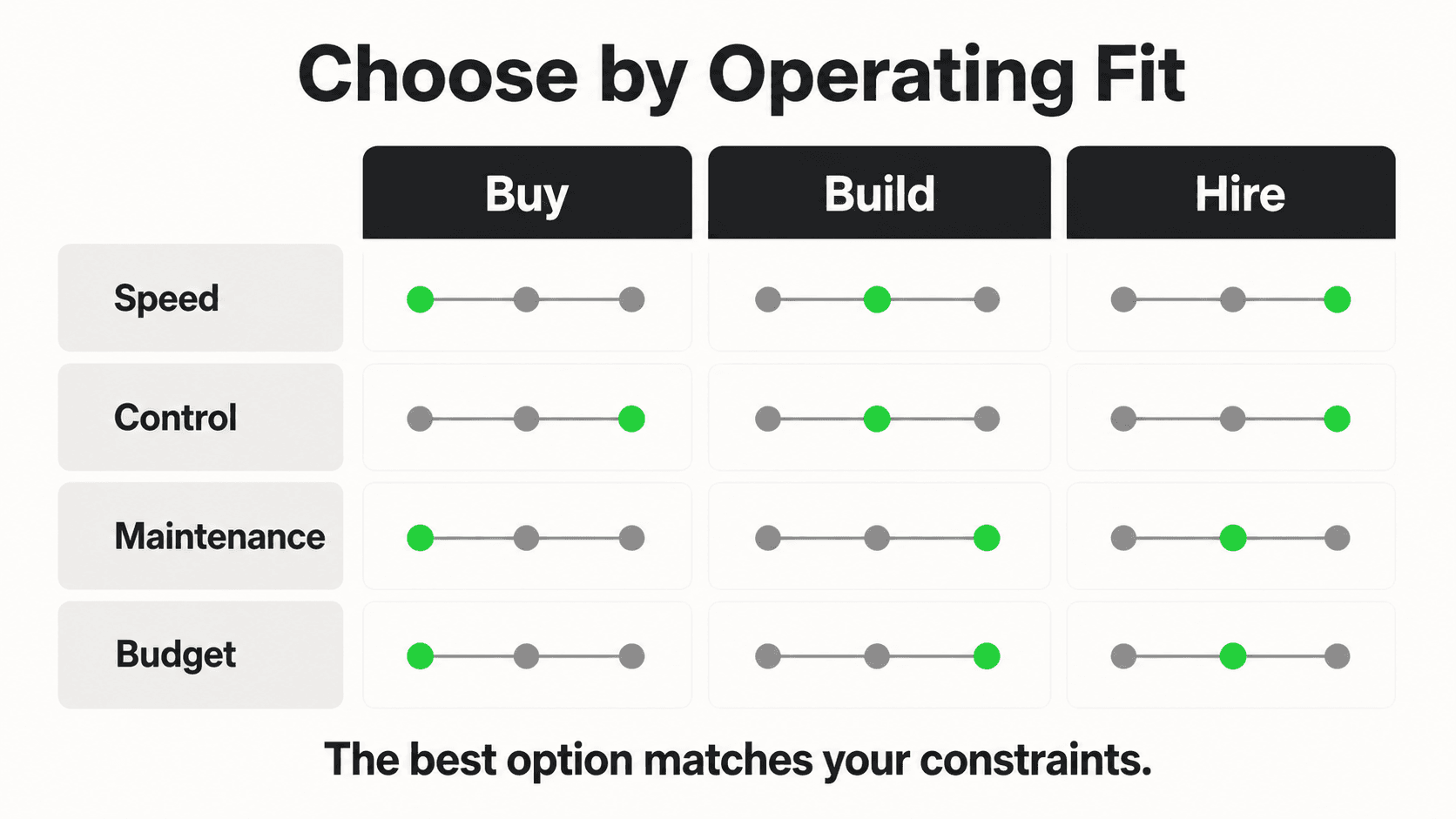
Speed to deployment is often the deciding factor when the business case is urgent and a competitor has already moved.
| Path | Discovery | Build / Configure | Test | Launch | Total |
|---|---|---|---|---|---|
| Custom dev agency | 2–3 weeks | 6–10 weeks | 2–3 weeks | 1 week | 8–16+ weeks |
| Platform + managed setup | 1–2 days | 2–3 days | 1 day | Same day | 3–5 days |
| Self-serve platform | None (you start immediately) | 1–5 days | 1–2 days | Same day | 1–7 days |
The 8–16 week custom development timeline is not padding. It reflects real complexity: requirements documentation, back-and-forth on conversation design, integration engineering, and formal QA cycles. For a business losing leads to a competitor who already has a chatbot, that timeline is a commercial problem, not just a scheduling inconvenience.
According to a Harvard Business Review study on online sales lead response, leads contacted within five minutes are dramatically more likely to convert than those contacted hours later — and 50% of small businesses don't respond to leads within five days. Every week your chatbot is not live is a week of potential leads handled by slower, costlier, or non-existent processes.
When Custom Development Is the Right Answer
Custom AI chatbot development is the right choice in a specific, narrow set of circumstances. If your situation matches multiple criteria below, the cost premium is likely justified.
Regulated industries with non-negotiable compliance requirements. Healthcare, financial services, and legal services often have documentation, data residency, and audit trail requirements that off-the-shelf platforms cannot satisfy without significant configuration. If your compliance team has specific technical requirements — on-premise deployment, custom data handling agreements, audit logging in a proprietary format — custom development gives you the control you need.
Genuinely novel use cases with no platform analogue. Most chatbot use cases are variations on well-solved problems: FAQ deflection, lead qualification, appointment booking, post-purchase support. If your use case genuinely requires the chatbot to execute multi-step workflows across legacy databases, integrate with a proprietary internal system through a non-standard protocol, or apply custom reasoning logic — platforms may not be able to do what you need.
Deep proprietary system integrations with no API surface. If your business runs on a legacy system with no REST API and no webhook capability, custom development may be the only path to a chatbot that can do useful work in your environment. Before concluding this is true, verify it — most modern systems have more API surface than is immediately obvious.
Brand and UX requirements that platforms cannot meet. Enterprise buyers with specific design mandates, deeply embedded product experiences, or requirements for first-party behavior (the chatbot must look and behave like a native product feature, not a widget) may find that platform-based solutions do not satisfy those requirements.
Even in these cases, the question is not simply "custom vs. platform" — it is "what is the minimum customization this use case actually requires, and does any platform get us to 80% of the outcome at 20% of the cost?" Sometimes the answer is genuinely no. Often the answer reveals that a platform-based chatbot solves the problem adequately at a fraction of the investment.
When to Skip Custom Development and Use a Platform
For the majority of SMBs evaluating this decision, a platform is the right answer. These are the clearest indicators.
Your use case fits a recognizable pattern. Answering customer questions from your documentation, capturing leads on your website, qualifying inquiries before routing them to your sales team, or supporting customers across Website, WhatsApp, Instagram DM, and Facebook Messenger — these are well-solved problems on modern chatbot platforms. You do not need custom software to solve well-solved problems.
You need to be live in days, not months. If a competitor already has an AI chatbot and you are losing leads as a result, a 12-week development timeline is commercially painful. Platform-based deployments can be live in 3–5 days from the moment your content is ready.
You need predictable, bounded costs. Custom development carries cost ceiling risk — scope changes, integration surprises, UAT cycles that surface requirements that were not in the original brief. Platform subscriptions are predictable. If your budget requires certainty, platforms win.
You do not have an engineering team for ongoing maintenance. Custom development produces a system that requires continued engineering attention — dependency updates, bug fixes, security patches. If you do not have that capability in-house, you are committing to an ongoing agency relationship for the life of the system. Platform providers handle all of this.
You want to iterate based on real conversation data. The best chatbot improvements come from watching actual conversations and adjusting based on where users get stuck or where answers fall short. Platform-based chatbots make this fast: update the knowledge base, test, deploy. A custom system requires an engineering change for every meaningful update.
For a deeper look at the distinction between AI agents and conventional chatbots — which affects which path makes sense — the AI agent vs chatbot comparison covers the strategic differences that matter for buyers.
Not sure which path is right for you?
See how Hyperleap AI works on your actual content before committing. 7-day free trial — configure it yourself or add Managed Setup and we will build it for you.
Explore PlansWhat to Look for in Any AI Chatbot Provider
Whether you are evaluating a development agency or a platform, these criteria separate credible providers from the rest.
Demonstrable experience in your specific use case, not just your industry. An agency that has built healthcare chatbots is not automatically qualified to build one for a specialty practice with complex intake workflows. Ask for examples that match your actual use case — FAQ deflection, appointment booking, lead qualification, post-purchase support — not just the vertical.
RAG-based architecture, not intent-classification. Chatbots built on intent-classification (keyword matching and decision trees) require exhaustive manual maintenance as your content changes. RAG-based chatbots retrieve answers from your actual documents, which means updates to your knowledge base automatically improve the chatbot's responses. In 2026, any serious AI chatbot solution should be RAG-powered. Ask directly: "How does the AI generate its answers?" If the answer implies a one-time training process rather than ongoing document retrieval, probe further.
A clear, demonstrated answer to "what happens when the AI doesn't know?" Every chatbot has knowledge gaps. What matters is how gracefully it handles them — whether it acknowledges the gap and escalates to a human, or (worst case) confidently generates a plausible but wrong answer. Ask to see a demo that deliberately tests the edge of the knowledge base. Document-grounded responses designed to minimize hallucinations are the standard to expect; "never makes a mistake" is not a claim any honest provider will make.
Conversation design as a named, visible deliverable. Many development shops treat conversation design as implicit in the engineering work. It is not. Ask to see examples of conversation design documentation — the dialogue scripts and failure-path maps the team works from. The quality of this work predicts the quality of the output far better than the technology stack.
Post-launch support with defined SLAs. Who handles it when the chatbot gives a wrong answer at 11 PM? What is the response time commitment? How are content updates made — through a self-service interface or a support ticket? These operational questions reveal the real cost of ownership over time.
IP and data ownership clarity. For custom development specifically: who owns the code? Who owns the conversation data? Where is data stored? Is your data used to train models? Get clear written answers before any significant commitment.
A live demo on your actual content. Any provider worth hiring should be able to configure a demonstration using a sample of your real FAQs, product descriptions, or policy documents. A demo on generic sample data tells you what the technology can do in principle. A demo on your content tells you whether it will work for your specific situation.
Red Flags When Evaluating Providers
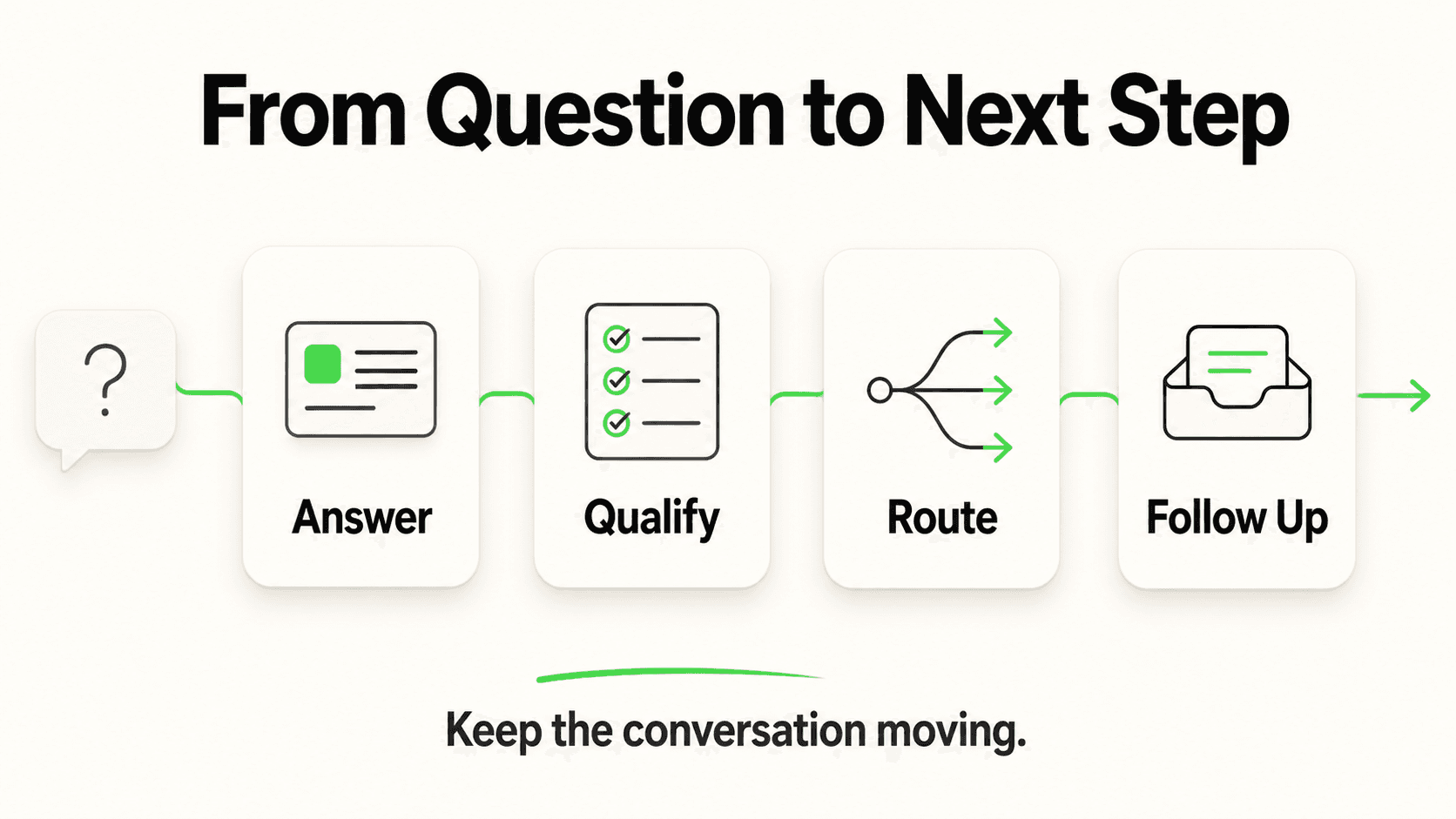
A headline price that excludes obvious scope. A chatbot quoted at $8,000 that bills separately for integration, conversation design, testing, and launch is not an $8,000 chatbot. Request a written scope statement that itemizes what is and is not included.
"100% accuracy" claims. No AI system achieves 100% accuracy. Any provider who claims this either does not understand their technology or is not being straightforward with you. The honest framing is "document-grounded responses designed to minimize incorrect answers" — with the acknowledgment that edge cases and knowledge gaps exist.
No demo on your data before a significant commitment. A vendor who cannot show the technology working on your specific content before a four- or five-figure purchase is asking for trust they have not earned.
Opaque technology stack. You do not need to understand the full architecture, but you should be able to get clear answers to "what LLM does this run on?" and "where is my data stored?" Evasion on these questions usually means the answers are unflattering.
No defined escalation path. A chatbot with no mechanism to hand off to a human is a liability. If a provider's demo has no escalation flow — no "I'll connect you with someone from our team" — ask why.
Waterfall-only delivery for an inherently iterative product. An agency that insists on a complete spec before writing any code, with no mechanism to see and react to progress until a full UAT phase, is applying a 2005 methodology to a product that requires iteration. The best chatbot deployments improve every week based on real conversation data. An agency that cannot accommodate this is setting you up for a disappointing launch and an expensive revision cycle.
How Hyperleap AI Fits in This Picture
Hyperleap AI is a chatbot platform — not a development agency. That distinction is important, and we are direct about it.
When you subscribe to Hyperleap AI, you get RAG-powered AI chatbot technology that pulls document-grounded answers from your knowledge base, deploys across Website, WhatsApp, Instagram DM, and Facebook Messenger, captures and qualifies leads, and hands off to your team when needed. The platform is designed to be configured by a non-technical business owner in a day or two.
If you want professional help setting it up without doing it yourself, Hyperleap AI offers Managed Setup $299 Free — the implementation team configures the chatbot for you, loads your knowledge base, sets up your channels, and delivers a chatbot ready to go live. This is not custom development. It is your chatbot built on Hyperleap's platform, configured by people who have done it dozens of times. The typical result is live in 3–5 days.
This is the honest bridge between "I want someone else to build it" (the intent embedded in "AI chatbot development services") and the platform path: you get professional implementation results without the custom development cost or timeline.
Platform plans:
| Plan | Monthly Cost | AI Responses | Chatbots | Channels |
|---|---|---|---|---|
| Plus | $40/mo | 3,000 | 1 | 4 |
| Pro | $100/mo | 12,000 | 2 | 8 (4 per chatbot) |
| Max | $200/mo | 30,000 | 5 | 20 (4 per chatbot) |
All plans include a 7-day free trial. Credit card required. There is no free plan.
Managed Setup ($299 one-time, from) is available as an add-on on any plan. Enterprise needs with requirements outside the platform's current ceiling — proprietary legacy integrations, strict on-premise data requirements — are situations where we would direct you to custom development rather than overpromise.
For a practical look at how conversational AI fits into customer service operations and where it creates the most value, that post covers the operational framing in detail.
Ready to see it working on your content?
Start a 7-day free trial and configure your first AI chatbot — or add Managed Setup and we will build it for you (~~$299~~ Free).
See Plans and PricingBefore comparing build-vs-buy costs, decide what job the chatbot should do — see how to build an AI chatbot for your business for that groundwork.
Frequently Asked Questions
What are AI chatbot development services?
AI chatbot development services is a broad term covering the full process of designing, building, and deploying a conversational AI system for a business. This includes use-case scoping, conversation design, knowledge base setup, system integration, testing, channel deployment, and ongoing maintenance. Depending on the path you choose, this work is done by an external development agency, a platform provider's implementation team (managed setup), or by you using a self-serve platform. The phrase covers everything from a $5,000 offshore build to a $150,000 enterprise engagement — which is why understanding what is actually included in a quote matters more than the headline number.
How much does AI chatbot development cost?
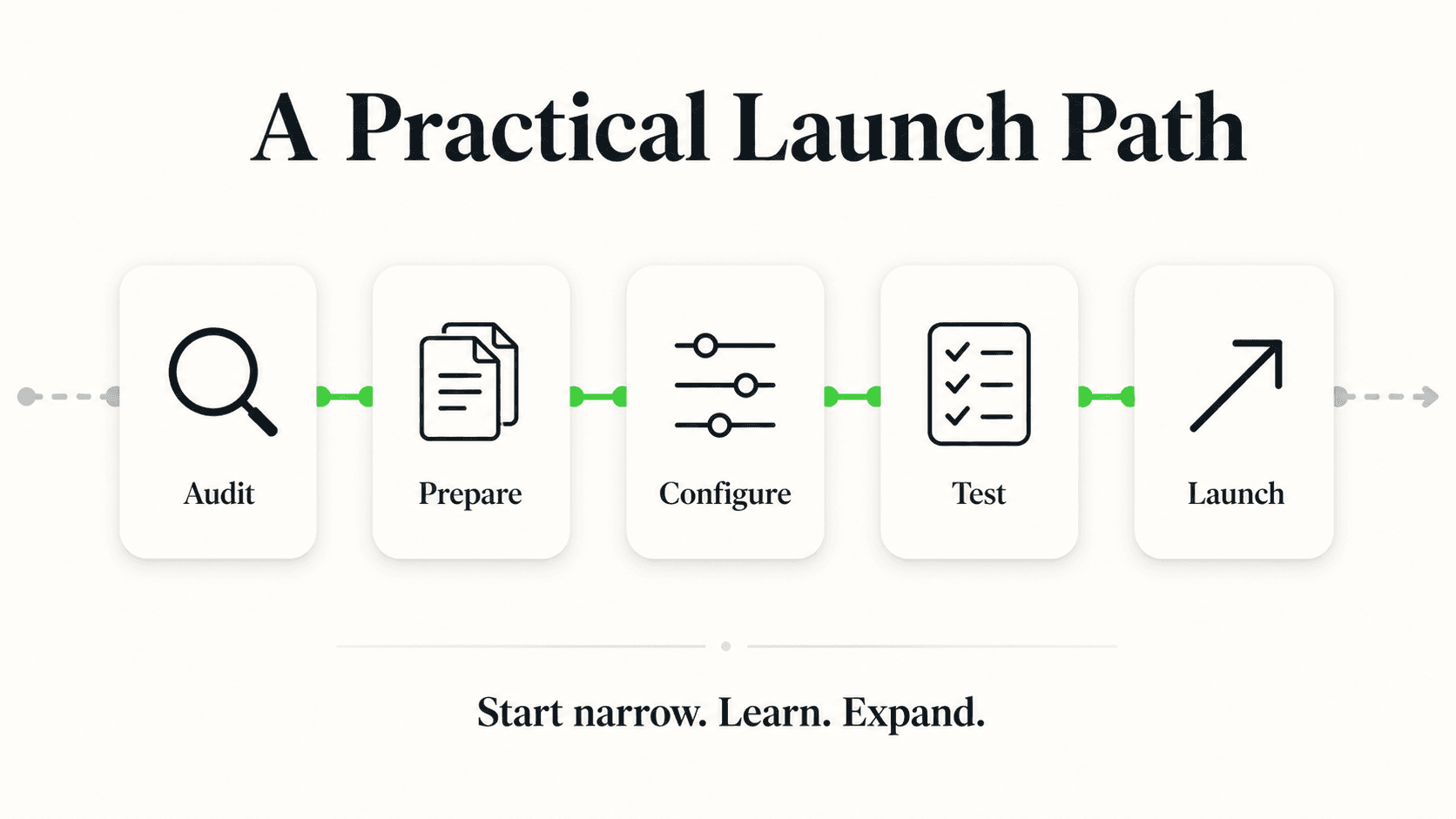
Cost depends heavily on the path. Custom development agencies typically charge $20,000–$100,000+ for an initial build, plus $1,000–$5,000 per month for maintenance — making first-year costs roughly $32,000–$160,000+. These are market estimates, not quotes; prices vary significantly by agency location and specialization. A chatbot platform with managed setup costs $299–$2,000 one-time plus a subscription of $40–$200 per month, bringing first-year cost to roughly $780–$4,400. A self-serve platform eliminates the setup fee but costs your own time to configure, at the same $40–$200/month subscription rate. First-year self-serve cost is typically $480–$2,400. The right question is not which path is cheapest but which delivers the outcome you need at a cost you can sustain.
Build vs buy — which is right for my business?
For most small and mid-sized businesses, a platform (buy) is the right answer. Custom development (build) makes sense when you have genuinely novel requirements: deep integrations with proprietary legacy systems that have no API, strict data residency needs in regulated industries, or brand and UX requirements that no platform can satisfy. For the large majority of SMB chatbot use cases — FAQ deflection, lead capture, appointment booking, multi-channel support — a modern RAG-powered platform delivers 90% of the outcome at 5–10% of the cost and a fraction of the time. Start with a platform. If you encounter a hard ceiling the platform cannot clear, that is the moment to evaluate custom development seriously.
How long does it take to build an AI chatbot?
Timeline depends on the path. Custom development agencies typically take 8–16 weeks from project start to launch, including requirements documentation, engineering, and formal testing. A platform with managed setup is typically live in 3–5 days from the time your content is ready. A self-serve platform can be live in 1–7 days depending on your content readiness and how quickly you can configure the knowledge base. If a competitor already has a chatbot and you are losing leads, a 12-week development timeline has a real commercial cost.
Do I need developers to build an AI chatbot?
Not with a modern self-serve platform. Platforms like Hyperleap AI are designed to be configured by non-technical business owners — you upload your documents, write your opening message, connect your channels, and go live with no code required. For REST API-based integrations or custom webhook setups, some technical knowledge is helpful but not required for the core chatbot experience. If you choose a platform with managed setup, the vendor's team handles all technical configuration; your involvement is providing your content and approving the result. If you choose custom development, you will work with an engineering team throughout — which is appropriate when your requirements genuinely need it.
Cost and timeline ranges in this post are estimates based on market knowledge and publicly available data. Vendor-specific figures reflect Hyperleap AI's current plans as of May 2026. Individual results and actual costs will vary by scope, provider, and business requirements.
Related Articles

AI Chatbot Development Company: How to Choose the Right Partner
What AI chatbot development companies actually do, the three partner types, how to evaluate them, real costs, red flags, and where Hyperleap AI's Managed Setup fits.
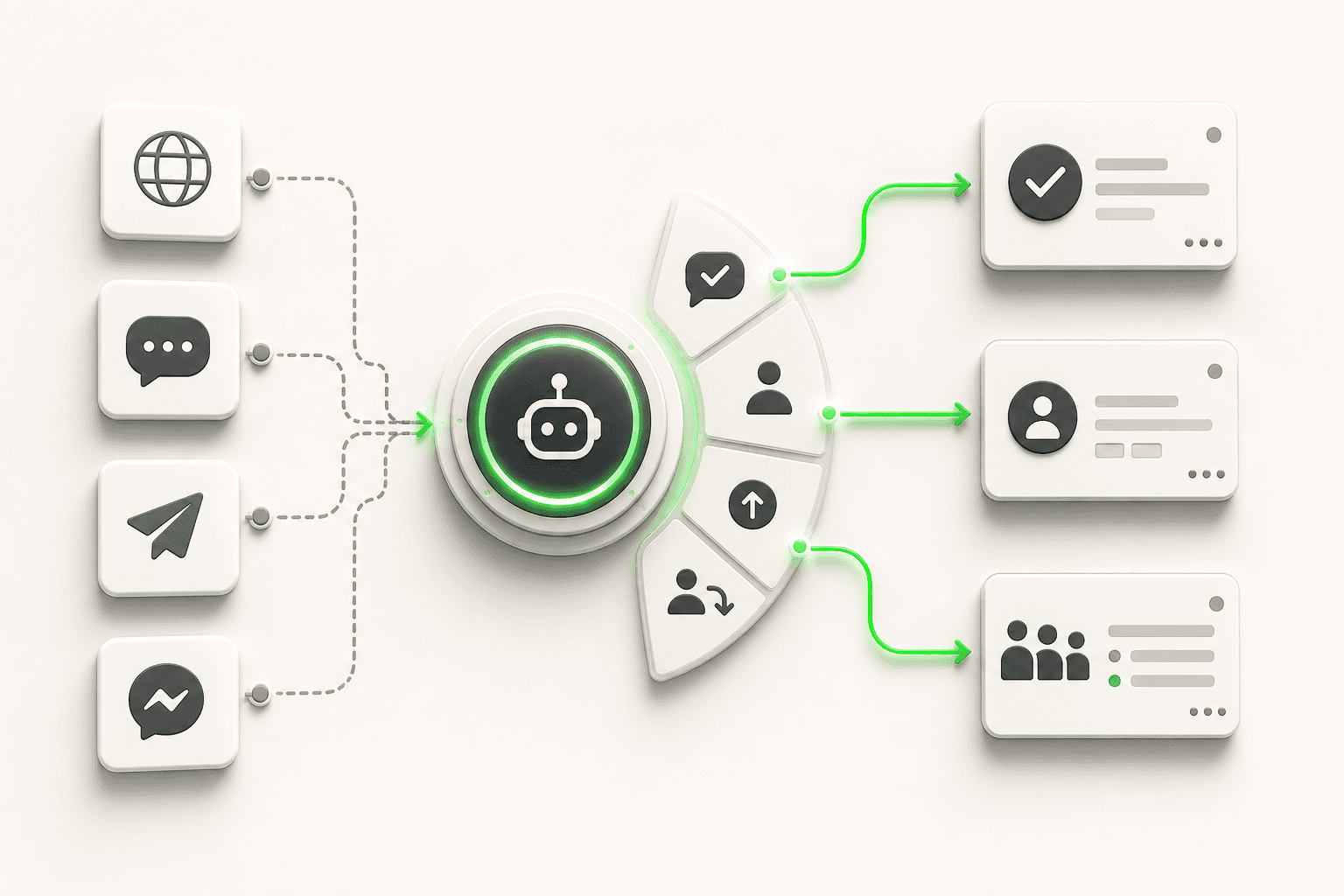
AI for Small Business Customer Service: Where to Start
A step-by-step guide to AI for small business customer service — triage your support load, choose buy vs. DIY vs. hire, set a budget, and roll out in 30 days.
Best Customer Service Software for Small Business (2026 Guide)
Compare the best customer service software for small business: help desks, live chat, AI agents, and shared inboxes — with an honest evaluation framework.

Customer Service Automation: The Complete Guide (2026)
Customer service automation done right: what to automate, what to keep human, which tools to evaluate, and how to roll it out without breaking what already works.