Conversational AI for Customer Service: An Operational Guide for SMBs
Where conversational AI actually creates value in customer service, how to operationalize it without breaking your support team, and the failure modes that sink most deployments.

TL;DR: Conversational AI earns its keep in customer service when it absorbs high-volume, repetitive, low-judgment work — answering FAQs, capturing leads after hours, qualifying inquiries, and giving instant first responses — while routing everything sensitive or ambiguous to a human. The value is not "replace your support team." It is "stop your support team from drowning in the same twenty questions and stop losing the inquiries that arrive at 11 PM." This guide covers where conversational AI creates the most value, how to operationalize it (knowledge base, escalation rules, channels, measurement), and the specific failure modes that cause deployments to disappoint.
Who This Guide Is For
This is written for owners and operators of small and mid-sized businesses who are evaluating or running conversational AI in customer service and want the operational reality — not the marketing version. If you are still deciding whether to build custom or buy a platform, start with our guide on AI chatbot development services and the build-vs-buy decision. This post assumes you have chosen the platform path and want to make it work.
"Conversational AI" is one of those terms that means everything and therefore nothing. For our purposes here, it means an AI system that understands a customer's question in natural language, retrieves a grounded answer from your business's own content, and either resolves the request or hands it to a person — across whichever channel the customer used. That is a narrow, useful definition, and it is the one that matters operationally.
The mistake most businesses make is treating conversational AI as a technology purchase. It is not. It is an operational change to how customer inquiries flow through your business. The platform is maybe 20% of the outcome. The other 80% is what you feed it, what you let it do, when it steps aside, and whether anyone watches the conversations afterward. This guide is about that 80%.
Where Conversational AI Creates the Most Value
Not all customer service work is a good fit for automation. The value concentrates in a specific quadrant: high-volume, repetitive, and low-judgment. The further a task moves from that quadrant — toward low-volume, novel, high-judgment — the worse the fit.
Repetitive FAQ deflection. Every business answers the same handful of questions hundreds of times: hours, location, pricing, availability, policies, "do you do X." This is the single highest-value use case because the volume is large, the answers are stable, and the judgment required is near zero. A conversational AI grounded in your documentation handles these instantly and consistently, freeing your team for work that actually needs a person.
After-hours and overflow coverage. A meaningful share of inquiries arrive when no one is at the desk — evenings, weekends, lunch breaks, and during the inevitable rush when every line is busy. Those inquiries do not wait politely; they go to a competitor who answered first. Conversational AI gives you a 24/7 first responder that captures the inquiry, answers what it can, and books the follow-up — turning a missed message into a logged lead.
Lead capture and qualification. For businesses where an inquiry is a potential sale, the job is not just to answer — it is to capture contact details and understand intent before the conversation ends. Conversational AI can ask the qualifying questions ("what are you looking for, what's your timeline, what's the best way to reach you"), structure the answers, and pass a clean summary to your sales team. This is often where the financial return shows up fastest.
Instant first response. Speed-to-first-response is one of the most consistently revenue-linked metrics in customer service. According to a widely cited Harvard Business Review analysis of lead response, the odds of qualifying a lead drop sharply when first contact slips from minutes to hours. A conversational AI responds in seconds, every time, which means even when the eventual resolution needs a human, the customer has already been acknowledged and engaged.
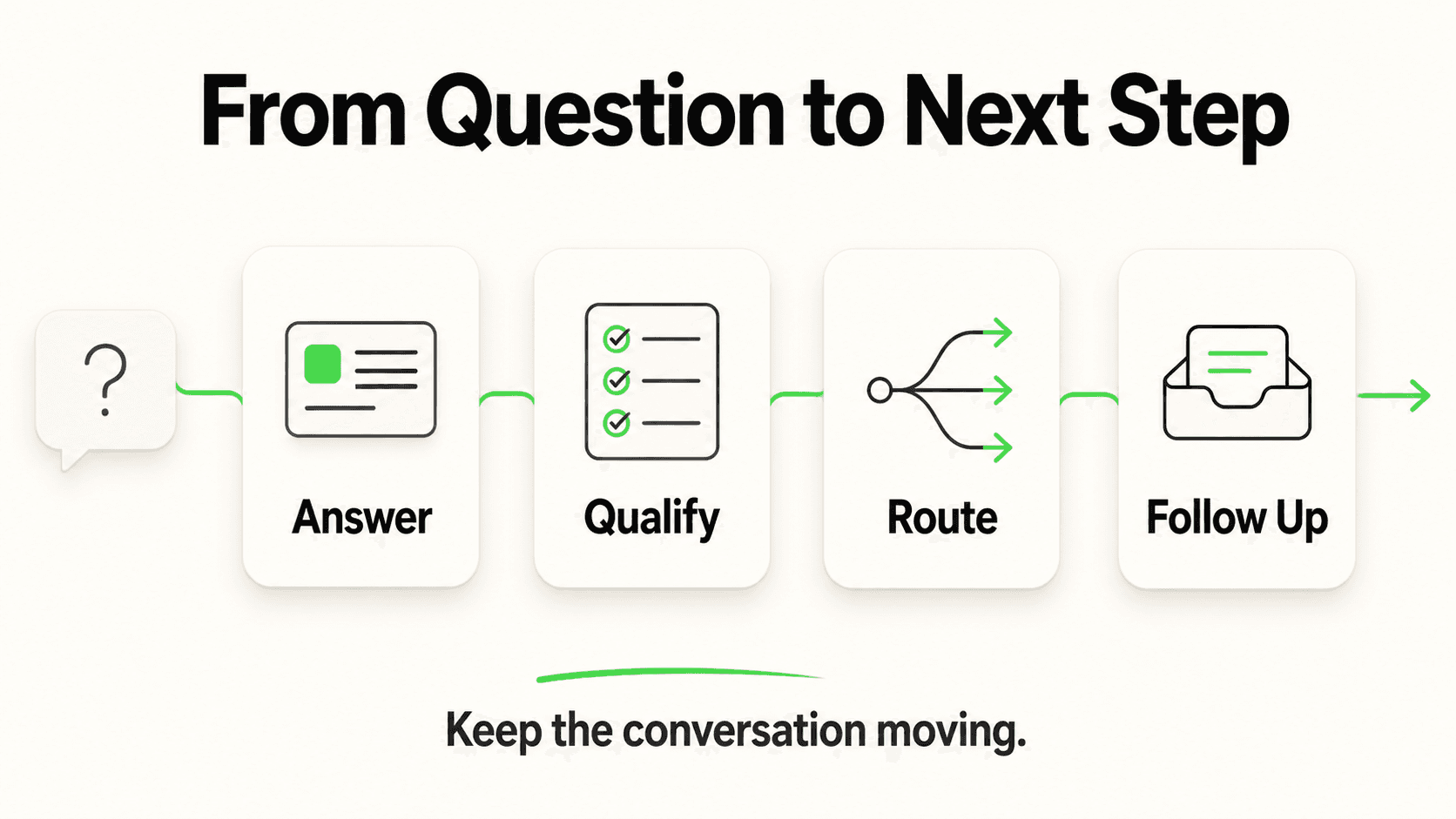
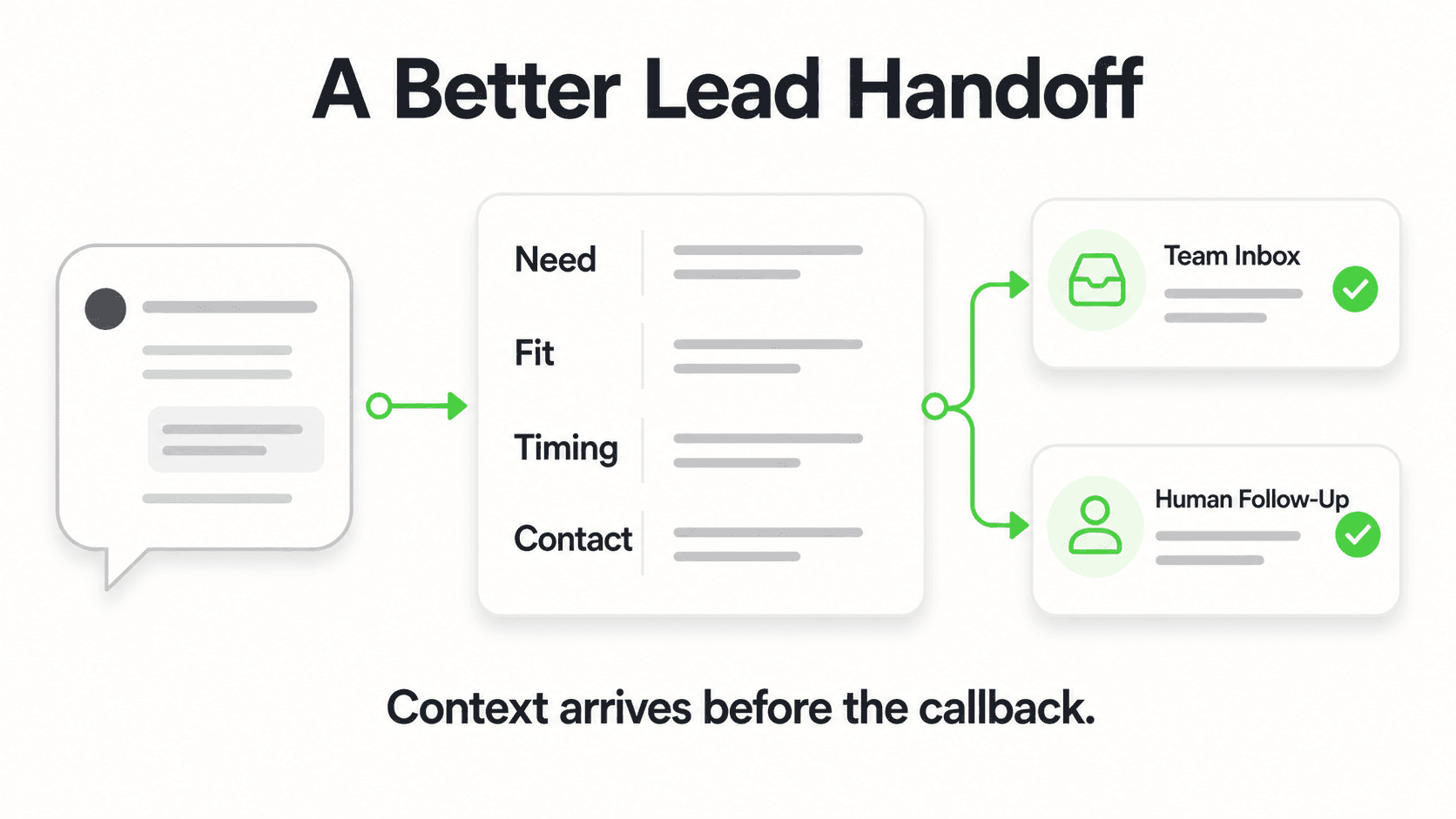
Triage and routing. Even when AI cannot resolve a request, it can categorize it, collect the relevant context, and route it to the right person or queue. A human who picks up a pre-triaged conversation with the customer's question, account context, and intent already captured resolves it far faster than one starting cold.
The Quadrant Test
Before automating any category of inquiry, ask three questions: Is it high-volume? Is the answer stable and documented? Does it require little human judgment? Three yeses means automate it now. Two means automate with a tight escalation path. One or zero means leave it with a human and let the AI only triage it.
Where Conversational AI Should Not Lead
Honesty about limits is what separates a deployment that builds trust from one that erodes it. These are the situations where conversational AI should assist or triage, but never be the final word.
Emotionally charged or complaint conversations. An angry customer, a service failure, a billing dispute — these need a human who can acknowledge frustration, exercise discretion, and make a judgment call. An AI that responds to "this is the third time this has broken" with a cheerful FAQ answer makes things worse. The right pattern is immediate, graceful escalation with full context handed to the person who takes over.
Anything requiring discretion or exceptions. "Can you make an exception just this once?" is a question about authority and judgment, not information. The AI should recognize it and route it, not invent a policy.
High-stakes or regulated advice. Medical, legal, and financial questions that go beyond documented facts (hours, services, general process) belong with qualified humans. The AI's job is to answer the logistics and route the substance — never to improvise advice it has no business giving.
Genuinely novel problems. If a customer describes something your documentation does not cover, the worst outcome is a confident, plausible, wrong answer. The correct behavior is "I don't have a confident answer to that — let me get you to someone who does." Designing this gracefully is the single most important quality signal in any deployment, which is why getting hallucinations under control with document-grounded answers matters more than raw conversational fluency.
The pattern across all four: conversational AI should know what it does not know and escalate without friction. A system that fails this test does not save your team work — it generates angry follow-ups that cost more than the inquiry would have.
How to Operationalize It: The Four Things That Actually Matter
Buying a platform is the easy part. Making it work is four pieces of operational discipline. Get these right and the technology mostly takes care of itself; get them wrong and the best platform on the market will still disappoint.
1. The Knowledge Base Is the Product
Modern conversational AI uses Retrieval-Augmented Generation (RAG): it answers from your documents rather than from a generic pre-trained model. This means the quality of its answers is bounded by the quality and currency of what you load into it. A chatbot launched with accurate pricing in January will confidently quote stale prices in April if no one updates the source.
The operational rule is simple: the knowledge base is a living asset, not a launch task. Gather your FAQs, policies, service descriptions, and process guides; structure them clearly; load them; and assign ownership for keeping them current. When pricing, hours, services, or staff change, the knowledge base changes the same day. Treat it like you treat your website — because to your customers, it is your website's voice.
2. Escalation Rules Are Where Trust Lives
Every conversational AI deployment needs an explicit, written escalation contract before launch: what the AI answers, what it always escalates, and what it must never say. This is not a technical setting — it is a business decision about where you draw the line between automation and human judgment.
A good escalation design covers: the trigger words and intents that force a handoff (refund, complaint, urgent, legal, emergency), the path the handoff takes (live agent, callback capture, ticket creation), and the context that travels with it (the full conversation, the customer's question, any details already captured). The customer should never have to repeat themselves to the human who takes over.
3. Meet Customers on Their Channels
Customers do not think in channels — they reach out wherever is convenient. A conversational AI confined to your website misses the inquiries that arrive on WhatsApp, Instagram, or Facebook Messenger. The operational goal is the same AI, with the same knowledge and persona, present on every channel your customers actually use. Hyperleap AI's shipped channels are Website, WhatsApp Business API, Instagram DM, and Facebook Messenger — the four that cover the overwhelming majority of SMB inbound. For how to decide which to prioritize, see our multi-channel AI chatbot strategy guide.
4. Watch the Conversations or You Are Flying Blind
The single biggest difference between deployments that improve and deployments that stagnate is whether anyone reviews the actual conversations. The transcripts tell you exactly where the AI got stuck, which questions it could not answer, where customers got frustrated, and which knowledge gaps to fill next. A weekly review of escalated and abandoned conversations, with the gaps fed back into the knowledge base, is what makes the system compound over time. For the metrics worth tracking, see our guide on the chatbot KPIs that measure real success.
The Compounding Loop
Conversational AI gets better not because you spend more, but because you close the loop: review conversations → find the gap → update the knowledge base or escalation rule → retest. A deployment that runs this loop weekly is materially smarter after three months. A deployment that launches and is never touched again is exactly as good as it was on day one — and slowly degrading as your business information drifts.
What the Data Says About Operational Impact
The case for conversational AI in customer service is increasingly measurable rather than aspirational. A few figures worth anchoring on:
30-40%
Average support cost reduction (McKinsey, 2025)
82%
Customer satisfaction with fast, accurate AI support (Tidio, 2025)
3 sec
Average AI first-response time vs. 45s human chat (Freshworks, 2025)
The throughline in the research is consistent: the savings come from automating the routine majority of inquiries — often 50-75% of total volume — while the satisfaction comes from speed and accuracy, and only when human escalation is seamless. Forrester has warned that a meaningful share of AI self-service rollouts fail, usually from overconfidence in the AI's ability to handle everything without a graceful human fallback. That failure mode is operational, not technological — which is the recurring theme of this entire guide.
The Failure Modes That Sink Deployments
If conversational AI disappoints, it is almost never because the model was not smart enough. It is one of these operational failures.
The stale knowledge base. The most common and most damaging. The AI confidently gives outdated information because nobody updated the source. This is worse than no chatbot, because customers act on the wrong answer. Fix: assign ownership and update the same day anything changes.
The dead-end with no escalation. The AI cannot answer, has no handoff path, and loops the customer into frustration. Fix: design the escalation flow before launch and test it by deliberately asking questions outside the knowledge base.
The confident hallucination. The AI invents a plausible answer rather than admitting a gap. Fix: insist on document-grounded (RAG) architecture and explicitly design the "I don't know" response.
The launch-and-forget. Nobody reviews conversations, so gaps never get closed and the deployment never improves. Fix: a recurring weekly conversation review with gaps fed back into the knowledge base.
Over-automation. The business tries to make the AI handle complaints, exceptions, and sensitive cases it has no business handling, eroding customer trust. Fix: apply the quadrant test and keep humans in the lead for high-judgment work.
Channel mismatch. The AI lives only on the website while customers reach out on WhatsApp and Instagram. Fix: deploy the same AI across the channels your customers actually use.
Notice that every fix is operational. The platform is a prerequisite, not the determinant. A disciplined operator with a mid-tier platform will beat a careless operator with the best platform on the market, every time.
See conversational AI working on your actual content
Start a 7-day free trial and configure your first AI agent across website, WhatsApp, Instagram, and Facebook Messenger — or add Managed Setup (~~$299~~ Free) and we will build it for you.
Explore PlansA Practical Rollout Sequence
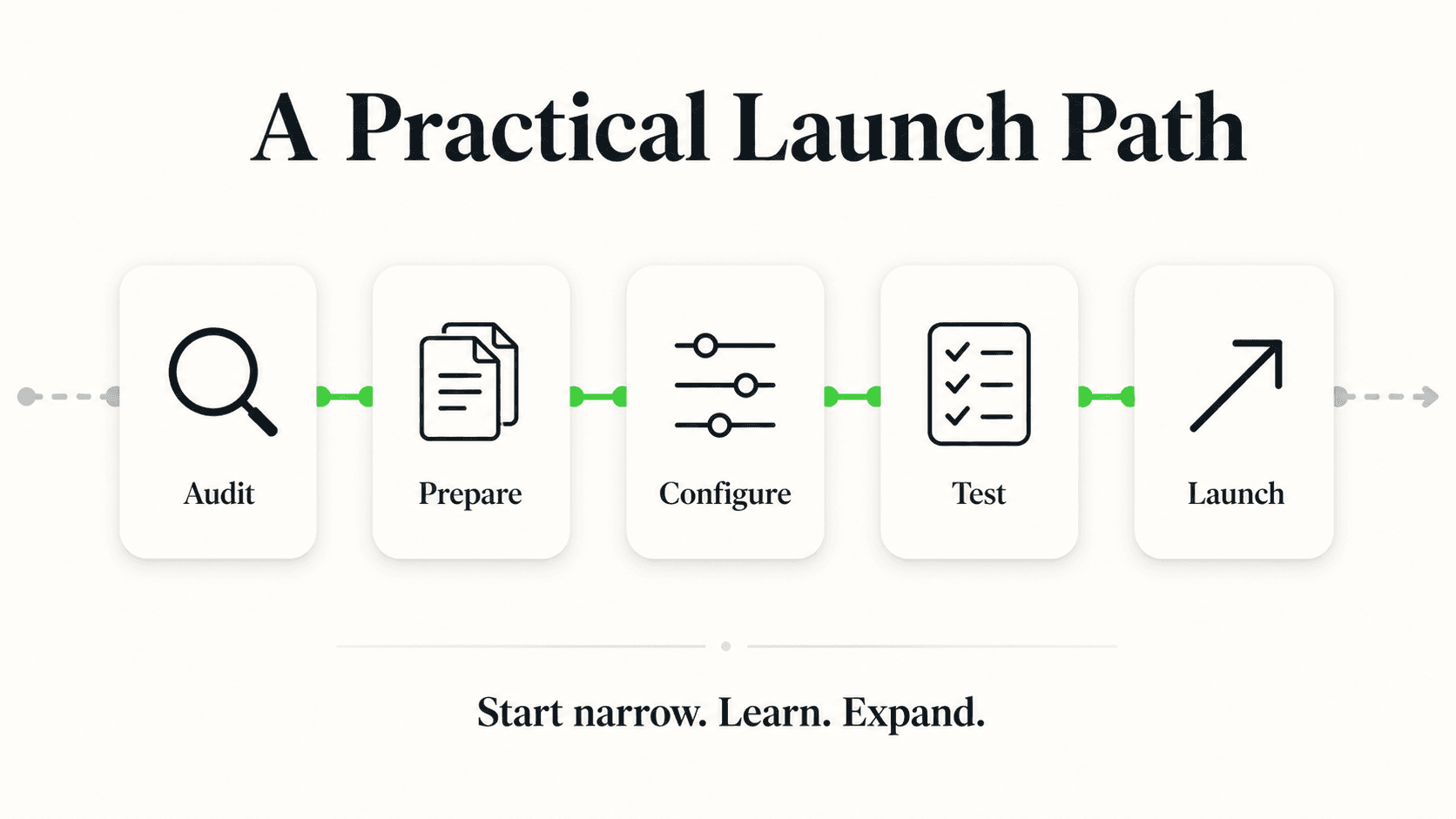
If you are starting from zero, this is the order that works — narrow first, expand based on evidence.
- Pick one channel and one job. Usually your website plus FAQ deflection. Do not try to boil the ocean on day one.
- Build a focused knowledge base. Your top 20-30 questions, answered accurately, beats a sprawling dump of every document you own.
- Write the escalation contract. Decide what escalates and how, before you go live.
- Test against real questions — including the hard ones. Deliberately try to break it. Ask things outside the knowledge base and confirm it escalates gracefully.
- Launch narrow, then watch. Review the first two weeks of conversations closely. The gaps will be obvious.
- Close the loop and expand. Fill the gaps, then add a channel (WhatsApp, Instagram DM) or a job (lead qualification) once the first one is solid.
This sequence keeps the failure surface small while you learn, and lets the deployment earn the right to expand based on actual performance rather than optimism. For a broader view of how AI chatbots work across business use cases, the AI chatbot for business hub covers the landscape.
How Hyperleap AI Fits the Operational Picture
Hyperleap AI is a conversational AI platform built around the operational principles in this guide. It uses RAG to ground answers in your knowledge base rather than the open internet, deploys the same AI across Website, WhatsApp Business API, Instagram DM, and Facebook Messenger, qualifies and captures leads, and hands off to your team with full context when a conversation needs a person. It is designed to be configured by a non-technical operator — and if you would rather not, Managed Setup ($299 Free, available on any plan) means the team configures it for you.
Plans run from Plus ($40/mo) through Pro ($100/mo) to Max ($200/mo), each with a 7-day free trial; a credit card is required and there is no free plan. We are deliberately not in the business of overpromising: conversational AI is a powerful tool for the routine majority of customer service work and a poor substitute for human judgment on the rest. A deployment that respects that line is the one that creates value.
Ready to operationalize conversational AI?
Configure a document-grounded AI agent on your real content and channels in days, not months. 7-day free trial on every plan.
See Plans and PricingFrequently Asked Questions
What is conversational AI in customer service?
Conversational AI in customer service is an AI system that understands customer questions in natural language, retrieves grounded answers from your business's own content, and either resolves the request or hands it to a human agent — across whichever channel the customer used. In practice for small businesses, this means an AI agent on your website and messaging channels that answers FAQs, captures and qualifies leads, provides instant first responses, and escalates anything sensitive or ambiguous to your team. The useful version is narrow and operational, not a general-purpose replacement for human support.
Where does conversational AI create the most value?
The value concentrates in high-volume, repetitive, low-judgment work: FAQ deflection (the same questions asked hundreds of times), after-hours and overflow coverage (inquiries that arrive when no one is at the desk), lead capture and qualification, instant first response, and triage/routing. The further a task moves toward low-volume, novel, and high-judgment, the worse the fit. Complaints, exceptions, regulated advice, and genuinely novel problems should be triaged by AI but led by humans.
Will conversational AI replace my customer service team?
No, and treating it that way is a common cause of failed deployments. Conversational AI works best as augmentation: it absorbs the routine majority of inquiries — often 50-75% of volume — so your team can focus on the complex, sensitive, and high-value work that genuinely needs human judgment. The highest customer satisfaction comes from AI handling instant first responses and routine resolution while routing harder cases to people with full conversation context. It changes what your team spends time on; it does not eliminate the team.
Why do conversational AI deployments fail?
Almost always for operational reasons, not technological ones. The common failure modes are: a stale knowledge base giving outdated answers, dead-ends with no escalation path, confident hallucinations from non-grounded systems, launch-and-forget (nobody reviews conversations to close gaps), over-automation of sensitive cases, and channel mismatch (the AI lives only on the website while customers use WhatsApp and Instagram). Every one of these is fixable with operational discipline — a current knowledge base, a clear escalation contract, document-grounded architecture, and a weekly conversation review.
How do I keep conversational AI from giving wrong answers?
Use a platform built on Retrieval-Augmented Generation (RAG), which grounds every answer in your documents rather than a generic model — this is the single biggest factor in minimizing hallucinations. Then keep the knowledge base current (update it the same day anything changes), and explicitly design the "I don't know" response so the AI escalates gracefully rather than inventing a plausible answer. No system achieves 100% accuracy; the honest standard is document-grounded responses designed to minimize wrong answers, with a clean handoff for anything outside the knowledge base.
How long does it take to operationalize conversational AI for an SMB?
Self-serve setup is typically live in 3-5 days once your content is ready: build a focused knowledge base of your top 20-30 questions, write your escalation rules, test against real questions, and launch narrow on one channel. With Managed Setup ($299 Free, available on every plan), the implementation team configures it for you on your content and channels. The faster part is launching; the ongoing part is the weekly conversation review that makes the system compound over time. A 7-day free trial is included on every plan.
Related Articles

Benefits of Conversational AI for Business (With Caveats)
The real benefits of conversational AI — 24/7 coverage, speed, cost, scale — with the conditions that make each one true, and where it doesn't hold.

12 Conversational AI Examples From Real Businesses
12 real conversational AI examples organized by job-to-be-done — after-hours capture, FAQ deflection, booking, and more — with sourced outcomes.

Conversational AI for Small Business: A Starter Guide
A practical guide to conversational AI for small business: what to build first, a 5-step setup week, real costs, and the 3 use cases that pay for it first.
Conversational AI vs Chatbot: The Real Difference
Conversational AI vs chatbot explained: rule-based scripted bots versus LLM-powered conversational AI, plus a comparison table and decision framework.