Conversational AI vs Chatbot: The Real Difference
Conversational AI vs chatbot explained: rule-based scripted bots versus LLM-powered conversational AI, plus a comparison table and decision framework.
TL;DR: "Chatbot" and "conversational AI" get used interchangeably, but they describe different generations of technology. A traditional chatbot is rule-based — it matches a customer's message to pre-written decision-tree branches and breaks the moment someone phrases a question differently than the script expects. Conversational AI uses large language models (LLMs) to understand intent and generate original responses, often grounded in a business's own documents through retrieval-augmented generation (RAG). Every LLM-powered chatbot today is a form of conversational AI; the reverse isn't true. If your customers ask questions in their own words, at odd hours, in more than one language, conversational AI resolves more of them without a human. If your flow is a fixed set of buttons (book now, cancel, track order), a scripted bot may be all you need. Below: the technical distinction, a side-by-side comparison table, and a decision framework for which one fits your business.
How this guide fits in
This article focuses specifically on the terminology question — rule-based chatbots versus LLM-powered conversational AI, and how to decide between them. For the deeper technical breakdown of how conversational AI actually works under the hood (NLU, LLMs, RAG), see What Is Conversational AI?. For the AI-agent-specific version of this same distinction — agents that reason and take multi-step actions versus both chatbot types — see AI Agents vs Chatbots: What's Actually Different in 2026.
A customer types "can I switch my appointment to next Tuesday instead" into your website chat widget. A rule-based chatbot sees no exact match for its "reschedule" button flow and returns "Sorry, I didn't understand that. Please choose an option below." The customer, mildly annoyed, closes the tab and calls a competitor instead. Conversational AI reads the same sentence, understands the intent is a reschedule request, and either handles it or routes it to a human with the context already attached.
That gap — between a system that matches patterns and a system that understands language — is the entire "conversational AI vs chatbot" question. It matters because vendors use the words loosely, and picking the wrong category for your business means either overpaying for capability you don't need or under-delivering on the experience your customers expect.
This guide breaks down exactly what separates the two, where each still makes sense in 2026, and how to evaluate which one your business should actually deploy on customer-facing channels — website, WhatsApp, Instagram DM, and Facebook Messenger.
What Is the Difference Between Conversational AI and a Chatbot?
A traditional chatbot is software that follows a pre-programmed decision tree: it matches keywords or button clicks to a fixed set of scripted responses and cannot handle input outside that script. Conversational AI is a broader technology category — built on natural language understanding and large language models — that interprets the actual meaning of a message and generates a response, even to phrasing it has never seen before.
The clearest way to see the distinction is by mechanism, not marketing label:
- Rule-based chatbot: If input matches Pattern A, return Response A. No understanding of intent — just pattern matching against a finite list of pre-written branches. Falls back to "I didn't understand" or a human handoff the moment a customer strays off-script.
- Conversational AI: Processes the input through an LLM that has learned the statistical structure of language. It doesn't match a script — it infers what the person means, holds context across multiple turns, and constructs a new sentence in response. In business deployments, the best implementations layer retrieval-augmented generation (RAG) on top, so the AI's answers are grounded in a company's actual documents — pricing sheets, policies, FAQs — rather than general internet knowledge.
Every conversational AI system that talks to customers is colloquially called a "chatbot" today, which is exactly why the terms blur. But not every chatbot is conversational AI — a huge share of the bots still running on small business websites in 2026 are the older, rule-based kind, dressed up in a modern chat-widget UI. The interface looks identical. What happens when a customer says something the designer didn't anticipate is where the two diverge completely.
Definition, in one line
Conversational AI is a category of natural-language technology; a chatbot is one delivery format for it. A rule-based chatbot and an LLM-powered chatbot both look like "a chat window," but only one of them actually understands what's typed into it.
Why the Terminology Confusion Costs SMBs Money
Every vendor selling anything with a chat bubble in 2026 calls it "AI-powered." That labeling gap means a business owner comparing two products that both say "AI chatbot" on the homepage can end up with wildly different capability — and wildly different results — for a similar monthly price.
Rule-based bots quietly fail on real customer language
A decision-tree bot can only cover the paths someone anticipated when they built it. Real customers don't phrase things the way flowcharts expect — they use typos, slang, indirect questions ("do you guys do the thing where you match a price"), or combine two questions in one message. Every one of those triggers a fallback message or a dead end. The business owner sees this as "our chatbot isn't working," when the real issue is a structural ceiling: rule-based systems cannot generalize beyond what was scripted.
The upgrade cost isn't obvious until you're locked in
Rule-based platforms are often cheaper to start and easier to demo — a clean flowchart builder looks approachable. But every new question type a business wants covered means someone manually adding another branch. Conversational AI systems, by contrast, get most of their coverage from the underlying language model plus a knowledge base upload — closer to writing an FAQ document than programming decision logic. The mistake is picking the cheaper-looking option for a use case that will outgrow it within a quarter.
"AI chatbot" claims without RAG can still hallucinate
Some products marketed as "AI chatbots" bolt a generic LLM onto a chat widget without grounding it in the business's own documents. That configuration can produce fluent, confident-sounding answers that are simply wrong about specific policies, prices, or availability — a different failure mode than a rule-based bot's blunt "I don't understand," but arguably worse, because it doesn't look like a failure. The fix is document-grounded, RAG-based conversational AI, not just "an AI chatbot" as a marketing phrase. See how accurate are AI chatbots in 2026 for how to evaluate accuracy claims from vendors.
Conversational AI vs Chatbot: Side-by-Side Comparison
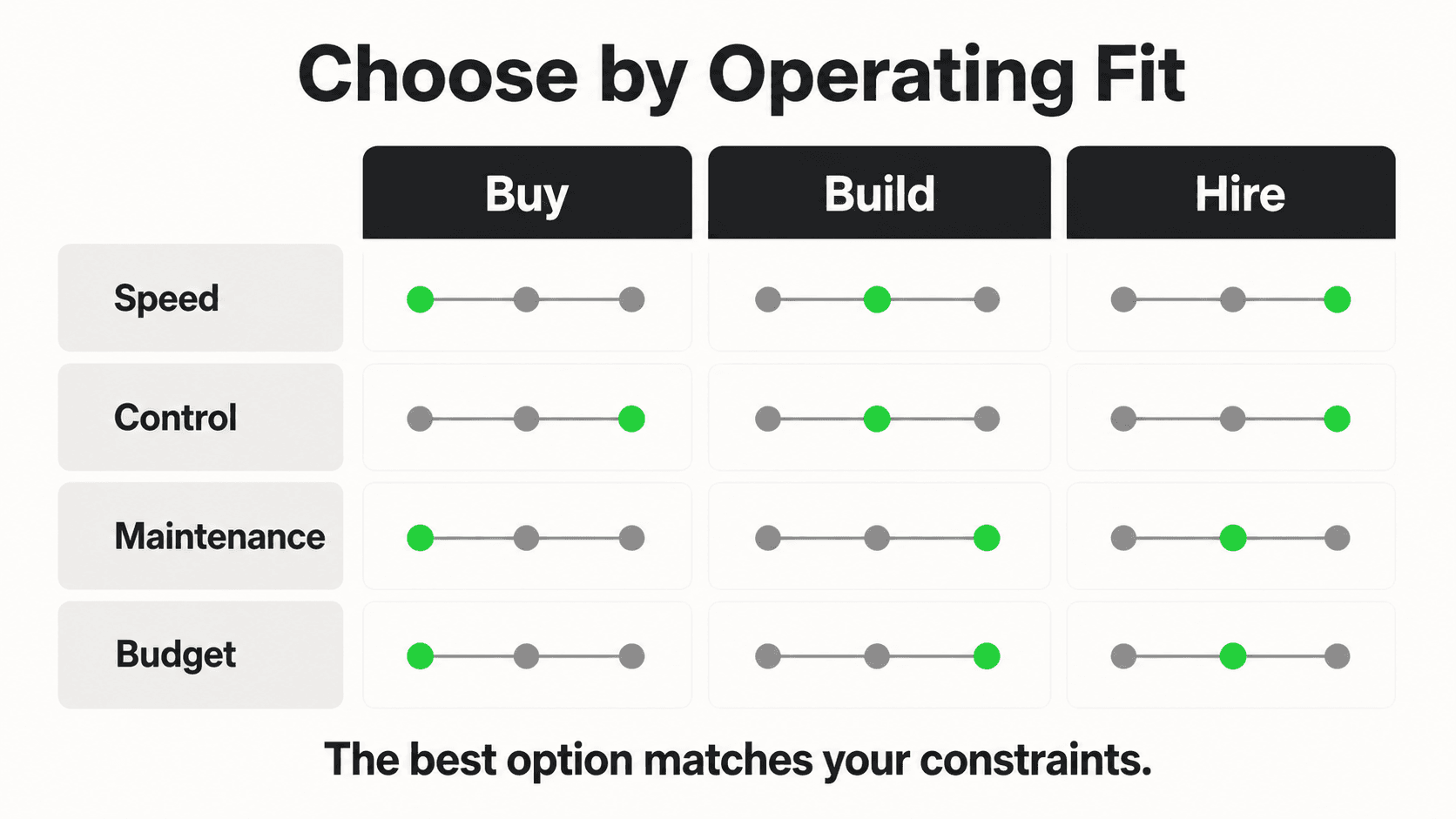
The table below compares the two approaches directly across the dimensions that matter for a buying decision.
| Dimension | Rule-Based Chatbot | Conversational AI |
|---|---|---|
| How it decides what to say | Matches keywords/buttons to pre-written scripts | LLM interprets intent and generates a response |
| Handles unscripted phrasing | No — falls back to "I didn't understand" | Yes — infers meaning from natural language |
| Multi-turn context | Limited to the current step in the flow | Holds context across the conversation |
| Setup effort | Manual flowchart/decision-tree building | Upload documents/FAQs; the model does the rest |
| Scales to new question types | Requires adding new branches manually | Generalizes from existing knowledge base |
| Accuracy source | As reliable as the script (never wrong within scope, blind outside it) | Depends on whether responses are grounded in your documents (RAG) vs. generic |
| Multilingual support | Requires separate scripted flows per language | Can respond in 100+ languages from one knowledge base |
| Best fit | Narrow, high-volume, fixed-path tasks (e.g., "check order status") | Open-ended customer questions, FAQs, lead qualification, support |
| Typical failure mode | Dead-end fallback message | Needs a documented knowledge base to avoid vague or generic answers |
A caveat on 'accuracy'
Neither approach is infallible. A rule-based bot is only as good as the flows someone wrote — it never improvises, but it also never covers a question outside its script. A well-built RAG-grounded conversational AI system is designed to answer only from the business's own documents, which reduces the risk of made-up answers, but no AI system should be described as delivering guaranteed or perfect accuracy. Evaluate vendors on how their system is grounded, not on unverifiable accuracy percentages.
When a Rule-Based Chatbot Still Makes Sense
A rule-based bot is the right tool when the task is genuinely narrow, repetitive, and has a small, fixed number of valid paths — think "check my order status," "pay my bill," or a single-step appointment cancellation button. In these cases, the predictability of a scripted flow is a feature, not a limitation: the bot will never go off-script because there's no script to go off of.
Where rule-based logic tends to fall short is anything involving open-ended customer questions — "what's included in the premium plan," "do you handle same-day requests," "I have a weird situation, can you help" — the exact kind of message that dominates real inbound volume for most SMBs. If more than a small fraction of your inbound messages are open-ended rather than transactional, a purely rule-based bot will generate a steady stream of frustrated fallbacks.
When Conversational AI Is the Right Choice
Conversational AI earns its cost when customer questions are varied, when volume is high enough that a human answering every one isn't sustainable, or when coverage needs to extend beyond business hours and a single language. It is the better fit for:
- FAQ and support deflection — resolving repetitive questions about pricing, policies, hours, and availability without a person typing the same answer for the fiftieth time that week
- Lead qualification and intake — asking follow-up questions naturally instead of forcing a rigid multi-step form flow
- After-hours coverage — customers research and message at night and on weekends; a scripted bot with narrow coverage leaves most of that traffic unresolved, while conversational AI can carry a real conversation regardless of when it arrives
- Multilingual audiences — one knowledge base can serve customers in many languages instead of building and maintaining separate scripted flows per language
See document-grounded conversational AI handle real questions
Curious what conversational AI looks like resolving actual customer questions across channels, not a scripted demo flow?
See How It Handles ThisA Decision Framework: Which Do You Actually Need?
Instead of asking "chatbot or conversational AI" as an abstract branding question, run your own use case through four practical checks.
1. How varied is your actual inbound volume?
Pull a week of real customer messages — website chat logs, WhatsApp threads, DMs — and count how many follow one of a handful of fixed patterns versus how many are open-ended or oddly phrased. If it's mostly fixed patterns, a scripted flow may cover you. If it's a long tail of unique phrasing, you need language understanding, not pattern matching.
2. Do you have documents to ground answers in?
Conversational AI is only as good as what it's grounded in. If you have a reasonably current FAQ, pricing sheet, policy document, or knowledge base, a RAG-based system can turn that into accurate, document-grounded conversation almost immediately. If that documentation doesn't exist yet, writing it is worthwhile regardless of which system you choose — a rule-based bot needs the same information to build its scripts.
3. How many channels and languages do you need to cover?
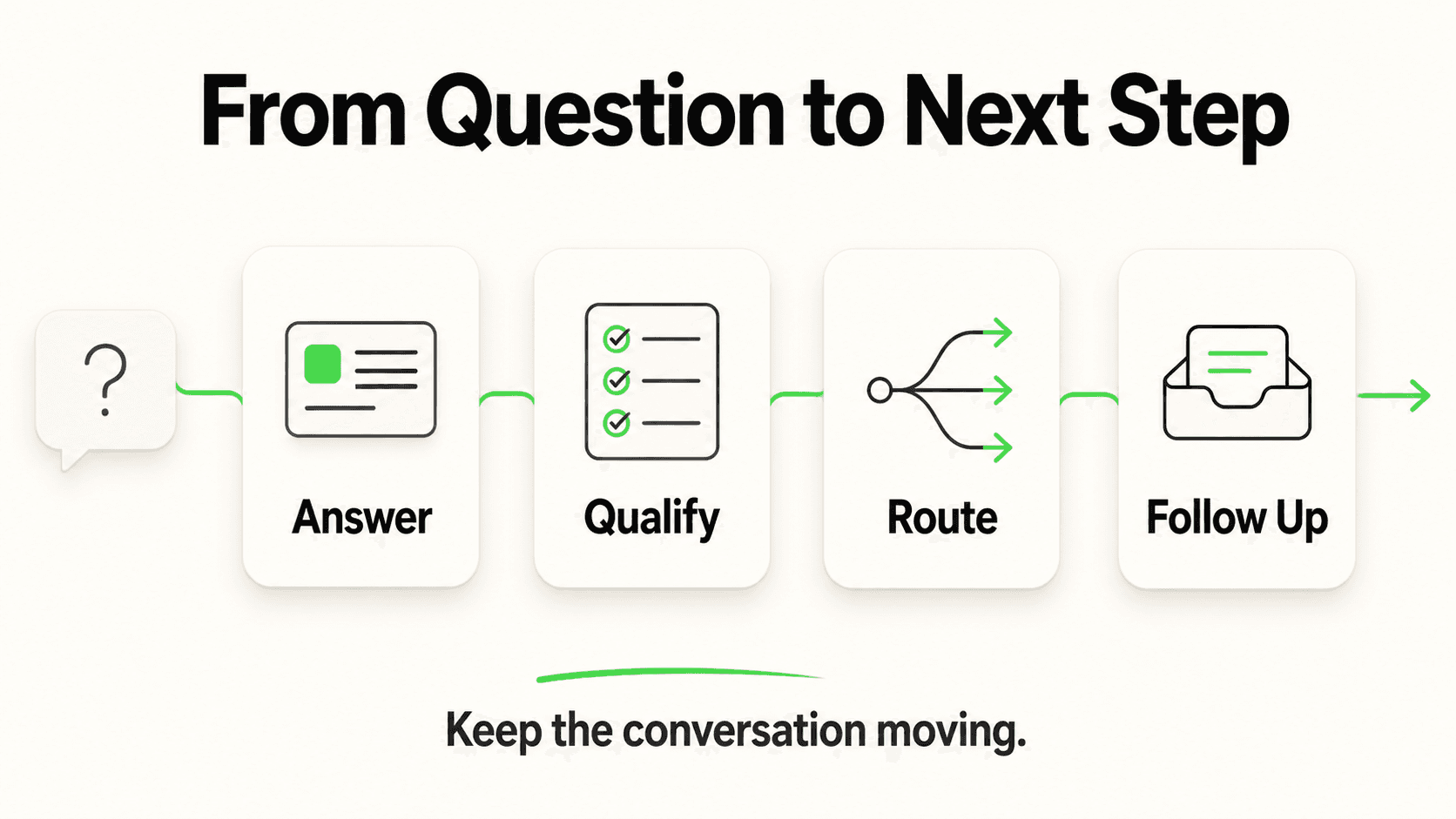
If customers reach you only through one channel in one language, a scripted bot on that single channel is a smaller lift. If you need consistent coverage across a website widget, WhatsApp, Instagram DM, and Facebook Messenger — and in more than one language — building and maintaining that many parallel scripted flows gets expensive fast. Conversational AI built for multi-channel deployment handles that from one shared knowledge base.
4. What happens when the bot doesn't know the answer?
Every system needs a clean escalation path to a human — this is not optional for either approach. Ask any vendor exactly how their system routes to your team when it hits its limits, and whether a real person, not a form-only submission, gets notified. The right answer is that a lead capture form collects the customer's contact details before or during the handoff so your team has enough context to follow up — not a claim that no forms are ever involved.
That pattern — a meaningful share of demand arriving when no one is watching the inbox — is documented in Hyperleap AI's Jungle Lodges & Resorts case study, a live hospitality deployment. It's a useful illustration of why "does it hold a real conversation at 11pm on a Saturday" is often the more decisive question than "chatbot or conversational AI" as a label.
How Hyperleap AI Fits Into This Comparison
Hyperleap AI is built as document-grounded conversational AI, not a rule-based decision-tree bot. It uses retrieval-augmented generation to answer from a business's own uploaded content — policies, FAQs, pricing, service details — rather than improvising from general knowledge, and it deploys across the four channels most SMBs actually field inquiries on: website chat widget, WhatsApp Business API, Instagram DM, and Facebook Messenger, with consistent behavior on each.
When the AI can't resolve something, or when a conversation reaches a point that needs a human, a lead capture form gathers the customer's contact details so your team has what it needs to follow up — the AI doesn't just say "someone will be in touch" and drop the thread. For teams that need it, Multi-variant (locations, courses, etc) (a paid add-on on Pro and Max plans, $40/mo plus 2x credits per request) answers from the right location or course when you have several similar ones, and asks which one when a customer doesn't say. CRM connectivity runs via REST API and webhooks rather than native one-click integrations, which are in active development. Voice and SMS are not supported today — they're on the roadmap.
Plans start at $40/month (Plus), with a 7-day free trial that requires a credit card to activate — see Hyperleap AI pricing for the full breakdown across Plus, Pro, and Max.
See document-grounded conversational AI in action
Deploy a chatbot that actually understands what customers type — grounded in your own documents, across website, WhatsApp, Instagram DM, and Facebook Messenger.
Start Free TrialGetting Started: Evaluating a Vendor's Real Capability
If you're comparing chatbot vendors and every one of them claims to be "AI-powered," here's how to cut through the labeling and find out what you're actually buying.
- Ask what happens with an off-script question. Type something intentionally unusual into their demo. A rule-based bot will fall back to a generic "I didn't understand" message almost immediately. Conversational AI will attempt to interpret and respond.
- Ask what the AI's answers are grounded in. "General AI" with no document upload is a red flag for factual accuracy — it can sound confident while answering from generic training knowledge rather than your specific business details. Ask specifically about RAG or document grounding.
- Check channel parity, not just channel count. Some platforms support "multi-channel" only in the sense that each channel triggers a different, less capable bot. Confirm the same knowledge base and behavior carry across every channel you need.
- Confirm what's shipped today versus roadmap. Ask directly which integrations, channels, and features are live in production versus planned. Vendors routinely blur this line in marketing copy — see the implementation checklist for the full list of questions worth asking before you sign.
- Test the escalation path. Ask what happens when the AI can't answer — does a real person get notified with context, or does the conversation just end?
Businesses that are still deciding whether to build internally or evaluate vendors should also read getting started with AI agents, which walks through the practical setup steps once you've picked an approach, and how customer service automation is applied across support workflows more broadly.
Frequently Asked Questions
Is every chatbot a form of conversational AI?
No. A chatbot is any software that lets you interact through a chat interface — that includes older rule-based systems that only match keywords to scripted responses. Conversational AI specifically refers to systems built on natural language understanding and large language models that interpret meaning rather than matching patterns. Modern LLM-powered chatbots are a form of conversational AI; decision-tree chatbots from the 2015–2020 era generally are not.
Can a rule-based chatbot be upgraded to conversational AI?
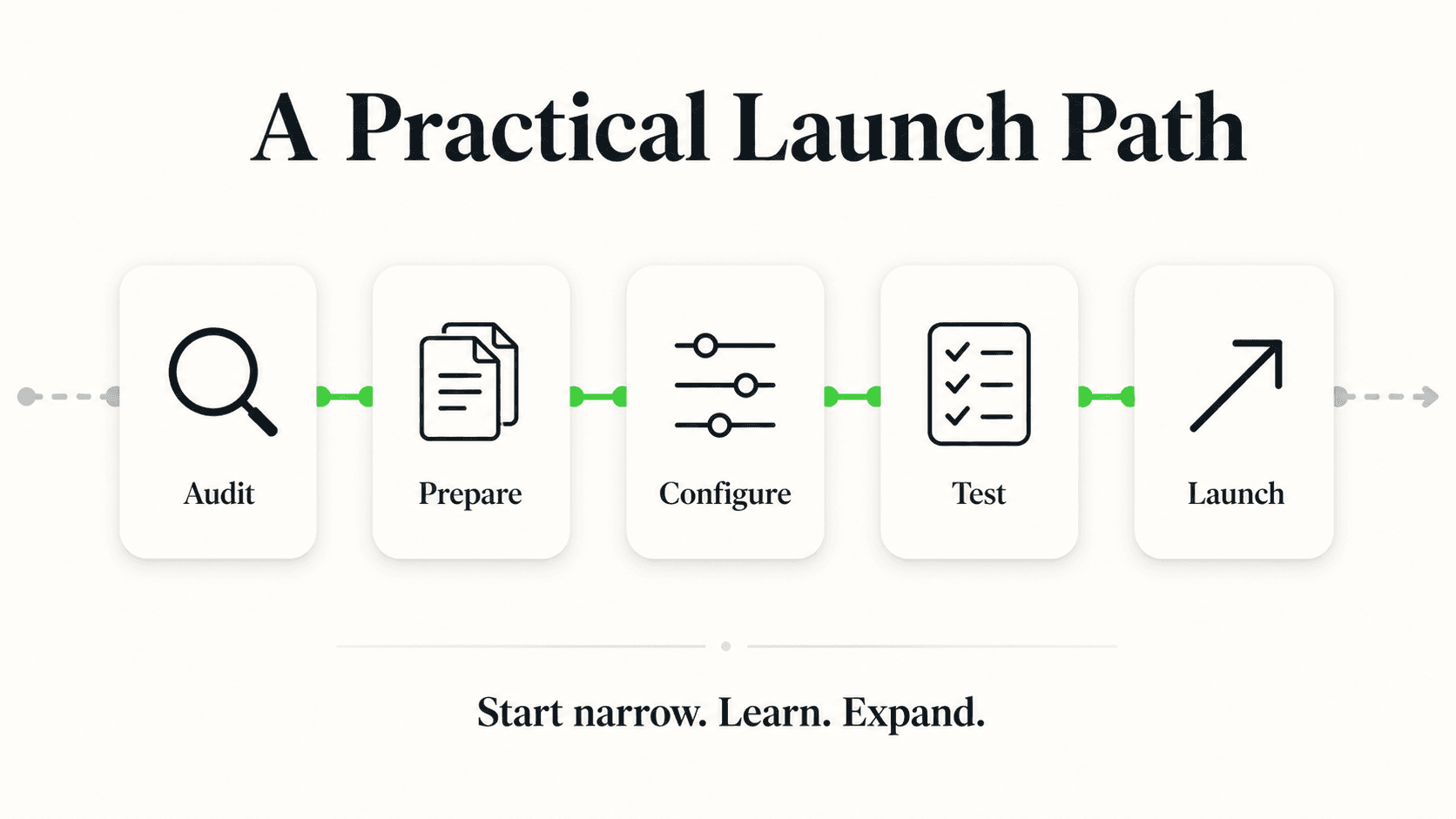
Not incrementally — the underlying architecture is different. A rule-based system is built around a decision tree of pre-written branches, while conversational AI is built around a language model that generates responses dynamically. Businesses moving from one to the other are typically switching platforms rather than upgrading a feature, since the two rely on fundamentally different mechanisms for producing a response.
Does conversational AI ever give wrong answers?
Yes, it can, particularly if it isn't grounded in a business's actual documents. A well-built conversational AI system uses retrieval-augmented generation to base its answers on uploaded FAQs, policies, and pricing information, which is designed to minimize incorrect or invented answers — but no AI system should be described as guaranteed error-free. Ask any vendor specifically how their system is grounded before assuming accuracy.
Is conversational AI more expensive than a chatbot?
Not necessarily. Many conversational AI platforms for small businesses are priced comparably to legacy chatbot builders — Hyperleap AI, for example, starts at $40/month. The cost difference to weigh isn't the subscription price alone; it's the ongoing labor cost of manually building and maintaining decision-tree branches for a rule-based bot versus uploading documents to a system that generalizes from them.
Which channels does conversational AI typically support for small businesses?
It varies by vendor. Hyperleap AI supports website chat widget, WhatsApp Business API, Instagram DM, and Facebook Messenger with consistent behavior across all four. Voice and SMS are common requests but remain roadmap items for most platforms in this category as of 2026 — confirm current channel support directly with any vendor rather than assuming based on marketing copy.
Does conversational AI replace human customer service reps?
No — the practical model is AI handling volume and routine questions while humans handle complex, high-stakes, or relationship-driven conversations. Conversational AI resolves the repetitive share of inbound messages and hands off anything it can't confidently answer, with a lead capture form collecting contact details so a team member has the context needed to follow up. See will AI replace customer service for a deeper look at where the human-plus-AI line typically falls.
How do I know if my business needs conversational AI instead of a simple chatbot?
Look at your actual inbound messages for a week. If most questions fit a small number of fixed patterns (order status, cancel a booking), a scripted bot may be sufficient. If questions are varied, phrased differently each time, arrive across multiple channels or languages, or come in heavily after business hours, conversational AI will resolve a meaningfully larger share of that volume without a person typing every response.
Want the deeper technical breakdown of how conversational AI works — NLU, LLMs, and RAG explained step by step? Read What Is Conversational AI? For the AI-agent-specific version of this comparison, see AI Agents vs Chatbots: What's Actually Different in 2026, or the quick-reference AI Agent vs Chatbot explainer page.
Related Articles

Conversational AI for Small Business: A Starter Guide
A practical guide to conversational AI for small business: what to build first, a 5-step setup week, real costs, and the 3 use cases that pay for it first.

12 Conversational AI Examples From Real Businesses
12 real conversational AI examples organized by job-to-be-done — after-hours capture, FAQ deflection, booking, and more — with sourced outcomes.
What Is Conversational AI? A Plain-English Guide
Conversational AI explained in plain English: how NLU, LLMs, and RAG work, how it differs from chatbots, and where businesses use it today.

AI Customer Service Best Practices for 2026
12 AI customer service best practices covering disclosure, escalation design, knowledge base upkeep, weekly KPI review, and PII handling for SMB teams.