Will AI Replace Customer Service? The Honest Answer
Will AI replace customer service? Not wholesale — but it's changing the job fundamentally. Here's what AI handles well, what still needs humans, and how to build a hybrid model.

TL;DR: AI will not replace customer service. It will replace the parts of customer service that should have been automated years ago — repetitive FAQs, routing, status checks, lead qualification — and hand the rest to humans who are now free to do higher-value work. The future is a hybrid model: AI handles volume, humans handle complexity and emotion. The businesses that get this right will serve customers better and build stronger teams. The ones that use AI as a cost-cutting blunt instrument will hurt both.
The question "will AI replace customer service?" is asked by three very different people right now. The business owner trying to manage support costs. The customer service rep worried about their job. And the analyst looking for the next disruption story.
All three deserve a straight answer, not hype from either side.
I've spent time thinking about this from first principles — not as an AI vendor with an agenda, but as someone who spent years building systems at Microsoft that had to serve hundreds of millions of users, and who now works every day with small and mid-sized businesses deploying conversational AI for the first time. What I've observed doesn't fit the apocalyptic narrative or the dismissive counter-narrative. The truth is more nuanced and, I think, more interesting.
AI is not coming for customer service jobs. It is coming for the parts of those jobs that nobody wanted to do in the first place.
What AI Does Exceptionally Well in Customer Service
Let's start with where AI genuinely excels, because the case for AI in customer service is real — just not for the reasons vendors often claim.
High-volume, predictable questions. Every business has a set of questions it answers hundreds of times a week. "What are your hours?" "How do I return this?" "Where is my order?" "Do you accept insurance?" "What's included in the Pro plan?" These questions are not complex. They don't require empathy or judgment. They require accurate, fast, consistent answers — and AI does this without fatigue, without inconsistency, and at any hour of the day or night.
When a business documents its knowledge well and connects it to a conversational AI agent, those repetitive questions become solved. The customer gets an answer in seconds. The human team member who would have answered that question now has that time back.
24/7 availability without staffing overhead. Human customer service teams work in shifts. That means your coverage has gaps — gaps that land on nights, weekends, public holidays, and peak seasons when you haven't over-hired. AI doesn't have shifts. A question asked at 2am on a Sunday gets the same response as one asked at 2pm on a Tuesday. For service businesses, this alone is a meaningful improvement in the customer experience.
Instant lead qualification before a human gets involved. Conversational AI for customer service has introduced a capability that didn't exist at scale for SMBs five years ago: the ability to qualify an inbound lead before any human time is spent. A well-designed AI agent can collect contact details via a form, understand the visitor's situation, ask clarifying questions, and route the conversation to the right team member with context already assembled. The human who picks it up knows who they're talking to and what they need. This isn't replacing the salesperson — it's making the salesperson dramatically more effective.
Consistent brand voice across every channel. Human agents vary. Their mood varies. Their product knowledge varies. How they phrase things varies. A document-grounded AI agent operating within a defined knowledge base delivers consistent, accurate information every time — on your website chat, WhatsApp, Instagram DM, and Facebook Messenger simultaneously. That consistency matters for brand trust, and it's genuinely hard to achieve at scale with human-only teams.
Handling volume spikes without breaking. Businesses have seasons, launches, incidents, and viral moments that create sudden spikes in inbound contact. Human teams struggle to scale for these — you can't hire and train staff in a week. AI handles spikes without degrading. The same capacity that handles 10 conversations also handles 1,000.
The most compelling business case for AI in customer service isn't cost reduction — it's coverage. Answering customers at 2am, qualifying leads before a human touches them, and responding in 100+ languages without a dedicated multilingual team. These are capabilities most SMBs simply didn't have before.
What Still Needs a Human Touch
Here is where I see a lot of AI vendors oversell their product — and where I want to be direct.
Complex, multi-step problem resolution. When a customer has an issue that involves multiple systems, exceptions to policy, account history that requires interpretation, or a situation that's genuinely ambiguous, AI without human judgment will either give a wrong answer or give a generic non-answer. Neither is acceptable. Document-grounded AI is designed to only answer from what it knows — which means it knows its limits and should escalate, not fabricate.
Emotionally charged situations. A customer who just had a terrible experience, lost money, received damaged goods, or is dealing with a time-sensitive emergency doesn't need a bot. They need to feel heard by a person. The research on this is consistent: customers with high-emotion problems who reach an AI agent before a human often feel worse, not better. AI can acknowledge distress, but it cannot absorb it the way a skilled human agent can. Human handoff is not a failure state — it is a design feature.
Negotiations, exceptions, and judgment calls. Issuing a refund outside policy for a loyal customer. Offering a free month to prevent a churn. Bending the rules for an edge case where bending the rules is actually the right call. These require judgment about what's right for the business and the customer in this specific context. AI should not make these calls autonomously. Humans should.
Relationship management with high-value accounts. If you have enterprise clients, key accounts, or VIP customers who expect personalized attention, a chatbot is not the interface for managing those relationships. AI can support the human who manages those relationships — surfacing information, prepping context, handling admin — but the relationship itself belongs to a person.
Regulatory and sensitive domains. Medical, legal, financial, and other regulated industries have interaction types that require licensed professionals. AI should handle intake, routing, and information — not advice. A healthcare chatbot that answers "What are your clinic's hours?" is appropriate. One that interprets symptoms or recommends treatment is not. The routing language is correct; the clinical language is not.
The honest summary: AI is excellent at breadth — handling many questions at scale — and humans are excellent at depth — handling complex situations with care. The right design gives each what it's meant to do.
The Hybrid Model: How Smart Teams Are Structuring This
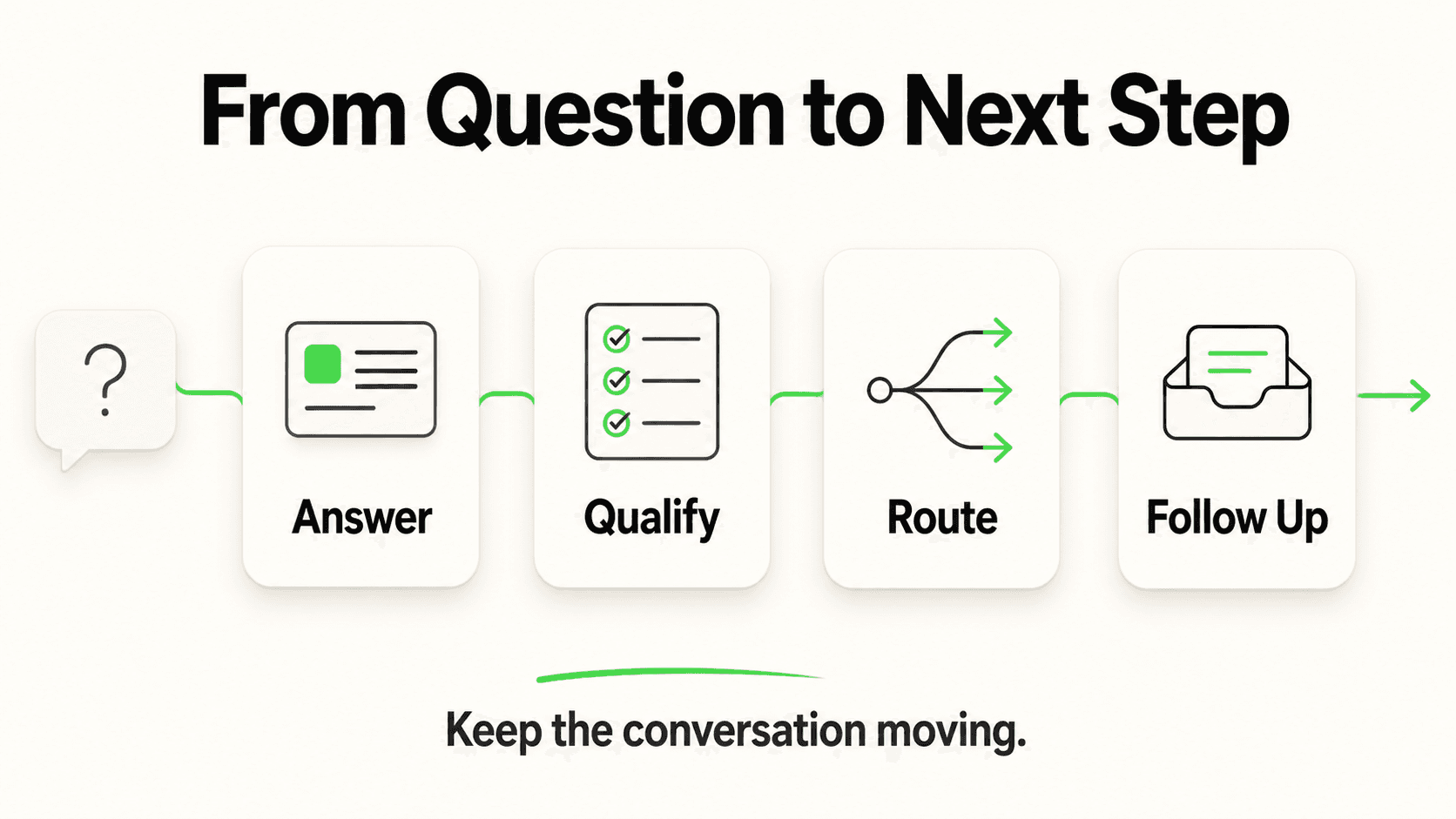
The false choice in this debate is "AI or humans." The real answer is "AI and humans, with clear handoffs."
Here's what the hybrid model actually looks like in practice:
First contact goes to AI. An inbound message on any channel — website chat, WhatsApp, Instagram DM, Facebook Messenger — is handled by the AI agent first. The agent collects the visitor's details via a lead form, understands the nature of their question, and either resolves it immediately or begins the qualification process.
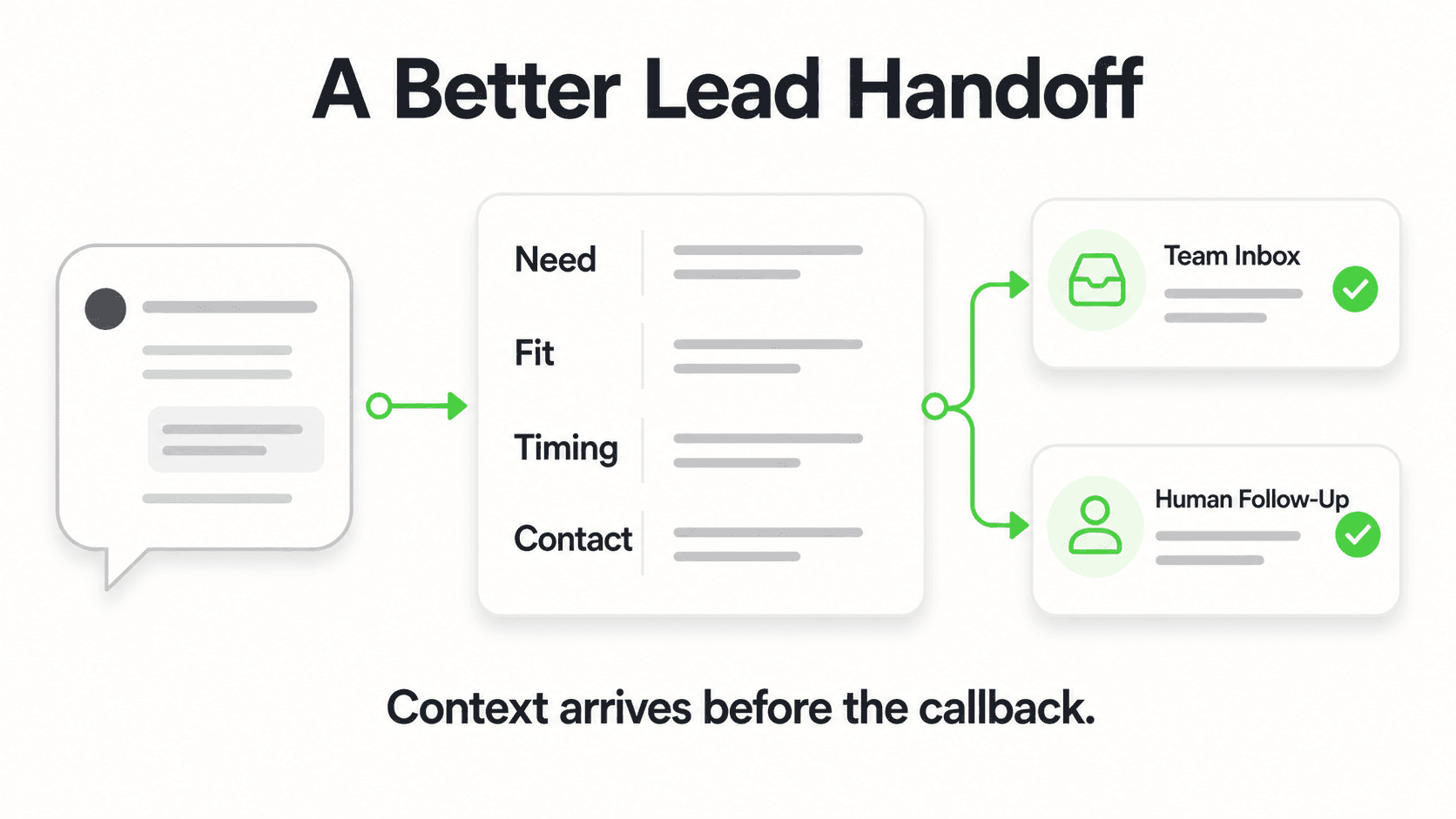
Resolution or escalation in real time. If the question falls within the AI's knowledge — hours, pricing, basic product questions, FAQs, appointment availability — it answers. If it detects something complex, emotionally charged, or outside its knowledge scope, it escalates to a human with full context: who the customer is, what they asked, what the AI responded, and why it's passing the conversation forward.
Humans receive context, not cold inquiries. The human agent who picks up an escalated conversation isn't starting blind. They know the customer's name, their contact details, the nature of their issue, and the conversation history. This dramatically reduces the time to resolution and removes the frustrating "can you repeat that for the third time?" experience that customers hate.
Routing by complexity and sentiment. More sophisticated deployments route by query type — routine to AI, high-value or high-complexity to senior human agents — and by detected sentiment. An angry or distressed customer gets a human faster.
This architecture is not a compromise. It's actually better than either pure human or pure AI. The AI handles what it handles well. The human handles what requires human judgment. And the customer gets faster, more consistent service for routine needs and more attentive, context-rich service when things get complicated.
If you're comparing AI options for your team, it's worth reading our breakdown of the AI chatbot vs hiring a receptionist cost picture — the math often surprises business owners.
What This Means for Customer Service Teams and Jobs
Let me address the job question directly, because it's the one that matters most to the people who actually do this work.
The jobs that are at risk are the ones built entirely around repetitive script-following. If a person's job is to answer the same 20 questions, all day, every day, from a script, without any judgment, decision-making, or relationship-building — that job was already fragile. Not because of AI, but because it was never a sustainable use of a person's cognitive capacity. The question was always when, not if, it would be automated.
The jobs that will grow are the ones that require judgment and care. When AI absorbs routine volume, human agents can do more of what they're actually good at. Complex problem resolution. Retention conversations. Escalation management. Account relationship work. Training and quality review of AI responses. These are higher-value activities, and they tend to be more satisfying to do.
Teams that deploy AI thoughtfully tend to redeploy, not reduce. The businesses I've seen use this well don't fire their customer service staff and replace them with a chatbot. They let their staff focus on higher-leverage work while AI handles the volume that was burning those same staff members out. The net effect is often a better team doing more meaningful work.
The risk is in the businesses that use AI as an excuse to underinvest in support. If you replace your customer service team with a chatbot and refuse to escalate to humans because you've "automated support," you will lose customers. AI as a cost-cutting mechanism with no human backstop is not a customer service strategy — it's a cost reduction program that eventually shows up in churn.
The businesses that win will use AI to raise their service ceiling, not lower their staffing floor.
How to Adopt AI in Customer Service Responsibly
If you're a business owner or leader thinking about deploying AI in customer service, here's how to do it without making the mistakes I've seen trip people up.
Start with your knowledge base, not your automation ambitions. The quality of an AI agent's responses is bounded by the quality of the knowledge it's given. Before you think about channels or workflows, document your business — your services, your pricing, your policies, your frequently asked questions, your escalation criteria. An AI agent fed poor or incomplete knowledge gives poor or incomplete answers. This is a documentation project before it's a technology project.
Design the human handoff before you deploy. Know exactly which question types, sentiment signals, or escalation triggers will route a conversation to a human. Know which human. Know what they'll see when they receive it. The handoff experience determines whether AI-assisted support feels seamless or frustrating.
Be transparent with your customers. Customers don't necessarily expect a human for every interaction — but they do expect honesty. Clearly presenting your AI agent as an AI, and making it easy to reach a human, builds trust rather than eroding it. Customers who feel deceived by a bot pretending to be a person become vocal detractors.
Measure the right things. Don't only measure containment rate — the percentage of conversations the AI handles without escalation. Also measure resolution quality, customer satisfaction scores for AI-handled conversations versus human-handled ones, and escalation response times. This full set of chatbot KPIs gives you a complete picture of whether your hybrid model is actually serving customers well.
Iterate on the knowledge base continuously. Every unanswered question or escalation your AI creates is a signal. Review those signals regularly and use them to improve your knowledge documentation. The AI gets better as your documentation gets better — and there's no ceiling on that improvement.
Don't automate apologies. If a customer has had a genuinely bad experience with your business, the AI should route them to a human. An automated apology for a serious failure is worse than no response — it signals that you don't actually care enough to have a person engage.
How Hyperleap AI Fits Into This Picture
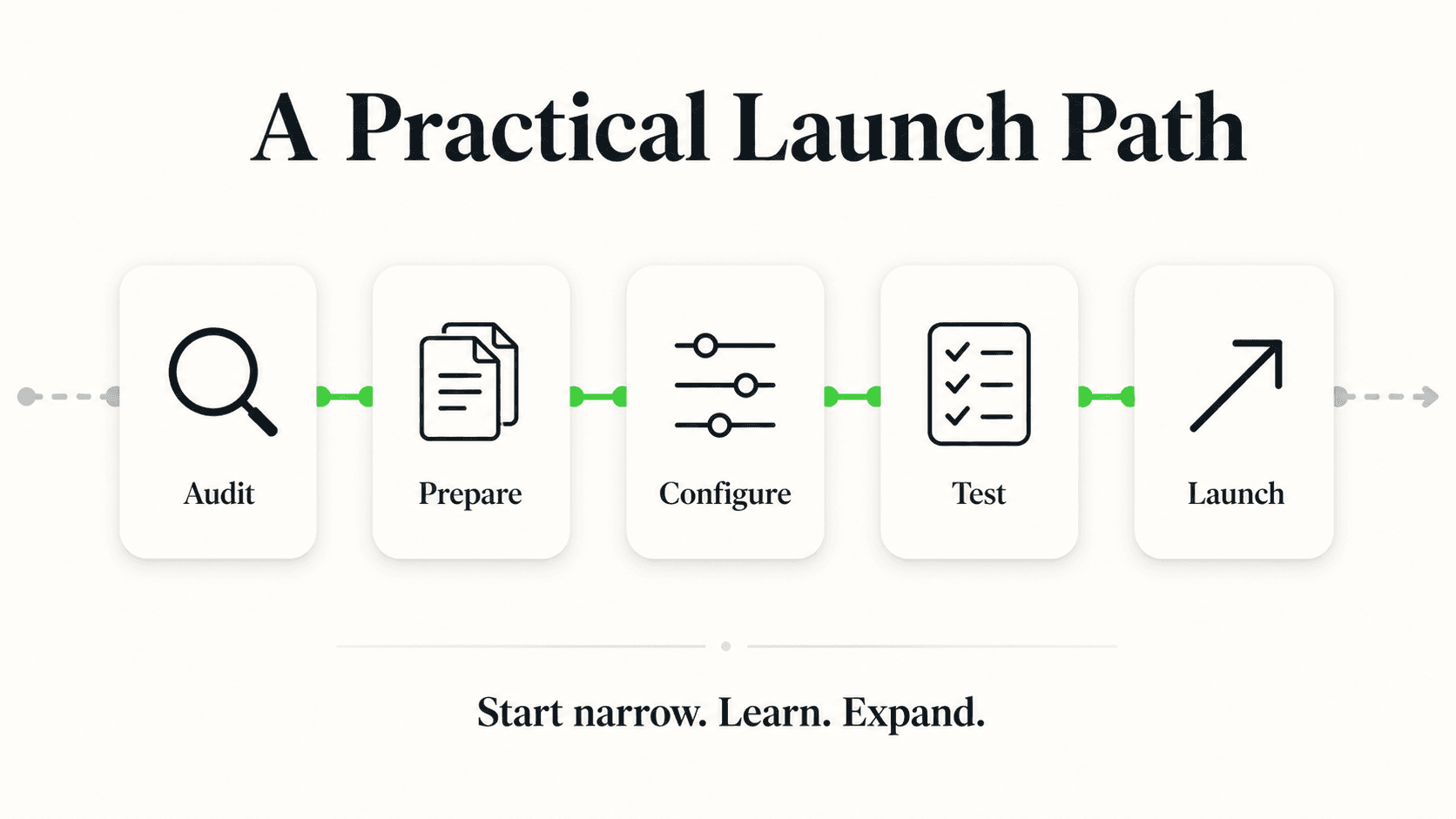
I built Hyperleap AI with this hybrid philosophy at the core. Not AI as a replacement, but AI as the first line that makes the human line better.
Here's what that looks like in practice for businesses that deploy us:
The AI agent handles the volume. Across your website chat widget, WhatsApp, Instagram DM, and Facebook Messenger, the agent answers questions grounded in your business's own documentation. It doesn't make things up — it only answers from what you've told it. That document-grounded approach keeps responses accurate and keeps AI in its lane.
Every chat starts with a lead form. Before a conversation begins, contact details are collected. That means every person the AI talks to is also a lead with a name, an email, and whatever other fields matter to your business. The AI qualifies, the human inherits a clean record — not a cold inquiry.
Handoffs deliver context, not confusion. On Pro and Max, when the AI escalates to your team, the conversation history and collected details go with it. Your team member knows exactly what happened before they say hello. That's the handoff experience customers don't notice — because it's seamless.
You can see every conversation. The team inbox gives you visibility into what the AI is handling, what it's escalating, and how customers are responding. That's how you iterate, improve, and catch the edge cases before they become problems.
Hyperleap AI is available on plans starting at $40/month (Plus), $100/month (Pro), and $200/month (Max), with a 7-day free trial on all plans. There is no free plan — a credit card is required to start. If you want us to build your chatbot for you, our Managed Setup service is $299 Free.
For a broader look at how businesses are putting this into practice, read our AI receptionist overview and our guide on companies using AI for customer service.
Frequently Asked Questions
Will AI completely replace human customer service agents?
No. AI will automate the high-volume, repetitive, and predictable parts of customer service — frequently asked questions, routing, status updates, lead qualification. The complex, emotionally charged, and judgment-intensive interactions will continue to require human agents for the foreseeable future. The most effective service operations use a hybrid model: AI handles volume, humans handle depth. This allows human agents to focus on higher-value work rather than being displaced entirely.
What types of customer service tasks can AI handle right now?
AI handles FAQ responses, operating hours and location questions, pricing inquiries, appointment availability, initial lead qualification, basic troubleshooting using documented procedures, and routing conversations to the right human with full context. These cover a significant share of inbound volume for most businesses. Document-grounded AI agents — those trained on your specific business knowledge — can also answer product-specific and policy-specific questions accurately without hallucinating.
What should AI never be allowed to handle in customer service?
AI should not autonomously handle complaints that require a formal resolution (refunds above a threshold, escalated disputes), situations where a customer is clearly distressed or angry, interactions in regulated domains that require licensed professional judgment (medical triage, legal advice, financial recommendations), and relationship management with high-value or enterprise accounts. These situations require human empathy, judgment, and accountability.
Will customer service jobs disappear because of AI?
Some roles built entirely around script-based repetitive response will contract. But the broader category of customer service work — which involves complex problem resolution, relationship management, quality oversight of AI systems, and handling exceptions — is not going away. Many businesses that deploy AI in customer service report that their human staff spend less time on low-value tasks and more time on the work that actually requires them. The workforce shift is real, but the direction is toward higher-value roles, not elimination.
How do customers feel about AI in customer service?
Customer sentiment is nuanced and context-dependent. For routine, fast inquiries — checking hours, getting pricing, tracking an order — customers increasingly prefer fast AI responses over waiting for a human. For complex problems, billing disputes, or emotionally charged situations, most customers still strongly prefer a human. The key design principle is matching the interaction type to the right channel: AI for speed and breadth, humans for depth and care. Transparency about what's AI and what's human also matters significantly — customers accept AI assistance, but dislike feeling deceived.
Related Articles

Companies Using AI for Customer Service: Industry Patterns
How companies using AI for customer service are transforming healthcare, hospitality, real estate, and more — with the specific jobs AI handles across each sector.
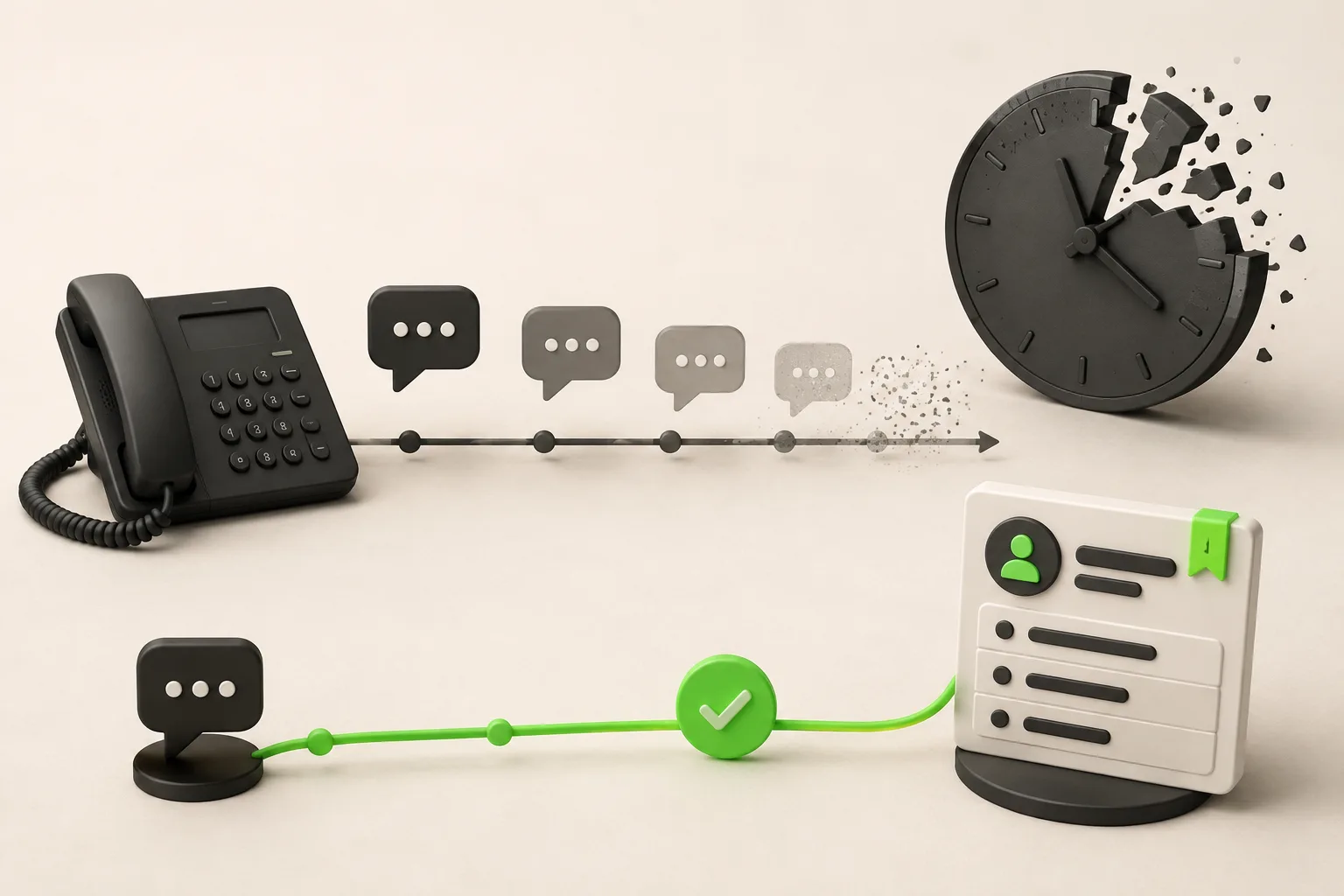
What Missed Calls Really Cost Your Small Business
A worked example of what missed calls cost small businesses in lost jobs, plus where inquiries actually arrive now and what to do about it.

AI Customer Service Best Practices for 2026
12 AI customer service best practices covering disclosure, escalation design, knowledge base upkeep, weekly KPI review, and PII handling for SMB teams.

AI Receptionist Cost in 2026: What You Actually Pay
AI receptionist cost ranges from $20/month for automated voice AI to $300+/month for live-agent phone answering. Full breakdown by category.