Companies Using AI for Customer Service: Industry Patterns
How companies using AI for customer service are transforming healthcare, hospitality, real estate, and more — with the specific jobs AI handles across each sector.

TL;DR: Businesses across healthcare, home services, hospitality, e-commerce, real estate, and professional services are all deploying AI for customer service — not as a pilot, but as operational infrastructure. The pattern repeats across every sector: AI handles the predictable, high-volume top layer of customer inquiries around the clock, qualifies leads before they hit a human calendar, and hands off cleanly when the situation requires judgment. The examples in this post are illustrative industry composites, not specific named case studies. Use them as a lens for your own business.
Imagine a receptionist who shows up at 2am, never gets impatient, knows your entire policy library by heart, speaks whatever language the customer writes in, and emails you a clean summary of every conversation before they leave. That's the functional reality of AI customer service for businesses in 2026.
What changed isn't just the technology — it's what that technology is grounded in. Earlier chatbots generated answers from thin air and frustrated customers with rigid menus and wrong answers. Modern AI agents are different in a fundamental way: they answer from documents you provide. Your FAQ, your service descriptions, your pricing sheet, your policies. The agent draws on your actual knowledge base — which is the only thing your customers ever wanted to hear from anyway.
The result is a deployable, grounded AI layer that businesses of almost every size and type can actually use. What's interesting to watch now isn't whether companies are adopting AI for customer service — they are — but how each industry uses it. The jobs AI handles, the boundaries that stay human, and the workflows that changed most.
This post maps those patterns by sector. The examples are illustrative composites drawn from common business workflows. They're not case studies of specific named companies.
Why the Adoption Curve Steepened
Three things converged to make practical AI customer service accessible outside the Fortune 500:
Grounded responses changed the accuracy picture. When an AI agent is restricted to answering from your uploaded documents — rather than generating from general knowledge — the hallucination risk drops significantly. You know what the agent knows: exactly what you told it. This shifts the accuracy question from "can we trust the AI?" to "is our knowledge base up to date?" — a problem every business already owns.
Deployment got fast. Configuring an AI agent no longer requires a six-figure systems integration project. A business can upload FAQs, connect four channels (Website, WhatsApp, Instagram DM, Facebook Messenger), set up a lead form, and go live in days. The barrier is low enough that the value case doesn't need to be enormous to justify moving.
Customer expectations moved past business hours. A customer who can't get a basic question answered until Monday morning is now measurably more likely to go elsewhere. That's not conjecture — it's a dynamic every business in a competitive market feels. AI doesn't take weekends. For the business that previously couldn't respond to a 10pm inquiry until the next day, this changes the competitive equation.
For a fuller picture of where SMB adoption stands right now — who's deploying, what's working, and what's still hard — see our state of AI customer service for small businesses report.
Industry Snapshot: What AI Handles by Sector
Note: The patterns below are illustrative composites representing common business workflows — not verified data from specific named companies.
| Industry | Common AI-Handled Jobs |
|---|---|
| Healthcare & Clinics | Hours and location, insurance FAQs, appointment process, routing urgent matters to staff |
| Home Services | Service area qualification, quote inquiry capture, scheduling via booking link, job status FAQ |
| Hospitality & Restaurants | Menu and dietary questions, hours, reservation process, event and private dining inquiries |
| E-commerce & Retail | Return policy, order timeline FAQ, product specs, size guides, shipping destinations |
| Real Estate | Listing FAQs, buyer qualification, viewing scheduling, neighborhood questions |
| Professional Services | Scope and service match, fee structure FAQ, intake routing, appointment booking |
The depth varies. Some businesses use AI purely for FAQ deflection — keeping the routine questions off the phone. Others build full lead qualification pipelines. But the entry point is almost always the same: answer the ten questions your team answers forty times a week.
Healthcare and Medical Clinics
Healthcare is where the 24/7 availability advantage matters most acutely. Patients don't restrict their health concerns to business hours, and the questions they ask first aren't clinical — they're logistical.
A typical dental practice fields a predictable set of inbound inquiries: Are you accepting new patients? Do you take my insurance? What does a cleaning cost if I don't have coverage? How long does an implant procedure take? Can I get an appointment this week? None of these require clinical judgment. They require accurate, consistent answers from someone who has actually read the practice's policies and fee schedule.
An AI agent trained on the practice's own documents handles all of them. It answers insurance questions from the practice's accepted-insurance list. It explains the appointment process. It captures the patient's contact details — name, email, phone — through a structured lead form at the start of the conversation, so the practice always has a follow-up record even if the patient drops off mid-chat. For anything requiring clinical input, it routes to a staff member.
For specialist practices, the volume math is compelling. A single-location practice might field the same thirty questions every week, across website chat, WhatsApp, and Instagram DM. Handling those consistently, at any hour, without taking a staff member off a patient — that's the operational win.
What AI does not do in healthcare: It never diagnoses, never performs clinical triage, never gives medical advice. The AI answers FAQs, routes inquiries to the right person, and schedules. Clinical work stays with the clinician. Any AI implementation that blurs this line creates liability and should be rejected.
For more on how this looks in practice: healthcare AI agent
Home Services: Contractors, HVAC, Cleaners, and More
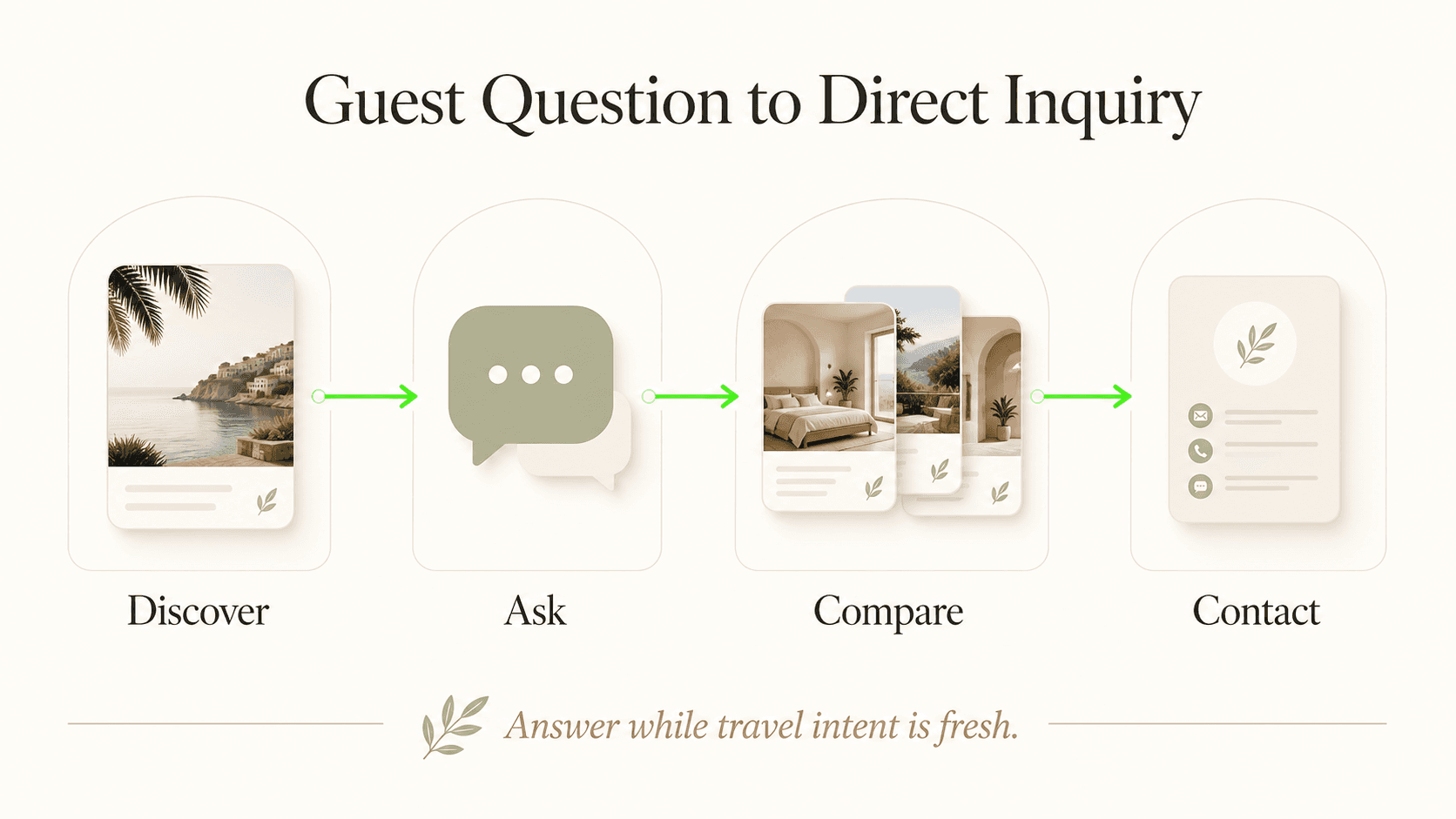
Home services businesses — plumbers, electricians, HVAC technicians, landscapers, house cleaners — face a structural customer service problem: the technician is on a job and can't answer the phone, but the lead is calling right now. By the time someone calls back, the customer has already booked with the first company that responded.
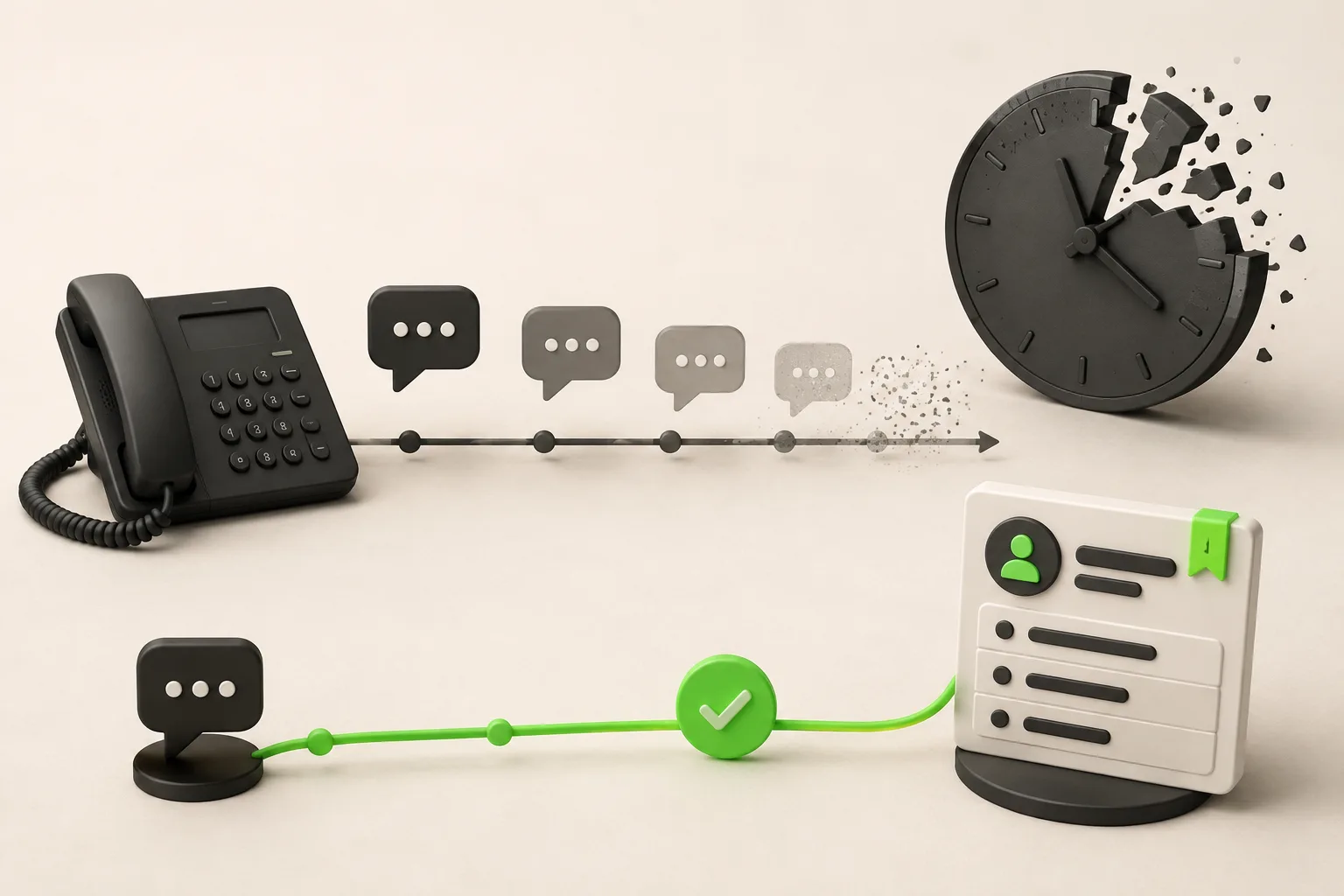
A typical home services company loses a meaningful share of its inbound leads this way. Not because the work isn't good, but because the response window closed before anyone picked up.
An AI agent changes this dynamic without requiring anyone to sit by a phone. It engages the moment someone messages through the website or WhatsApp. It asks the qualifying questions — what service, what part of town, what's the situation — collects the customer's contact information via a structured lead form before the conversation proceeds, and routes a complete summary to the team for follow-up. If the company schedules through Calendly or Cal.com, the agent offers real open times and books the job in the conversation on Pro and Max, so the customer never waits for a callback to get on the calendar (on Plus, or with other booking tools, it shares the booking link).
This isn't just about speed. It's about consistency. Every lead gets the same professional, complete response — regardless of whether it comes in at 9am or 9pm. The business that answers midnight inquiries at midnight wins those leads.
Common jobs AI handles for home services:
- Service area qualification ("Do you work in the north side of the city?")
- Scope FAQ ("Do you handle emergency HVAC repairs on weekends?")
- Ballpark pricing questions ("What does a standard furnace service run?")
- Lead capture with job details via structured form
- Appointment booking in the chat (Calendly or Cal.com) or booking-link sharing for self-scheduling
Hospitality and Restaurants
Restaurants and hotels deal with high volumes of repetitive, time-sensitive questions that are textbook candidates for AI: What are your hours today? Do you have gluten-free options? How do I book the private room? Is the patio open in winter?
A typical restaurant running an AI agent on its website and Instagram DM handles the entire pre-visit inquiry flow without staff involvement. The agent knows the current menu, hours, dietary accommodations, reservation process, and private dining options. It shares the booking link for table reservations and answers follow-up questions without anyone at the host stand needing to type a reply.
For restaurants that run high-demand weekend brunch service or seasonal menus, AI handles the inbound surge that often overwhelms a front desk: answering the same availability question from forty people simultaneously, with consistent accuracy. The staff who were previously fielding those DMs can now focus on the guests who are already in the room.
Hotels benefit on a different axis: time zones. A mid-size hotel with guests and prospects across international markets receives inquiries at all hours. Check-in and check-out times, pet policies, parking options, room type comparisons, early check-in availability — all of these are answerable from the hotel's own documentation. The AI handles them at 3am from a traveler in a different time zone without the front desk losing a minute of sleep.
Customers don't care that it's 11pm. They care that they got an answer. AI customer service doesn't level the playing field between large and small businesses — it tilts it toward whoever was faster to deploy it.
For restaurants specifically: restaurant AI agent
E-commerce and Retail
E-commerce has the volume problem in its sharpest form. A store doing real sales volume fields hundreds of support inquiries a week, and most of them cluster around the same handful of questions: Where's my order? How do I return something? Do you ship to my country? Does this come in a different color? What's the return window for gifts?
These questions have known, deterministic answers. They don't require empathy or judgment. They require speed and accuracy. An AI agent trained on the store's return policy, shipping guidelines, and product documentation handles them without routing to a human — which means the support team only touches the genuinely complex cases: the damaged shipments, the payment disputes, the unusual situations that actually require a decision.
For e-commerce businesses with a pre-purchase discovery workflow, AI adds another layer of value. A visitor browsing product pages at 8pm has questions that could close the sale — or lose it. An AI agent that can answer sizing questions, explain the material, clarify the warranty, and note the return window keeps the visitor moving toward purchase instead of back to Google.
Common AI jobs in e-commerce:
- Return and refund policy FAQ
- Shipping timelines and international shipping
- Product specification and compatibility questions
- Size guide and fit questions
- Promotional and discount code FAQ
- Pre-purchase product comparison questions
One important scoping note: AI agents answer policy-level questions from documents. For actual order lookup — "where is my specific order right now?" — that requires a REST API integration with your e-commerce platform to pull live order data. This is a more involved implementation, but architecturally possible via the agent's API integration layer.
Real Estate
Real estate is a leads-volume business. Agencies and independent agents generate inquiries from listings, paid ads, and organic search — and the economics of conversion are heavily front-weighted. Leads that don't get contacted within the first hour go cold quickly.
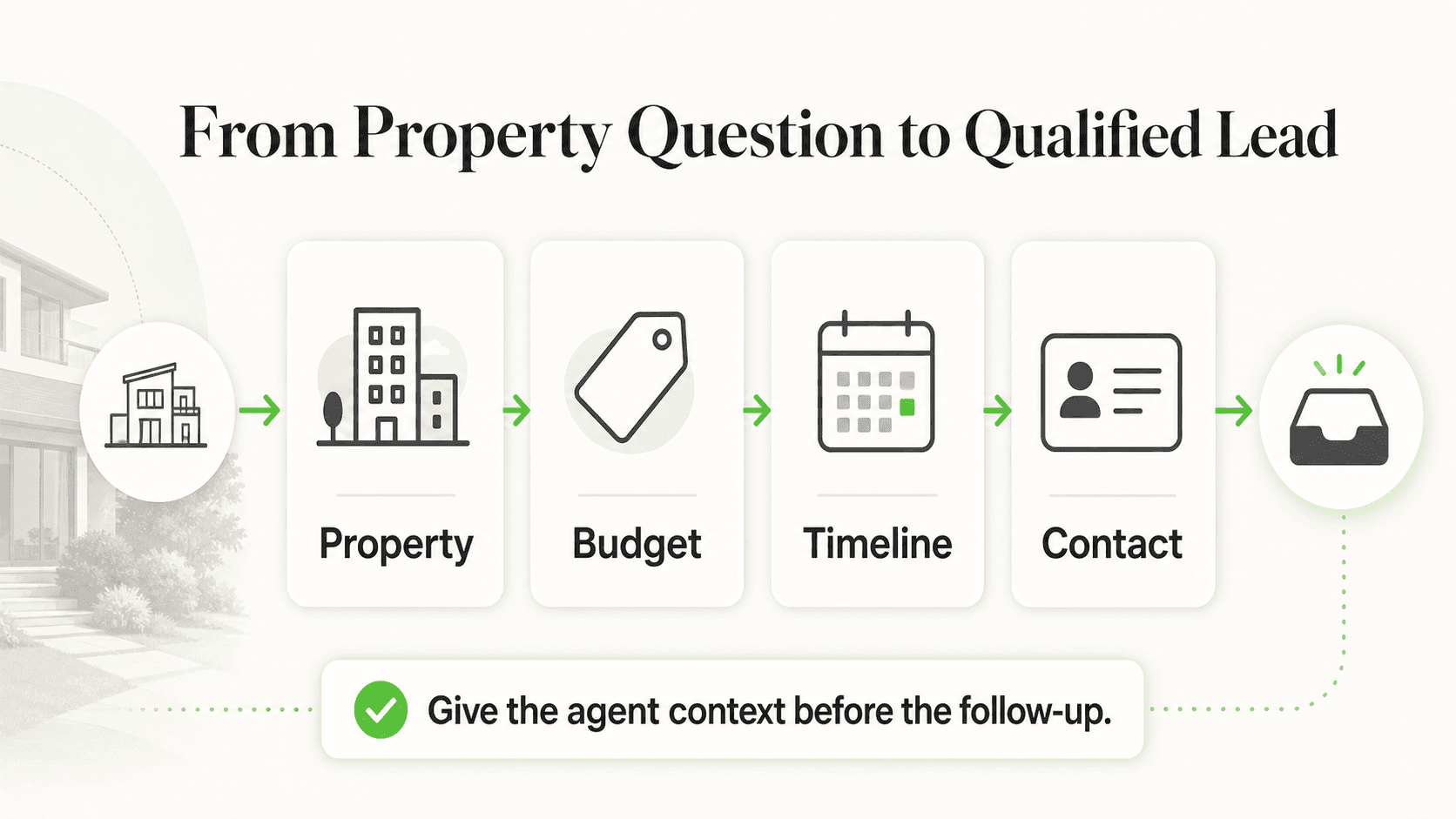
A typical real estate agency deploys an AI agent to handle the first layer of every inbound inquiry. For a listing question, the agent answers property-specific questions from the listing data — square footage, recent updates, HOA structure, school district — collects the prospect's contact details and buying timeline through a structured lead form, and either shares the agent's booking link for a viewing or routes a qualified summary to the agent for follow-up.
For buyers early in their search, the AI handles the ambient questions that don't yet warrant a phone call: neighborhood comparison, commute estimates, general buying process timeline, what a pre-approval involves. It qualifies as it goes — asking about pre-approval status, budget range, timeline — so the agent receiving the lead summary knows exactly who they're calling back.
For seller leads, the pattern is similar: the AI captures the property address, the seller's rough timeline, and their contact information, then routes to an agent for a follow-up CMA call. A well-designed agent makes the seller feel heard immediately — not left on a web form for 48 hours.
Common AI jobs in real estate:
- Listing FAQ and property details
- Buyer qualification (pre-approval status, timeline, budget range)
- Viewing scheduling via booking link
- Neighborhood and area questions
- General buying process FAQ
- Seller inquiry capture and routing to agent
The agent doesn't close deals — the agent does. But it ensures that every lead is captured, qualified, and summarized before the human ever picks up the phone.
Explore this in more detail: real estate AI agent
Professional Services: Legal, Financial, and Insurance
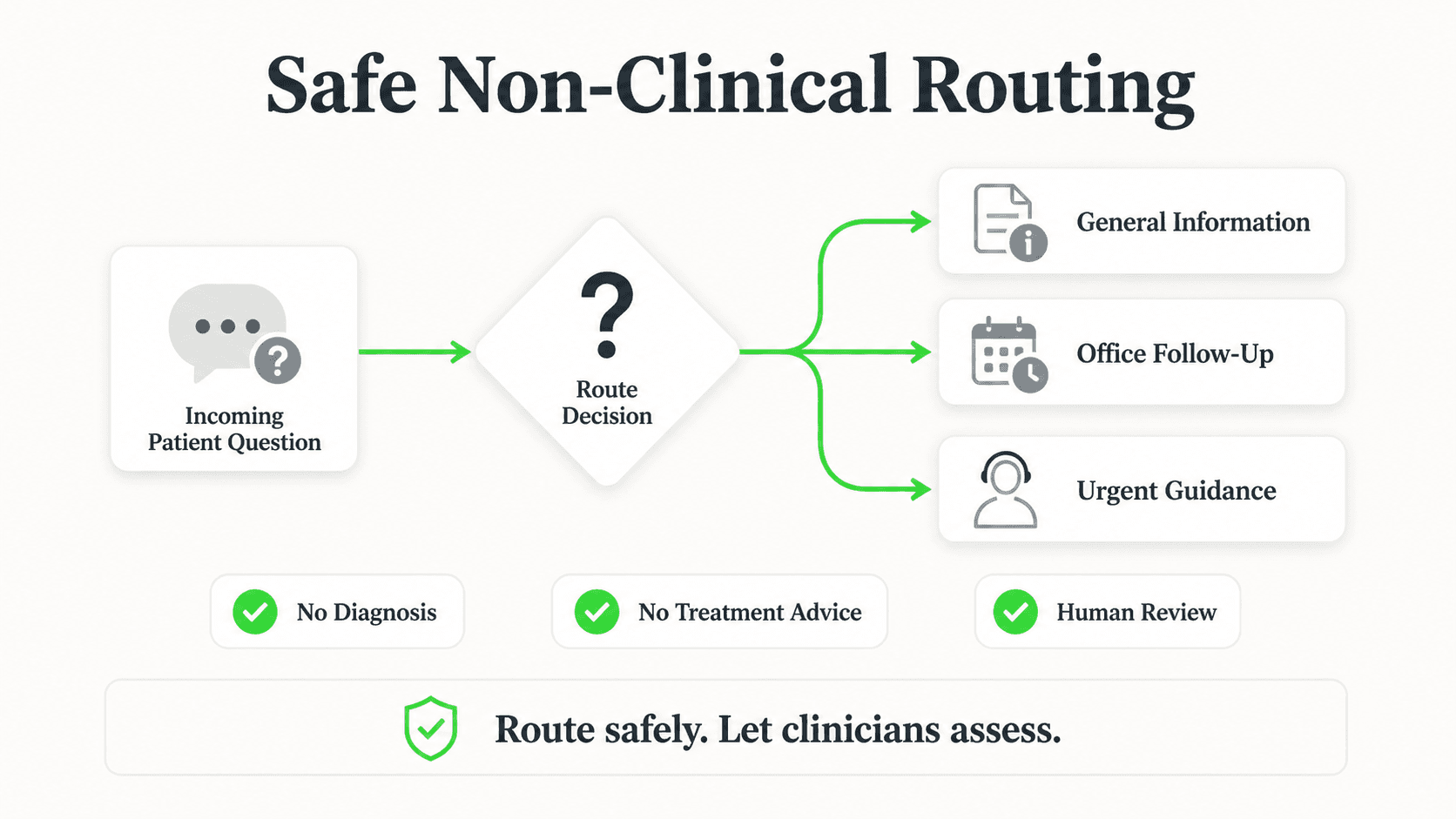
Professional services firms — law firms, financial advisors, insurance brokers, accounting practices — have a specific constraint: the actual service is heavily regulated and cannot be delivered by AI. Legal advice, financial planning, and clinical assessment require licensed professionals. But the pre-engagement questions — the scope and process questions that every prospective client asks before signing an engagement — are not regulated, and they're drowning inboxes.
A law firm's most common inbound questions are scope-and-process: Do you handle employment disputes? What does an initial consultation cost? How long does a case like mine typically take? These aren't legal advice. They're service descriptions. An AI agent trained on the firm's practice areas, fee structures, and process documentation can answer them reliably — and capture the prospect's contact details and situation summary via a lead form so the attorney reviewing the intake already has context.
For financial advisors, the intake workflow is particularly well-suited to AI. Prospects have qualification questions before they'll book a meeting: What types of accounts do you manage? What's your minimum? Do you work with clients in my state? What does the first meeting look like? The AI answers these, qualifies the prospect (investment horizon, account type, goals at a high level), and routes a summary to the advisor with a clean record — rather than a cold email inquiry with no context.
Insurance brokers face similar dynamics: a prospect with a specific need wants to confirm service fit before committing to a conversation. AI handles this first layer cleanly.
What AI handles in professional services:
- Initial scope and service match questions
- Process and timeline FAQ
- Fee structure FAQ at a general level
- Intake form collection and routing
- Appointment booking in the chat (Calendly or Cal.com) or via booking link
- Routing urgent matters or sensitive situations to a human
What stays with humans:
- Legal analysis, financial planning, clinical judgment, tax advice
- Any conversation requiring licensed professional input
- Relationship-intensive conversations where the human is the product
This boundary, configured clearly in the agent's scope, makes AI a powerful intake layer without creating professional liability.
How Hyperleap AI Fits Into This Picture
Hyperleap AI is an AI agent platform built for the pattern that repeats across healthcare, home services, hospitality, e-commerce, real estate, and professional services: AI handles the high-volume, predictable top layer of customer inquiry, while humans handle the exceptions, the relationships, and the judgment calls. It is designed for businesses that need an AI agent grounded in their own documents, deployed across the channels their customers already use.
Here's what makes the implementation practical:
Document-grounded responses. You upload your knowledge base — FAQs, service descriptions, policies, pricing sheets. The agent answers from those documents, not from general internet knowledge. This is the architecture that makes accuracy a solvable problem: your agent can only be as wrong as your source material.
Lead form before the conversation. This is a design choice with real business impact. Capturing contact details at the start of the interaction — name, email, phone, one or two qualifying questions — means every conversation generates a usable lead record, even if the customer leaves before the end. Traditional approaches that ask for contact details at the end of a conversation lose a significant share of inquiries. Hyperleap AI captures them upfront.
Four channels, one knowledge base. Website chat, WhatsApp, Instagram DM, and Facebook Messenger — one agent, consistent responses, without rebuilding your FAQ for each platform. Customers reach you where they already are.
Clean lead summaries by email. When a conversation closes, your team receives a structured email summary: who the customer is, what they asked, what was collected. No digging through chat logs to reconstruct what happened.
100+ languages. Customers write in the language they're most comfortable in. The agent responds in kind.
Pricing:
- Plus: $40/month — 3,000 AI responses, 1 chatbot, 4 channels
- Pro: $100/month — 12,000 AI responses, 2 chatbots, 8 channels, white-label branding
- Max: $200/month — 30,000 AI responses, 5 chatbots, 20 channels
All plans include a 7-day free trial. Credit card required. No free plan.
Explore AI agents by industry or read more about the conversational AI for customer service layer in depth.
Common Patterns That Cut Across Every Industry
After mapping AI customer service deployment across six industries, a handful of principles appear consistently — regardless of sector.
The top ten questions are most of the volume. In most businesses, a small number of inbound questions account for the large majority of customer service volume. If your AI can answer those questions accurately and immediately, you've resolved most of your customer service problem. Everything else — complex situations, complaints, unusual requests — still goes to a human. The AI doesn't have to be comprehensive; it has to be accurate on the things customers actually ask.
Speed of first response is the primary filter. For high-intent inquiries — a listing question, a service quote request, a patient scheduling question — the first business to respond often wins the conversation. An AI agent that engages immediately, captures contact details, and gives a complete initial response doesn't just deflect volume. It changes the conversion dynamic for leads that come in outside business hours.
Lead form first is a structural advantage. This is one of the least intuitive but most important design decisions in an AI customer service deployment. Starting with a structured form — collecting contact details before the conversation proceeds — ensures every interaction produces a usable record. Businesses that collect contact details conversationally, at the end of a chat, consistently lose a portion of those records when the conversation drops. Starting upfront is the pattern that works.
AI is most valuable at the edges of business hours. The inquiries an AI handles at 2pm on a Tuesday matter. But the inquiries it handles at 9pm on a Sunday matter more. Those are the ones that would previously have waited until Monday, sat in an inbox unanswered, and converted to nothing. AI doesn't have a weekend. That's not just a cost savings — it's an operational capability that was structurally unavailable to most businesses before this technology existed.
The handoff is as important as the automation. The best AI implementations are explicit about what the agent handles and what triggers a human. Urgent medical situations, legal matters, escalating complaints, and anything that falls outside the agent's defined scope should route to a person reliably. The handoff signal — "I'm going to connect you with a team member" — needs to feel clean, not like a failure. A well-designed agent improves by having clear edges, not by trying to handle everything.
Integration depth follows proven value. Most businesses start with document-grounded FAQ — the agent answers from uploaded content, no backend integration required. That delivers immediate value: faster response, consistent answers, lead capture. Booking (native in-chat booking with Calendly and Cal.com, link sharing for other tools), CRMs (via REST API and webhooks), and other operational tools typically comes after the base value case is proven. The entry point is low. The depth scales as confidence builds.
For related reading: conversational AI for customer service
Frequently Asked Questions
What kinds of companies are using AI for customer service today?
Businesses of almost every size and sector are deploying AI agents for customer service — this is no longer limited to enterprise budgets or technical teams. Dental clinics answering patient FAQ, HVAC companies capturing overnight lead inquiries, restaurants handling reservation questions on Instagram DM, e-commerce stores deflecting return policy tickets, real estate agencies qualifying buyer leads — these represent the current deployment reality. The common thread is a predictable volume of inbound questions that don't require human judgment to answer correctly.
How is an AI customer service agent different from the chatbots that frustrated customers five years ago?
Earlier chatbots followed rigid decision trees. Ask anything outside the scripted paths and they failed — usually with "I didn't understand that, please try again." Modern AI agents are grounded in your specific documents and understand natural language. They can handle variations in how a question is phrased, draw on the full context of your knowledge base, and give a complete answer rather than redirecting to a dead end. The practical difference is significant: a document-grounded AI agent handles a question like "does your warranty cover accidental damage if I bought it as a gift?" without you having written that exact phrasing into a flow.
Does deploying AI for customer service mean replacing support staff?
The model that generates real business value isn't replacement — it's reallocation. AI handles the high-volume, predictable layer: the FAQ, the policy questions, the qualification workflow, the after-hours inquiries. Support staff handle the complex, judgment-intensive interactions where a human genuinely adds more value: escalations, relationship-sensitive conversations, situations that require discretion. Most businesses find that deploying AI changes the composition of their team's work rather than the size of it — the repetitive ticket volume drops; the interesting, relationship-building work remains.
How does an AI agent maintain accuracy when answering customer questions?
Accuracy is a direct function of the knowledge base. An agent restricted to answering from your uploaded documents — your FAQ, your policy pages, your service descriptions — can only be as wrong as what you've written. The mechanism is fundamentally different from an AI that generates answers from general knowledge, where accuracy depends on what the model was trained on. Maintaining a document-grounded agent means keeping your source material current: updating the pricing sheet when prices change, refreshing the FAQ when products change. That's a problem every business already manages. The AI inherits your accuracy.
What should I look for when evaluating an AI customer service platform?
Five criteria matter most: (1) Does it ground responses in your documents rather than generating from general training data? (2) Does it capture lead contact details at the start of the interaction, not at the end? (3) Does it support the channels your customers actually use — Website, WhatsApp, Instagram DM, Facebook Messenger? (4) Does it route to a human reliably when the situation requires it? (5) Does it operate in 100+ languages without requiring separate configurations? These are the functional requirements that determine whether an AI agent actually performs in a live business environment. Anything that can't answer all five clearly should be pressed harder before signing up.
Related Articles

Will AI Replace Customer Service? The Honest Answer
Will AI replace customer service? Not wholesale — but it's changing the job fundamentally. Here's what AI handles well, what still needs humans, and how to build a hybrid model.
What Missed Calls Really Cost Your Small Business
A worked example of what missed calls cost small businesses in lost jobs, plus where inquiries actually arrive now and what to do about it.

AI Customer Service Best Practices for 2026
12 AI customer service best practices covering disclosure, escalation design, knowledge base upkeep, weekly KPI review, and PII handling for SMB teams.

AI Receptionist Cost in 2026: What You Actually Pay
AI receptionist cost ranges from $20/month for automated voice AI to $300+/month for live-agent phone answering. Full breakdown by category.