What Is Conversational AI? A Plain-English Guide
Conversational AI explained in plain English: how NLU, LLMs, and RAG work, how it differs from chatbots, and where businesses use it today.
TL;DR: Conversational AI is technology that lets computers understand natural human language, hold a back-and-forth exchange, and respond in a way that feels like talking to a person rather than filling out a form. It combines natural language understanding (NLU) to interpret what someone means, a large language model (LLM) to generate a fluent reply, and — in well-built business systems — retrieval-augmented generation (RAG) to ground that reply in a specific company's actual documents instead of general internet knowledge. Every modern AI chatbot is a form of conversational AI, but not every conversational AI is a "chatbot" in the old sense — the term also covers voice assistants and, increasingly, AI agents that complete tasks, not just answer questions.
Who This Guide Is For
This is the plain-English explainer: what conversational AI is, how it actually works under the hood, and where businesses use it. If you have already decided to deploy it in customer service and want the operational playbook — knowledge base design, escalation rules, channel strategy, measurement — read conversational AI for customer service, which picks up where this guide leaves off.
Ask ten people what "conversational AI" means and you will get ten different answers — a customer service chatbot, Siri, a voice assistant in a car, an AI that drafts emails. They are not wrong, exactly. They are each describing one application of a broader category of technology. The confusion is understandable: conversational AI is not a single product. It is a set of techniques — natural language understanding, large language models, and retrieval-augmented generation — applied to the specific problem of letting a machine hold a conversation instead of processing a rigid command.
That distinction matters if you are evaluating this technology for your business. This guide breaks conversational AI down in plain language: what it actually is, how the pieces underneath it work, how it differs from the chatbots and voice assistants you already know, and where businesses are putting it to use in 2026.
What Is Conversational AI?
Conversational AI is a category of technology that enables computers to understand natural human language, maintain context across a multi-turn exchange, and generate responses that resemble natural conversation rather than a scripted menu of options. Unlike traditional rule-based systems that match keywords to pre-written answers, conversational AI interprets meaning — including synonyms, typos, and indirect phrasing — and can hold a coherent thread across several back-and-forth exchanges.
The term describes the underlying capability, not a specific product. It shows up in several forms:
- Text-based chat assistants on websites and messaging apps (the most common business use case)
- Voice assistants like Siri, Alexa, or Google Assistant that convert speech to text, interpret it, and respond
- In-app virtual assistants embedded in software products to guide users or answer questions
- AI agents that go a step further than answering questions — they can look things up, fill out forms, or complete a defined task inside a conversation
What ties these together is the underlying architecture, not the interface. A conversational AI system typically has three jobs to do, in sequence, every time someone sends a message:
- Understand what the person actually means (not just the words they used)
- Retrieve or generate the right information to respond with
- Respond in natural language that keeps the conversation coherent
The next section breaks down how each of those three jobs actually gets done — because "how it works" is where most of the confusion (and most of the marketing hype) lives.
How Conversational AI Works: NLU, LLMs, and RAG Explained
Conversational AI works by combining three distinct technical layers: natural language understanding to interpret intent, a large language model to generate fluent responses, and — for business-grade systems — retrieval-augmented generation to ground those responses in real, current information. None of these three pieces alone produces a usable business assistant; it's the combination that does.
Natural Language Understanding (NLU)
Natural language understanding is the layer that interprets what a person means, not just the literal words they typed. NLU handles the messiness of real human language: typos, slang, regional phrasing, incomplete sentences, and questions that imply something without stating it directly.
For example, "you open Sunday?", "are you open on the weekend", and "hrs for sat/sun" are three very different strings of text asking essentially the same question. Older, rule-based chatbots that matched exact keywords would treat these as three separate (or unrecognized) inputs. NLU recognizes them as the same underlying intent — checking weekend hours — and routes the conversation accordingly.
Two sub-tasks sit inside NLU:
- Intent recognition — classifying what the person is trying to accomplish (get information, book something, complain, ask for a human)
- Entity extraction — pulling out the specific details that matter (a date, a product name, a location, a price range)
Large Language Models (LLMs)
A large language model is the component that generates the actual reply in fluent, natural-sounding language. LLMs are trained on enormous volumes of text to learn the statistical patterns of how language works — grammar, tone, structure, and how ideas typically follow one another — which lets them produce a response that reads as if a person wrote it, rather than a robotic string of pre-written phrases.
This is the technology that made conversational AI dramatically better starting around 2022-2023. Earlier systems (built on rigid decision trees or basic pattern matching) could only respond with text someone had explicitly written in advance. An LLM can construct a new sentence on the fly, adapt its phrasing to the question asked, and maintain a natural tone across a long exchange — which is why modern conversational AI feels categorically different from the "chatbots" of the 2015-2020 era.
The catch: an LLM by itself only knows what was in its training data, which has a cutoff date and includes no information about your specific business. Left on its own, an LLM can produce fluent, confident-sounding answers that are simply wrong — a known limitation generally referred to as hallucination. That is the exact problem the third layer solves.
Retrieval-Augmented Generation (RAG)
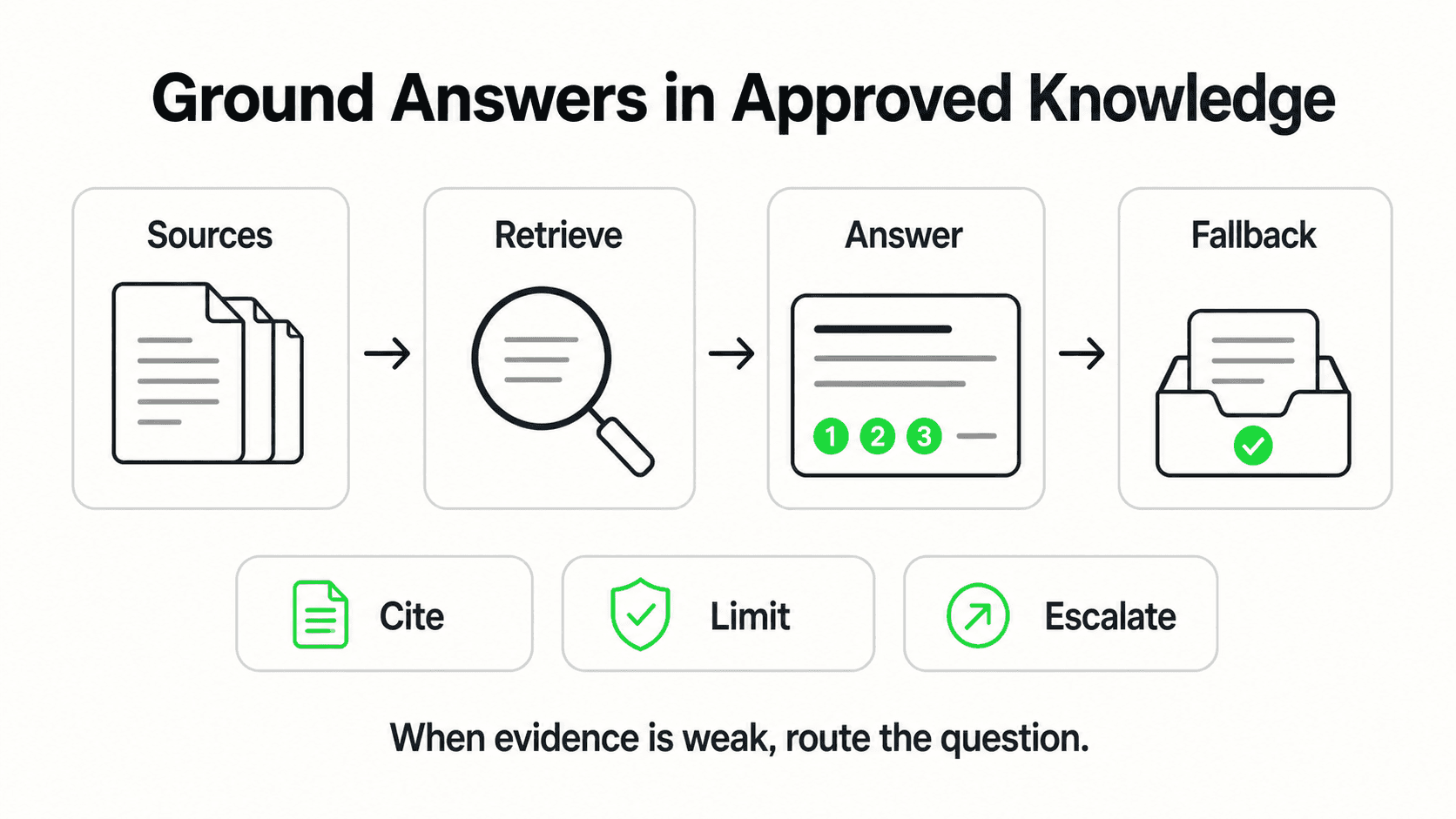
Retrieval-augmented generation is a technique that grounds an LLM's response in a specific, current set of documents — your FAQs, policies, pricing, service descriptions — instead of letting it answer purely from general training data. Before generating a reply, a RAG system searches your actual knowledge base for the passages most relevant to the question, then feeds those passages to the LLM along with instructions to answer using them.
In practice, this is the difference between "the AI vaguely knows about businesses like yours" and "the AI knows your actual hours, your actual prices, and what you changed last week." It's the architecture that makes conversational AI viable for business use rather than a novelty. Document-grounded, RAG-based responses are designed to reduce hallucinated answers — though no system, RAG-based or otherwise, can promise 100% accuracy, which is why any credible deployment still pairs RAG with a clear path to a human for anything the AI isn't confident about. For a deeper technical look at how retrieval grounds answers in your documents, see our guide to RAG chatbots.
The Three-Layer Mental Model
Think of it as: NLU figures out what you're asking, RAG finds the right facts to answer with, and the LLM turns those facts into a natural sentence. A conversational AI system missing any one of these three layers will either misunderstand questions, answer from stale generic knowledge, or sound robotic and rigid.
Conversational AI vs. Chatbots vs. Voice Assistants
Conversational AI is the underlying technology; chatbot and voice assistant are two of the interfaces it powers. All modern text-based business chatbots and voice assistants use conversational AI techniques, but the terms aren't interchangeable, and the distinction affects what you should expect from each.
Chatbot is a broad, interface-level term for any automated system that has a text-based conversation with a user — regardless of how sophisticated the underlying technology is. This is important: not every "chatbot" uses conversational AI. Many older or budget systems are still rule-based, matching keywords to a fixed decision tree with no real language understanding at all. When a chatbot is genuinely built on conversational AI (NLU + LLM + ideally RAG), it can handle open-ended questions, follow context across turns, and hold something resembling a real conversation — which is why the more precise, capability-implying term for this category has become "AI agent." For a full breakdown of what separates a rule-based chatbot from a true AI agent, see our comparison of AI agents vs. chatbots.
Voice assistant is conversational AI delivered through speech instead of text — Siri, Alexa, Google Assistant, and phone-based AI receptionists are all examples. The underlying NLU/LLM/RAG stack is largely the same; a voice assistant adds two extra layers on top: speech-to-text (converting what you say into words the system can process) and text-to-speech (converting the generated reply back into spoken audio). Voice is currently the fastest-growing conversational AI interface for business phone lines — see our guide on AI receptionists for how that specific application works. Voice support is not yet part of Hyperleap AI's shipped capabilities; it is on the roadmap.
The table below summarizes the practical distinctions:
| Rule-based chatbot | AI chatbot (conversational AI) | Voice assistant | |
|---|---|---|---|
| Understands phrasing variations | No — exact keyword match | Yes — via NLU | Yes — via NLU |
| Generates novel responses | No — pre-written only | Yes — via LLM | Yes — via LLM |
| Grounds answers in your documents | Rarely | Yes, if RAG-based | Yes, if RAG-based |
| Interface | Text | Text | Speech |
| Handles multi-turn context | Limited | Yes | Yes |
The practical takeaway: when you're evaluating a "chatbot" for your business, the question that actually matters isn't "is it a chatbot" — it's "is it conversational AI underneath, and is it grounded in my actual business content." Those two things determine whether it will be genuinely useful or just an automated FAQ page with extra steps.
7 Ways Businesses Use Conversational AI
Conversational AI has moved from novelty to standard infrastructure across a range of business functions, with customer-facing communication as the largest and fastest-growing category. Here are the seven applications where businesses are seeing the clearest return.
1. Customer Service and Support
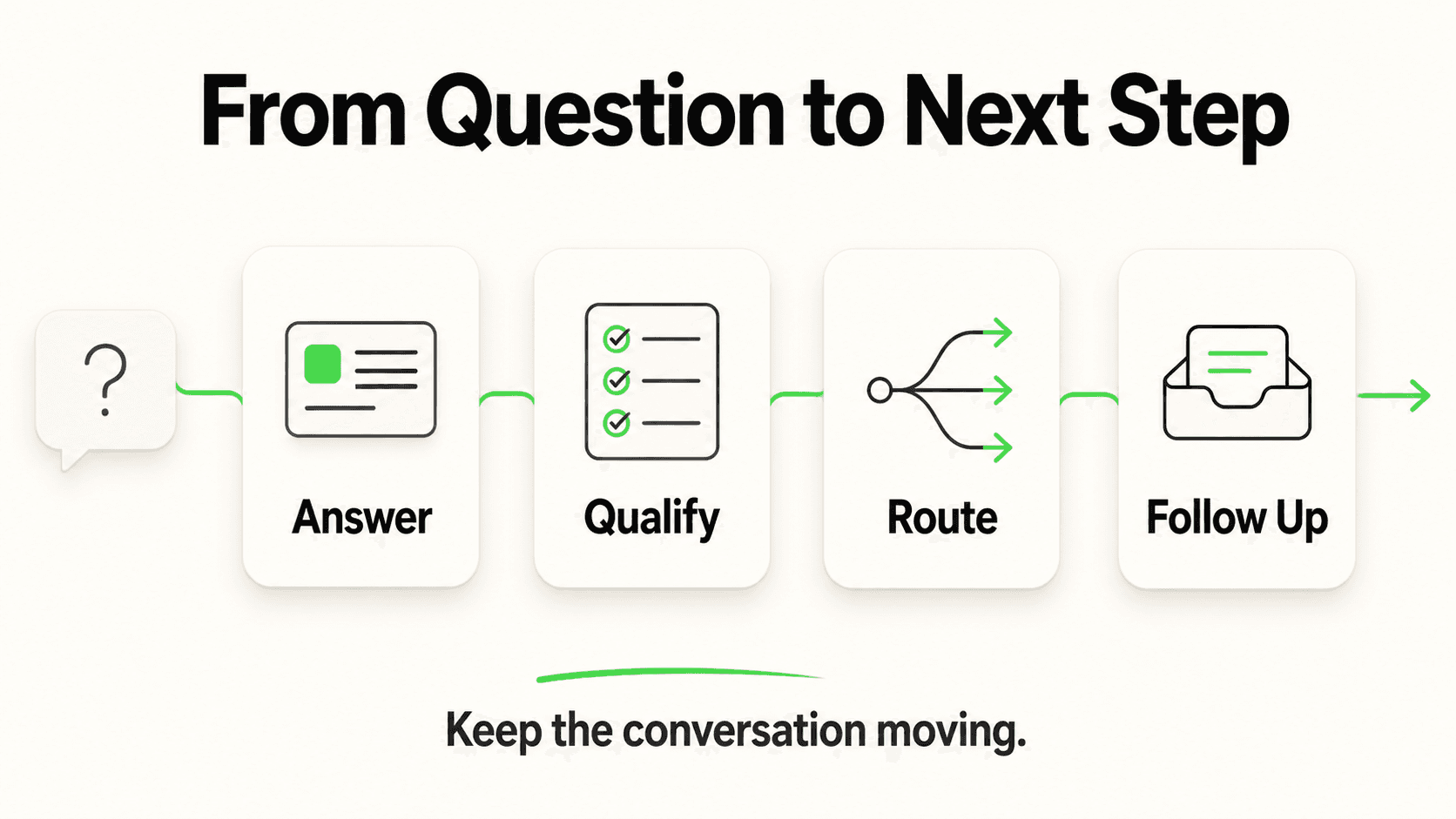
What this looks like in practice: An AI agent on a company's website or messaging channels answers routine questions — hours, pricing, policies, order status — instantly, 24/7, without a person needing to be online.
Real-world impact: Support-focused conversational AI deployments are estimated to reduce support costs by 30-40% on average, largely by absorbing the high-volume, repetitive share of inquiries (McKinsey, 2025).
Why it works: Most support volume is the same handful of questions asked over and over. Conversational AI handles that predictable majority so human agents can focus on complex or sensitive cases. For the full operational playbook on making this work — knowledge base design, escalation rules, what never to automate — see conversational AI for customer service.
2. Lead Capture and Qualification
What this looks like in practice: A website or WhatsApp chatbot engages a visitor, asks qualifying questions (what they need, their timeline, how to reach them), and hands a structured lead to the sales team instead of a name in a spreadsheet.
Real-world impact: Speed to first response is one of the most consistently revenue-linked metrics in sales — leads contacted within five minutes convert dramatically better than those contacted hours later (InsideSales research).
Why it works: A conversational AI system never sleeps, never gets backed up during a rush, and asks the same qualifying questions every time — consistency a busy front desk can't always guarantee.
3. Appointment Scheduling
What this looks like in practice: A customer asks to book a time; the AI checks live availability, offers real open slots, and books the one the customer picks — right in the conversation.
Real-world impact: Businesses that let customers self-serve simple booking questions free up phone and front-desk time for higher-value interactions.
Why it works: Scheduling is a repetitive, rules-based conversation — exactly the kind of task conversational AI handles well. (In Hyperleap AI, native in-chat booking works with Calendly and Cal.com — in-chat booking needs Calendly Standard or higher. For any other scheduling tool, the AI shares your booking link instead.)
4. After-Hours and Overflow Coverage
What this looks like in practice: A meaningful share of customer inquiries arrive nights, weekends, and during rush periods when no one is available to answer. Conversational AI captures those inquiries instead of letting them go unanswered.
Real-world impact: Industry estimates suggest 40-60% of inbound inquiries for many service businesses arrive outside standard business hours; in Hyperleap AI's own Jungle Lodges deployment, 35% of chatbot inquiries arrived after hours and were captured automatically.
Why it works: Customers researching at 9 PM don't wait until 9 AM — they move to whichever business responds first.
5. Internal Knowledge Assistance
What this looks like in practice: Employees ask an internal conversational AI assistant questions about company policy, HR procedures, or product documentation instead of searching through shared drives or interrupting a colleague.
Real-world impact: This use case saves time rather than generating revenue directly, but it compounds — every avoided "let me ask someone" interruption returns focus time to the team.
Why it works: The same RAG architecture that grounds a customer-facing chatbot in company documents works just as well pointed at an internal knowledge base.
6. Order and Account Status Inquiries
What this looks like in practice: A customer asks "where's my order" or "what's my account balance," and the conversational AI retrieves and reports the status without a person looking it up manually.
Real-world impact: These are high-volume, low-complexity inquiries — exactly the profile that benefits most from automation, freeing staff for issues that need judgment.
Why it works: The question is repetitive and the answer is a data lookup, not a decision — a natural fit for automation with a clear escalation path for anything more complex.
7. Multilingual Customer Reach
What this looks like in practice: A single conversational AI deployment understands and responds in 100+ languages, letting a small business serve a diverse customer base without hiring multilingual staff for every shift.
Real-world impact: Businesses in tourism and hospitality and diverse metro markets report that language coverage alone unlocks customer segments they previously had to turn away or serve poorly.
Why it works: Because the underlying LLM was trained on multilingual text, the same conversational AI system can carry a conversation in Spanish, Arabic, German, or Portuguese without separate deployments. Our guide on multilingual AI chatbots covers this in more depth.
See conversational AI answer from your own content
Start a 7-day free trial and set up an AI agent grounded in your business documents across website, WhatsApp, Instagram DM, and Facebook Messenger.
Get StartedWhat the Research Says About Conversational AI's Impact
The case for conversational AI is increasingly backed by measurable data rather than vendor promises. A few figures worth anchoring on:
The consistent theme across this research: conversational AI's value comes from absorbing high-volume, predictable work and responding fast — not from replacing human judgment entirely. Every credible account of successful deployments pairs automation of the routine majority with a fast, well-designed handoff to a person for anything sensitive, novel, or high-stakes.
Getting Started with Conversational AI for Your Business
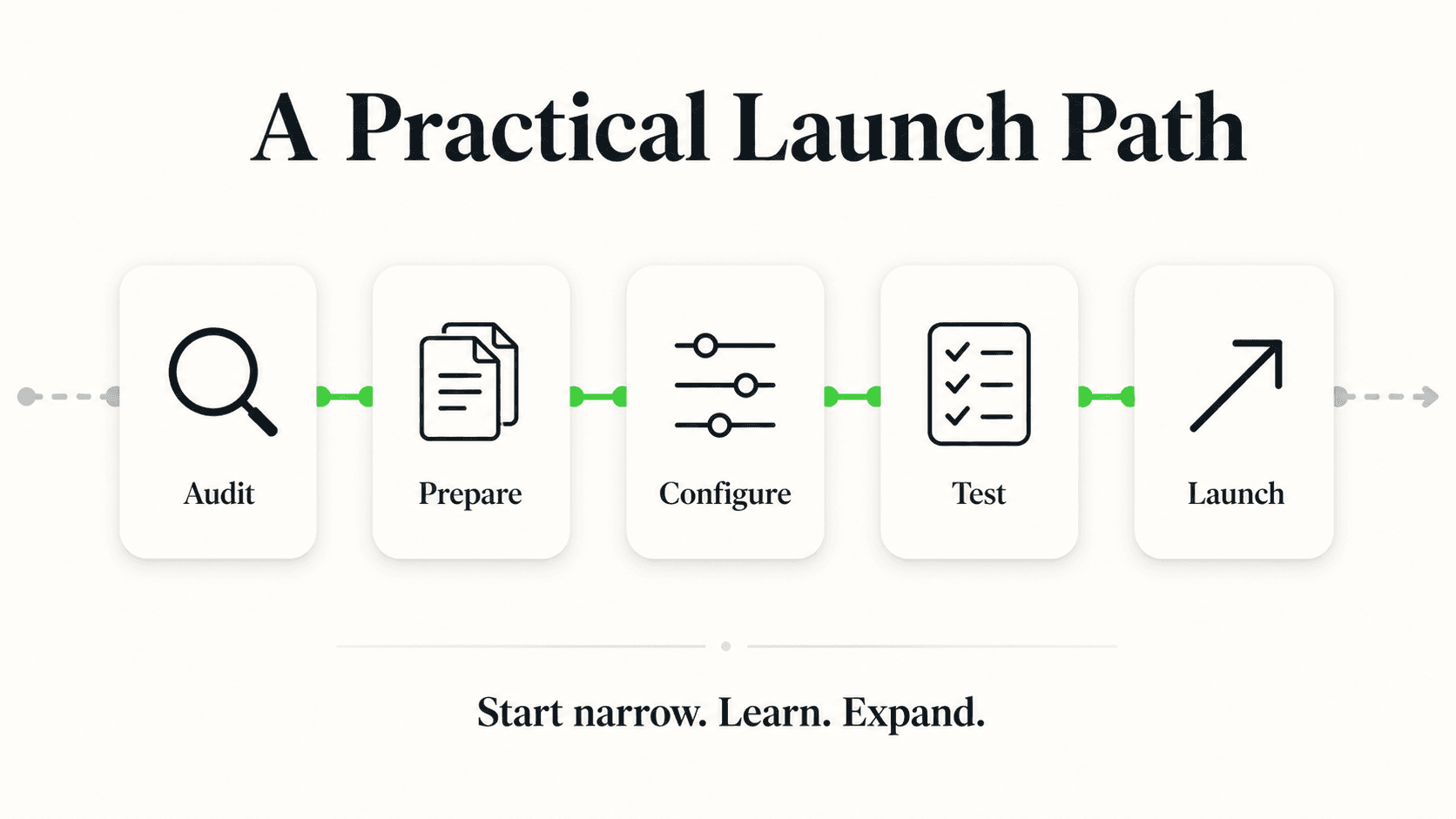
The fastest path to conversational AI that actually works is narrow, specific, and grounded in your own content, not a general-purpose bot pointed at the open internet. Start with one channel and one job — typically your website plus your twenty or thirty most common questions — before expanding.
A workable starting sequence looks like this:
- Pick the highest-volume, lowest-judgment question category your team currently handles manually (hours, pricing, availability are common starting points).
- Write down the actual answers in a structured document — this becomes the knowledge base a RAG-based system draws from.
- Choose your channels. Website chat is the default starting point; many small businesses add WhatsApp Business, Instagram DM, or Facebook Messenger once the first channel is working, since customers don't think in channels — they reach out wherever is convenient.
- Define what the AI should never answer on its own — complaints, exceptions, anything regulated — and make sure those hand off cleanly to a person with full conversation context, not a dead end.
- Launch narrow, review conversations weekly, and expand once the first deployment is proven.
This is the same operational approach covered in depth in our guide to conversational AI for customer service, which walks through knowledge base design, escalation contracts, and the specific failure modes that sink deployments.
Hyperleap AI is one platform built on this exact model: RAG-grounded conversational AI deployed across Website, WhatsApp Business API, Instagram DM, and Facebook Messenger, with lead capture (via a lead form that gathers contact details before the chat continues), in-chat booking through Calendly or Cal.com (or booking-link sharing for other tools), and REST API/webhook connectivity for your CRM. Plans run from Plus ($40/mo) through Pro ($100/mo) to Max ($200/mo), each with a 7-day free trial (credit card required, no free plan). Managed Setup ($299 Free, any plan) is available if you'd rather have the initial configuration done for you.
Ready to put conversational AI to work?
Configure a document-grounded conversational AI agent on your real content in days, not months. 7-day free trial on every plan.
See Plans and PricingFor how this relates to the broader generative-AI category, see conversational AI vs generative AI. For a category comparison of the leading platforms, see best conversational AI platforms in 2026.
Frequently Asked Questions
What is conversational AI in simple terms?
Conversational AI is technology that lets a computer understand natural human language, hold a back-and-forth exchange, and reply in a way that sounds like a real conversation rather than a scripted menu. It combines natural language understanding (to interpret what you mean), a large language model (to generate a natural-sounding reply), and, in well-built business systems, retrieval-augmented generation (to ground that reply in real, current facts rather than generic internet knowledge).
Is conversational AI the same thing as a chatbot?
Not exactly. "Chatbot" is a broad interface-level term for any automated system that chats with users — some chatbots are simple rule-based systems that only match exact keywords, with no real language understanding. Conversational AI is the more advanced technology (natural language understanding plus a large language model) that powers modern AI chatbots. Every conversational-AI-based chatbot is a chatbot, but not every chatbot uses conversational AI. See our full AI agent vs. chatbot comparison for the detailed breakdown.
What is the difference between conversational AI and generative AI?
Generative AI is the broader category of AI that creates new content — text, images, code, audio. Conversational AI is a specific application of generative AI (usually via a large language model) focused on holding a back-and-forth dialogue. All conversational AI uses generative AI techniques to produce responses, but generative AI also covers things with no conversational element at all, like image generation or code completion.
Does conversational AI use ChatGPT?
Conversational AI and tools like ChatGPT both rely on large language models, but they aren't the same thing. ChatGPT is a general-purpose consumer product built on an LLM with broad training-data knowledge and no awareness of any specific business. Business-grade conversational AI platforms typically use an LLM as one component inside a larger system that also includes retrieval-augmented generation, so responses are grounded in a specific company's own documents rather than general internet knowledge.
Can conversational AI understand multiple languages?
Yes. Because large language models are trained on multilingual text, conversational AI systems built on them can typically understand and respond in 100+ languages without a separate deployment for each one. This is one of the more immediately useful capabilities for businesses serving diverse or multilingual customer bases.
Will conversational AI replace human customer service reps?
Not in any deployment built responsibly. Conversational AI is best suited to high-volume, repetitive, low-judgment work — FAQs, scheduling, lead capture, order status — while complaints, exceptions, and anything requiring real judgment should stay with a human. The pattern that works is augmentation: AI absorbs the routine majority so people can focus on the harder, higher-value conversations.
How accurate is conversational AI?
Accuracy depends heavily on architecture. Systems built on retrieval-augmented generation (RAG), which ground responses in a business's actual documents, are designed to reduce hallucinated or fabricated answers compared to a general-purpose LLM answering from memory alone. No system — RAG-based or otherwise — can guarantee 100% accuracy, which is why any well-designed deployment pairs document grounding with a clear, graceful escalation path to a human for anything the AI isn't confident about.
How much does conversational AI cost for a small business?
Pricing varies by platform and scale. As a reference point, Hyperleap AI's plans start at $40/month (Plus), scaling to $100/month (Pro) and $200/month (Max) based on response volume and channel count, each with a 7-day free trial and a credit card required to start (no free plan). Costs generally scale with conversation volume, number of channels, and whether you want the deployment configured for you (Managed Setup) versus self-service setup.
Industry Solutions
See how AI chatbots work for these industries:
Related Articles

Conversational AI for Small Business: A Starter Guide
A practical guide to conversational AI for small business: what to build first, a 5-step setup week, real costs, and the 3 use cases that pay for it first.

12 Conversational AI Examples From Real Businesses
12 real conversational AI examples organized by job-to-be-done — after-hours capture, FAQ deflection, booking, and more — with sourced outcomes.
Conversational AI vs Chatbot: The Real Difference
Conversational AI vs chatbot explained: rule-based scripted bots versus LLM-powered conversational AI, plus a comparison table and decision framework.
Conversational AI vs Generative AI: A Business Guide
Conversational AI vs generative AI explained: how they relate, a comparison table, risks and controls, and what a small business actually buys.