Conversational AI vs Generative AI: A Business Guide
Conversational AI vs generative AI explained: how they relate, a comparison table, risks and controls, and what a small business actually buys.
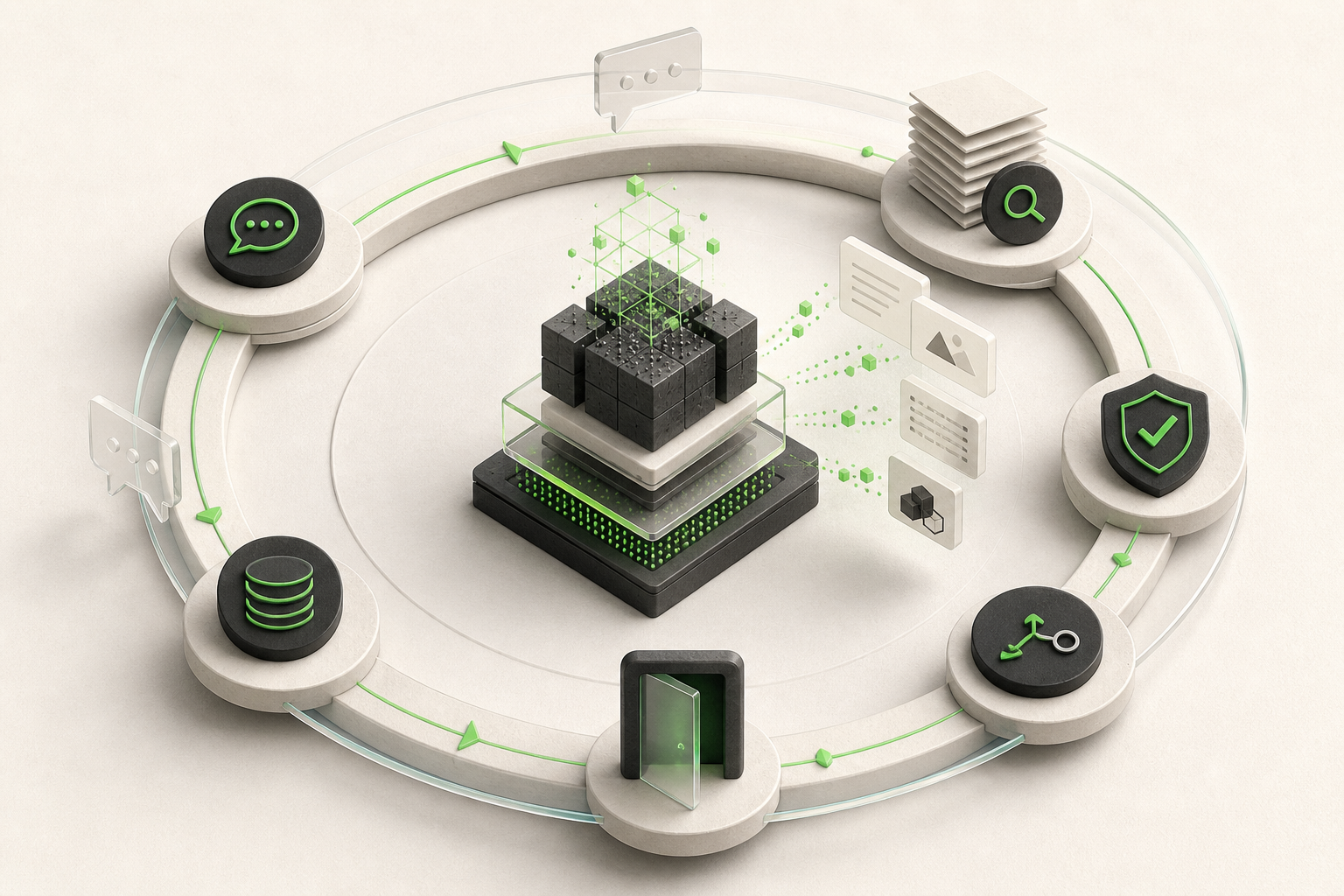
TL;DR: Conversational AI is technology built to hold a back-and-forth exchange with a person — understanding what they mean and replying in natural language across multiple turns. Generative AI is the broader category of AI that creates new content of any kind — text, images, code, audio — with no requirement that it be conversational at all. The two overlap heavily today because most modern conversational AI systems use a generative model (a large language model, or LLM) as the component that actually writes each reply, but they aren't the same thing: image generation is generative AI with no conversation involved, and a classic rule-based chatbot from a decade ago was conversational (of a kind) with nothing generative underneath. What a small business actually buys when it deploys a customer-facing AI agent is a conversational front desk that uses a generative model, grounded in its own documents, with guardrails and a human handoff — not "generative AI" or "conversational AI" as a standalone purchase.
How this fits with our other definitional guides
This article is about the conversational-AI-vs-generative-AI distinction specifically. For the deeper technical breakdown of conversational AI's three-layer architecture (NLU, LLM, RAG), see What Is Conversational AI?. For rule-based chatbots vs. LLM-powered conversational AI, see conversational AI vs chatbot. For the agentic question — systems that reason and take multi-step actions, not just talk — see AI agents vs chatbots. And for the deployment playbook once you've picked an architecture, see generative AI for customer service.
Vendors use "conversational AI" and "generative AI" almost interchangeably in 2026 marketing copy, and the overlap is real enough that the confusion is understandable. But the two terms describe different things — one is about how a system talks, the other is about what a system creates — and knowing the difference changes what questions you should ask before buying either one. This guide untangles the two categories cleanly, shows exactly where they overlap in a modern AI agent, and gives you the risk framework and buying questions that matter more than the terminology itself.
What Is Conversational AI vs Generative AI?
Conversational AI is a category of technology built specifically to understand natural human language, hold a coherent exchange across multiple turns, and respond the way a person would in a dialogue. Generative AI is a much broader category of technology that produces new content — text, images, audio, video, or code — regardless of whether that content is part of a conversation at all.
The cleanest way to see the difference is by what each is for:
- Conversational AI's job is dialogue: understanding a question, keeping track of context across an exchange, and replying in a way that feels like a real conversation rather than a form or a menu.
- Generative AI's job is creation: producing something new from a prompt — a paragraph, an image, a snippet of code, a synthesized voice — with no inherent requirement that it be part of a back-and-forth exchange.
A single-shot image generator that turns a text prompt into a picture is generative AI with zero conversational element. A customer service chat widget that answers questions is conversational AI — and, in nearly every modern implementation, it's also generative AI, because the component that writes each individual reply is a generative language model. That overlap is where the confusion mostly comes from, and it's worth unpacking directly.
How Conversational AI and Generative AI Relate
Modern conversational AI and generative AI overlap because the large language models (LLMs) that power today's best conversational systems are themselves a form of generative AI — but the relationship wasn't always this tight, and understanding the history clarifies why the terms still mean different things.
Classic conversational AI was rule-based, not generative
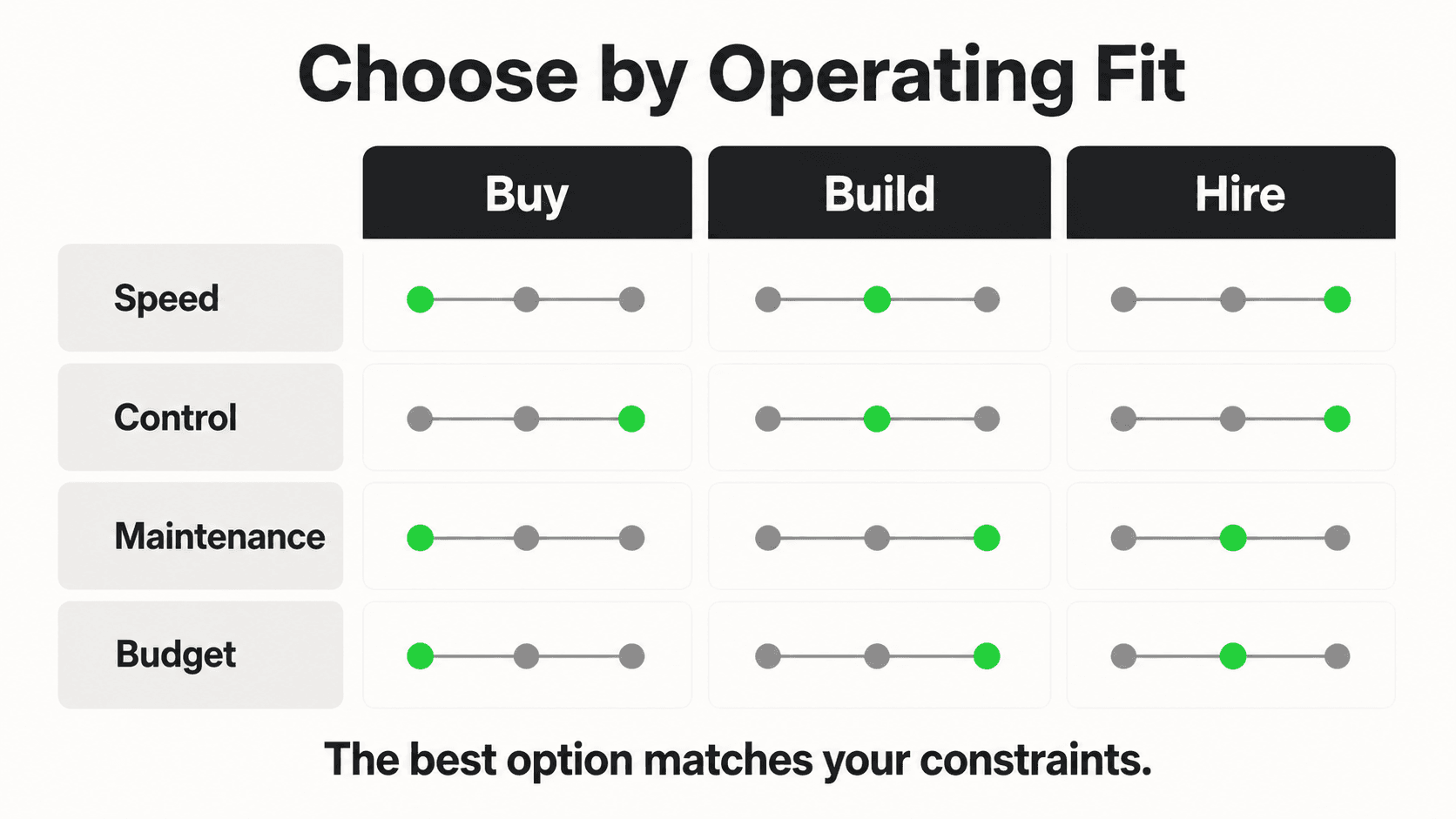
Before LLMs became practical for business use (roughly 2022-2023), conversational AI systems were mostly built on natural language understanding (NLU) paired with rule-based or template-driven response logic. These systems could genuinely hold a structured conversation — classify intent, extract entities like a date or a product name, follow a decision tree — without generating a single original sentence. Every possible reply was pre-written by a human; the system's job was picking the right one, not creating new language. That's conversational AI with no generative component at all.
Generative models became the engine inside modern conversational systems
The shift that happened with LLMs is that the reply-writing step stopped being "select from pre-written options" and became "generate a new sentence on the fly, shaped by the conversation so far." A large language model is fundamentally a generative AI system — it produces new text token by token, using patterns learned from enormous volumes of training text — and when that generative capability is wrapped in a system designed for back-and-forth dialogue, tracking context, and responding to what a specific person just said, the result is what we now call modern conversational AI. Our deeper breakdown of what conversational AI is covers this three-layer architecture — NLU, LLM, and retrieval-augmented generation (RAG) — in full detail.
They are not interchangeable even now
Generative AI still covers vast territory with no conversational element: an image generator, a code-completion tool, a text-to-speech voice synthesizer working from a script, a system that drafts a marketing email from a bullet-point brief. None of these hold a dialogue; all of them generate new content. Conversely, a narrowly scoped IVR phone tree that says "press 1 for billing" is conversational (in the loosest sense — it's a structured back-and-forth) with nothing generative in it at all. The overlap in a modern AI agent is real and important, but it's an overlap, not an equivalence.
Conversational AI vs Generative AI: Side-by-Side Comparison
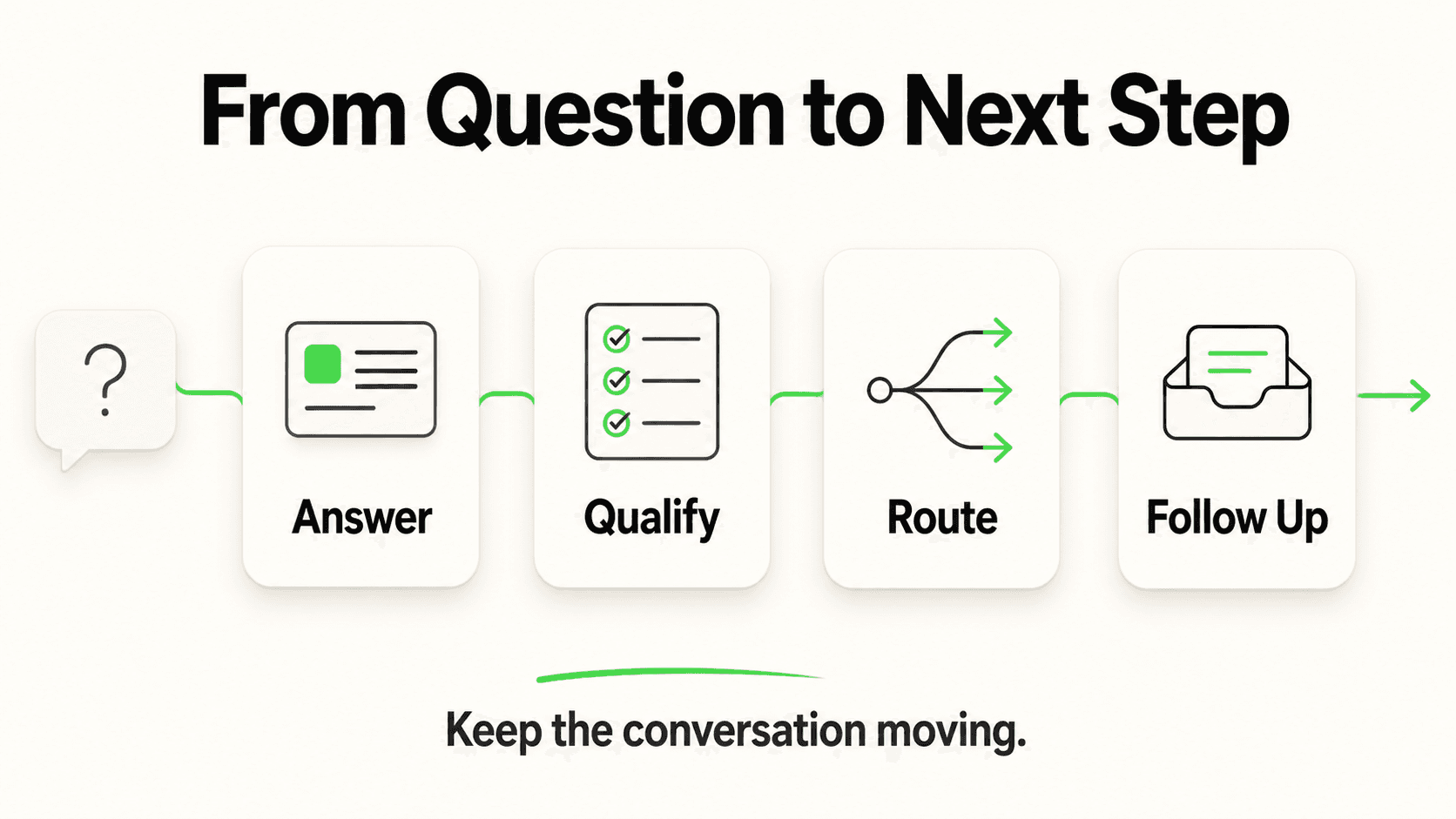
The table below compares the two categories directly across the dimensions that matter for a business evaluating either one.
| Dimension | Conversational AI | Generative AI |
|---|---|---|
| Primary purpose | Hold a coherent, multi-turn dialogue | Create new content of any kind |
| Typical inputs | A message in an ongoing exchange, plus prior context | A prompt, instruction, or brief |
| Typical outputs | A reply that continues the conversation | Text, images, audio, video, or code — standalone or continuous |
| Grounding needs | High for business use — should answer from real business documents (RAG), not general knowledge | Varies by use case — a marketing draft may not need document grounding at all |
| Risk profile | Wrong answers reach a customer in real time, in your voice, on your channels | Wrong or low-quality output is usually reviewed by a person before it reaches an audience |
| Typical business uses | Customer support, lead qualification, FAQ resolution, appointment-related conversation | Content drafting, image creation, code generation, summarization, internal documents |
| Cost model | Usually priced per conversation, per response, or per seat — often bundled per plan (e.g. Hyperleap: "one AI reply = one response," no model-credit multiplier) | Usually priced per generation, per token, or per image/output unit |
The one-line distinction to remember
Conversational AI is about the shape of the interaction (a dialogue). Generative AI is about the mechanism producing the content (creation from a model). A modern AI agent is conversational AI that uses generative AI as its engine — but "generative AI" alone doesn't imply a conversation, and "conversational AI" historically didn't require generation at all.
What a Small Business Actually Buys
What a small business buying an "AI chatbot" in 2026 actually needs is a conversational front desk built on a generative model, grounded in its own documents, with explicit guardrails and a clean human handoff — not "generative AI" or "conversational AI" as an abstract capability. Neither term, on its own, tells you whether the system will give your customers accurate, on-brand answers.
The practical shape of that front desk, as covered across our guides, has five parts:
- A generative model (an LLM) that writes fluent, natural-sounding replies rather than selecting from a fixed script — this is the "generative AI" layer.
- Conversation management that tracks context across a multi-turn exchange, so a customer doesn't have to repeat themselves mid-conversation — this is the "conversational AI" layer.
- Document grounding via RAG, so the model answers from your actual pricing, policies, and FAQs rather than general internet knowledge. See generative AI for customer service for the full mechanics.
- Guardrails and scope boundaries that define what the AI should never attempt to answer on its own — billing disputes, regulated topics, anything requiring human authority.
- A clean escalation path to a human when the AI reaches the edge of its knowledge or scope, covered in depth in chatbot-to-human handoff best practices.
None of those five parts is "conversational AI" or "generative AI" by itself. They're the assembled system — and evaluating a vendor on which of those five parts they've actually built matters more than which buzzword sits on their homepage.
See the assembled system, not just the buzzword
A document-grounded conversational front desk — generative model, RAG grounding, and human handoff — deployed across your website, WhatsApp, Instagram DM, and Facebook Messenger.
See It In ActionRisks and Controls: Making Generative Conversational AI Safe to Deploy
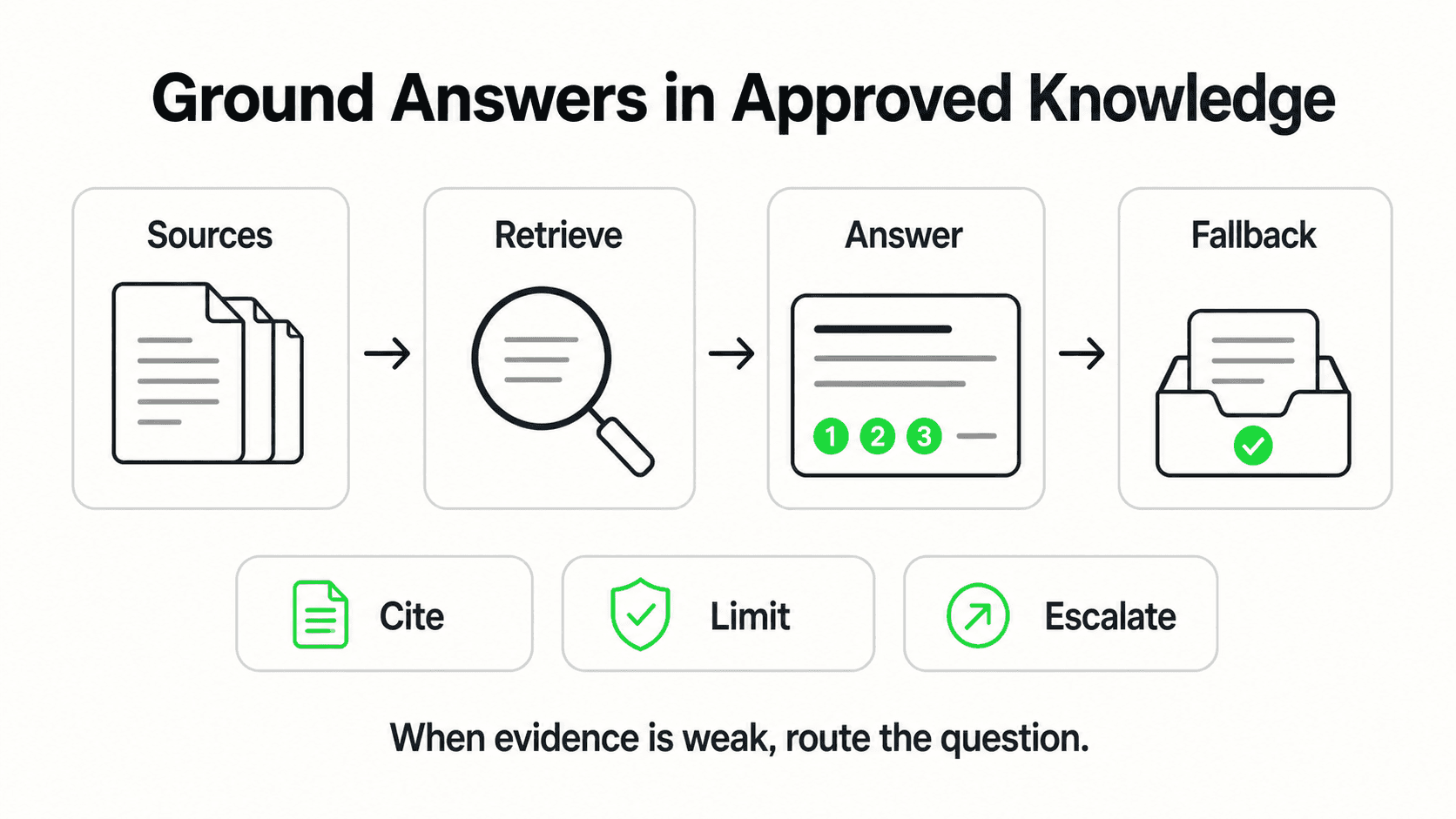
The core risk of using a generative model inside a conversational system is hallucination — a fluent, confident-sounding reply that is factually wrong — and the controls that manage that risk are document grounding, explicit guardrails, and human handoff, used together rather than any single one alone.
Hallucination minimization via document grounding. A generative model with no grounding answers from general training data, which has no knowledge of your specific pricing, hours, or policies and can produce fluent but incorrect answers about your business with total confidence. Retrieval-augmented generation (RAG) retrieves relevant passages from your own documents before generating a response, which is designed to minimize — not guarantee the elimination of — hallucinated answers. No responsibly described AI system claims zero hallucinations; the honest framing is "document-grounded" and "designed to minimize" incorrect responses.
Guardrails on scope. Even a well-grounded system needs explicit boundaries on what it should attempt to answer. Billing disputes, account security changes, and anything in a regulated category (healthcare, legal, financial advice) should be configured to escalate automatically, independent of how confident the model's answer sounds — because confidence and correctness aren't the same thing in a generative system.
Human handoff as the backstop. Every deployment needs a designed escalation path for the moment the AI reaches its limits — explicit customer requests, low-confidence situations, and policy-restricted topics should all route cleanly to a person with the full conversation context attached, not end in a dead end. This is covered in full in chatbot-to-human handoff best practices.
What 'zero hallucination' claims actually mean
Any vendor claiming "zero hallucinations" or "100% accuracy" for a generative conversational system is overstating what the underlying technology can currently guarantee. The credible claim is "document-grounded" and "designed to minimize hallucinations" — paired with visible guardrails and a real escalation path. Ask to see the guardrails and the handoff, not just an accuracy percentage.
Choosing Questions: What to Ask Before You Buy Either One
The right question when evaluating a vendor is not "is this conversational AI or generative AI" — it's a specific set of questions about grounding, scope, and escalation that determine whether either category of technology will actually work for your business.
- Is the model's output grounded in my documents, or general knowledge? A generative model with no retrieval step answering customer questions about your specific policies is a meaningfully higher-risk deployment than one grounded in your actual content.
- What happens when the model isn't confident? A well-built system acknowledges the gap and escalates. A poorly built one may generate a plausible-sounding answer regardless of whether it's grounded in anything real.
- What's explicitly configured to always escalate, regardless of confidence? Billing, security, and regulated topics should be a hard-coded list, not left to a confidence threshold alone.
- Which channels does the conversational layer actually run on? Confirm today's shipped channels versus roadmap claims — website widget, WhatsApp Business API, Instagram DM, and Facebook Messenger are commonly shipped; voice, SMS, and channels like Slack or Microsoft Teams are frequently roadmap items dressed up as "coming soon."
- What does the pricing model actually charge for? Some platforms multiply cost by underlying model-credit consumption in ways that are opaque to the buyer. A clearer model — one AI reply priced as one response, without a hidden model-credit multiplier — is easier to budget against.
- Can I bring my own model key? Some platforms let you use your own OpenAI, Anthropic, or Gemini API key (BYOK) to choose the underlying generative model, without a plan-tier restriction or credit multiplier attached to that choice.
A Quick Glossary of Adjacent Terms
A handful of adjacent terms get used alongside "conversational AI" and "generative AI," and knowing each one in a single sentence clears up most remaining confusion.
- LLM (large language model) — A generative AI model trained on large volumes of text that predicts and generates language, one token at a time, based on learned statistical patterns; it's the engine inside most modern conversational AI systems.
- RAG (retrieval-augmented generation) — A technique that retrieves relevant passages from a specific knowledge base before generating a reply, grounding a generative model's output in real, current business content instead of general training data. See RAG chatbots for a deeper technical look.
- NLU (natural language understanding) — The layer that interprets what a person actually means (intent and entities) rather than just the literal words typed — the "understanding" half of conversational AI, distinct from the "generating" half.
- AI agent — A conversational AI system, usually built on an LLM with RAG, that can also take on more autonomous behavior — looking things up, filling out a structured intake, or in more advanced cases taking multi-step actions inside other systems. See AI agents vs chatbots for the full breakdown of where a standard RAG-based conversational agent ends and a more autonomous agent begins.
Ready to deploy the assembled system?
Configure a document-grounded conversational AI agent on your real business content, with guardrails and human handoff built in. 7-day free trial, all plans.
Start Free TrialFrequently Asked Questions
Is conversational AI a type of generative AI?
Not by definition, though most modern examples of conversational AI are also generative. Conversational AI is defined by its purpose — holding a coherent, multi-turn dialogue — while generative AI is defined by its mechanism — creating new content. Older, rule-based conversational systems held dialogues with no generative component at all, and generative AI covers plenty of use cases (image generation, code completion) that involve no conversation whatsoever. The overlap in today's best systems is real, but it isn't a strict subset relationship in either direction.
What's the difference between conversational AI and an AI agent?
Conversational AI describes the underlying dialogue capability — understanding and responding in natural language across turns. "AI agent" typically refers to a specific implementation of conversational AI (usually LLM-powered, grounded via RAG) that businesses deploy customer-facing, sometimes with additional capabilities like structured lead intake. See AI agents vs chatbots for how the more autonomous end of that spectrum differs from a standard conversational agent.
Does generative AI always hallucinate?
Generative AI models can produce fluent, confident-sounding output that is factually incorrect, particularly when generating from general knowledge without grounding in specific, current source material. This risk is reduced — not eliminated — by techniques like retrieval-augmented generation (RAG), which constrains the model's output to a business's own documents. No generative AI system should be described as guaranteed error-free; the responsible framing is "designed to minimize hallucinations" paired with human review and escalation paths.
Can a business use generative AI without it being conversational?
Yes. Generative AI covers content creation broadly — drafting marketing copy, generating product images, summarizing documents, writing code — with no requirement that any of it happen inside a back-and-forth conversation. A business might use generative AI purely for internal content drafting while having no customer-facing conversational AI deployment at all, or vice versa.
Which is more expensive to deploy, conversational AI or generative AI?
Cost depends entirely on the specific use case and vendor rather than the category itself. Customer-facing conversational AI platforms for small businesses are commonly priced per plan tier based on response volume and channels — Hyperleap AI, for example, starts at $40/month (Plus), scaling to $100/month (Pro) and $200/month (Max), each with a 7-day free trial (credit card required, no free plan). Standalone generative AI tools (image generators, writing assistants) are typically priced per generation or per seat, which can be cheaper or more expensive depending on volume.
What should a small business actually look for when comparing vendors that use these terms?
Look past the "conversational AI" or "generative AI" label entirely and ask about the assembled system: is the model's output grounded in your business's own documents, what's explicitly configured to always escalate to a human, which channels are actually shipped today versus roadmap, and how the pricing model charges for usage. Those questions predict real-world performance far better than which buzzword appears on the homepage.
Is Hyperleap AI conversational AI or generative AI?
Both, in the sense that matters: Hyperleap AI is a conversational front desk — it holds multi-turn dialogue across website, WhatsApp Business API, Instagram DM, and Facebook Messenger — built on a generative language model whose responses are grounded in each business's own uploaded documents via retrieval-augmented generation. See what is conversational AI and generative AI for customer service for the deeper technical breakdown of how each layer works.
Industry Solutions
See how AI chatbots work for these industries:
Related Articles

Generative AI for Customer Service: A Practical Guide
Generative AI for customer service explained: how RAG-grounded agents work, what benefits they deliver, hallucination risks to manage, and implementation steps for SMBs.

What Is Conversational AI? A Plain-English Guide
Conversational AI explained in plain English: how NLU, LLMs, and RAG work, how it differs from chatbots, and where businesses use it today.
Chatbot-to-Human Handoff: Escalation Design That Works
How to design chatbot-to-human handoff: when to escalate, what context to pass, routing options, SLAs, and a copy-ready escalation script.

Conversational AI for Hotels: From Enquiry to Booking
How conversational AI moves a hotel guest from a website or WhatsApp question to a booked room — and what it honestly doesn't do with your PMS or Cloudbeds.