AI Agents vs Chatbots: What's Actually Different in 2026
AI agents and chatbots are not the same. Learn the real technical differences and why the distinction matters for your business.

TL;DR: A chatbot follows rules. An AI agent reasons. Chatbots are decision trees — they follow the paths someone scripted, and they break the moment a conversation wanders off-script. AI agents work differently: they read intent, pull relevant facts from a knowledge base, and generate a response to something they've never seen phrased that way before. So skip the "chatbot or AI agent" question. Ask instead: what kind of AI agent is this, and what's it actually built on?
Want the quick, structured answer? See our AI agent vs chatbot explainer — this article is the deeper 2026 deep-dive.
AI Agents vs Chatbots: What's Actually Different in 2026
Every vendor selling anything customer-service-adjacent in 2026 calls their product an "AI agent." Most of them aren't.
"Chatbot," "AI chatbot," "AI agent," "virtual assistant" — marketing copy uses these words like they're synonyms. They're not, and the blur makes it genuinely hard to know what you're buying, or what problem it's actually going to solve for you.
This guide untangles the terminology. What technically separates an AI agent from a rule-based chatbot, why it matters for the outcomes you actually care about, and how to size up a vendor's claims when they use these words.
Who This Guide Is For
This guide is written for business owners and operations leaders evaluating customer-facing AI. You do not need a technical background—the goal is a clear mental model, not a computer science lecture.
What Is a Traditional Chatbot?
A rule-based chatbot is a decision tree wearing a chat interface. Someone maps out the paths in advance, and the bot walks customers down whichever one matches.
How Rule-Based Chatbots Work
A customer types something. The bot checks it against a list of patterns it was given. Match found — it follows the scripted branch. No match — a typo, an unexpected phrasing, a question nobody thought to write for — and it stalls out, loops back to the menu, or shrugs with "I didn't understand that."
Picture an old phone tree. Press 1 for billing, 2 for support, 3 for sales. Fine, as long as your question fits one of the buttons. The second it doesn't, the whole thing falls apart.
What Rule-Based Chatbots Are Good For
They're actually solid in narrow, predictable situations:
- Lead routing: "New customer or existing?" → sends to different queues
- Simple FAQ display: a static list of common questions with canned answers
- Form collection: name, email, date, in a fixed order
- Transaction status queries: "Order #12345 arrives Tuesday," pulled straight from a database
Here's the tell: the bot doesn't need to understand language at all. It just needs to match a pattern or fill in a field.
Where Rule-Based Chatbots Break Down
- Open-ended questions: "Can you help me figure out what's right for my situation?" — there's no script for that
- Multi-turn context: remembering what got said three messages back and using it now
- Nuanced language: "How much does it cost?" and "What are your rates?" and "Is this expensive?" mean the same thing to a human. A pattern-matcher might catch one and miss the other two
- Novel scenarios: anything the script writer didn't think of
Real customers ask unpredictable things — about pricing, availability, their specific situation. Scripting for all of it takes forever, and the bot still fails constantly.
What Is an AI Agent?
An AI agent is a customer-facing system built on a large language model (LLM) that reads customer intent, retrieves relevant facts from a business's own knowledge base, and generates a plain-language response — rather than following a pre-scripted decision tree.
The Three Core Components of an AI Agent
1. Language Understanding An LLM (GPT-4, Claude, Gemini, or similar) parses what the customer is actually asking — intent, context, phrasing quirks — no matter how it's worded.
2. Knowledge Retrieval (RAG) Instead of answering off the model's general training (which might be stale or just wrong for your business), a properly built AI agent pulls relevant content from your own knowledge base first. That's Retrieval-Augmented Generation, or RAG.
3. Response Generation It writes a response that blends the retrieved facts with what the customer specifically asked — handling follow-ups, clarifications, and topic shifts in one continuous conversation.
The Practical Difference
Rule-based chatbot scenario: Customer: "I'm looking for a room for my anniversary, something romantic. Do you have anything with a view?"
Chatbot with a "Room inquiry" flow: shows a menu of room types. Ignores the anniversary entirely.
AI agent scenario: Same customer, same message.
AI agent: "Congratulations on the anniversary! Our [Suite Name] would be perfect — it has [a specific view], a private balcony, and it's our most-booked room for couples celebrating something special. Starts at [price] a night. Want me to check availability for your dates?"
Notice what happened. The agent caught the emotional context — anniversary, romantic — pulled the right room and its actual features, and gave a specific recommendation. Nobody wrote a script for "anniversary + view request."
The Real Spectrum: From Scripted to Autonomous
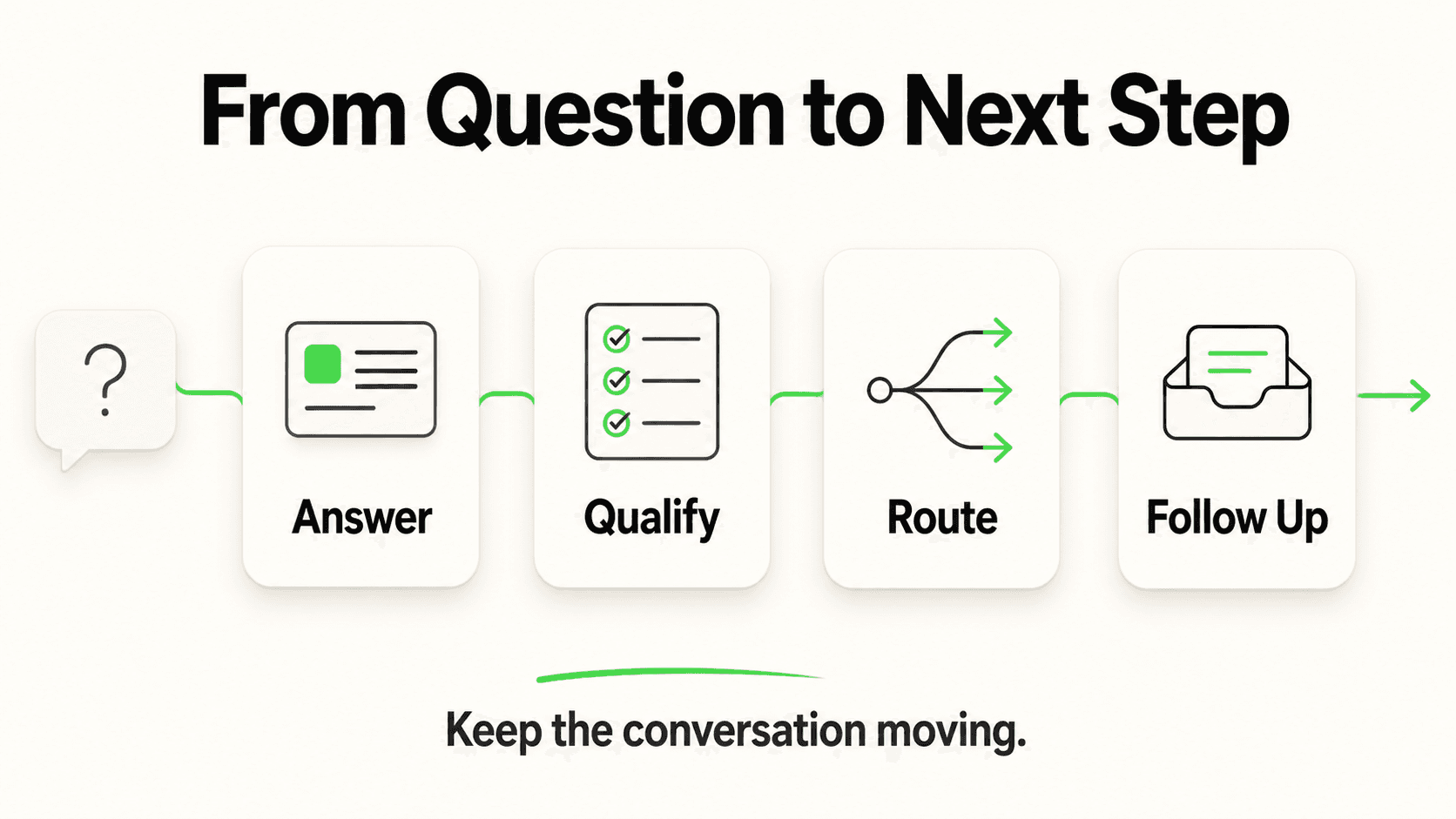
AI agents and chatbots exist on a spectrum from fully scripted to fully autonomous, not as two separate categories.
| System Type | How It Works | Handles Novel Questions | Maintains Context | Requires Scripting |
|---|---|---|---|---|
| Button-based bot | Fixed menus, button clicks | No | No | Extensive |
| Rule-based chatbot | Pattern matching to scripts | Rarely | Limited | High |
| FAQ-retrieval bot | Matches questions to a Q&A database | Sometimes | Limited | Moderate |
| RAG AI agent | LLM + knowledge base retrieval + generation | Yes | Yes | Minimal |
| Autonomous AI agent | LLM + tools + external actions | Yes | Yes | None |
Most products sold as "AI chatbots" or "AI agents" to SMBs land in that RAG AI agent row — an LLM grounded in a business's own documents. That's also where most of the practical value sits for customer-facing use.
Fully autonomous agents — the kind that book calendar slots, update CRM records, or fire off refunds on their own — are a different animal. They need real integrations and much tighter guardrails. Most SMB support deployments don't need that, and honestly, shouldn't reach for it without a careful review first.
7 Ways AI Agents Outperform Rule-Based Chatbots for Business
1. Handling Questions You Did Not Anticipate
This is the big one. AI agents answer questions nobody scripted for.
Take a dental practice bot built on rules — every possible patient question has to be scripted ahead of time. An AI agent trained on that same practice's fee schedules, procedure notes, and insurance policies handles questions the builder never imagined, because it understands the content instead of matching it against a list.
For any business with a varied service list, that's a real drop in ongoing maintenance. Rule-based bots need constant patching as new questions surface. AI agents just need the knowledge base kept current — a much lighter lift.
2. Multi-Turn Conversation Context
Rule-based bots tend to treat every message as its own island. Ask something, then a follow-up, and the customer has to repeat themselves.
An AI agent holds the thread. "I want to book a room" → "Actually make it two, one for my parents" → "Do both have air conditioning?" — each answer builds on what came before instead of starting cold.
3. Natural Language Understanding Across Phrasings
"How much does it cost?" "What are your rates?" "Is it expensive?" "Price?" "pricing pls" — five ways of asking the same thing. A pattern-matcher might catch two of them. An AI agent treats all five as one intent and answers the same way every time.
That matters a lot on WhatsApp, where people type in shorthand, drop punctuation, and abbreviate everything — exactly the kind of input that breaks a rule-based matcher.
4. Nuanced Handling of Complex Scenarios
"I need a room next weekend, but it's a surprise for my wife, so I don't want her seeing a confirmation email." A rule-based bot has no branch for that — it either gives an irrelevant menu or fails outright. An AI agent can catch the nuance: "Of course — our team can handle discreet communication for surprise bookings. Want me to flag this for them?"
5. Lower Long-Term Maintenance Cost
Someone has to sit down and map every conversation path for a rule-based bot. New service? Update the scripts. Price change? Go find every script that mentions it and fix it. That cost compounds as the business grows.
AI agents need a document swapped or a FAQ page updated, and the responses shift automatically. Maintenance tracks the complexity of your information, not the number of conversation branches someone had to imagine in advance.
6. Graceful Failure Handling
When a rule-based bot misses, it's obvious and clunky: "I didn't understand that," then the same menu, again.
A well-built AI agent fails softer. Can't find the answer in the knowledge base? "I want to make sure you get this right — let me connect you with our team." That's a handoff, not a dead end.
7. Consistent Quality Across Languages and Phrasings
Businesses serving customers across multiple languages see this gap widen fast. Rule-based systems need separate scripts written and maintained per language. An AI agent handles the variation natively, supporting 100+ languages without a parallel scripting effort for each one.
What AI Agents Cannot Do (Yet)
AI agents have clear limits: they cannot promise zero hallucinations, cannot act inside external systems without a built integration, and should not make high-stakes regulated calls on their own. Worth being straight about the limits here.
They can't promise zero hallucinations. RAG grounding cuts hallucination risk substantially by tying responses to your documents, but no AI system today can guarantee it will never produce a wrong statement. A strong knowledge base, confidence thresholds, and an honest "I don't know" fallback minimize the risk. They don't erase it.
They can't act in external systems without an integration. An agent can say "I've noted your preference — our team will update your account." It can't actually touch a CRM record unless someone built that connection. If a vendor claims their agent "automatically updates your CRM," ask what integration is doing the work — or whether they're overselling.
They struggle with high-stakes, regulated calls. Clinical diagnosis, legal advice, financial planning — these need a human. In those industries, an AI agent should route and intake, not decide.
They're only as good as the knowledge base behind them. Feed it thin or outdated information, and it'll answer confidently anyway. That's the real ceiling — not the model, the content.
How the Industry Uses These Terms (And What They Actually Mean)
Knowing the vendor lingo helps you figure out what you're actually being sold.
| Vendor Claim | What It Usually Means |
|---|---|
| "AI Chatbot" | Often a rule-based bot with light NLP bolted on for intent detection. Sometimes a genuine LLM agent. Ask directly which one. |
| "AI Agent" | Usually LLM-powered with some form of knowledge retrieval. Confirm whether RAG is actually implemented, not just claimed. |
| "GPT-powered chatbot" | Runs on OpenAI's API — but may lack real knowledge-base grounding. Ungrounded, it can hallucinate freely. |
| "No-hallucination AI" | Red flag. Nobody can guarantee that. A vendor saying this is either confused about their own system or stretching the truth. |
| "Autonomous AI agent" | Claims to take real actions — booking, updating, sending. Ask exactly which actions, and what guardrails sit around them, before you deploy anything. |
The Grounding Question
The single most important technical question to ask any AI chatbot vendor: "Is the AI grounded in my knowledge base, or does it answer from its general training data?" An ungrounded LLM will hallucinate business-specific information (prices, policies, services) it was never given. Grounding—through RAG or fine-tuning—is what makes an AI agent business-safe.
AI Agents vs Chatbots: Key Differences at a Glance
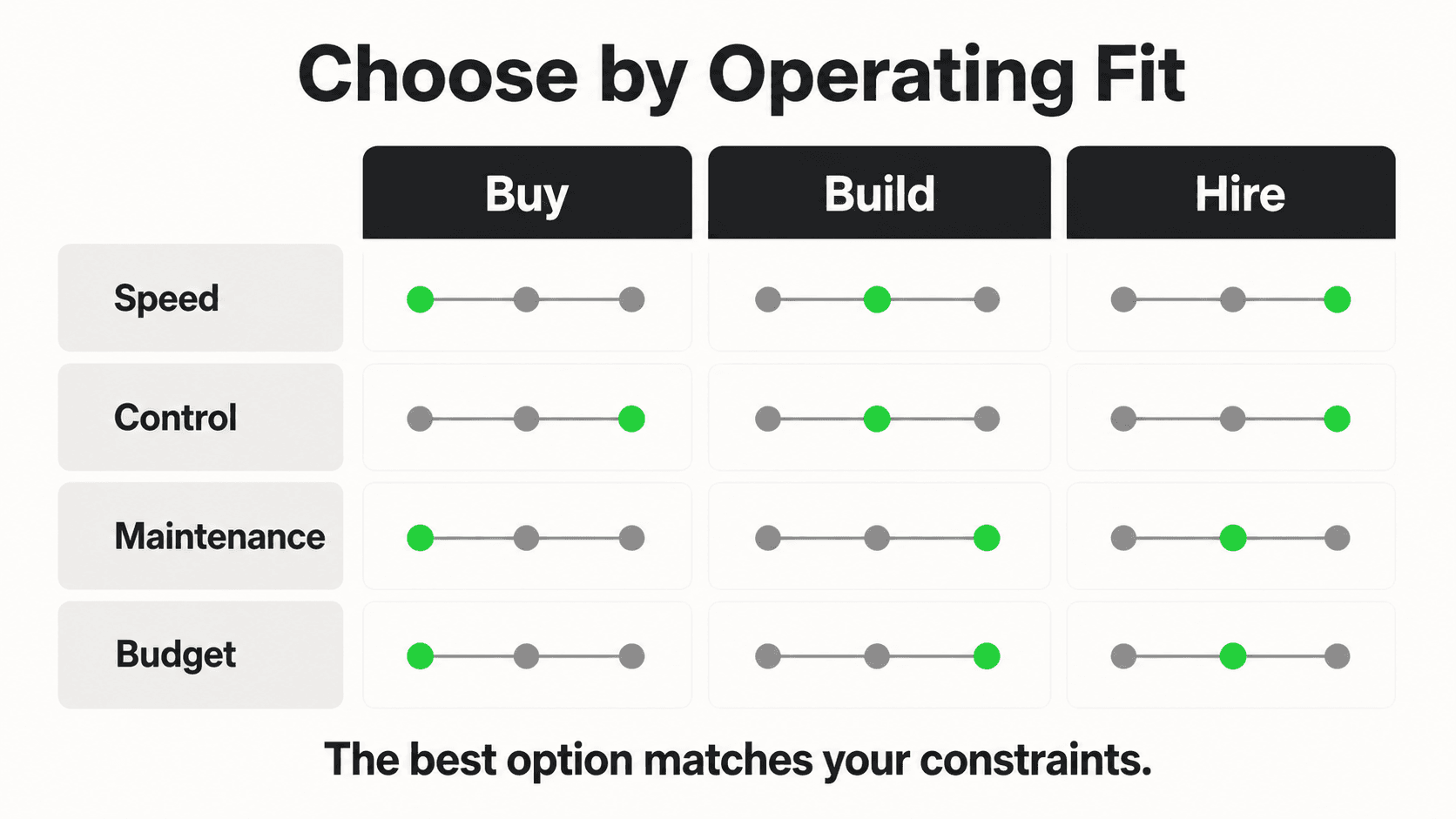
| Dimension | Rule-Based Chatbot | AI Agent (RAG-Based) |
|---|---|---|
| Handles novel questions | No | Yes |
| Requires scripting | Extensive upfront | Minimal (knowledge base only) |
| Maintains conversation context | Limited | Yes |
| Language variation handling | Pattern-dependent | Natural |
| Multilingual | Requires separate scripts | Native with LLM |
| Failure mode | Visible, abrupt | Graceful escalation |
| Maintenance | High (update scripts) | Lower (update knowledge base) |
| Hallucination risk | None (only says what's scripted) | Low-medium (RAG reduces this) |
| Setup time | Weeks-months of scripting | Days-weeks of knowledge base setup |
| Best for | Simple, constrained flows | Complex, varied customer questions |
What This Means for Your Buying Decision
If your inbound is genuinely simple and predictable — "Are you open Sundays?" "Where's your address?" — a well-built rule-based bot or a plain FAQ widget does the job fine, and with less risk.
If your customers show up with varied, personal questions where context actually matters, an AI agent grounded in a real knowledge base wins by a mile — better experience, and a much larger share of conversations resolved without a human stepping in.
Five questions to ask any vendor before you sign:
- Is this actually LLM-powered, or is it pattern-matching dressed up in AI language?
- Is it grounded in my specific knowledge base, or answering from general training data?
- What happens when it can't answer — graceful escalation, or a visible failure?
- How does the knowledge base get updated when my business information changes?
- What human oversight and escalation paths exist?
If a vendor can't answer these cleanly, that's worth sitting with before you commit.
The 2026 Standard: What Good Looks Like
In 2026, a customer-facing AI agent for a small or medium business should ship with:
- LLM-powered understanding — natural language, not pattern matching
- RAG knowledge base grounding — answers tied to your actual business documents
- Conversation memory — context carried through the whole interaction
- Graceful escalation — a clean handoff to a human when the AI isn't confident
- Multi-channel deployment — present where your customers already are (website, WhatsApp, Instagram, Facebook Messenger)
- Lead capture — contact details collected and routed to your team
- Analytics — visibility into what customers ask and where conversations stall
Missing any of that, and what you're looking at is either a rebranded rule-based bot or an underpowered build that's going to struggle the first time a real customer asks something unexpected.
Frequently Asked Questions
Is an AI chatbot the same as an AI agent?
An AI chatbot and an AI agent are not always the same thing. "AI chatbot" gets used loosely for both rule-based systems and LLM-powered ones. "AI agent" more specifically points to something LLM-powered that reasons, retrieves, and handles conversations it wasn't scripted for. In practice the terms blur together — so skip the label and ask the vendor directly about the architecture underneath.
Are AI agents safe to deploy without human oversight?
For anything customer-facing, no — build in a human escalation path, always. Even a well-designed AI agent will hit questions it can't answer confidently, or situations that need judgment. A clear escalation flow, plus a team process for reviewing what gets escalated, isn't optional. It's part of the design.
How much does an AI agent cost compared to a rule-based chatbot?
Rule-based bots look cheaper upfront, but the scripting maintenance adds up fast. AI agent platforms typically bundle LLM usage, knowledge-base management, and conversation infrastructure into a subscription — for small businesses, all-in costs generally run $40 to $200 a month, which usually comes out cheaper than the labor of building and maintaining a well-scripted rule-based system yourself.
Can an AI agent replace my customer service team?
No — and it's not built to. Conversational AI for customer service is strong at high-volume, routine questions with answers sitting in your knowledge base, and at capturing leads after hours. Emotional conversations, edge cases, anything needing judgment or a relationship — that's still a human's job. Think of it this way: the agent handles the volume, your team handles the relationship.
What is the difference between RAG and fine-tuning for a business chatbot?
RAG pulls information from your knowledge base at the moment of the query and uses it to shape the answer. Fine-tuning trains the model itself on your data, baking the knowledge into its weights. For most SMBs, RAG wins — faster to set up, easier to update (swap a document instead of retraining a model), and more transparent about where an answer came from. Fine-tuning has its place, but mostly in narrow, specialized domains.
Conclusion: The Label Matters Less Than the Architecture
"AI agents vs chatbots" is mostly an argument about vocabulary. What actually matters for your business isn't the label — it's whether the system underneath can handle your real customer conversations, the messy ones, not the demo script.
Here's a simple test. Describe your three most complicated or unusual customer scenarios. Ask the vendor to show you, live, how their system responds — to weird phrasing, ambiguous questions, a conversation that changes direction halfway through.
Whatever passes that test is worth your attention. Whatever it's called.
What is an AI chatbot in business terms?
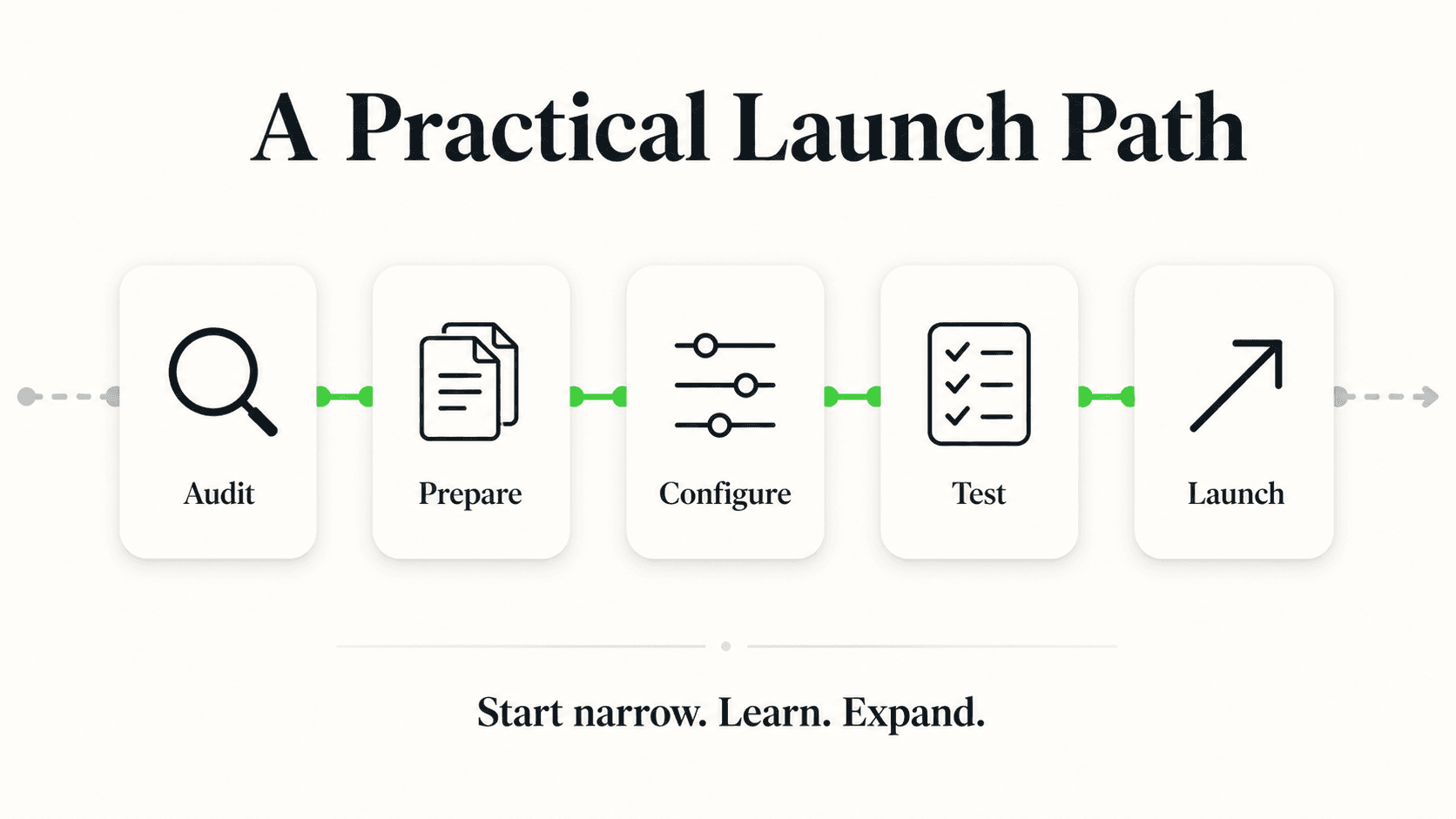
A customer-facing chat agent that answers questions, qualifies inquiries, and captures leads 24/7. Modern AI chatbots are grounded in your business content (not the open internet) and run across your website and messaging channels with the same persona and knowledge.
How is Hyperleap different from a chat widget or a live chat tool?
Live chat tools route to humans; basic widgets follow scripted flows. Hyperleap is an AI agent grounded in your content — it understands intent, retrieves from your knowledge base, qualifies leads, and escalates only when needed. Same answers across website, WhatsApp, Instagram DM, and Facebook Messenger.
How long does it take to set up an AI chatbot with Hyperleap?
Most SMBs go live in 3–5 days for self-serve setup. With Managed Setup ($299 Free, available on every plan), Hyperleap builds the bot for you on your content and channels. A 7-day free trial is included on every plan.
Further Reading
Authoritative external sources used and recommended for further research on this topic:
- Anthropic research and product documentation
- Google Search Central documentation
- Gartner customer service research
For the conversational-vs-generative distinction specifically (not the agentic one), see conversational AI vs generative AI.
See What a Real AI Agent Looks Like in Action
Hyperleap AI Agents are RAG-powered, multi-channel, and built for business conversations—not demos. Deploy on WhatsApp, web, Instagram, and Facebook Messenger in under a week.
Start Your Free TrialRelated Resources
- RAG vs Fine-Tuning vs Prompt Engineering: The Business Owner's Guide — How to choose the right AI architecture
- Answering for the Right Location — How a chatbot keeps several similar locations, courses, or plans apart
- What Makes AI Chatbots Actually Work — Deployment analysis
- How to Choose an AI Chatbot Platform — Selection framework
- AI Chatbot Statistics 2026 — Market data and benchmarks
- Getting Started with AI Agents — Implementation guide
Related Articles

What is MCP (Model Context Protocol)? SMB Guide
MCP lets AI tools like Claude and Cursor query your business data directly. Here is what Model Context Protocol means, why it matters, and how to use it.

How Accurate Are AI Chatbots in 2026? An Honest Benchmark
Document-grounded (RAG) chatbots answer far more reliably than vanilla LLMs. How to benchmark accuracy and what accurate enough means.
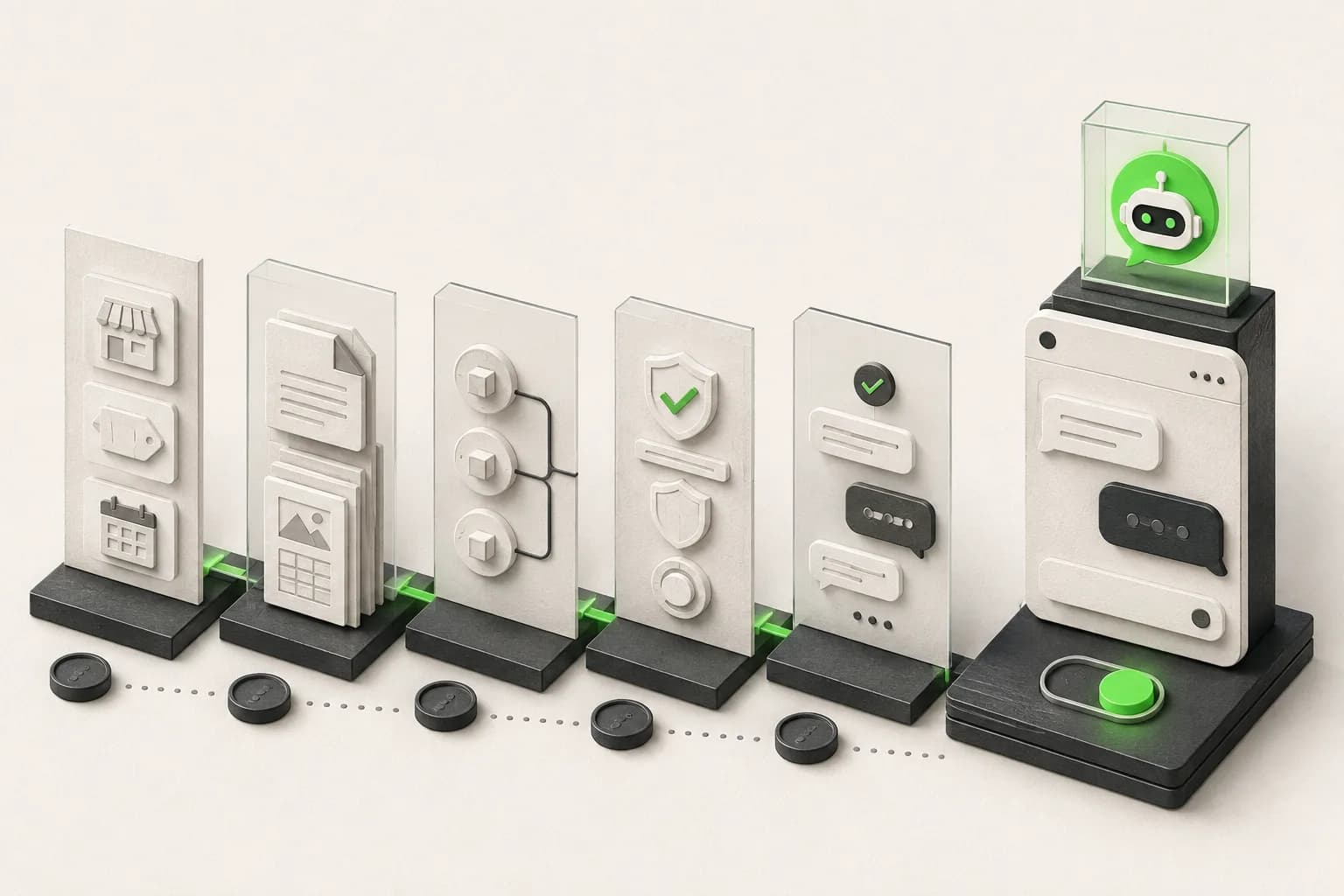
How to Build an AI Chatbot for Your Business
How to build an AI chatbot for your business: decide the jobs it should do, gather knowledge, choose channels, test, and go live in under 5 minutes.
How to Add an AI Chatbot to an HTML Website
Add an AI chatbot to a plain HTML site with one script tag before </body>. Step-by-step setup, testing, styling, and knowledge base tips.