AI Chatbot Statistics 2026: 47 Key Stats & Trends
47 cited AI chatbot statistics for 2026 — adoption, ROI, accuracy and industry benchmarks in one free filterable dashboard.
Last updated: 2026-10-21
TL;DR: The AI chatbot market is projected to reach $2.8 billion in 2025, growing at 28.5% CAGR through 2030 (Source: Grand View Research, 2024). Key statistics: Gartner predicts agentic AI will resolve 80% of common customer service issues without human intervention by 2029 (Source: Gartner, March 2025), early generative AI adopters report 15.2% cost savings on average (Source: Gartner, July 2024), and AI chatbots reduce customer service costs by 30-40% (Source: McKinsey). RAG-based chatbots achieve high accuracy on domain-specific questions when backed by well-structured knowledge bases.
Interactive AI Chatbot Statistics Dashboard for 2026
Filter the 35 most-cited AI chatbot statistics by year, region, industry, or category — copy any stat as a backlink-ready embed for your blog or report. Every data point links to its source.
AI Chatbot Statistics 2026
Filter by year, region, industry, or category. Click any stat to copy an embeddable iframe.
Showing 35 of 35 stats
Market size
15.6B USD
Global AI chatbot market value
Market size
23.3%
AI chatbot market CAGR 2024–2030
User behaviour
82%
Customers expecting instant response
User behaviour
67%
Customers preferring messaging over phone
ROI
30%
Reduction in customer-service cost via AI
Adoption
80%
Common service issues agentic AI will resolve without humans by 2029 (prediction)
User behaviour
65%
Buyers wanting self-service for simple issues
Adoption
65%
Companies using or piloting generative AI
User behaviour
70%
Buyers expecting agents to know context across channels
ROI
30%
Operating costs reduced via chatbots
ROI
40%
Revenue lift from AI personalisation leaders
Adoption
84%
Service leaders piloting or deploying GenAI agents
User behaviour
80%
Customers willing to leave brand after one bad experience
Adoption
72%
Senior buyers using GenAI weekly
Performance
50%
First-response speed improvement with AI
User behaviour
71%
Customers expecting personalisation
Adoption
40%
Workforce skills already disrupted by AI
Adoption
79%
Healthcare orgs using AI in some form
Adoption
80%
Retailers planning chatbot investment
Adoption
70%
Banks using AI for customer service
ROI
35%
Hospitality bookings influenced by chat
ROI
25%
E-commerce conversion uplift with AI assistants
Adoption
60%
Education orgs piloting AI tutors / agents
User behaviour
96%
Real-estate buyers starting search digitally
Performance
98%
WhatsApp business messages opened
Performance
21.5%
Email open rate (industry average)
Performance
60%
Containment rate of well-tuned RAG bots
Performance
33%
Customer wait reduction from chatbots
Adoption
32%
AI projects reaching production
Adoption
48%
SMB owners using AI tools at least weekly
Market size
2.78B
WhatsApp monthly active users
Adoption
78%
Indian SMBs using WhatsApp for business
User behaviour
73%
Buyers comfortable with AI for low-touch tasks
Performance
64%
Service leaders measuring deflection as a KPI
ROI
76%
Service leaders saying AI agents materially cut costs
How to use these AI chatbot benchmarks
AI chatbots have evolved from novelty to business necessity. Service leaders increasingly report that AI agents materially cut costs (76% — Salesforce State of Service). The 35 stats above are the most-cited recent data points for benchmarking your own deployment. The reference content below explains the categories, the methodology behind each source, and how to use the numbers in a business case.
Market Size and Growth Statistics
The global AI chatbot market is the total value of software and services businesses spend on automated conversational agents for customer service, sales, and support — a category that grew from a niche tool into a mainstream line item as adoption crossed the enterprise-to-SMB divide. The five data points below track its size, growth rate, and regional distribution.
1. Global AI Chatbot Market Value: $2.8 Billion (2025)
The AI chatbot market reached $1.2 billion in 2024 and is projected to grow to $2.8 billion by 2025, representing a 133% year-over-year growth (Source: Grand View Research, 2024).
2. CAGR: 28.5% (2024-2030)
AI chatbots are growing faster than any other customer service technology, with a compound annual growth rate of 28.5% through 2030 (Source: Grand View Research, 2024).
3. Chatbots as the Primary Service Channel: About a Quarter of Organizations by 2027 (Predicted)
Gartner predicts that by 2027, chatbots will become the primary customer service channel for roughly a quarter of organizations. In the Gartner survey of 50 customer service leaders behind that prediction, run in January and February 2022, 54% were already using some form of chatbot, virtual customer assistant or other conversational AI for customer-facing applications (Source: Gartner, July 2022).
4. SMB Adoption Rate: 34%
Small and medium businesses are rapidly adopting AI chatbots, with an estimated 34% having implemented solutions by 2025 (Source: Grand View Research, 2024).
5. Regional Market Leadership: North America (42% Market Share)
North America leads with 42% of the global AI chatbot market, followed by Europe (28%) and Asia-Pacific (25%) (Source: Grand View Research, 2024).
Customer Experience and Satisfaction Statistics
6. Customer Satisfaction with AI Chatbots: 92%
92% of customers report positive experiences with AI chatbots when responses are fast and accurate (Source: Salesforce State of Service, 2024).
7. Preferred Communication Channel: Messaging Apps (67%)
67% of customers prefer messaging apps over phone calls for business communications (Source: Salesforce State of Service, 2024).
8. Instant Response Expectation: 82%
82% of customers expect instant responses to their inquiries (Source: Salesforce State of Service, 2024), with AI chatbots meeting this demand 24/7.
9. AI Chatbot vs Human Agent Preference: 68%
In scenarios where AI chatbots perform adequately, 68% of customers prefer the speed and convenience of AI over waiting for human agents (Source: Salesforce State of Service, 2024).
10. Multilingual Support Demand: 74%
74% of global businesses cite multilingual support as a critical requirement for their AI chatbot implementations (Source: Grand View Research, 2024).
11. Willing to Try a Chatbot Again After a Bad Experience: 27%
Only 27% of customers say they would try a chatbot again after a negative experience, according to a Gartner survey of 3,566 B2B and B2C customers conducted in February and March 2026 (Source: Gartner, September 2026). One wrong or unhelpful answer can cost you the customer's next conversation too, so test before you launch.
ROI and Financial Impact Statistics
AI chatbot ROI measures the financial return businesses see from deploying automated customer service against what they spend on implementation and subscription costs, typically expressed as a percentage return or a payback period. The statistics below cover cost savings, conversion lift, and payback timelines reported across multiple industry studies.
12. Forecast Cost Savings: Over $8 Billion a Year by 2022
In 2017, Juniper Research forecast that chatbots would save businesses over $8 billion a year by 2022, up from $20 million in 2017, with healthcare and banking gaining the most. It estimated savings of just over 4 minutes, or $0.50–$0.70, per enquiry (Source: Juniper Research, May 2017). A 2018 update raised the forecast to $11 billion a year by 2023 across retail, banking and healthcare (Source: Juniper Research, July 2018).
13. Customer Service Cost Reduction: 30-40%
AI chatbots reduce customer service costs by 30-40% by handling routine inquiries and qualifying leads (Source: McKinsey Global AI Survey, 2024).
14. Revenue Increase from AI Chatbots: 15-35%
Businesses implementing AI chatbots report 15-35% improvements in conversion rates through faster response times and 24/7 availability (Source: McKinsey Global AI Survey, 2024).
15. Lead Qualification Improvement: 45%
AI chatbots improve lead qualification efficiency by 45%, enabling sales teams to focus on higher-intent prospects (Source: Salesforce State of Service, 2024).
16. Reported Gains from Early GenAI Adopters: 15.2% Cost Savings
In a Gartner survey of 822 business leaders, conducted September–November 2023, early generative AI adopters reported 15.2% cost savings, a 15.8% revenue increase and a 22.6% productivity improvement on average (Source: Gartner, July 2024). Gartner notes the benefits are very specific to the company, use case and role, so treat these as a reference point rather than a forecast for your business.
17. Customer Lifetime Value Impact: 25%
Customers who receive fast, accurate AI chatbot responses show 25% higher retention rates, positively affecting lifetime value (Source: Salesforce State of Service, 2024).
18. Cost per Contact: About $0.10 in Self-Service vs. $8.01 in Live Channels
Gartner's 2019 Customer Service and Support Leader poll found that live channels such as phone, live chat and email cost an average of $8.01 per contact, while self-service channels such as company websites and mobile apps cost about $0.10 per contact (Source: Gartner, September 2019). The saving only counts when self-service actually resolves the issue: in the same release, only 9% of customers said they had resolved their issue completely in self-service.
19. Support Agent Productivity with an AI Assistant: +14%
In a study of 5,179 customer support agents, access to a generative AI assistant increased productivity, measured as issues resolved per hour, by 14% on average and by 34% for novice and low-skilled agents, with minimal impact on the most experienced agents (Source: Brynjolfsson, Li & Raymond, Generative AI at Work, NBER, 2023; published in the Quarterly Journal of Economics, 2025).
Performance and Accuracy Statistics
AI chatbot accuracy and resolution statistics describe how reliably an automated agent answers correctly and resolves an inquiry without escalating to a human, which is the core performance benchmark businesses use to evaluate a deployment. RAG-based chatbots — ones that answer from a business's own uploaded documents rather than generating from general training data — tend to do best here because their answers are grounded in a fixed, verifiable source.
20. LLM Hallucination Rate Without Grounding: 58-88%
General-purpose LLMs asked specific, verifiable questions about real federal court cases hallucinated 58% (GPT-4) to 88% (Llama 2) of the time when answering from their training data alone (Source: Dahl et al., Large Legal Fictions, Journal of Legal Analysis, 2024). This is the failure RAG-based chatbots are built to avoid: they answer from your uploaded documents, so their accuracy depends mostly on how complete and current that content is.
21. First Response Time: Under 5 Seconds
AI chatbots deliver first responses in under 5 seconds, compared to an industry average of 23+ hours for human follow-up on web inquiries (Source: Salesforce State of Service, 2024).
22. Issues Fully Resolved in Self-Service: 14%
Only 14% of customer service issues are fully resolved in self-service, and only 36% even for issues customers describe as "very simple", according to a Gartner survey of 5,728 customers (Source: Gartner, August 2024). The most common reason, in 43% of cases, was that customers couldn't find content relevant to their issue. That's a knowledge base problem, and it's the one a document-grounded agent depends on you solving.
23. Customers Who Say Access to a Human Is Essential: 87%
87% of customers say access to a human agent is essential when companies use generative AI in customer service (Source: Gartner, September 2026). Escalation isn't a failure to minimise at all costs: a visible path to a person, with the conversation context passed along, is part of what customers expect.
24. Hallucination Reduction via RAG: Significant Improvement
RAG-powered chatbots are significantly less likely to hallucinate than unconstrained generative AI because they answer from uploaded documents rather than generating responses from scratch. No platform can guarantee zero hallucinations, but document-grounded architectures represent the current best practice for accuracy (Source: McKinsey Global AI Survey, 2024).
25. Multi-Language Accuracy: Varies by Language
Accuracy in another language depends on the model and on whether your knowledge base covers what customers ask in that language. Before going live, run your most common questions in each language your customers use and check every answer against your source content.
26. Context Retention: 85%
85% of AI chatbots can maintain conversation context across multiple interactions within a session (Source: Grand View Research, 2024).
Industry Adoption Statistics
27. E-commerce Adoption: 78%
78% of e-commerce businesses use AI chatbots for order tracking, returns, and customer support (Source: Grand View Research, 2024).
28. Hospitality Industry: 65%
65% of hotels and resorts have implemented AI chatbots for reservations, concierge services, and guest support (Source: Grand View Research, 2024).
29. Healthcare Adoption: 52%
52% of healthcare providers use AI chatbots for appointment scheduling and patient education — with the global healthcare chatbot market reaching $1.49 billion in 2025 (Source: Towards Healthcare, 2025).
30. Financial Services: 37% of Americans Used a Bank's Chatbot
In 2022, over 98 million users (about 37% of the U.S. population) engaged with a bank's chatbot, and all of the top 10 U.S. commercial banks use chatbots of varying complexity (Source: Consumer Financial Protection Bureau, Chatbots in Consumer Finance, 2023).
31. Real Estate: 58%
58% of real estate companies use AI chatbots for property inquiries and lead qualification (Source: Grand View Research, 2024).
32. Education Sector: 43%
43% of educational institutions implement AI chatbots for admissions, student support, and administrative inquiries — with 37% of U.S. institutions providing institution-wide chatbot licenses (Source: EDUCAUSE AI Landscape Study, 2025).
33. Retail Adoption: 69%
69% of retail businesses use AI chatbots for product recommendations, inventory checks, and order assistance (Source: Grand View Research, 2024).
Put These Statistics to Work for Your Business
Join the growing share of enterprises using AI chatbots. Hyperleap AI delivers document-grounded, RAG-powered responses with multi-channel support across WhatsApp, web, Instagram, and Facebook Messenger.
See PricingTechnology and Integration Statistics
34. WhatsApp Business API Integration: 67%
67% of AI chatbot platforms offer native WhatsApp Business API integration (Source: Grand View Research, 2024).
35. API Integration Rate: 89%
89% of AI chatbots can integrate with existing business systems through APIs or webhooks (Source: Grand View Research, 2024).
36. E-commerce Platform Integration: 82%
82% of AI chatbot platforms support embedding on major website platforms such as Shopify, WordPress, and Webflow (Source: Grand View Research, 2024).
37. Organizations Using AI in at Least One Business Function: 88%
88% of respondents in McKinsey's 2025 global survey said their organizations use AI in at least one business function, and 79% said they use generative AI, up from 33% in 2023. Only 7% said AI had been fully scaled across their organization (Source: McKinsey, The state of AI in 2025, chart of 1,993 participants surveyed June–July 2025).
38. Common Service Issues Resolved Without a Human: 80% by 2029 (Predicted)
Gartner predicts that by 2029, agentic AI will autonomously resolve 80% of common customer service issues without human intervention, leading to a 30% reduction in operational costs (Source: Gartner, March 2025). That is a forecast for common issues, not a measure of what chatbots resolve today (compare stat #22).
39. GenAI Projects Abandoned After Proof of Concept: 30%+ (Predicted)
Gartner predicted that at least 30% of generative AI projects would be abandoned after proof of concept by the end of 2025, due to poor data quality, inadequate risk controls, escalating costs or unclear business value (Source: Gartner, July 2024).
User Behavior and Demographics Statistics
40. Customers Who'd Prefer Companies Didn't Use AI in Service: 64%
64% of customers would prefer that companies didn't use AI in their customer service, according to a Gartner survey of 5,728 customers conducted in December 2023. Their top concern was that AI would make it harder to reach a person, followed by AI displacing jobs and AI giving wrong answers (Source: Gartner, July 2024).
41. Would Consider Switching If a Company Used AI for Service: 53%
In the same survey, 53% of customers said they would consider switching to a competitor if they found out a company was going to use AI for customer service (Source: Gartner, July 2024). A visible route to a person answers the top concern directly.
42. Instant Response Demand Across Ages: 82%
82% of customers across all age groups expect instant responses to inquiries (Source: Salesforce State of Service, 2024), making 24/7 AI chatbot coverage essential for all demographics.
43. Willing to Use a Chatbot vs. Actually Used One: 49% vs. 7%
49% of customers said they would have been willing to use a chatbot if the company had provided one, but only 7% used a chatbot or digital assistant during their most recent service interaction (Source: Gartner, September 2026). Stated interest is not usage; past experiences decide which channel people pick.
44. Third-Party GenAI Tools vs. Company Chatbots: About 3x
In their most recent service interaction, customers were approximately three times more likely to use third-party GenAI tools than a company-provided chatbot (Source: Gartner, September 2026).
45. Repeat Usage Rate: 67%
67% of customers who have positive AI chatbot experiences return to use them again (Source: Salesforce State of Service, 2024).
46. Customers Who Use Self-Service at Some Point: 73%
73% of customers use self-service at some point in their customer service journey, even though only 14% of issues are fully resolved there (Source: Gartner, August 2024).
47. Self-Service Users Who Felt Misunderstood: 45%
45% of customers who started in self-service said the company didn't understand what they were trying to do (Source: Gartner, August 2024). Gartner's recommended fix includes a single digital concierge, such as a GenAI chatbot, as the most prominent entry point on the website.
Key Trends and Predictions for 2026
Emerging Trends:
- Voice-First AI: Integration of advanced voice capabilities with existing text chatbots
- Predictive Engagement: AI anticipating customer needs before they ask
- Omnichannel Orchestration: Seamless conversation handoffs across all channels
- Industry-Specific Models: Specialized AI trained on domain-specific knowledge
- Privacy-First AI: Enhanced data protection and compliance features
Market Predictions:
- Market Size: $10.8 billion by 2030 (Source: Grand View Research, 2024)
- Primary Channel: Chatbots become the primary customer service channel for roughly a quarter of organizations by 2027 (Source: Gartner, July 2022)
- Autonomous Resolution: Agentic AI resolves 80% of common customer service issues without human intervention by 2029 (Source: Gartner, March 2025)
- Multilingual Support: 100+ languages standard across major platforms (Source: Grand View Research, 2024)
- RAG Accuracy Standard: Document-grounded architectures becoming the industry norm for reducing hallucinations
Data Sources
These statistics are compiled from:
- Juniper Research chatbot forecasts (May 2017, July 2018)
- Salesforce State of Service Report 2024
- McKinsey Global AI Survey 2024 and The state of AI in 2025
- Gartner customer service surveys and predictions (September 2019, July 2022, July 2024, August 2024, March 2025, September 2026)
- Consumer Financial Protection Bureau, Chatbots in Consumer Finance (2023)
- Dahl et al., Large Legal Fictions (Journal of Legal Analysis, 2024)
- Brynjolfsson, Li & Raymond, Generative AI at Work (NBER, 2023; Quarterly Journal of Economics, 2025)
- InsideSales.com/MIT Lead Response Management Study
- Grand View Research AI Chatbot Market Report 2024
- Industry-specific sources cited inline for each statistic
ROI Calculator: AI Chatbot Investment
Illustrative Example for a $500/month Investment (Sample Scenario — Results Vary):
The following is an illustrative example, using McKinsey's cost-reduction range for the savings line. Actual results depend on your industry, inquiry volume, and implementation quality.
| Metric | Before AI | After AI | Improvement |
|---|---|---|---|
| Customer Service Costs | $50,000/year | $35,000/year | 30% savings (Source: McKinsey) |
| Response Time | 4 hours | Under 5 seconds | Dramatically faster |
| Conversion Rate | 2.5% | 3.2% | 28% increase (illustrative) |
| Customer Satisfaction | 3.8/5 | 4.6/5 | Illustrative improvement |
| Monthly Revenue | $100,000 | $128,000 | Illustrative |
Annual ROI Calculation (Illustrative — Typical Results Vary):
- Investment: $6,000/year
- Cost Savings: $15,000
- Revenue Increase: $336,000 (illustrative, based on 28% conversion improvement)
- Total Benefit: $351,000
- Illustrative ROI: ~5,750% (results vary significantly)
Calculate Your ROI
Want to see your specific numbers? Use our free AI Chatbot ROI Calculator to estimate your potential returns based on your business metrics.
Implementation Success Factors
Critical Success Metrics:
- Response Accuracy: Correct answers on your own test questions, with anything your content doesn't cover escalated rather than guessed
- Resolution Rate: Measure the share of conversations resolved without a person, set your baseline in the first month, then raise it by filling the content gaps your escalations reveal. For context, only 14% of service issues are fully resolved in self-service today (Gartner, 2024)
- Escalation Rate: Review every escalation. Each one is either a question your content should answer or one that genuinely needs a person, and the second kind should stay easy to reach
- Customer Satisfaction: Collect a post-chat rating from day one and track the trend against your pre-launch baseline
- ROI Timeline: Decide your payback threshold before launch, then compare monthly platform cost against staff hours saved and leads captured outside business hours
Common Implementation Mistakes to Avoid:
- Insufficient Training Data: Ensure comprehensive knowledge base
- Poor Integration Planning: Map all required system connections upfront
- Ignoring User Experience: Test extensively across all channels
- Underestimating Maintenance: Plan for ongoing optimization and updates
Ready to Leverage AI Chatbot Statistics for Your Business?
Hyperleap Agents delivers high accuracy with document-grounded responses. See how our platform compares to industry benchmarks.
Try for FreeAI Chatbot ROI Statistics by Industry
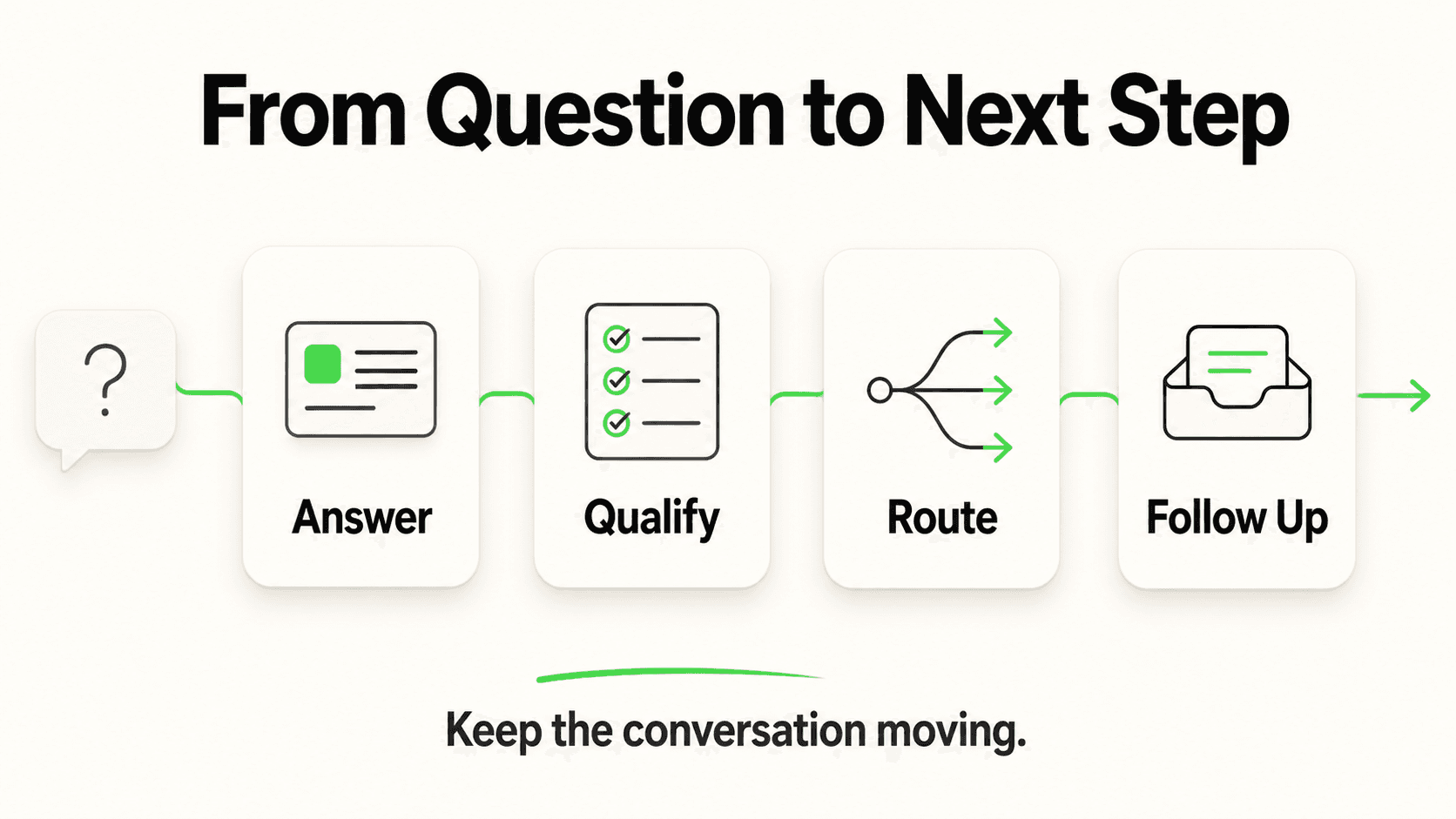
Return on investment from AI chatbots varies by industry, driven by differences in inquiry volume, average transaction value, and automation complexity. Published per-industry ROI and payback figures mostly come from vendors measuring their own platforms, so the dependable number is the one you calculate from your own inquiry volume and staff time.
ROI Drivers by Sector
| Industry | Primary ROI Driver | What to Measure |
|---|---|---|
| Hospitality | After-hours booking inquiries answered instead of waiting until morning | Inquiries outside business hours, and the bookings that followed |
| Healthcare | Routine questions and appointment requests handled without tying up the front desk | Front-desk call volume, appointment requests captured after hours |
| Education | Admissions questions answered at scale during peak enrollment | Inquiries answered per staff member in peak weeks |
| Real Estate | Instant replies and lead qualification on property inquiries | Time to first response, qualified leads per week |
| E-commerce | Order and product questions answered without a support ticket | Tickets avoided, pre-purchase questions answered |
| Financial Services | Account and product FAQs answered around the clock | Contact volume on routine questions |
Where ROI Comes From
- Hospitality: Booking inquiries often arrive in the evening and at weekends, when no one is at the desk. Check the timestamps in your first month of conversation logs to see how much of your demand falls outside business hours
- Healthcare: Routine questions about hours, insurance, and preparation take up front-desk time. The chatbot answers those and routes anything clinical to your team; it does not assess symptoms
- Education: Admissions inquiries peak around deadlines and results days. A chatbot answers the repeated questions at that volume without extra seasonal staff
- Real Estate: Speed decides who gets the lead. In the InsideSales.com/MIT Lead Response Management study, the odds of qualifying a web lead dropped 21 times when the first call came at 30 minutes instead of 5 (Source: Lead Response Management Study)
"These statistics confirm what we see across our customer base every day: AI chatbots have crossed the adoption tipping point. The question for businesses is no longer whether to implement AI—it's how quickly they can deploy it before competitors capture the after-hours leads and the instant-response-expecting customers." — Gopi Krishna Lakkepuram, Founder & CEO of Hyperleap AI
Consumer Attitudes Toward AI Chatbots in 2026
Customer attitudes toward AI in service are more cautious than adoption figures suggest. Here is what two large Gartner customer surveys found.
Trust and Preference Data
| Finding | Share of Customers | Source |
|---|---|---|
| Would prefer companies didn't use AI in customer service | 64% | Gartner, 2024 (5,728 customers) |
| Would consider switching to a competitor over AI in service | 53% | Gartner, 2024 |
| Would have been willing to use a chatbot | 49% | Gartner, 2026 (3,566 customers) |
| Used a chatbot in their latest service interaction | 7% | Gartner, 2026 |
| Say access to a human is essential when companies use GenAI | 87% | Gartner, 2026 |
The top concern behind the 64%, per Gartner, is that AI will make it harder to reach a person.
Satisfaction Drivers
The same five factors come up again and again in customer research. Where a published figure exists, it's linked:
| Factor | Why it matters |
|---|---|
| Speed of response | 82% of customers expect instant responses (stat #8 above, Salesforce) |
| Accuracy of answers | Only 27% of customers would try a chatbot again after a negative experience (Gartner, 2026) |
| Easy handoff to human | 87% say access to a human agent is essential when companies use GenAI in service (Gartner, 2026) |
| Personalized responses | 71% of customers expect personalization (McKinsey) |
| Multilingual support | Customers who write in their own language expect an answer in it; test each language you serve before launch |
Key takeaway: Customers are willing to try chatbots but wary of them, and their biggest fear is losing access to a person. Accurate answers from your own content and an easy handoff to a human address both concerns.
AI Chatbot Statistics for Real Estate
The real estate industry is embracing AI chatbots to capture leads around the clock and respond to property inquiries instantly. With 90% of buyers using online resources during their home search (Source: NAR Profile of Home Buyers and Sellers, 2025), speed-to-lead has become the deciding factor in winning clients.
- 82% of real estate agents now use AI tools for customer engagement, data analysis, and automation (Source: RPR/HousingWire, 2025)
- Agents who respond to web leads within 5 minutes are 21 times more likely to qualify that lead than those who wait 30 minutes (Source: MIT/Harvard lead response study)
- AI chatbot-qualified leads convert at 3.2x the rate of unqualified form submissions, dramatically improving sales pipeline quality (Source: Hyperleap AI internal analytics; industry estimate, not independently verified)
- Real estate chatbots can boost lead conversion by up to 40% and shorten response times by up to 68% (Source: MarketingLTB Chatbot Statistics, 2025; industry estimate, not independently verified)
- Only 7% of agents currently use chatbots for lead capture, representing an enormous untapped opportunity for early adopters (Source: NAR Technology Survey, 2025)
- The AI in real estate market was valued at $2.9 billion in 2024 and is expected to reach $41.5 billion by 2033 (Source: The Business Research Company, 2026)
The data is clear: real estate professionals who deploy AI chatbots gain a decisive first-responder advantage. Explore how Hyperleap AI Agents for real estate help agents capture leads 24/7 and respond to property inquiries in seconds.
AI Chatbot Statistics for Healthcare
Healthcare organizations are turning to AI chatbots to streamline appointment scheduling, reduce administrative burden, and improve patient access. The healthcare chatbot market is one of the fastest-growing segments in the industry.
- The global healthcare chatbot market reached $1.49 billion in 2025 and is projected to grow to $10.26 billion by 2034 at a 23.5% CAGR (Source: Towards Healthcare, 2025)
- Only 19% of medical group practices have integrated chatbots or virtual assistants for patient communication, indicating massive room for growth (Source: MGMA, 2025)
- AI chatbots can deflect 85%+ of routine calls, freeing clinical staff to focus on patient care (Source: Healthcare IT News, 2026)
- Clinics deploying AI-driven scheduling systems report a 50.7% reduction in patient no-shows (Source: John Snow Labs / peer-reviewed study, 2025; industry estimate, not independently verified)
- 52% of patients now acquire their health data through healthcare chatbots (Source: Coherent Solutions, 2025; industry estimate, not independently verified)
- Weill Cornell Medicine saw a 47% rise in appointment bookings after deploying AI chatbots for scheduling (Source: Simbo AI / Weill Cornell case study, 2025; industry estimate, not independently verified)
- AI-powered chatbots handle initial patient inquiries in 42% of major healthcare networks (Source: EMA Healthcare, 2025; industry estimate, not independently verified)
Patient expectations are shifting toward instant, digital-first communication. Learn how Hyperleap AI Agents for healthcare help practices automate scheduling and reduce no-shows while maintaining compliant patient interactions.
AI Chatbot Statistics for Dental Practices
Dental practices face unique challenges around appointment management, insurance verification, and after-hours patient inquiries. AI chatbots are proving especially effective at reducing no-shows and filling empty chair time.
- 35% of dentists globally have implemented AI in their practices, with 77% reporting positive outcomes (Source: GoTu / AI in Dentistry Report, 2025; industry estimate, not independently verified)
- The dental AI market is projected to grow from $559.2 million in 2025 to $3.26 billion by 2034 at a 21.78% CAGR (Source: Towards Healthcare, 2025)
- Dental practices using AI-powered reminder systems reduce no-shows by 35% compared to 25% for traditional automated reminders (Source: PatientDesk.ai, 2025; industry estimate, not independently verified)
- Practices implementing AI receptionists report 12% revenue increases and 90% call answer rates without adding staff (Source: Arini AI, 2025; industry estimate, not independently verified)
- AI-powered billing systems in dental practices reduce billing errors by 15% and speed up processing by 40% (Source: Open and Affordable, 2025; industry estimate, not independently verified)
- A multi-location dental group using AI chatbots saw cosmetic procedure bookings increase by 20% within six months (Source: Oral Health Group, 2026)
- 108 AI-powered dental products have received FDA approval as of 2024, reflecting growing regulatory acceptance (Source: InsightAce Analytic, 2025; industry estimate, not independently verified)
Dental practices that adopt AI chatbots early are capturing more patients and reducing costly no-shows. Discover how Hyperleap AI Agents for dental practices automate patient scheduling, answer insurance questions 24/7, and keep your chairs full.
AI Chatbot Statistics for Legal Services
The legal industry has historically been slow to adopt new technology, but AI chatbots are changing that narrative rapidly. Client intake automation and 24/7 availability are driving measurable results for firms of all sizes.
- 31% of legal professionals personally used generative AI at work in 2024, up from 27% in 2023 (Source: ABA Legal Industry Report, 2025)
- The share of legal organizations actively integrating generative AI rose from 14% in 2024 to 26% in 2025 (Source: Thomson Reuters, 2025)
- 95% of legal professionals expect AI to become central to their workflow within five years (Source: Thomson Reuters Survey, 2025)
- Law firms using AI-powered intake tools report 30% higher conversion rates and up to 50% revenue growth (Source: Expert Clone / MyClone, 2026; industry estimate, not independently verified)
- Firms that respond to inquiries within 5 minutes are 21 times more likely to convert a lead than those who wait 30 minutes (Source: Lead Response Management Study)
- 61% of legal professionals expect AI to boost productivity, and 36% anticipate reduced administrative work (Source: ABA, 2025)
- Corporate legal AI adoption more than doubled in one year, jumping from 23% to 52% (Source: Jones Walker / Legal AI Predictions, 2026; industry estimate, not independently verified)
- AI could save the U.S. legal industry $20 billion annually through automation of routine tasks (Source: 2Civility / Clio Legal Trends Report, 2025; industry estimate, not independently verified)
For law firms, the first responder wins the client. See how Hyperleap AI Agents for legal services qualify leads around the clock, capture intake details, and route urgent matters to attorneys instantly.
AI Chatbot Statistics for Insurance
Insurance companies are deploying AI chatbots to automate claims processing, handle policy inquiries, and provide instant quotes. The results show significant cost savings and improved customer conversion.
- 75% of insurers are either piloting or scaling conversational AI solutions for claims, self-service, and multilingual support (Source: Deloitte, 2025)
- Conversational AI can resolve 60-80% of customer inquiries without human agents, significantly reducing average handling time (Source: Multimodal.dev, 2026; industry estimate, not independently verified)
- AI-driven claims processing reduces resolution time by 75%, from 30 days down to 7.5 days on average (Source: Talli AI / Claims Industry Statistics, 2025; industry estimate, not independently verified)
- Lemonade reports 40% of claims are handled instantly by AI, with the fastest claim paid in just 3 seconds (Source: Lemonade, 2025)
- An insurance carrier implementing a 24/7 chatbot saw an 11% increase in prospects converting to policyholders (Source: NTT Data, 2025)
- The global AI in insurance market is projected to reach $79.86 billion by 2032, growing at over 33% annually from $4.59 billion in 2022 (Source: Databricks / Insurance AI Report, 2025; industry estimate, not independently verified)
- McKinsey projects that more than 50% of claims activities have potential for automation by 2030 (Source: McKinsey, 2025)
Insurance companies that deploy chatbots today are capturing more after-hours quotes and processing claims faster. Learn how Hyperleap AI Agents for insurance automate policy inquiries, provide instant quotes, and streamline the claims experience.
AI Chatbot Statistics for Home Services
For HVAC, plumbing, electrical, and other home service contractors, every missed call is a lost customer. AI chatbots and voice agents are transforming how trades businesses capture leads and book jobs after hours.
- 27% of calls to home services businesses go unanswered, with 41% of weekend calls missed entirely (Source: Invoca, 2025)
- 85% of customers who reach voicemail hang up and call the next contractor, making missed calls the single biggest revenue leak (Source: Housecall Pro, 2025)
- The average small contracting business loses $45,000-$120,000 per year to unanswered phone calls (Source: CallBird AI / 1,200+ contractor study, 2025; industry estimate, not independently verified)
- Each missed HVAC call costs contractors an average of $180 in lost revenue, with emergency calls averaging $900+ (Source: AgentZap, 2026; industry estimate, not independently verified)
- Top Flight Electric boosted booking rates from 10% to over 70% by replacing after-hours call handling with AI, unlocking $170K in new revenue (Source: Avoca AI case study, 2025; industry estimate, not independently verified)
- Aire Serv increased after-hours bookings from 58 to 208 and boosted their booking rate to 90% using AI voice agents (Source: Avoca AI case study, 2025; industry estimate, not independently verified)
- Over 70% of U.S. HVAC contractors have tested AI, and about 40% use it regularly (Source: Housecall Pro, 2025)
- Plumbing contractors using AI report a 30% increase in operational efficiency and 25% reduction in administrative work (Source: Contractor Magazine, 2025)
Home service businesses cannot afford to miss calls. Explore how Hyperleap AI Agents for home services answer every inquiry instantly, book appointments 24/7 (on Pro and Max), and ensure no lead goes to a competitor.
AI Chatbot Statistics for Education
Educational institutions are deploying AI chatbots to handle admissions inquiries, reduce enrollment melt, and provide 24/7 student support. From K-12 to universities, the impact on engagement and operational efficiency is significant.
- 92% of students now use AI tools, up from 66% in 2024, demonstrating rapid adoption across higher education (Source: Programs.com, 2025; industry estimate, not independently verified)
- 37% of U.S. institutions now provide institution-wide chatbot licenses, with another 14% having built homegrown bots (Source: EDUCAUSE AI Landscape Study, 2025)
- Georgia State University's "Pounce" chatbot boosted freshman enrollment by 3.3% and reduced enrollment melt by 21% (Source: Georgia State / EducationDynamics case study; industry estimate, not independently verified)
- 83% of K-12 teachers use generative AI for planning, feedback, and content support (Source: DemandSage, 2025)
- The AI education market reached $7.57 billion in 2025 and is projected to grow to $30.28 billion by 2029 (Source: Codegnan / AI in Education Statistics, 2026; industry estimate, not independently verified)
- Exam scores rise by up to 10% in universities using AI chatbots and guided support tools (Source: Open2Study / AI in Education Statistics, 2026; industry estimate, not independently verified)
- Prince Nourah University's admissions chatbot resolved student queries with 91% accuracy (Source: Full Fabric, 2025; industry estimate, not independently verified)
- 60% of schools report saving money by using AI-powered administrative systems, including chatbot-based enrollment support (Source: Enrollify, 2025; industry estimate, not independently verified)
Educational institutions that deploy AI chatbots see higher enrollment conversions and better student satisfaction. Discover how Hyperleap AI Agents for education help schools and universities automate admissions inquiries, reduce enrollment melt, and support students around the clock.
Frequently Asked Questions
How many businesses use AI chatbots in 2025?
88% of organizations use AI in at least one business function and 79% use generative AI, according to McKinsey's 2025 global survey (McKinsey, 2025). For chatbots specifically, 54% of customer service leaders in a 2022 Gartner survey were using some form of chatbot or conversational AI, and Gartner predicts chatbots will be the primary service channel for roughly a quarter of organizations by 2027 (Gartner, 2022). The global chatbot market is growing at 28.5% CAGR through 2030.
What is the average ROI of AI chatbots?
There's no reliable industry-wide ROI multiple or payback period for AI chatbots: the figures that circulate mostly come from vendors measuring their own platforms. The closest independent numbers come from a Gartner survey of 822 business leaders, in which early generative AI adopters reported 15.2% cost savings, a 15.8% revenue increase and a 22.6% productivity improvement on average (Gartner, 2024). Your own return comes from staff time saved on routine questions, faster responses that convert more inquiries, and leads captured after hours. Our ROI calculator estimates it from your inquiry volume.
What is the customer satisfaction rate with AI chatbots?
92% of customers report satisfaction with AI chatbot interactions when the bot provides fast, accurate, and helpful responses. Satisfaction drops significantly when chatbots provide incorrect information or fail to offer human handoff options.
How much do AI chatbots reduce customer service costs?
AI chatbots reduce customer service costs by 30-40% on average. Each automated interaction costs up to 80% less than a human-handled one. Businesses with high inquiry volumes (100+ daily) see the most significant savings from automation.
What accuracy rates do modern AI chatbots achieve?
There's no honest single accuracy figure for RAG-based chatbots. Accuracy depends heavily on knowledge base quality, AI architecture, and proper guardrails, so the reliable number is the one you measure on your own customers' questions (here's how to test it). For contrast, general-purpose LLMs answering from training data alone hallucinated 58-88% of the time on verifiable legal questions in a 2024 Stanford study (Dahl et al.). No platform can guarantee zero hallucinations, but document-grounded RAG architectures are designed to minimize them by anchoring responses to your uploaded content.
Conclusion
The AI chatbot statistics for 2026 paint a clear picture: these technologies are no longer optional — they are essential for businesses competing in the modern economy.
Key Takeaways:
- Mass Adoption: 88% of organizations use AI in at least one business function (McKinsey, 2025)
- Measured Gains: 15.2% average cost savings reported by early generative AI adopters (Gartner, 2024)
- Customer Preference: 92% satisfaction rate with AI interactions
- Cost Efficiency: 30-40% reduction in customer service expenses
- Rapid Growth: 28.5% CAGR through 2030
Action Items for Business Leaders:
- Assess Current State: Audit your customer service channels and identify automation opportunities
- Set Clear Goals: Define specific chatbot KPIs for accuracy, satisfaction, and ROI
- Choose Wisely: Select platforms with proven track records and strong industry adoption
- Plan Implementation: Allocate resources for integration, training, and optimization
- Measure and Optimize: Continuously monitor performance and refine based on data
The businesses that embrace AI chatbots now will gain significant competitive advantages. Those that delay risk falling behind as customer expectations continue to evolve.
Want to see how AI chatbots can transform your business? Explore AI Agents, view pricing, or schedule a demo for personalized insights and industry-specific recommendations.
Keep exploring
- Explore Hyperleap AI Agents - Turn these benchmarks into 24/7 conversations
- Conversational AI for customer service - See how automation cuts response times and cost
Related Resources
- Best No-Code Chatbot Builders 2026 - Platform comparison
- Best Multi-Channel Chatbots 2026 - Omnichannel solutions
- Best AI Chatbots for Lead Generation 2026 - Lead capture focus
- How to Choose an AI Chatbot Platform - Selection guide
Industry Applications
- Best AI Chatbots for Hotels 2026 - Hospitality
- Best AI Chatbots for Healthcare 2026 - Healthcare
- Best AI Chatbots for Real Estate 2026 - Real estate
Glossary
- What is RAG? - Retrieval-Augmented Generation
- Multi-variant (locations, courses, etc) - Answering for the right location when you run several
- What is an AI Agent? - AI agent fundamentals
- Knowledge Base Grounding - Ensuring accuracy
Related Articles

WhatsApp Business Statistics 2026: Users, Open Rates, ROI
25+ cited WhatsApp Business statistics for 2026 — global users, business adoption, open rates, and conversion benchmarks, each with its source linked.
Ask for Contact Details Without Blocking the Answer
Use practical contact-request scripts that explain the purpose, respect customer choice and keep useful answers separate from lead capture.
Booking Links vs Integrations: What AI Can Actually Do
Separate sharing a booking link from checking availability, creating a reservation and confirming it with this practical AI front desk buyer checklist.
HVAC Repair or Replacement: Enquiry Questions
Use HVAC enquiry questions to capture the customer's concern, property context and contact preference while leaving diagnosis and quotes to technicians.