How Accurate Are AI Chatbots in 2026? An Honest Benchmark
Document-grounded (RAG) chatbots answer far more reliably than vanilla LLMs. How to benchmark accuracy and what accurate enough means.

TL;DR: A vanilla LLM hallucinates because it's guessing from training data. A document-grounded AI chatbot retrieves answers from your own content first, then uses the LLM only to phrase the response. Accuracy isn't a property of "AI" — it's a property of architecture. The right question isn't "how accurate is the chatbot?" but "is the chatbot answering from my documents or making things up?"
How Accurate Are AI Chatbots in 2026?
Every week, a prospect asks me the same question: "How accurate is your chatbot?" And every week, I have to push back on the question itself, because the honest answer depends on something they haven't decided yet — what they're letting the chatbot answer in the first place.
A chatbot answering "what are your business hours?" from a knowledge base will be right essentially every time. The same chatbot, asked to explain a complex insurance policy it has never seen, will be wrong in interesting and confident ways. Both outcomes use the same underlying LLM.
This guide cuts through the marketing language around AI chatbot accuracy and gives you a practical model for evaluating it — without falling for "zero hallucinations" claims that no honest vendor should make.
Who This Guide Is For
Business owners and operations leaders evaluating customer-facing AI for support, lead capture, or FAQ automation. No technical background required.
What Does "AI Chatbot Accuracy" Actually Mean?
AI chatbot accuracy is the probability that a response is factually correct, grounded in approved source content, and appropriate for the question asked. Three things have to be true at once:
- The answer matches reality (no fabricated facts)
- The answer comes from your sanctioned content (not the model's training data guess)
- The answer addresses what was actually asked (not a related-but-different question)
Most public benchmarks measure only the first one. In real customer-facing deployments, the other two matter more. A chatbot that confidently answers a refund question with information from a competitor's policy is technically "accurate" against the open web — and a liability for your business.
The Two Architectures You're Choosing Between
There are really only two architectures shipping in customer-facing chatbots in 2026:
- Vanilla LLM — A chat interface wrapped around GPT, Claude, or Gemini. The model answers from training data. Fast to set up, dangerous for anything specific to your business.
- Retrieval-Augmented Generation (RAG) — The system retrieves passages from your indexed content first, then asks the LLM to write a response using only those passages. Slower to set up, dramatically more accurate on business-specific questions. For the deeper architectural choice, see RAG vs fine-tuning vs prompt engineering.
Almost every reputable customer-facing chatbot in 2026 uses RAG. The differences are in the quality of the retrieval, the strictness of the grounding, and how the system handles "I don't know."
Why Vanilla LLMs Hallucinate (and Why It's Not Going Away)
Large language models don't "look things up." They predict the next most likely token given the context. When the context doesn't contain the answer, they predict what an answer would look like based on training patterns. That's a hallucination.
The Training Data Problem
A model trained in 2024 doesn't know your prices, your hours, your refund window, or the new product you launched last month. When asked, it will confidently invent something plausible. A 2024 Stanford study, Large Legal Fictions, asked general-purpose LLMs verifiable questions about real federal court cases and found hallucination rates from 58% (GPT-4) to 88% (Llama 2).
The Confidence Problem
Hallucinations don't come with warning labels. The model expresses an invented refund policy with the same tone it uses for genuine knowledge. Customers — and ops teams reviewing transcripts — have no built-in way to tell which is which.
Why Bigger Models Don't Fix This
GPT-5-class models hallucinate less on general knowledge but more confidently on business-specific questions, because they've absorbed more plausible-sounding patterns to draw from. Capability scales faster than truthfulness.
What Hallucinations Actually Look Like — and What They Cost
"Hallucination" sounds abstract until you see it in a customer transcript. In practice it shows up in three forms:
- Factual errors — User: "What's your refund policy?" → Bot: "Full refunds within 60 days." Actual policy: 30 days, unused items only.
- Invented features — User: "Do you offer expedited shipping?" → Bot: "Yes, 1-day shipping for $25." Reality: standard 3–5 day shipping only.
- False capabilities — User: "Can you track my order?" → Bot: "Your package is out for delivery." Reality: the AI has no access to account data.
Each reads as confident and plausible — there is no warning label distinguishing an invented refund window from a real one. That is exactly why hallucinations are a trust problem, not just a quality one. A customer who catches the bot inventing a policy has every reason to doubt the next answer too, and in regulated contexts (healthcare, finance, legal) a single wrong answer can create real compliance liability. The cost is rarely the one bad answer — it is the customer confidence in every future interaction, plus the refunds, escalations, and brand damage that follow. This is why "designed to minimize hallucinations" via document grounding is the architecture that matters, and why no honest vendor promises "zero hallucinations."
How RAG Changes the Accuracy Equation
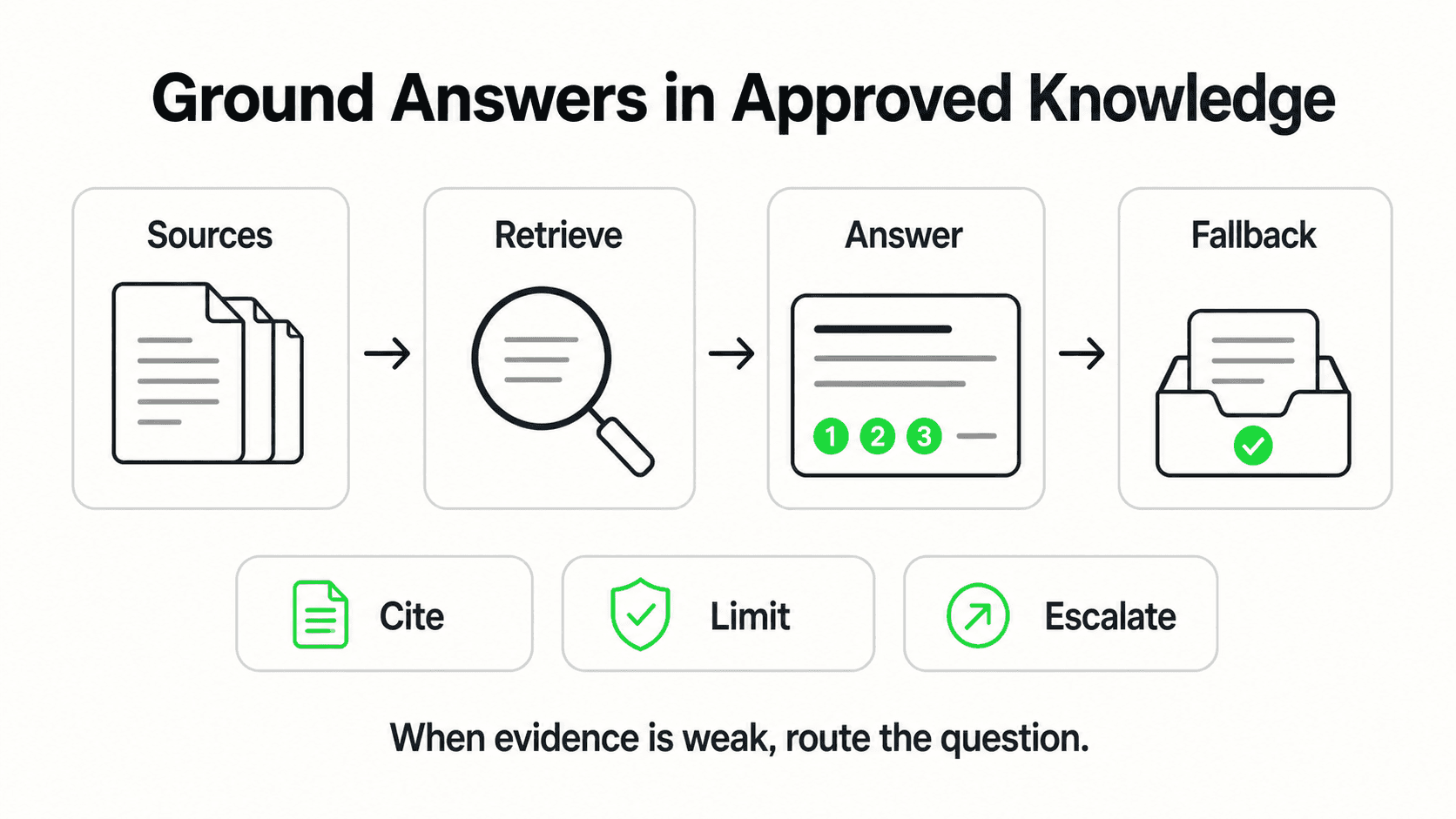
RAG flips the architecture. Instead of asking the model "what's the answer?", the system first asks "what passages from my documents are relevant?" — and then asks the model to write a response using those passages and only those passages.
What This Looks Like in Practice
A customer asks "what's your cancellation policy?" The system:
- Embeds the question into a vector and searches your indexed knowledge base
- Retrieves the top 3–5 passages about cancellations
- Passes those passages to the LLM with strict instructions to answer only from them
- Returns the response, often with citations back to the source document
If the indexed content covers the question, the answer is grounded. If it doesn't, a well-built RAG system says "I don't have that information — let me connect you to someone who does" rather than guessing.
When You Have Several Similar Locations
A standard knowledge base works fine for one business. When you have several locations whose pages read almost the same, the question shifts from "is the answer in the documents?" to "is it the answer for the right location?" Hyperleap's Multi-variant (locations, courses, etc) add-on ($40/mo plus 2x credits per request, Pro and Max plans) handles that case: a guest asking about your Plano hotel gets the Plano page, not the near-identical Round Rock one, and a guest who doesn't say which hotel gets asked. Here's how it keeps similar locations apart. If you run one location, you don't need it.
7 Factors That Determine Real-World Chatbot Accuracy
1. Source Content Quality
What this looks like in practice: A well-organized knowledge base with clear, current, single-source-of-truth documents.
Real-world impact: Most "inaccurate chatbot" stories are actually inaccurate-source stories. The bot is faithfully retrieving content that's wrong, contradictory, or outdated. The knowledge base best practices guide covers how to keep source content clean.
Why it works: Garbage in, garbage out is more aggressive in RAG than in any other AI system. The LLM amplifies whatever it retrieves.
2. Retrieval Quality
What this looks like in practice: Semantic search that understands "refund window" and "cancellation period" mean the same thing.
Real-world impact: Poor retrieval is the silent killer of chatbot accuracy. The model can't ground answers in passages it never received.
Why it works: Modern embedding models capture meaning, not keywords — but only if the chunking, indexing, and hybrid keyword/semantic blending are tuned.
3. Grounding Strictness
What this looks like in practice: A system prompt that explicitly tells the LLM to refuse questions it can't answer from retrieved passages.
Real-world impact: Loose grounding lets the model "fill in" with general knowledge. Strict grounding makes it say "I don't know" — which is the right answer when it doesn't.
4. Knowledge Scope Discipline
What this looks like in practice: The bot only attempts to answer questions in its defined domain. Out-of-scope questions get routed.
Real-world impact: Most embarrassing chatbot failures happen when bots try to answer things they were never meant to handle.
5. Conversation Context Handling
What this looks like in practice: The bot remembers what was said three turns ago and uses it to disambiguate the current question.
Real-world impact: Without conversation memory, multi-turn questions degrade fast. With it, accuracy on follow-ups stays high.
6. Human Escalation Path
What this looks like in practice: Clear handoff to a human when confidence drops, the question is sensitive, or the user explicitly asks.
Real-world impact: Accuracy isn't only about answering correctly — it's about knowing when not to answer. A chatbot that escalates well only answers the questions your content actually covers, which is where its answers are most reliable.
7. Continuous Evaluation
What this looks like in practice: Conversation transcripts reviewed weekly, source content updated, edge cases added to the knowledge base.
Real-world impact: Accuracy isn't a launch metric. It decays as your business changes and improves only when you measure and tune it.
Real Results: What Accuracy Looks Like in Production
Lead Capture Use Cases
In Hyperleap's Jungle Lodges deployment, the chatbot captured 3,300+ qualified leads in 90 days, with 35% of those inquiries arriving outside business hours. The accuracy bar for this use case is straightforward: "did the bot collect the right fields and not say anything wrong about the property?" — and grounded RAG handled it cleanly.
Knowledge-Heavy FAQ
For knowledge-heavy FAQ deployments, the right metric isn't "% correct" but % answered without escalation, with zero corrections. As an illustration: a bot that confidently answers 70% of questions and cleanly escalates the other 30% beats a bot that answers 95% but is wrong on 8% of those answers.
What Accuracy Cannot Replace
Accuracy doesn't replace human judgment for medical assessment, legal advice, complex claims handling, or any conversation where being wrong has irreversible consequences. Hyperleap's framing is consistent: the AI handles the volume; your team handles the relationship and the edge cases.
How to Evaluate Chatbot Accuracy Before You Buy
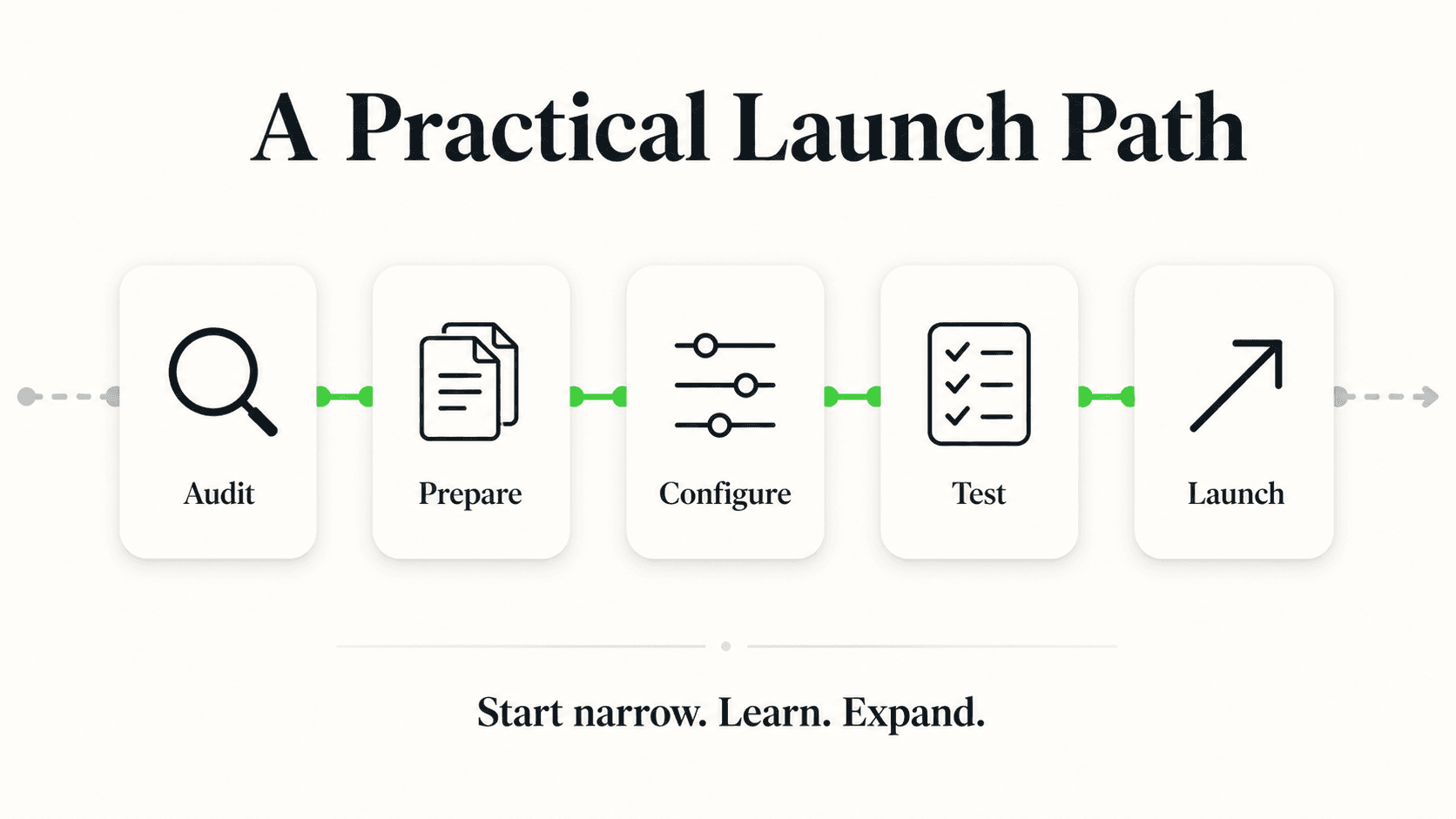
A practical 5-step evaluation that takes about an hour:
- Build a question set. Write 30 real questions from your inbox or call logs. Mix easy FAQs, multi-turn questions, edge cases, and one or two questions the bot shouldn't answer.
- Run them through a trial deployment. Use your real content. Not a vendor demo with curated data.
- Score three things per response: Is it correct? Is it grounded in your content? Did it know its limits?
- Pay special attention to "I don't know" behavior. The bot's failure mode matters more than its success rate.
- Re-run the same set in 30 days. Accuracy that holds is real. Accuracy that drifts means the system needs work.
See document-grounded responses on your own content
Every Hyperleap chatbot answers from your knowledge base — not from a model's training data guesses. Upload your content and test it yourself.
Start a Free TrialData Sources
- Dahl, Magesh, Suzgun & Ho (Stanford), "Large Legal Fictions: Profiling Legal Hallucinations in Large Language Models", Journal of Legal Analysis (2024)
- Hyperleap AI Jungle Lodges deployment data (2024)
- Anthropic, Claude documentation on retrieval grounding (2025)
Frequently Asked Questions
Can any AI chatbot guarantee 100% accuracy?
No. Any vendor claiming 100% accuracy or "zero hallucinations" is misrepresenting how LLMs work. What you can guarantee is document-grounded behavior — the bot only answers from your sanctioned content and escalates everything else.
Is RAG enough to make a chatbot safe for customer use?
RAG is necessary but not sufficient. You also need clear knowledge scope, strict grounding instructions, a human escalation path, and ongoing transcript review. A poorly tuned RAG system can still hallucinate when retrieval misses.
Do multi-location businesses need anything extra?
Only if their location pages read almost the same. Standard RAG already keeps answers grounded in your documents. The Multi-variant add-on (Pro and Max plans) solves one specific problem: answering from the right one of several near-identical sources. A guest asking about your Plano hotel gets answers from the Plano page rather than the Round Rock one, and a guest who doesn't name a hotel gets asked which one.
How long does it take to reach acceptable accuracy?
For a focused use case (lead capture, FAQ for a single product), most teams reach acceptable accuracy in the first week. Complex, multi-domain knowledge bases take 3–6 weeks of tuning and content cleanup.
What's the right metric to track over time?
Track three: percentage of conversations resolved without escalation, percentage of escalations that were genuinely necessary, and number of factual corrections per 100 conversations. Together they tell you whether the bot is helpful, well-calibrated, and accurate.
Does using a bigger model (GPT-5, Claude Opus) automatically improve accuracy?
Not for business-specific questions. Bigger models help with phrasing and reasoning but don't know your prices, hours, or policies. Retrieval and grounding matter more than model size for the questions your customers actually ask.
Accuracy Is an Architecture Decision
The companies happiest with their AI chatbots in 2026 aren't the ones that chose the smartest model. They're the ones that chose an architecture where the model can only answer from approved content, and a workflow where humans review what the bot doesn't know.
Hyperleap is built around that principle. Document-grounded responses via RAG (plus the Multi-variant add-on for businesses with several similar locations), multi-channel deployment across WhatsApp, web, Instagram, and Facebook Messenger, and a clean human handoff (Pro and Max) for anything the bot shouldn't be answering on its own. The goal isn't a chatbot that pretends to know everything — it's a chatbot you can actually trust in front of your customers.
What is retrieval-augmented generation (RAG) in plain English?
RAG means the chatbot looks up relevant passages from your uploaded documents before generating an answer — instead of pulling from the LLM's pre-trained knowledge. That is why a Hyperleap bot only answers from your documents and not from the open internet.
How do I keep my chatbot's knowledge fresh?
Re-upload or re-sync your knowledge base whenever your pricing, policies, hours, or product specs change. Hyperleap surfaces the documents an answer was grounded in, so you can audit what is being used and update specific files when needed.
How long does it take to set up an AI chatbot with Hyperleap?
Most SMBs go live in 3–5 days for self-serve setup. With Managed Setup ($299 Free, available on every plan), Hyperleap builds the bot for you on your content and channels. A 7-day free trial is included on every plan.
Further Reading
Authoritative external sources used and recommended for further research on this topic:
Test accuracy on your own content
See how document-grounded responses behave with your real questions.
Try Hyperleap FreePut this into practice
Related Articles

AI Agents vs Chatbots: What's Actually Different in 2026
AI agents and chatbots are not the same. Learn the real technical differences and why the distinction matters for your business.
How to Build an AI Chatbot for Your Business
How to build an AI chatbot for your business: decide the jobs it should do, gather knowledge, choose channels, test, and go live in under 5 minutes.

Conversational AI vs Generative AI: A Business Guide
Conversational AI vs generative AI explained: how they relate, a comparison table, risks and controls, and what a small business actually buys.
How to Add an AI Chatbot to an HTML Website
Add an AI chatbot to a plain HTML site with one script tag before </body>. Step-by-step setup, testing, styling, and knowledge base tips.