Generative AI for Customer Service: A Practical Guide
Generative AI for customer service explained: how RAG-grounded agents work, what benefits they deliver, hallucination risks to manage, and implementation steps for SMBs.

TL;DR: Generative AI for customer service uses large language models to understand natural language questions and generate contextually appropriate responses — without requiring anyone to pre-script every possible conversation. When grounded in your business's own documents through Retrieval-Augmented Generation (RAG), it answers accurately, stays within scope, and scales to handle simultaneous conversations across every channel you operate. The meaningful shift from earlier chatbots is not speed or coverage — it is the move from pattern-matching to genuine language understanding. Understanding that shift, and its limits, is what separates businesses that deploy AI effectively from those that create a customer experience problem.
Customer service has always been a staffing problem dressed up as a quality problem. You hire more agents to cover more hours. You train them again each time a product or policy changes. You apologize to customers who waited twenty minutes for an answer that took thirty seconds to give. And through all of it, the resolution rate stays stubbornly flat — because the bottleneck was never expertise. It was availability.
Conversational AI for customer service has been promised as the fix for years. But early chatbots — rigid, scripted, frustrating — set expectations so low that "chatbot" became a pejorative in customer experience circles. The technology has fundamentally changed. Generative AI is not a better decision tree. It is a different category of system entirely, and understanding that difference matters before you deploy it in any customer-facing context.
This guide is for business owners, operations leaders, and customer service managers who want an honest, technically grounded explanation of what generative AI does in a customer service setting — what it does well, where it falls short, and how to implement it in a way that builds customer trust rather than eroding it.
Generative AI vs Rule-Based Bots: What Actually Changed
Most customer service chatbots deployed before 2023 were rule-based systems — sometimes called scripted bots or decision-tree bots. A developer mapped out a conversation flow: if the customer says X, show response Y; if they click option A, branch to path B. These systems are deterministic and auditable, which is their strength. They are also brittle and expensive to maintain, which is their defining limitation.
When a customer's question does not fit a mapped path — and a surprising proportion of real questions do not — rule-based bots either fail silently with a generic "I didn't understand that" or surface an irrelevant response. Every product change, pricing update, or new policy requires a content manager or developer to manually update the conversation flow. The bot is always one product launch behind.
Generative AI systems work differently at a fundamental level. They use large language models (LLMs) trained on vast corpora of text to understand the intent behind a question, not just match it to a specific phrase. The same model that understands "what's your cancellation policy?" also understands "can I get out of my subscription?" and "I want to stop being billed" — without any of those phrasings needing to be explicitly pre-scripted.
More importantly, generative AI generates responses rather than selecting from a predefined set. It synthesizes an answer from context, which is why it can handle complex, multi-part questions, carry thread across a conversation, and respond in a way that reads like a human wrote it rather than a developer scripted it.
This generative capability is also the source of generative AI's primary risk in customer service — which we will address directly and honestly in the risks section. But first, it is worth understanding how modern deployments address that risk before it becomes a problem.
How RAG Keeps Generative AI Accurate
The most significant architectural advance in deploying generative AI for customer service is Retrieval-Augmented Generation, or RAG. Understanding RAG is not optional for any business owner evaluating an AI customer service platform — it is the mechanism that determines whether the system answers from your actual policies or makes things up.
A base large language model — regardless of which one powers it — is trained on general internet data up to a cutoff date. It knows a great deal about the world in general and nothing specific about your pricing, your return policy, your hours, your product details, or your team's escalation procedures. If you deployed a base LLM directly as your customer service agent, it would answer questions about your business with information it generalized from similar businesses it encountered during training, or it would improvise.
RAG solves this by separating knowledge storage from language generation. Here is how it works in practice:
Step 1: Your knowledge base is ingested and indexed. You upload your FAQs, product documentation, pricing pages, policies, onboarding guides, and any other business-specific content. The system converts this content into a searchable vector index — a mathematical representation of the meaning of each passage.
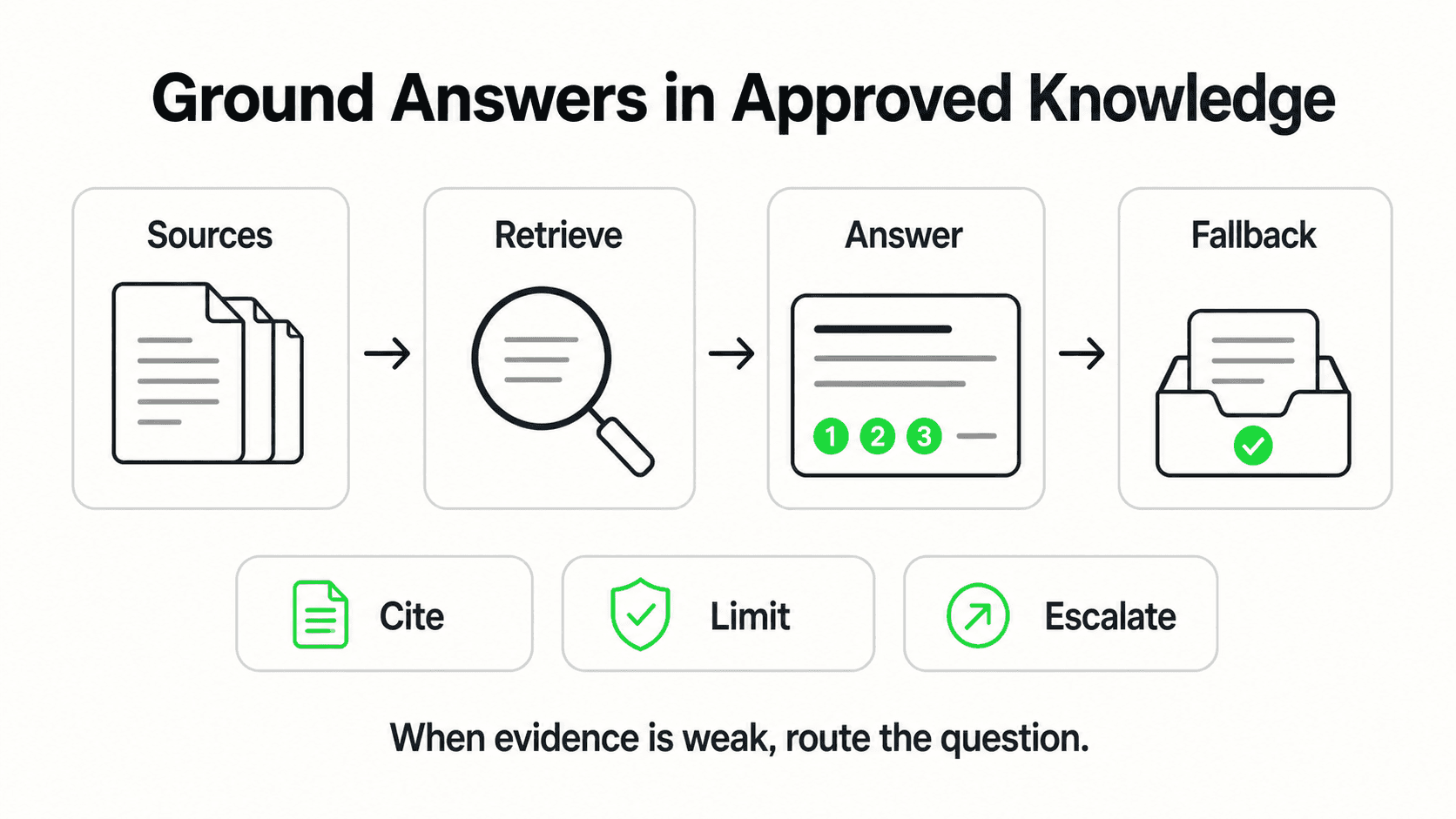
Step 2: When a customer asks a question, the system retrieves relevant chunks before generating anything. The AI searches your indexed documents for passages most semantically similar to what the customer asked. This retrieval step happens in milliseconds.
Step 3: The language model generates a response grounded in those retrieved passages. The LLM receives both the customer's question and the retrieved document passages as context. It synthesizes a response drawing on that content, constrained by what your documents actually say.
The result is knowledge grounding — the AI's responses are anchored to your actual business content rather than to general world knowledge or inference. When a customer asks about your refund window, the AI retrieves your returns policy and answers from it. When it cannot find relevant information in your documents, a well-configured system acknowledges the limitation and offers to connect the customer with a human, rather than inventing an answer.
A RAG chatbot is meaningfully different from an ungrounded LLM chatbot in the same way a doctor who consults your actual medical records differs from one who generalizes from demographic averages. The grounding mechanism is what makes generative AI deployable in customer service without accepting unacceptable accuracy risks.
Use Cases Where Generative AI Customer Service Delivers Real Value
With the technical foundation established, here are the customer service use cases where generative AI — particularly RAG-grounded agents — delivers consistent, measurable value for SMBs:
Answering FAQs and policy questions at scale. The majority of customer service volume at most businesses is a small set of questions asked repeatedly: What are your hours? How does shipping work? Can I return this? What's included in my plan? Generative AI handles this category with high accuracy when the answers exist in the knowledge base — freeing human agents for conversations that require judgment, empathy, or account-specific context.
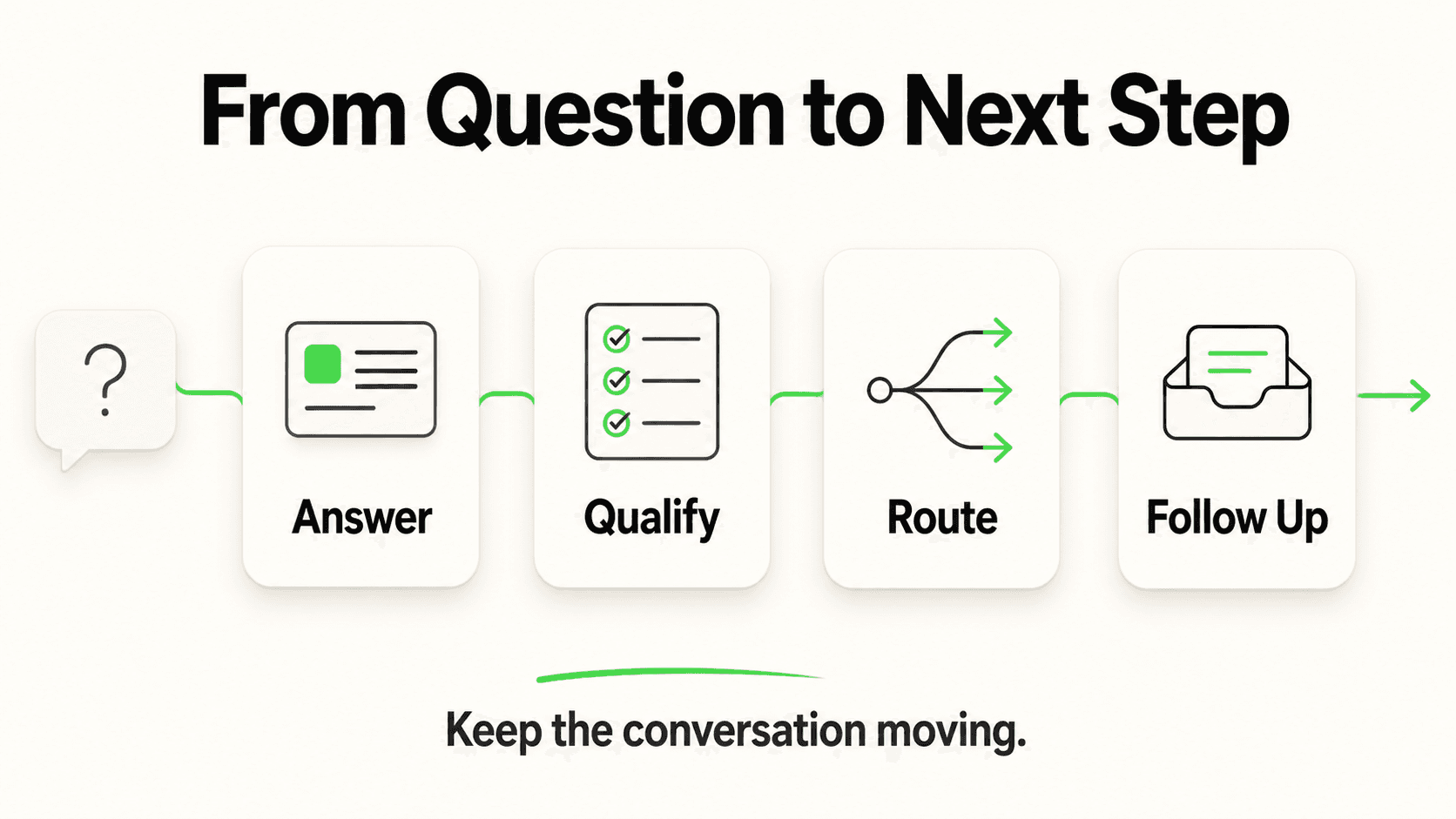
Lead qualification and structured first-contact intake. Before a conversation begins, a well-designed AI system collects contact details — name, email, the nature of the inquiry — through a lead form. The agent then uses the customer's stated intent to qualify the inquiry, surface relevant product information, and capture a clean conversation summary for your sales or support team. This is structured intake followed by intelligent engagement: every lead captured, nothing falling through the cracks.
After-hours coverage without staffing costs. Customer questions do not conform to business hours, particularly for businesses with customers across time zones. An AI agent that can answer the majority of inbound questions at 2 AM eliminates the choice between overstaffing nights and frustrating customers with delayed responses.
Consistent first-response quality. Human agents have good days and difficult ones. Generative AI agents respond consistently regardless of queue pressure, time of day, or the difficulty of the previous conversation. For businesses where brand consistency in customer communications is a priority, this consistency has real operational value.
Intelligent escalation routing. When a question exceeds the agent's configured scope — account-specific issues, complaints, nuanced situations requiring judgment — a well-configured system identifies this and routes to the appropriate human with a full conversation summary attached. The customer does not need to repeat their question. The agent does not pretend to know what it does not.
Multilingual engagement without multilingual staffing. Generative AI agents handle conversations in 100+ languages without requiring a multilingual knowledge base. A customer who begins in French or Portuguese receives a response in their language, drawn from the same English-language source documents.
The Business Benefits Beyond Cost Reduction
The temptation in any AI conversation is to reduce the benefit to cost savings. That is real but incomplete.
Capacity decoupling. The relationship between conversation volume and headcount is linear with human agents. With AI agents, you can handle significantly higher conversation volume with the same team — the team shifts to handling higher-value, more complex conversations rather than absorbing routine volume. This matters most during peak periods: product launches, seasonal spikes, promotional campaigns.
Response speed as a conversion driver. Response time in the first minutes of a customer inquiry significantly affects conversion. An AI agent that responds to a website inquiry at 11 PM is competing favorably against competitors whose human team responds the next business morning. For lead-generating businesses in competitive categories, speed is a differentiator, not just a convenience.
Knowledge base discipline as a byproduct. The process of building an effective AI knowledge base — auditing, organizing, and maintaining your business documentation — creates organizational clarity that has value independent of the AI. Businesses that go through this process regularly discover inconsistent policies, outdated content, and critical knowledge that existed only in individual employees' heads.
Omnichannel presence from a single configuration. AI agents by industry can be deployed across Website chat, WhatsApp Business API, Instagram DM, and Facebook Messenger from one knowledge base. A policy change you make once propagates to all four channels immediately. Customers engage on their preferred platform; your team manages one source of truth.
The Real Risks — and Why They Require Honest Attention
Generative AI systems are designed to minimize hallucinations through document grounding, but no AI system is zero-risk. Every business deploying an AI customer service agent should establish human review processes for edge cases, configure scope boundaries explicitly, and monitor agent responses on a regular cadence. AI in customer service is a tool that requires ongoing oversight — not a set-and-forget automation. Any vendor who tells you otherwise is overstating the current state of the technology.
The single most important risk in generative AI customer service deployment is hallucination — the tendency of language models to generate plausible-sounding but factually incorrect responses when they lack sufficient grounding or venture outside their training context.
In an ungrounded LLM deployment, hallucination is a constant risk. The model may confidently cite a policy that does not exist, quote a price that is incorrect, or describe a feature your product does not have. This is not a traditional software bug — it is an inherent property of probabilistic text generation systems operating without content constraints.
RAG-based document grounding addresses hallucination at the mechanism level by constraining the AI to information that actually exists in your knowledge base. When the retrieval step finds strong matches, the model responds from that grounded content. When it does not find relevant content, a properly configured system acknowledges the limitation rather than improvising.
But grounding does not eliminate risk entirely. Several scenarios require explicit attention:
Knowledge base gaps. If a customer asks about something not covered in your documents, the AI may attempt to answer from general knowledge rather than decline — particularly if explicit scope boundaries are not configured. Maintaining a comprehensive, current knowledge base is not optional; it is the primary accuracy lever.
Policy changes not reflected in documents. A document-grounded AI answers based on the documents it has access to. When your policies change, your knowledge base must be updated before the AI reflects the change. Stale documents produce stale answers with full confidence.
Account-specific questions. Generative AI excels at answering general questions about your business. It cannot access your CRM, order management system, or individual account records unless those systems are explicitly integrated via API. For account-specific questions — "where is my order?" or "what's my current balance?" — AI agents should route to a human with context, not attempt to answer from general knowledge.
Edge cases and adversarial inputs. Customers occasionally ask about topics well outside your business scope, attempt to elicit responses the system was not designed to give, or present genuinely complex situations requiring human judgment. Explicit scope configuration and escalation paths are not optional features — they are essential guardrails.
The responsible framing is this: generative AI, when deployed with proper document grounding, configured scope, and clear escalation paths, is designed to minimize inaccurate responses and provide consistent, accurate answers. It is not a zero-risk system. Any deployment that does not include ongoing monitoring and human oversight is accepting unnecessary risk.
Implementation Considerations for SMBs
The gap between "generative AI sounds useful" and "we have a working AI customer service agent" is narrower than it was two years ago, but it requires deliberate decisions at each step.
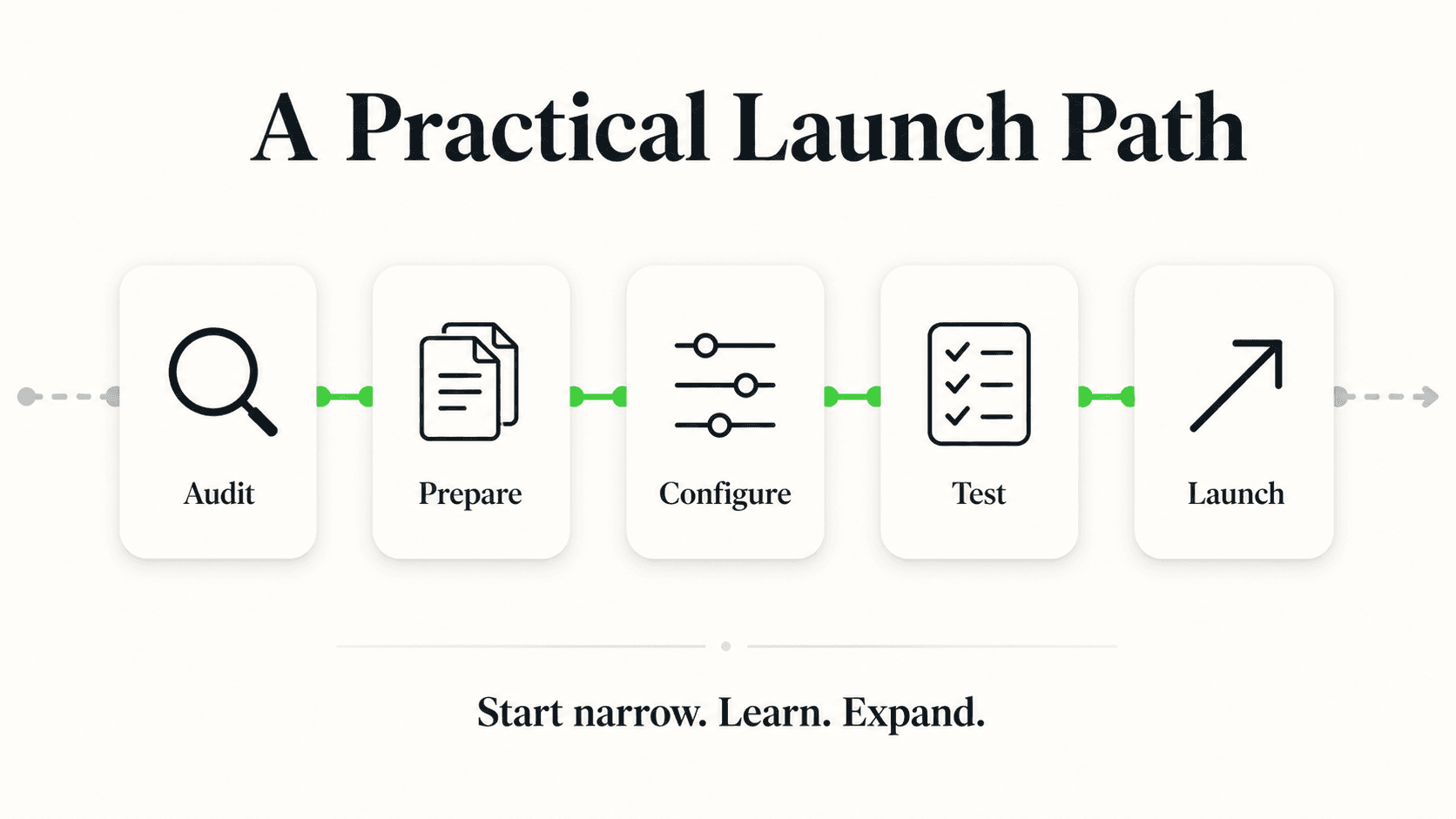
Define scope before you configure anything. The most common implementation mistake is trying to make the AI answer everything on day one. The better approach is to identify the ten to twenty questions that represent eighty percent of your inbound volume and make the AI excellent at those first. Explicitly configure the agent to route anything outside that scope to a human. Scope discipline produces better accuracy and fewer misdirected responses than scope maximalism.
Build your knowledge base from the customer's perspective. Technical documentation written for internal use often does not map cleanly to how customers phrase questions. As you organize your knowledge base, write FAQ entries from the customer's viewpoint: "What happens if I cancel mid-month?" is more useful than "Subscription lifecycle documentation." RAG retrieval works on semantic similarity — questions that use the same framing as your documents retrieve more accurately.
Configure escalation paths explicitly. Decide upfront which categories of questions always route to a human — complaints, billing disputes, account-specific issues, anything involving account security — which the AI always handles, and which are judgment calls that the AI handles with a human notification. These should be business logic decisions, not whatever defaults come with the platform.
Test adversarially before going live. Before deploying publicly, have someone ask questions the agent should not answer — questions about competitors, out-of-scope topics, questions with incorrect premises, ambiguously phrased requests. Review the responses. Adjust your scope configuration and knowledge base accordingly. An hour of adversarial testing before launch prevents customer-facing failures after.
Establish a review cadence. Generative AI customer service agents require ongoing attention. Review conversation logs weekly. Identify questions the agent answered incorrectly or deflected unnecessarily. Update the knowledge base. For most SMBs, thirty to sixty minutes per week is sufficient — but skipping it means accepting accuracy drift.
Start with one channel. If you are deploying across multiple channels, begin with website chat where your team can review conversations most easily. Expand to messaging channels once you have confidence in the agent's performance and have tuned the knowledge base based on real conversations.
How Hyperleap AI Applies Generative AI Responsibly
Hyperleap AI is built on the principles described in this guide. Here is how each one manifests in the product.
Document-grounded responses. Every Hyperleap AI agent is grounded in your knowledge base — the documents, FAQs, pricing pages, and policies you upload. The AI retrieves from your content before generating any response. When it cannot find relevant information, it is configured to acknowledge that and route to your team rather than improvise. Responses are designed to minimize hallucinations by anchoring to what your business has actually documented.
Lead form before conversation. Hyperleap's lead capture works through a structured form that collects contact details before the conversation begins. Every conversation then generates a clean lead summary emailed to your team. This is structured intake that ensures no lead is lost and every conversation has a clear owner on your side — not conversational lead capture that relies on asking mid-conversation.
Omnichannel from one configuration. One Hyperleap agent configuration deploys across Website chat, WhatsApp Business API, Instagram DM, and Facebook Messenger. Your knowledge base updates once; all four channels reflect the change immediately. Customers engage on the channel they prefer; you manage one source of truth.
Human handoff with context. On Pro and Max, when a conversation exceeds the agent's configured scope — or when a customer requests a human — Hyperleap routes the conversation to your team with the full conversation history attached. Your agent does not start the handoff by asking the customer to repeat everything they already said.
Multilingual without multilingual knowledge bases. Hyperleap AI agents support 100+ languages without additional configuration. A customer who begins in Spanish, Arabic, or Portuguese receives responses in their language, drawn from your existing English-language knowledge base.
Transparent pricing with no hidden add-ons. Hyperleap is available on three paid plans: Plus at $40 per month (3,000 AI responses, 1 chatbot, 4 channels), Pro at $100 per month (12,000 AI responses, 2 chatbots, 8 channels, white-label branding), and Max at $200 per month (30,000 AI responses, 5 chatbots, 20 channels). All plans include a 7-day free trial — credit card required, no free tier. Add-ons including Suite ($99 one-time), Managed Setup ($299 Free), and OTP Verification (usage-based, Pro and Max only) are priced separately; nothing is bundled as "included" that costs extra.
For businesses that want a fully configured agent without doing the build themselves, Managed Setup means our team builds the agent for you, loads your knowledge base, and hands you a tested, live deployment.
For use cases across professional services, e-commerce, hospitality, and beyond, the implementation path is the same: upload your knowledge base, configure your escalation rules, deploy on your channels. See AI agents by industry to understand how businesses in your sector are using document-grounded agents today.
For the terminology question — how conversational AI and generative AI relate — see conversational AI vs generative AI.
Frequently Asked Questions
Is generative AI safe to deploy for customer service without human oversight?
No AI customer service deployment should run without human oversight, and any vendor who tells you otherwise is overstating the current state of the technology. Generative AI — particularly when document-grounded via RAG — is designed to minimize inaccurate responses, but "designed to minimize" is not the same as "guaranteed to eliminate." Every responsible deployment includes regular review of conversation logs, explicitly configured escalation paths for sensitive inquiries, and a process for updating the knowledge base when policies change. Oversight is not a sign that the AI is underperforming; it is what responsible deployment looks like.
What is the practical difference between a generative AI chatbot and a traditional rule-based chatbot?
Rule-based chatbots use decision trees or keyword matching to select from predefined responses. They are deterministic, easy to audit, and brittle — they fail when customers phrase questions in ways the builder did not anticipate. Generative AI chatbots use large language models to understand natural language and generate contextually appropriate responses. When grounded in your business documents via RAG, they handle far more varied questions without requiring pre-scripted response paths for every possible phrasing. The trade-off is that they require more deliberate configuration and ongoing monitoring to maintain accuracy. See our guide on conversational AI for customer service for a deeper comparison.
What is RAG and why does it matter for accuracy?
RAG stands for Retrieval-Augmented Generation. It is the technical mechanism by which AI agents are constrained to answer from your business's actual documents rather than from general training data or inference. Before generating a response, a RAG system retrieves the most semantically relevant passages from your indexed knowledge base and passes them to the language model as context. The model then generates a response grounded in those passages. This significantly reduces — though does not eliminate — the risk of the AI generating inaccurate or invented responses. Our knowledge grounding glossary entry explains the mechanism in detail, and our hallucination entry covers the risk that grounding is designed to address.
How long does it take to get a generative AI customer service agent live?
With a platform like Hyperleap AI, the technical deployment is typically a matter of hours, not weeks. The time investment is primarily in knowledge base preparation — organizing and uploading your documentation, FAQs, and policies. A business with well-organized documentation can have a working agent live in a day. A business whose knowledge lives primarily in employees' heads will spend more time on documentation before the agent can perform well. The quality of your knowledge base is the primary determinant of response quality; the technical deployment itself is fast.
What types of customer questions should always be routed to a human rather than handled by AI?
Several categories should be configured to escalate to humans by default: complaints and emotionally charged situations requiring genuine empathy; billing disputes or account adjustments requiring approval authority; account-specific questions requiring access to CRM or order data the AI does not have; anything involving account security or identity verification; and complex, multi-factor situations requiring human judgment that cannot be resolved by retrieving a policy. The right role for AI in your customer service operation is handling the high-volume, repeatable questions accurately and consistently, while routing the nuanced and sensitive conversations to humans with full context of what the customer has already shared.
Can generative AI customer service agents handle multiple languages?
Yes — generative AI agents process and generate text in 100+ languages without requiring a separate multilingual knowledge base. A customer who begins a conversation in French, Portuguese, Arabic, or any other supported language receives responses in their language, even when your underlying documentation is in English. This allows businesses to serve customers across markets without hiring multilingual agents for every channel and shift.
Related Articles
Conversational AI vs Generative AI: A Business Guide
Conversational AI vs generative AI explained: how they relate, a comparison table, risks and controls, and what a small business actually buys.
Chatbot-to-Human Handoff: Escalation Design That Works
How to design chatbot-to-human handoff: when to escalate, what context to pass, routing options, SLAs, and a copy-ready escalation script.
AI for Small Business Customer Service: Where to Start
A step-by-step guide to AI for small business customer service — triage your support load, choose buy vs. DIY vs. hire, set a budget, and roll out in 30 days.

What Is Conversational AI? A Plain-English Guide
Conversational AI explained in plain English: how NLU, LLMs, and RAG work, how it differs from chatbots, and where businesses use it today.