Best Customer Service Software for Small Business (2026 Guide)
Compare the best customer service software for small business: help desks, live chat, AI agents, and shared inboxes — with an honest evaluation framework.

TL;DR: Small businesses need customer service software that is fast to set up, affordable at low seat counts, and capable of handling the volume without requiring a full support team. The market splits into five categories — help desk/ticketing, live chat, AI agents, shared inbox, and knowledge base. Each solves a different operational problem. This guide explains how to identify which category your business needs first, what to evaluate within that category, and how pricing actually stacks up when you move beyond the marketing page.**
When I talk to small business owners about customer service, the complaint is almost always the same: "We're losing customers between the question and the answer." A lead fills out a contact form at 9 p.m. on a Friday and hears back Monday afternoon. A support request goes to an overflowing inbox and gets buried under a weekend's worth of email. A WhatsApp message goes unanswered for six hours.
The problem is not that the team doesn't care. The problem is that customer expectations — shaped by Amazon, Uber, and every other consumer app they use — have moved to "instant," and most small businesses are still running customer service on goodwill and a shared Gmail account.
Customer service software exists to close that gap. But the market is enormous, the pricing varies wildly, and vendors tend to market their category as the only one that matters. Help desk companies position ticketing as the universal answer. Live chat vendors position real-time agents as the gold standard. AI companies (my company included) position automation as the future. All of them are partially right and partially overselling.
This guide cuts through that. I'll walk you through the five software categories, give you an honest evaluation framework, and help you figure out which tool — or combination of tools — actually matches where your business is today.
What Small Businesses Actually Need From Customer Service Software
Enterprise software is designed to be configured by IT teams with weeks of runway. That's the wrong frame for a business with ten employees and a Tuesday deadline.
Here is what actually matters for an SMB customer service stack:
Fast time-to-value. If a tool takes more than a few days to go live, your team will lose momentum and the project will stall. Prioritize tools with pre-built templates, guided onboarding, and no-code setup paths.
Predictable pricing at low seat counts. Many tools price beautifully at 50 seats and brutally at 2. Understand what "per agent" means when you have one or two people handling support. Some tools have flat monthly prices; others bill per conversation or per resolution. Run the math for your actual volume.
Coverage across the channels your customers already use. Your customers are not going to switch channels because it's more convenient for your software. They'll text WhatsApp because that's where they already are. They'll send a DM on Instagram. Your software needs to meet them there, not funnel them to a ticketing portal they've never seen.
Automation that doesn't require a full-time admin. A chatbot that needs 40 hours of configuration and a developer to maintain is not an SMB tool. Look for platforms where non-technical staff can update the knowledge base, edit responses, and add new questions without filing a ticket.
A clear path to a human. Fully automated customer service sounds appealing until a customer hits a scenario the system can't handle and has nowhere to go. Every good stack needs a defined handoff path — to a live agent, to a form, to a callback, to an email — so that no customer ends up in a dead end.
The Five Categories of Customer Service Software
Before comparing specific tools, understand that "customer service software" is actually five different markets, each solving a different operational problem.
| Category | Core problem it solves | Best for |
|---|---|---|
| Help desk / ticketing | Organizing inbound requests so nothing falls through the cracks | Teams with structured support workflows and SLA requirements |
| Live chat | Real-time conversations with website visitors during business hours | Businesses with staff available to chat and high-intent website traffic |
| AI chatbot / AI agent | Answering questions instantly at any hour, without a live agent | Businesses with predictable, repeatable questions and 24/7 coverage needs |
| Shared inbox | Giving a team visibility into a single support email or social channel | Small teams collaborating on customer email or social DMs |
| Knowledge base | Letting customers find answers themselves before contacting support | Businesses with complex products or high question volume |
Most small businesses start with one category and add a second as they grow. A common early stack is shared inbox + knowledge base. A common growth stack is AI agent + help desk for escalations. The right answer depends on your question volume, your staffing, and where your customers are reaching out.
How to Evaluate Customer Service Software: A Practical Framework
When you sit down to evaluate tools, run every option through the same checklist. This keeps vendor demos from overshadowing operational reality.
1. Availability coverage. What percentage of your inbound questions arrive outside of 9-to-5 business hours? If the answer is more than 30%, a live-agent-only solution will leave a gap every evening and weekend. Tools that automate outside business hours — or always — have a structural advantage for time-starved SMBs.
2. Channel fit. List every channel where customers currently reach you: website, WhatsApp, Instagram, Facebook, email, phone. Then verify — not just claim — that the software handles each one natively. "Integration" sometimes means a clunky third-party connector that breaks quarterly.
3. Setup timeline. Ask vendors for a realistic time-to-live estimate. Then ask what setup looks like: Does it require developers? Do you need to migrate existing data? Is there a free trial long enough to actually test it?
4. Pricing transparency at your scale. Get a quote for your actual seat count and conversation volume, not the "plans start at" number. Per-conversation pricing can be cheap at low volume and expensive fast. Per-seat pricing punishes small teams if the per-seat rate is high. Flat monthly pricing is easiest to model.
5. Escalation and handoff design. Automation is only as valuable as its fallback. Ask: what happens when the system doesn't know the answer? Can it route to a live agent? Can it collect information via a form and send a summary to your inbox? A broken handoff is worse than no automation.
6. Reporting. What does the software tell you about performance? Response times, resolution rates, question volume by topic — these numbers tell you where to focus next. Minimal reporting is fine at the start; it becomes a problem once you're scaling.
7. Knowledge management. How do you update the software when your pricing changes, your hours change, or you launch a new product? If it takes a developer or a support ticket to the vendor, that friction will cause your customer-facing content to go stale fast.
Help Desk and Ticketing Software
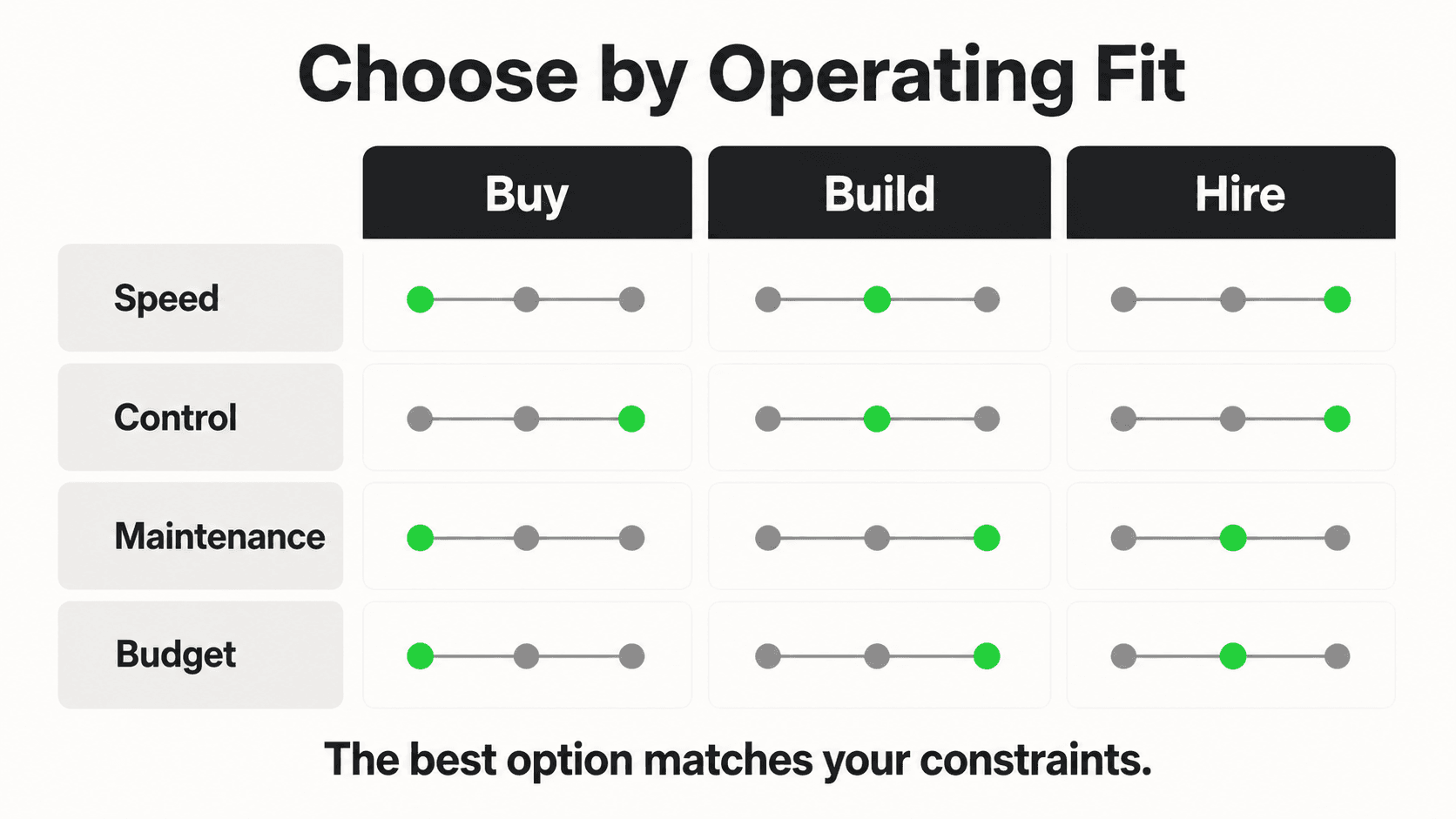
Help desks convert every inbound message — email, form, chat — into a structured ticket with a status, an owner, and a due date. The core value is organization: nothing gets lost, SLAs get tracked, and managers can see what's open and what's overdue.
When it's the right fit: If your customers send complex, multi-step questions that need research and back-and-forth to resolve, a ticketing system keeps those conversations organized across multiple agents. If you have SLA commitments to customers — a response within four hours, a resolution within 24 — a help desk enforces those and flags breaches before they happen.
Where it falls short for SMBs: Most help desks are priced and designed for teams of five-plus agents. Below that threshold, the organizational overhead — routing rules, ticket statuses, macros, SLA policies — adds work rather than removes it. If you're a two-person team handling 50 tickets a week, a shared inbox tool with assignment and status often covers 80% of the same value at a fraction of the cost.
Representative tools in this category: Freshdesk offers a free tier for small teams (up to ten agents) and paid plans from around $15 per agent per month. Zendesk Suite starts at roughly $55 per agent per month and is oriented toward growing support organizations. Help Scout positions itself for smaller, customer-centric teams with a simpler interface, starting around $20 per agent per month. All three handle email and web form tickets natively; channel support (WhatsApp, social) varies by plan.
Live Chat Software
Live chat puts a chat widget on your website and routes incoming conversations to an available agent in real time. When it works, it's high-signal: a visitor actively trying to buy or get help is connected directly to a person who can close the sale or resolve the issue in minutes.
When it's the right fit: Live chat pays off when you have staff available during peak traffic hours, when your website generates high-intent traffic (people who are close to buying), and when the questions customers ask are complex enough that a scripted response wouldn't satisfy them. High-ticket products, complex services, and custom-quote businesses tend to benefit most.
Where it falls short for SMBs: The moment your agent is unavailable — evenings, weekends, during a busy period — live chat goes offline or routes to an email fallback. That gap is meaningful. If 40% of your traffic comes on Saturday, a live-agent-only chat tool misses 40% of your opportunities every week. The other structural limitation is cost: live chat tools priced per seat become expensive once you need more than one or two agents, and conversation-based pricing can spike during traffic surges.
Representative tools in this category: Intercom is feature-rich and widely used, with a Starter plan around $39 per month for very small teams and growth plans that scale by seat and usage. Tidio offers a more accessible entry point for small e-commerce businesses, with a free tier and paid plans starting around $29 per month. Crisp similarly targets SMBs with a free plan and affordable paid tiers. These tools vary significantly in their AI capabilities, channel coverage, and integration depth — evaluate based on your specific channel needs.
AI Chatbot and AI Agent Software
This is the newest — and fastest-growing — category in customer service software. Where live chat requires a human on the other end, an AI agent handles the conversation autonomously, drawing on a knowledge base of your actual business information to answer questions, qualify leads, and hand off to your team when needed.
The practical difference is availability: an AI agent responds at 2 a.m. on a Sunday with the same accuracy as at 10 a.m. on a Tuesday, because it is not a person. For SMBs that cannot staff 24/7 coverage, this is significant.
When it's the right fit: If your business receives a high volume of repeatable questions — hours, pricing, FAQs, how to book, what's included in a service — an AI agent handles those without consuming anyone's time. If you're capturing leads through your website or social channels and want to qualify them before a sales conversation, an AI agent can collect key information via a form before the conversation begins, qualify intent, and send your team a clean summary.
Where it falls short: AI agents are strongest on well-documented, predictable questions. Open-ended consultative conversations — where the answer genuinely depends on nuanced context the customer hasn't shared — still benefit from a human touch. The best AI agent implementations know their boundaries and hand off gracefully rather than attempting to answer everything.
On accuracy: No AI system eliminates errors entirely. The best implementations ground the agent's responses in your own documents and knowledge base — so answers are drawn from what you've actually written, not generated from general training data. This "document-grounded" approach significantly reduces incorrect responses, but it requires keeping your knowledge base current.
Representative tools in this category: This includes a range of vendors from large platforms (Intercom Fin, Zendesk AI) to purpose-built SMB tools like Tidio's Lyro and Hyperleap AI. The meaningful differences are channel coverage, how the knowledge base is managed, lead capture mechanics, and pricing model. For a deeper look at what this category can do beyond support tickets, see our comparison of the best AI chatbots for small business.
AI agents are not a replacement for your entire support team — they are a first-response layer that handles the repeatable 70% so your team can focus on the conversations that actually need a human.
Shared Inbox Software
A shared inbox is exactly what it sounds like: one email address (or one social inbox) visible to your whole team, with the ability to assign conversations, add internal notes, and track status. It is the minimum viable step up from a personal Gmail account that your team is fighting over.
When it's the right fit: If your customer service volume is primarily email, and you have two to five people handling it, a shared inbox gives you visibility and accountability without the overhead of a full help desk. You can see who owns what, leave internal context for your colleagues, and close conversations once they're resolved.
Representative tools in this category: Front is widely used for email-centric support teams, with plans starting around $19 per person per month. Help Scout occupies a similar position with a cleaner interface. Gmail's collaborative inbox is a free but limited option that many teams outgrow quickly as volume increases.
Pricing Considerations: What Small Businesses Should Watch For
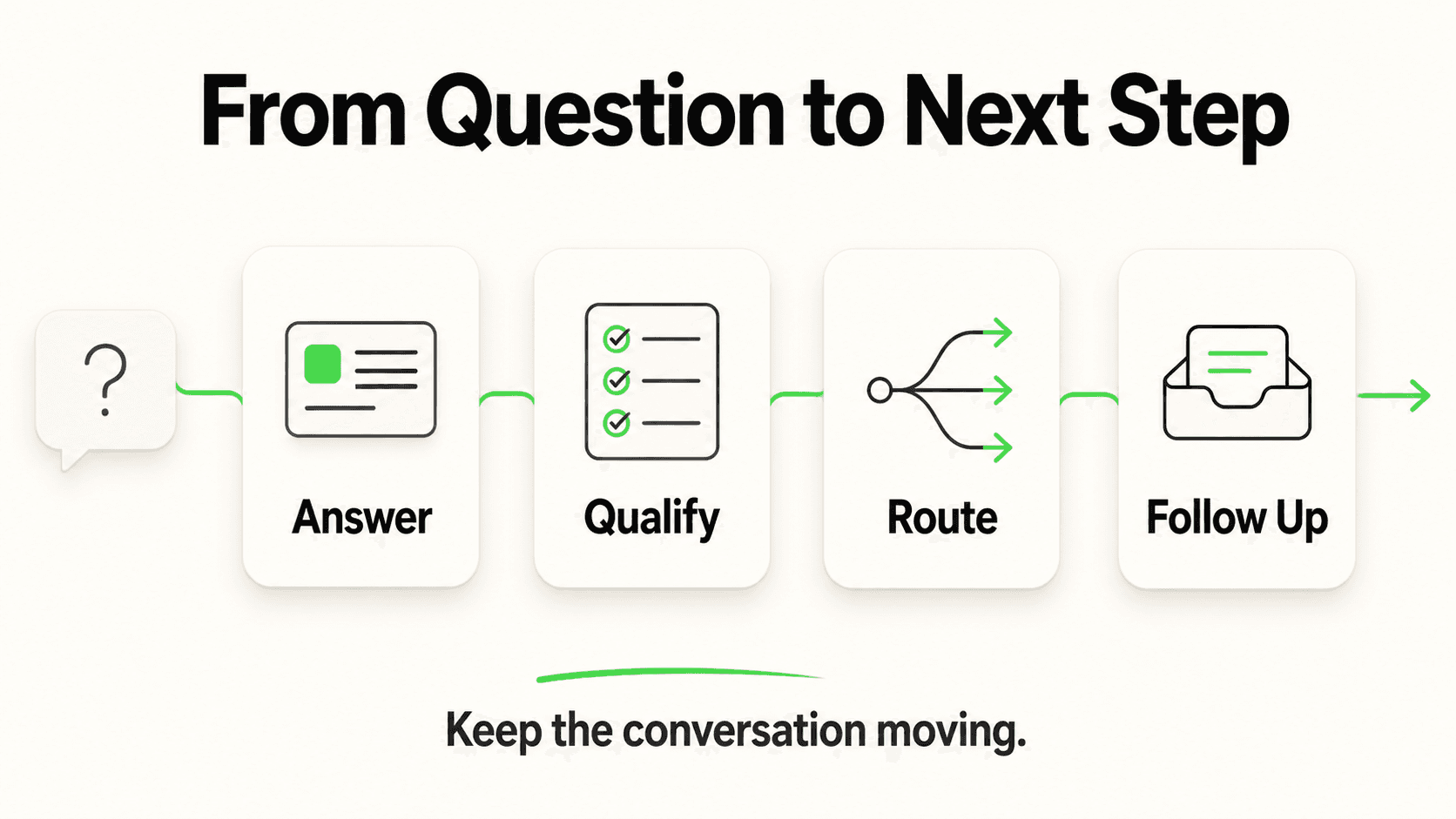
Marketing pages are optimized to show you the lowest possible number. Here is what to look for beneath it.
Per-agent pricing stacks fast. A tool at $25 per agent per month sounds affordable. Four agents means $100 per month, before any add-ons. Six months later, you hire two more. Now you're at $150. Understand what "scale" looks like financially before you commit.
Conversation-based pricing has a ceiling problem. Some AI tools price per conversation or per resolution. At low volume, this is cheap. At high volume — or during a traffic spike — the bill is unpredictable. Model for your realistic peak volume, not your average.
Free tiers usually do not include what you actually need. Free plans typically exclude the integrations (WhatsApp, social channels), the automation features, or the reporting that make the tool useful at even modest scale. Evaluate against the paid tier you would actually use.
Trial length matters. A seven-day free trial is tight for a business that receives support questions at variable frequency. Fourteen days is more realistic. Ask whether you can extend the trial if you need more time to evaluate.
Add-ons accumulate. Some tools advertise a low base price and charge separately for channels, AI features, automation, or reporting. Get a fully-loaded quote — base plan plus everything you would actually enable — before you compare across vendors.
How Hyperleap AI Fits Into This Picture
I'll be transparent: Hyperleap AI sits in the AI agent category. We are not a help desk, not a live chat tool, and not a shared inbox. Understanding what we are — and what we are not — is the only honest way to present this.
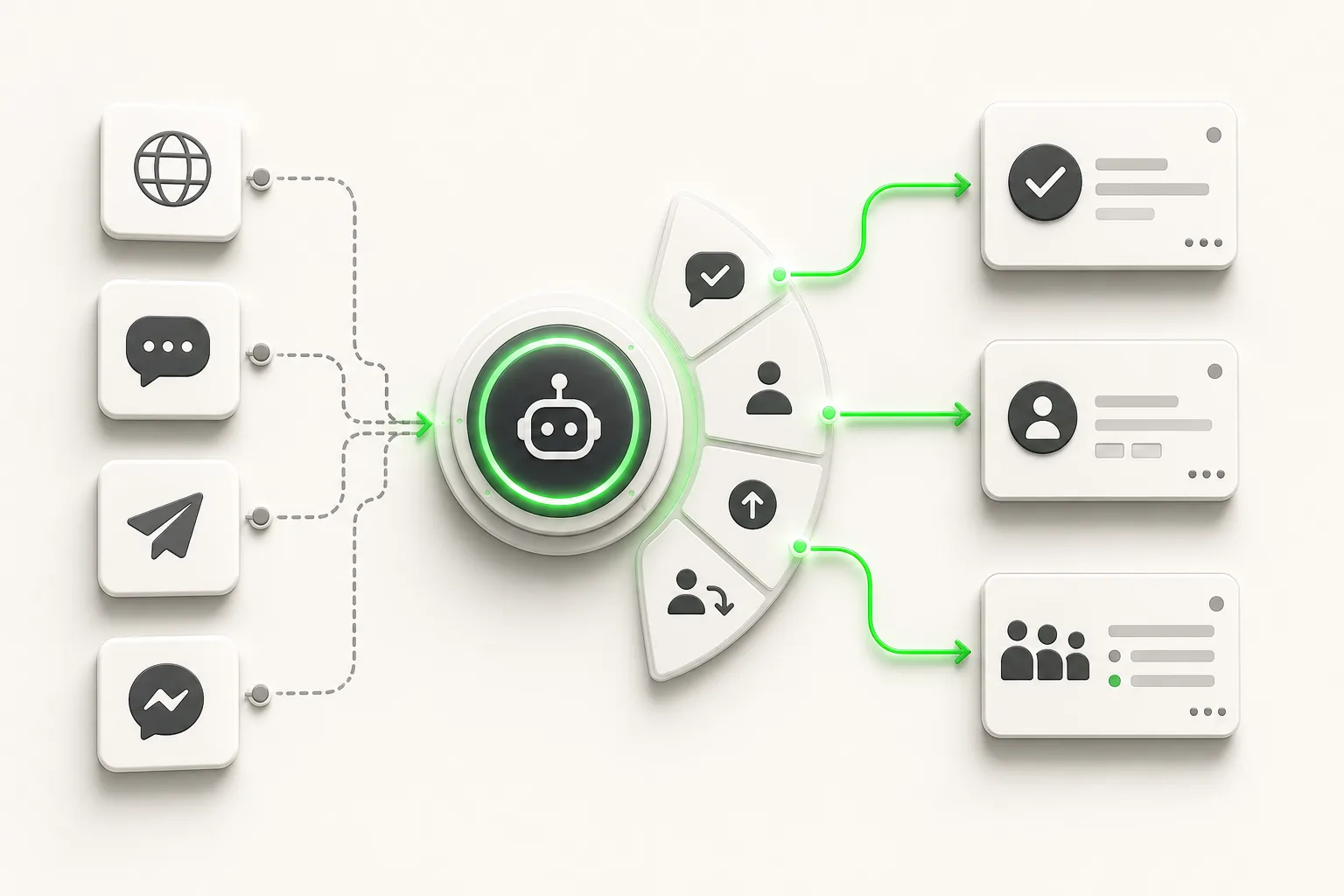
What we do: Hyperleap AI deploys a document-grounded AI agent on your website chat widget, WhatsApp Business, Instagram DM, and Facebook Messenger. The agent answers questions from your knowledge base around the clock, without a live agent on the other end. It supports conversations in 100+ languages, which matters if your customers are global or multilingual.
Lead capture mechanics: Before a conversation begins, the agent presents a lead form — collecting the visitor's name, email, and any other fields you configure. This means every conversation starts with a qualified contact, not an anonymous chat. Your team receives an email summary of the lead and the conversation once it ends. This is not a replacement for a CRM; it is a structured handoff from the AI layer to your team.
What we are not: We do not process payments. We do not integrate natively with most CRMs today (connectivity is available via REST API and webhooks for custom implementations). We do not support SMS, voice, or email as customer-facing channels. If those are your primary channels, Hyperleap is not the right fit — or at least not the complete fit — today.
Pricing: Plus plan at $40 per month (3,000 AI responses, 1 chatbot, 4 channels). Pro plan at $100 per month (12,000 AI responses, 2 chatbots, 8 channels, white-label). Max plan at $200 per month (30,000 AI responses, 5 chatbots, 20 channels). All plans include a 7-day free trial; no free plan exists. A credit card is required at trial start. Add-ons — including the Suite ($99 one-time), OTP Verification (Pro/Max only, usage-based from $100 recharge), Multi-variant (locations, courses, etc) ($40/month, Pro/Max only), and Managed Setup ($299 Free) — are priced and purchased separately and are never included in base plans.
Where we fit in a small business stack: Hyperleap is most useful as a first-response and lead-capture layer for businesses whose customers reach out across website and social channels at unpredictable hours. Teams then use their own inbox, CRM, or help desk tool to manage the conversations that need a human response. For businesses that need a complete ticketing system or have complex support workflows requiring SLA tracking, pairing Hyperleap with a dedicated help desk tool is a more complete answer than using either alone.
If you are curious how this compares to other tools in the AI chatbot space, the chatbot pricing comparison and best no-code chatbot builders guides go deeper on the category.
Putting It Together: A Decision Framework
Here is a simple routing guide based on the most common SMB scenarios:
"We're losing track of support emails and nothing has a clear owner." → Start with a shared inbox tool (Front, Help Scout). Get visibility and assignment before adding automation.
"We have website traffic converting poorly and staff available during business hours to chat." → Live chat (Tidio, Intercom Starter, Crisp) is a logical first step. Pair with a knowledge base to handle common questions.
"We get the same 20 questions repeatedly and can't staff 24/7." → AI agent is the right category. Evaluate tools — including Hyperleap — based on channel coverage, knowledge base management, and pricing at your volume.
"We handle complex, multi-step tickets with SLA commitments." → Help desk first (Freshdesk, Zendesk, Help Scout on the ticketing side). AI can be layered in later for first-response automation.
"We need to qualify leads from website and WhatsApp before a sales call." → AI agent with a lead-form-before-chat mechanic is purpose-built for this scenario. See how chatbot for small business implementations typically work before committing to a vendor.
The honest reality is that most small businesses end up with two tools: one that handles automation and first response, and one that organizes the escalations that need a human. The goal is not to find the single perfect platform — it is to cover first response well so your team spends their time on the conversations that actually require them.
For a broader view of where conversational AI for customer service is heading and what the technology actually enables today, that guide is worth reading before you finalize any vendor decision.
Frequently Asked Questions
What is the best customer service software for a small business just starting out?
For most small businesses at the start, the right answer is the simplest tool that solves your most immediate pain. If your biggest problem is lost emails, a shared inbox tool costs very little and delivers immediate visibility. If your biggest problem is after-hours inquiries and lead capture, an AI agent pays off faster. Avoid over-investing in a complex help desk with SLA routing and ticket macros until your volume genuinely requires it — that overhead will slow you down more than it helps.
How much should a small business spend on customer service software?
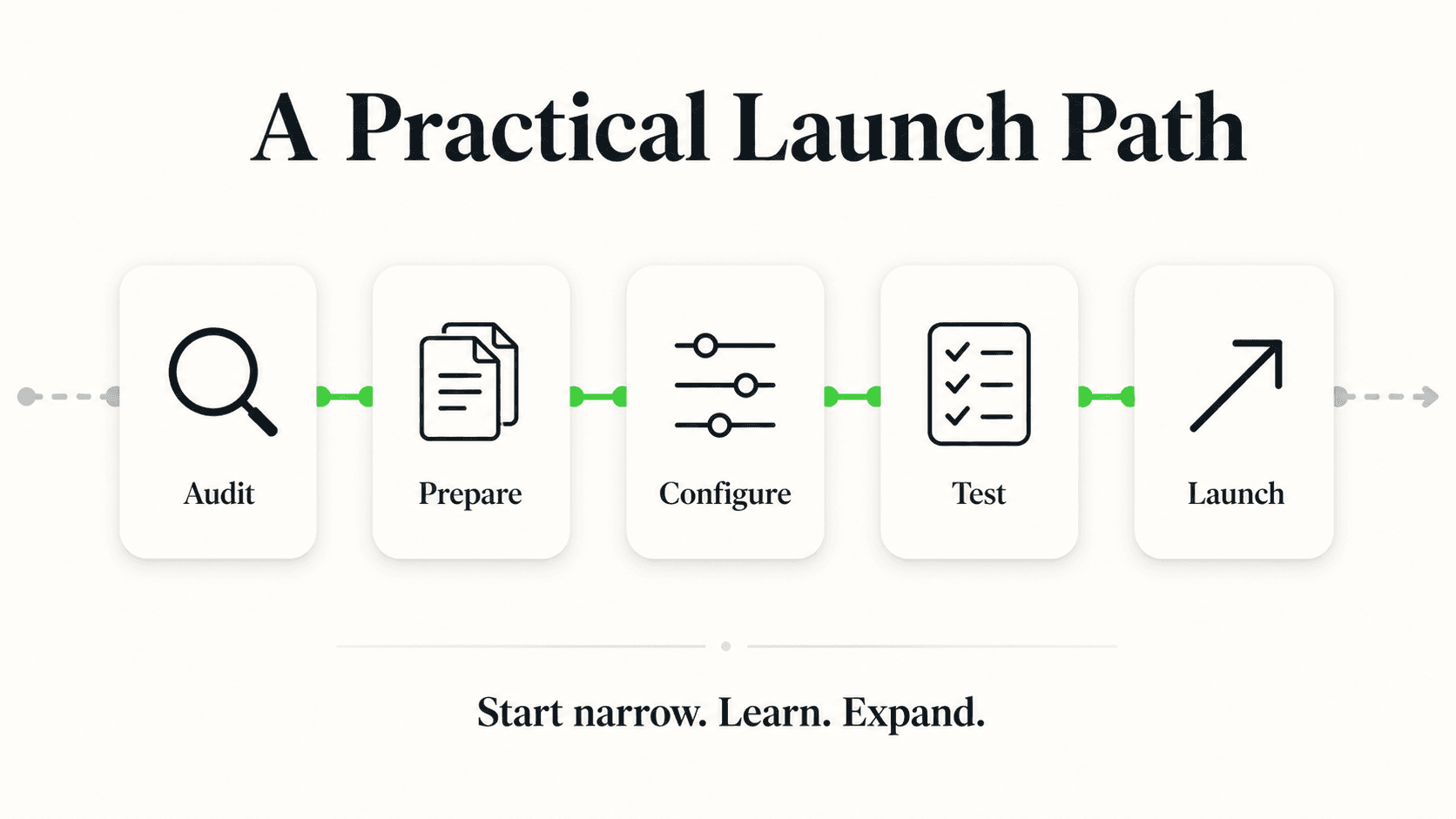
A reasonable starting budget is $40 to $100 per month for a core tool, depending on your volume and channel needs. Live chat and help desk tools priced per agent can run $20 to $55 per agent per month — manageable for one agent, more significant for four or five. AI agent tools priced on a flat monthly basis are easier to model and often more economical at low-to-mid volume. Factor in the cost of your team's time: a tool that saves one hour per day at $25/hour is worth $500 per month in recovered capacity.
Can a small business run customer service without any live agents?
For a business with predictable, repeatable questions — FAQs, hours, pricing, product details, appointment booking links — an AI agent can handle a large share of inbound volume without a live agent on standby. The realistic ceiling is questions that require genuine judgment, sensitive escalations, or nuanced consultation. A well-designed AI agent stack routes those to a human via form, email, or callback; it does not attempt to answer everything. The right expectation is not "no humans ever" but "humans spend their time where they add the most value."
What channels should small business customer service software cover?
Start with where your customers actually reach you — not where you think they should reach you. For most SMBs with consumer or SMB customers, that means website chat and at least one social messaging channel (WhatsApp and/or Instagram DM are the most common). Email remains important for asynchronous support. Verify native channel support rather than accepting "integration" as equivalent — a native channel typically means better reliability, richer message formatting, and no connector maintenance.
Is AI customer service software reliable enough for a small business to trust?
The reliability of an AI customer service tool depends almost entirely on the quality and currency of the knowledge base behind it. A document-grounded AI agent — one that answers only from your uploaded documents and FAQs — is predictable and maintainable. A generic AI with no grounding in your specific business information is not suitable for customer-facing deployment. Evaluate the knowledge management experience: How easy is it to update? How does the agent handle questions that fall outside the knowledge base? A clear "I don't know, let me connect you to our team" response is a feature, not a failure.
Related Articles
AI for Small Business Customer Service: Where to Start
A step-by-step guide to AI for small business customer service — triage your support load, choose buy vs. DIY vs. hire, set a budget, and roll out in 30 days.

Customer Service Automation: The Complete Guide (2026)
Customer service automation done right: what to automate, what to keep human, which tools to evaluate, and how to roll it out without breaking what already works.

How to Automate Customer Support: A Practical Playbook
Learn how to automate customer support the right way — audit repetitive tickets, ground an AI agent in your docs, and keep humans where they matter most.

FAQ Chatbot: What It Is and How to Build One
An FAQ chatbot answers customer questions instantly, 24/7, from your own documents — how it works, how it beats a static FAQ page, and how to build one.