12 Conversational AI Examples From Real Businesses
12 real conversational AI examples organized by job-to-be-done — after-hours capture, FAQ deflection, booking, and more — with sourced outcomes.
TL;DR: Conversational AI examples are easiest to evaluate by the job they do, not the industry they sit in — after-hours lead capture, FAQ deflection, booking, order status, lead qualification, and multilingual support are the same jobs whether the business sells hotel rooms or HVAC repairs. This guide walks through 12 examples organized by job-to-be-done: four are sourced, first-party Hyperleap deployments with disclosed metrics (Jungle Lodges, Ridhira Zen, Ridhira Group, Campinground); several are widely documented public deployments (Bank of America's Erica, Domino's ordering assistant, Sephora's Messenger bot, KLM's Messenger assistant) described qualitatively without invented numbers; and two are explicitly labeled illustrative composites for jobs where no public case study exists. Every statistic here is either sourced to a named case study or a linked third-party report — none are fabricated.
Who This Guide Is For
This is a working reference for anyone evaluating conversational AI for a small or mid-sized business — you want to see what it actually does in practice, not a marketing definition. If you haven't read the plain-English explainer yet, start with what conversational AI is. If you've already decided to deploy it and want the operational playbook, read conversational AI for customer service, which covers knowledge base design, escalation rules, and measurement.
Most "conversational AI examples" articles are industry listicles — ten screenshots of chatbots on hotel websites, ten on real estate sites, ten on dental sites, all doing the same three things with different logos. That's not actually useful if you're trying to figure out whether conversational AI would help your business, because the industry isn't the variable that matters. The job is.
A hotel's after-hours booking inquiry and an HVAC company's after-hours emergency call are the same underlying job: capture the inquiry, answer what you can, and hand off a qualified lead before the customer moves to the next search result. A retailer's "is this in stock?" question and a clinic's "do you take my insurance?" question are the same job: FAQ deflection. Organizing by job-to-be-done, rather than by vertical, is what actually tells you whether a given conversational AI pattern applies to your business.
That's how this guide is structured. Twelve examples, each mapped to a specific job. Four come from Hyperleap deployments with disclosed, sourced metrics. Several come from large, publicly documented conversational AI deployments at well-known companies — described by what they do, not by numbers nobody can verify. Two are labeled illustrative examples for jobs where no citable public case study exists, because describing a pattern honestly is better than inventing a statistic to make it sound proven.
1. After-Hours Lead Capture: Jungle Lodges & Resorts
The job: Answer the inquiries that arrive when nobody is at the desk, before the customer moves on to a competitor.
Situation. Jungle Lodges & Resorts (JLR), a Karnataka government tourism enterprise operating wildlife resorts across the state, had no way to measure how many potential guests were reaching out outside business hours — and no staff coverage to answer them even if they knew.
What the AI does. JLR deployed a Hyperleap AI chatbot trained on its property-specific knowledge — room types, wildlife viewing schedules, and seasonal availability across a multi-property portfolio — available on its website around the clock.
Outcome. The chatbot captured 3,300+ leads in its first 90 days. The chatbot's own logs revealed that 35% of all inquiries arrived after business hours — inquiries that were previously going unanswered entirely. Full detail is in the Jungle Lodges case study.
This is the single most common conversational AI job in service businesses: not "replace the front desk," but "cover the hours the front desk can't."
See what an after-hours conversation actually looks like
Try the same kind of AI chatbot that captured 3,300+ leads for Jungle Lodges — trained on your business in minutes.
Get Started2. Lead Qualification Before Handoff: Ridhira Zen
The job: Filter inquiries by budget, timeline, and intent before a salesperson spends time on the call.
Situation. Ridhira Zen, a 28-acre wellness real estate community in Hyderabad, was fielding a high volume of property inquiries, but not every inquiry was a qualified buyer — sales time was going to unqualified leads as often as real ones.
What the AI does. The AI chatbot asks structured qualifying questions (budget range, timeline, purpose) as part of the conversation, then routes only the leads that meet the qualification bar to the sales team, with a summary of what the buyer said.
Outcome. Ridhira Zen saw a 4x increase in qualified leads and a 66% reduction in cost per qualified lead, per the client's disclosed results in Hyperleap's case studies.
The pattern generalizes to any business where "an inquiry" and "a real customer" aren't the same thing — see how it applies to real estate broadly in our guide on AI chatbot lead qualification.
3. Scaling Query Volume Without Adding Headcount: Ridhira Group
The job: Absorb a growing number of routine questions across many locations without a proportional increase in staff.
Situation. Ridhira Group operates across 31 cities with more than 1.5 million customers in its wellness and hospitality portfolio — a query volume that would require significant call-center headcount to handle manually at consistent quality.
What the AI does. A single AI chatbot deployment, grounded in the group's knowledge base, handles the bulk of routine queries across the portfolio and hands off booking-ready conversations to the team.
Outcome. Ridhira Group reported a 7.5x increase in queries handled and a 92% improvement in booking conversions after deployment, per Hyperleap's case studies.
This is the job most relevant to multi-location and franchise businesses: volume grows faster than the team, and the AI absorbs the growth instead of the headcount.
4. WhatsApp-Native Booking: Campinground
The job: Let customers complete a booking inquiry inside the channel they're already using — no separate booking portal required.
Situation. Campinground, a glamping and events venue in Mysuru, gets a disproportionate share of its inquiries through WhatsApp, especially on weekends when staff availability is thinnest and inquiry volume is highest.
What the AI does. A WhatsApp-native AI assistant handles accommodation, activity, and event-venue booking questions directly in the chat thread — no app download, no separate form, no waiting for a callback.
Outcome. Campinground saw a 108% increase in direct bookings and a 95% capture rate on weekend inquiries, per Hyperleap's case studies.
Weekend and after-hours volume concentration is common across hospitality businesses — see our deeper breakdown in why hotels lose revenue to slow after-hours response.
5. Repetitive FAQ Deflection: Bank of America's Erica
The job: Answer the same handful of questions hundreds or thousands of times a day without routing every one of them to a human.
Situation. Every customer-facing business fields a small set of questions constantly — hours, balances, policies, "do you offer X." At consumer-banking scale, that volume is enormous.
What the AI does. Bank of America's virtual financial assistant, Erica, answers routine account questions, surfaces spending insights, and helps customers navigate common banking tasks inside the bank's own app, without a phone call.
Outcome. Erica is one of the most widely cited public examples of conversational AI operating at scale in a regulated industry — Bank of America has publicly described it as handling a large share of routine customer interactions that would otherwise reach a call center or branch, freeing staff for the interactions that need a person. Exact interaction volumes are disclosed by Bank of America directly rather than independently audited, so treat any specific figure you see quoted elsewhere with appropriate skepticism.
For an SMB, the same job looks smaller in scale but identical in shape: a conversational AI grounded in your own FAQ content handles the "what are your hours" volume so your team handles the calls that actually need judgment.
6. Order and Service Status Lookups: Domino's Ordering Assistant
The job: Let a customer check on something they already ordered without waiting on hold.
Situation. Order status is one of the highest-volume, lowest-judgment support categories in retail and food service — "where's my order" doesn't need a human, it needs a database lookup with a conversational front end.
What the AI does. Domino's has run AI-driven ordering and status assistants across voice and chat channels for years, letting customers place and track orders conversationally instead of navigating a static order-tracking page.
Outcome. This is one of the most mature, widely known applications of conversational AI in consumer retail — an established pattern rather than a new one, and a useful reference point for any SMB with a "check my order/appointment/request status" use case.
Where this pattern applies beyond retail
The same job shows up as "where's my repair technician," "is my prescription ready," or "has my application been reviewed" — any business where a customer already gave you an order number, appointment ID, or reference number and just wants a status update without a phone call.
7. Multilingual Customer Support: KLM's Messenger Assistant
The job: Support customers in the language they're most comfortable with, without hiring native speakers for every language.
Situation. Airlines serve genuinely global customer bases, and flight-related questions — boarding passes, delays, check-in — need to reach travelers in whatever language and channel they're already using.
What the AI does. KLM Royal Dutch Airlines has operated a Messenger-based assistant that sends boarding passes, flight status updates, and check-in reminders directly in chat, supporting multiple languages so the same automated flow reaches travelers regardless of home market.
Outcome. KLM's deployment is frequently referenced as one of the earlier large-scale examples of an airline moving routine customer communication into a messaging channel rather than email or a call center — again, a pattern reference rather than a source of a specific performance number.
This is the job SMBs increasingly face too: Hyperleap AI chatbots support 100+ languages out of the box, which matters most for businesses near tourist destinations, immigrant communities, or global e-commerce customer bases — see our guide on building a multi-language AI chatbot for diverse customers.
8. Rich Cards and Carousel Product Discovery: Sephora's Messenger Bot
The job: Help a customer browse and choose between visual options — products, rooms, packages — inside a chat conversation instead of a separate catalog page.
Situation. Choosing between dozens of shade or product options is hard in plain text; customers need to see and compare, not just read a description.
What the AI does. Sephora's Facebook Messenger chatbot has used interactive, image-based product cards to help customers browse shades and get personalized recommendations, turning a text conversation into something closer to browsing a catalog.
Outcome. This remains one of the most cited early examples of conversational commerce moving beyond plain text into rich, swipeable product cards — a format that has since become standard across chat platforms.
Hyperleap AI supports rich cards too: when the agent shares your photos, documents, or booking link, each arrives as a tappable card — swipeable as a carousel on Instagram DM and Facebook Messenger, and as individual card messages on WhatsApp — so a customer can browse rooms, services, or guides without leaving the chat.
9. Escalating Complex or Sensitive Cases to a Human
The job: Recognize when a conversation has moved outside what the AI should handle, and route it to a person — cleanly, with context.
Situation (illustrative example): A patient messages a clinic's website chatbot asking about a symptom that sounds urgent. This is not a job for an AI to resolve — it's a job for the AI to recognize and route correctly.
What the AI does. A well-configured conversational AI is scoped to answer what it's grounded in — hours, services, insurance questions, scheduling — and to route anything that sounds urgent, sensitive, or outside its knowledge straight to a human, with the conversation history attached so the patient doesn't have to repeat themselves. The AI does not perform clinical assessment or triage; it routes.
Outcome. The measurable outcome here isn't a percentage — it's whether the handoff happens fast and with context, or whether the customer gets stuck in a dead-end conversation. This is the job most often done badly by older rule-based chatbots, and it's the reason "human + AI" framing matters more than "AI replaces staff" framing. See our guide on HIPAA-compliant AI chatbots for healthcare for how routing rules should be scoped in regulated, sensitive contexts.
10. Consistent Answers Across Multiple Locations
The job: Give the same accurate answer whether the customer messages the flagship location or the newest franchise, without maintaining a separate knowledge base for each one.
Situation (illustrative example): A regional HVAC franchise with eight locations has different service areas, technician schedules, and after-hours emergency policies at each branch, but customers expect one consistent brand experience regardless of which branch's number they call.
What the AI does. A single AI deployment answers from one shared knowledge base that holds brand-wide policies alongside each branch's hours and service areas, so updating a company-wide policy doesn't mean editing eight separate knowledge bases. With eight near-identical branch pages, Hyperleap's Multi-variant (locations, courses, etc) add-on makes sure each answer comes from the branch the customer asked about, and asks which branch when they don't say.
Outcome. The Ridhira Group example above (7.5x queries handled across a 31-city footprint) is the closest sourced real-world instance of this exact job at scale; this composite scenario illustrates how the same architecture applies to a much smaller multi-location business. Read more in our guide on multi-location and franchise chatbot strategy.
11. Instant First Response to Price and Availability Questions
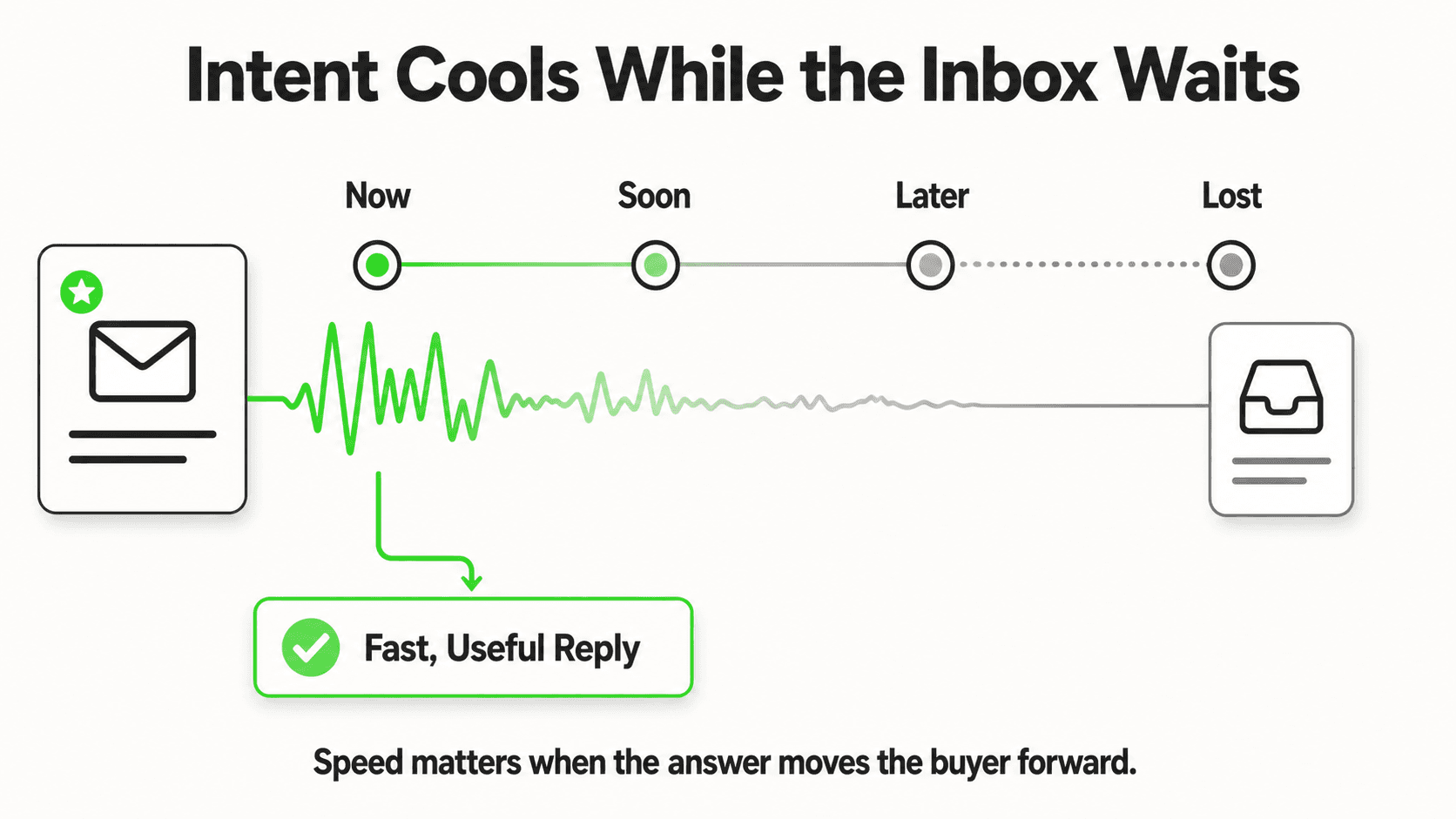
The job: Answer "how much" and "do you have availability" immediately, because response speed is often the deciding factor in who wins the booking.
Situation. Research on B2B and B2C lead response consistently finds that speed, not just quality, determines who wins a deal. A frequently cited Harvard Business Review analysis of over 2,000 US companies found that firms responding to web-generated leads within an hour were far more likely to qualify the lead than those that waited even a few hours longer — see the HBR analysis of lead response times.
What the AI does. Conversational AI removes the human bottleneck from the first response — a customer asking about pricing or availability at 9pm gets an immediate, document-grounded answer instead of waiting until the next business day.
Outcome. This is the economic core of most conversational AI deployments in service businesses: the value isn't primarily "save staff time," it's "stop losing the deal to whichever competitor answered first." Jungle Lodges (Example 1) and Campinground (Example 4) above are both sourced instances of this exact dynamic playing out in a real deployment.
12. Structured Lead Handoff to a Sales or Support Team
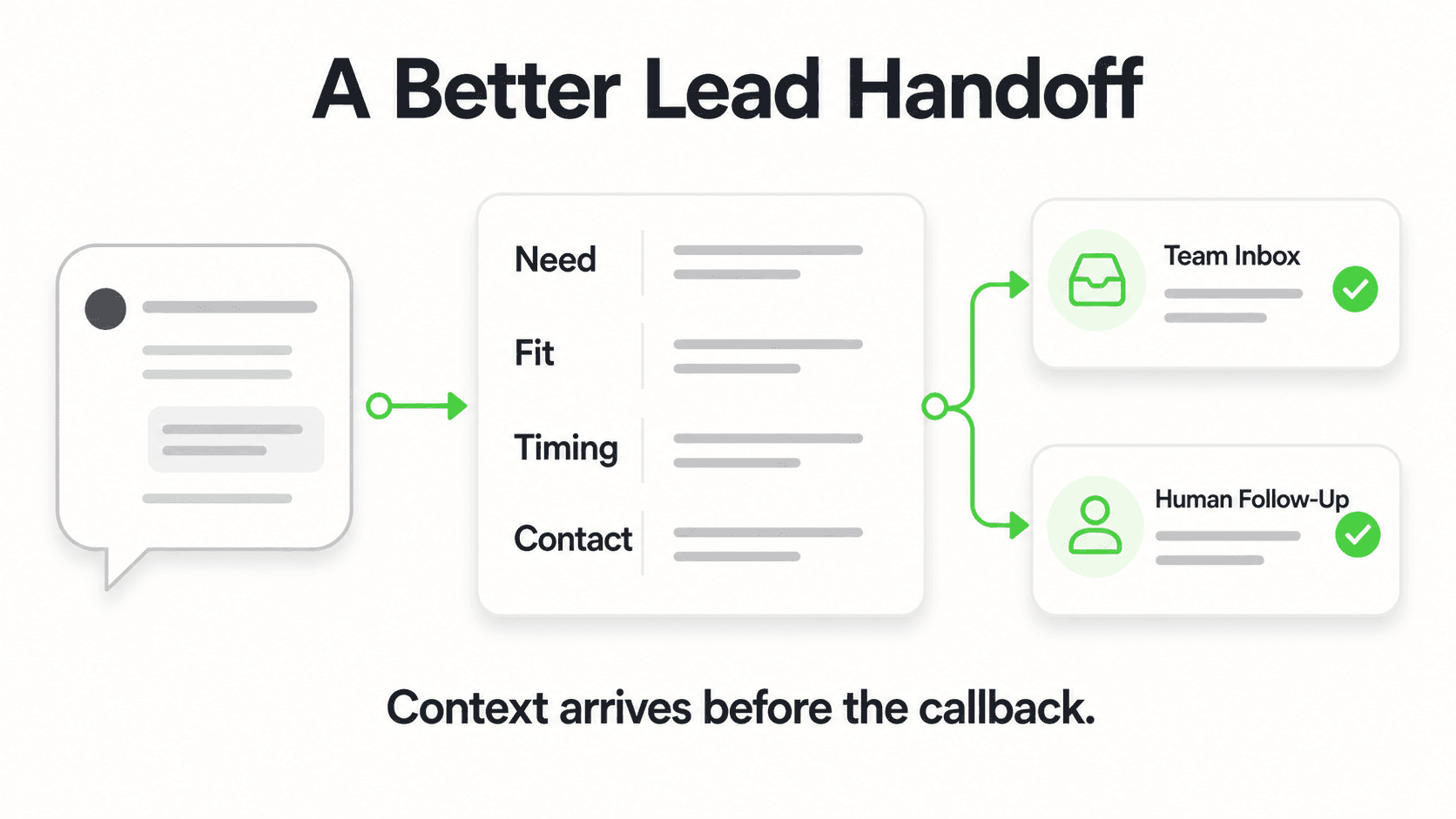
The job: Turn a chat conversation into a clean, actionable lead your team can act on — not a transcript someone has to comb through.
Situation. A common failure mode in conversational AI deployments is capturing a conversation but not converting it into something a sales or support team can actually use quickly.
What the AI does. Hyperleap AI's chatbot uses a lead form to collect contact details and key qualifying answers before or during the conversation on the website widget (on messaging channels like WhatsApp, Instagram DM, and Facebook Messenger, the customer's phone number and profile are captured automatically from the platform). Every completed lead triggers an automated team notification and is exportable to CSV, and when a customer is ready to schedule, the AI can book the slot right in the chat through Calendly or Cal.com, or share your booking link for any other tool.
Outcome. The measurable value of this job is response speed and lead completeness, not a specific conversion percentage — a fully qualified lead sitting in your CRM or inbox within seconds of the conversation ending, instead of a chat log nobody reviews until Monday. See our practical breakdown in AI lead capture chatbot fundamentals.
What ties all 12 examples together
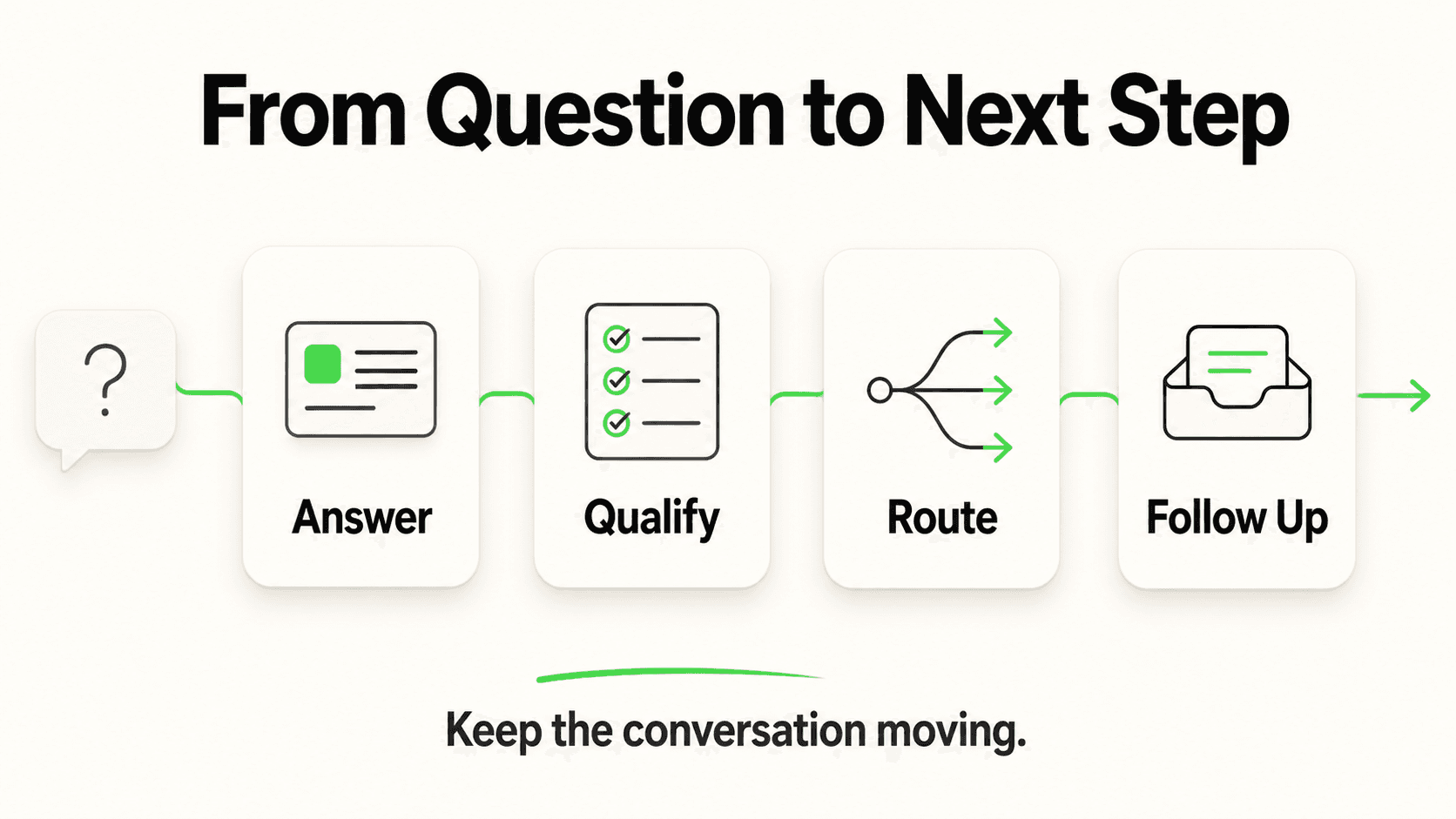
None of these are "the chatbot is smarter than a human." Every single one is a business identifying a specific, high-volume, low-judgment job — after-hours capture, FAQ deflection, status lookup, qualification, multilingual coverage — and giving it to an AI so the humans on the team can spend their time on the 20% of conversations that actually need a person.
Data Sources
- Hyperleap AI, Jungle Lodges & Resorts case study (2025) — 3,300+ leads in 90 days, 35% after-hours
- Hyperleap AI, customer case studies — Ridhira Zen (4x qualified leads, 66% lower cost per lead), Ridhira Group (7.5x queries handled, 92% booking conversion improvement), Campinground (108% increase in direct bookings, 95% weekend capture rate)
- Harvard Business Review, "The Short Life of Online Sales Leads" (2011) — lead response speed and qualification rate
- Public company disclosures and reporting on Bank of America's Erica, Domino's ordering assistants, Sephora's Messenger bot, and KLM's Messenger assistant — cited qualitatively; specific interaction volumes for these third-party deployments are self-reported and not independently verified here
Frequently Asked Questions
What is a conversational AI example, exactly?
A conversational AI example is a real or documented deployment where an AI system holds a natural-language, back-and-forth exchange with a customer to complete a specific job — answering a question, capturing a lead, checking an order, or booking an appointment — rather than just generating a one-off response. The defining feature is the multi-turn conversation, not just an automated reply.
Are these examples all chatbots, or something more?
Most are text-based chat assistants, which remain the most common business application of conversational AI. A few, like KLM's assistant, extend into structured actions (sending boarding passes, check-in reminders) inside the same chat thread — closer to what's often called an AI agent. For a full breakdown of the terminology, see what conversational AI actually is.
Which conversational AI example is most relevant to a small business?
The after-hours lead capture example (Jungle Lodges) and the FAQ deflection example (Erica) are the two most broadly applicable jobs for SMBs, regardless of industry — nearly every business loses some inquiries outside business hours and answers the same handful of questions repeatedly. Start with whichever job costs you more revenue today.
Do these AI examples replace human customer service staff?
No — in every sourced example here, the AI absorbs high-volume, repetitive work while sensitive, complex, or judgment-heavy conversations still route to a person. Hyperleap AI is built around this "human + AI" model rather than full automation: the AI covers volume and hours; your team covers relationships and edge cases.
How accurate are AI chatbot responses in these examples?
Accuracy depends heavily on how the AI is grounded. Systems built on retrieval-augmented generation (RAG) — pulling answers from a business's own documents rather than general internet knowledge — are designed to minimize hallucinations and stay within what they actually know. No conversational AI system should be described as 100% accurate; the more meaningful question is whether it's grounded in your content and configured to escalate what it doesn't know.
What channels do these conversational AI examples typically run on?
The examples above span website chat widgets (Jungle Lodges, Bank of America's Erica), WhatsApp (Campinground), and Facebook Messenger (Sephora, KLM). Hyperleap AI supports Website chat, WhatsApp Business API, Instagram DM, and Facebook Messenger, with rich cards and carousels rendering consistently across all four.
How much does it cost to deploy conversational AI like these examples?
Costs vary enormously by scale — enterprise deployments like Erica or KLM's assistant represent years of custom engineering investment. For an SMB, purpose-built platforms like Hyperleap AI start at $40/month (Plus plan) with a 7-day free trial, scaling to $100/month (Pro) and $200/month (Max) as response volume and channel needs grow. See full plan details on the pricing page.
Can I combine several of these jobs — lead capture, FAQ deflection, and multilingual support — in one deployment?
Yes, and most real deployments do exactly that rather than picking a single job. Jungle Lodges' chatbot both captures after-hours leads and answers property-specific FAQs; Ridhira Group's deployment handles high query volume and improves booking conversion in the same conversations. Our guide on how to choose an AI chatbot platform covers how to evaluate a platform against multiple jobs at once instead of one narrow use case.
The Best Conversational AI Example Is the One Solving Your Specific Job
The twelve examples above cover most of what conversational AI is actually used for in the real world — and none of them started as "let's add a chatbot." Each started as a specific, expensive, recurring problem: inquiries dying after hours, sales time wasted on unqualified leads, a growing customer base outpacing headcount, weekend volume nobody could staff for.
That's the honest way to evaluate conversational AI for your own business: not "which vendor has the best demo," but "which of these twelve jobs is costing me the most right now." If it's after-hours capture or lead qualification, the Jungle Lodges and Ridhira Zen examples above are the closest reference points. If it's FAQ volume or multilingual coverage, look at the Erica and KLM patterns.
Hyperleap AI's chatbots are built to handle several of these jobs at once — lead capture, FAQ deflection, qualification, multilingual support, and rich card product discovery — grounded in your own business content, live on your website, WhatsApp, Instagram DM, and Facebook Messenger, with a 7-day free trial to see how it handles your actual conversations before you commit.
Ready to see your own conversational AI example?
Train an AI chatbot on your business content and deploy it across Website, WhatsApp, Instagram, and Facebook Messenger in minutes.
Start Your Free TrialIndustry Solutions
See how AI chatbots work for these industries:
Related Articles

Benefits of Conversational AI for Business (With Caveats)
The real benefits of conversational AI — 24/7 coverage, speed, cost, scale — with the conditions that make each one true, and where it doesn't hold.

Conversational AI for Small Business: A Starter Guide
A practical guide to conversational AI for small business: what to build first, a 5-step setup week, real costs, and the 3 use cases that pay for it first.

Conversational AI vs Chatbot: The Real Difference
Conversational AI vs chatbot explained: rule-based scripted bots versus LLM-powered conversational AI, plus a comparison table and decision framework.
What Is Conversational AI? A Plain-English Guide
Conversational AI explained in plain English: how NLU, LLMs, and RAG work, how it differs from chatbots, and where businesses use it today.