Benefits of Conversational AI for Business (With Caveats)
The real benefits of conversational AI — 24/7 coverage, speed, cost, scale — with the conditions that make each one true, and where it doesn't hold.

TL;DR: Conversational AI's real benefits for a business are 24/7 coverage, faster first response, lower cost per conversation, consistent answers, multilingual reach, the ability to absorb demand spikes, and structured data capture from every inquiry. None of these benefits are unconditional — each depends on a decent knowledge base, a reasonable volume of inquiries, and honest handoff rules for anything sensitive or novel. This guide states each benefit as a specific claim, names the condition under which it holds, and states plainly where it doesn't — because a business evaluating this technology deserves the caveats, not just the highlight reel.
Where This Fits
This is the "here's the payoff, with the fine print" companion to two other guides: What Is Conversational AI? explains the underlying technology (NLU, LLMs, RAG), and Conversational AI for Customer Service walks through how to operationalize it — knowledge base design, escalation rules, measurement. This guide sits between them: it answers "is this actually worth it for a business like mine, and under what conditions."
Most articles on the benefits of conversational AI read like a vendor's highlight reel: 24/7 availability, cost savings, happier customers, done. That framing isn't wrong, exactly — those benefits are real and increasingly well documented. But it's incomplete in a way that costs businesses money. A benefit stated without its operating conditions isn't useful information; it's marketing. "Conversational AI cuts support costs" is true for a business with a decent knowledge base and enough inquiry volume to justify the setup effort. It's false, or at least irrelevant, for a business fielding four support emails a week.
This guide takes the honest-broker approach: every benefit below is stated as a specific, citable claim, paired with (a) the condition under which it actually holds, and (b) the case where it doesn't. If you're evaluating conversational AI for your business — not reading a pitch deck about it — this is the version you need.
Benefit 1: 24/7 Coverage Without Staffing Every Hour
The claim: Conversational AI answers customer inquiries around the clock — nights, weekends, holidays — without a person needing to be on shift, capturing inquiries that would otherwise go unanswered until the next business day.
This is the single most concrete, most frequently cited benefit of conversational AI, and it's also the one with the best first-party evidence behind it. In Hyperleap AI's Jungle Lodges deployment, 35% of chatbot inquiries arrived after standard business hours — more than a third of total demand landing in a window when no human was answering the phone or the website chat. Those inquiries didn't wait politely for 9 AM; in a competitive market, the business that answers first usually keeps the customer.
The condition: This benefit only pays off if your business genuinely receives meaningful volume outside your staffed hours. A business that closes at 5 PM and gets almost no evening or weekend inquiries won't see much lift from after-hours coverage — there's nothing there to capture. It also depends on the AI actually being able to answer the after-hours question (hours, pricing, availability, booking-link sharing) rather than needing a live person for everything asked at 11 PM.
Where it doesn't hold: If your customer base only ever contacts you during business hours — common for certain B2B services with fixed operating windows — 24/7 coverage is a nice-to-have, not the primary ROI driver. And after-hours coverage doesn't help at all if the knowledge base behind it is thin; an AI that can't answer the 11 PM question just produces a different kind of missed opportunity.
How to check if this applies to you
Pull your website analytics or call logs for the last 90 days and look at the time-of-day distribution of inbound contact. If a meaningful share clusters outside your staffed hours, 24/7 coverage is a real lever for you. If it's flat and concentrated in business hours, weight this benefit lower in your evaluation.
Benefit 2: Faster Response Speed
The claim: Conversational AI responds to inquiries in seconds rather than minutes or hours, and response speed is one of the most consistently revenue-linked variables in sales and support.
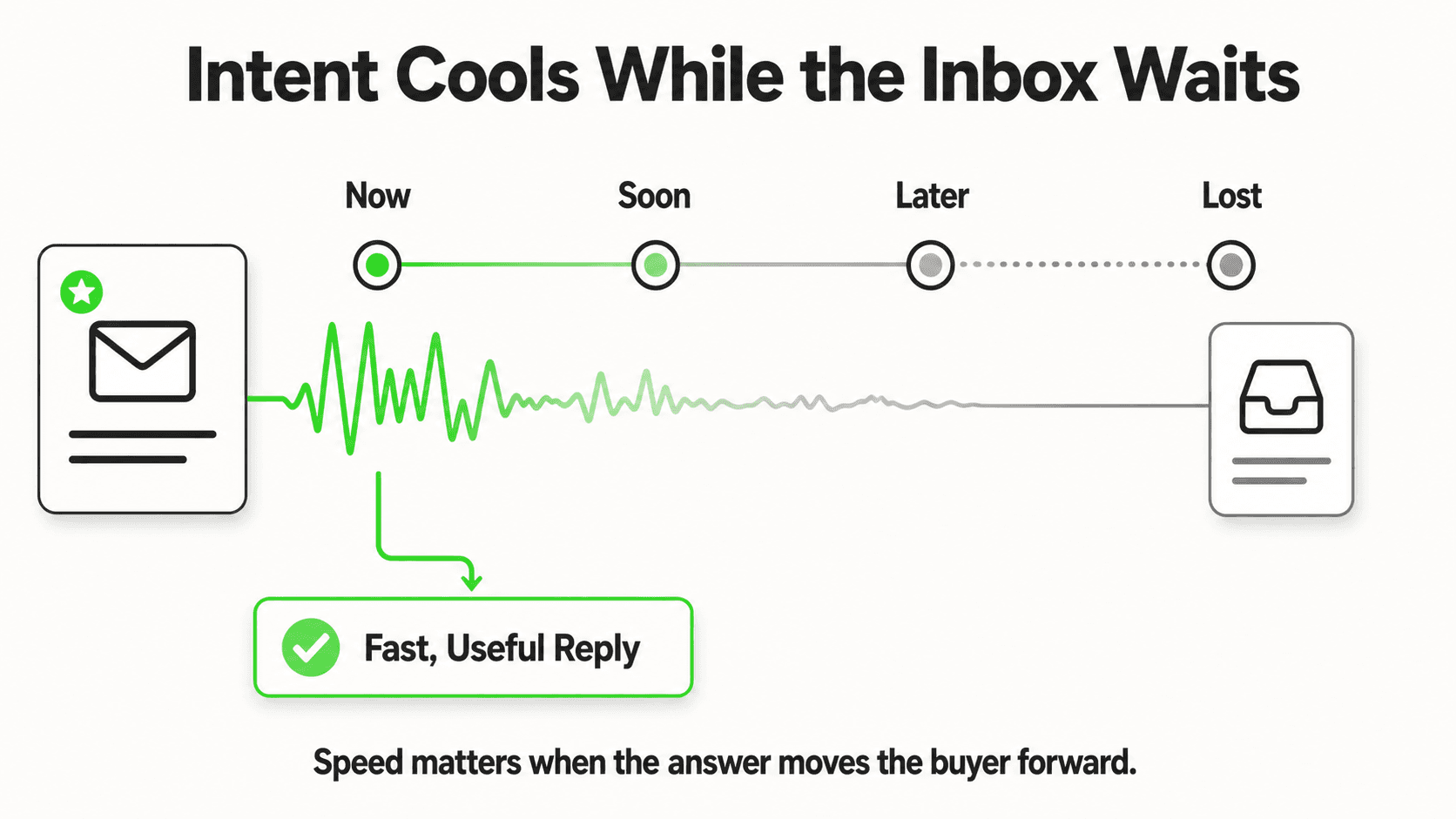
According to InsideSales' widely cited lead response research, leads contacted within five minutes convert dramatically better than leads contacted even 30 minutes later — the odds of qualifying a lead drop sharply as response time slips. Separately, HubSpot survey data finds 82% of customers expect an immediate response to a sales inquiry, and rate immediate response as an important factor in choosing who to buy from. Neither of these studies was designed to measure AI chatbots specifically, but they both establish the underlying economic mechanism conversational AI exploits: the business that responds first has a structural advantage, regardless of how it responds.
The condition: The speed advantage only converts to a business outcome if the fast reply is also a useful reply. Answering instantly with something vague, generic, or wrong doesn't out-convert a slower, accurate answer — customers routing around a bad automated response actually raises effective response time back to zero. Speed pairs with document-grounded accuracy (see how accurate AI chatbots are), not as a substitute for it.
Where it doesn't hold: For low-urgency inquiries — a general inquiry sent to a mailing list, a slow-moving RFP — response speed is not the deciding factor and doesn't meaningfully move outcomes. Speed matters most where customers are comparison-shopping in real time, which is common in home services, hospitality, and lead-generation-driven businesses, and less relevant for long sales cycles with scheduled touchpoints.
Benefit 3: Lower Cost Per Conversation
The claim: Once deployed and maintained, a conversational AI system handles a growing volume of repetitive inquiries at a materially lower marginal cost than adding headcount to answer the same volume manually.
This is directionally well established but genuinely hard to state as a single universal number, because the comparison depends heavily on what you're comparing against (an existing agency retainer, a part-time hire, an overworked owner) and how much of your inquiry volume is actually repetitive enough to automate. Gartner research puts the addressable share at up to 80% of routine customer inquiries that AI can handle without human intervention — that 80% is the volume against which the cost math works.
The condition: The cost benefit is a function of volume and repetitiveness. If the bulk of your inbound inquiries are the same handful of questions — hours, pricing, availability, "do you do X" — a conversational AI system absorbs that volume at a cost that scales far more slowly than adding staff. The setup and knowledge-base maintenance cost is largely fixed, so the more repetitive volume you run through it, the better the unit economics look.
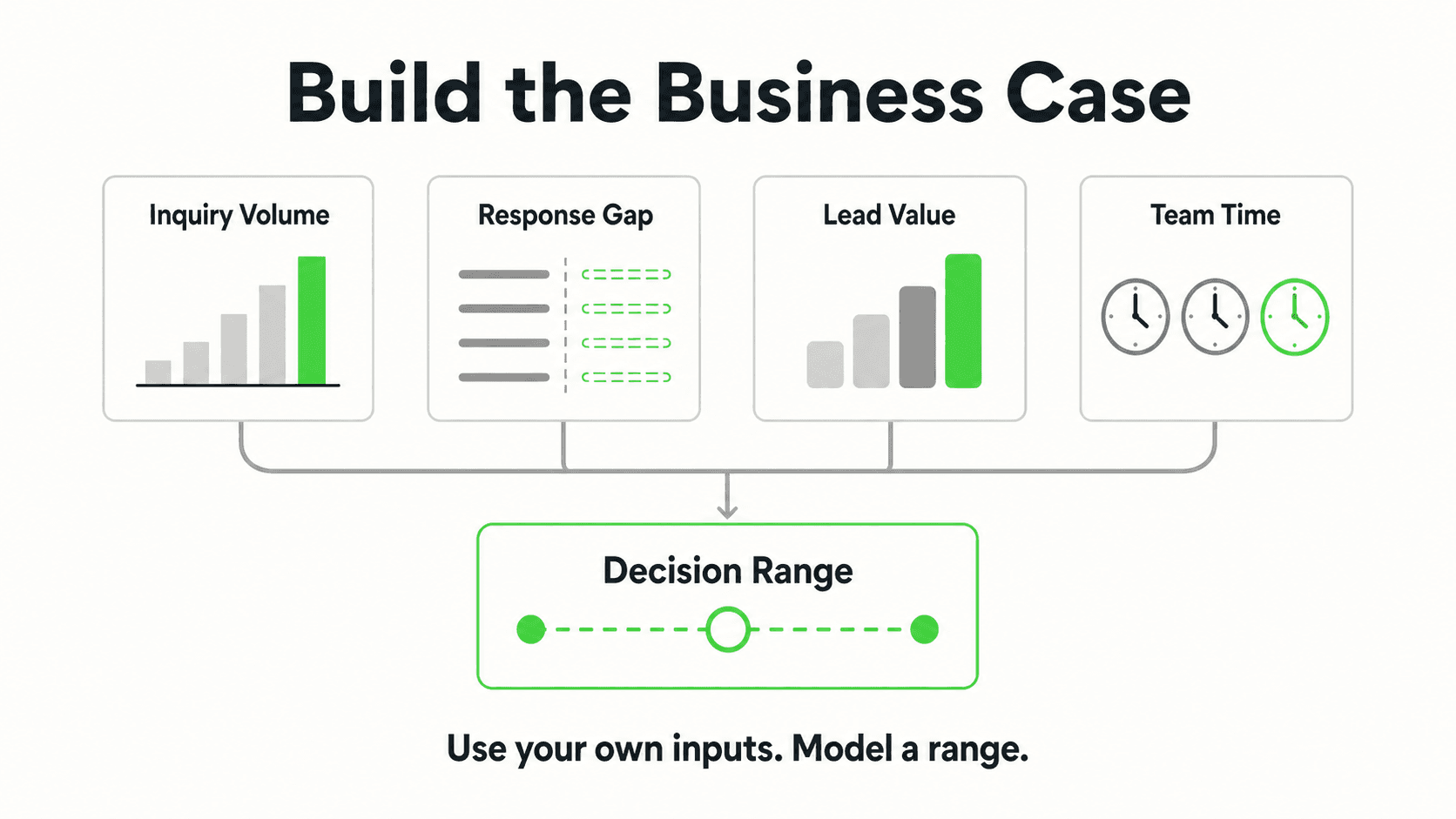
Where it doesn't hold: A business with very low inquiry volume — a handful of contacts a week — won't recoup the setup and subscription cost through savings alone; the math only works past a certain volume threshold, which varies by business but is worth calculating before committing. And cost-per-conversation improvements evaporate if a large share of conversations still need human escalation, because you're then paying for both the AI and the person.
Do the volume math before you buy
Before evaluating any conversational AI platform on cost, estimate your current monthly inquiry volume and what share is genuinely repetitive (same handful of questions, stable answers). If that repetitive share is small in absolute terms, the cost-per-conversation benefit will be real but modest — weight your decision on speed and after-hours coverage instead.
Benefit 4: Consistency Across Every Interaction
The claim: Conversational AI gives the same accurate answer to the same question every time, regardless of who's "on duty," how busy the team is, or how many times the question has already been asked that day.
Human-delivered answers vary — not from bad intent, but from fatigue, staff turnover, incomplete training, or simple human inconsistency, especially by the fortieth time someone's answered "are you open Sunday?" that week. A conversational AI system grounded in a maintained knowledge base draws from the same source every time, which removes a category of error that has nothing to do with intelligence and everything to do with human variability.
The condition: Consistency is only a benefit if the underlying knowledge base is correct and current. A conversational AI system will apply that same consistency to a stale price or an outdated policy just as reliably as it applies it to a correct one — consistently wrong is worse than inconsistently right, because customers trust the confident tone of an AI response more than they'd trust an uncertain human. This is why conversational AI for customer service treats the knowledge base as a living asset requiring ownership, not a one-time launch task.
Where it doesn't hold: Consistency is not a benefit for judgment calls — situations where the "right" answer legitimately varies by context (a service exception, a pricing negotiation, a complaint that needs discretion). Forcing a consistent scripted answer onto a situation that needs human judgment produces a worse outcome than variability would.
Benefit 5: Multilingual Reach Without Multilingual Staffing
The claim: A single conversational AI deployment can understand and respond in 100+ languages, letting a business serve a linguistically diverse customer base without hiring or scheduling multilingual staff for every shift.
Because the large language models underneath modern conversational AI are trained on multilingual text, the same deployment that answers in English can typically hold a coherent conversation in Spanish, Arabic, German, Portuguese, or dozens of other languages without a separate build for each one. For businesses in tourism, hospitality, and diverse metro markets, this unlocks customer segments that were previously turned away or served poorly simply because no one on staff spoke the customer's language during that shift.
The condition: This benefit is strongest for businesses that already serve — or want to serve — a genuinely multilingual customer base, and it depends on the knowledge base itself being written clearly enough that translation and retrieval work well across languages. It's most valuable in hospitality, retail, and any business operating in linguistically diverse markets.
Where it doesn't hold: A business with a genuinely homogeneous, single-language customer base gets essentially no lift from this benefit — it's a real capability, not a universal one. And multilingual coverage doesn't compensate for a thin knowledge base; an AI that can respond fluently in Portuguese but still can't answer the question correctly hasn't solved the underlying problem.
Benefit 6: Absorbing Demand Spikes Without Hiring
The claim: Conversational AI scales to handle sudden increases in inquiry volume — a marketing campaign, a seasonal rush, a viral moment — without the lead time, cost, or reversibility problem of hiring temporary staff.
A phone line or a small support team has a hard capacity ceiling; once every line is busy, the next caller waits or hangs up. A conversational AI system doesn't have that same ceiling in the same way — it can field a much larger simultaneous volume of conversations without degrading response time, which matters most in exactly the moments when a business can least afford to be slow: a promotional push, a seasonal peak, or unplanned press coverage.
The condition: This benefit is real for spike absorption on the repetitive share of inquiries — the FAQ volume that scales without needing more judgment applied per conversation. It requires the knowledge base to already be solid before the spike hits; you can't build institutional knowledge into an AI system in the middle of a surge.
Where it doesn't hold: If a spike in volume is also a spike in complexity — a product recall, a service outage generating angry, non-standard complaints — conversational AI absorbs the routine "what's going on" inquiries but doesn't reduce the need for human judgment on the harder ones. Scale in volume is not the same as scale in capability.
Benefit 7: Structured Data Capture From Every Conversation
The claim: Every conversational AI interaction can be captured as structured data — contact details, intent, timing, channel — turning what used to be an unlogged phone call or a missed message into a record your team can act on and analyze.
A missed call leaves no trace. A conversational AI conversation, by contrast, produces a timestamped, searchable record: what the customer asked, what they were told, and — when a lead-capture form gates the conversation — verified contact details collected before the chat continues. That record does two things a phone call doesn't: it hands your team a structured lead instead of a voicemail to transcribe, and it accumulates into a dataset you can actually analyze — which questions come up most, what times of day drive volume, where the AI hands off to a human and why.
The condition: The value of this data depends on someone actually reviewing it. A weekly look at conversation logs — what's being asked, what's getting escalated, where the AI is guessing — is what turns a chatbot from a static tool into a system that improves. Skipping that review means you're capturing data you never use.
Where it doesn't hold: Data capture doesn't substitute for a working escalation path. If leads are captured but no one follows up on them promptly, you've digitized the missed opportunity rather than solved it — the InsideSales research on response speed applies to the human follow-up step just as much as the AI's first response.
See how conversational AI handles your busiest hour
Set up an AI agent grounded in your own business content — across Website, WhatsApp, Instagram DM, and Facebook Messenger — and see which of these benefits actually apply to your volume.
Get StartedThe Honest Caveats: Where Conversational AI Falls Short
Every benefit above comes with a condition. This section pulls the recurring caveats together into one place, because a fair evaluation needs them stated plainly rather than buried inside each section.
Setup effort is real, not zero. A conversational AI system is only as good as the knowledge base behind it, and building that knowledge base — gathering FAQs, policies, pricing, and service descriptions into a structured, current document set — takes actual time. Businesses that treat setup as a five-minute toggle end up with a chatbot that gives vague or wrong answers, then blame the technology instead of the incomplete input. Managed Setup services ($299 Free, on any Hyperleap AI plan) exist specifically because this step is real work, not marketing friction.
Edge cases still need a human, and that handoff has to be designed. No credible conversational AI deployment resolves 100% of inquiries — complaints, exceptions, and anything requiring discretion should escalate to a person, and that escalation needs to be explicit and graceful, not an afterthought. A system that confidently guesses at questions it can't answer does more damage than one that says "let me get you to someone who can help" and hands off cleanly.
Very low-volume businesses may not clear the ROI bar. If your total inbound inquiry volume is small, the fixed cost of setup and subscription may not be recouped by the savings or conversion lift conversational AI provides. This isn't a knock on the technology — it's a volume-threshold problem, and it's worth estimating your own numbers before committing rather than assuming the benefit applies uniformly.
Complex, high-stakes, or emotionally charged conversations still need a human touch. Medical, legal, and financial questions beyond documented facts, angry or upset customers, and genuinely novel problems are situations where conversational AI's job is to route, not resolve. Positioning AI as a full replacement for judgment-heavy human interaction — rather than augmentation of the repetitive majority — is the single most common reason deployments disappoint. The right mental model, covered in more depth in conversational AI for customer service, is that AI absorbs volume so people can focus on the conversations that actually need them.
The Honest Version, In One Line
Conversational AI is a strong bet if you have real repetitive volume, a knowledge base you're willing to maintain, and a clear escalation path for what it shouldn't handle. It's a weak bet if you have none of those three.
Weighing the Benefits Against the Caveats
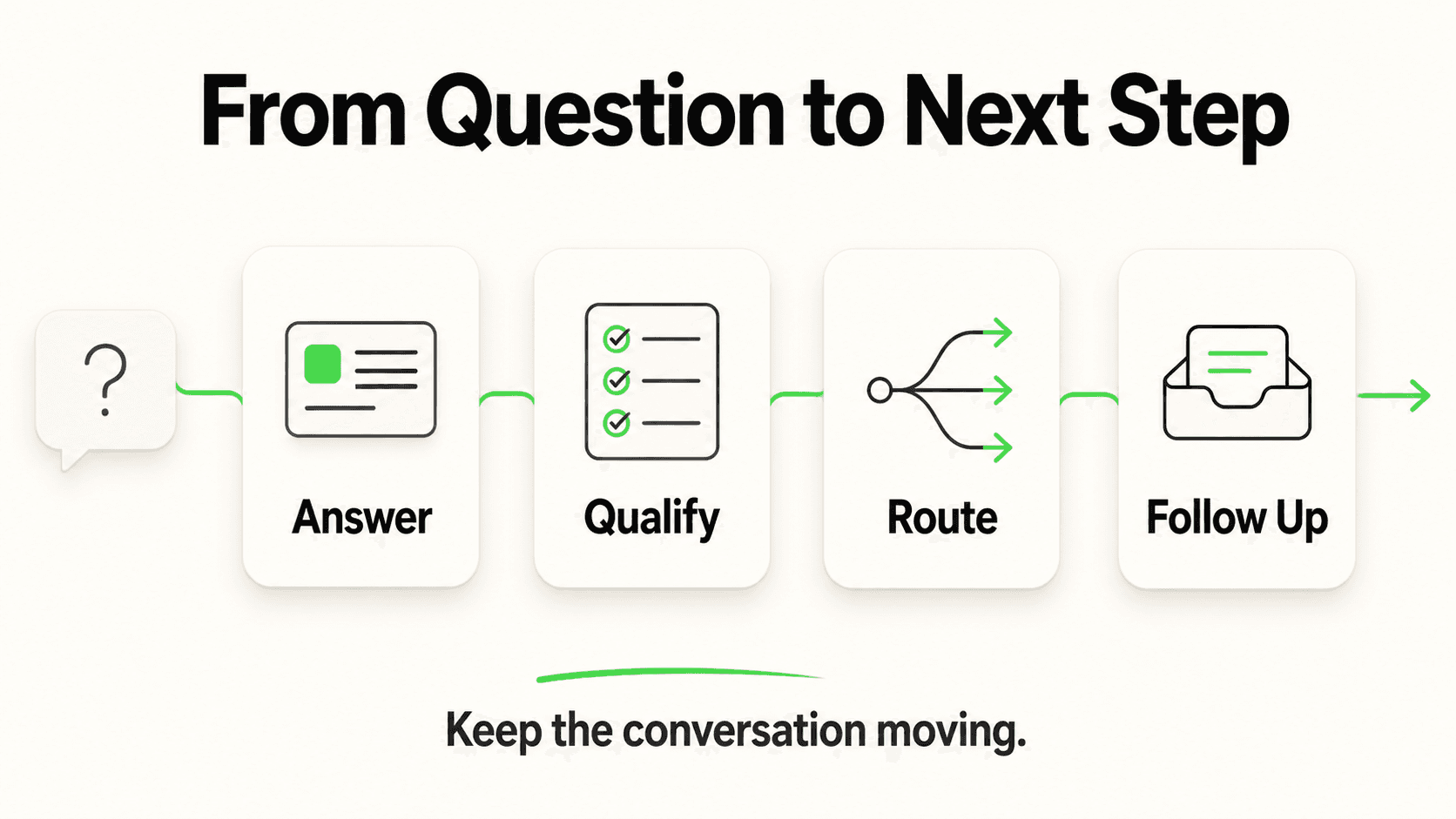
Putting the seven benefits and their conditions side by side makes the evaluation more concrete than reading either list alone.
| Benefit | Strongest when | Weakest when |
|---|---|---|
| 24/7 coverage | Meaningful after-hours inquiry volume | Business hours-only contact pattern |
| Response speed | Comparison-shopping, time-sensitive inquiries | Long sales cycles, scheduled touchpoints |
| Cost per conversation | High repetitive-question volume | Low total inquiry volume |
| Consistency | Stable, well-documented policies | Judgment calls and exceptions |
| Multilingual reach | Diverse customer base | Homogeneous single-language base |
| Demand spike absorption | Volume spikes in routine questions | Complexity spikes (outages, complaints) |
| Data capture | Team reviews and acts on the data | No follow-up process on captured leads |
The pattern across all seven: conversational AI's benefits are real, well-evidenced, and conditional — not universal. A business that maps its own inquiry volume, question repetitiveness, and after-hours pattern against this table gets a far more accurate read on expected ROI than a vendor's highlight reel would provide.
Find out which benefits apply to your business
Start a 7-day free trial and configure a document-grounded AI agent on your own content across Website, WhatsApp, Instagram DM, and Facebook Messenger. Plans start at $40/month.
Get StartedData Sources
- InsideSales, Lead Response Management research — response-time-to-conversion relationship
- HubSpot, customer expectations research — 82% expect immediate response to sales inquiries
- Gartner — up to 80% of routine customer inquiries addressable by AI without human intervention
- Hyperleap AI, Jungle Lodges case study (2024) — 3,300+ leads in 90 days, 35% after-hours inquiries
Frequently Asked Questions
What are the main benefits of conversational AI for a small business?
The main benefits are 24/7 coverage of inquiries outside staffed hours, faster first response to leads and customers, lower cost per conversation once volume is high enough to justify setup, consistent answers across every interaction, multilingual reach without hiring multilingual staff, the ability to absorb sudden demand spikes, and structured data capture from every conversation. Each benefit depends on having a maintained knowledge base and enough repetitive inquiry volume to make automation worthwhile.
Does conversational AI actually save businesses money?
It can, but the savings scale with volume and repetitiveness, not automatically. Gartner research suggests AI can handle up to 80% of routine customer inquiries without human intervention — that repetitive share is where the cost savings materialize. A business with low total inquiry volume may not recoup setup and subscription costs through savings alone, so it's worth estimating your own volume before assuming the ROI applies.
Is conversational AI worth it for a low-volume business?
Often not primarily for cost savings — the fixed cost of setup and knowledge-base maintenance is harder to justify against a small number of monthly inquiries. Low-volume businesses may still see value from consistency and after-hours capture if even a few missed inquiries represent meaningful revenue, but the strongest ROI case requires a meaningful, repetitive volume of inquiries.
Can conversational AI replace human customer service entirely?
No, and no credible deployment aims for that. Conversational AI is best suited to high-volume, repetitive, low-judgment work — FAQs, scheduling questions, lead qualification, order status — while complaints, exceptions, and anything requiring discretion should route to a human. The pattern that works is augmentation: AI absorbs the routine majority so people can focus on higher-judgment conversations.
How accurate is conversational AI, and does that limit its benefits?
Accuracy depends heavily on architecture. Systems using retrieval-augmented generation (RAG) ground responses in a business's actual documents, which is designed to reduce hallucinated answers compared to a general-purpose model answering from memory. No system can guarantee 100% accuracy, which is why every benefit in this guide is paired with the condition that a well-designed deployment includes a clear escalation path to a human for anything the AI isn't confident about. See how accurate are AI chatbots for more detail.
What's the biggest reason conversational AI deployments underperform?
The most common reason is treating the platform as the whole solution rather than 20% of the outcome. The knowledge base, escalation rules, and ongoing review of conversations are the other 80%, and skipping them produces vague or stale answers that undercut every benefit described above. This is covered in operational detail in conversational AI for customer service.
How much does conversational AI cost for a small business?
As a reference point, Hyperleap AI's plans start at $40/month (Plus), scaling to $100/month (Pro) and $200/month (Max) based on response volume and channel count, each with a 7-day free trial (credit card required, no free plan). Managed Setup, which handles the knowledge-base and configuration work described in the caveats above, is offered $299 Free on any plan.
Which businesses see the fastest payback from conversational AI?
Businesses with high volumes of repetitive, time-sensitive inquiries tend to see the fastest payback — home services, hospitality, and other verticals where a fast first response has a direct, measurable effect on whether the business wins the customer. Businesses with low inquiry volume or long, judgment-heavy sales cycles typically see a slower or smaller return.
Industry Solutions
See how AI chatbots work for these industries:
Related Articles

12 Conversational AI Examples From Real Businesses
12 real conversational AI examples organized by job-to-be-done — after-hours capture, FAQ deflection, booking, and more — with sourced outcomes.

Conversational AI for Customer Service: An Operational Guide for SMBs
Where conversational AI actually creates value in customer service, how to operationalize it without breaking your support team, and the failure modes that sink most deployments.

Conversational AI for Small Business: A Starter Guide
A practical guide to conversational AI for small business: what to build first, a 5-step setup week, real costs, and the 3 use cases that pay for it first.
Conversational AI vs Chatbot: The Real Difference
Conversational AI vs chatbot explained: rule-based scripted bots versus LLM-powered conversational AI, plus a comparison table and decision framework.