Automate Insurance Quote Collection Without Losing Quality
A step-by-step guide to automating your agency's quote intake across auto, home, life, and commercial lines — while keeping lead quality high.

TL;DR: The average insurance agency takes 47 hours to respond to a quote request, yet leads contacted within 5 minutes convert at dramatically higher rates than those contacted after 30 minutes (Source: ProPair, 2025). Automating quote collection — the information-gathering phase, not the advice — lets your team spend time on consultative selling instead of chasing down VIN numbers and property addresses. This guide walks agency principals through a 7-step process for automating intake across auto, home, life, and commercial lines while keeping lead quality high.
Every insurance agency principal knows the feeling: you walk in Monday morning to find three voicemails from the weekend, two "Request a Quote" form submissions with half the fields blank, and an email from a prospect who already bound with a competitor. Research from ProPair shows that 84% of insurance prospects abandon the quoting process altogether — the highest abandonment rate of any industry (Source: ProPair, 2025). Meanwhile, IBISWorld data reveals that 47% of all insurance inquiries arrive outside standard business hours (Source: AgentZap, 2026), exactly when your office is empty.
The agencies winning in 2026 are not replacing their licensed agents with robots. They are automating the collection — the tedious but critical step of gathering coverage type, vehicle or property details, current policy information, and contact preferences — so that their producers can focus on what actually requires expertise: advising, quoting competitively, and closing.
This guide shows you how to do the same, step by step, without sacrificing the lead quality your book of business depends on.
Who This Guide Is For
This guide is written for independent agency principals, agency managers, and operations leads at P&C, life, and multi-line agencies in the US. No technical background required — we focus on workflow decisions, not code.
What Is Automated Quote Collection for Insurance Agencies?
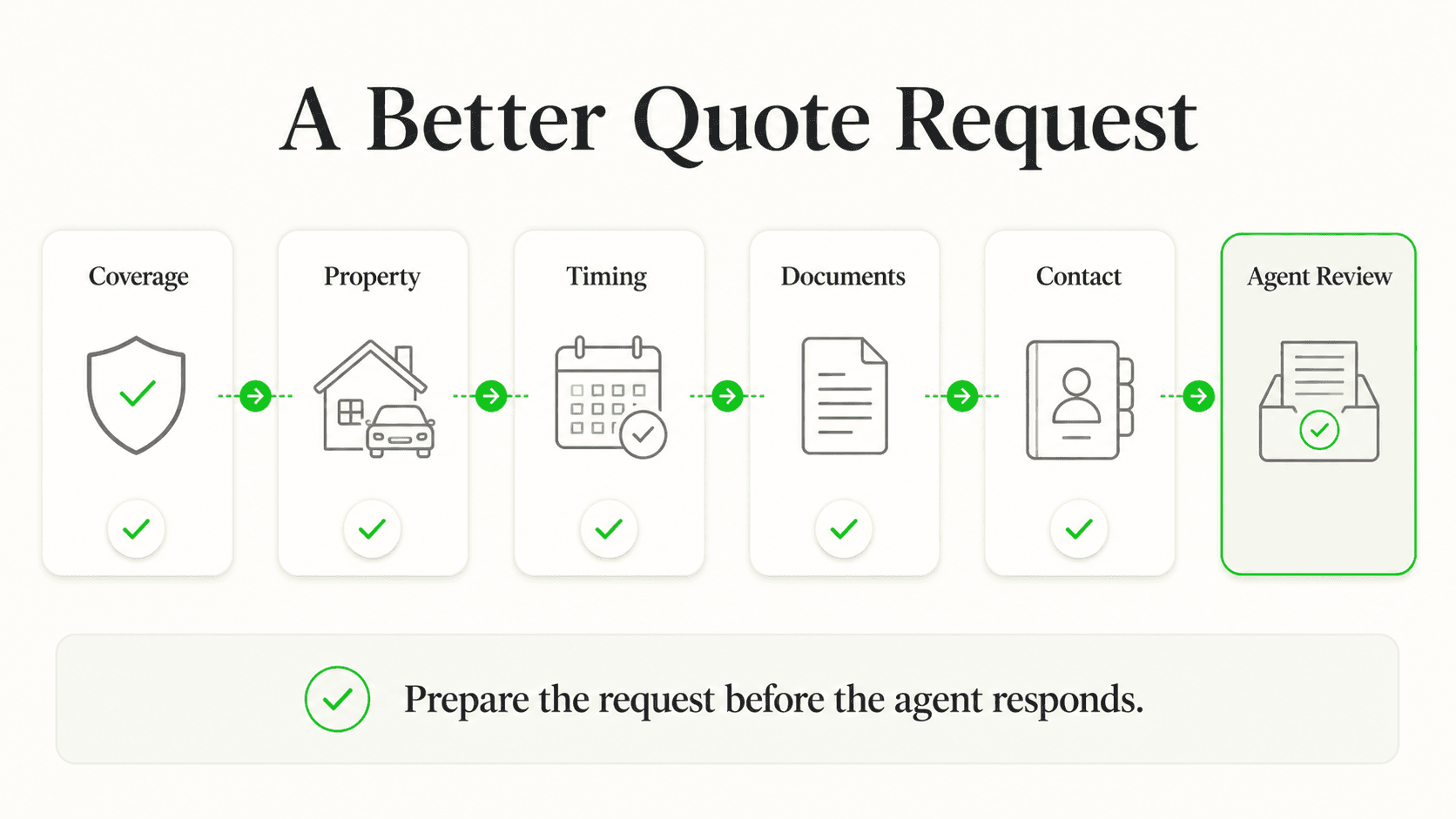
Automated quote collection is the process of using technology — web forms, chatbots, IVR systems, or a combination — to gather the information a producer needs before they can run a quote. It is not underwriting, binding, or advising. It is the digital equivalent of having a well-trained CSR answer the phone, ask the right questions, and hand a complete submission to the right agent.
What automated collection covers:
- Contact details: Name, phone, email, preferred contact method and time
- Coverage type: Auto, homeowners, renters, umbrella, life, commercial general liability, BOP, workers' comp
- Risk details: VIN numbers, property addresses, square footage, construction year, driver DOB and license info, business revenue and employee count
- Current coverage: Existing carrier, policy expiration date, current premium, claims history
- Qualification signals: Timeline to purchase, reason for shopping (price, coverage gap, new asset, renewal), budget expectations
What it does NOT cover:
- Recommending coverage limits or deductibles (requires a licensed agent)
- Comparing carrier rates (requires a comparative rater and agent judgment)
- Binding a policy (requires agent authorization and carrier approval)
- Providing legal or claims advice
The distinction matters for compliance. The NAIC Model Bulletin on AI, adopted by 24 states as of early 2026, requires that insurers and agencies maintain human oversight of AI systems that make or support decisions affecting consumers (Source: Quarles & Brady, 2025). Automating data collection keeps you on the right side of this requirement, because you are automating intake, not advice.
Think of it this way: you are not replacing the conversation between agent and client. You are making sure that conversation starts with a complete file instead of a half-filled sticky note.
Why Insurance Quote Collection Breaks Down
Before you automate anything, it helps to understand exactly where the current process leaks value. Here are the five most common failure points we see in agencies across the US.
After-Hours Inquiries Disappear
Nearly half of insurance shoppers inquire outside of 9-to-5 hours. According to IBISWorld, peak quote-request volume hits between 6 PM and 8 PM on weekday evenings (Source: AgentZap, 2026). If your phone rolls to voicemail after 5 PM, those prospects are not waiting until tomorrow — the majority of insurance shoppers contact multiple agencies when comparing quotes, and the one that answers first has an enormous advantage.
Slow Response Times Kill Conversion
The industry average response time for an insurance lead is 47 hours (Source: ProPair, 2025). That is not a typo — nearly two full business days. Meanwhile, leads contacted within 5 minutes are significantly more likely to convert than those contacted after 30 minutes — ProPair's research on insurance conversion shows that response speed is the single biggest controllable variable in closing a policy (Source: ProPair, 2025). Every hour of delay shrinks your close rate. For more on what slow response costs your agency, see our deep dive on how slow response times cost businesses revenue.
Incomplete Information Requires Multiple Follow-Ups
A prospect fills out your "Request a Quote" web form. You get a name, a phone number, and "auto insurance" in the comments field. Now your CSR has to call back, leave a voicemail, wait for a callback, and start a 10-minute conversation just to collect the VIN, driver history, and current coverage details that a comparative rater needs. Each follow-up touch adds 24-48 hours of delay and increases the chance the prospect goes elsewhere.
Manual Data Entry Creates Errors and Bottlenecks
Even when information arrives, it often arrives in unstructured formats — voicemails, emails, handwritten notes — that someone must manually key into your AMS. Agencies that have studied their own workflows report that manual data entry accounts for 20-25% of CSR time, and error rates on manually entered policy data run between 5-10% (Source: Strada, 2026). Those errors lead to incorrect quotes, re-work, and frustrated prospects.
No Routing Logic Means Wrong-Agent Delays
In a multi-agent or multi-line agency, a commercial lines lead that lands in the personal lines queue sits there until someone notices the mismatch. Without automated routing based on coverage type, geography, or producer specialization, leads bounce around internally before anyone picks up the phone. That internal delay is invisible to management but painfully obvious to the prospect.
7 Steps to Automate Quote Collection While Maintaining Quality
Now for the practical part. These seven steps take you from documenting your current workflow to measuring conversion at every stage. Tackle them in order — each builds on the previous one.
1. Map Your Current Quote-to-Bind Workflow
Before you buy any technology, document what actually happens today when a quote request arrives. This is not a theoretical exercise — sit with your CSRs and producers for a day and track the journey of three to five real leads from first contact to either a bound policy or a lost opportunity.
What to document:
- Entry points: Where do leads come from? (Phone, website form, email, walk-in, referral, carrier lead, third-party aggregator)
- Information collected at first touch: What do you get upfront, and what requires a callback?
- Handoff points: Who touches the lead, and when does it move from one person to another?
- AMS entry: When and how does the information get into your Agency Management System?
- Time stamps: How long does each step take? Where are the longest delays?
Most agencies discover that a significant majority of the total quote-to-bind cycle is spent on collection and data entry, not on the actual quoting, advising, or binding. That is your automation opportunity.
Deliverable: A simple flowchart (whiteboard is fine) showing each step, the average time it takes, and where information is lost or delayed.
2. Identify What Information to Collect Upfront by Line
Not all insurance lines require the same intake data. Before you design any automated workflow, create a "minimum viable submission" checklist for each line of business your agency writes. This ensures your automation collects enough to run a quote — but does not ask so many questions that the prospect abandons the process.
Auto insurance intake checklist:
- Driver name(s), DOB, marital status
- Driver's license number and state
- Vehicle year, make, model, VIN
- Current carrier and expiration date
- Desired coverage level (state minimum, standard, full)
- Any recent accidents or violations (last 3-5 years)
Homeowners insurance intake checklist:
- Property address
- Year built, square footage, construction type
- Roof age and material
- Current carrier and expiration date
- Desired coverage amount
- Any prior claims (last 5 years)
Life insurance intake checklist:
- Applicant name, DOB, gender
- Tobacco use (last 12 months)
- Coverage amount and type (term, whole, universal)
- General health status
- Beneficiary information
Commercial lines intake checklist:
- Business name, address, entity type
- Industry / SIC or NAICS code
- Annual revenue, employee count, payroll
- Current coverage types and carriers
- Desired coverage (GL, BOP, WC, commercial auto, E&O)
- Claims history (last 5 years)
The 80/20 Rule of Intake Questions
Aim to collect 80% of what a comparative rater needs in the initial automated interaction. The remaining 20% — edge-case details, clarifying questions — is where your licensed agent adds value on a follow-up call. Trying to automate 100% of data collection leads to long, frustrating sessions that drive abandonment.
3. Design Qualification Questions to Route Leads to the Right Agent or Team
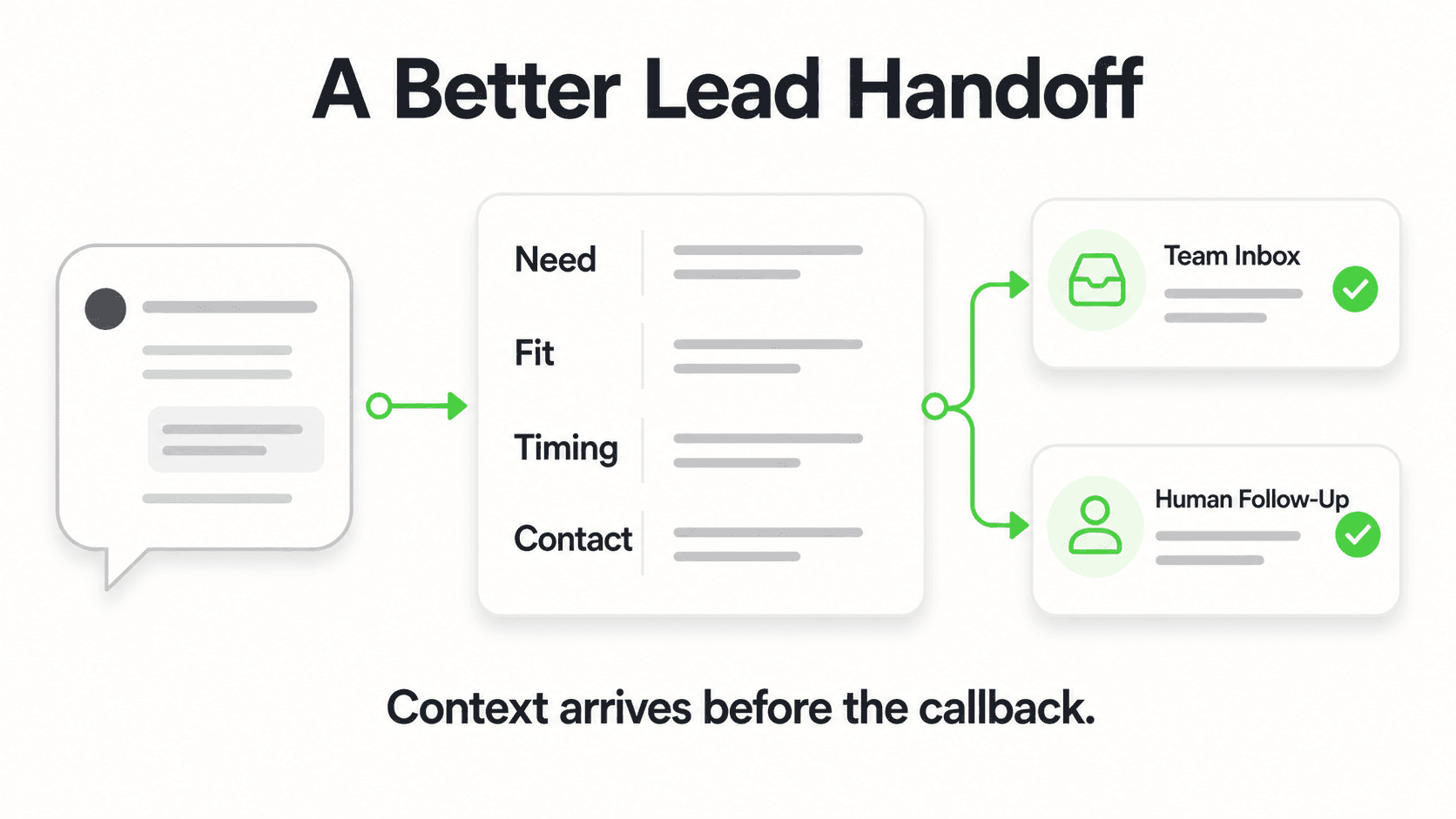
Automation is not just about collecting data — it is about getting the right lead to the right person. Add 2-3 qualification questions to your intake flow that determine routing:
Line-of-business routing:
- "What type of coverage are you looking for?" (Auto / Home / Life / Business / Multiple)
- Route personal lines to your PL team, commercial to your CL producers
Urgency routing:
- "When does your current policy expire?" or "When do you need coverage by?"
- Leads expiring within 14 days go to a priority queue
Value routing:
- For commercial lines: "What is your approximate annual revenue?" helps prioritize larger accounts
- For personal lines: multi-policy prospects (auto + home bundle) get flagged for a senior producer
Geographic routing:
- If you have producers licensed in specific states or specializing in certain territories, route by zip code
The goal is to replicate the judgment that your best receptionist uses when deciding who gets the call — but do it consistently, 24/7, with no missed handoffs.
4. Choose Your Automation Technology
This is where agency principals typically get overwhelmed by vendor pitches. Here is an honest comparison of the three main approaches, with pros and cons for each.
Option A: Enhanced Web Forms
Web forms are the simplest starting point. Tools like Gravity Forms, Typeform, or insurance-specific form builders let you create multi-step forms with conditional logic — if the prospect selects "auto," they see vehicle questions; if "commercial," they see business questions.
Pros: Low cost ($20-50/month), familiar to staff, easy to set up, works on any website.
Cons: No conversational flow — still feels like filling out paperwork. Average form abandonment rate is 68% (Source: Zuko Analytics). No ability to answer prospect questions in real time. Only works on your website (not WhatsApp, Facebook, etc.).
Option B: AI Chatbots
AI-powered chatbots use natural language to walk prospects through quote intake in a conversational format. Instead of a long form, the prospect answers one question at a time in a chat interface. Modern chatbots can handle branching logic, validate inputs in real time (e.g., "That VIN doesn't look right — can you double-check?"), and answer basic questions about the process along the way.
Pros: Conversational experience reduces abandonment. Works 24/7 across multiple channels (website, WhatsApp, Facebook Messenger, Instagram DM). Research from Glassix shows chatbot-assisted intake increases conversion rates by 23% compared to static forms (Source: Glassix, 2025). Can answer FAQs during intake ("Do I need an SR-22?" or "What documents should I have ready?"). Estimated cost per interaction: $0.50 vs. $6.00 for a live phone call (Source: Sonant AI, 2026).
Cons: Requires more upfront configuration to get the conversation flow right. Needs ongoing training to handle edge cases. Prospect must be comfortable with chat interfaces. If you want to learn more about evaluating chatbot platforms, see our guide to choosing an AI chatbot platform.
Option C: Phone IVR / Voice AI
Interactive Voice Response systems and newer voice AI solutions let prospects call your agency number and answer intake questions by voice. The system transcribes and routes the information.
Pros: Meets prospects who prefer phone calls. Can capture after-hours calls that would otherwise go to voicemail. Familiar interaction model for older demographics.
Cons: Higher per-minute cost than chat. Transcription errors are more common than typed inputs. Harder to validate information in real time. Limited ability to share documents or images (e.g., a photo of a current dec page).
Our recommendation: Most agencies will get the best results from a combination — an AI chatbot for website and messaging channels, plus a well-configured phone IVR for voice callers. The key is that both systems feed into the same data pipeline and AMS.
See How AI Chatbots Handle Insurance Quote Collection
Hyperleap AI Agents collect quote details across website, WhatsApp, and Facebook Messenger — then deliver complete submissions to your team.
Explore Insurance Agents5. Integrate with Your Agency Management System
Your automation tool is only as good as its connection to the system your team actually works in every day. If collected data sits in a separate dashboard that nobody checks, you have not saved any time — you have added another inbox.
The major AMS platforms and integration considerations:
Applied Epic: The most widely used AMS among larger independent agencies. Supports API integrations for automated data import. Look for automation tools that can create or update client records and activity notes in Epic via the Applied IVANS exchange or direct API.
HawkSoft: Popular among small to mid-sized agencies. Offers API access for data exchange. Integration typically works by pushing contact and submission data into HawkSoft as a new prospect record with attached notes.
EZLynx: Functions as both an AMS and a comparative rater. If you are already using EZLynx for rating, look for automation tools that push collected data directly into EZLynx's applicant fields so your team can run a quote without re-keying anything.
QQ Catalyst (now Vertafore): Supports automated data import through its API. Similar integration pattern to Applied Epic — create prospect records and attach submission details.
Integration checklist:
- Can the automation tool create a new contact/prospect in your AMS automatically?
- Can it attach collected data (structured fields, not just a text blob) to the record?
- Does it trigger a task or notification in your AMS so the assigned producer knows to act?
- Does it map to your AMS's required fields to avoid incomplete records?
- Is the integration real-time, or does it batch-sync on a schedule? (Real-time is strongly preferred.)
Agencies that implemented process automation with AMS integration have reported up to 47% faster response times and 32% fewer manual errors (Source: Strada, 2026). The reduction in re-keying alone typically saves a CSR 1-2 hours per day.
6. Set Up Multi-Channel Collection
Your prospects do not all reach you the same way. A 28-year-old renter shopping for auto insurance may start on your website chat at 9 PM. A 55-year-old business owner may call your office line at 3 PM. A referral from a realtor partner may come through a WhatsApp message. Your automation should meet prospects on the channel they prefer.
Website: The primary channel for most agencies. Embed a chatbot or smart form on your homepage, quote request page, and each line-of-business page. Make sure it is mobile-responsive — the majority of insurance research now happens on mobile devices.
WhatsApp: Particularly effective for agencies serving communities where WhatsApp is a primary communication tool. Supports rich messages (buttons, lists), file sharing (prospects can send photos of their current dec page), and automated follow-ups.
Facebook Messenger and Instagram DM: Good for agencies that generate leads through social media advertising. An automated intake flow on Messenger captures lead data where the prospect is already engaged instead of sending them to a separate form.
Phone/voicemail: Even with digital channels, phone remains critical. At minimum, replace your after-hours voicemail greeting with a message that directs callers to your website chat or text-based intake. Better yet, implement a voice AI that collects basic information and routes it into your pipeline.
Email: Automate structured responses to inbound email inquiries. Instead of replying with "Thanks for your interest — when can we call you?", send an automated response with a link to your intake chatbot or form that pre-fills the prospect's email address.
The key principle: Every channel should feed data into the same centralized pipeline (your AMS or a staging queue in front of it). A prospect who starts on WhatsApp and calls the next day should not have to repeat their information.
7. Measure and Optimize Conversion at Each Step
You cannot improve what you do not measure. Set up tracking for every stage of your automated quote collection funnel.
Key metrics to track:
| Metric | What It Tells You | Target |
|---|---|---|
| Intake start rate | % of visitors who begin the quote collection flow | 15-25% of page visitors |
| Completion rate | % who finish providing all required information | 60-75% of those who start |
| Time to complete | How long the intake takes | Under 5 minutes for personal lines |
| Data completeness | % of AMS-required fields populated | 80%+ without agent follow-up |
| Agent response time | Time from completed submission to first agent outreach | Under 15 minutes during business hours |
| Quote-to-bind ratio | % of completed submissions that become bound policies | Track by channel, line, and agent |
| Channel mix | Which channels generate the most and best-quality leads | Varies by agency |
Optimization cycle:
- Weekly: Review completion rates by channel. If one channel has a significantly lower completion rate, investigate — the flow may be too long, a question may be confusing, or there may be a technical issue.
- Monthly: Analyze quote-to-bind ratios by lead source. Are chatbot-collected leads closing at the same rate as phone leads? If not, adjust qualification questions.
- Quarterly: Compare your average response time to the 5-minute benchmark. The data on response speed and conversion is clear: agencies that respond to leads in under 5 minutes significantly outperform the 47-hour industry average on close rates. Track your own before-and-after numbers — this is where automation's impact is most visible.
For a deeper look at calculating the ROI of automation in your agency, check out our AI chatbot ROI calculator and case studies.
Real Results: What Agencies Are Achieving with Automated Quote Collection
Automation is not theoretical — agencies across the US are already seeing measurable improvements. Here is what the data shows for agencies that have implemented automated quote collection systems.
Faster Response, Higher Close Rates
Agencies that automated their intake process cut average response times from 47 hours to under 15 minutes for digital leads. That speed advantage translates directly to revenue: industry data consistently shows that leads contacted within 5 minutes convert at dramatically higher rates than those reached after 30 minutes or more — ProPair's insurance-specific research shows response speed is the single biggest controllable factor in conversion (Source: ProPair, 2025). For an agency writing 200 quotes per month, even a modest 10% improvement in close rate can mean 20 additional bound policies per month.
Reduced Operational Costs
Automated chat-based intake costs approximately $0.50 per interaction, compared to $6.00 for a CSR phone call handling the same information collection (Source: Sonant AI, 2026). For an agency handling 500 inbound quote requests per month, that is a potential savings of $2,750/month on intake alone — before accounting for the freed-up CSR time that can be redirected to retention calls, cross-selling, or service.
Improved Data Quality
Structured automation — where each field is validated as the prospect enters it — reduces manual data entry errors by 80-90% and increases employee productivity by 20-25% (Source: BizData360, 2025). Fewer errors mean fewer re-quotes, fewer E&O exposure incidents, and faster carrier turnaround times.
Around-the-Clock Coverage
Agencies that deploy 24/7 automated intake capture the 47% of inquiries that arrive outside business hours — leads that previously went to voicemail and were often lost. One key advantage: after-hours automated leads can convert at rates comparable to business-hours leads, because the prospect's intent is high and the information is complete by the time an agent follows up the next morning.
Implementation Checklist: Your First 30 Days
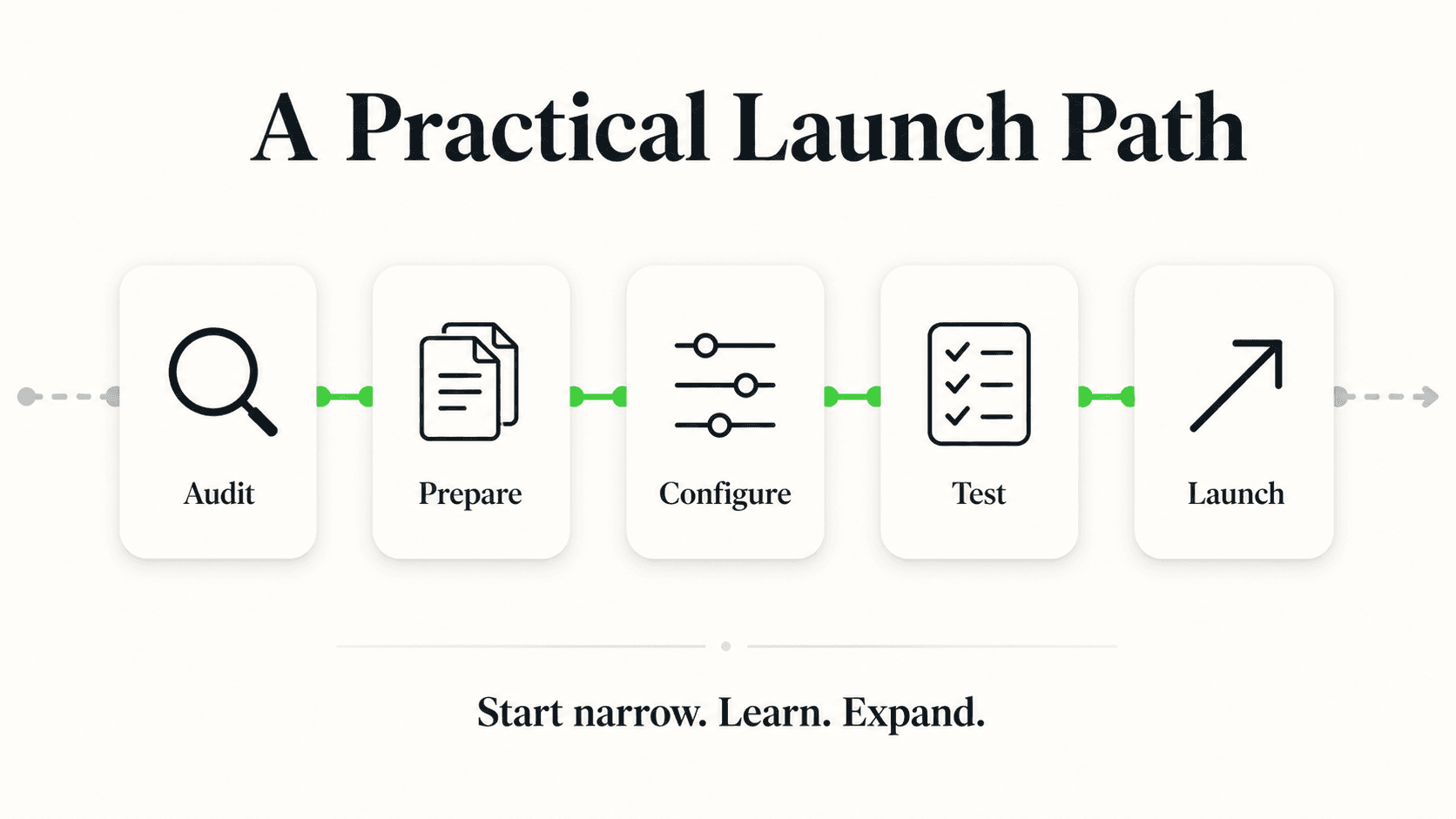
Use this checklist to move from planning to production in 30 days. Each item includes a realistic time estimate.
Week 1: Discovery and Documentation
- Map your current quote-to-bind workflow (2-3 hours)
- Document intake requirements for each line of business (1-2 hours)
- Identify your top 3 lead sources by volume (pull from AMS reports)
- Establish baseline metrics: current response time, completion rate, close rate
- Review your AMS integration options (check vendor documentation or call support)
Week 2: Design and Configuration
- Create your qualification and routing rules (which leads go to which agents)
- Write the question flow for your top 2 lines of business (start with personal auto and homeowners)
- Select your automation technology (chatbot, enhanced form, or both)
- Set up the integration with your AMS (or confirm API access with your vendor)
- Configure notification rules (how and when agents get alerted to new submissions)
Week 3: Test and Refine
- Run 10-15 test submissions through the entire flow (intake through AMS entry)
- Have 2-3 CSRs test from a prospect's perspective and note friction points
- Verify data lands in the correct AMS fields with no mapping errors
- Test after-hours scenarios (does the chatbot/form work at 9 PM? Does the agent get notified in the morning?)
- Refine question wording based on tester feedback
Week 4: Launch and Monitor
- Go live on your website (primary channel first)
- Monitor completion rates daily for the first week
- Collect feedback from producers: Is the data they are receiving usable? Complete?
- Add secondary channels (WhatsApp, Messenger) once the primary channel is stable
- Schedule your first monthly review to compare against baseline metrics
Compliance Reminder
Before going live, confirm that your automated intake flow includes required disclosures for your state. At minimum, disclose that the prospect is interacting with an automated system, and provide an option to reach a licensed agent. As of early 2026, 24 states have adopted the NAIC Model Bulletin on AI, which requires transparency when AI systems interact with consumers in insurance contexts (Source: Quarles & Brady, 2025).
Automate the Collection, Elevate the Conversation
The insurance agencies that will grow their book of business in 2026 and beyond are not the ones with the most producers or the biggest ad budgets. They are the ones that capture every quote opportunity — at 8 AM or 8 PM, on a website or a WhatsApp message — and get a complete, qualified submission in front of the right agent within minutes.
Automated quote collection is not about removing the human element from insurance. It is about removing the busywork that prevents your humans from doing what they do best: advising clients, building relationships, and writing good business.
The technology is ready. Your competitors are adopting it — 83% of insurance CIOs plan to increase automation budgets in 2026 (Source: Strada, 2026). The question is whether your agency will be ahead of that curve or behind it.
Start with one line of business, one channel, and one week of testing. The results will speak for themselves.
Frequently Asked Questions
Will automated quote collection replace my CSRs or producers?
No. Automated quote collection replaces the most repetitive part of your CSRs' day — gathering basic information — not their judgment, relationship skills, or licensing. Think of it as giving your team a head start: instead of spending the first 10 minutes of a call collecting a VIN and driver DOB, they start the conversation with a complete submission and can immediately focus on coverage advice and cross-sell opportunities. Most agencies find that automation lets existing staff handle significantly more volume without adding headcount — freeing them to focus on coverage advice and cross-selling rather than data collection.
How much does it cost to implement automated quote collection?
Costs vary widely by approach. A basic enhanced web form with conditional logic runs $20-50/month. An AI chatbot platform typically costs $40-200/month depending on volume and channels. Phone IVR or voice AI solutions range from $100-500/month. AMS integration may require a one-time setup fee of $200-1,000 depending on your AMS and the automation vendor. For most agencies, the total investment is $100-400/month — which pays for itself if it helps you bind even 2-3 additional policies per month. See our pricing page for one example of chatbot platform costs.
How long does implementation take?
A focused agency can go from decision to live in 2-4 weeks for the first channel (usually website). Adding additional channels like WhatsApp or Messenger typically takes another 1-2 weeks each. The biggest variable is AMS integration — if your AMS has a well-documented API and your automation vendor supports it natively, integration can be done in days. If custom work is needed, budget an extra 1-2 weeks.
Is automated quote collection compliant with state insurance regulations?
Automating information collection is generally compliant because you are gathering data, not providing insurance advice or making coverage recommendations. However, you must disclose that the prospect is interacting with an automated system, and you should always provide an escalation path to a licensed agent. The NAIC Model Bulletin adopted by 24 states emphasizes transparency and human oversight when AI interacts with consumers in insurance contexts. Consult your state's Department of Insurance guidelines and your E&O carrier for specific requirements.
Can automation handle complex commercial lines intake?
Yes, but with caveats. Commercial lines intake is inherently more complex than personal lines — a contractor's BOP requires different questions than a restaurant's GL policy. The best approach is to use automation for the initial qualification (industry, revenue, employee count, desired coverage types) and then have a commercial lines producer follow up with a tailored questionnaire for the specific class of business. Trying to automate the entire commercial intake in one session leads to 15-20-minute interactions that frustrate prospects.
What if a prospect wants to talk to a person instead of a chatbot?
Always provide an escape hatch. Your automated flow should include a clear, easy-to-find option to connect with a human at any point — whether that is a "Talk to an Agent" button, a phone number, or a live chat handoff. Offering both options actually increases automation adoption: prospects who know they can reach a human when needed are more comfortable engaging with automated systems for routine tasks. In practice, the majority of prospects complete the automated flow when a human option is visibly available.
Ready to Automate Your Agency's Quote Collection?
Hyperleap AI Agents collect quote details 24/7 across website, WhatsApp, and Messenger — then deliver complete, structured submissions to your team via REST API and webhooks.
Start Your Free TrialIndustry Solutions
See how AI chatbots work for these industries:
Related Articles

AI Front Desk for Insurance Agencies: Quoting & Compliance
How an AI front desk handles insurance quoting, lead qualification, and multiple lines of business — and exactly where a licensed agent takes over.

5 Questions Insurance Agencies Must Ask Before a Chatbot
Insurance isn't like other industries. Here are the 5 questions that separate the right chatbot from an expensive mistake for your agency.

Qualify Leads in Claude Desktop with Hyperleap MCP
Stop scoring leads on gut feel. Connect Claude Desktop to Hyperleap via MCP and rank chatbot leads on what they actually said: prompts plus a scoring rubric.

Chatbot Lead Summaries: What Your Team Should Receive
A raw transcript creates work. A chatbot lead summary — contact details, intent, qualification signals, timeline, and a next action — means your rep is ready to call in 30 seconds.