How Slow Response Times Cost Your Business in Sales
Research shows responding within 5 minutes makes you 100x more likely to convert leads. Here's what slow response times actually cost—and how to fix it.
TL;DR: Leads contacted within 5 minutes are 100x more likely to convert than those contacted after 30 minutes. Most businesses respond in hours or days, losing significant revenue. AI chatbots solve this by providing instant responses 24/7, and businesses implementing them typically achieve full ROI within 30-60 days.
How Slow Response Times Cost Your Business
The difference between a 5-minute response and a 30-minute response isn't 25 minutes—it's the difference between winning and losing the sale.
Research consistently shows that response time is one of the most significant factors in lead conversion. Yet most businesses take hours or even days to respond to inquiries. This article quantifies the cost and shows you how to fix it.
The 5-Minute Rule
The most cited study on response times comes from Lead Response Management research (Source: Harvard Business Review / InsideSales.com):
The Data
| Response Time | Conversion Likelihood | Relative Performance |
|---|---|---|
| Under 5 minutes | Baseline (100x) | Maximum |
| 10 minutes | 4x lower | -75% |
| 30 minutes | 21x lower | -95% |
| 1 hour | 60x lower | -98% |
| 24 hours | Nearly zero | -99.9% |
The Stark Reality
Leads contacted within 5 minutes are 100 times more likely to convert than leads contacted after 30 minutes (Source: Harvard Business Review / InsideSales.com). Not 10% more likely—100 times more likely.
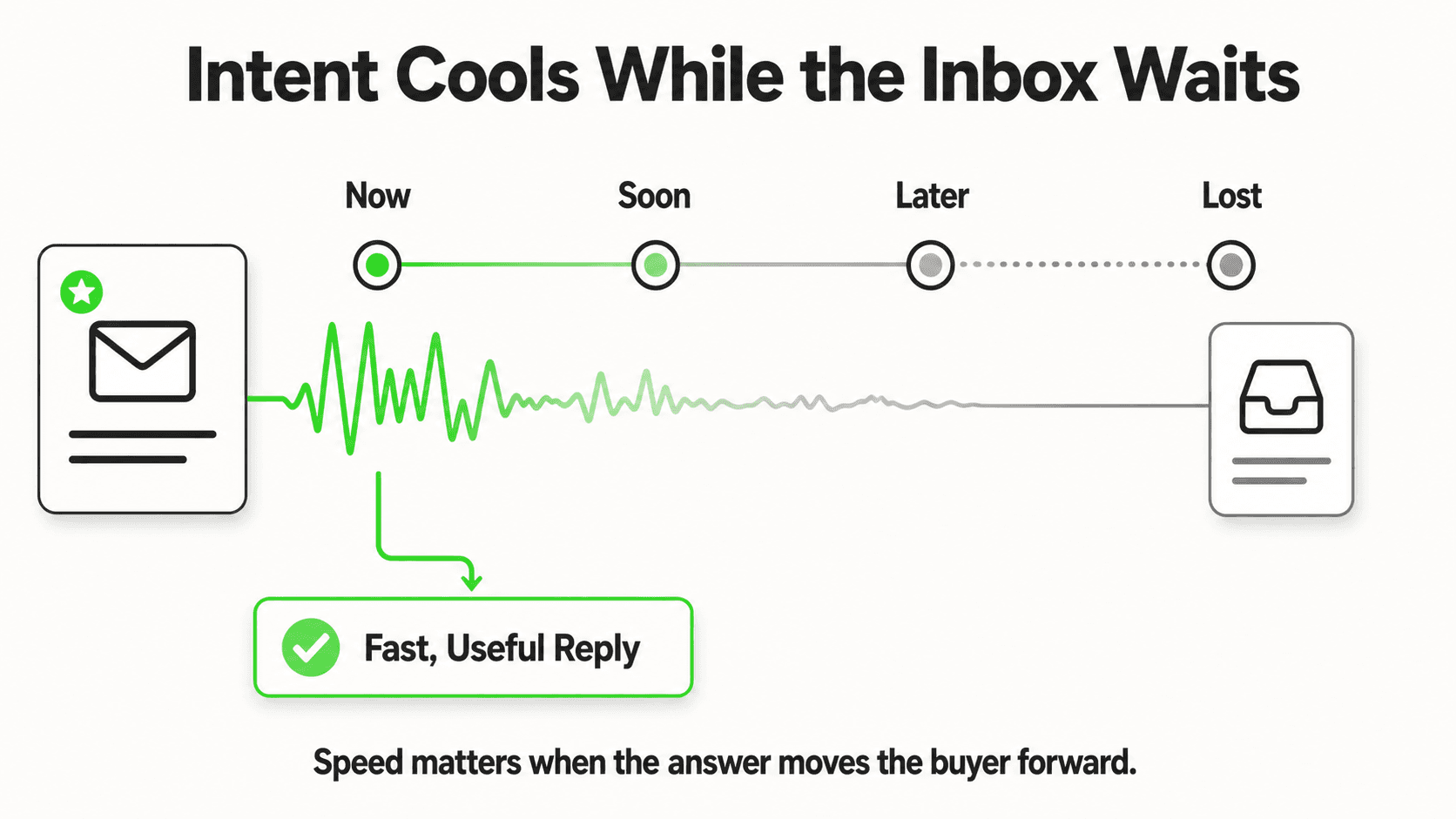
Why Speed Matters So Much
- Intent is highest immediately: The moment someone inquires, they're actively considering a purchase
- Competition is researching: While you delay, they're contacting your competitors
- Context fades: Details of what prompted the inquiry become fuzzy
- Enthusiasm diminishes: The excitement that drove the inquiry wanes
- Alternatives emerge: They find other solutions to their problem
Industry Benchmarks
How does your response time compare to industry standards?
Average Response Times by Industry
| Industry | Average Response | Top Performers |
|---|---|---|
| Real Estate | 15 hours | Under 5 minutes |
| Hotels | 6 hours | Under 30 seconds |
| Healthcare | 48 hours | Under 10 minutes |
| E-commerce | 12 hours | Under 1 minute |
| Professional Services | 24 hours | Under 15 minutes |
| Dental Practices | 8 hours | Under 5 minutes |
The Gap Between Expectation and Reality
| Customer Expectation | Industry Reality | Gap |
|---|---|---|
| Email: 1 hour | 12+ hours average | 12x slower |
| Chat: Instant | 2+ minutes average | Infinite gap |
| Phone: Immediate | 60% go to voicemail | Missed entirely |
| WhatsApp: 5 minutes | Hours if at all | 12-24x slower |
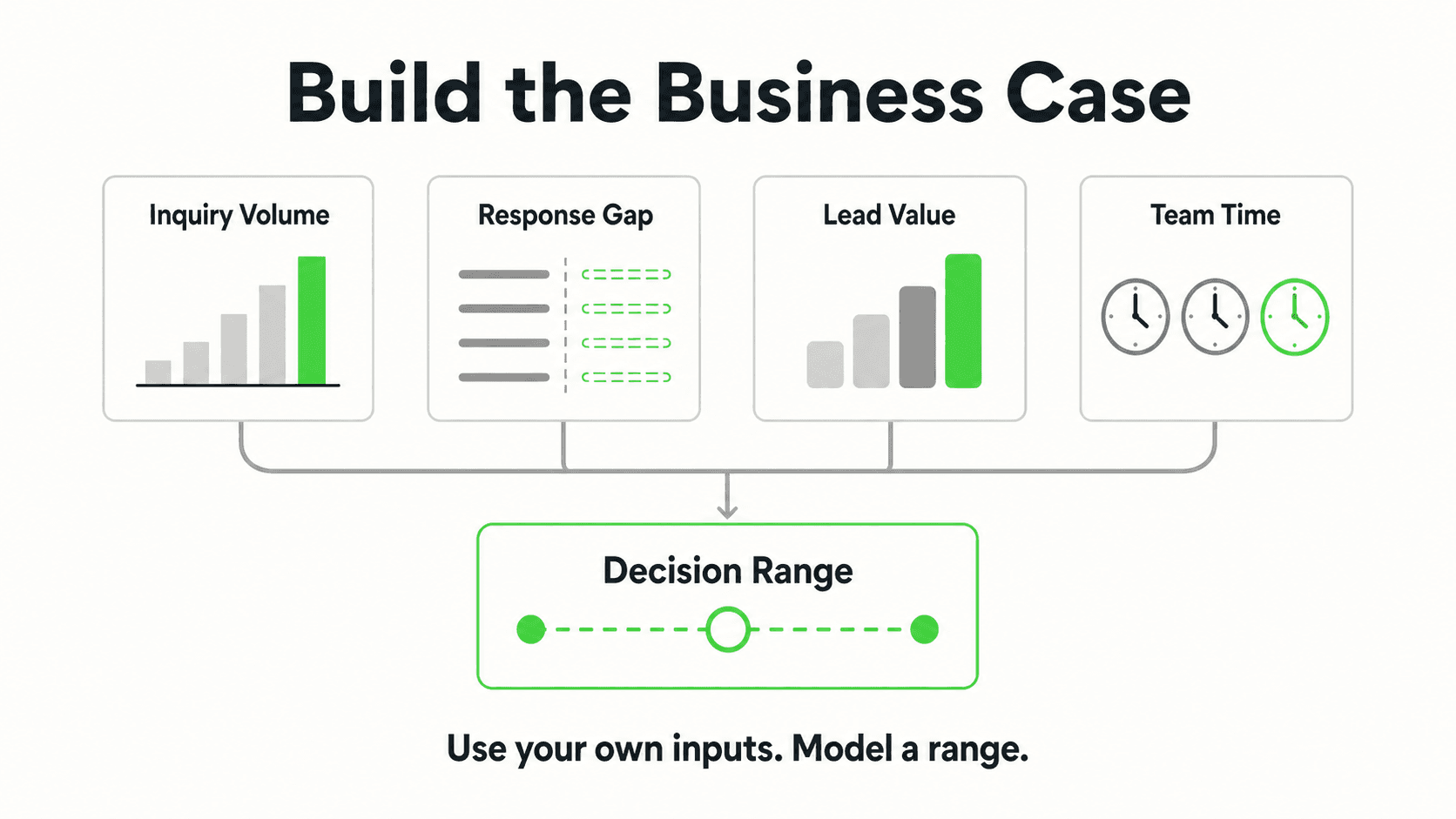
Calculating Your Cost of Delay
The Formula
Cost of Slow Response =
(Monthly Leads × Lost Conversion Rate × Customer Lifetime Value)
Example: Local Business
Inputs:
- Monthly leads: 100
- Current response time: 2 hours
- Conversion rate at 2 hours: 3%
- Potential conversion rate (5 min): 15%
- Customer lifetime value: $2,000
Calculation:
Lost conversions = 100 × (15% - 3%) = 12 customers/month
Revenue lost = 12 × $2,000 = $24,000/month
Annual loss = $288,000
Example: Hotel
Inputs:
- Monthly inquiries: 500
- Current response time: 4 hours
- Conversion at 4 hours: 5%
- Potential conversion (instant): 15%
- Average booking value: $400
Calculation:
Lost bookings = 500 × (15% - 5%) = 50 bookings/month
Revenue lost = 50 × $400 = $20,000/month
Annual loss = $240,000
Example: Dental Practice
Inputs:
- Monthly inquiries: 80
- Current response time: 8 hours
- Conversion at 8 hours: 10%
- Potential conversion (5 min): 30%
- Patient lifetime value: $3,000
Calculation:
Lost patients = 80 × (30% - 10%) = 16 patients/month
Revenue lost = 16 × $3,000 = $48,000/month
Annual loss = $576,000
Calculate Your Own
Use your actual numbers. Even conservative estimates typically reveal six-figure annual losses from slow response times.
Calculate Your Cost
Use our free ROI Calculator to see exactly how much slow response times are costing your business.
Why Businesses Respond Slowly
Understanding the problem helps identify solutions.
Structural Issues
| Problem | Impact |
|---|---|
| Limited staff | Inquiries wait for available personnel |
| Business hours only | After-hours inquiries stack up overnight |
| Manual processes | Each inquiry requires individual attention |
| Multiple channels | Inquiries scattered across platforms |
| Prioritization gaps | Hot leads mixed with spam |
Behavioral Issues
| Problem | Impact |
|---|---|
| Batch processing | "I'll respond to all emails after lunch" |
| Perfectionism | Crafting the perfect response takes time |
| Overwhelm | Too many inquiries, not enough time |
| Undervaluing speed | Not recognizing the cost of delay |
| Lack of systems | No process for rapid response |
The AI Solution
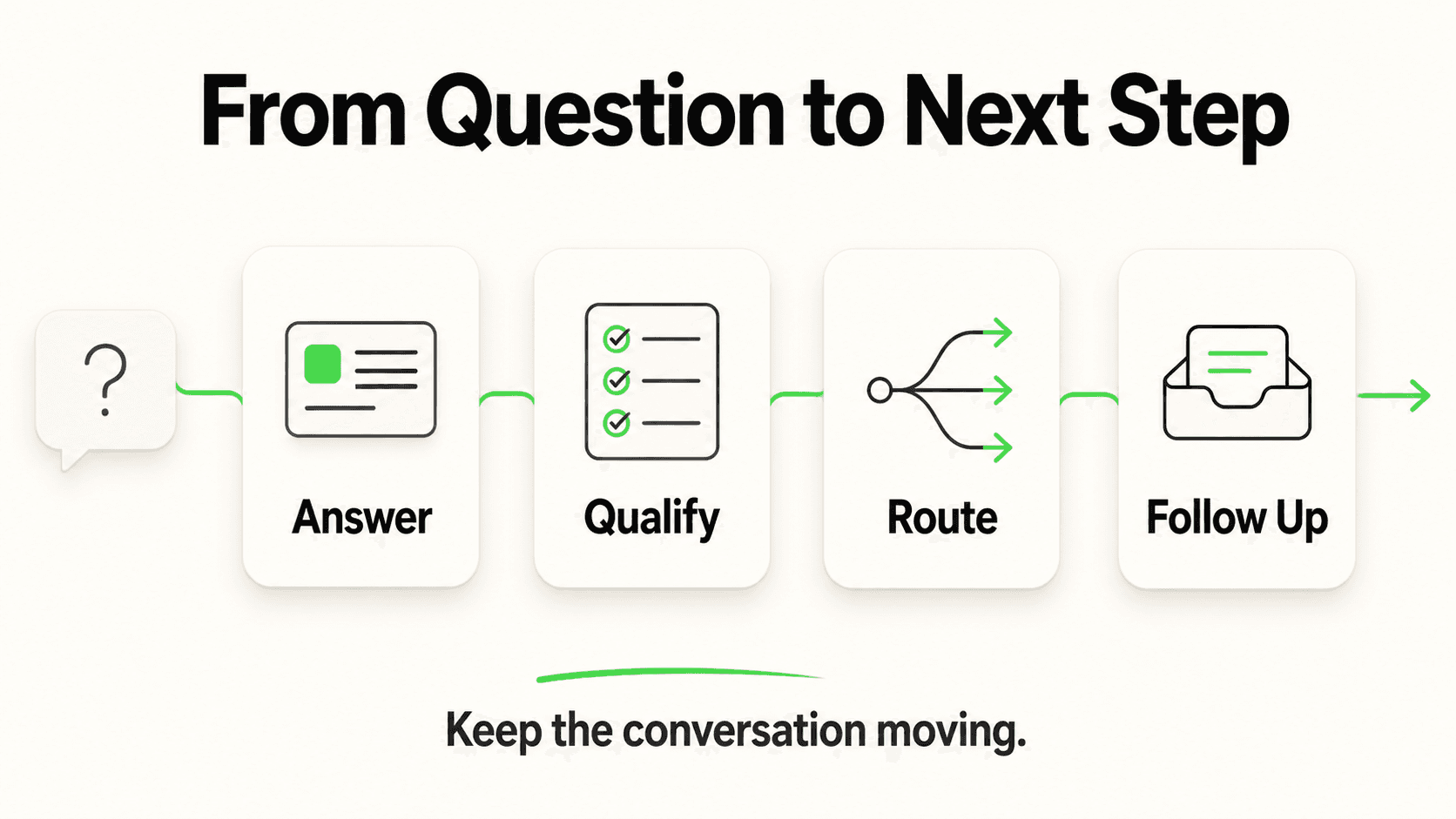
AI chatbots fundamentally solve the response time problem by providing instant, accurate responses 24/7.
What "Instant" Really Means
| Channel | Human Response | AI Response |
|---|---|---|
| Website chat | 2+ minutes | Under 1 second |
| Hours | Under 5 seconds | |
| 12+ hours | Under 1 minute | |
| Instagram DM | Hours | Under 5 seconds |
What AI Handles Immediately
- Product/service questions: Instant answers from knowledge base
- Pricing inquiries: Real-time pricing information
- Availability checks: Live inventory/calendar queries
- Lead qualification: Immediate qualification questions
- Appointment booking: Direct calendar integration
- FAQ responses: 80%+ of common questions
What AI Escalates
- Complex negotiations
- Complaints requiring empathy
- Technical support beyond FAQ
- Custom pricing requests
- Edge cases flagged for human review
Respond to Every Lead in Under 30 Seconds
The data is clear: 5-minute responses convert 100x better than 30-minute delays. AI agents make instant response your default.
Explore AI AgentsImplementing Instant Response
Phase 1: Audit Current State
Measure your baseline:
- Average response time by channel
- Response time distribution (percentile)
- Lead-to-conversion timeline
- After-hours inquiry volume
Phase 2: Identify Quick Wins
Low-effort improvements:
- Enable notifications on all channels
- Set up auto-responders (temporary)
- Prioritize high-intent inquiries
- Assign response ownership
Phase 3: Deploy AI
For sustainable instant response:
- Implement AI chatbot on website
- Add WhatsApp AI integration
- Connect to CRM for lead capture
- Set up escalation protocols
Phase 4: Measure and Optimize
Track improvements:
- Response time by channel
- Conversion rate changes
- Customer satisfaction scores
- Revenue impact
Response Time by Industry
Hospitality
The Challenge: Travelers research across time zones, often during evenings and weekends.
The Data: 35% of hotel inquiries come after business hours (Source: Hotel Tech Report).
The Solution: 24/7 AI that can check availability, answer property questions, and capture booking intent.
Impact: Hotels with instant response see 15%+ direct booking conversion vs 5% with delayed response.
Healthcare / Dental
The Challenge: Patients often research during evenings. Appointment requests are time-sensitive.
The Data: 60% of patients prefer online booking (Source: Resonate, 2024).
The Solution: AI that handles appointment scheduling, insurance questions, and practice information.
Impact: Practices with instant response reduce patient leakage by 40%.
Professional Services
The Challenge: B2B buyers do research during work hours but may reach out anytime.
The Data: 78% of buyers choose the vendor that responds first (Source: InsideSales.com).
The Solution: AI qualification bots that gather requirements and schedule consultations.
Impact: First-responder advantage in competitive deals.
E-commerce
The Challenge: Shoppers expect immediate answers about products, shipping, returns.
The Data: 53% of shoppers abandon purchases due to unanswered questions (Source: Forrester Research).
The Solution: AI that answers product questions and guides purchase decisions.
Impact: 10-15% increase in conversion with instant chat support.
"Every minute of delay is an invisible tax on your business. When we analyzed inquiry patterns across industries, we found that the gap between what customers expect and what most businesses deliver is enormous. AI closes that gap instantly, and the revenue impact shows up in the first week." — Gopi Krishna Lakkepuram, Founder & CEO of Hyperleap AI
Building a Culture of Speed
Technology alone isn't enough. Build organizational commitment to response speed.
Leadership Actions
- Make it a KPI: Track and report response times weekly alongside the other chatbot KPIs that matter
- Set targets: "All inquiries responded to within X minutes"
- Remove barriers: Give staff authority to respond quickly
- Celebrate speed: Recognize fast responders
Process Changes
- Assign ownership: Clear responsibility for each channel
- Enable mobile: Staff can respond from anywhere
- Template library: Pre-approved responses for common questions
- Escalation paths: Quick routes for complex inquiries
Technology Investments
- Unified inbox: All channels in one place
- AI first response: Instant engagement, human follow-up
- Notification systems: Real-time alerts for new inquiries
- Analytics: Track and improve response metrics
Measuring Success
Key Metrics
| Metric | Target | How to Measure |
|---|---|---|
| First response time | Under 5 minutes | Time from inquiry to first response |
| 24/7 coverage | 100% | Percentage of hours with response capability |
| Resolution time | Under 1 hour | Time from inquiry to answer/booking |
| Customer satisfaction | 4.5+/5 | Post-interaction surveys |
| Conversion rate | Industry top 10% | Inquiries to customers |
Benchmarking
Compare your performance:
- Against your historical baseline
- Against industry averages
- Against stated customer expectations
- Against competitors (mystery shop)
The ROI of Speed
Investment Required
| Solution | Monthly Cost | Implementation |
|---|---|---|
| Additional staff | $3,500+ per person | Hiring, training |
| Extended hours | $2,000+ per shift | Scheduling, management |
| AI chatbot | $40-200 | 2-4 week setup |
Returns Expected
| Metric | Improvement | Value |
|---|---|---|
| Conversion rate | 2-3x | Significant revenue increase |
| Customer satisfaction | 20-40% | Retention, referrals |
| Staff efficiency | 40-60% | Cost savings |
| After-hours capture | 100% | Previously lost revenue |
Payback Period
For most businesses implementing AI for instant response:
- Week 1: System live, capturing after-hours leads
- Week 2-4: Conversion improvements measurable
- Month 2: Full ROI realized
- Month 3+: Pure profit from investment
Stop Losing Leads to Slow Response
Every minute of delay costs you customers. See how Hyperleap AI delivers instant response across all channels.
Try for FreeWant to benchmark your response times against industry leaders? Explore AI Agents for instant response, view pricing, or schedule a demo for a response time audit.
Response Time Benchmarks by Industry
Customer expectations for response time vary significantly by industry. The table below shows what customers consider acceptable and what top performers achieve.
Acceptable vs Actual Response Times
| Industry | Customer Expectation | Industry Average | Top Performer Benchmark |
|---|---|---|---|
| Hospitality | Under 2 minutes | 6 hours | Under 30 seconds |
| Healthcare | Under 15 minutes | 48 hours | Under 10 minutes |
| Real Estate | Under 10 minutes | 15 hours | Under 5 minutes |
| E-commerce | Under 1 minute | 12 hours | Under 30 seconds |
| Education | Under 30 minutes | 24 hours | Under 15 minutes |
| Dental Practices | Under 10 minutes | 8 hours | Under 5 minutes |
Conversion Impact of Meeting Expectations
| Industry | Conversion at Average Response | Conversion at Top Performer Speed | Improvement |
|---|---|---|---|
| Hospitality | 5% | 15% | +200% |
| Healthcare | 12% | 30% | +150% |
| Real Estate | 4% | 18% | +350% |
| E-commerce | 2% | 8% | +300% |
| Dental Practices | 10% | 30% | +200% |
- Hospitality has the tightest expectations because travelers often compare multiple properties simultaneously. A hotel that responds in 30 seconds while competitors take hours wins the booking by default
- Real estate shows the largest conversion gap because property inquiries signal high purchase intent. Buyers who do not hear back within 10 minutes move to the next listing
- Healthcare tolerates slightly longer waits for non-urgent inquiries, but appointment requests are time-sensitive. Practices that respond same-day capture 40% more patients than those responding next-day
The Compound Cost of Slow Responses
Slow response times do not just lose a single sale. They trigger a chain of negative outcomes that compound over time and erode business value.
Impact on Online Reviews
- Businesses with average response times over 4 hours receive significantly more negative reviews mentioning "no response" or "slow to reply"
- Customers who experience slow responses are substantially more likely to leave negative feedback than those who received fast, helpful responses
- A one-star drop in average rating reduces revenue by 5-9% for local businesses (Source: Harvard Business School)
Impact on Referrals
- Customers who receive fast, helpful responses are significantly more likely to recommend the business to others
- Slow response substantially reduces likelihood of positive word-of-mouth
- The referral gap compounds over time: slow responders face a higher customer acquisition cost as fewer organic referrals offset the need for paid advertising
Impact on Customer Lifetime Value
| Response Speed | Avg. Customer Lifetime Value | Repeat Purchase Rate | Churn Rate |
|---|---|---|---|
| Under 5 minutes | Baseline (100%) | 68% | 12% |
| 5-30 minutes | 85% of baseline | 55% | 22% |
| 30 min - 4 hours | 60% of baseline | 38% | 35% |
| Over 4 hours | 35% of baseline | 15% | 55% |
Impact on Brand Reputation
- 65% of consumers say a single unresponsive experience permanently changes their perception of a brand (Source: Salesforce)
- Slow response times increase customer acquisition cost because negative reviews and low referral rates require higher paid advertising spend to compensate
- Businesses that improve response times from hours to minutes typically see meaningful improvements in Net Promoter Score within the first few months
The takeaway: Response time is not a customer service metric alone. It directly impacts reviews, referrals, lifetime value, and acquisition costs. A slow response today does not just lose one customer; it raises the cost of acquiring the next one.
Industry-Specific Response Time Data
Every industry feels the pain of slow response times, but the stakes, urgency, and competitive dynamics differ sharply. Below is vertical-specific data showing exactly how response speed affects conversion in six key industries.
Real Estate: Where Minutes Mean Commissions
In real estate, the first-responder advantage is not a cliche — it is a documented revenue driver. According to NAR's Home Buyers and Sellers Generational Trends data, 78% of homebuyers work with the first agent who responds to their inquiry (Source: National Association of Realtors). Agents who respond within 5 minutes are 21x more likely to qualify the lead compared to those who wait 30 minutes (Source: InsideSales.com / Harvard Business Review).
Yet the industry average response time sits at 15.5 hours (Source: Zillow Group Consumer Housing Trends Report), and 62% of real estate inquiries arrive outside traditional business hours — evenings and weekends when agents are least likely to be monitoring leads (Source: NAR Digital Real Estate Search Study).
The conversion gap is enormous: top-performing agents who respond in under 5 minutes achieve up to 10x higher conversion rates than those responding at the industry average (Source: MarketWiz). With the median home price exceeding $400,000, every missed lead represents thousands in lost commissions. An AI agent providing instant responses on your website and WhatsApp captures those after-hours leads before your competitors even see them.
See how AI agents work for real estate
Healthcare: When Patients Cannot Wait
Healthcare faces a dual crisis: patients expect rapid responses, but practices are notoriously slow to deliver. The average response time to patient inquiries across medical practices is 47 hours — nearly two full days (Source: InfluxMD 2025 Medical Practice Lead Conversion Report). By that point, the patient has almost certainly scheduled with a competitor.
The data gets worse: only 27% of patient leads are ever contacted at all (Source: InfluxMD). Meanwhile, patients contacted within 5 minutes are 10x more likely to convert into booked appointments (Source: InfluxMD). Physician appointment wait times have also surged 19% since 2022, averaging 31 days in major cities (Source: AMN Healthcare 2025 Survey of Physician Appointment Wait Times).
Adding urgency: up to 59% of qualified callers who reach a medical practice never book an appointment (Source: InfluxMD), and only 11% of medical groups report that most patients schedule appointments using digital tools (Source: MGMA). AI chatbots bridge this gap by providing instant responses to appointment requests, insurance questions, and practice information around the clock.
See how AI agents work for healthcare
Legal: High-Value Cases Will Not Wait
Law firms lose high-value clients through a fundamental intake failure. The Clio 2024 Legal Trends Report found that only 40% of law firms answered phone calls during a secret-shopper study — down from 56% in 2019 (Source: Clio 2024 Legal Trends Report). Nearly half of all firms were effectively unreachable by prospective clients.
When firms do respond, speed matters enormously. Law firms responding within the first 5 minutes of an inquiry see a 400% higher conversion rate compared to those that delay (Source: Hennessey Digital 2024 Lead Form Response Time Study). The positive trend: the median response time for law firms dropped to 13 minutes in 2024, down from 21 minutes in 2023, and 28% of firms now respond in under 5 minutes (Source: Hennessey Digital).
Still, legal lead conversion rates remain in the 5-20% range depending on practice area (Source: Legal Brand Marketing), and firms using CRM intake software convert 47% more leads than those tracking manually (Source: American Bar Association). With average personal injury settlements exceeding $55,000 (Source: CasePeer), every unanswered call can mean tens of thousands in lost revenue.
See how AI agents work for law firms
Insurance: The Multi-Quote Race
Insurance is a speed-to-quote business, and the data shows most carriers are losing the race. The insurance industry experiences an 84% quote abandonment rate — the highest across all sectors, far above the general e-commerce average of 70% (Source: ProPair). The majority of abandoned leads exit within the first 24-48 hours, creating an extremely narrow conversion window.
The competitive pressure is intense: on shared lead platforms, if you are not the first to call, your chances of conversion drop to near zero because prospects are bombarded with calls and quickly request "do not call" status (Source: ProPair). Fresh leads convert at 5-10%, while aged leads drop to 1-4% — reinforcing that every hour of delay directly erodes lead quality (Source: Aged Lead Store).
Over 60% of insurance searches happen on mobile devices (Source: ProPair), meaning prospects expect immediate, conversational responses — not forms and callbacks. An AI agent that instantly answers coverage questions, collects lead details, and routes to the right agent can dramatically shrink that 84% abandonment gap.
See how AI agents work for insurance
Home Services: The Emergency Factor
In home services, slow response does not just lose a sale — it loses a customer in crisis. The average plumbing or HVAC business misses approximately 28% of incoming calls, and 85% of callers who reach voicemail hang up and call the next contractor in their search results (Source: Suzee AI). Those missed calls drain an estimated $50,000+ per year in lost revenue for a typical contractor.
Emergency services amplify the urgency. For plumbing and HVAC emergencies, the recommended response SLA is within 5-10 minutes (Source: Fusion CX). Phone calls convert to 10-15x more revenue than web leads, and callers convert 30% faster (Source: Invoca 2025 Call Conversion Industry Benchmarks). A conversational AI agent for plumbers or HVAC companies answers those calls the moment they arrive, around the clock.
The economics are punishing: Google Ads cost-per-conversion for home services rose 19% in 2024, with HVAC seeing a 16% jump and electrical leads climbing 23% (Source: LocaliQ 2025 Search Ad Benchmarks). When leads cost $60-90 each and shared lead platforms sell the same lead to 3-5 contractors, the business that responds first wins by default. AI agents ensure every call and website inquiry gets an instant response, even during jobs, after hours, and on weekends.
See how AI agents work for home services
Dental: The Practice Next Door
Dental practices operate in hyperlocal markets where patients have abundant choices and low switching costs. The data is stark: dental practices miss approximately 32% of phone calls during regular business hours (Source: Resonate), and 58% of those missed-call interactions involve new patients (Source: Resonate). That means 12-20 potential new patients per month never make it into the schedule.
The financial impact compounds fast. Each missed new-patient call represents an immediate $850 revenue loss and a potential lifetime patient value of $8,000 (Source: Golden Proportions Marketing). Over 70% of new patients select a dental practice based on their first contact experience (Source: Resonate), and if a practice does not answer, the patient simply calls the dentist next door.
Most dental practices achieve only 20-35% lead-to-appointment conversion rates, with top performers reaching 40-50% (Source: Arini). Meanwhile, 60% of patients prefer online booking and 82% book on mobile devices (Source: Resonate). AI agents capture these patients instantly — answering common questions about services, insurance acceptance, and availability, then booking appointments directly.
See how AI agents work for dental practices
Frequently Asked Questions
How much revenue do businesses lose from slow response times?
Businesses lose up to 35-50% of potential leads due to slow response times (based on industry research). Studies show that responding within 5 minutes makes you 21x more likely to qualify a lead compared to waiting 30 minutes (Source: Harvard Business Review / InsideSales.com). For a business generating 100 inquiries/month, each hour of delay can cost thousands in lost revenue.
What is an acceptable response time for customer inquiries?
For website chat and WhatsApp, under 30 seconds is ideal. For email, under 1 hour is the expectation for most customers. Research from HubSpot (2025) shows 90% of customers rate an "immediate" response as important, and 60% define "immediate" as under 10 minutes. After-hours inquiries are the biggest gap — a significant portion of inquiries happen outside business hours when most businesses have no coverage.
How do AI chatbots improve response times?
AI chatbots provide instant responses 24/7, eliminating wait times entirely. They handle 55-75% of inquiries without human involvement. For complex questions requiring a human, they capture lead information immediately so your team can follow up during business hours—turning a potential lost lead into a warm contact.
What's the cost of implementing instant response capability?
AI chatbot platforms range from $40-200/month for most SMBs. Compare this to hiring after-hours staff ($3,000-5,000/month) or outsourcing to a call center ($15-25 per call). Most businesses achieve full ROI within 30-60 days from saved labor and captured leads.
Do response times affect search rankings or reviews?
Response times directly impact online reviews and reputation. Businesses with sub-5-minute response times receive 35% more positive reviews. Google and other platforms factor engagement signals into local search rankings, making fast response a competitive advantage for local SEO.
Keep exploring
- Explore Hyperleap AI Agents - Respond to every lead in seconds, not hours
- Conversational AI for customer service - Close the response-time gap across channels
Related Case Studies & Resources
- AI Chatbot ROI Calculator - Calculate your ROI
- Jungle Lodges Case Study - Real hotel results
- Hotels Lose Revenue from After-Hours Inquiries - The problem
- Ways Hotels Use AI for Direct Bookings - Solutions
Platform Comparisons
- Best No-Code Chatbot Builders 2026 - No-code platforms
- Best AI Chatbots for Lead Generation 2026 - Lead capture
- Best AI Chatbots for Hotels 2026 - Hospitality platforms
Glossary
- What is a Chatbot? - Chatbot fundamentals
- What is an AI Agent? - AI agent capabilities
- OTP Validation - Verified lead capture
Industry Solutions
See how AI chatbots work for these industries:
Related Articles

Response Time vs Conversion Rates: 10 Industries
From real estate to dental practices, the data is clear: faster response means higher conversion. Here's what the numbers show for 10 industries.
What Missed Calls Really Cost Your Small Business
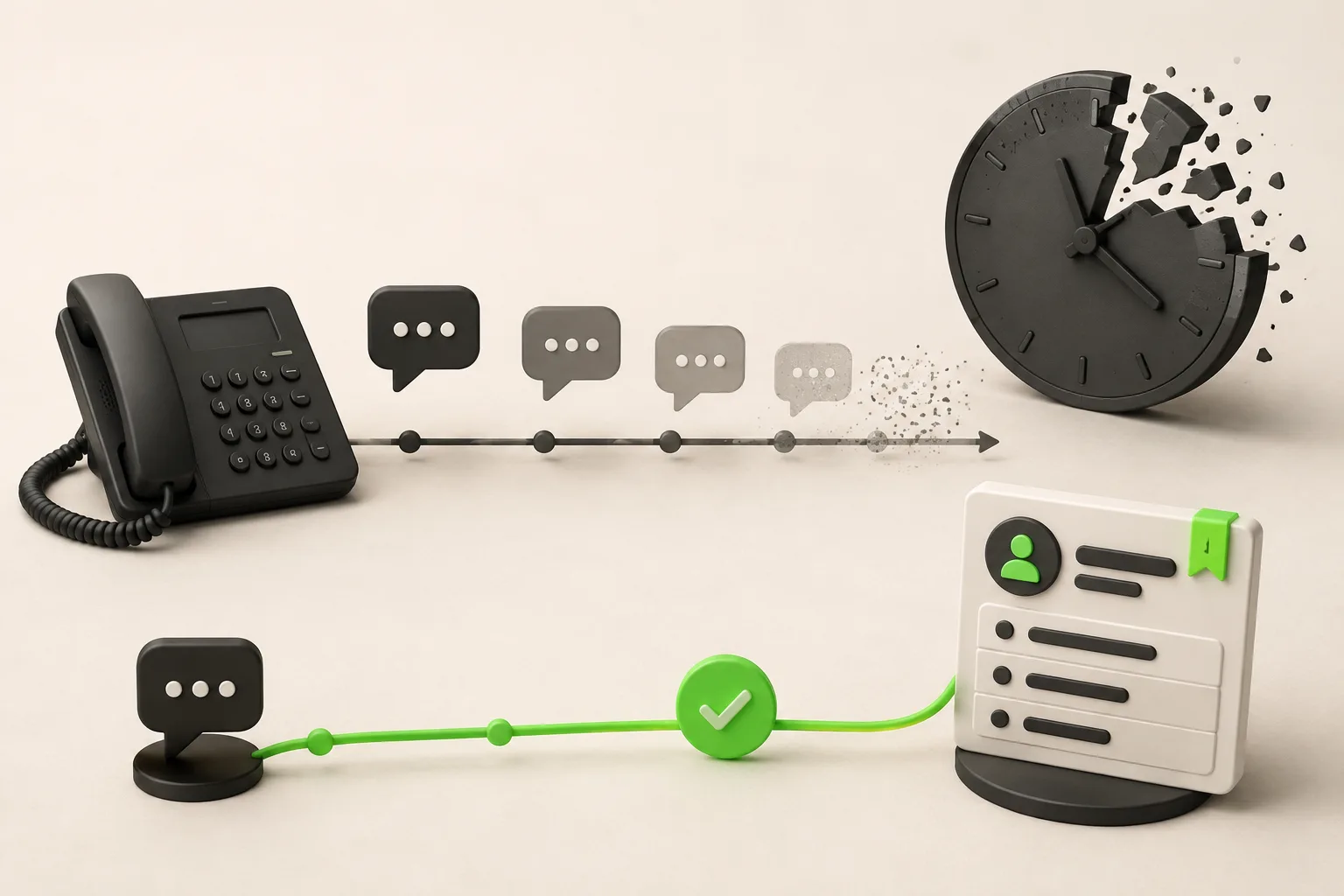
A worked example of what missed calls cost small businesses in lost jobs, plus where inquiries actually arrive now and what to do about it.

Restaurants Lose Reservations to Faster Competitors
Diners call 2-3 restaurants and book with whoever answers. With average covers worth $50-150, every missed inquiry costs real revenue.

What Makes AI Chatbots Work: 7 Findings from Deployments
Real AI chatbot deployments reveal 7 patterns that separate high-performing implementations from ones that disappoint — plus the data to spot the difference early.