AI Admissions Assistant: What Works for Schools in 2026
Learn how K-12 schools use AI to handle 200-500% more inquiries during admission season, improve conversion by 30-45%, and enhance parent satisfaction.

TL;DR: K-12 schools receive 200-500% more inquiries during admissions season, with over 65% arriving outside office hours. AI admissions assistants handle parent inquiries 24/7, improve inquiry-to-enrollment conversion by 30-45%, and reduce administrative burden by 60-75% -- allowing admissions teams to focus on campus tours, personal counseling, and high-value family interactions.
AI Admissions Assistant: What Actually Works for Schools in 2026
The admissions season is make-or-break for schools. It's when inquiries multiply 4-5x, phone lines stay perpetually busy, emails pile up unanswered, and stressed administrative staff work overtime just to keep up. Meanwhile, prospective parents—your most important stakeholders—grow frustrated with delayed responses and choose schools that communicate more efficiently.
According to education research (Source: NCES / Inside Higher Ed), K-12 schools receive 200-500% more inquiries during admissions season compared to regular periods, with questions spanning curriculum details, admission procedures, fee structures, extracurricular programs, and facility tours. More concerning is that over 65% of parent inquiries now happen outside school office hours—evenings after work, weekends when families research together, and late nights when decisions are being made.
Traditional admissions management through phone calls, emails, and office visits creates overwhelming bottlenecks during the exact period when responsiveness matters most. Prospective parents interpret delayed responses as lack of organization or care, directly impacting their perception of your school's quality.
The solution isn't hiring more administrative staff for seasonal peaks—it's implementing AI-powered admissions assistants specifically designed for educational institutions. But not all AI systems work well for schools, and poor implementation can damage your reputation more than help it.
What Is an AI Admissions Assistant for Schools?
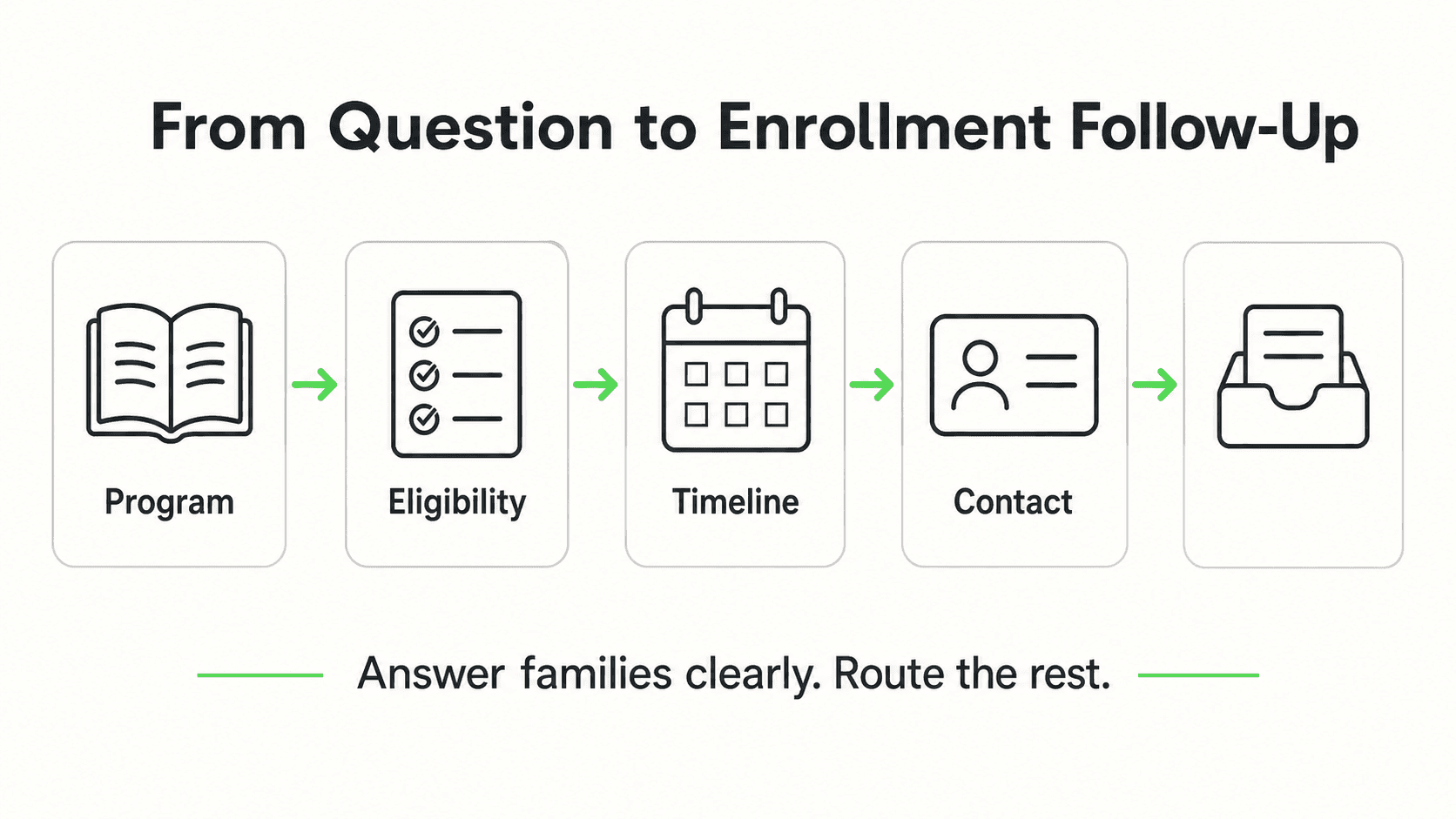
An AI admissions assistant is an intelligent system that handles the complete range of admissions inquiries and administrative tasks that overwhelm school staff during enrollment periods. For K-12 schools specifically, this means technology that understands:
- How to communicate with parents in ways that build trust and confidence
- The difference between inquiries for different grade levels (preschool vs. middle school vs. high school)
- Age-appropriate program details and developmental considerations
- Complex admission processes with multiple steps, documentation, and deadlines
- The sensitivity required for questions about special needs, financial aid, and educational approaches
- How to balance automation with the personal touch parents expect when choosing schools
Modern AI admissions assistants use natural language processing, integration with school management systems, and conversational intelligence to create experiences that feel personal despite being automated—operating 24/7 across website chat, WhatsApp, phone calls, email, and social media.
How it differs from basic school chatbots
The chatbots of the past frustrated parents with rigid, unhelpful responses. Modern AI admissions assistants engage naturally:
Basic chatbot: "For admissions, click here. For fees, click here. For a tour, fill out this form." AI assistant: "I'd be happy to help you learn about our school! Which grade is your child currently in, and what aspects of our program are most important to your family?"
The AI understands context, maintains conversation flow across multiple questions, provides comprehensive answers, asks clarifying questions, and knows when situations require human attention—creating experiences that parents describe as "surprisingly helpful" rather than frustratingly mechanical.
Why School Admissions Teams Are Struggling
The challenges aren't unique to your school—they're systemic issues affecting K-12 institutions globally as parent expectations evolve:
The seasonal surge problem
Admissions inquiry patterns create impossible staffing challenges:
Regular periods: 10-50 daily inquiries manageable by 1-2 administrative staff Admission season: 50-250+ daily inquiries overwhelming even larger teams
Real example: A premium K-12 school handles 50+ inquiries daily during regular periods. During admission season, this multiplies 4x to 200+ daily inquiries. Each inquiry requires 10-20 minutes of staff time for thorough responses—meaning 33-66 hours of work needed daily just for inquiry management.
Even with a dedicated admissions team working extended hours, response times stretch from hours to days, follow-ups get missed, and qualified families slip away to competitors with faster communication.
The after-hours communication gap
Modern parent lifestyles create inquiry patterns that school office hours can't accommodate:
- Parents research schools after work (6 PM - 11 PM peak inquiry time)
- Weekend research sessions when families discuss options together
- International families in different time zones
- Working parents who can't call during school hours
Over 65% of school inquiries now happen outside office hours (Source: ICEF Monitor), but most schools only respond during 8 AM - 4 PM. This misalignment means the majority of opportunities go unanswered when parents are most engaged and ready to make decisions.
Information consistency challenges
Parents contact schools through multiple channels and expect consistent information everywhere:
- Phone calls to the office
- Website inquiry forms
- Email to admissions@
- WhatsApp messages
- Social media DMs (Facebook, Instagram)
- Walk-in visits
Without centralized systems, parents receive different answers depending on who responds and which channel they used. One staff member says tours happen Wednesdays, another says Fridays. Different fee information gets quoted. Application deadlines are inconsistent.
These inconsistencies erode trust at the exact moment when parents are evaluating whether your school is professionally managed and detail-oriented enough to educate their children.
Repetitive questions drain valuable time
Admissions staff report that 75-80% of parent inquiries ask the same core questions (Source: ICEF Monitor):
- "What are your fee structures?"
- "What is your curriculum approach?" (CBSE, ICSE, IB, Cambridge, etc.)
- "Do you provide transportation?"
- "What extracurricular activities do you offer?"
- "What's the admission process and timeline?"
- "Can we schedule a campus tour?"
- "Do you have programs for [specific needs]?"
Staff with deep educational expertise spend hours answering routine questions that could be automated, leaving insufficient time for high-value activities like personalized counseling for families with complex needs or relationship building with serious prospects.
Handle Admissions Season Without the Chaos
Respond instantly to every parent inquiry 24/7. Qualify families, schedule campus tours, and guide them through the admissions process automatically.
See How It WorksThe personalization vs. scale dilemma
Parents expect personalized attention—they're choosing where to entrust their child's education, one of life's most important decisions. But during admission season, providing personalized communication to 200+ daily inquiries is mathematically impossible for human teams.
The result: schools sacrifice either personalization (generic responses that don't address specific family situations) or scale (slow responses that frustrate parents and lose opportunities). Neither option is acceptable in competitive markets.
Documentation and process complexity
Modern school admissions involve multi-step processes with numerous requirements:
- Application forms (often different for each grade level)
- Document submissions (birth certificates, previous records, medical forms)
- Entrance assessments or interviews
- Fee payment deadlines
- Registration confirmation
- Orientation scheduling
Parents get confused about what's required when, miss deadlines, submit incomplete documentation, and need frequent hand-holding through the process. Managing this complexity across hundreds of families simultaneously overwhelms administrative teams.
The 7 Essential Capabilities of Effective AI Admissions Assistants
Not every AI system will work for your school. Here are the critical capabilities that separate effective solutions from disappointing ones:
1. Trust-building, parent-appropriate communication
Parents are making high-stakes decisions about their children's education. AI must communicate in ways that build confidence rather than create concern.
What this looks like in practice:
A parent inquires about admission for their 6-year-old. Rather than bombarding them with information, the AI:
- Greets warmly and acknowledges the importance of their decision
- Asks about the child (current grade, interests, specific needs)
- Shares relevant program highlights for that age group
- Addresses common parent concerns proactively
- Uses reassuring language that conveys care and competence
- Provides clear next steps without pressure
The conversation feels like talking with a knowledgeable, caring admissions counselor rather than filling out a form or navigating a phone tree.
Why it matters:
Trust is everything in education. Parents who feel dismissed, rushed, or treated transactionally will question whether your school will treat their child with care and attention. AI that communicates warmly, patiently, and helpfully creates positive first impressions that influence enrollment decisions.
Key features:
- Empathetic language patterns
- Parent-focused (not institution-focused) communication
- Age-appropriate information for each grade level
- Sensitivity to diverse family situations
- Ability to convey school values and culture
2. Grade-specific and program-specific intelligence
K-12 encompasses vastly different educational stages, and AI must provide relevant information for each:
What this looks like in practice:
For a preschool inquiry, the AI emphasizes:
- Play-based learning approaches
- Social-emotional development focus
- Parent involvement opportunities
- Daily routine and care
- Safety and security measures
For a high school inquiry, the AI highlights:
- Academic rigor and college preparation
- Advanced placement or IB programs
- Career guidance and counseling
- Competitive advantages for university admissions
- Independent learning and responsibility development
The same parent asking about multiple siblings at different grade levels receives appropriately tailored information for each child.
Why it matters:
Generic information frustrates parents and suggests your school doesn't understand developmental differences or individualized education. Parents expect information relevant to their specific situation, and AI must deliver that specificity to be valuable.
Technical requirements:
- Grade-level specific content libraries
- Understanding of different curricula (CBSE, ICSE, IB, etc.)
- Age-appropriate program details
- Developmental milestone awareness
- Appropriate extracurricular emphasis for different ages
3. Comprehensive admission process guidance
Parents need clear roadmaps through multi-step admission processes, and AI can provide this guidance consistently:
What this looks like in practice:
A parent ready to apply receives step-by-step guidance:
- Complete online application form (with direct link)
- Submit required documents (checklist with examples)
- Schedule admission assessment/interview (available slots shown)
- Pay application fee (payment options and links)
- Receive admission decision (timeline set)
- Complete enrollment if accepted (next steps explained)
At each stage, the AI:
- Explains what's required in simple terms
- Provides document templates or examples
- Sets clear deadlines
- Sends reminder notifications for pending items
- Answers questions about each step
- Offers to connect with admissions staff if needed
Why it matters:
Confusion and friction in the admission process cause abandonment. Every unclear requirement or missing piece of information is an opportunity for parents to delay, get frustrated, or choose competitors with smoother processes. AI removes friction by providing clarity and support throughout the journey.
Process management capabilities:
- Multi-step process tracking
- Automated reminders and follow-ups
- Document checklist management
- Status visibility for parents
- Integration with application systems
- Deadline enforcement
4. 24/7 multi-channel availability
Parents should be able to get information when they're researching and ready to engage, not just during school office hours:
What this looks like in practice:
Saturday evening, 9 PM: A working parent finally has time to research schools. They visit your website and begin chatting with the AI. Within minutes, they've learned about your curriculum, seen fee structures, compared programs for their two children at different grade levels, scheduled a campus tour for the following week, and bookmarked your application portal—all without waiting for Monday morning to call the office.
The same AI handles inquiries via:
- Website chat widget
- WhatsApp (increasingly popular in many regions)
- Social media messaging (Facebook, Instagram)
- Email triage and response
Parents can switch channels (start on website, continue on WhatsApp) without repeating information.
Why it matters:
Parents research and make decisions on their own schedules, which rarely align with school office hours. After-hours availability isn't a luxury—it's a competitive necessity. Schools that make parents wait 12-24 hours for basic information lose opportunities to more accessible competitors.
Technical requirements:
- True 24/7 operation without downtime
- Omnichannel consistency (same info, different platforms)
- Conversation context maintained across channels
- High reliability and uptime
- Mobile-optimized experiences
5. Intelligent lead qualification and prioritization
Not all inquiries represent equal opportunity, and AI can help admissions teams focus time where it matters most:
What this looks like in practice:
The AI collects qualifying information during conversations:
- Child's current grade/age (determines urgency)
- Desired enrollment timing (immediate vs. future)
- Specific program interests or requirements
- Prior school experience or special considerations
- Geographic proximity to your school
- Budget sensitivity or financial aid needs
Based on responses, the AI:
- Assigns priority scores (hot leads vs. early research)
- Routes high-intent families to senior admissions staff
- Schedules immediate campus tours for serious prospects
- Nurtures early-stage inquiries with relevant content
- Flags families with complex needs requiring personalized attention
Why it matters:
Admissions teams are limited resources during peak seasons. Using their time efficiently means matching effort to opportunity value. AI handles qualification that previously consumed 60-70% of staff time, allowing humans to focus on families most likely to enroll or most in need of personalized guidance.
Qualification capabilities:
- Dynamic question flows
- Lead scoring algorithms
- Priority-based routing rules
- Automated nurture sequences
- High-value opportunity flagging
- CRM integration for tracking
6. Cultural and values communication
Parents don't just choose schools based on curriculum and facilities—they're assessing cultural fit, values alignment, and educational philosophy:
What this looks like in practice:
A parent asks: "What makes your school different from others in the area?"
The AI doesn't just list features—it conveys your school's distinctive character:
- Educational philosophy (child-centered, inquiry-based, traditional excellence, etc.)
- Core values and how they manifest daily
- Community culture and parent involvement
- Success stories that exemplify your approach
- What types of families thrive at your school
The response helps parents self-assess fit while showcasing what makes your school special.
Why it matters:
Commoditized information (curriculum, fees, facilities) doesn't differentiate schools—culture and values do. Parents want schools that align with their family values and educational priorities. AI that can articulate your school's distinctive character helps parents make confident decisions and improves enrollment quality (families who fit your culture are more satisfied and stay longer).
Cultural communication requirements:
- Deep understanding of your school's mission and values
- Ability to articulate educational philosophy
- Examples and stories that illustrate culture
- Alignment with your brand voice and tone
- Sensitivity to diverse family values and priorities
7. Seamless human handoff when needed
AI should know its limitations and gracefully transition to humans for situations requiring personal attention:
What this looks like in practice:
A parent shares that their child has specific learning needs requiring accommodations. The AI:
- Acknowledges the importance of this conversation
- Validates the parent's concerns
- Explains your school's support programs at a high level
- Recognizes this requires detailed, personalized discussion
- Immediately offers to connect them with your special education coordinator
- Provides multiple contact options (call now, schedule appointment, send email)
- Sends a summary of the conversation to the coordinator for context
The parent feels heard and appropriately supported, not frustrated by AI trying to handle something beyond its capacity.
Why it matters:
Trying to automate everything creates poor experiences. Parents can sense when they need human expertise, empathy, or judgment. AI that recognizes these moments and facilitates smooth handoffs maintains trust while maximizing automation benefits.
Handoff triggers:
- Complex special needs discussions
- Financial hardship or aid applications
- Behavioral or disciplinary concerns
- Unique family circumstances
- High-value or VIP families
- Complaints or negative experiences
- Legal or policy questions
Streamline Your Admissions Process
Handle 200-500% more parent inquiries during admissions season without adding staff. Respond instantly 24/7 and convert more families into enrolled students.
Try for FreeReal Results from Schools Using AI Admissions Assistants
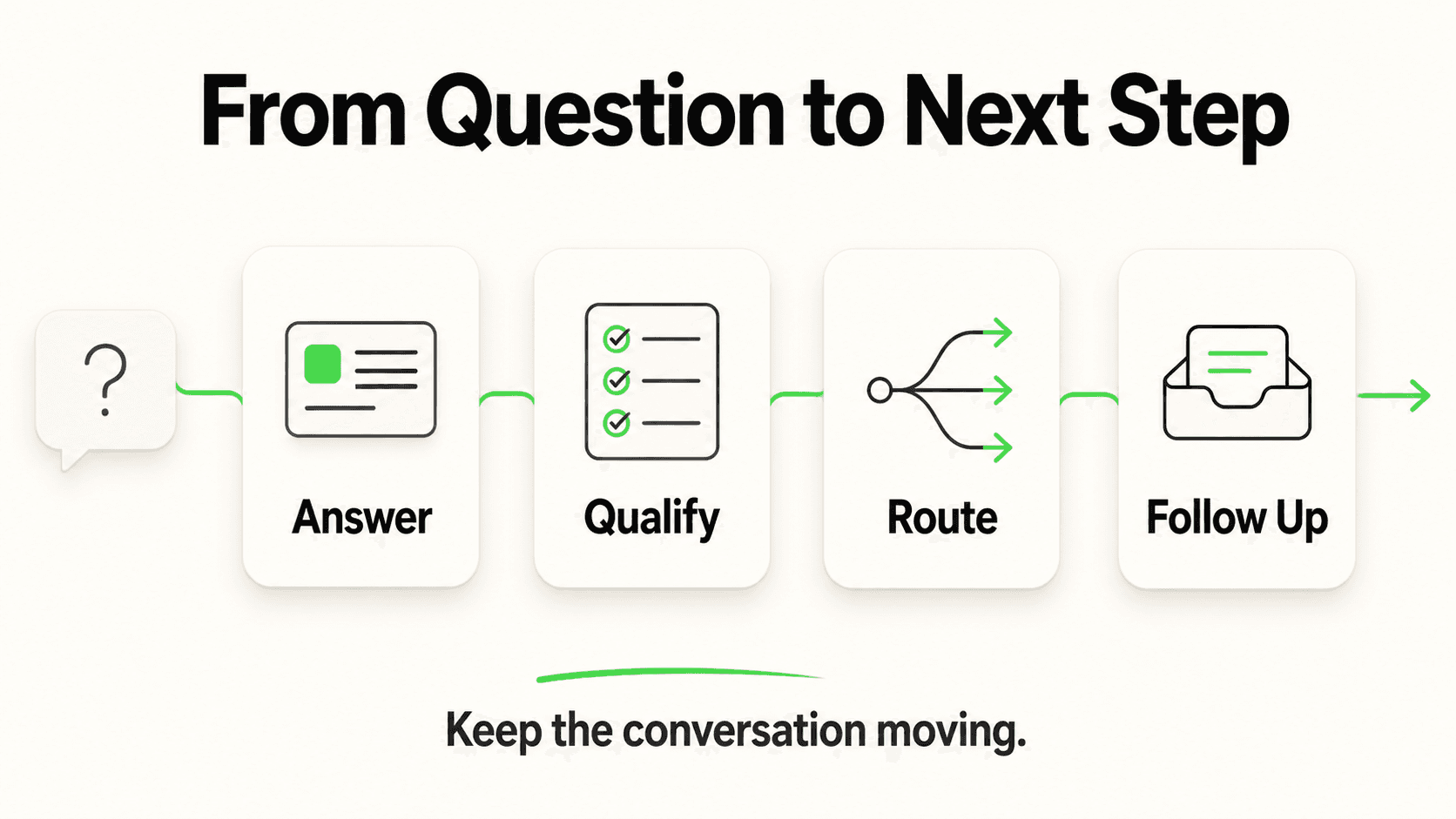
Theory is compelling, but what outcomes are schools actually experiencing?
Enrollment and conversion improvements
Schools implementing AI admissions assistants report:
- 30-45% improvement in inquiry-to-enrollment conversion rates
- 50-70% increase in after-hours inquiry capture (previously missed opportunities)
- 40-60% higher attendance for scheduled campus tours
- 25-35% reduction in application drop-off during admission process
- 20-30% more applications from families who previously couldn't reach the school
One premium K-12 school calculated that improved conversion rates during admission season resulted in 18 additional enrollments in their first year with AI—representing $270,000-$360,000 in annual tuition revenue, far exceeding the AI system cost.
Administrative efficiency gains
Beyond enrollment impact, schools see dramatic operational improvements:
- 60-75% reduction in administrative time spent on routine inquiries
- 4-6x increase in inquiry handling capacity without additional staff
- Elimination of inquiry backlog during peak admission season
- 80-90% faster initial response times (instant vs. next-day)
- 35-50% reduction in phone interruptions for office staff
Admissions coordinators report being able to focus on high-value activities like campus tours, personal counseling, enrollment completion, and relationship building rather than answering the same basic questions hundreds of times.
Parent satisfaction improvements
Experience metrics show significant gains:
- 95%+ of inquiries get instant responses regardless of time or day
- 4.6+ out of 5 average satisfaction ratings from parents interacting with AI
- Consistent information quality across all channels and staff
- Reduced frustration about "not being able to reach anyone"
- Better perception of school professionalism and organization
These satisfaction improvements translate directly to better online reviews, stronger word-of-mouth referrals, and enhanced reputation—benefits that compound over time as more families share positive experiences.
Competitive advantages
Schools with AI admissions assistants gain strategic positioning:
- Faster parent response than competitors still using manual processes
- Professional image that signals innovation and parent-focus
- Better capture of competitive comparison shoppers (instant info wins)
- Ability to scale marketing without proportional operations growth
- Data insights for continuous improvement
In competitive education markets where academic quality is comparable, operational excellence in the admissions experience becomes a key differentiator.
Frequently Asked Questions
Will parents be upset about talking to AI instead of humans?
Modern AI has reached a point where 80%+ of parents prefer instant, accurate AI responses over waiting hours or days for human responses (Source: McKinsey, 2023)—as long as human escalation is available when needed. Parents care about getting their questions answered quickly and completely; they're less concerned about whether AI or humans provide those answers. The key is offering choice: AI for immediate help, humans for complex situations.
How do you handle sensitive topics like special needs or financial aid?
AI can provide high-level information about support programs and financial aid availability, but should immediately offer connection to specialized staff for detailed discussions. The AI recognizes keywords indicating sensitive topics ("my child has dyslexia," "we need financial assistance") and gracefully transitions to human support with full context.
What if the AI gives wrong information?
Properly configured AI systems achieve high accuracy for factual information when loaded with correct content. The key is thorough initial setup and regular content updates. Additionally, AI should clearly indicate uncertainty ("I'm not certain about this, let me connect you with our admissions coordinator") rather than guessing, and all AI responses should be periodically reviewed for accuracy.
How much does AI admissions assistant cost for schools?
Pricing varies based on inquiry volume and features:
- Small schools (< 100 daily inquiries): $300-$800/month
- Medium schools (100-300 daily inquiries): $800-$2,000/month
- Large schools (300+ daily inquiries): $2,000-$5,000+/month
Most schools see positive ROI within one admission season through increased enrollments and reduced administrative costs. The calculation: if AI helps convert even 5-10 additional families, the tuition revenue far exceeds the annual AI cost.
How long does implementation take?
Timeline depends on school complexity and readiness:
- Basic setup: 3-4 weeks for single-campus schools
- Standard deployment: 5-7 weeks for schools with multiple programs
- Complex implementation: 8-10 weeks for multi-campus or international schools
Most schools see meaningful results immediately upon launch, with continuous improvement over subsequent months as the AI learns from real interactions.
Can AI handle multiple languages?
Yes—modern AI can communicate fluently in multiple languages, essential for international schools or diverse communities. The AI can detect the parent's preferred language and respond accordingly, or allow manual language selection. This capability dramatically expands reach without hiring multilingual staff.
What happens during technical issues or system downtime?
Quality AI providers offer 99.9%+ uptime guarantees with redundancy and failover systems. In the rare event of technical issues, systems should automatically notify admissions staff and provide fallback options (traditional contact forms, emergency phone support). Service level agreements (SLAs) should clearly define uptime guarantees and support response times.
Convert 30-45% More Inquiries to Enrollments
Schools using Hyperleap AI capture after-hours inquiries, provide consistent information, and guide families from first question to enrollment.
View Pricing"Parents choosing a school are making one of the most emotionally significant decisions of their lives. When they reach out at 9 PM on a Saturday and get an instant, helpful response, it signals that your school cares about families -- not just during office hours, but always," says Gopi Krishna Lakkepuram, Founder & CEO of Hyperleap AI and former Microsoft engineer.
The Future of School Admissions
AI admissions assistants aren't experimental technology—they're becoming standard infrastructure for schools serious about enrollment growth and operational excellence. Schools implementing these systems now are building competitive advantages that compound over time, while those delaying adoption risk falling permanently behind as parent expectations continue rising.
The evidence is clear: AI dramatically improves conversion rates, reduces administrative burden, and enhances parent satisfaction—all while being cost-effective compared to hiring additional staff for seasonal peaks.
Your next admission season will be make-or-break regardless of whether you have AI. The question is whether you'll face it with overwhelmed staff, delayed responses, and lost opportunities—or with an AI assistant that ensures every parent gets instant, accurate, helpful information 24/7.
Start by assessing your current admission process: how many inquiries do you miss? How long do parents wait for responses? What percentage of interested families never complete applications? Calculate the cost of these gaps in enrollment opportunities and administrative efficiency.
Then evaluate AI solutions designed specifically for schools, prioritizing those with proven results from similar institutions, strong integration capabilities, and comprehensive implementation support.
Your prospective parents deserve immediate, helpful, consistent communication. Your admissions team deserves relief from repetitive questions and the ability to focus on high-value relationship building. Your school deserves every qualified family who inquires, not just the fraction you can currently handle.
Keep exploring
- AI admissions agents for schools - Answer parent questions and capture enrollments 24/7
- Conversational AI for customer service - Support families across every channel automatically
Education Resources
- Best AI Chatbots for Schools & Universities 2026 - Platform comparison
- AI Chatbot Statistics 2026 - Industry benchmarks
- How to Choose an AI Chatbot Platform - Selection guide
- Getting Started with AI Agents - Implementation guide
Related Comparisons
- Best No-Code Chatbot Builders 2026 - No-code platforms
- Best Multi-Channel Chatbots 2026 - Omnichannel solutions
- Best WhatsApp Automation Tools 2026 - WhatsApp for education
Glossary
- What is a Chatbot? - Chatbot fundamentals
- WhatsApp Business API - Popular education channel
- OTP Validation - Verified lead capture
Related Articles

How Coaching Institutes Use AI for 1000+ Daily Inquiries
Learn how coaching institutes use AI to manage overwhelming inquiry volumes, respond 24/7, and convert more students during peak admission seasons.

Handle 1,000+ Admission Inquiries Without New Hires
Learn how schools and coaching institutes manage 1,000+ admission inquiries during peak season without hiring extra staff using AI-powered automation.

100+ Customer Support Chatbot Templates (Free Scripts)
Copy-paste chatbot templates for customer support, service requests, call centers, help desks, billing, bookings, and after-hours lead capture.

What is an AI Chatbot? The Complete Guide for 2026
Everything about AI chatbots in 2026. How they work, types, use cases, benefits, and how to choose the right platform for your business.