Handle 1,000+ Admission Inquiries Without New Hires
Learn how schools and coaching institutes manage 1,000+ admission inquiries during peak season without hiring extra staff using AI-powered automation.

TL;DR: During peak admissions, Indian coaching institutes and schools receive 1,000+ inquiries per week, but most operate with 3-5 person admissions teams. AI-powered inquiry management resolves 65-75% of routine questions without human intervention, captures leads 24/7 on WhatsApp, and automates follow-ups so no parent falls through the cracks. Institutions using these systems report handling 3-5x more inquiries while reducing seasonal staffing costs by 50-70%.
Picture this: board exam results just dropped. Your coaching institute's WhatsApp Business number has 347 unread messages. The front desk phone has not stopped ringing since 7 AM. Your three-person admissions team is simultaneously handling walk-ins, replying to Instagram DMs, and trying to update the fee spreadsheet that five parents have already found errors in. By 2 PM, your team is drowning, and it is only Monday.
This scenario plays out every year at thousands of schools and coaching institutes across India. Research consistently shows that 78% of customers enrol with the first institution that responds to their inquiry (Source: LeadAngel). With India's coaching institute market projected to reach USD 17.4 billion by 2033 (Source: IMARC Group) and over 22 lakh NEET aspirants competing annually (Source: Careers360), the volume of admission inquiries is only growing. Yet most institutions still rely on the same manual processes that buckled under half the load five years ago.
The result? Lakhs of rupees in lost enrolments every season, not because of poor teaching quality, but because of slow responses to parents who were ready to enrol.
The solution is not hiring 10 temporary counsellors every March. It is building automated systems that handle 1,000+ inquiries simultaneously, 24 hours a day, without compromising the quality of each interaction.
Who This Guide Is For
This guide is written for admissions heads, institute directors, and school principals in India who face seasonal inquiry surges during JEE/NEET results, board exam results, and new academic year admissions. Whether you run a coaching institute in Kota, a CBSE school in Hyderabad, or a chain of centres across tier-2 cities, this roadmap applies to your situation.
What Is Automated Admissions Inquiry Management?
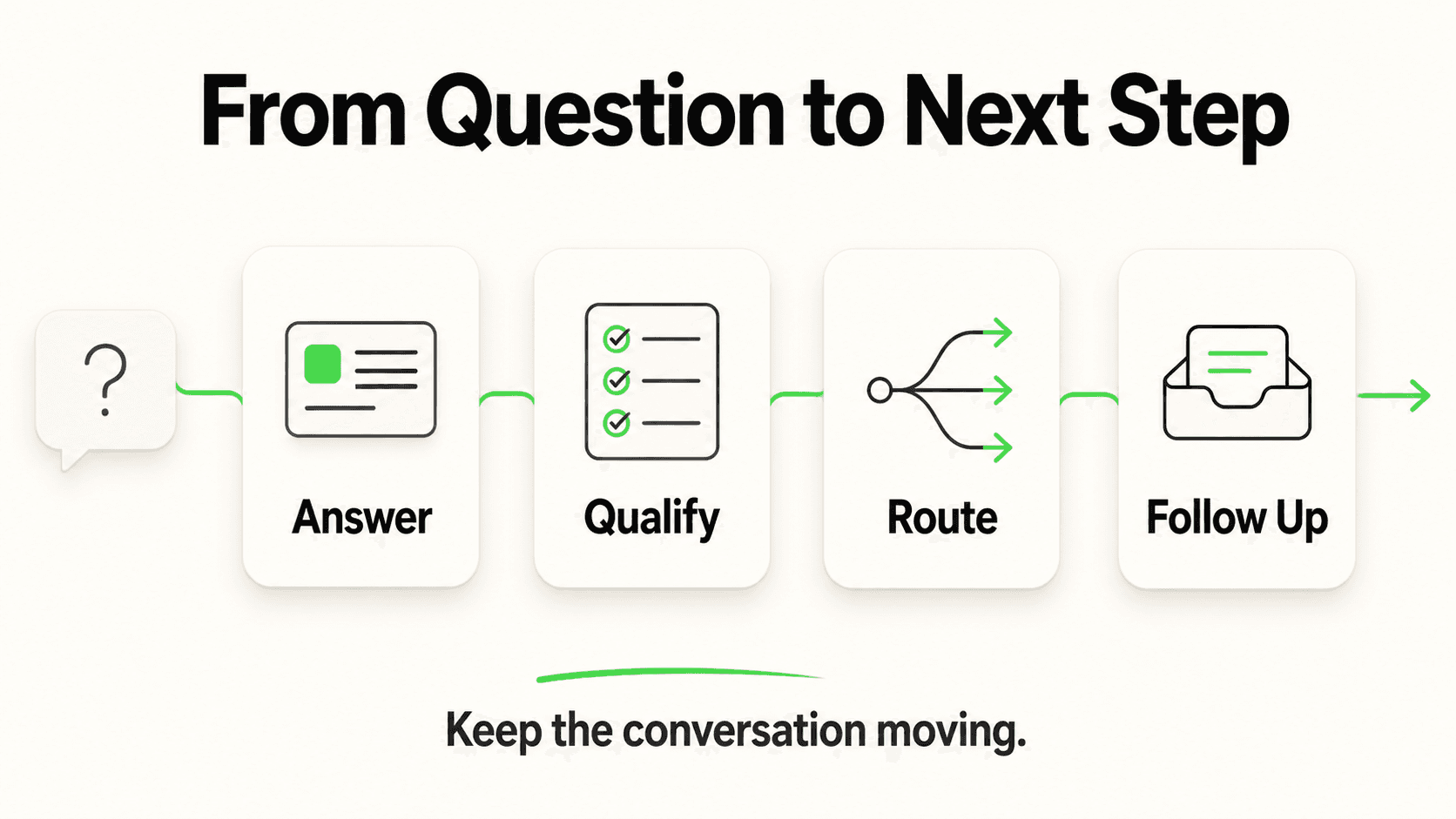
Automated admissions inquiry management uses AI-powered chatbots and workflow automation to handle the flood of questions that schools and coaching institutes receive during peak admission periods. Instead of relying solely on human counsellors to answer every WhatsApp message, phone call, and walk-in query, institutions deploy intelligent systems that can:
- Answer the top 30-50 frequently asked questions instantly — fees, eligibility, batch timings, hostel facilities, scholarship criteria, and documentation requirements
- Capture lead information automatically — student name, class, exam target, preferred batch, parent contact details, and city
- Operate 24/7 across WhatsApp, website chat, Instagram DM, and Facebook Messenger — meeting parents where they already spend their time
- Route complex inquiries to the right counsellor — a JEE Advanced query goes to the senior physics faculty, not the front desk receptionist
- Send automated follow-ups and deadline reminders — so undecided parents receive timely nudges without anyone remembering to call
- Provide consistent, accurate information — every parent gets the same fee structure, the same scholarship criteria, and the same batch details regardless of which channel they use or what time they inquire
This is fundamentally different from the old-school IVR systems or basic menu-driven chatbots that frustrated parents with rigid "Press 1 for admissions, Press 2 for fees" workflows. Modern AI inquiry systems engage in natural conversations, understand context, handle multi-part questions, and know when to escalate to a human — all in Hindi, English, Tamil, Telugu, or whichever language the parent prefers.
For coaching institutes preparing students for JEE, NEET, UPSC, CA, CLAT, and other competitive exams, the stakes during admissions are immense. A single missed inquiry during the 4-6 week window after results can mean ₹2-3 lakhs in lost revenue per student. Automated inquiry management ensures that every message gets a response within seconds, not hours.
Why Schools and Coaching Institutes Buckle Under Admission Inquiry Volume
The inquiry management crisis is not a sign of institutional failure. It is a structural problem created by extreme seasonality, limited staff, and rapidly shifting parent behaviour. Here is exactly why institutions lose enrolments during peak admissions. The education admissions customer service statistics for 2026 paint a sobering picture of the scale of this challenge.
Seasonal spikes that no team can absorb
Indian education admissions follow a predictable but brutal seasonal pattern. A mid-sized NEET coaching institute in Hyderabad or Patna might handle 30-50 inquiries per day during September-November. When NEET results are announced, that number explodes to 300-500+ daily inquiries within 48 hours. CBSE and ICSE schools experience a similar 4-5x surge between January and April as parents scramble to secure seats for the new academic year.
The math is unforgiving. If each inquiry requires an average of 10 minutes to handle properly — answering questions, collecting details, explaining fee structures — then 400 inquiries demand 66 hours of counsellor time per day. A team of 3 counsellors working 10-hour shifts can handle 180 inquiries. The remaining 220 inquiries either wait until the next day (by which time the parent has enrolled elsewhere) or receive rushed, incomplete responses that fail to convert.
The repetitive question trap
Admissions counsellors at coaching institutes report that 70-80% of inquiries involve the same 20-30 questions asked in slightly different ways:
- "What is the fee for the 2-year NEET batch?"
- "Is hostel facility available? What is the cost?"
- "My son scored 85% in boards. Is he eligible for the scholarship?"
- "What is the difference between the regular and intensive batches?"
- "Do you have a centre in Lucknow/Jaipur/Nagpur?"
Each time a counsellor types the same fee structure into WhatsApp, copies the same scholarship criteria, or explains the same batch schedule, they are spending valuable time on work that could be automated. This repetitive load is the single biggest drain on admissions team productivity.
Manual data entry that slows everything down
In most coaching institutes, the inquiry-to-enrollment pipeline still runs on spreadsheets, notebooks, and memory. A parent calls the front desk, the receptionist writes down the name and phone number on a register, and sometime later (if the register does not get buried under other paperwork), someone enters it into an Excel sheet. By the time the data reaches a counsellor for follow-up, 2-3 days have passed.
This manual data entry creates three compounding problems: data loss (inquiries that never make it from the notebook to the spreadsheet), data errors (wrong phone numbers, misspelled names), and data delay (the 2-3 day gap between inquiry and follow-up, during which the parent has already spoken to three competitors).
Follow-up gaps that kill conversion
Only 3-5% of education inquiries convert to enrolment on first contact (Source: Reshape). The majority of conversions happen through systematic follow-up over 1-3 weeks as families discuss options, compare institutions, and make decisions. In Indian families, this decision often involves parents, grandparents, and sometimes uncles and aunts — each with different questions and concerns.
During peak admissions, when new inquiries flood in every hour, follow-up with existing prospects collapses entirely. The counsellor who promised to call a parent back on Thursday is now buried under 200 new messages. The parent who visited the campus last week and was "90% decided" never receives the scholarship deadline reminder. The family that asked for a callback after discussing with their grandfather never hears from you again.
These follow-up failures are invisible — they do not show up in any dashboard because the inquiries were technically "handled." But they represent the largest source of lost enrolments at most institutions.
7 Ways to Handle 1,000+ Admission Inquiries Without Adding Staff
Handling massive inquiry volumes is not about working harder. It is about deploying systems that multiply the capacity of your existing team. Here are seven specific strategies that institutions across India are using to manage peak admissions without hiring additional staff.
1. AI-Powered FAQ Resolution
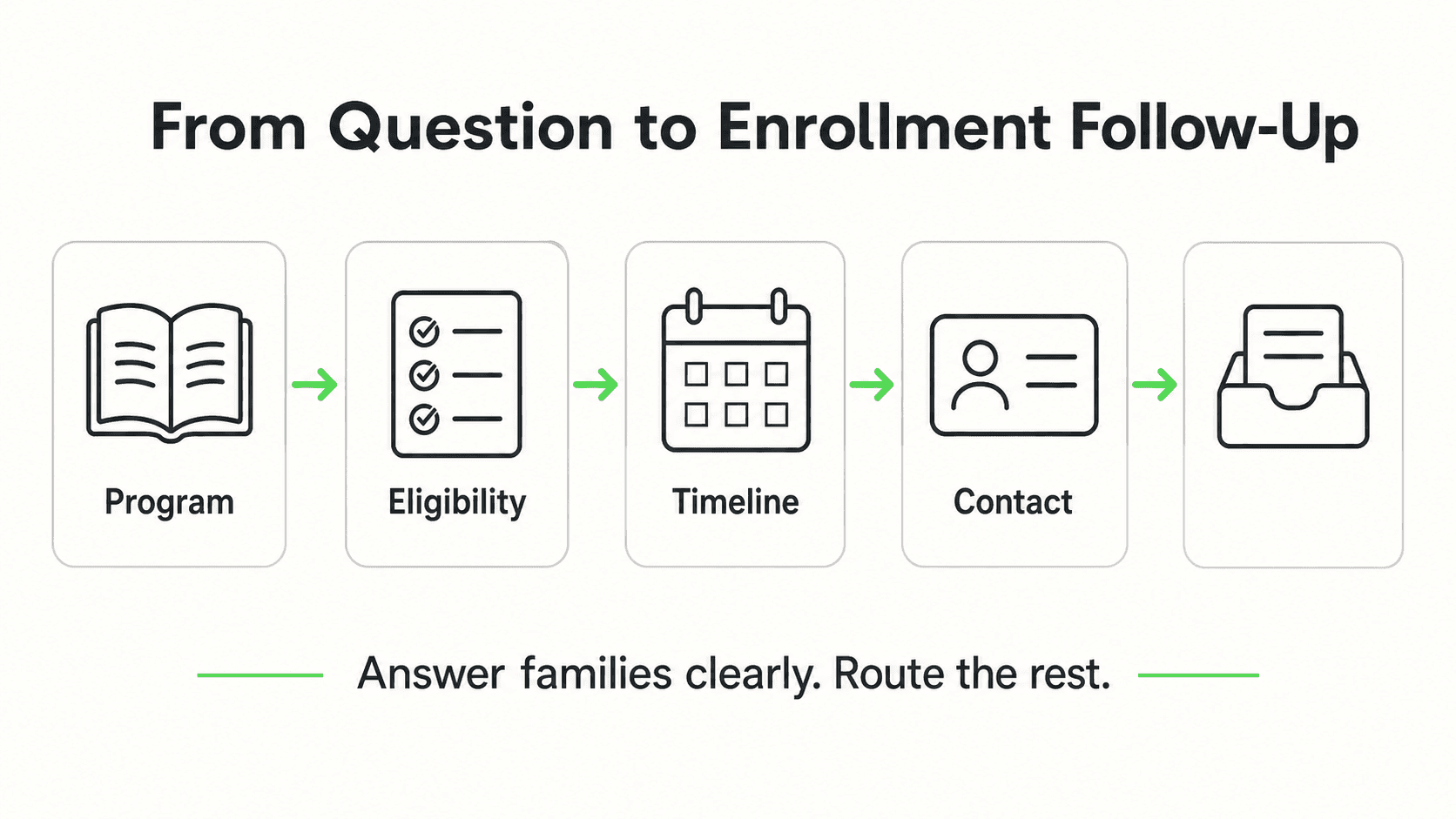
The fastest way to free up your admissions team is to automate the 70-80% of inquiries that ask the same questions every day.
What this looks like in practice: A parent messages your WhatsApp Business number at 9:30 PM asking, "What is the fee for 2-year JEE batch and is hostel available?" Within 5 seconds, the AI responds with the exact fee breakdown (tuition, materials, test series), hostel options with pricing, and a link to download the detailed prospectus. The parent then asks a follow-up: "Is there a scholarship for students scoring above 90% in boards?" The AI provides the complete scholarship slab — 90-95%: 10% fee waiver, 95-98%: 25% fee waiver, 98%+: 50% fee waiver — along with the application process and deadline.
Real-world impact: Coaching institutes implementing AI-powered FAQ resolution report that 65-75% of all inquiries are resolved completely without human intervention (Source: DemandSage). For a coaching institute receiving 500 daily inquiries during peak season, that means 325-375 inquiries handled automatically, freeing counsellors to focus on the 125-175 complex inquiries that genuinely need human judgment.
Why it works: Parents do not care whether a human or an AI answers their fee structure question. They care about getting an accurate, complete answer quickly. When the AI provides the same information a counsellor would (because it is trained on your actual prospectus and fee documents), the parent experience is identical — or better, because it happens in seconds rather than hours.
Key features:
- Document-grounded responses that pull answers directly from your prospectus, fee circulars, and policy documents
- Multi-language support covering Hindi, English, Tamil, Telugu, Kannada, Bengali, Marathi, and Gujarati
- Context-aware follow-up handling so multi-part conversations flow naturally
- Automatic escalation when the AI detects a question it cannot answer confidently
2. Automated Lead Capture on Every Channel
Every inquiry is a potential enrolment. Automated lead capture ensures no parent's contact details are lost, regardless of which channel they use or what time they reach out.
What this looks like in practice: A parent sends an Instagram DM at 11 PM asking about your NEET crash course. A quick lead form captures the student's name, current class, target exam, city, and parent phone number up front, then the AI engages in a helpful conversation and answers their questions. This data is automatically synced to your CRM or admissions spreadsheet. The next morning, your admissions team opens their dashboard and sees 47 new qualified leads captured overnight — each with complete contact details, the questions they asked, and their level of interest.
Real-world impact: Institutions using automated lead capture report 35-50% more leads captured from after-hours inquiries compared to manual processes. These are leads that would have been entirely lost in a manual system because the parent messaged at a time when no one was available to respond and collect details.
Why it works: Manual lead capture depends on a human being available, attentive, and disciplined about data entry. Automated capture removes all three dependencies. Whether the inquiry comes at 3 AM on WhatsApp or 2 PM as a website chat, the system captures the same structured data with the same consistency.
Key features:
- Conversational data collection that feels natural, not like filling out a form
- Automatic de-duplication so parents who inquire on multiple channels appear as a single lead
- Lead scoring based on inquiry urgency, exam timeline, and engagement level
- Real-time sync with your CRM, Google Sheets, or student management system
3. WhatsApp-First Communication
With over 537 million monthly active WhatsApp users in India (Source: Statista), WhatsApp is the dominant channel for education inquiries. Building your admission inquiry system around WhatsApp is not optional — it is essential.
What this looks like in practice: Your coaching institute's WhatsApp Business number handles the entire inquiry-to-enrolment journey. A parent discovers your institute through a Google ad, clicks the WhatsApp CTA, and immediately enters a conversation with your AI assistant. The assistant answers questions about courses, shares batch schedules as PDF attachments, sends a Google Maps link to your nearest centre, and schedules a campus visit — all within WhatsApp. After the visit, the assistant sends a follow-up message with the fee payment link and scholarship application form.
Real-world impact: WhatsApp messages achieve 98% open rates compared to 22% for email (Source: Statista). For education institutions, this means WhatsApp follow-ups are 4-5x more likely to be seen and acted upon than email follow-ups. Institutions that shift their primary communication to WhatsApp report 40-60% improvement in parent engagement during the admissions process.
Why it works: Indian parents already live on WhatsApp. They use it to communicate with their children's current school, coordinate with other parents, and share information with family members involved in the education decision. When your institute communicates on WhatsApp, you are meeting families in the app they check 50+ times per day, not asking them to check email or visit a website.
Key features:
- WhatsApp Business API integration for handling high volumes without getting blocked
- Rich media support: PDFs (prospectus, fee structure), images (campus photos), videos (testimonials), and location pins
- Template messages for proactive outreach (deadline reminders, result announcements, batch updates)
- Group broadcast capability for announcements to specific segments (JEE parents, NEET parents, scholarship applicants)
4. Smart Routing by Program and Course
Not all inquiries are equal, and not all counsellors are equally qualified to handle every type of inquiry. Smart routing ensures each inquiry reaches the person best equipped to convert it.
What this looks like in practice: A parent asks about the JEE Advanced integrated programme for their Class 11 daughter. The AI recognises this as a high-value, complex inquiry (2-year programme, ₹3-4 lakhs revenue potential) and routes it to your senior JEE counsellor with a summary: "Parent of Class 11 student, interested in JEE Advanced integrated batch, asked about scholarship eligibility and hostel, currently comparing with Allen and FIITJEE." The counsellor does not start from zero — they have full context and can have a personalised, high-impact conversation.
Meanwhile, a simpler inquiry about NEET foundation batch timings for a Class 9 student is handled entirely by the AI, which provides batch details, fee structure, and schedules a demo class.
Real-world impact: Coaching institutes using intelligent routing report 40-50% improvement in counsellor productivity because counsellors spend their time on qualified, high-intent prospects rather than answering basic questions about location and timings. Conversion rates on routed inquiries are 2-3x higher than on unrouted inquiries because the right counsellor is matched to the right prospect.
Why it works: A front desk receptionist should not be handling a ₹3 lakh enrolment decision. A senior faculty member should not be spending 15 minutes explaining bus routes. Smart routing respects the expertise of your team and the value of each inquiry, creating better outcomes for both your staff and your prospective families.
Key features:
- Program-based routing (JEE inquiries to JEE team, NEET to NEET team, school admissions to school admin)
- Intent-based prioritisation (ready-to-enrol parents get immediate human attention)
- Context transfer so counsellors see the complete conversation history before engaging
- Fallback routing when primary counsellors are unavailable
Handle Peak Admissions Without the Chaos
Deploy an AI admissions assistant on WhatsApp and web in under a week. Resolve 65-75% of inquiries automatically while your counsellors focus on high-value conversations.
See How It Works5. Automated Follow-Up Sequences
The biggest revenue leak in admissions is not unanswered inquiries — it is the systematic failure to follow up with parents who showed interest but did not enrol immediately. Automated follow-up sequences close this gap permanently.
What this looks like in practice: A parent visits your Kota centre for a campus tour on a Saturday. On Monday morning, the system automatically sends a WhatsApp message: "Thank you for visiting our centre, Mrs. Sharma. We hope Arjun enjoyed the demo class. Here is the batch schedule we discussed. The early bird discount of ₹15,000 is available until March 15. Would you like me to connect you with Dr. Verma to discuss Arjun's study plan?" If the parent does not respond, a second follow-up goes out on Wednesday with a student success story. On the following Monday, a final message reminds them that the early bird deadline is approaching.
Real-world impact: Institutions using automated follow-up sequences report 25-40% improvement in inquiry-to-enrolment conversion because no prospect falls through the cracks. The improvement is most dramatic for "warm" leads — parents who showed genuine interest but needed time to decide. Without automation, 80-90% of these warm leads go cold because no one follows up consistently during peak season.
Why it works: Human follow-up fails during peak admissions because counsellors are overwhelmed with new inquiries. Automated sequences run independently of workload. Whether your institute receives 50 or 500 new inquiries today, every existing prospect in the pipeline continues to receive timely, personalised follow-ups. This consistency is what separates institutions that convert 30-40% of inquiries from those stuck at 10-15%.
Key features:
- Triggered sequences based on prospect behaviour (visited campus, downloaded prospectus, attended demo class, started but did not complete application)
- Personalised messaging using the student's name, target exam, and specific programme of interest
- Deadline-driven urgency (early bird discounts, batch capacity limits, scholarship deadlines)
- Automatic pause when the parent responds or enrols, so they are not bombarded with unnecessary messages
6. Bulk Communication for Deadlines and Announcements
During admissions, there are critical moments when you need to reach hundreds or thousands of prospective parents simultaneously — application deadlines, batch start dates, scholarship announcements, and result celebrations.
What this looks like in practice: Your coaching institute's JEE batch starts on April 1. You have 800 prospective parents in your pipeline who inquired but have not enrolled. On March 20, your system sends a targeted WhatsApp broadcast: "Only 12 days left to enrol in our JEE 2028 batch. 73% of seats are filled. Book your spot now to secure the early bird fee of ₹1,85,000." The message includes a one-tap enrolment link and a "Talk to counsellor" button. Parents who click but do not complete enrolment receive a follow-up the next day.
Real-world impact: Targeted deadline communications typically generate 15-25% enrolment surges in the final 2 weeks before batch start dates. These are conversions that would not happen without the reminder because parents, busy with their own lives, simply forget deadlines. One coaching institute chain reported that their automated deadline broadcasts generated ₹45 lakhs in additional enrolments in a single admission cycle — entirely from prospects who had already inquired but not enrolled.
Why it works: Manual bulk communication is slow, inconsistent, and error-prone. Sending 800 individual WhatsApp messages takes a counsellor 2-3 full days. Automated broadcasts reach everyone simultaneously, can be segmented by programme, city, or inquiry stage, and include tracking to see who opened, clicked, and enrolled.
Key features:
- Segmented broadcasts by exam (JEE, NEET, UPSC), stage (inquired, visited, applied), and location (city, state)
- WhatsApp template messages that comply with Meta's business messaging policies
- One-tap CTAs for enrolment, payment, campus visit scheduling, or counsellor callback
- Delivery and engagement analytics so you know exactly which messages drive enrolments
7. Analytics Dashboard for Admissions Intelligence
You cannot improve what you do not measure. An analytics dashboard transforms admissions from gut-feel decision-making to data-driven strategy.
What this looks like in practice: Your admissions head opens the dashboard on Monday morning and sees: 1,247 inquiries received last week across all channels. 68% were resolved by AI without human intervention. 312 new qualified leads captured. Top inquiry topics: fee structure (34%), batch timings (22%), scholarship eligibility (18%), hostel facilities (12%). Conversion from inquiry to campus visit: 23%. Conversion from campus visit to enrolment: 41%. Channel breakdown: WhatsApp 62%, website 21%, Instagram 11%, Facebook 6%. Peak inquiry hours: 7-9 PM.
Real-world impact: Institutes using analytics dashboards make measurably better decisions. When data shows that 62% of inquiries come via WhatsApp, the marketing team shifts ad spend to WhatsApp CTAs instead of website landing pages. When data reveals that scholarship-related inquiries convert at 2x the rate of general inquiries, the content team creates more scholarship-focused communications. These data-driven adjustments compound over time, improving both inquiry volume and conversion rates.
Why it works: Most institutions operate with almost no visibility into their admissions funnel. They know how many students enrolled, but not how many inquired, where the dropoffs occurred, which channels performed best, or which counsellors had the highest conversion rates. Analytics changes admissions management from reactive firefighting to proactive strategy.
Key features:
- Real-time inquiry volume tracking across all channels
- Conversion funnel visualisation (inquiry to lead to campus visit to application to enrolment)
- Counsellor performance metrics (response time, conversion rate, inquiry volume handled)
- Channel attribution so you know which marketing spend drives the most enrolments
- Exportable reports for board presentations and strategic planning
Real Results: What Institutions Are Achieving
Schools and coaching institutes that have implemented automated admission inquiry management are seeing measurable improvements across their entire enrolment funnel.
Inquiry handling capacity
- Institutions handle 3-5x more inquiries during peak season without adding staff
- 65-75% of routine inquiries (fees, eligibility, timings, documentation) are resolved by AI without human intervention
- Average response time drops from 4-8 hours to under 30 seconds
- After-hours inquiry capture increases by 35-50%, recovering inquiries that were previously lost entirely
Enrolment conversion
- Inquiry-to-application conversion rates improve from 15-20% to 30-45% when response times drop below 5 minutes
- Automated follow-up sequences increase warm lead conversion by 25-40%
- Deadline-driven broadcasts generate 15-25% enrolment surges in the final 2 weeks before batch start dates
- Marketing ROI improves by 40-60% because every ad-generated inquiry receives an instant response
Cost efficiency
- Seasonal staffing costs reduce by 50-70% as AI handles the inquiry volume that previously required temporary hires
- Cost per qualified lead drops by 30-40% through automated lead capture and qualification
- Counsellor productivity improves by 40-50% as they focus exclusively on high-value interactions
- Information consistency eliminates re-work caused by incorrect fee quotes and conflicting details
Implementation Roadmap for Schools and Coaching Institutes
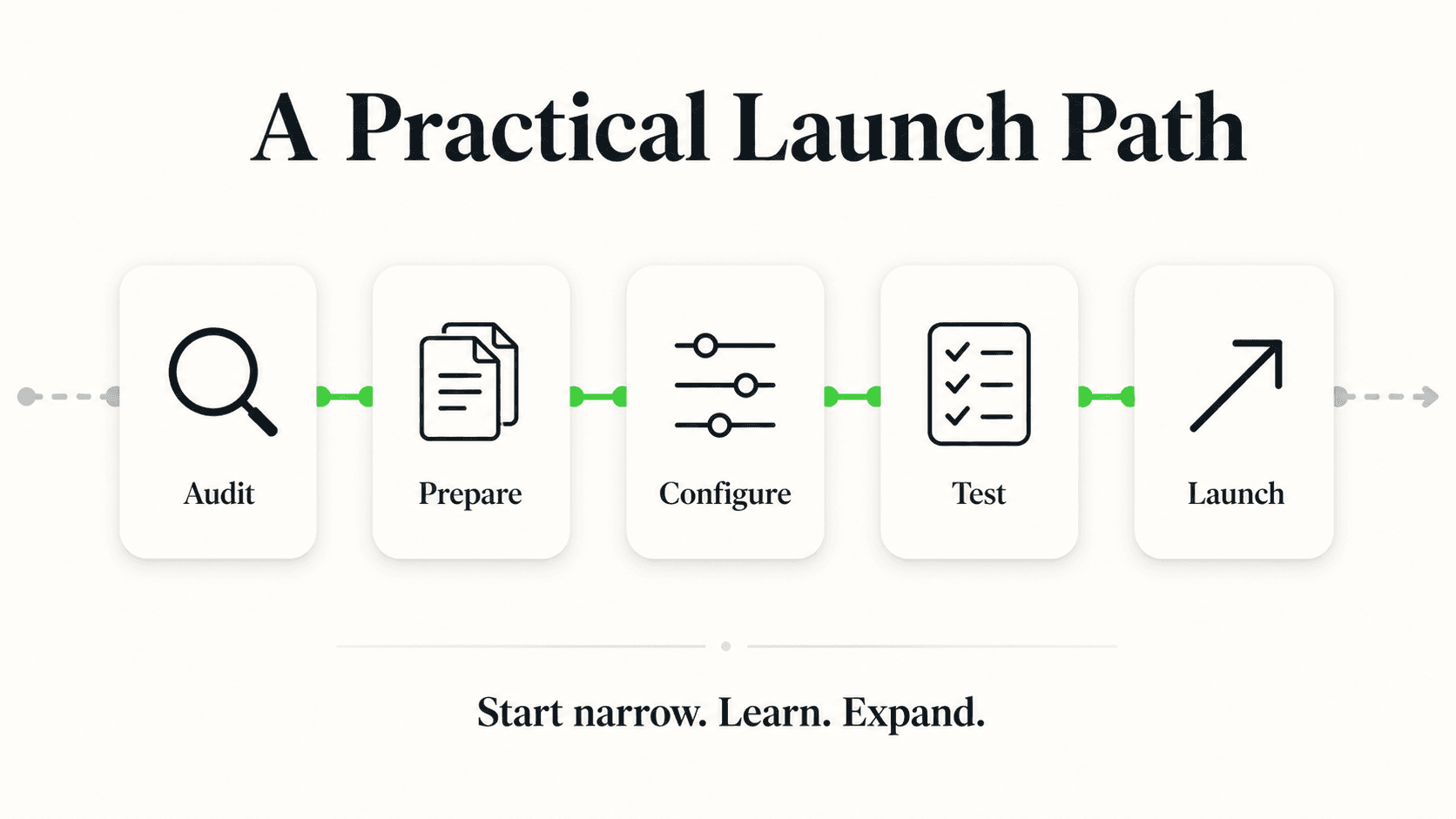
Implementing automated admissions inquiry management does not require a 6-month IT project or a ₹50 lakh budget. Here is a realistic phased approach that gets you operational before peak season.
Phase 1: Audit and preparation (Week 1-2)
Start by understanding your current state:
- Document your top 30 questions. Pull the last 500 WhatsApp messages and phone call notes. Categorise every inquiry by topic (fees, batches, eligibility, hostel, scholarship, location, documentation). You will likely find that 20-30 questions account for 70-80% of all inquiries.
- Measure your current response time. Check the average gap between when a WhatsApp message arrives and when it gets a reply. During peak season, this is often 6-12 hours for institutions relying on manual processes.
- Calculate your inquiry-to-enrolment conversion rate. Divide the number of students who enrolled last season by the total number of inquiries received. If this is below 20%, there is significant room for improvement.
- Identify your channel mix. Determine what percentage of inquiries come through WhatsApp, phone, website, Instagram, Facebook, and walk-ins. This determines where to deploy automation first.
Phase 2: Deploy AI-powered responses (Week 2-4)
With your audit complete, deploy an AI inquiry system:
- Upload your knowledge base. Your prospectus, fee structure, batch schedule, scholarship criteria, hostel details, campus facilities information, and admission process documentation. Platforms like Hyperleap AI allow you to train an education-focused chatbot on your specific institution's information in days.
- Configure WhatsApp Business API. Connect your WhatsApp Business number to the AI system so incoming messages receive instant automated responses. This single step addresses the 60%+ of inquiries that arrive after office hours.
- Set up lead capture flows. Configure a lead form that collects student name, class, target exam, city, and parent contact details before the conversation begins. Ensure this data syncs to your CRM or spreadsheet in real-time.
- Define escalation rules. Determine which inquiry types should be handled entirely by AI (fee queries, timings, eligibility) and which should be routed to human counsellors (scholarship negotiations, custom batch requests, complaints).
Phase 3: Activate follow-ups and scale (Week 4-8)
With the core system running:
- Build follow-up sequences. Create 3-5 message sequences for each stage of the admissions journey: post-inquiry, post-campus visit, post-demo class, pre-deadline, and post-deadline.
- Configure deadline broadcasts. Set up templates for batch start reminders, scholarship deadlines, early bird discount expiry, and seat availability alerts.
- Train your counsellors. Teach your admissions team to work with AI-qualified leads rather than raw inquiries. They should focus on relationship-building and objection-handling, not data collection and FAQ responses.
- Monitor and optimise. Review the analytics dashboard weekly. Identify which questions the AI struggles with and update the knowledge base. Track conversion rates at each funnel stage and adjust follow-up messaging accordingly.
The goal is a system where every parent receives an instant, helpful response regardless of time or channel — and your human team focuses exclusively on the 25-35% of interactions that genuinely require empathy, judgment, and expertise. For a deeper look at how AI handles the day-to-day, see our guide on AI inquiry management for coaching institutes.
Your Next Admissions Season Does Not Have to Be Chaos
The pattern is clear: India's education market is growing rapidly, with the school sector projected to reach USD 138 billion by 2034 and the coaching institute market reaching USD 17.4 billion by 2033. Inquiry volumes will only increase. The institutions that thrive will be those that build systems to handle this volume efficiently, not those that keep throwing temporary staff at a structural problem.
Every admissions season, institutions that rely solely on manual processes lose enrolments to competitors who respond faster, more consistently, and around the clock. The cost compounds — lost enrolments mean lost revenue, lost referrals, and lost reputation in parent communities and Google reviews.
Automated admissions inquiry management is not about replacing your admissions team. It is about giving them superpowers. When AI handles the 65-75% of inquiries that are routine, your counsellors can devote their full attention to the families that need human expertise — the scholarship negotiations, the nervous parents, the students deciding between your institute and a competitor. That is where human skill matters most, and that is where enrolments are won.
The institutions already using these systems are not going back to manual processes. They are handling 3-5x more inquiries, converting at significantly higher rates, and doing it all with the same team size. The question is whether you will join them before your next peak admissions season — or spend another year watching enrolments walk out the door.
Frequently Asked Questions
Will automated responses make our institution feel impersonal to parents?
No. Modern AI systems communicate naturally and warmly, matching the tone parents expect from educational institutions. The AI handles routine questions (fees, timings, eligibility) instantly, freeing your counsellors to provide deeply personal attention to families who need it. Parents report higher satisfaction when they receive immediate, accurate answers rather than waiting hours or days for a human to respond with the same information. The key is ensuring the AI is trained on your institution's voice and can seamlessly escalate to a human when the conversation requires personal judgment.
How much does it cost to set up automated admissions management?
AI-powered chatbot solutions for education typically start at ₹3,000-8,000 per month, which is a fraction of the cost of hiring even one temporary admissions counsellor at ₹25,000-40,000 per month. Platforms like Hyperleap AI offer plans starting at $40/month (approximately ₹3,400) with a 7-day free trial. Most institutions see positive ROI within the first week of peak admissions — preventing just 2-3 lost enrolments pays for an entire year of the platform.
Can an AI chatbot handle complex questions about scholarships and batch selection?
AI chatbots handle detailed questions about scholarship criteria, eligibility requirements, batch comparisons, and fee structures with high accuracy, as long as this information is in the knowledge base. For genuinely complex situations requiring judgment — such as evaluating whether a student should join the regular or intensive batch based on their mock test scores — the AI qualifies the inquiry and routes it to a senior counsellor with full context. The counsellor spends their time on the decision, not on collecting background information.
How long does it take to get operational before peak admissions?
Most institutions can have a functional AI admissions assistant operational within 1-2 weeks. The process involves uploading your institution's information (prospectus, fee structure, FAQ document, batch details), configuring response tones and escalation rules, and connecting to your WhatsApp Business account and website. No technical skills are required. With a phased approach, you can start handling inquiries on WhatsApp and web within Week 2, and have the complete system (including follow-ups and broadcasts) running by Week 4-6. See our AI for school admissions guide for detailed implementation steps.
Does this work for inquiries in Hindi, Tamil, Telugu, and other regional languages?
Yes. Modern AI chatbots support multiple Indian languages including Hindi, Tamil, Telugu, Kannada, Malayalam, Bengali, Marathi, and Gujarati. This is particularly critical for coaching institutes and schools in tier-2 and tier-3 cities — Patna, Indore, Vijayawada, Coimbatore, Bhopal — where parents often prefer communicating in their regional language. The AI detects the language of the incoming message and responds in the same language, including handling code-switching (mixing Hindi and English in the same message), which is extremely common in Indian education conversations.
What if our admissions process is unique or involves entrance tests?
The AI is configured around your specific admission process, however unique it may be. If your coaching institute conducts a scholarship-cum-admission test (SCAT), the AI can explain the test format, share sample papers, schedule test dates, and collect registrations. If your school has a multi-step process (application form, parent interview, child assessment, document verification), the AI guides parents through each step and sends reminders for pending items. The system adapts to your process — you do not have to change your process to fit the system.
How do we measure ROI from automated admissions management?
Track three key metrics: response time (should drop from hours to seconds), inquiry-to-enrolment conversion rate (should increase by 25-40%), and inquiries handled per day without adding staff (should increase by 3-5x). Most AI platforms provide built-in analytics dashboards that show these metrics in real-time. For a mid-sized coaching institute charging ₹2 lakhs per student, improving conversion by even 5 percentage points during a peak season with 5,000 inquiries translates to 250 additional enrolments — or ₹5 crores in additional revenue.
Ready to Handle 1,000+ Inquiries Without Adding Staff?
Join schools and coaching institutes across India using Hyperleap AI to respond instantly to every parent and student inquiry, 24/7, on WhatsApp, web, and social media. Start your 7-day free trial today.
Get StartedIndustry Solutions
See how AI chatbots work for these industries:
Related Articles
AI Admissions Assistant: What Works for Schools in 2026
Learn how K-12 schools use AI to handle 200-500% more inquiries during admission season, improve conversion by 30-45%, and enhance parent satisfaction.

AI Chatbot for Property Managers: Tenant Requests 24/7
How AI chatbots handle routine maintenance, lease, and availability inquiries 24/7 — and lighten the load on property managers.

Instagram Chatbot: DM Automation Setup Guide (2026)
How to set up an Instagram chatbot in 2026 — where AI beats rule-based DM tools for lead capture, FAQs, and 24/7 replies, with real setup examples.

AI Chatbot for Daycares: Streamline Parent Communication
Daycare AI chatbots handle enrollment inquiries, daily updates, and parent questions so your staff can focus on the children.