Case Study
How AI Chatbots Reduce Admin Workload in Education
Discover how schools, colleges, and coaching institutes use AI chatbots to automate admissions, parent queries, and student support — without growing the admin team.

Gopi Krishna Lakkepuram · Founder & CEO
· Updated · 17 min read
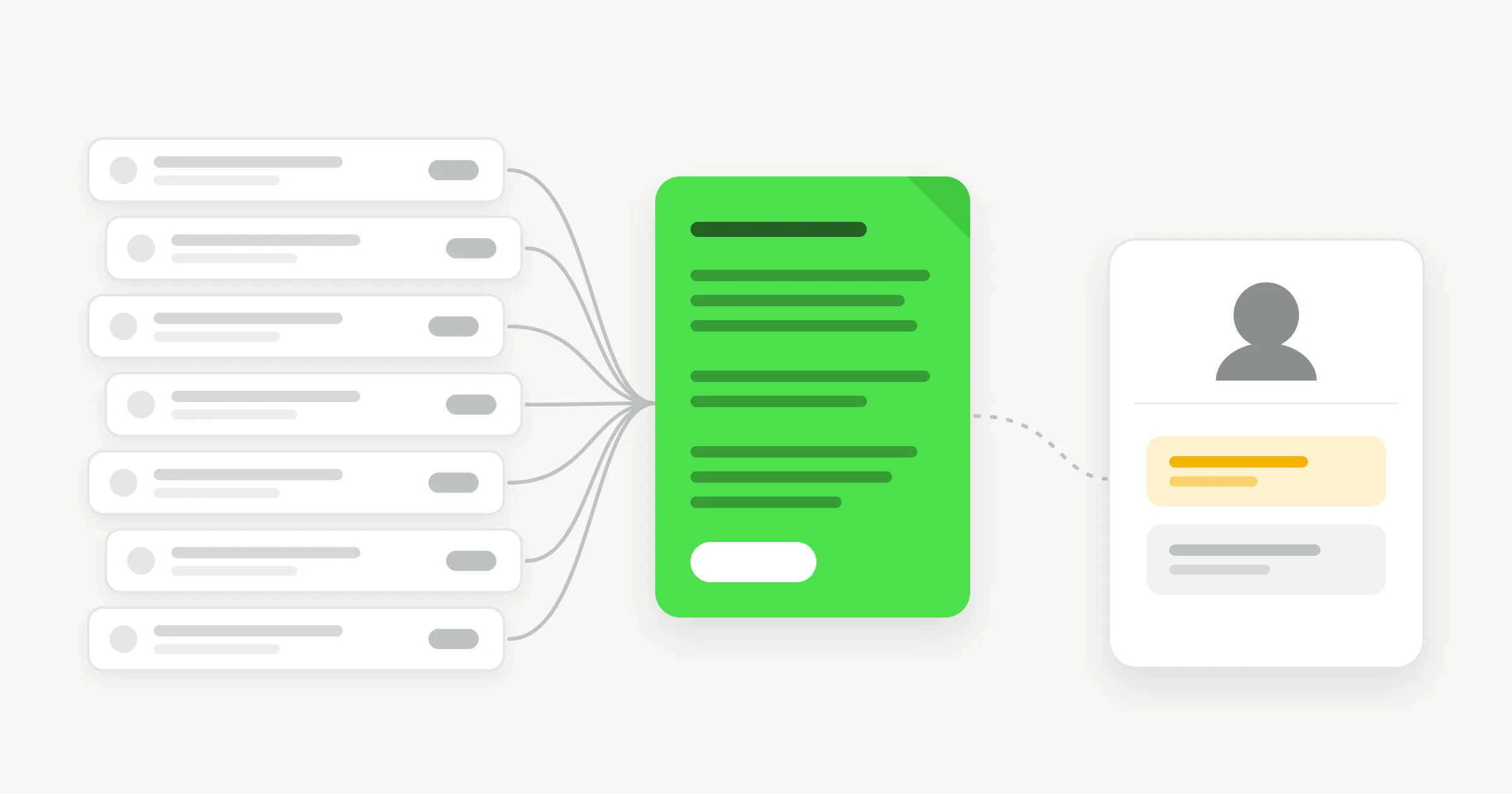
TL;DR: AI chatbots can handle a significant share of routine student inquiries automatically, reducing repetitive administrative workload and improving response times. Educational institutions implementing AI for admissions, registration, and student support can see returns through staff time savings and improved enrollment conversion. Typical results vary based on institution size and implementation quality.
How AI Chatbots Reduce Admin Workload in Education
Educational administrators spend significant time answering repetitive questions — AI chatbots can handle a large share of student inquiries instantly, freeing staff for higher-value work. Institutions implementing AI chatbots typically report measurable reductions in administrative workload and improvements in student satisfaction (typical results vary).
This guide explores how educational institutions leverage AI chatbots to automate admissions, student support, and administrative processes, with illustrative implementation examples and what to measure.
The Administrative Burden in Education
Current Challenges
Time-Intensive Administrative Tasks
- Admissions Inquiries: Course requirements, application deadlines, fee structures
- Student Support: Registration questions, schedule changes, financial aid queries
- Academic Advising: Program information, prerequisite checking, career guidance
- Administrative Services: Transcript requests, document verification, facility bookings
Resource Constraints
- Limited Staff: High student-to-administrator ratios
- Operating Hours: 9-5 availability vs 24/7 student needs
- Seasonal Peaks: Admission season overload, semester start/end rushes
- Response Times: Multi-hour delays for non-urgent queries
Quality Issues
- Inconsistent Information: Different responses from different staff
- After-Hours Gaps: No support during evenings and weekends
- Language Barriers: International students and diverse populations
- Manual Processes: Repetitive data entry and verification tasks
Education Administrative Challenge
A significant portion of administrative time in educational institutions is consumed by repetitive student inquiries — questions about deadlines, fees, registration, and program requirements that could be handled automatically.
How AI Chatbots Transform Education Administration
Automation of Repetitive Tasks
1. Admissions Inquiry Handling
Challenge: Thousands of prospective students asking similar questions about programs, requirements, and deadlines.
AI Solution: 24/7 automated responses with accurate, up-to-date information.
// AI chatbot handling admissions queries
const admissionsBot = {
  queries: {
    program_requirements: "What are the requirements for Computer Science?",
    application_deadlines: "When is the deadline for fall admission?",
    fee_structure: "How much are the tuition fees?",
    scholarship_info: "What scholarships are available?"
  },

  responses: {
    // Pre-programmed with accurate, current information
    program_requirements: "For Computer Science: high school diploma with calculus, minimum 3.0 GPA. SAT/ACT optional.",
    application_deadlines: "Fall 2025 admission deadline: March 31, 2025. Spring 2025: October 31, 2024.",
    fee_structure: "Annual tuition: $32,000. Additional fees: $1,500. Scholarships available up to 50%.",
    scholarship_info: "Merit scholarships: 25-50% based on entrance exam scores. Need-based aid available."
  }
};
Impact: Most routine admissions inquiries handled automatically, freeing staff for qualification-focused conversations.
2. Student Registration Support
Challenge: Students needing help with course registration, schedule conflicts, and prerequisite checks.
AI Solution: Course and registration assistance from your published catalog. Checking an individual student's record needs a connection to your own systems (Actions on Pro and Max call your API) or a hand-off to staff.
// Course registration automation
const registrationBot = {
  studentProfile: {
    major: "Computer Science",
    completedCourses: ["CS101", "MATH201", "PHYS101"],
    gpa: 3.8,
    graduationRequirement: "128 credits"
  },

  recommendCourses: function() {
    // AI analyzes student profile and recommends optimal courses
    const recommendations = [
      {
        course: "CS301 - Advanced Algorithms",
        reason: "Prerequisite satisfied, aligns with CS major",
        schedule: "MWF 10:00-11:30",
        seats: "15 available"
      },
      {
        course: "CS351 - Database Systems",
        reason: "Required for CS degree, schedule compatible",
        schedule: "TTH 2:00-3:30",
        seats: "8 available"
      }
    ];
    return recommendations;
  },

  checkConflicts: function(selectedCourses) {
    // AI detects scheduling conflicts and prerequisite issues
    return {
      conflicts: [],
      prerequisites: ["All satisfied"],
      recommendations: ["Consider CS301 before CS401"]
    };
  }
};
Impact: Fewer registration-related administrative inquiries reaching staff.
Intelligent Query Routing
Smart Query Classification
Challenge: Determining which inquiries need human attention vs automated responses.
AI Solution: Intelligent classification and escalation based on complexity and urgency.
// Intelligent query routing
const queryRouter = {
  classifyQuery: function(query) {
    const complexity = analyzeComplexity(query);
    const urgency = assessUrgency(query);
    const category = classifyCategory(query);

    if (complexity === 'simple' && urgency === 'low') {
      return { action: 'auto_respond', confidence: 0.95 };
    } else if (complexity === 'medium') {
      return { action: 'provide_options', confidence: 0.85 };
    } else {
      return {
        action: 'escalate',
        department: routeToDepartment(category),
        priority: urgency === 'high' ? 'urgent' : 'normal'
      };
    }
  },

  routeToDepartment: function(category) {
    const routing = {
      admissions: 'Admissions Office',
      financial_aid: 'Financial Aid Office',
      academic_advising: 'Academic Advising Center',
      technical_issues: 'IT Support',
      facilities: 'Facilities Management'
    };
    return routing[category] || 'General Inquiry';
  }
};
Impact: Routine queries resolved without human intervention, with intelligent routing for complex cases.
Multi-Language Support for Diverse Students
Challenge: International students and diverse populations needing support in multiple languages.
AI Solution: Automatic language detection and translation with culturally appropriate responses.
// Multi-language support system
const languageSupport = {
  detectLanguage: function(message) {
    // AI detects language and intent
    return {
      language: 'es', // Spanish detected
      intent: 'fee_structure',
      confidence: 0.92
    };
  },

  translateResponse: function(response, targetLanguage) {
    // AI translates while maintaining educational terminology accuracy
    const translations = {
      en: "Annual tuition fees are $32,000 for undergraduate programs.",
      es: "La matrícula anual es de $32,000 para los programas de pregrado.",
      zh: "本科课程的年度学费为32,000美元。"
    };
    return translations[targetLanguage] || response;
  },

  culturalAdaptation: function(response, culture) {
    // Adapts communication style for cultural preferences
    if (culture === 'formal') {
      return response.replace('Hi', 'Dear Student');
    }
    return response;
  }
};
Impact: International students answered in their own language, with less language-barrier administrative burden.
Automate Routine Student Inquiries
From admissions FAQs to registration support, Hyperleap AI handles routine questions 24/7 so your staff can focus on students who need personal attention.
See How It WorksIllustrative Implementation Scenarios
The following scenarios are illustrative examples showing how AI chatbots can reduce administrative workload in educational institutions. They are not based on specific named institutions. Actual results vary based on institution size, implementation quality, and existing processes.
Illustrative Example: State University System
Institution Profile:
- Large undergraduate population across a multi-campus system
- A central admissions and registrar team fielding thousands of monthly inquiries
Implementation:
- Platform: Hyperleap AI
- Channels: Website, WhatsApp
- Training Data: Policies, procedures, and course catalogs
- Rollout: Admissions first, then registration and financial aid questions
What changes:
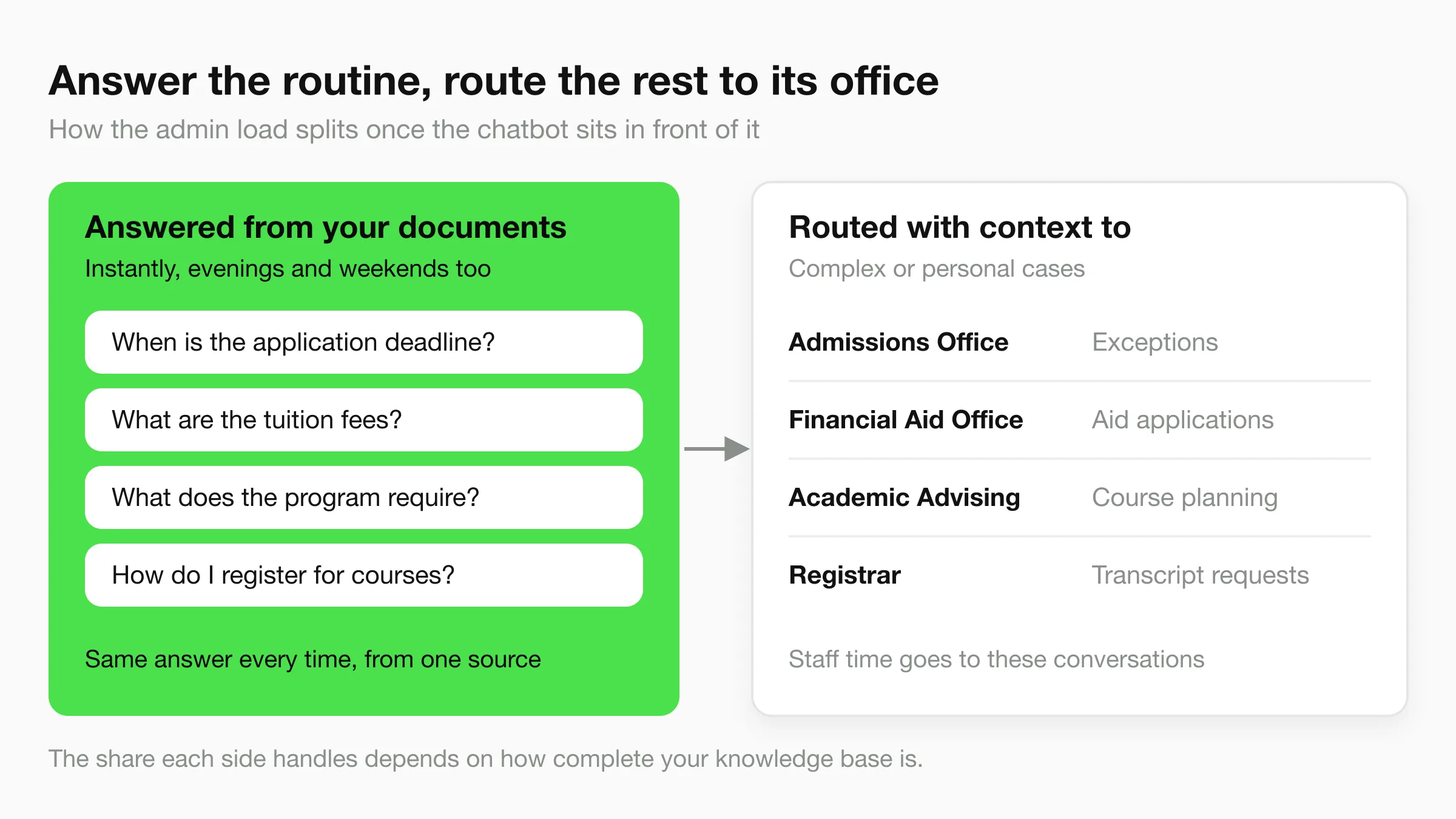
- Routine questions about deadlines, fees, and requirements get answered in seconds, including evenings and weekends
- Staff handle the personal and complex cases the AI routes to them, instead of the same FAQ for the hundredth time
- Students get the same answer on every channel, drawn from the official documents
Illustrative Example: International Business School
Institution Profile:
- MBA and executive education programs with a large international cohort
- A small administrative team
Implementation:
- Platform: Hyperleap AI
- Channels: Website, WhatsApp, Facebook Messenger
- Special Features: Executive program inquiries, international student support in the student's own language
What changes:
- Executive program inquiries are answered and qualified at any hour, then passed to admissions with the details captured
- International applicants get answers to visa-letter, fee, and deadline questions in their language
- The admissions team spends its time on qualified applicants rather than first-contact FAQs
Illustrative Example: Community College Network
Institution Profile:
- Several campuses with limited administrative resources
- Diverse student population including working adults
- High volume of basic inquiries
Implementation:
- Platform: Hyperleap AI
- Channels: Website, WhatsApp
- Focus: High-volume, low-complexity inquiries
What changes:
- Working adults get answers about registration, financial aid basics, and program information outside office hours
- Campus staff see fewer repeat questions and more of the cases that need a person
- Every campus answers from the same up-to-date knowledge base
Implementation Framework for Educational Institutions
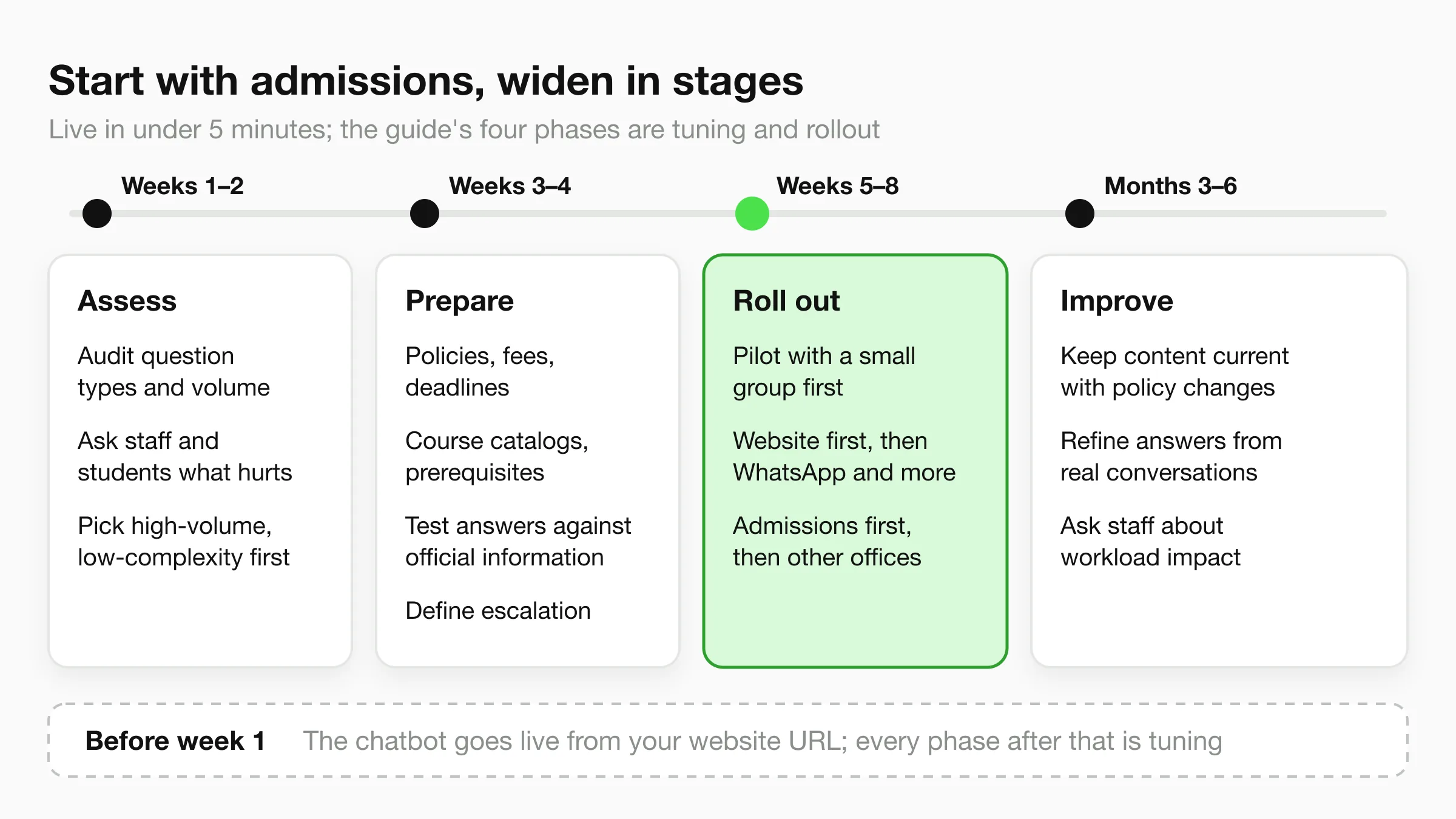
The chatbot itself is live in under 5 minutes from your website URL. The phases below are the tuning and rollout work an institution does around it.
Phase 1: Assessment and Planning (Weeks 1-2)
Current State Analysis
- Inquiry Audit: Track types and volumes of student/administrative questions
- Pain Point Identification: Survey staff and students on biggest challenges
- Resource Assessment: Evaluate current staff bandwidth and technology
- ROI Modeling: Calculate potential time and cost savings
Use Case Prioritization
- High-Volume, Low-Complexity: FAQ responses, basic information requests
- Repetitive Tasks: Registration assistance, document requests
- After-Hours Coverage: Evening and weekend inquiries
- Multi-Language Support: International student assistance
Phase 2: Content Preparation and Training (Weeks 3-4)
Knowledge Base Development
- Policy Documentation: Admissions policies, academic regulations, fee structures
- Course Catalogs: Program requirements, course descriptions, prerequisites
- Administrative Procedures: Registration processes, financial aid applications
- Student Resources: Campus services, support contacts, emergency procedures
AI Training and Testing
- Conversation Flow Design: Map out common inquiry patterns
- Response Accuracy Testing: Validate AI responses against official information
- Edge Case Handling: Plan for complex or unusual inquiries
- Escalation Protocols: Define when to route to human staff
Phase 3: Deployment and Optimization (Weeks 5-8)
Phased Rollout
- Pilot Testing: Deploy to limited user groups for feedback
- Channel-by-Channel: Start with website, then add WhatsApp and other channels
- Department-by-Department: Begin with high-volume areas like admissions
- Full Implementation: Expand to all student touchpoints
Performance Monitoring
- Accuracy Tracking: Monitor response correctness and user satisfaction
- Usage Analytics: Track query volumes, resolution rates, and peak times
- Staff Feedback: Regular check-ins on workload impact
- Student Surveys: Gather feedback on response quality and speed
Phase 4: Scaling and Enhancement (Months 3-6)
Advanced Features Implementation
- SIS integration requirements to evaluate: Connecting to your Student Information System through your own API (Actions on Pro and Max) or a technical partner
- Personalized Responses: Student-specific information, once that connection exists
- Predictive Support: Anticipate common questions during peak periods
- Advanced Analytics: Deep insights into student behavior and needs
Continuous Improvement
- Content Updates: Keep information current with policy changes
- Performance Optimization: Refine responses based on usage data
- Feature Expansion: Add capabilities based on user needs
- ROI Measurement: Track and report on business impact
ROI Analysis for Educational AI Chatbots
Cost-Benefit Calculation Framework
Implementation Costs
- Platform: Hyperleap AI plans are $40 (Plus), $100 (Pro), or $200 (Max) per month
- Setup: Live in under 5 minutes; Managed Setup is
$299Free if you want Hyperleap to build it - Content Development: Staff time to gather and review your knowledge base
- Integration: Any custom connection to your own systems, if you need one
Operational Savings
- Administrative Time: Hours per week staff no longer spend on repeat questions
- Staff Costs: Your average administrative hourly cost
- Seasonal Peaks: Less overtime during admissions and semester-start rushes
Revenue Impact
- Enrollment: Prospective students answered while they are still deciding
- Student Retention: Faster answers to the questions that cause friction
- International Enrollment: Applicants answered in their own language
Sample ROI Calculation
Multiply the routine questions your team answers each month by the minutes each one takes, convert that to staff hours at your hourly cost, and compare it with the platform cost. Count enrollment and retention gains only if you can measure them; staff time alone is usually the clearest case (typical results vary).
Give Administrators Their Hours Back
See how Hyperleap AI handles routine questions for admissions, registration, and student support, and what it costs for your institution.
View Pricing"Education is one of the most inquiry-intensive industries we work with. During admissions season, a single institution can receive thousands of identical questions about deadlines and fees. AI doesn't just answer faster -- it answers consistently, which builds trust with parents and students alike," says Gopi Krishna Lakkepuram, Founder & CEO of Hyperleap AI and former Microsoft engineer.
Best Practices for Educational AI Implementation
Content Management
- Centralized Knowledge Base: Single source of truth for all information
- Regular Updates: Monthly review and update of policies and procedures
- Version Control: Track changes and maintain audit trails
- Quality Assurance: Regular review of AI responses for accuracy
User Experience Design
- Intuitive Interactions: Natural conversation flows for students
- Clear Escalation Paths: Easy access to human support when needed
- Multi-Channel Consistency: Same information across all channels
- Accessibility Compliance: WCAG 2.1 AA compliance for all users
Staff Training and Adoption
- Change Management: Clear communication about AI role (assistant, not replacement)
- Training Programs: Comprehensive training on chatbot capabilities and limitations
- Feedback Loops: Regular staff input on performance and improvements
- Success Metrics: Shared dashboards showing workload reduction benefits
Compliance and Security
- FERPA Compliance: Secure handling of student records and personal information
- Data Privacy: GDPR compliance for international students
- Audit Trails: Complete logging of all interactions for compliance
- Access Controls: Role-based permissions for different user types
Future Trends in Educational AI
Emerging Capabilities
- Predictive Advising: AI anticipating student needs and providing proactive support
- Personalized Learning: Adaptive content delivery based on student performance
- Voice Interfaces: Natural voice interactions for hands-free support
- Virtual Advisors: AI-powered academic and career counseling
- Automated Assessment: Intelligent grading and feedback systems
Technology Evolution
- Multi-Modal Learning: Combining text, voice, and visual learning experiences
- Blockchain Credentials: AI-powered verification of educational achievements
- AR/VR Integration: Immersive virtual campus tours and learning experiences
- IoT Integration: Smart campus infrastructure with AI optimization
Further Reading
Authoritative external sources used and recommended for further research on this topic:
Reduce Administrative Workload
Hyperleap AI answers routine student inquiries 24/7 from your own documents, so staff can focus on the students who need them.
Try for FreeConclusion
AI chatbots are revolutionizing educational administration by automating repetitive tasks, providing 24/7 support, and enabling institutions to scale their services without proportional increases in administrative costs.
Key Benefits Achieved (typical results vary):
- Significant reduction in administrative workload — staff freed from repetitive FAQ handling
- High share of inquiries resolved automatically (proportion depends on knowledge base quality)
- Improved staff productivity — focus shifts to complex, high-value student interactions
- Improved student satisfaction — faster responses and 24/7 availability
- Returns through staff time savings and improved enrollment
Implementation Success Factors:
- Comprehensive knowledge base with accurate, current information
- Intelligent escalation for complex queries requiring human judgment
- Multi-channel support meeting students where they communicate
- Continuous optimization based on usage data and user feedback
- Staff training ensuring smooth adoption and collaboration
The educational institutions that embrace AI chatbots now will provide superior student experiences while achieving significant operational efficiencies. The technology is mature and the implementation barriers have never been lower.
Ready to reduce your administrative workload? Contact our education specialists for a customized implementation plan tailored to your institution's needs.
Keep exploring
- AI agents for schools and universities - Automate admissions and student support
- Conversational AI for customer service - Handle enrollment questions 24/7 across channels
Education Resources
- Best AI Chatbots for Schools & Universities 2026 - Platform comparison
- AI Chatbot Statistics 2026 - Industry benchmarks
- How to Choose an AI Chatbot Platform - Selection guide
- Getting Started with AI Agents - Implementation guide
Related Comparisons
- Best No-Code Chatbot Builders 2026 - No-code platforms
- Best Multi-Channel Chatbots 2026 - Omnichannel solutions
- Best WhatsApp Automation Tools 2026 - WhatsApp for education
Frequently Asked Questions
How much do AI chatbots cost for schools and universities?
Hyperleap AI plans are $40/month (Plus), $100/month (Pro), or $200/month (Max), with a 7-day free trial (credit card required). To compare that against the cost of additional administrative staff, multiply the routine questions your team answers each month by the minutes each one takes, and weigh those staff hours against the platform cost (our ROI calculator does the arithmetic). The return depends mostly on your inquiry volume and how much of it your content can answer.
How long does it take to implement an AI chatbot in an educational institution?
With Hyperleap AI, a chatbot is live in under 5 minutes from your website URL. Adding catalogs and policies, writing guardrails, and testing admissions, enrollment, and financial aid answers is tuning you do afterwards. A connection to your student information system is a separate integration requirement to evaluate.
How does an AI chatbot protect student data privacy?
Ask each vendor how it handles student data and check it against your own FERPA and GDPR obligations. Hyperleap AI is GDPR compliant, hosted on Microsoft Azure, encrypts data in transit (TLS 1.3) and at rest (AES-256), and uses role-based permissions; it does not hold third-party certifications such as SOC 2. Keep student records in your own systems and configure the chatbot to capture only what an inquiry needs.
Which administrative tasks can AI chatbots automate in education?
AI chatbots can automate repetitive tasks including admissions FAQs, fee and deadline questions, class scheduling queries, and document requirement questions, which together make up a large share of routine admin work. They can also handle after-hours inquiries, which represent a significant portion of student questions that would otherwise go unanswered until the next business day.
What ROI can educational institutions expect from AI chatbots?
Returns depend on your inquiry volume and how much of it your content can answer (typical results vary). The clearest gains are staff hours no longer spent on repeat questions and faster answers for students; enrollment and retention gains are worth tracking, but measure them before counting them.
Glossary
- What is a Chatbot? - Chatbot fundamentals
- WhatsApp Business API - Popular education channel
- OTP Validation - Verified lead capture
Can the chatbot answer questions about specific courses or programs?
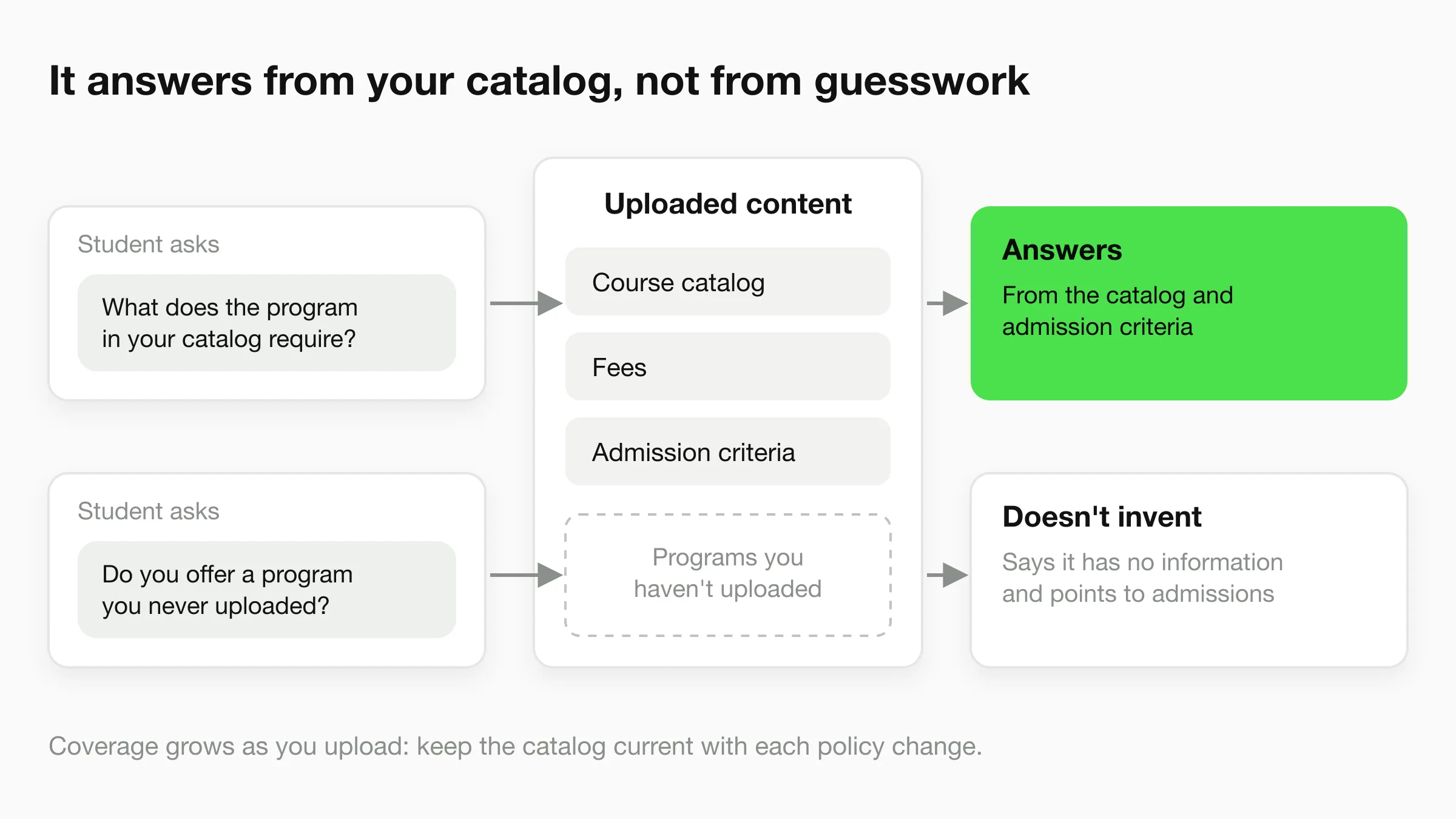
Yes — when your course catalog, fees, and admission criteria are uploaded as knowledge base content, the bot answers from that content. It does not invent answers about programs that are not in your knowledge base.
Does it handle admissions in multiple languages?
Yes. Hyperleap supports 100+ languages so admissions inquiries from international students get answered in their language. The same deployment serves English, Spanish, Mandarin, Arabic, Hindi, and dozens more.
How long does it take to set up an AI chatbot with Hyperleap?
Self-serve setup is live in under 5 minutes; adding your documents, guardrails and testing is tuning you do afterwards. With Managed Setup ($299 Free, available on every plan), Hyperleap builds the bot for you on your content and channels. A 7-day free trial is included on every plan.
Industry Solutions
See how AI chatbots work for these industries:
Related Articles
View all
Case Study9 min read
Campinground Case Study: 108% More Direct Bookings
How a glamping and events venue used a WhatsApp-native AI agent to lift direct bookings 108% and capture 95% of weekend inquiries, per disclosed results.
Case Study9 min read
Mysuru Zoo Case Study: 6x Visitor Queries Handled
How a government wildlife park used an AI assistant to handle 6x more visitor queries in five languages, plan visit routes, and share conservation content.
Case Study10 min read
Ridhira Group Case Study: 7.5x Queries Handled with AI
How Ridhira Group scaled to 7.5x more customer queries and a 92% improvement in booking conversions with a 24/7 AI concierge, per disclosed results.
Guide20 min read
AI Admissions Assistant: What Works for Schools in 2026
Learn how K-12 schools use AI to handle the admission-season inquiry surge, answer parents 24/7, and give admissions teams time back for tours and counseling.