Automate Property Inquiry Follow-ups Personally
A step-by-step guide to automating property inquiry responses and follow-ups while keeping the personal connection that closes deals.

TL;DR: 78% of buyers work with the first agent who responds, yet 44% of agents give up after just one follow-up. Automating property inquiry follow-ups lets agents respond instantly to every lead, maintain consistent follow-up sequences, and focus their personal attention on the high-value interactions that actually close deals. This guide walks you through seven steps to build a follow-up system that is both automated and genuinely personal.
How to Automate Property Inquiry Follow-ups Without Losing the Personal Touch
Picture this: A couple browses listings on a Sunday evening. They find a property that checks every box---great neighborhood, right price, enough bedrooms for the kids. They fill out an inquiry form at 9:47 PM. By Monday morning, they have already scheduled a showing with a different agent who responded within three minutes.
This scenario plays out thousands of times every day. According to the National Association of Realtors, 78% of homebuyers end up working with the first agent who responds to their inquiry (Source: NAR 2025 Home Buyers and Sellers Generational Trends Report). Research from InsideSales.com shows that responding within 5 minutes makes you 21x more likely to qualify a lead compared to waiting just 30 minutes.
Yet most real estate professionals still rely on manual follow-up processes that guarantee slow responses, inconsistent communication, and lost opportunities. The gap between what buyers expect and what agents deliver is where deals go to die.
The good news: you can close this gap without turning into a robot. The key is building an automated follow-up system that handles the speed and consistency while preserving the personal connection that ultimately closes deals.
What Are Automated Property Inquiry Follow-ups?
Automated property inquiry follow-ups are technology-driven systems that respond to and nurture real estate leads without requiring manual intervention at every step. They use a combination of AI chatbots, email sequences, messaging platforms, and CRM workflows to ensure every inquiry receives a fast, relevant, and helpful response.
But here is the critical distinction: automation handles the timing and logistics; personalization handles the relationship. The best automated follow-up systems are not about replacing the agent---they are about making sure no lead falls through the cracks while the agent focuses on high-value conversations.
How automated follow-ups work in real estate
A modern automated follow-up system operates across multiple stages:
-
Instant acknowledgment: The moment an inquiry arrives---whether from a website form, WhatsApp message, or social media DM---the system responds within seconds with a personalized greeting and relevant property information.
-
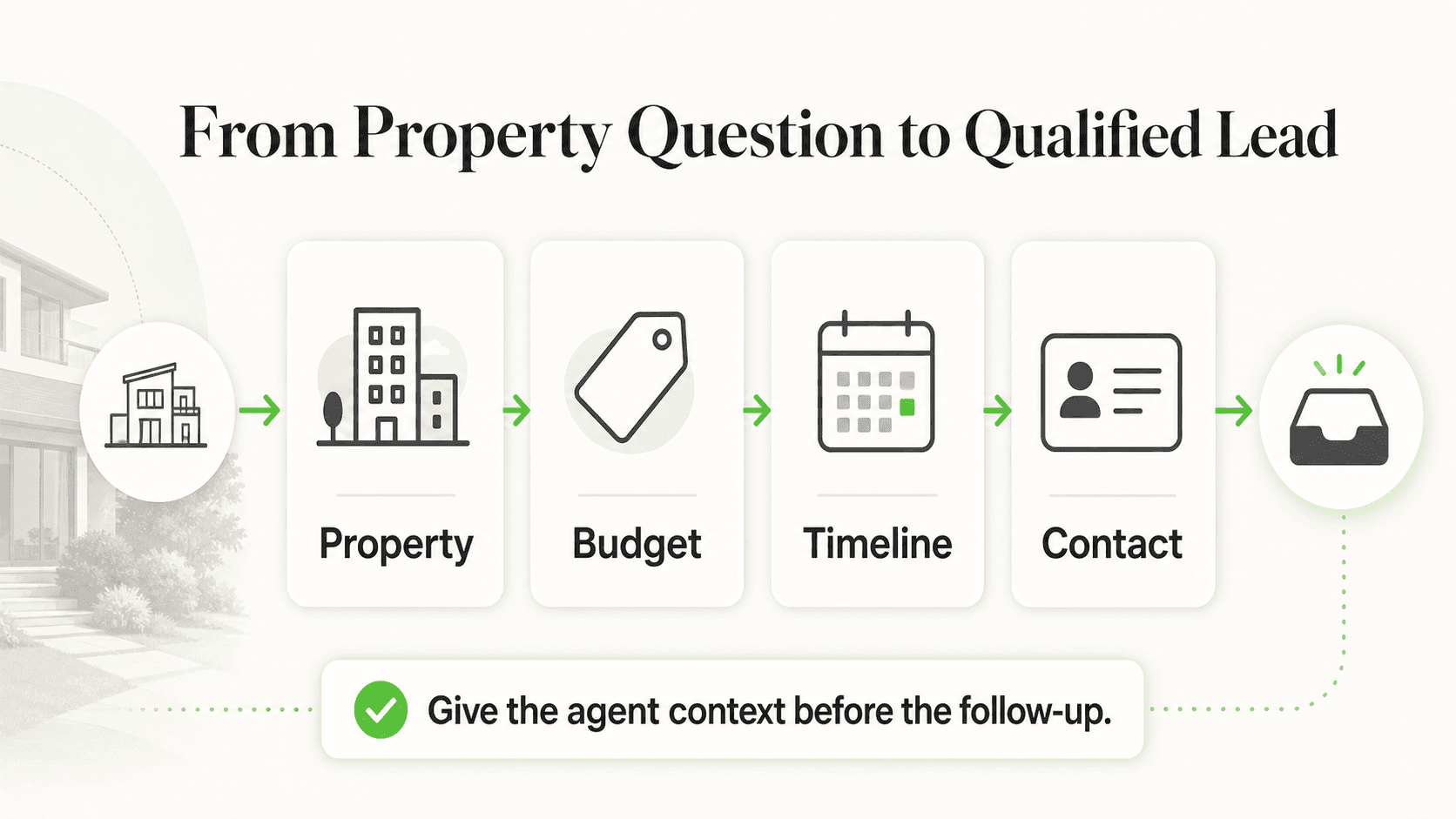
Qualification: The system asks targeted questions to understand the prospect's timeline, budget, property preferences, and motivation level.
-
Information delivery: Based on the prospect's responses, the system shares relevant listings, virtual tours, neighborhood guides, and market data.
-
Appointment scheduling: Qualified leads are offered available viewing times and connected directly with an agent's calendar.
-
Nurture sequences: Prospects who are not ready to act immediately receive a series of timed follow-ups with relevant content, market updates, and new listings that match their criteria.
-
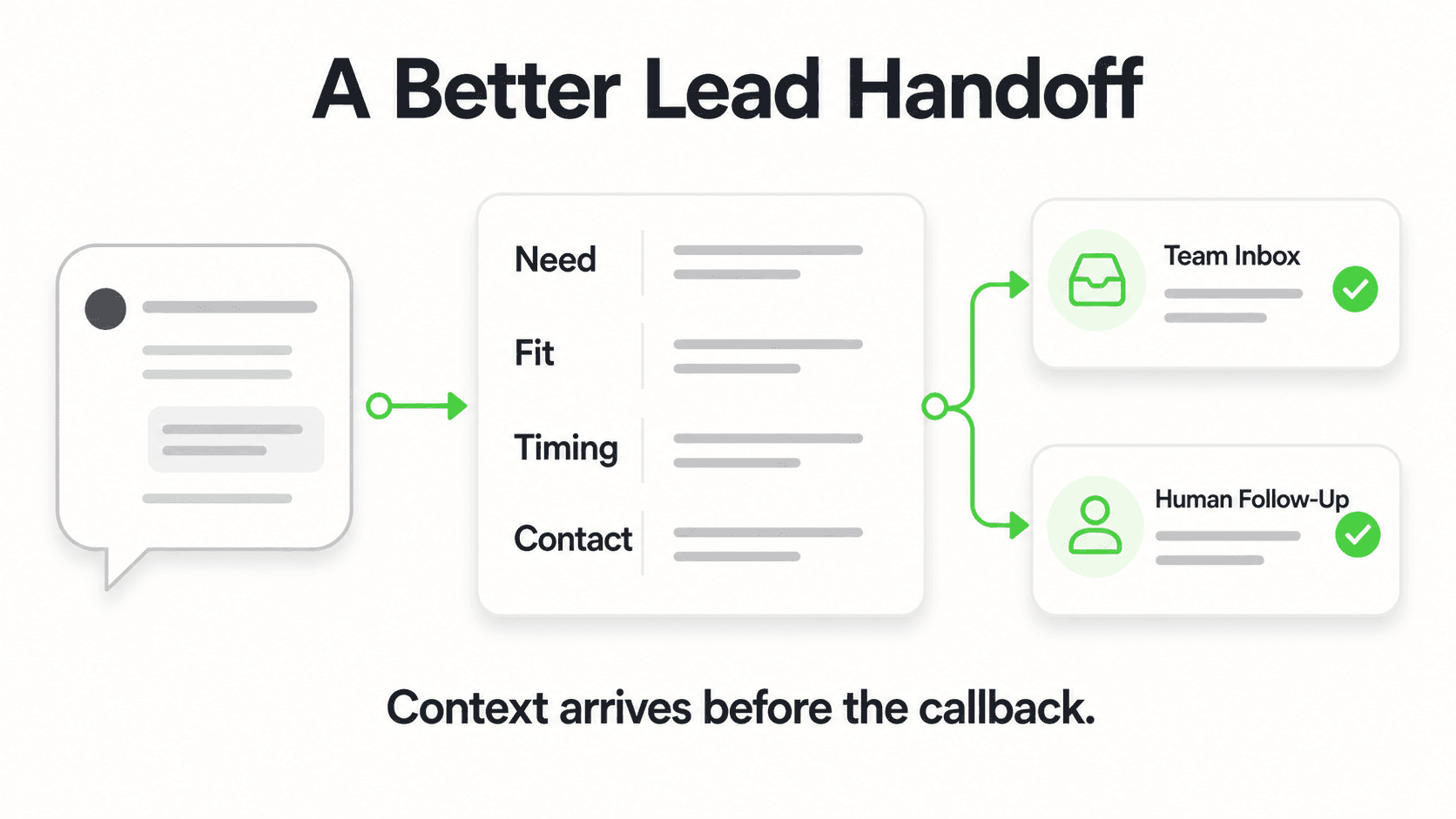
Human handoff: When a prospect signals high intent or asks complex questions, the system transfers the conversation to a human agent with full context of the interaction so far.
Speed vs. Personal Touch
The goal of automation is not to eliminate personal interaction---it is to ensure that personal interaction happens at the right moment, with the right context, and without delay. Agents who automate routine follow-ups consistently report spending more time on face-to-face client interactions that actually close deals.
Why Manual Follow-ups Are Failing Real Estate Professionals
Before diving into the solution, it is worth understanding exactly why manual follow-up processes create such significant revenue leakage in real estate.
The response time gap
Research consistently shows that leads contacted within 5 minutes are 21x more likely to convert than leads contacted after 30 minutes (Source: Lead Connect / InsideSales.com). Yet the average real estate professional takes 4-24 hours to respond to a new inquiry, and many never respond to after-hours inquiries at all.
Consider the math: many real estate inquiries arrive outside business hours---evenings when buyers are browsing after work, weekends when they are house-hunting, late nights when they are researching---and a team that only responds during 9-to-5 is systematically ignoring its most active prospects. In Hyperleap's deployment with Jungle Lodges & Resorts, 35% of all chatbot inquiries arrived after business hours.
78%
Buyers Work With First Responder
44%
Agents Quit After One Follow-up
21x
Conversion Lift With 5-Min Response
The follow-up persistence problem
Even when agents respond promptly to the initial inquiry, follow-up persistence is dismal. Industry data shows that 80% of sales require five or more follow-up contacts after the initial inquiry, but 44% of agents give up after just one follow-up (Source: National Association of Realtors). Research consistently shows that leads who receive multiple contact attempts over time convert at meaningfully higher rates than those who receive only one or two touches.
The reason is straightforward: most real estate professionals are juggling active transactions, showings, open houses, paperwork, and prospecting simultaneously. Following up consistently with every lead---especially the ones that do not respond immediately---is the first task to slip.
Channel fragmentation
Today's buyers reach out through website forms, WhatsApp, Instagram DMs, Facebook Messenger, phone calls, and email. Without a unified system, agents struggle to track which leads came from which channel, what was said, and when the last contact occurred. Leads inevitably fall through the cracks.
The personalization paradox
Here is the real tension: buyers want instant responses and personal attention. They want to feel like they are talking to someone who understands their needs, not receiving a generic template. Manual processes cannot deliver both speed and personalization at scale. Automation can---if implemented thoughtfully.
Respond to Every Inquiry in Seconds
Hyperleap AI captures property inquiries 24/7, qualifies leads automatically, and routes hot prospects to your agents with full context.
See How It Works7 Steps to Automate Property Inquiry Follow-ups
Here is a practical, step-by-step framework for building an automated follow-up system that is fast, consistent, and---crucially---still personal.
Step 1: Audit your current follow-up workflow
Before automating anything, you need a clear picture of your existing process. Spend one week documenting:
- Response times: How long does it take to respond to inquiries from each channel? Track website forms, phone calls, WhatsApp messages, and social media DMs separately.
- Follow-up frequency: How many times do you follow up with each lead? When do you stop?
- Conversion funnel: What percentage of inquiries become showings? What percentage of showings become offers? Where is the biggest drop-off?
- Channel distribution: Where are your leads actually coming from? You might be surprised.
- After-hours volume: What percentage of inquiries arrive when your team is unavailable?
This audit reveals your specific pain points. One brokerage might discover that 80% of website leads never receive a second follow-up. Another might find that WhatsApp inquiries convert 3x better than email but take twice as long to respond to.
Action item: Create a simple spreadsheet tracking every inquiry for one week. Log the channel, time received, time responded, number of follow-ups, and outcome.
Step 2: Separate what should be automated from what should stay personal
Not every interaction should be automated. The key is drawing a clear line:
Automate these interactions:
- Initial inquiry acknowledgment (within seconds)
- Property information delivery (specs, photos, virtual tours)
- Basic qualification questions (budget, timeline, preferred areas)
- Appointment scheduling and confirmations
- Showing reminders and pre-showing information packets
- Market update emails and new listing alerts
- Re-engagement messages for dormant leads
- Post-showing follow-up surveys
Keep these personal:
- Detailed property consultations and advice
- Price negotiations and offer discussions
- Addressing specific concerns or objections
- Relationship-building conversations with qualified prospects
- Complex buyer needs (relocation, investment strategy, first-time buyers needing guidance)
- Sensitive situations (divorce sales, estate sales, financial difficulties)
The rule of thumb: automate the informational, personalize the relational. If an interaction is primarily about delivering data or logistics, automate it. If it requires empathy, judgment, or negotiation, keep a human in the loop.
The 80/20 Rule of Real Estate Follow-ups
In most real estate operations, roughly 80% of follow-up messages are informational (property details, scheduling, reminders) and only 20% require genuine personal interaction. Automating that 80% frees your agents to be fully present for the 20% that matters most.
Step 3: Choose the right technology stack
Your automation technology needs to handle three core capabilities: instant response, multi-channel communication, and CRM integration. Here is what to look for:
AI chatbot / conversational AI
- Responds instantly to inquiries on your website, WhatsApp, Instagram, and Facebook
- Understands natural language (not just rigid keyword matching)
- Answers property-specific questions from your knowledge base
- Qualifies leads through conversational question flows
- Hands off to a human agent when needed, with full conversation context
Email automation platform
- Drip campaign capability for long-term nurture sequences
- Dynamic content insertion (property names, neighborhoods, price ranges)
- Behavioral triggers (opens, clicks, website visits)
- A/B testing for subject lines and content
Scheduling integration
- Direct calendar booking for showings and consultations
- Automatic confirmation and reminder messages
- Buffer time between appointments
- Team member availability and routing
CRM with automation workflows
- Lead source tracking and attribution
- Automated task creation for agents
- Pipeline stage management
- Activity logging across all channels
Platforms like Hyperleap AI combine the AI chatbot, multi-channel messaging, and lead qualification into a single system that integrates with your existing CRM---reducing the number of tools you need to manage and ensuring nothing falls through the cracks between systems.
Step 4: Design your inquiry response flow
The first 5 minutes after an inquiry determines whether you capture or lose a lead. Here is a proven response flow:
Seconds 0-10: Instant acknowledgment The prospect receives a personalized greeting that references the specific property or search criteria they inquired about. This is not a generic "Thanks for reaching out"---it demonstrates that their inquiry was received and understood.
Example: "Hi Sarah! Thanks for your interest in the 3-bedroom home at 142 Oak Street. I have all the details on this property and can help you schedule a viewing. Would you like to know more about the layout, the neighborhood, or available viewing times?"
Minutes 1-3: Qualification questions If the prospect engages, the system asks 2-3 targeted questions to understand their needs:
- "Are you looking to buy or rent?"
- "What is your ideal timeline for moving?"
- "Have you been pre-approved for a mortgage, or would you like a lender recommendation?"
Minutes 3-5: Information delivery Based on their responses, the system provides relevant information: additional photos, a virtual tour link, neighborhood stats, or similar listings that match their criteria.
Minutes 5-10: Appointment offer For qualified leads, the system offers to schedule a showing or consultation: "I would love to arrange a private showing for you. Our agent [Agent Name] has availability this Saturday at 10 AM or 2 PM. Which works better for you?"
Human handoff trigger If the prospect asks complex questions, expresses concerns, or shows high purchase intent, the system notifies the assigned agent immediately and provides a complete summary of the conversation.
Step 5: Set up multi-channel follow-up sequences
Different prospects prefer different channels, and the most effective follow-up uses multiple touchpoints. Here is a multi-channel sequence framework for a prospect who inquired but did not schedule a showing:
Day 0 (Inquiry day):
- Instant AI response on the inquiry channel (WhatsApp, web chat, etc.)
- Follow-up email with property details and virtual tour link
Day 1:
- WhatsApp message with one additional similar listing: "Based on your interest in 142 Oak Street, you might also like this similar property at 88 Elm Avenue"
Day 3:
- Email with neighborhood guide or market insights for their target area
Day 5:
- WhatsApp or web chat message: "Hi Sarah, just wanted to check---did you have any questions about the Oak Street property? Happy to arrange a private viewing at a time that works for you."
Day 7:
- Email with a "Weekly picks" curated list based on their preferences
Day 14:
- Personal phone call or video message from the agent (this is the human touch moment)
Day 21:
- Email with market update: "Prices in [neighborhood] moved X% this month---here is what it means for buyers like you."
Day 30+:
- Monthly market updates and new listing alerts until they unsubscribe, buy, or re-engage
Channel Compliance
Always respect prospect channel preferences and obtain proper consent before messaging on WhatsApp or other platforms. Different regions have varying regulations around commercial messaging---ensure your sequences comply with local rules and platform terms of service.
Step 6: Integrate with your CRM
Automation without CRM integration creates data silos that undermine the entire system. Your follow-up automation must sync bidirectionally with your CRM so that:
- Every interaction is logged: When the AI chatbot qualifies a lead, the CRM records the conversation, qualification data, and lead score.
- Agent context is complete: When an agent picks up a conversation, they see the full history---initial inquiry, questions asked, properties viewed, appointment attempts---without asking the prospect to repeat themselves.
- Pipeline stages update automatically: A lead that books a showing moves from "New" to "Showing Scheduled" without manual data entry.
- Tasks are assigned intelligently: High-scoring leads trigger immediate agent notifications. Lower-priority leads enter nurture sequences automatically.
Common real estate CRMs to evaluate:
| CRM | Key Strength | What to Look For |
|---|---|---|
| Follow Up Boss | Speed-to-lead routing | API access for third-party connections |
| kvCORE (BoldTrail) | All-in-one brokerage platform | Webhook support for lead ingestion |
| LionDesk | Affordability for solo agents | Open API for custom integrations |
| Chime (Lofty) | AI-powered lead scoring | REST API for bi-directional data sync |
| Salesforce | Enterprise customization | Real estate-specific configuration options |
When evaluating which CRM to pair with your AI chatbot, prioritize platforms with open REST APIs and webhook support — these enable your chatbot and CRM to exchange lead data without manual entry.
The goal is a closed-loop system where every touchpoint---from the first automated response to the final handshake at closing---is tracked, measured, and optimized.
For teams using Hyperleap AI, integration with your existing CRM happens via REST API and webhooks, ensuring lead data flows seamlessly between your AI chatbot and your brokerage's system of record.
Step 7: Measure, optimize, and iterate
Automation is not set-and-forget. The best follow-up systems improve continuously based on data. Track these metrics weekly:
Response metrics:
- Average response time by channel
- Percentage of inquiries receiving a response within 5 minutes
- After-hours response rate (should be 100% with automation)
Engagement metrics:
- Reply rate to automated messages (aim for 30-40% on WhatsApp, 15-20% on email)
- Qualification completion rate (percentage of leads that answer all qualification questions)
- Drop-off points in the conversation flow (where are prospects disengaging?)
Conversion metrics:
- Inquiry-to-showing conversion rate
- Showing-to-offer conversion rate
- Lead source ROI (cost per acquired client by channel)
- Speed-to-appointment (time from inquiry to scheduled showing)
Satisfaction metrics:
- Client feedback on initial interaction experience
- Agent satisfaction with lead quality and context
- Handoff smoothness (are agents receiving sufficient context?)
20-30%
Conversion Rate Improvement (Follow Up Boss)
100%
After-Hours Response Rate
21x
Conversion Lift With 5-Min Response (InsideSales)
Review your data monthly and adjust. If WhatsApp messages on Day 3 get low engagement, test a different message format or timing. If qualification questions cause high drop-off, simplify them. If agents report that automated handoffs lack context, enrich the summary the system provides.
What Results Can You Expect?
Real estate professionals who implement structured automated follow-up systems report significant improvements across key metrics. Based on industry research and platform benchmarks:
Response time transformation
The most immediate change is response time. Manual processes typically produce 4-24 hour average response times. Automated systems respond in under 60 seconds, 24 hours a day, 7 days a week. This alone captures leads that would have otherwise gone to faster-responding competitors.
According to research from Follow Up Boss, real estate teams that achieve consistent sub-5-minute response times see conversion rate improvements of 20-30% compared to industry averages (Source: Follow Up Boss).
Follow-up consistency
Companies that automate lead management see a 10% increase in revenue within 6-9 months (Source: Forrester Research). In real estate specifically, the impact is amplified because of the high value per transaction---even a modest improvement in conversion rate translates to significant additional commission.
Agent productivity
Agents using automated follow-up systems consistently report spending significantly less time on administrative follow-up tasks, freeing them to focus on showings, negotiations, and relationship building. The personal touch does not disappear---it gets concentrated on the moments where it matters most.
Lead nurture recovery
Perhaps the most underappreciated benefit: automated nurture sequences reactivate leads that would otherwise go cold. A prospect who was not ready to buy three months ago receives a market update, sees that prices in their target area have shifted, and re-engages. Without automation, this lead would have been forgotten entirely.
Turn Every Inquiry Into an Opportunity
Hyperleap AI responds instantly to property inquiries on your website, WhatsApp, and social channels. Qualify leads, schedule viewings, and nurture prospects automatically.
Start Your Free TrialImplementation Roadmap
Getting from manual follow-ups to a fully automated system does not happen overnight. Here is a phased approach that minimizes disruption:
Phase 1: Quick wins (Week 1-2)
- Set up an AI chatbot on your website to handle after-hours inquiries
- Create a standard email template for immediate inquiry acknowledgment
- Configure your CRM to auto-assign leads and create follow-up tasks
- Draft your first 5-message follow-up email sequence
Phase 2: Multi-channel expansion (Week 3-4)
- Add WhatsApp Business as a response channel for property inquiries
- Connect your chatbot to WhatsApp and Facebook Messenger
- Build your multi-channel follow-up sequence (as outlined in Step 5)
- Set up calendar integration for automated showing scheduling
Phase 3: Intelligence and optimization (Month 2-3)
- Implement lead scoring based on engagement signals
- Add dynamic content to emails based on property preferences
- Create specialized follow-up sequences for different lead types (buyer, seller, renter, investor)
- Train your AI chatbot with property-specific knowledge (listings, neighborhoods, FAQs)
Phase 4: Scale and refine (Month 3+)
- Analyze conversion data and optimize message timing, content, and channels
- A/B test different qualification question flows
- Expand to new channels based on prospect preferences
- Build re-engagement sequences for leads that have gone dormant
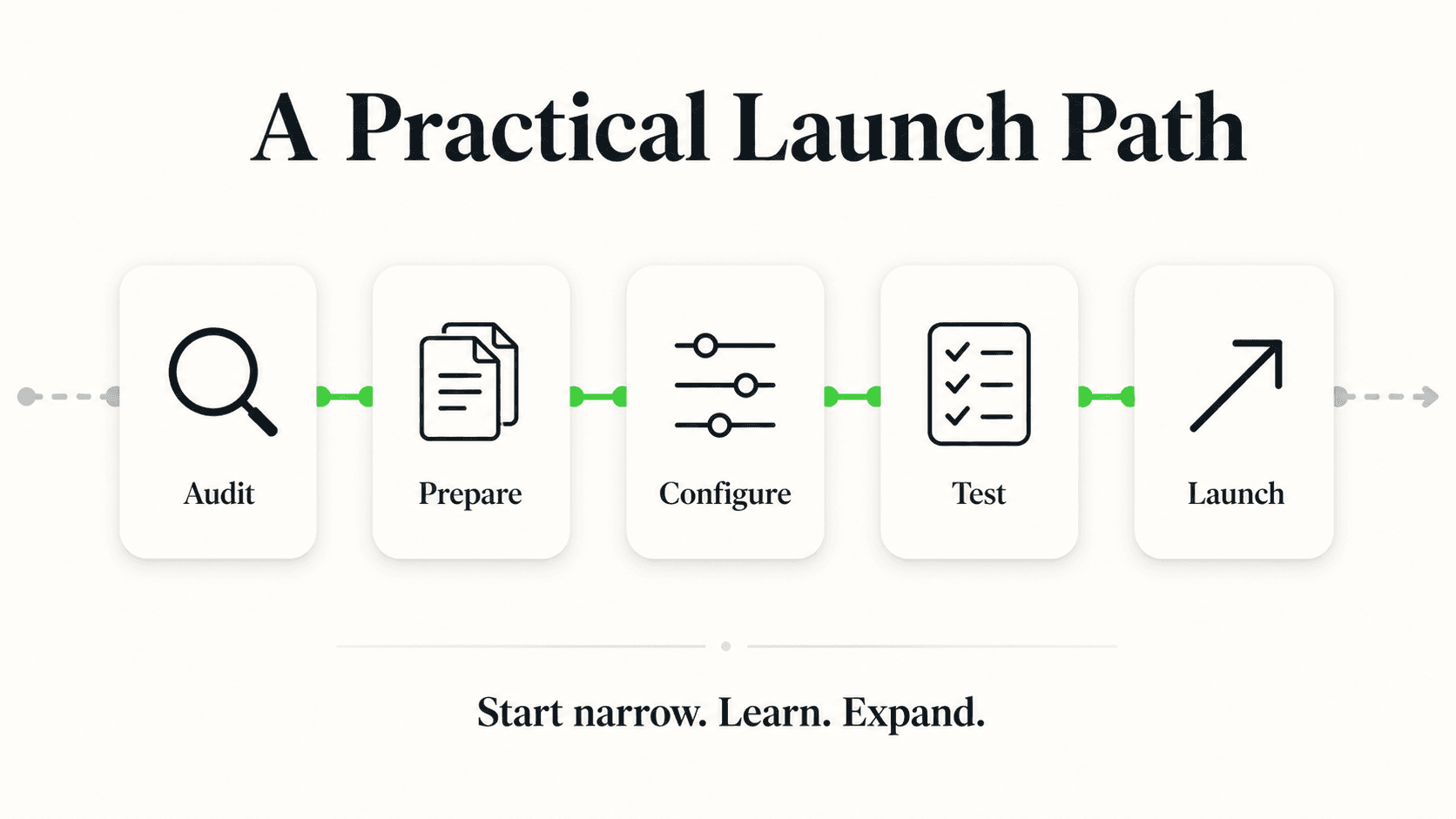
The key principle: start simple, measure everything, and add complexity only where the data supports it. Many teams try to build the perfect system on day one and never launch. A basic automated response that goes live this week is infinitely better than a sophisticated system that launches in three months.
Frequently Asked Questions
Will automated follow-ups feel impersonal to prospects?
Not if you design them well. The best automated follow-ups reference specific properties, neighborhoods, and buyer preferences. They feel like a knowledgeable assistant, not a spam bot. The key is using the prospect's name, referencing their specific inquiry, and providing genuinely useful information rather than generic sales pitches. Studies show that prospects care more about speed and relevance than whether a human or AI sent the first message.
How do I handle leads that require nuanced conversations?
This is exactly why the automation-to-human handoff is critical. Your system should detect signals of high intent or complexity---questions about negotiations, financing concerns, specific property comparisons---and immediately route these conversations to a human agent with full context. The agent picks up the conversation seamlessly, already knowing what the prospect has asked and what information they have received.
What is the right number of follow-up messages before stopping?
Industry research consistently shows that leads who receive multiple follow-up contacts convert at meaningfully higher rates than those who receive only one or two touches (Source: National Association of Realtors). However, the cadence matters as much as the count. Spread your follow-ups over weeks rather than days, vary the content and channel, and always provide value---never send a message that is just "checking in" without something useful to share.
Can I automate follow-ups without a large budget?
Yes. You can start with basic email automation (many CRM platforms include this), a simple AI chatbot on your website, and WhatsApp Business for messaging. Platforms like Hyperleap AI offer plans starting at $40/month that include AI-powered chatbot responses, multi-channel messaging, and lead qualification---a fraction of what a missed commission costs.
How do automated follow-ups work with team lead routing?
The best systems route leads based on configurable rules: geography, property type, price range, lead source, or round-robin distribution. When the AI chatbot qualifies a lead and determines they are interested in luxury condos downtown, it routes to the agent who specializes in that segment---not just the next agent in line. This improves both conversion rates and client satisfaction.
Does automation comply with real estate marketing regulations?
Automation tools must comply with the same regulations as manual outreach: CAN-SPAM for email, TCPA for calls and texts, and platform-specific terms of service for WhatsApp and social media messaging. Always obtain explicit consent before adding prospects to automated sequences, include unsubscribe options in every message, and maintain records of consent. Fair housing laws apply equally to automated and manual communications---ensure your AI is trained to avoid discriminatory language or steering.
The Bottom Line
The real estate industry is experiencing a fundamental shift in how leads are captured, qualified, and nurtured. Agents who rely solely on manual follow-up processes are losing deals every day---not because they lack skill or dedication, but because they cannot be everywhere at once.
Automated follow-up systems solve the speed and consistency problem while freeing agents to do what they do best: build relationships, negotiate deals, and guide clients through one of the biggest financial decisions of their lives.
The agents and brokerages that thrive in this market will be those that combine the efficiency of automation with the authenticity of personal connection. The technology handles the when and the logistics. The agent handles the why and the relationship.
Start with Step 1: audit your current workflow this week. You might be surprised by how many opportunities you are already missing---and how quickly the right system can capture them.
Can the chatbot integrate with my MLS or Zillow account?
Hyperleap does not have a native MLS or Zillow API integration today. The chatbot captures buyer / seller intent, qualifies leads, and shares your listing pages or booking link — agents follow up using their existing MLS tools.
How does the chatbot qualify real estate leads?
It asks for the essentials in a natural conversation — budget range, locations of interest, timeline, financing status — and hands a structured lead summary to your team via REST API or webhook so reps can prioritize follow-up.
How long does it take to set up an AI chatbot with Hyperleap?
Most SMBs go live in 3–5 days for self-serve setup. With Managed Setup ($299 Free, available on every plan), Hyperleap builds the bot for you on your content and channels. A 7-day free trial is included on every plan.
Ready to Automate Your Follow-ups?
See how Hyperleap AI helps real estate professionals respond to every inquiry instantly, qualify leads automatically, and never miss a follow-up again.
Get Started FreeFurther reading:
- AI Receptionists for Real Estate Brokerages --- How top US brokerages handle 24/7 inquiries
- AI Chatbot Lead Qualification for Real Estate --- Qualifying buyers before the handoff
- Why Slow Response Times Cost Businesses --- The data behind speed-to-lead
- How to Choose an AI Chatbot Platform --- Evaluation framework for real estate teams
- Real Estate AI Agents --- Hyperleap AI for real estate professionals
Industry Solutions
See how AI chatbots work for these industries:
Related Articles

AI Chatbot for Property Managers: Tenant Requests 24/7
How AI chatbots handle routine maintenance, lease, and availability inquiries 24/7 — and lighten the load on property managers.

Capture & Nurture Senior Living Leads (6-Month Cycle)
Senior living sales cycles average 6-12 months. Learn 7 proven strategies to capture and nurture leads through every stage of the family decision journey.

How to Respond to a Real Estate Lead
Respond within minutes, answer their actual question, qualify naturally, and share the showing link. Example replies and a first-hour playbook inside.

AI Chatbot for Real Estate: Capture Leads 24/7
An AI chatbot for real estate qualifies buyers and sellers around the clock, capturing leads before agents ever pick up the phone.