How to Build a Business Case for AI Chatbots: ROI Framework
A practical ROI framework for SMBs evaluating AI chatbots — calculate costs, measure returns, and build a convincing business case.

TL;DR: Build an AI chatbot business case by quantifying value across four dimensions — cost savings, revenue captured, time reclaimed, and customer experience — instead of treating ROI as a single number. The right baseline is not "things are fine without one"; it is the current cost of missed leads and slow responses (Harvard Business Review found 5-minute responders are 21x more likely to qualify leads than 30-minute responders). Industry benchmarks like Juniper Research's 340% first-year ROI figure are a starting point, not a guarantee — typical results vary by industry and execution. This framework gives SMBs a structured method to estimate inputs, validate them post-deployment, and avoid both gut-feel buys and analysis paralysis.
Every business owner asks the same question before investing in AI: will this actually pay for itself?
It is a fair question. For small and mid-sized businesses, every dollar in the software budget has to earn its keep. You are not a Fortune 500 company with an "innovation lab" budget. You need tools that generate more revenue than they cost — preferably within months, not years. And AI chatbots, despite the hype, are still unfamiliar territory for most SMBs. The marketing says "save time" and "capture more leads," but what does that look like in actual numbers?
The challenge is not that AI chatbot ROI is hard to achieve. According to Juniper Research (2024), businesses using AI chatbots see an average 340% ROI in the first year. The challenge is that most businesses never build the business case in the first place. They either buy on gut instinct and struggle to justify the spend later, or they get stuck in analysis paralysis and never make a decision at all.
This guide gives you a practical framework to calculate AI chatbot ROI for your specific business — not hypothetical numbers from a vendor pitch deck, but a structured method for estimating costs, measuring returns, and making a case that holds up to scrutiny.
Who This Guide Is For
This guide is written for SMB owners, operations managers, and decision-makers evaluating whether an AI chatbot investment makes sense for their business. It works whether you are a solo operator or managing a team of 50.
What Is an AI Chatbot ROI Framework?
An AI chatbot ROI framework is a structured method for calculating the total financial impact of deploying an AI chatbot across your business. Unlike simple cost-savings calculators, a proper framework accounts for multiple value dimensions — not just what you save, but what you gain.
Most people think of ROI as a single number: revenue minus cost, divided by cost. That formula works, but only if you capture all the inputs. For AI chatbots, the value shows up in at least four categories:
- Cost savings — reduced staff time on repetitive inquiries, lower cost-per-interaction, fewer missed calls requiring callbacks
- Revenue captured — leads collected outside business hours, faster response times converting more prospects, multi-channel presence reaching customers where they already are
- Time reclaimed — staff hours freed up for higher-value work like relationship building, upselling, and complex problem-solving
- Customer experience improvement — faster first response, consistent answers, 24/7 availability that meets modern expectations
A good framework forces you to quantify each of these before you buy — and then gives you the metrics to validate them after deployment. If you are already tracking chatbot KPIs, this framework connects those metrics directly to business outcomes.
The key insight is that AI chatbot ROI is not a single event. It compounds. The chatbot gets better as you refine its knowledge base. Your team gets faster at handling escalations. Your lead pipeline gets fuller. Month three looks different from month one, and month six looks different from month three.
Why Most Businesses Struggle to Justify AI Chatbot Investment
If the ROI is real, why do so many businesses stall at the decision stage? In our experience, the problem is almost never the technology. It is the framing. Here are the four most common traps.
Intangible Benefits Are Hard to Quantify
"Better customer experience" is real, but how do you put a dollar sign on it? When the CEO asks "What's the return?" and the answer is "customers are happier," the conversation stalls. The fix is to translate experience improvements into measurable proxies: repeat purchase rate, review scores, referral volume, support ticket reduction. These are not perfect, but they are better than "it feels like it is working."
Comparing to the Wrong Baseline
Many businesses evaluate AI chatbots against a hypothetical zero — "we're handling things fine without one." But the real baseline is not zero. It is the current cost of missed leads, slow response times, and after-hours silence. According to a Harvard Business Review study (2011), businesses that respond to leads within five minutes are 21 times more likely to qualify them than those who wait 30 minutes. If your business takes hours or days to respond — or does not respond to after-hours inquiries at all — the baseline is not "things are fine." It is "we are already losing money."
For a deeper look at what slow responses actually cost, see our analysis of how response times affect revenue.
Ignoring the Cost of Doing Nothing
Every month without a solution is another month of leaked revenue. In Hyperleap AI's Jungle Lodges deployment, 35% of inquiries arrived outside business hours. Before the chatbot, those inquiries went unanswered until the next morning — by which time many prospects had moved on to a competitor. The cost of "doing nothing" was not zero. It was 35% of their lead pipeline, quietly disappearing every night.
The cost of inaction is invisible until you measure it, which is why most businesses underestimate it. You cannot see the leads you never captured.
Short-Term Thinking vs. Compounding Returns
AI chatbots are not like hiring a contractor for a one-time project. They are a system that improves over time. The knowledge base gets refined. The conversation flows get optimized. Staff learn which escalations to handle and which the chatbot resolves on its own. Evaluating ROI based on the first 30 days is like judging a new hire during orientation week. The real value shows up in months three through twelve, and it compounds from there.
See What Your Business Could Save
Use our ROI calculator to model your specific costs and returns before you commit.
Try the ROI Calculator7 Revenue and Cost Levers in Your AI Chatbot ROI Calculation
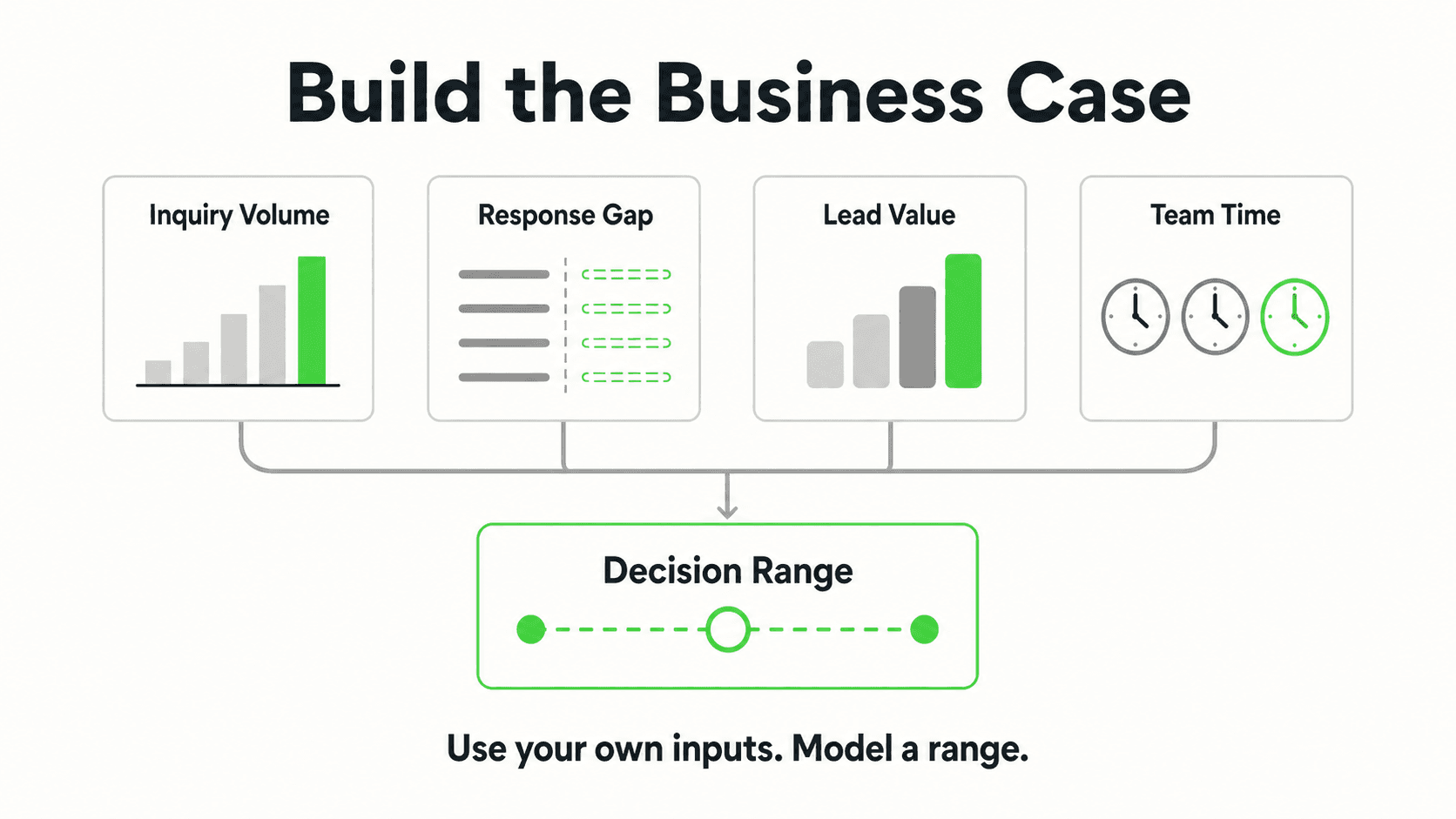
This is where the framework gets concrete. Each of these seven levers represents a measurable line item in your business case. Not every lever will apply to every business, but most SMBs will find at least four or five that directly affect their bottom line.
1. After-Hours Lead Capture
What this looks like in practice: A potential customer visits your website at 9:30 PM, has a question about your services, and finds a chatbot that answers immediately and collects their contact information. Without the chatbot, that visitor leaves and likely contacts a competitor the next morning.
Real-world impact: In Hyperleap AI's deployment with Jungle Lodges, 35% of all inquiries arrived after business hours. These were not casual browsers — they were people actively looking for information about booking a stay. Before the chatbot, those inquiries went unanswered overnight. After deployment, the chatbot captured contact details and provided instant answers around the clock.
How to calculate it: Count your total monthly inquiries (from forms, calls, chats, and social messages). Estimate the percentage that arrive outside your staffed hours — for most businesses, this ranges from 25% to 40%. Multiply by your average lead-to-customer conversion rate, then by your average customer value. That is the revenue currently walking out the door every month.
Example: 200 monthly inquiries x 35% after-hours = 70 missed leads. At a 10% conversion rate and $500 average deal, that is $3,500 in monthly revenue you are not capturing.
2. Response Time Improvement and Conversion Lift
What this looks like in practice: Instead of a prospect waiting hours for a reply to their website form submission, they get an immediate response from your AI chatbot. The chatbot answers their initial questions, qualifies their need, and either resolves the inquiry or routes it to your team with full context.
Real-world impact: The Harvard Business Review (2011) found that businesses responding within five minutes are 21 times more likely to qualify a lead. AI chatbots respond in seconds — not minutes or hours. For businesses where the current average response time is measured in hours, the conversion lift from instant response alone can be substantial.
How to calculate it: Measure your current average response time and your current inquiry-to-customer conversion rate. Even a modest improvement — say, moving from a 3-hour average response to under 1 minute — can meaningfully increase the percentage of inquiries that convert. Track your conversion rate before and after deployment over a 90-day window to measure the actual lift.
3. Staff Time Reallocation
What this looks like in practice: Your front desk staff currently spend a significant portion of their day answering the same 15-20 questions: "What are your hours?" "Do you accept insurance?" "How much does X cost?" "Where are you located?" An AI chatbot handles these repetitive inquiries automatically, freeing your team to focus on complex customer needs, upselling, and relationship building.
Real-world impact: According to IBM (2024), AI chatbots can handle up to 80% of routine customer inquiries without human intervention. This does not mean replacing staff — it means redirecting their time from low-value repetitive tasks to high-value activities that require human judgment and empathy.
How to calculate it: Track how many inquiries your team handles per day and estimate the percentage that are routine, repetitive questions. Multiply the time spent on those inquiries by the hourly cost of the staff handling them. That is the direct labor cost that gets reallocated — not eliminated, but redirected to work that generates more value.
Example: 2 staff members spending 3 hours/day on routine questions = 6 hours/day. At $20/hour, that is $120/day or roughly $2,600/month in staff time that could be spent on higher-value activities.
4. Reduced No-Shows via Automated Follow-Ups
What this looks like in practice: A customer books an appointment or expresses interest in a service. The chatbot sends a confirmation, follows up with reminders, and provides relevant information before the appointment — reducing the likelihood that the customer forgets or decides not to show up.
Real-world impact: No-show rates vary by industry, but they are universally expensive. The Medical Group Management Association (MGMA) estimates that healthcare no-shows cost the U.S. healthcare system over $150 billion annually, with individual practices losing an average of $200 per missed appointment. Dental, legal, salon, and other appointment-based businesses face similar challenges. Automated reminders and follow-ups through chatbot channels like WhatsApp consistently reduce no-show rates.
How to calculate it: Take your current monthly no-show count and multiply by the average revenue lost per missed appointment (including the opportunity cost of the empty slot). Then estimate the percentage reduction you could achieve with automated follow-ups — a conservative estimate is 20-30% reduction, though results vary by industry and implementation.
5. Multi-Channel Reach Without Multi-Channel Staffing
What this looks like in practice: Your customers are on WhatsApp, your website, Instagram, and Facebook Messenger. Without AI, covering all four channels means either hiring channel-specific staff or consolidating everything into one channel (usually email) and losing the customers who prefer the others. An AI chatbot deploys across all channels simultaneously from a single knowledge base.
Real-world impact: Customers increasingly expect to reach businesses on the channel they prefer. A business that is only reachable via phone during business hours is invisible to prospects who prefer messaging. Multi-channel presence is no longer a luxury — it is an expectation. But the cost of staffing multiple channels is prohibitive for most SMBs.
How to calculate it: Estimate the cost of hiring or training staff to monitor each additional channel (even part-time). Compare that to the cost of an AI chatbot subscription that covers all channels. The savings multiply with each channel you add. For a deeper dive on channel strategy, see our guide to multi-channel AI chatbot strategy.
6. First-Party Data Collection
What this looks like in practice: Every chatbot conversation collects structured data — names, phone numbers, email addresses, specific needs, preferred timing, and intent signals. Unlike anonymous website visits or social media impressions, this is actionable first-party data with verified contact information.
Real-world impact: The value of first-party data is compounding. Each lead with a phone number or email is a prospect you can follow up with, nurture, and convert — not just today, but over weeks and months. In an era of declining third-party cookies and rising customer acquisition costs, owning your lead data directly is a strategic advantage.
How to calculate it: Compare the number of leads you capture today (form submissions, phone calls answered, walk-ins) with the total number of website visitors and social media engagements. The gap between "people who showed interest" and "people whose contact info you have" represents the data collection opportunity. AI chatbots close that gap by collecting contact details naturally during conversations, rather than demanding them upfront through static forms.
7. Customer Satisfaction and Retention Lift
What this looks like in practice: Customers get instant answers at any hour, consistent information every time, and a smooth handoff to a human when the question requires one. No hold music. No "we'll get back to you." No conflicting answers from different staff members.
Real-world impact: Customer retention is significantly cheaper than customer acquisition. According to Bain & Company, increasing customer retention by just 5% can increase profits by 25-95%. AI chatbots contribute to retention by ensuring that existing customers always get fast, accurate responses — even during peak hours or holidays when your team is stretched thin.
How to calculate it: Track customer satisfaction scores (CSAT) before and after chatbot deployment. Monitor your customer churn rate and repeat purchase rate. Even if the chatbot's contribution to retention is modest — say, it prevents 2-3 customers per month from leaving — multiply that by your average customer lifetime value. The numbers add up quickly.
Not Every Lever Applies to Every Business
Service-based businesses (clinics, law firms, salons) will see the biggest impact from after-hours capture and no-show reduction. Product-based businesses will lean more on response time conversion lift and multi-channel reach. Identify the 3-4 levers most relevant to your business and focus your ROI calculation there.
Building Your Business Case: A Step-by-Step Framework
Now that you know the levers, here is how to assemble them into a business case that holds up to scrutiny — whether you are presenting to a business partner, a board, or convincing yourself.
Step 1: Establish Your Current Cost Baseline
Before calculating what a chatbot will save you, document what you are spending now. This includes:
- Staff time on customer inquiries — hours per week multiplied by hourly cost
- Missed leads — estimate based on after-hours traffic, unanswered calls, abandoned forms
- No-show costs — average revenue lost per missed appointment multiplied by monthly no-shows
- Opportunity cost — revenue your team could generate if they were not answering routine questions
Be honest with these numbers. Underestimating your current costs makes the business case weaker, not stronger.
Step 2: Project Your Savings and New Revenue
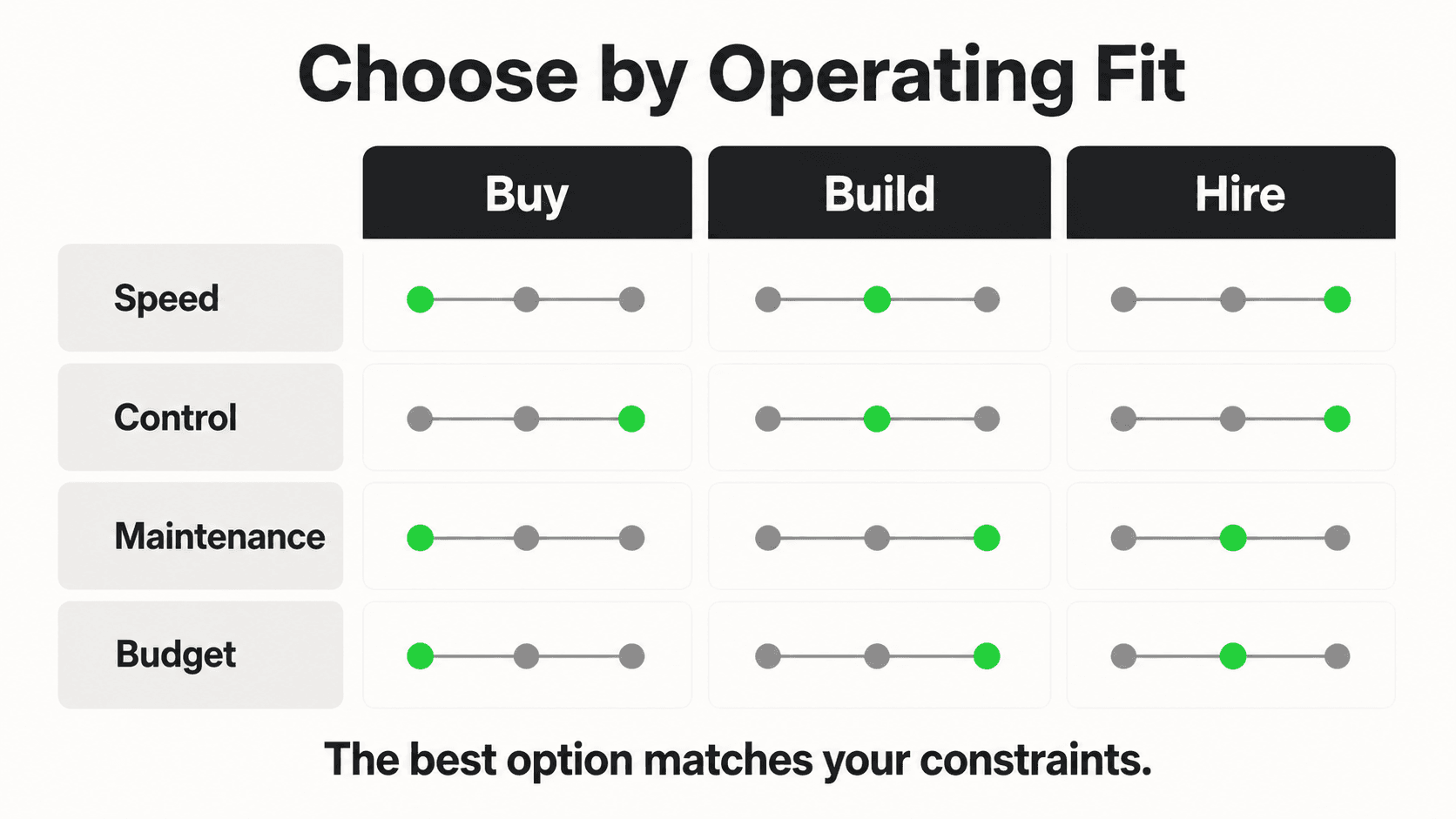
For each of the seven levers above, estimate the monthly impact. Use conservative numbers — it is better to over-deliver than over-promise. A reasonable approach:
- After-hours lead capture: (Monthly inquiries) x (% after hours) x (conversion rate) x (average deal value)
- Response time lift: (Current conversion rate) x (estimated improvement %) x (monthly inquiry volume) x (average deal value)
- Staff time savings: (Hours saved per week) x (hourly cost) x 4.3 weeks
- No-show reduction: (Monthly no-shows) x (% reduction) x (revenue per appointment)
- Multi-channel savings: (Cost of additional channel staffing) - (chatbot subscription cost)
- Data collection value: Qualitative in the short term, quantifiable once you track lead-to-conversion from chatbot-captured leads
- Retention lift: (Customers retained) x (average lifetime value)
Step 3: Calculate Net ROI
The formula is straightforward:
Monthly ROI = (Total Monthly Benefits - Monthly Chatbot Cost) / Monthly Chatbot Cost x 100
For most SMBs, AI chatbot subscriptions range from $40 to $200 per month depending on features and scale. When your projected monthly benefits run into the hundreds or thousands of dollars, the math speaks for itself.
For a detailed look at pricing tiers and what you get at each level, visit our pricing page.
Step 4: Estimate Your Payback Period
The payback period is how long it takes for cumulative benefits to exceed cumulative costs. For most SMBs deploying AI chatbots:
- Solo operators and micro-businesses (1-5 employees): Typical payback in 30-60 days, driven primarily by after-hours lead capture and time savings
- Small businesses (5-25 employees): Typical payback in 30-90 days, with the biggest impact from staff time reallocation and multi-channel presence
- Mid-sized businesses (25-100 employees): Typical payback in 60-120 days, with compounding returns from data collection and retention improvement
These ranges are based on typical deployment patterns. Your actual payback will depend on your industry, inquiry volume, and how quickly you optimize your chatbot's knowledge base. Businesses that invest time in building a strong knowledge base tend to see faster returns.
Step 5: Present the Business Case
Structure your presentation around three numbers:
- The cost of doing nothing — what you are losing every month without a chatbot (missed leads, wasted staff time, no-shows)
- The investment required — monthly subscription cost plus setup time
- The projected return — monthly net benefit with a conservative payback timeline
This framing works because it shifts the conversation from "Can we afford this?" to "Can we afford not to do this?"
Common ROI Mistakes to Avoid
Even with a solid framework, there are pitfalls that can undermine your business case or set up unrealistic expectations.
Overestimating Day-One Impact
An AI chatbot does not deliver its full value on launch day. The first week is about testing, refining responses, and catching gaps in your knowledge base. The first month is about optimization. Expect 60-70% of projected value in month one, with full run-rate by month three. If you build your business case around immediate full impact, you will feel disappointed even when the chatbot is performing well.
Ignoring Setup and Ramp-Up Time
The chatbot subscription is not the only cost. Factor in the time to build your knowledge base, configure conversation flows, train your team on the escalation process, and refine responses based on early conversations. For most SMBs, this is 5-15 hours of setup time in the first two weeks. It is a real cost, and including it in your business case makes the analysis more credible.
Tracking the Wrong Metrics
Message volume is not ROI. Neither is "conversations started." The metrics that matter are leads captured, conversations that resulted in a booking or sale, staff hours saved, and customer satisfaction scores. If you are not tracking these, you cannot prove ROI — and you cannot improve it. Our guide on chatbot KPIs covers the specific metrics to set up from day one.
Forgetting to Re-Evaluate
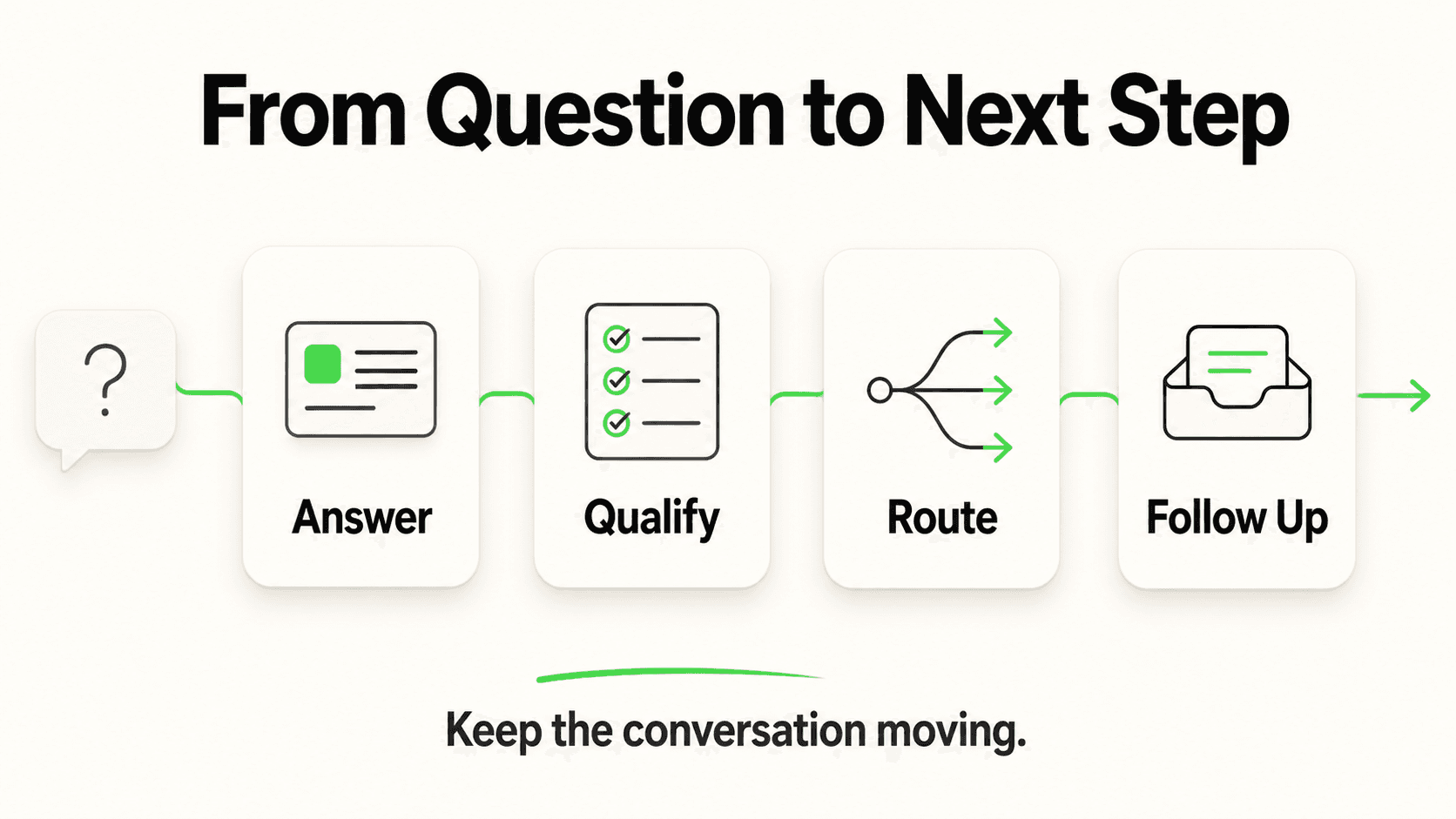
Your business case is a projection. After 90 days of operation, go back and compare actual results to your projections. You will almost certainly find that some levers performed better than expected and others fell short. That is normal. The value of re-evaluation is not proving you were right — it is identifying where to focus your optimization efforts next.
Ready to Build Your Business Case?
Start with a 7-day free trial and measure real results against your framework.
Start Your Free TrialStop Guessing, Start Measuring
The businesses that get the most value from AI chatbots are not the ones with the biggest budgets or the most technical expertise. They are the ones that approach the decision with a framework — clear about what they expect to gain, honest about what they are currently losing, and disciplined about measuring results after deployment.
The AI chatbot ROI framework in this guide gives you that structure. Map your costs. Identify your highest-impact levers. Run the numbers. And then validate them with real data once the chatbot is live.
The question is not whether AI chatbots can deliver ROI for small businesses. The evidence — from case studies to industry research — consistently shows they can. The question is whether you will build the business case to capture that value, or whether you will keep losing leads, wasting staff time, and leaving money on the table while you wait for more certainty.
Certainty comes from measurement, not from more research.
Frequently Asked Questions
How long before I see ROI from an AI chatbot?
Most SMBs see positive ROI within 30-90 days, depending on inquiry volume and how quickly the knowledge base is optimized. Businesses with high after-hours traffic or long current response times tend to see the fastest returns because the gap between "before" and "after" is largest. The chatbot delivers incremental value from day one, but full run-rate typically takes 60-90 days as you refine responses and conversation flows.
What if I am a solo operator with no staff to reallocate?
The ROI framework still works — you just weight different levers. For solo operators, the biggest value comes from after-hours lead capture (you cannot answer inquiries when you are asleep or with a client) and time savings (every hour you do not spend answering "What are your hours?" is an hour you spend on billable work). At $40/month for a chatbot subscription, capturing even one additional lead per month at a reasonable deal value puts you in positive ROI territory.
How do I track chatbot-attributed revenue?
Set up tracking at deployment, not after. Tag every lead the chatbot captures with a source identifier. When that lead converts to a customer, attribute the revenue to the chatbot. Most AI chatbot platforms provide lead export or webhook notifications that make this straightforward. For a deeper dive on measurement, see our KPI tracking guide. The key is establishing the tracking before you launch, so you have clean data from day one.
Is the ROI different for service businesses vs. product businesses?
Yes, but both can be strong. Service businesses (clinics, law firms, salons, consultancies) typically see the biggest impact from after-hours lead capture and no-show reduction, because each missed appointment has a high direct cost. Product businesses and e-commerce see more value from response time conversion lift and multi-channel reach, because the chatbot handles pre-purchase questions that remove buying friction. The framework is the same — you just weight the levers differently.
What is a realistic cost range for AI chatbots?
AI chatbot pricing for SMBs typically ranges from $40 to $200 per month for subscription-based platforms. At the lower end, you get core functionality — a single chatbot, a few channels, and a reasonable knowledge base. At the higher end, you get multiple chatbots, more channels, white-label branding, and higher response volumes. Some platforms also offer one-time setup fees or paid add-ons for advanced features. Compare options on our pricing page to see what fits your budget and needs.
Do I need technical skills to deploy an AI chatbot?
No. Modern AI chatbot platforms are designed for business owners, not developers. Setup typically involves uploading your existing documents (website pages, FAQs, service descriptions), configuring basic settings, and embedding a widget on your website. Most businesses complete initial setup in a few hours. The ongoing work is refining your knowledge base and reviewing conversation logs — tasks that require business knowledge, not coding skills. For a step-by-step walkthrough, see our getting started guide.
Never Miss Another After-Hours Lead
See how Hyperleap AI captures leads, answers questions, and qualifies prospects 24/7 across your website, WhatsApp, Instagram, and Facebook Messenger.
Get StartedRelated Articles

AI Chatbot vs Receptionist: Cost Comparison for SMBs
Should your small business hire a receptionist or deploy an AI chatbot? A practical cost comparison covering salary, availability, scalability, and ROI.
What Missed Calls Really Cost Your Small Business
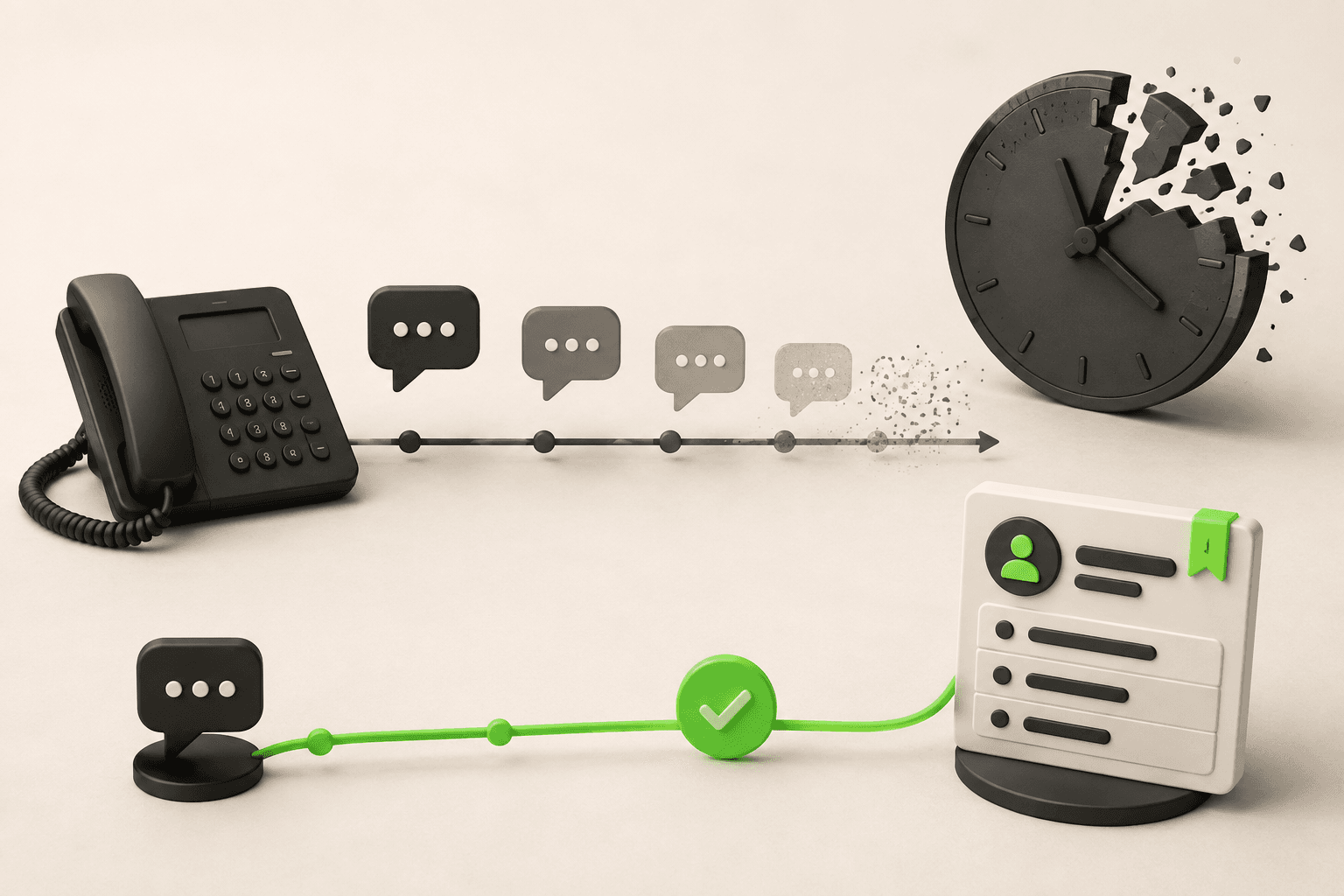
A worked example of what missed calls cost small businesses in lost jobs, plus where inquiries actually arrive now and what to do about it.

AI Receptionist Cost in 2026: What You Actually Pay
AI receptionist cost ranges from $20/month for automated voice AI to $300+/month for live-agent phone answering. Full breakdown by category.

AI Chatbot Pricing Models Compared: Per-Message vs Flat-Rate
Per-message, per-resolution, and flat-rate pricing all have different cost profiles. Here's exactly how each model works and what to watch for before signing.