Why Home Service Businesses Lose Jobs to Faster Rivals
Homeowners contact 3–5 contractors per job, and the data shows the first responder wins most. How home service businesses fix slow response and keep the work.

TL;DR: Research shows 78% of customers hire the first contractor who responds. Yet home service businesses miss 27% of inbound calls, and the average lead response time across the industry exceeds 42 hours. For HVAC, plumbing, and electrical companies spending $45-$95 per lead on Google Ads, every missed or delayed response is money wasted. An AI receptionist can close this gap for a fraction of the cost of a night hire.
Why Home Service Businesses Lose Jobs to the Contractor Who Answers First
A homeowner's pipe bursts at 9 PM. They search "emergency plumber near me," and within 10 minutes they have contacted three plumbing companies. The first one to respond gets the $800 job. The other two never hear back.
This scenario plays out millions of times every day across the United States. Research from InsideSales.com shows that leads contacted within 5 minutes are 100 times more likely to convert than those contacted after just 30 minutes. In home services, where urgency drives most inquiries, that 5-minute window is the difference between a full schedule and an empty one.
The US home services market generates hundreds of billions in annual revenue (Source: Verified Market Research), and competition is fiercer than ever. Yelp reported that home services led all industries in new business openings throughout 2024. With more contractors competing for the same jobs, the one who answers first wins -- not the one with the best reviews, the lowest price, or the most experience.
What Is Speed-to-Lead in Home Services?
Speed-to-lead measures the time between when a homeowner submits an inquiry -- whether by phone call, website form, Google Local Services Ad, or message -- and when a contractor actually responds. In home services, this metric is the single strongest predictor of whether you win or lose a job.
What makes home services different from other industries:
- High urgency: A broken AC in July or a burst pipe at midnight cannot wait
- Multiple quotes: 85% of homeowners contact 3 or fewer contractors before deciding (Source: Arcsite Homeowner Survey)
- First-responder advantage: Nearly 4 out of 5 clients award projects to the first contractor who provides a live response (Source: AgentZap / Construction Phone Statistics)
- High ticket values: Emergency calls range from $150 for a simple repair to $10,000+ for system replacements
- Perishable leads: Unlike retail shoppers who browse, homeowners with emergencies need immediate help
This is why response time matters more in home services than almost any other industry. A lead that goes unanswered for even 30 minutes is likely already booked with your competitor.
Why Home Service Contractors Lose Leads
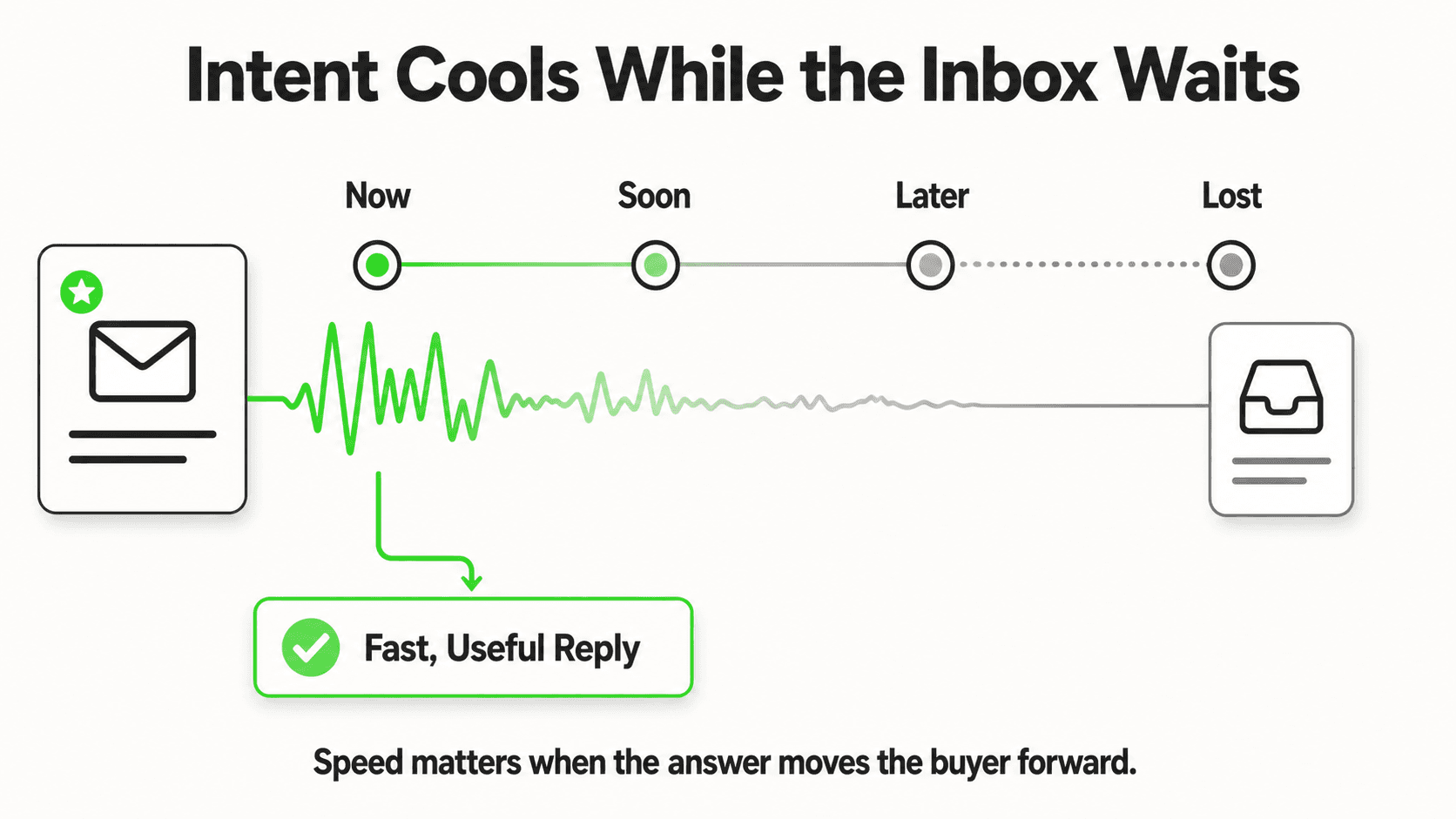
The gap between what homeowners expect and what most contractors deliver is staggering. Understanding why this gap exists is the first step to closing it.
Field Crews Cannot Answer Phones
The fundamental challenge of home services is structural: your best salespeople are also your technicians, and they are on job sites all day. A plumber elbow-deep in a water heater installation cannot pick up the phone. An HVAC technician on a roof cannot pause to respond to a website inquiry.
The result: Home service businesses miss 27% of inbound calls on average (Source: Invoca). Some sources report the miss rate as high as 62% (Source: Medium / Jack Graham). Every missed call represents $300-$1,200 in lost revenue.
After-Hours Emergencies Go Unanswered
Emergencies do not follow business hours. A frozen pipe bursts at 2 AM. An AC unit dies on a Saturday afternoon during a heat wave. A power outage trips the main panel at midnight. Research shows that home service companies receive 8-12 after-hours calls per week (Source: Suzee AI). At an average emergency ticket of $500, those missed after-hours calls represent over $120,000 in potential annual revenue.
Seasonal Surges Overwhelm Staff
HVAC companies experience 3-4x call volume during the first heat wave of summer and the first cold snap of winter. Plumbers see surges during freeze-thaw cycles. Roofers are overwhelmed after every major storm. When volume spikes, even well-staffed offices miss calls -- precisely when demand (and willingness to pay premium rates) is highest.
High Cost-Per-Lead Gets Wasted
Home service companies pay significant amounts for every lead. According to industry data from LocaliQ and WebFX, average cost per lead by trade is: HVAC $45-$85, Plumbing $40-$75, Electrical $35-$70, Roofing $50-$95. When leads go unanswered, that ad spend is completely wasted. And cost per lead increased for 69% of home services businesses year-over-year (Source: LocaliQ), making each wasted lead even more expensive.
Google LSA Competition Is Intensifying
Google's Local Services Ads now display your average response time directly in your ad listing. If you respond to LSA leads within 5 minutes 90%+ of the time, you rank higher. The platform rewards speed with visibility -- and punishes slow responders by pushing them down the results. With the 2025 transition from "Google Guaranteed" to the new "Google Verified" badge, responsiveness has become even more central to your ad performance (Source: Coalmarch Marketing).
The Math on Wasted Ad Spend
If your HVAC company spends $5,000/month on Google Ads generating 70 leads at $71 per lead, and you miss or slowly respond to 30% of them, that is 21 wasted leads -- $1,491 per month thrown away. Over a year, that is nearly $18,000 in wasted ad spend alone, before accounting for the lost revenue those jobs would have generated.
7 Ways Slow Response Costs Your Home Service Business
The cost of slow response goes far beyond the single missed job. Here are seven compounding ways that delayed responses drain revenue from your home service business.
1. Lost Emergency Calls Worth $1,000-$10,000 Each
What this looks like in practice: A homeowner discovers their basement is flooding at 11 PM. They call three plumbers. Two go to voicemail. One responds instantly with an estimated arrival time and dispatches a technician. That plumber gets the $2,500 water extraction and pipe repair job.
Real-world impact: Emergency plumbing calls cost homeowners $150-$500+ for the service call alone, with total jobs frequently exceeding $1,000 (Source: American Mains and Drains). Emergency HVAC repairs run $200-$300 for the after-hours service call plus $150-$250/hour labor -- often double to triple daytime rates (Source: Hoover Electric / HousecallPro). These are your highest-margin jobs, and they go to whoever answers first.
Why it works against you: 85% of callers who reach voicemail will never call back (Source: Invoca / Dialzara). They call the next contractor on the list. You do not get a second chance at emergency calls.
Key consequences:
- Emergency jobs carry premium pricing (1.5x-3x standard rates)
- After-hours callers have the least patience for delays
- One missed emergency call can equal an entire day's revenue from routine jobs
- The homeowner who needed you at midnight will never call you for their $8,000 system replacement either
2. Wasted Advertising Spend on Leads That Never Convert
What this looks like in practice: Your Google Ads campaign generates a lead at 6:15 PM Friday. Your office closed at 5. The lead sits in your CRM until Monday morning. By then, the homeowner has already hired someone else.
Real-world impact: With HVAC leads costing $45-$85 each and roofing leads at $50-$95 (Source: The Media Captain / LocaliQ), every lead that goes cold is a significant financial loss. Google LSA message leads cost roughly half of phone leads, but they still represent real dollars wasted when not responded to promptly.
Why it works against you: Marketing ROI is calculated on closed jobs, not leads generated. If your response time turns a 15% conversion rate into a 3% rate, your effective cost per acquired customer increases 5x.
Key consequences:
- $45-$95 per lead wasted when response is delayed past the 5-minute window
- CPL increasing 10% year-over-year means waste compounds annually
- Competitors bidding on the same keywords benefit from your missed leads
- Your Quality Score drops as Google detects poor lead follow-through
3. Seasonal Bottlenecks That Crush Your Busiest Periods
What this looks like in practice: The first 95-degree day in Dallas. Your HVAC company gets 4x normal call volume. Your two-person office staff is overwhelmed. Hold times stretch to 15 minutes. Half the callers hang up and call competitors.
Real-world impact: Seasonal demand spikes are when home service companies make the majority of their annual profit. Missing 40-50% of calls during a 2-week heat wave or cold snap can cost tens of thousands in lost revenue -- revenue that cannot be recaptured because the season passes.
Why it works against you: You cannot economically hire temporary staff for unpredictable 2-week surges. Training takes weeks. By the time temps are productive, the surge is over.
Key consequences:
- Peak-season calls carry the highest urgency and willingness to pay
- Competitors with overflow capacity capture your missed demand
- Seasonal bottlenecks create negative reviews from frustrated callers
- Revenue lost during peak weeks cannot be recovered during slow periods
4. Reputation Damage from Unresponsive Service
What this looks like in practice: A homeowner leaves a voicemail at your plumbing company on Tuesday. You call back Thursday. They have already hired someone else and are frustrated. They leave a 2-star Google review: "Called about a leak and never heard back for two days."
Real-world impact: 94% of consumers say negative reviews have convinced them to avoid a business (Source: BrightLocal). One negative review about unresponsiveness can deter dozens of future leads -- especially when it appears in your Google Business Profile alongside your Local Services Ads.
Why it works against you: Reputation damage from slow response is a silent killer because most unhappy leads never tell you they were unhappy. They simply hire someone else. Only the most frustrated ones leave negative reviews, but those reviews have outsized impact.
Key consequences:
- Negative reviews about responsiveness signal systemic problems to prospects
- Google factors review sentiment into local search rankings
- Potential customers specifically search for "responsive" and "reliable" contractors
- Reputation recovery takes months of positive reviews to offset one bad one
5. Competitor Advantage Compounds Over Time
What this looks like in practice: Your competitor installs an AI chatbot that responds to every inquiry within seconds, 24/7. Their Google LSA response time shows "Usually responds within minutes." Yours shows "Usually responds within hours." Google promotes their listing. They win more jobs. More jobs mean more reviews. More reviews mean higher rankings. Higher rankings mean more leads.
Real-world impact: 60% of homeowners make a hiring decision within 72 hours (Source: Service Direct Homeowner Survey). The contractor with the fastest response gets the first appointment, sets the frame for the project, and is more likely to close -- even at a higher price. Nearly 80% of construction clients award projects to the first contractor who provides a live response.
Why it works against you: Speed advantage is a compounding advantage. The contractor who responds faster captures more jobs, generates more reviews, earns better ad placement, and gets more leads -- creating a virtuous cycle that widens the gap with every month.
Key consequences:
- Google LSA now displays response time, making slow response visible to prospects
- Faster responders accumulate reviews faster, improving rankings
- Each lost job also loses the 2-3 referrals that customer would have generated
- The competitive gap widens monthly, making it harder to catch up
6. Missed Upsell and Cross-Sell Opportunities
What this looks like in practice: A homeowner calls about a clogged drain ($200 job). During conversation, the technician discovers the water heater is 15 years old and showing signs of failure. That is a $3,000-$5,000 replacement opportunity. But if the initial call goes to voicemail and the homeowner hires a competitor for the drain, you lose both the $200 job and the $4,000 upsell.
Real-world impact: The lifetime value of a home service customer is $5,000-$15,000 (Source: HousecallPro), including repeat maintenance, system replacements, and referrals. Every missed initial contact is not just one lost job -- it is the entire customer lifetime value.
Why it works against you: Upsell opportunities only exist when you are the contractor on-site. The initial service call is your foot in the door for maintenance agreements, system upgrades, and referral relationships.
Key consequences:
- Average customer lifetime value is 5-15x the initial job value
- Maintenance agreements provide predictable recurring revenue
- Referrals from satisfied customers are the lowest-cost lead source
- One missed $200 drain call can mean losing $15,000 in lifetime value
7. Follow-Up Failures That Kill Repeat Business
What this looks like in practice: You complete an AC tune-up in June. The customer was satisfied. Six months later, their furnace needs service. But you never followed up, never sent a maintenance reminder, and never asked for a review. They search online and find a different contractor.
Real-world impact: It costs 5-7x more to acquire a new customer than to retain an existing one. Yet most home service businesses have no systematic follow-up process. Without automated reminders, review requests, and seasonal maintenance outreach, you are constantly paying to re-acquire customers you have already won.
Why it works against you: Home service businesses that implement automated follow-up sequences see significantly higher repeat business rates. Without follow-up, you compete on price and speed every single time.
Key consequences:
- No follow-up means paying full acquisition cost for every job
- Competitors with CRM automation win your previous customers back
- Missed review requests mean fewer Google reviews and lower rankings
- Seasonal maintenance reminders drive predictable, schedulable revenue
Stop Losing Jobs to Slower Competitors
See how Hyperleap AI responds to every lead instantly, 24/7 -- on your website, WhatsApp, and more.
Start Your Free TrialReal Results: What Home Service Businesses Are Achieving
When home service companies close the response time gap, the results are measurable and significant.
Revenue Recovery
- Captured after-hours leads: Businesses report capturing emergency calls that previously went to voicemail, recovering revenue that was being lost nightly
- Higher conversion rates: Plumbing companies that respond in under 5 minutes convert leads at 8x the rate of those responding in 30 minutes (Source: Vendasta / Convoso)
- Reduced cost per acquisition: When more leads convert, your effective cost per customer drops significantly even with the same ad spend
- Seasonal surge capture: AI-powered response handles 3-4x call volume spikes without missing leads
Operational Efficiency
- Office staff freed from phone duty: Receptionists focus on scheduling and customer service instead of screening calls
- Consistent lead qualification: Every inquiry gets the same professional response with the same qualifying questions
- Reduced no-shows: Automated appointment confirmations and reminders reduce no-show rates
- Better dispatch decisions: Qualified and categorized leads allow dispatchers to prioritize high-value emergency calls
Customer Satisfaction
- Instant acknowledgment: Homeowners get immediate confirmation that their request was received, even at 2 AM
- Professional first impression: Consistent, professional responses regardless of when the inquiry arrives
- Faster resolution: Emergency calls get routed to on-call technicians immediately instead of waiting in voicemail
- Review generation: Automated follow-up prompts satisfied customers to leave reviews
Getting Started: A Step-by-Step Guide
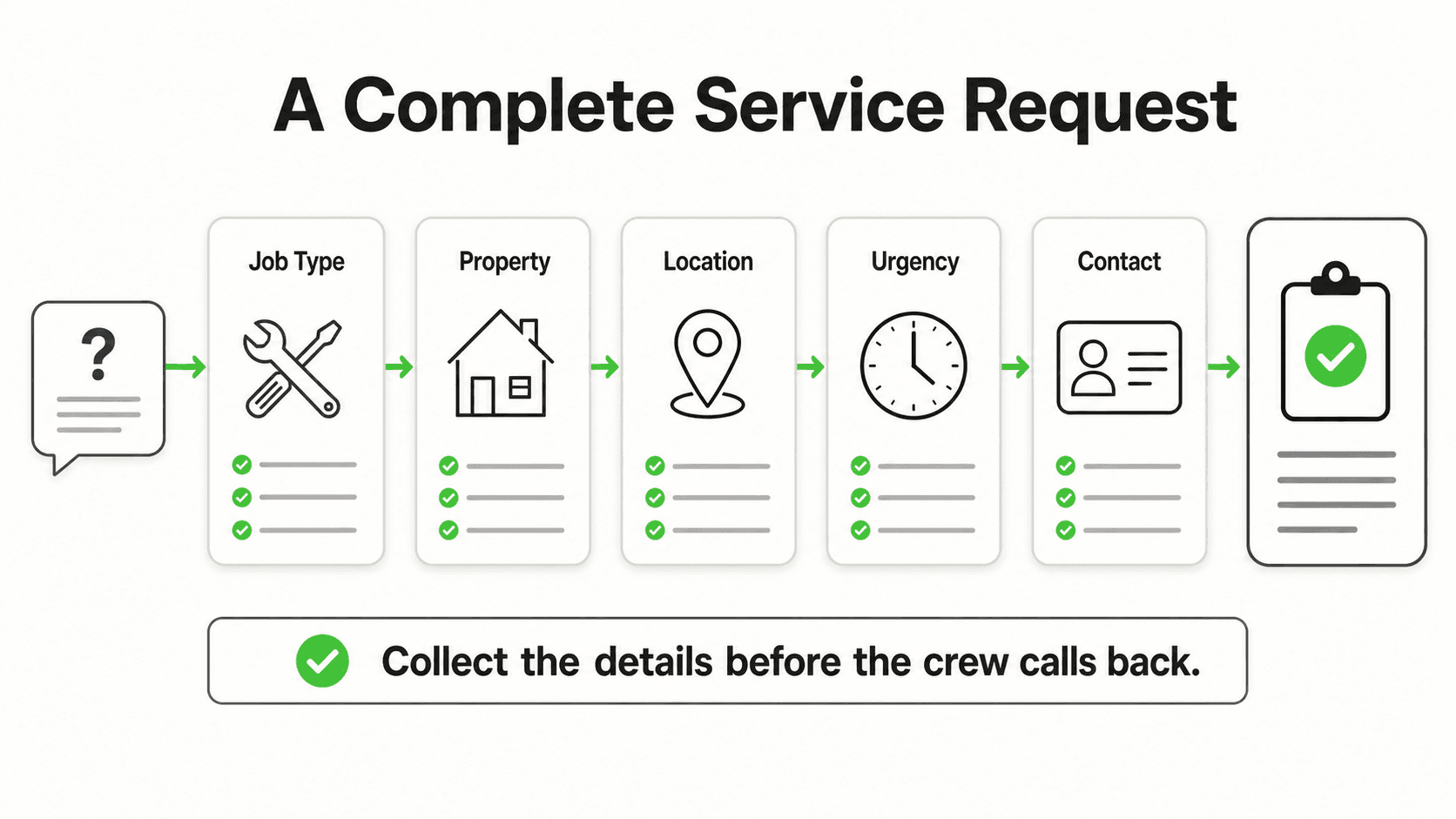
Fixing your response time does not require overhauling your entire operation. Here is a practical roadmap that any home service business can follow.
Phase 1: Audit Your Current State (Week 1)
Start by measuring what you cannot see:
- Pull your call data: Check your phone system for missed call rates, average hold times, and after-hours call volume
- Review lead response times: How long does it take from form submission to first contact?
- Calculate your waste: Multiply missed leads by your average job value to quantify the revenue gap
- Identify peak periods: When do most of your misses happen? After hours? During seasonal surges?
Phase 2: Implement Instant Response (Weeks 2-3)
Deploy an AI chatbot on your website and messaging channels to provide instant responses 24/7:
- Website chat: Capture visitors who find you through Google search and ads
- WhatsApp and Facebook Messenger: Meet customers on channels they already use
- Lead qualification: Program your chatbot to ask the right questions (service type, urgency level, location, preferred time)
- Emergency routing: Flag urgent issues for immediate dispatch to on-call technicians
Platforms like Hyperleap AI let you deploy multi-channel AI chatbots that are trained on your specific services, service areas, and pricing -- so responses are accurate and professional, not generic.
Phase 3: Integrate and Optimize (Weeks 3-4)
Connect your AI response system to your existing workflow:
- CRM integration via API and webhooks: Route qualified leads into ServiceTitan, Jobber, or Housecall Pro using your platform's REST API or webhook events
- Dispatch coordination: Set rules for which leads get dispatched immediately vs. scheduled for next-day callback
- Review your results: Track conversion rates from AI-qualified leads vs. your previous baseline
- Iterate on responses: Refine your chatbot's responses based on the questions homeowners actually ask
Phase 4: Scale and Compound (Month 2+)
Once instant response is working, extend the advantage:
- Automated follow-up: Set up post-job review requests and seasonal maintenance reminders
- Multi-channel expansion: Add channels where your customers are reaching out
- Referral programs: Automated referral prompts to satisfied customers
- Data-driven marketing: Use lead data to optimize your ad targeting and budget allocation
Start With Your Highest-Value Gap
If your audit reveals that most missed leads happen after hours, prioritize 24/7 coverage first. If seasonal surges are the main issue, focus on overflow capacity. Fix the biggest leak before optimizing the smaller ones.
Frequently Asked Questions
Does response time matter as much for routine jobs as emergencies?
Yes, though the dynamics differ. For emergencies (burst pipes, no heat, no AC), response time is the single most important factor -- homeowners will hire the first available contractor regardless of price. For routine work (remodels, installations, maintenance), response time still matters because 78% of customers hire the first business that responds (Source: Convoso). Even for a kitchen remodel quote, the contractor who responds in 5 minutes demonstrates professionalism and reliability -- qualities homeowners value for larger projects.
How do HVAC companies specifically benefit from faster response?
HVAC companies benefit disproportionately because of seasonal urgency. When an AC unit fails during a heat wave or a furnace dies in January, homeowners are desperate. Emergency HVAC labor rates are 2-3x standard rates (Source: HousecallPro), meaning these high-margin calls go to whoever answers first. Additionally, Google's Local Services Ads now display response times, so HVAC companies with faster response get better ad placement during the exact periods when lead volume and job values are highest.
What about plumbing companies -- is the pattern the same?
Plumbing companies face even more extreme urgency because water damage compounds by the minute. A slow leak becomes a flooded basement in hours. Plumbing companies that respond in under 5 minutes convert leads at 8x the rate of those responding in 30 minutes. A typical plumbing business loses $50,000-$60,000 annually to missed calls alone (Source: Suzee AI). Emergency plumbing calls average $150-$500+, with major repairs exceeding $1,000.
Can an AI chatbot really handle home service inquiries effectively?
AI chatbots trained on your specific services can handle the initial qualification that makes up the bulk of homeowner inquiries: what type of service, how urgent, what is the address, and when are they available. The chatbot does not need to diagnose the problem -- it needs to capture the lead, qualify the urgency, and route it appropriately. For emergency calls, it routes to on-call staff immediately. For routine inquiries, it books a callback or appointment. The key is that the homeowner gets an instant, professional response instead of voicemail.
How much does it cost compared to hiring a receptionist or answering service?
Traditional answering services for contractors cost $200-$500 per month for basic call handling. A full-time night receptionist costs $3,000-$5,000 per month. AI chatbot solutions like Hyperleap AI start at $40/month for multi-channel coverage (website, WhatsApp, Facebook Messenger, Instagram DM) that works 24/7 without breaks, sick days, or overtime. That is 85-95% less than live answering services for more consistent, always-available coverage.
Will this work for electrical and roofing contractors too?
Absolutely. Electrical contractors see similar patterns -- emergency calls for power outages, tripped breakers, and electrical fires carry premium pricing and extreme urgency. Roofing contractors benefit especially after storms, when lead volume surges and homeowners are contacting multiple roofers simultaneously. The contractor who responds first after a hailstorm with a prompt inspection schedule locks in not just the initial repair but often the full roof replacement.
How long does it take to see ROI from improving response time?
Most home service businesses see measurable improvement within the first two weeks. If you are currently missing 27% of calls (the industry average) and each missed call represents $300-$1,200 in revenue (Source: HousecallPro / Invoca), even capturing a fraction of those missed leads pays for an AI chatbot solution many times over. At $40/month for an AI chatbot, you need to capture just one additional small job per month to achieve positive ROI. For a detailed breakdown, see our AI chatbot ROI calculator.
The Contractor Who Answers First Wins
The data is clear: in home services, speed is the ultimate competitive advantage. 78% of customers hire the first responder. Leads contacted within 5 minutes convert at 8x the rate of those contacted in 30 minutes. And 85% of callers who reach voicemail will never call back.
Every day that your home service business relies on voicemail, delayed callbacks, or office-hours-only coverage, you are handing jobs to competitors. The fix is not complicated or expensive. AI-powered instant response provides 24/7 coverage across your website, WhatsApp, and social channels -- qualifying leads, routing emergencies, and booking appointments while your technicians focus on the work they do best.
The question is not whether you can afford to implement instant response. It is whether you can afford not to.
Can the chatbot dispatch a technician?
It captures the job details (problem, address, urgency, preferred time window) and routes to your dispatcher or scheduling tool. The bot does not directly assign technicians — it removes the inbound-call bottleneck so your team can dispatch faster.
Does it handle emergency calls outside business hours?
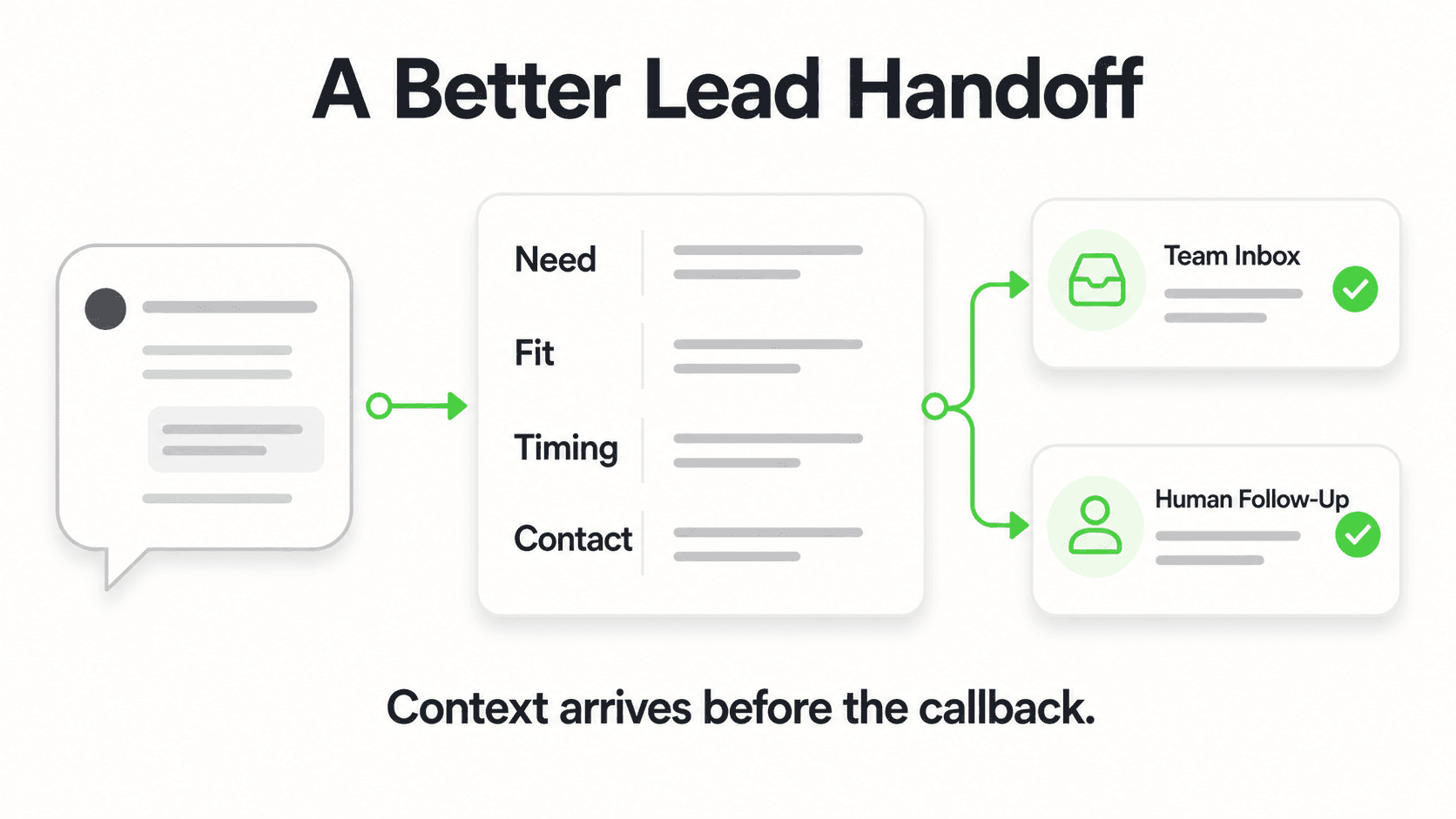
Yes. The bot runs 24/7, captures emergency calls when your team is asleep, and routes urgent jobs to your on-call number based on rules you configure. After-hours capture is one of the most-cited reasons home service operators deploy a chatbot.
How long does it take to set up an AI chatbot with Hyperleap?
Most SMBs go live in 3–5 days for self-serve setup. With Managed Setup ($299 Free, available on every plan), Hyperleap builds the bot for you on your content and channels. A 7-day free trial is included on every plan.
Further Reading
Authoritative external sources used and recommended for further research on this topic:
To put a number on it for your own business, see what missed calls really cost your small business.
Ready to Capture Every Lead?
Hyperleap AI responds to homeowner inquiries instantly, 24/7 -- qualifying leads, routing emergencies, and booking appointments across all your channels.
Get StartedIndustry Solutions
See how AI chatbots work for these industries:
Related Articles
Speed to Lead in Real Estate: 78% Pick First Responder
Real estate leads cost $200-$450 each. When 78% of buyers choose the first agent who responds, every minute of delay costs you commissions.

Why Auto Dealerships Lose After-Hours Online Buyers
70%+ of car shopping happens online after hours. A 9-5 BDC loses $5K-$25K gross-profit buyers to dealers who respond instantly.

Why Dental Clinics Lose Patients to Faster Practices
New patients call 2-3 practices and book with whoever answers. With $2,500-$15,000 LTV, every missed call costs real revenue.

Why Insurance Agencies Lose Quotes to Faster Agents
Insurance prospects request quotes from 3-4 agencies at once. The data shows the first responder wins over 50% of the time—here's what that costs you.