Sales Funnel Automation: Convert Leads 24/7
Boost revenue & efficiency with sales funnel automation. Learn stages, tactics & AI tools for SMBs to capture & convert leads 24/7.
You're probably dealing with some version of this right now.
A lead comes in while you're with a customer, driving between appointments, or finally off the clock. Someone fills out a form, sends a WhatsApp message, or clicks on a service page and leaves with questions unanswered. By the next morning, that lead has cooled off, picked a competitor, or vanished into your inbox.
That's why small businesses get frustrated with lead generation. The problem usually isn't demand. It's follow-through. Most SMBs don't need more scattered tools. They need a sales process that responds fast, asks the right questions, routes inquiries correctly, and keeps moving even when nobody on the team is available.
Done well, sales funnel automation gives you that system. It acts like a reliable front desk, intake coordinator, and follow-up assistant working at the same time. It doesn't replace your judgment. It removes the repetitive work that keeps your team from using that judgment where it matters.
Table of Contents
- Why Sales Funnel Automation Is No Longer Optional
- What Is a Sales Funnel and How Does Automation Fit In
- Automating Each Stage of Your Sales Funnel
- Sales Automation in Action for Small Businesses
- Key Metrics and Tools for Your Automated Funnel
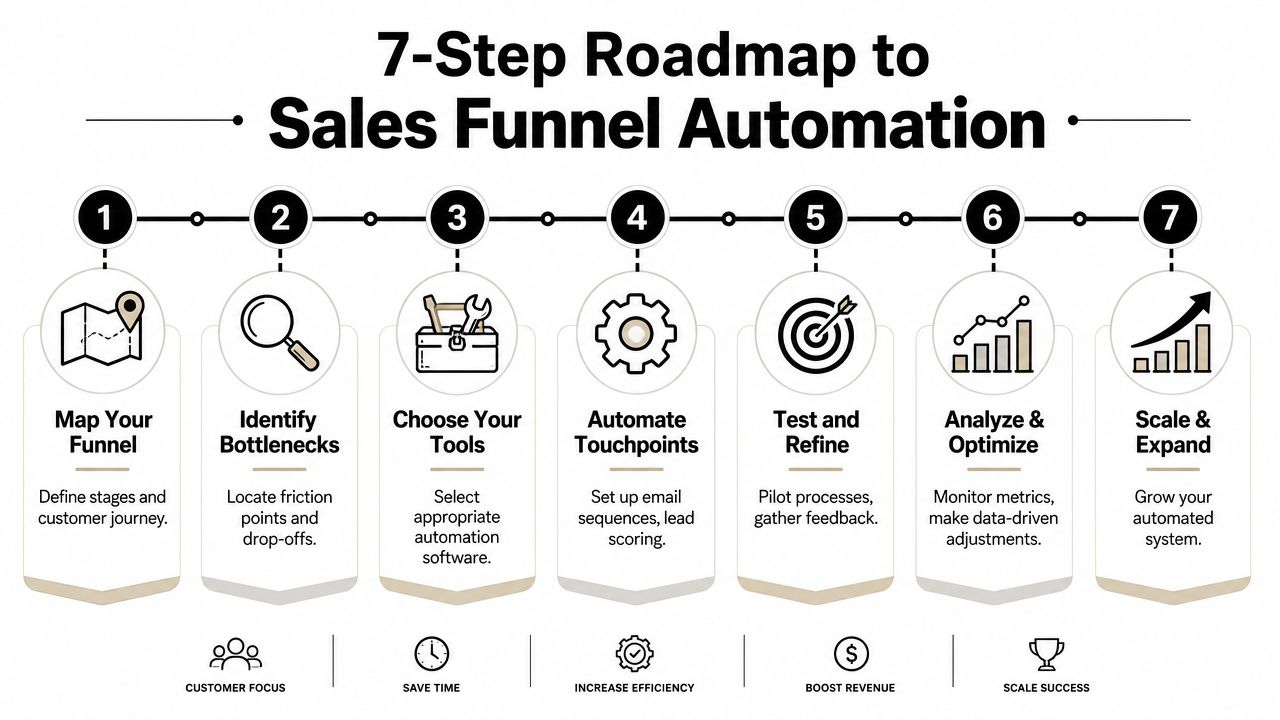
- Your 7-Step Roadmap to Implementing Sales Funnel Automation
Why Sales Funnel Automation Is No Longer Optional
Small business owners usually don't lose leads because they don't care. They lose them because manual follow-up breaks under normal operating conditions. Someone forgets to call back. A receptionist gets busy. An inquiry arrives after hours. A lead lands in the wrong inbox and sits there.
That used to be an inconvenience. Now it's a revenue problem.
Companies that integrate sales automation have seen a 14.5% increase in sales revenue, an 18% reduction in average sales cycle length, and about 5 hours of a sales professional's week freed up according to 2025 sales automation statistics. For an SMB, those hours matter because they usually come from the owner, a practice manager, or a small sales team already stretched thin.
The cost of staying manual
Manual processes fail in predictable ways:
- Responses arrive too late: A lead who asked a simple question yesterday often won't wait for a reply tomorrow.
- Admin crowds out selling: Your team spends time copying form submissions, forwarding emails, and checking calendars instead of speaking to qualified buyers.
- Consistency disappears: One staff member follows the script, another improvises, and a third forgets the follow-up entirely.
Practical rule: If the same task happens every day and the steps are predictable, automate it first.
That doesn't mean automating everything. It means automating the parts that don't need human judgment. Lead capture, first response, intake questions, scheduling prompts, reminder messages, and internal routing are good examples.
Why SMBs feel this pain first
Larger companies can hide inefficiency behind bigger teams. SMBs can't. When one person wears five hats, every missed handoff gets expensive fast. Automation gives smaller teams leverage. It keeps the front end of the funnel moving even when the business owner is busy doing actual client work.
If you're still handling every inquiry by hand, it's worth reviewing practical examples of automation for small business and looking at where your team loses time between first contact and booked appointment.
The core shift is simple. Stop treating follow-up like a memory test. Build a system that runs whether someone remembers or not.
What Is a Sales Funnel and How Does Automation Fit In
A sales funnel is just the path people take from first awareness to purchase. It sounds technical, but it isn't. It's similar to how someone moves through a physical store.
At the front window, they notice you. In the aisle, they compare options. At the counter, they decide whether to buy. Good staff help them at each point. A good automated funnel does the same online.
Think of the funnel like a real storefront
Most SMB funnels can be understood in four simple stages:
- Awareness: Someone finds your business through search, social, referral, or an ad.
- Interest: They browse your services, read a page, ask a question, or download something.
- Decision: They compare options, check pricing, look for trust signals, and decide whether to contact you.
- Action: They book, call, submit details, or buy.
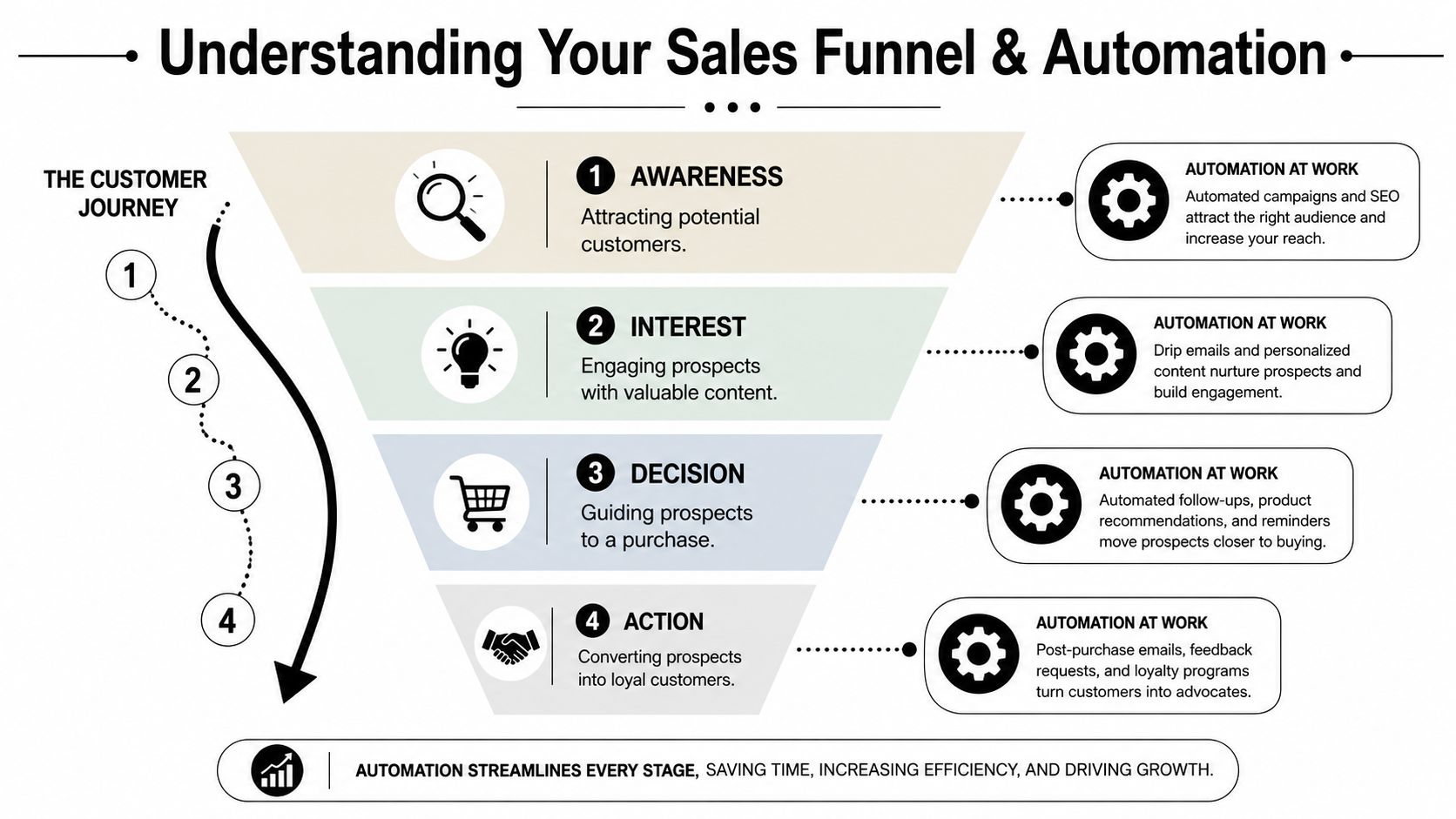
Without automation, businesses often treat these stages like isolated tasks. They post content. Then they wait. Then they answer inquiries when they can. Then they manually chase people who showed interest. That gap between stages is where leads drop out.
A well-organized automated funnel creates continuity. Businesses with that kind of system have seen revenue growth 18 times greater than those without one, and one reason is that automation helps cover the follow-up gap created when 44% of sales reps fail to follow up after an initial conversation, according to sales funnel statistics compiled here.
Where automation actually helps
Automation isn't magic. It's process discipline.
A useful way to think about it is this: automation becomes your most consistent employee. It doesn't improvise, forget, or get distracted. It greets visitors, asks the same qualifying questions every time, delivers the right brochure, and nudges the next step when interest appears.
Here's where it fits:
- At the top of the funnel: capture inbound interest from forms, chat, and social traffic.
- In the middle: send follow-ups based on behavior, not guesswork.
- At the bottom: route warm leads to scheduling, sales, or a location-specific team.
If you want a broader reference on how to build an effective sales funnel, that guide is useful for thinking through offer flow and handoff points before you start wiring tools together.
A funnel isn't a landing page. It's the full path from first touch to next action.
That distinction matters. Most SMBs don't need more pages. They need fewer dead ends.
Automating Each Stage of Your Sales Funnel
Once the funnel is clear, the next step is matching automation to buyer intent. At this stage, many businesses overbuild. They buy software meant for enterprise teams, then automate things nobody asked for.
A better approach is to automate one practical job at each stage.
Top of funnel capture
At the top, the goal is simple. Turn attention into identifiable interest.
That usually means:
- Website chat capture: Answer basic questions and collect contact details when someone is still browsing.
- Lead magnet delivery: Send a brochure, guide, menu, pricing explainer, or comparison sheet automatically.
- Channel response: Catch inquiries coming from website, Instagram, Facebook, or WhatsApp before they go stale.
At this stage, speed matters more than sophistication. You don't need a complex scoring model to greet a visitor and ask what they need.
Middle of funnel nurture
Most manual funnels leak badly. A person shows interest, but nobody follows up in a relevant way. They get a generic drip campaign or no response at all.
Behavior-based follow-up works better than calendar-based follow-up because it reacts to what the lead does. Behavioral email sequences outperform time-based sequences by 35% to 40% in lead-to-conversion rates when they respond to prospect actions and create a just-in-time educational experience.
That means your sequence should change based on signals like:
- Content viewed: Someone who looked at pricing needs a different message from someone who read a basic service overview.
- Downloads completed: A brochure request is stronger intent than a casual blog visit.
- Return visits: Repeated visits often signal comparison shopping or buying readiness.
If you want examples of how conversational intake connects with nurture, this lead generation chatbot playbook is useful because it focuses on what to ask before handing a lead to sales.
Bottom of funnel conversion
At the bottom, automation should reduce friction. This is not the place for long forms or vague “we'll get back to you” messages.
Use automation to:
- Offer scheduling: Give qualified leads a direct path to book.
- Send reminders: Reduce missed appointments and internal back-and-forth.
- Route correctly: Push inquiries to the right salesperson, clinic, branch, or service team.
Here's a simple planning table.
| Funnel Stage | Goal | Automation Tactic Example |
|---|---|---|
| Top of Funnel | Capture attention and contact details | Website chatbot answers FAQs and collects lead info |
| Middle of Funnel | Build trust and keep momentum | Behavioral email sequence triggered by brochure download |
| Bottom of Funnel | Turn intent into action | Appointment booking flow with reminders and internal routing |
Don't automate for novelty. Automate the next obvious step a buyer already wants to take.
That's the practical test. If the automation removes waiting, repetition, or confusion, it usually helps. If it adds extra clicks, extra forms, or generic messaging, it usually hurts.
Sales Automation in Action for Small Businesses
The easiest way to understand sales funnel automation is to look at a business that needs it badly. A multi-location dental practice is a good example because it has constant inbound questions, appointment demand, and location-specific routing problems.
A parent lands on the website at night looking for pediatric dentistry. Another visitor asks about teeth whitening on WhatsApp during lunch. A third wants emergency care and needs the nearest clinic. If staff handle all of that manually, speed drops and mistakes pile up.
A practical example with a multi-location dental practice
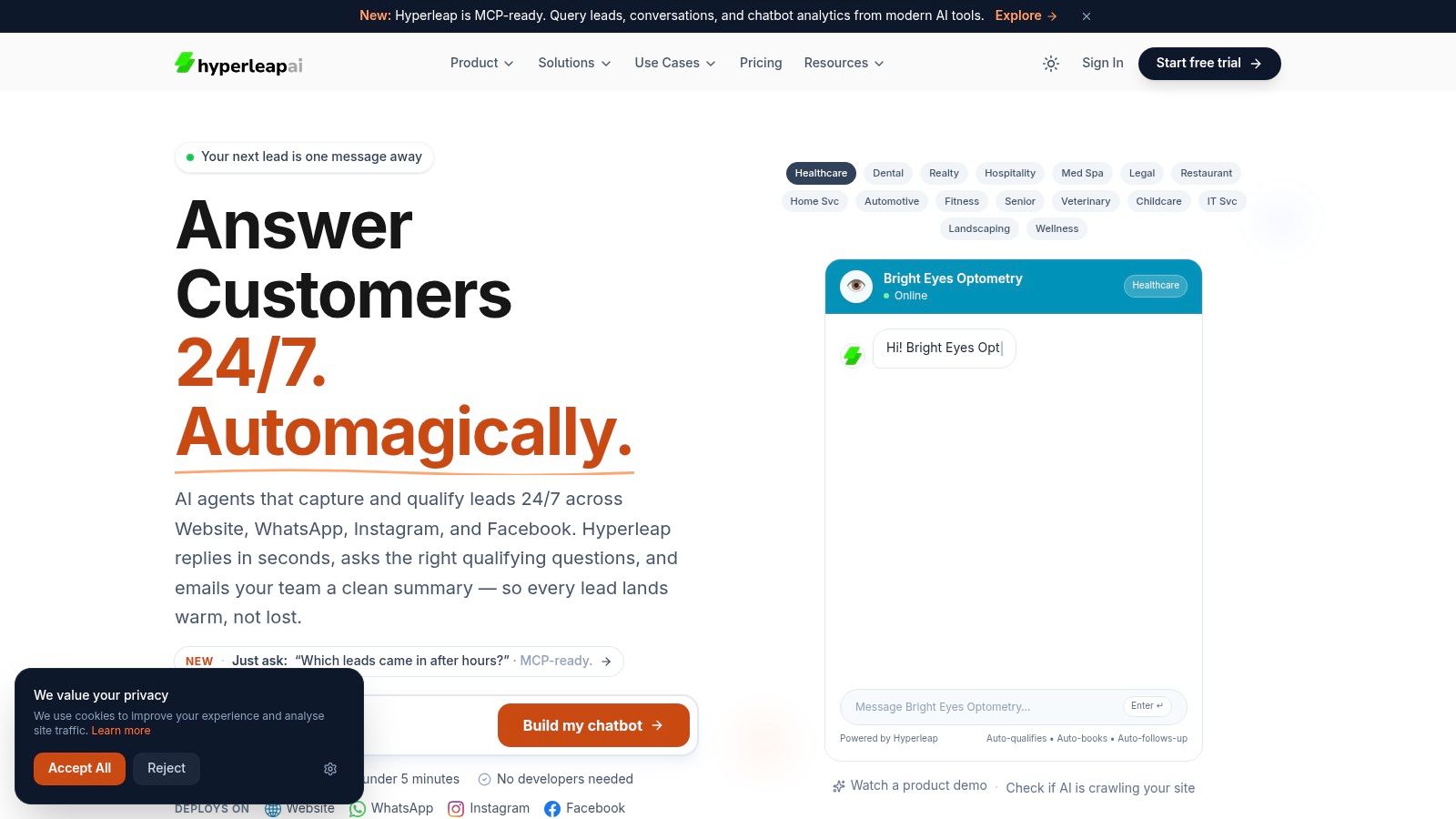
A practical setup looks like this.
First, the chatbot appears on the website and messaging channels to capture inquiries around the clock. It answers common questions, asks why the person is reaching out, and identifies the preferred clinic location.
Second, it qualifies the inquiry with a short branching conversation. Is this general dentistry, cosmetic work, implants, or an urgent issue? Is the person ready to book or just gathering information? Which location is most convenient?
Third, it sends the lead to the right destination. The pediatric inquiry goes to the clinic that offers that service. The emergency request goes to the nearest front desk. The cosmetic lead gets the relevant brochure and a scheduling prompt.
A single tool can manage significant front-end operations. Hyperleap AI is one example of a no-code chatbot platform that handles website and messaging conversations, routes leads by location, supports OTP-verified lead capture, and connects inquiries to scheduling workflows. For an SMB, that's useful because it reduces the need to stitch together separate chat, inbox, routing, and intake systems.
What makes conversational automation work
A lot of business owners have tried chatbots and hated them. Usually for good reason. The bot asked canned questions, missed context, and trapped visitors in loops.
Structured conversational workflows work differently. AI-powered conversational workflows can book demos 24/7 and achieve a 28% higher meeting-booking rate than traditional chatbots when they guide users from answering questions to requesting meetings.
The practical difference comes down to design:
- Good flow design: The conversation asks only what's needed to move to the next step.
- Clear qualification rules: The system knows what counts as a fit, what needs human review, and what should be routed elsewhere.
- Useful handoff: Staff receive the inquiry with context, not just a name and phone number.
Here's the kind of media walkthrough that helps teams visualize that setup in practice:
The business benefit isn't that the bot “talks like a person.” It's that the workflow removes dead time between interest and action. The lead gets help immediately. The correct team gets context. The customer doesn't have to repeat everything later.
When automation works, staff start their job at the informed handoff, not at data collection.
That's the ROI most SMBs care about. Fewer missed inquiries, less internal forwarding, and a faster path to booked appointments.
Key Metrics and Tools for Your Automated Funnel
Automation only helps if you can tell whether the funnel is getting healthier. That doesn't require a giant dashboard. It requires a short list of metrics tied to revenue and workload.
What to measure without overcomplicating it
Start with four basics:
- Lead conversion rate: How many inquiries move to the next meaningful step.
- Cost per lead: What you spend to generate each captured lead.
- Customer lifetime value: What a customer is worth over time, especially important for repeat-service businesses.
- Sales cycle length: How long it takes to move from first contact to sale or booking.
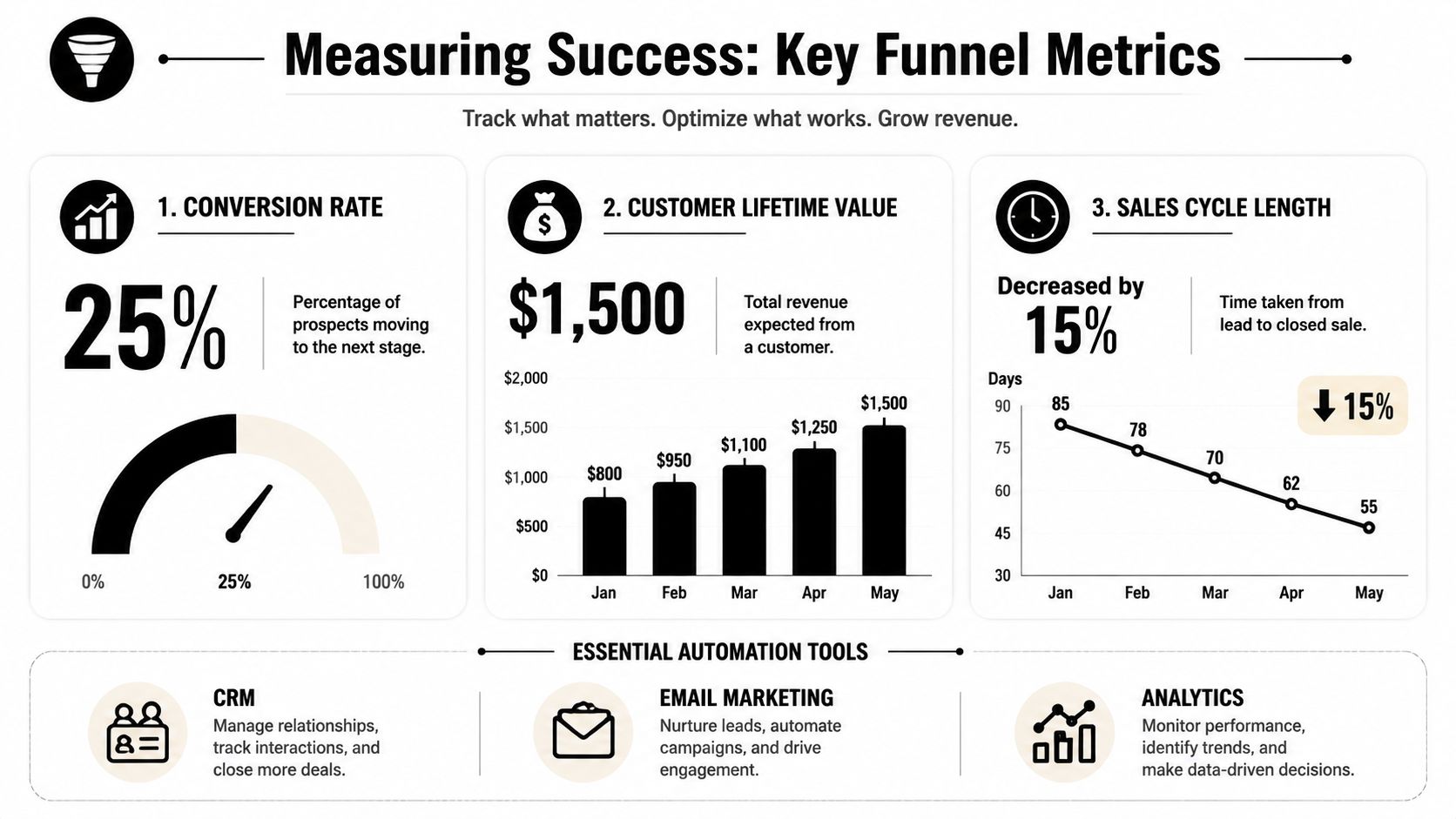
If your lead conversion rate looks weak, don't assume the offer is bad. Look at the handoffs first. Are people waiting too long? Are they getting generic follow-up? Are location-specific requests going to the wrong team? Metrics tell you where to inspect. They don't diagnose the whole problem by themselves.
For top-of-funnel creative, some SMBs pair their funnel with tools like ShortGenius automated ad generation to produce ad variations faster and test more entry points into the funnel. That kind of tool belongs at the acquisition layer. The funnel still has to qualify and convert the traffic it brings in.
Why fake leads ruin good decision-making
One problem gets ignored in too many automation setups: bad input.
An estimated 20% to 30% of contacts captured through standard web forms are fake or bot-generated, which distorts CRM data and wastes sales resources. OTP-verified lead capture can eliminate this data pollution at the source.
If your team is looking at inflated lead volume, every downstream metric becomes less trustworthy. Conversion rate looks worse than it really is. Cost per lead looks lower than it really is. Sales staff complain about “bad leads,” and they're often right.
Watch for these signs:
- Suspicious form quality: Nonsense names, throwaway numbers, or repeated low-intent submissions.
- Sales complaints: Reps say they're spending time on unreachable or irrelevant contacts.
- Misleading optimization: Marketing channels appear to perform well because they generate volume, but the volume isn't real.
A cleaner funnel starts with better capture. OTP verification, required qualification fields, and structured intake all improve what enters the system. If you're evaluating tools, this overview of an AI lead generation tool is a useful reference point for thinking about lead quality, not just lead quantity.
Better reporting starts before the report. It starts at the form, chat, or messaging entry point.
That's a practical lesson many SMBs learn late. Dirty data makes smart teams look confused.
Your 7-Step Roadmap to Implementing Sales Funnel Automation
Most businesses don't fail because automation is too hard. They fail because they try to automate the whole customer journey in one shot. Start with one path, one workflow, and one measurable outcome.
A practical rollout plan
Map your customer journey
Write down how people currently discover you, ask questions, evaluate options, and book. Don't make this theoretical. Use real examples from the last week.Define your funnel stages
Keep them simple. Inquiry, qualified lead, booked appointment, closed sale is enough for many SMBs. If stages are fuzzy, reporting will stay fuzzy.Choose your core tool
Pick the platform that will handle the most repetitive front-end work. For many service businesses, that's an AI chatbot or conversational intake tool connected to your website, messaging channels, and calendar.Build one automated workflow first
A strong first workflow is usually lead capture plus qualification plus scheduling prompt. It's visible, practical, and easy to judge.Integrate with your existing systems
Connect the workflow to your CRM, inbox, or calendar so staff don't have to re-enter the same information. If integration is weak, automation creates extra work instead of removing it.Test and monitor
Run through the experience yourself. Have staff do the same. Submit test inquiries for different services, channels, and edge cases.Optimize and expand
Once one path works, add nurture messages, better routing logic, reminders, and post-inquiry follow-up.
What to do if you have multiple locations
Single-location businesses can get away with rough processes for longer. Multi-location businesses usually can't. A 2025 report noted that 60% of multi-location SMBs struggle with inconsistent customer data routing, which is why location-specific automation should be planned from the start.
That means your setup should answer questions like:
- Which location should receive this inquiry?
- Do all locations offer the same services?
- Should brochures, pricing, or hours change by branch?
- Who gets notified when the lead is qualified?
If you don't solve that upfront, teams end up maintaining workarounds with manual forwarding, copied spreadsheets, and constant staff correction. That's not automation. That's admin with better branding.
The simplest successful rollout is usually the one that removes a real bottleneck first. After that, you can layer in smarter routing, behavioral nurture, cleaner reporting, and channel expansion without creating chaos.
If you want a practical starting point, Hyperleap AI is built for SMBs that need to capture leads, answer questions, route inquiries, and book appointments across website, WhatsApp, Instagram, and Facebook without a custom development project. It's especially relevant if fake leads and multi-location routing are already causing wasted time.