Capture Emergency Service Calls 24/7 Affordably
Home service businesses miss 27% of inbound calls. Learn 7 ways to capture emergency plumbing, HVAC, and electrical calls 24/7 without overnight staff.

TL;DR: Home service businesses miss 27% of inbound calls and 85% of voicemail callers never call back (Invoca) — meaning every after-hours emergency that hits voicemail is effectively a referral to your competitor. The fix is not a night hire or a generic answering service; it is an AI receptionist that captures calls across phone, web, WhatsApp, and social DMs, qualifies urgency, collects address and problem details, and routes true emergencies to your on-call dispatcher within seconds. Leads contacted within 5 minutes are 100x more likely to convert than those reached after 30 minutes (InsideSales / Convoso), and 78% of customers hire the first contractor who responds. This guide gives plumbing, HVAC, electrical, and roofing operators seven concrete ways to capture every emergency call 24/7 without adding overnight payroll.
It is 2:14 AM and a homeowner in Phoenix discovers water pouring through the kitchen ceiling. They grab their phone and call the first plumber that appears on Google. Voicemail. They call the second. Voicemail again. The third plumber has an automated system that responds instantly, confirms the emergency, collects the address, and dispatches an on-call technician. That plumber gets the $2,500 job. The other two never hear from the homeowner again.
This scenario is not hypothetical. Research from Invoca shows that home service businesses miss 27% of all inbound calls, and the miss rate climbs dramatically after business hours (Source: Invoca). Meanwhile, 85% of callers who reach voicemail will not call back -- they call the next contractor on their list (Source: Invoca / Dialzara). For emergency plumbing, HVAC, and electrical companies, those after-hours calls are often the highest-value jobs of the week.
The traditional fix -- hiring a night receptionist or subscribing to an answering service -- is expensive and inconsistent. But a new generation of AI-powered tools makes 24/7 emergency call capture affordable for even the smallest contractor. Here is how to set it up without adding overnight payroll.
Who This Guide Is For
What Is 24/7 Automated Call Capture for Home Services?
24/7 automated call capture is a system that ensures every customer inquiry -- phone call, website message, WhatsApp text, or social media DM -- receives an immediate response, regardless of when it arrives. For home service businesses, this means emergency calls at 2 AM get the same professional, qualifying response as calls at 2 PM.
Unlike a traditional answering service that simply takes a message, modern automated call capture systems can:
- Qualify the urgency level -- distinguishing a burst pipe from a dripping faucet
- Collect critical details -- address, type of problem, whether water or gas is involved, how many occupants are in the home
- Route emergencies to on-call staff -- escalating true emergencies to a dispatcher or technician immediately
- Schedule non-urgent requests -- booking a next-day callback or appointment for routine work
- Respond across multiple channels -- website chat, WhatsApp, Facebook Messenger, and Instagram DM simultaneously
- Provide accurate information -- service areas, pricing ballparks, and estimated response times based on your actual business data
This is fundamentally different from the rigid, menu-driven phone trees of the past. Modern AI chatbots use natural language understanding to have real conversations with homeowners, collecting the same information a trained dispatcher would -- but doing it instantly at any hour.
The distinction matters because home service businesses lose jobs to the contractor who answers first. Research shows that 78% of customers hire the first contractor who responds, and leads contacted within 5 minutes are 100 times more likely to convert than those reached after 30 minutes (Source: InsideSales / Convoso). Automated call capture closes that gap permanently.
Why Home Service Businesses Lose Emergency Jobs
Before diving into solutions, it is worth understanding exactly why emergency calls are so difficult for home service companies to handle. The problem is structural, not a sign of laziness or poor management.
After-Hours Calls Go Straight to Voicemail
Home service companies receive an estimated 8-12 after-hours calls per week (Source: Suzee AI). At an average emergency job value of $500, that represents $4,000-$6,000 per week in potential revenue -- over $200,000 annually -- reaching voicemail instead of a live person. In a market where response time directly impacts conversion rates, voicemail is effectively a "we are closed" sign that sends customers to your competitor.
The math is brutal: if 85% of voicemail callers never call back and your average emergency job is $500, every after-hours call that hits voicemail costs you approximately $425 in expected revenue.
Homeowners Contact Multiple Contractors Simultaneously
When a homeowner has a real emergency, they do not wait. They call 2-3 contractors in rapid succession. Research from Arcsite shows that 85% of homeowners contact 3 or fewer contractors before making a decision (Source: Arcsite Homeowner Survey). The window to win that job is measured in minutes, not hours. By the time you check your voicemail the next morning, the job was booked at 2:30 AM by the contractor across town who had automated response set up.
Seasonal Spikes Crush Your Capacity
HVAC companies see 3-4x normal call volume during the first heat wave of summer or the first hard freeze of winter. Plumbers are overwhelmed during freeze-thaw cycles. Roofers cannot keep up after major storms. These surge periods are when your highest-margin emergency work happens, and they are precisely when your existing staff cannot answer every call.
A two-person office that handles 40 calls per day during normal periods suddenly faces 120-160 calls during a surge. Even with perfect staffing during business hours, the after-hours overflow during these peaks represents tens of thousands in lost revenue.
Traditional Answering Services Fall Short
Many contractors have tried live answering services, only to be disappointed. Traditional answering services cost $200-$500 per month and typically offer:
- Basic message-taking with limited scripting
- No ability to qualify urgency or collect technical details
- Slow relay times -- messages may not reach the on-call technician for 15-30 minutes
- No multi-channel coverage (phone only, no web or messaging)
- Variable quality depending on the operator
The result is a half-measure that costs money but does not meaningfully improve capture rates for true emergencies. Homeowners can tell when they are talking to a generic call center, and it does not inspire confidence during a crisis.
7 Ways to Capture Emergency Service Calls Without a Night Receptionist
Here are seven proven approaches, ranging from simple configuration changes to AI-powered automation, that keep your phone ringing into revenue instead of ringing into the void.
1. Deploy an AI Chatbot on Your Website for Instant 24/7 Response
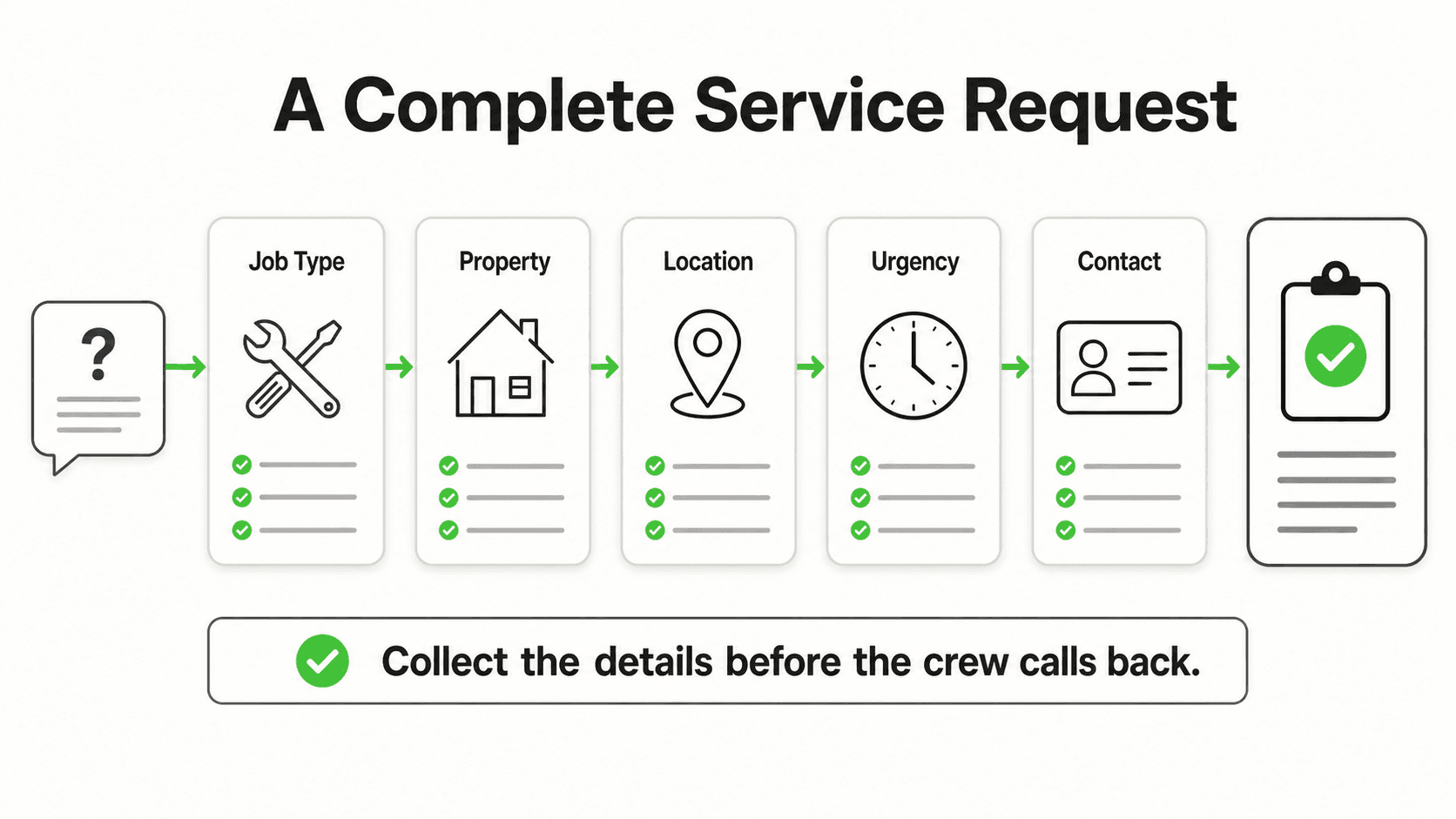
What this looks like in practice: A homeowner searches "emergency plumber near me" at 11 PM, lands on your website, and is immediately greeted by a chat widget. The AI chatbot asks what the problem is, determines it is a burst pipe, collects the address, and sends an alert to your on-call technician -- all within 90 seconds. The homeowner gets a confirmation message that help is on the way.
Real-world impact: AI chatbots can handle 80% of routine customer inquiries without human intervention (Source: Gartner). For home service businesses, the most common after-hours interactions -- "I have a leak," "My AC stopped working," "I smell gas" -- follow predictable patterns that AI handles well. The chatbot does not need to diagnose the problem. It needs to capture the lead, assess urgency, and route it correctly.
Why it works: Website visitors who engage with chat are 2.8 times more likely to convert than those who do not (Source: Forrester). When a homeowner in distress sees an instant response on your site at midnight, it signals that your company is responsive and professional. That first impression often determines who gets the job.
Key features to look for:
- Natural language understanding (not rigid menu trees)
- Custom training on your specific services, pricing, and service areas
- Emergency escalation rules that alert on-call staff immediately
- Multi-channel deployment (website, WhatsApp, Facebook Messenger)
2. Set Up Intelligent Call Routing with Urgency Detection
What this looks like in practice: Your phone system is configured so that after-hours calls are routed through an AI-powered triage layer. A homeowner calls about a gas smell and the system recognizes keywords like "gas," "smell," and "emergency," immediately forwarding the call to your on-call technician's cell phone. A homeowner calling about a dripping faucet gets a professional automated message confirming that the request is logged and they will receive a callback first thing in the morning.
Real-world impact: Not every after-hours call is an emergency. By intelligently sorting urgent from routine, you avoid burning out your on-call technicians with non-emergency calls while ensuring genuine emergencies get immediate human attention. This approach has been shown to reduce unnecessary after-hours dispatches while improving capture rates for true emergencies.
Why it works: The key insight is that homeowners do not mind an automated response for non-emergencies -- they mind getting no response at all. A system that acknowledges their request and gives a clear timeline ("You will hear from us by 8 AM tomorrow") is vastly better than voicemail silence. Meanwhile, true emergencies bypass the queue entirely.
Key features to look for:
- Keyword and intent detection for emergency classification
- Configurable escalation rules (gas leak = immediate; dripping faucet = next day)
- On-call rotation support for technician scheduling
- Fallback handling if the on-call technician does not answer within a set timeframe
3. Enable Multi-Channel Capture Beyond Phone Calls
What this looks like in practice: A homeowner's basement starts flooding at 1 AM. They are too stressed to navigate a phone tree, so they send a message on your Facebook page: "HELP flooding basement need plumber NOW." Your AI-powered system responds within seconds on Facebook Messenger, collects the address, and dispatches your on-call crew.
Real-world impact: Phone calls are no longer the only way customers reach out during emergencies. A growing share of consumers -- especially those under 40 -- prefer messaging over calling. Research shows that 60% of consumers under 40 prefer text-based communication for service inquiries (Source: Zipwhip / OpenPhone). By limiting your after-hours capture to phone only, you are invisible to a large segment of customers who reach out via web chat, WhatsApp, Facebook Messenger, or Instagram DM.
Why it works: Multi-channel presence means you are available wherever the homeowner reaches out, reducing friction in their moment of crisis. A home service AI agent that covers your website, WhatsApp, Facebook Messenger, and Instagram DM simultaneously captures leads that a phone-only setup misses entirely.
Key features to look for:
- Unified inbox across all messaging channels
- Consistent responses and qualification across every channel
- Channel-specific formatting (images, quick-reply buttons)
- Real-time notifications to your dispatch team regardless of source channel
4. Create a Self-Service Emergency Booking System
What this looks like in practice: Your website has a prominent "Emergency Service Request" form that is available 24/7. A homeowner with a burst pipe fills out a 4-field form (name, phone, address, problem description) and immediately receives a confirmation text and email: "Emergency request received. Our on-call technician will contact you within 15 minutes." The form submission triggers an alert to your dispatcher.
Real-world impact: Research from Zendesk indicates that 67% of customers prefer self-service over speaking to a company representative for straightforward interactions (Source: Zendesk). A well-designed emergency request form gives homeowners a fast, friction-free way to get help without waiting on hold or navigating an IVR menu. Combined with an AI chatbot, the form serves as a secondary capture method for homeowners who prefer filling out a form over chatting.
Why it works: Self-service booking removes the biggest barrier to after-hours lead capture: the assumption that "they are closed, I will call tomorrow." When homeowners see a clear emergency request option with an explicit response time promise, they submit the request instead of calling your competitor.
Key features to look for:
- Mobile-optimized form (most emergency searches happen on phones)
- Automatic confirmation via text and email
- Urgency classification based on problem type
- Direct integration with your dispatch or CRM system
5. Implement Automated Follow-Up Sequences for Every Inquiry
What this looks like in practice: A homeowner submits an after-hours request about an AC unit that stopped cooling. The system immediately confirms receipt and provides a timeline. At 7:30 AM, an automated follow-up is sent: "Good morning -- our team has your AC service request. A technician will call you within the hour to schedule today's visit. In the meantime, here are some troubleshooting steps..." At 8:15 AM, your dispatcher calls with a confirmed appointment time.
Real-world impact: The time between a homeowner's initial request and your first human follow-up is the highest-risk window for losing the job. Automated follow-up sequences bridge that gap. Even when you cannot dispatch a technician at 3 AM for a non-emergency, an automated sequence keeps the homeowner engaged and confident that help is coming -- reducing the chance they call a competitor in the morning.
Why it works: Speed of response directly affects conversion rates. But response is not binary -- it is a continuum. An immediate automated acknowledgment, followed by a scheduled morning follow-up, followed by a human call creates a chain of reassurance that a single voicemail callback cannot match.
Key features to look for:
- Time-based automation (immediate confirmation, morning follow-up, appointment reminder)
- Personalized messaging with the homeowner's name and problem type
- SMS and email delivery for redundancy
- Automatic cancellation of the sequence once a human takes over
Capture Every Emergency Call -- Day or Night
Hyperleap AI responds to homeowner inquiries instantly across your website, WhatsApp, and social channels. Qualify leads, route emergencies, and book appointments 24/7 (booking on Pro and Max).
Start Your Free Trial6. Train Your AI on Your Specific Services and Service Area
What this looks like in practice: Instead of deploying a generic chatbot that gives vague answers, you train your AI on your actual service offerings, pricing ranges, service area zip codes, and common emergency scenarios. When a homeowner in your service area asks "Do you handle water heater replacements?" at midnight, the AI responds: "Yes, we service water heaters including tank and tankless models. For emergencies like a leaking or non-functioning water heater, we can dispatch a technician tonight. What is your zip code so I can confirm you are in our service area?"
Real-world impact: Generic chatbot responses erode trust. Homeowners in crisis can tell when they are interacting with a bot that does not understand their problem. An AI trained on your specific business gives confident, accurate answers -- which services you offer, what zip codes you cover, approximate pricing ranges, and realistic response times. This builds the kind of confidence that turns a panicked midnight inquiry into a booked job.
Why it works: The difference between a generic chatbot and a business-trained AI is the difference between "I can help you with that" and "Yes, we replace water heaters in the Greater Phoenix area. Emergency dispatch is available tonight -- a technician can typically arrive within 60-90 minutes." The specificity signals competence. Platforms like Hyperleap AI let you train your chatbot on your own documents, FAQs, and service details so responses are accurate and reflect your brand voice.
Key features to look for:
- Document-based training (upload your service descriptions, pricing sheets, FAQs)
- Service area validation by zip code or city
- Custom response templates for common emergency scenarios
- Regular updates as your services, pricing, or coverage area change
7. Use Data to Optimize Your After-Hours Coverage Strategy
What this looks like in practice: After 60 days of automated call capture, you review the data. You discover that 43% of your emergency calls come between 6 PM and 10 PM on weekdays, 31% come on weekends between 8 AM and 6 PM, and only 26% come between 10 PM and 6 AM. You restructure your on-call rotation to have a dedicated evening dispatcher from 5 PM to 10 PM and rely on AI-only coverage for the late-night window.
Real-world impact: Most home service companies set up their after-hours coverage based on assumptions, not data. They either over-invest (paying a night receptionist to sit idle from midnight to 5 AM) or under-invest (sending everything to voicemail after 5 PM). Data-driven coverage lets you match your investment to actual demand patterns.
Why it works: When you know precisely when emergency calls arrive, you can allocate resources efficiently. A plumbing company that sees 70% of after-hours calls between 5 PM and midnight can staff a human dispatcher for that window and let AI handle the truly late-night calls -- delivering faster response during peak hours while keeping overnight costs near zero.
Key features to look for:
- Call volume analytics by hour of day and day of week
- Emergency vs. routine classification tracking
- Conversion rate tracking by response time
- Seasonal trend analysis for staffing planning
Real Results: What Home Service Businesses Are Achieving
When home service companies implement 24/7 automated call capture, the improvements show up across revenue, operations, and customer satisfaction.
Revenue Recovery
- After-hours leads captured instead of lost: Companies that deploy 24/7 response report recovering leads that previously went straight to voicemail, with some businesses attributing meaningful monthly revenue to jobs they would have otherwise missed
- Higher close rates on emergency calls: Plumbing companies that respond within 5 minutes convert leads at 8x the rate of those who respond in 30 minutes (Source: Vendasta / Convoso)
- Reduced ad waste: When every lead gets a response, your cost per acquired customer drops even if your ad spend stays the same
- Seasonal surge capture: AI-powered response handles 3-4x normal volume without missing a single inquiry
Operational Efficiency
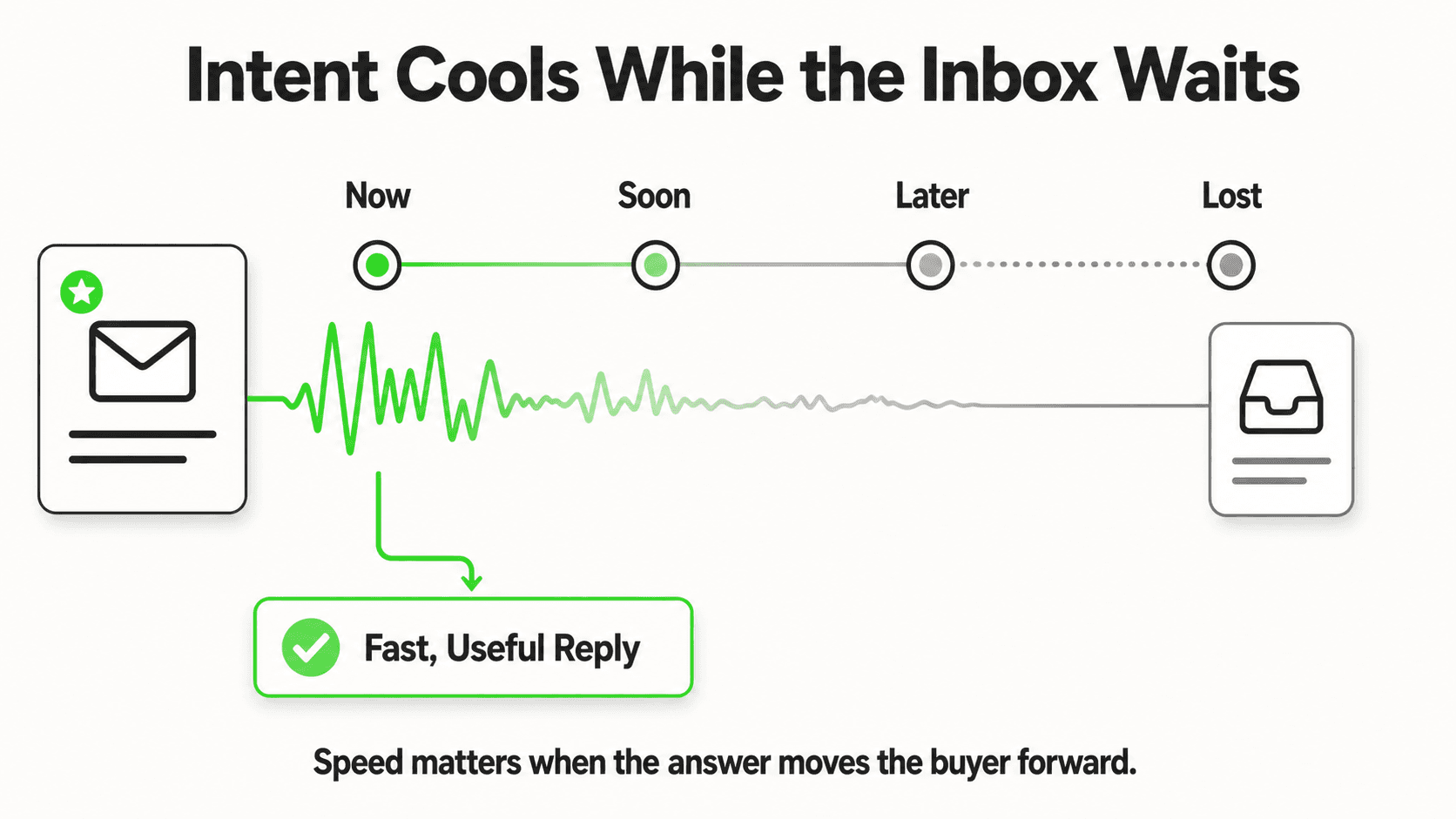
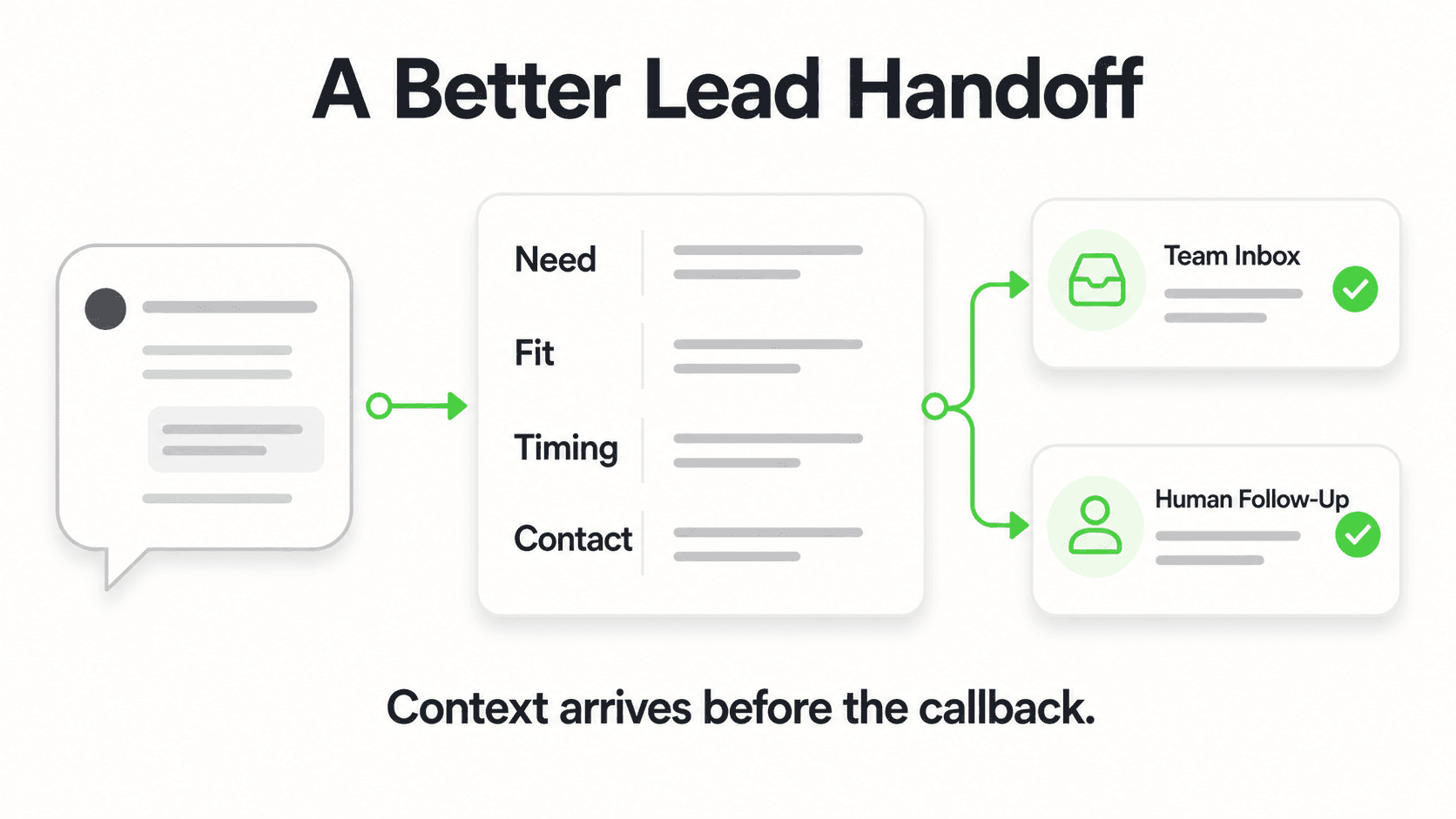
- Office staff focus on dispatching, not answering: Morning callbacks are pre-qualified with addresses, problem descriptions, and urgency levels already collected
- On-call technicians get actionable alerts: Instead of listening to voicemails, technicians receive structured alerts with the homeowner's address, problem type, and urgency level
- Fewer unnecessary after-hours dispatches: Intelligent urgency classification means on-call techs respond only to true emergencies, reducing fatigue and overtime costs
- Consistent lead qualification: Every inquiry gets the same thorough qualifying questions -- no more missed details or incomplete messages
Customer Satisfaction
- Instant acknowledgment builds trust: Homeowners get confirmation within seconds that their request was received, even at 3 AM
- Professional first impression at every hour: Consistent, knowledgeable responses regardless of time of day signal a well-run operation
- Faster emergency resolution: True emergencies get routed to on-call staff immediately, not discovered on a voicemail at 7 AM
- Positive review generation: Companies that respond quickly and resolve emergencies promptly earn the kind of 5-star reviews that drive future business
Implementation Roadmap for Home Service Businesses
You do not need to overhaul your entire operation to start capturing after-hours calls. Here is a phased approach that any home service business can follow.
Phase 1: Audit and Baseline (Days 1-7)
Start by understanding what you are currently missing:
- Pull your call logs: Check your phone system for total after-hours calls, missed call rates, and voicemail abandonment over the past 90 days
- Review your website analytics: How many visitors land on your site between 6 PM and 8 AM? What pages do they visit? Where do they drop off?
- Calculate the revenue gap: Multiply your average missed after-hours calls per week by your average emergency job value. This is your baseline cost of inaction.
- Survey your on-call technicians: Ask them what information they need from an after-hours inquiry to decide whether to dispatch immediately. This becomes your AI qualification script.
Quick Revenue Gap Calculation
Average missed after-hours calls per week (check your phone system) x average emergency job value x 52 weeks = your annual after-hours revenue gap. For a plumbing company missing 10 calls per week at $500 average value, that is $260,000 per year in potential revenue going to competitors.
Phase 2: Deploy 24/7 Automated Response (Days 8-21)
Implement the core capture system:
- Choose your platform: Select an AI chatbot that supports multi-channel deployment and custom training. Look for solutions designed for home services that understand urgency classification.
- Train the AI on your business: Upload your service descriptions, service area zip codes, pricing ranges, and common emergency scenarios. Write scripts for the top 10 questions homeowners ask.
- Configure urgency routing: Set rules for what qualifies as an emergency dispatch (gas leak, flooding, no heat in winter, no AC in extreme heat) versus a morning callback (slow drain, thermostat questions, maintenance requests).
- Deploy across channels: Go live on your website first, then add WhatsApp, Facebook Messenger, and Instagram DM as secondary channels.
- Test thoroughly: Have a friend or family member submit test inquiries at various hours. Verify that emergency alerts reach your on-call staff within the expected timeframe.
Phase 3: Optimize and Integrate (Days 22-45)
Refine based on real-world data:
- Connect to your CRM or dispatch software: Use REST API and webhooks to push qualified leads from your AI into ServiceTitan, Jobber, Housecall Pro, or your scheduling system
- Review conversation logs: Read through the first 2-3 weeks of AI interactions. Identify questions the AI struggled with and update its training.
- Adjust urgency thresholds: If your on-call technicians are getting too many non-emergency alerts, tighten the classification rules. If genuine emergencies are being deferred to morning, loosen them.
- Set up automated follow-up: Configure morning follow-up messages for non-emergency after-hours requests so homeowners hear from you before they start calling competitors.
Phase 4: Scale the Advantage (Day 46+)
Turn your after-hours capture into a competitive moat:
- Track ROI monthly: Compare jobs booked from after-hours inquiries against your pre-implementation baseline
- Expand coverage to new channels: Add any channels your customers use that you have not yet covered
- Build seasonal playbooks: Create specific AI responses for common seasonal emergencies (frozen pipes, AC failures, storm damage) so your system is ready before the surge hits
- Leverage reviews: Prompt homeowners who received fast emergency response to leave reviews mentioning your availability and speed
Capturing Every Emergency Call Starts Now
The math on after-hours call capture is straightforward. Home service businesses miss an estimated 27% of inbound calls. After-hours emergency calls represent some of the highest-value work in the industry. And 85% of callers who reach voicemail call a competitor instead of leaving a message.
Every night that your home service business sends emergency calls to voicemail, you are handing premium-priced jobs to the contractor down the street who figured out 24/7 coverage. The gap between businesses that capture emergency calls and those that do not will only widen as more contractors adopt AI-powered response tools and as homeowners increasingly expect instant availability.
The good news: you do not need a night receptionist, an expensive answering service, or a dedicated IT team. Modern AI chatbots trained on your specific services can qualify emergencies, collect critical details, and route urgent calls to your on-call technician -- all for less than the cost of a single missed emergency job per month.
The contractor who answers first wins the job. Make sure that contractor is you.
Further Reading
Authoritative external sources used and recommended for further research on this topic:
Frequently Asked Questions
Will an AI chatbot replace my dispatcher or office staff?
No. AI chatbots handle the initial capture and qualification that happens outside business hours or when your staff is busy. During business hours, your dispatcher remains the primary point of contact. The AI handles the overnight gap, the weekend surge, and the hold-time overflow. Think of it as adding a tireless first responder who works the shifts nobody else wants -- not replacing the team that runs your operation during the day.
How much does 24/7 automated call capture cost compared to a night receptionist?
A dedicated night receptionist costs $3,000-$5,000 per month in salary, benefits, and overhead. Traditional answering services run $200-$500 per month for basic message-taking. AI chatbot platforms like Hyperleap AI start at $40 per month for multi-channel coverage across your website, WhatsApp, Facebook Messenger, and Instagram DM. That is a fraction of the cost with broader channel coverage and more consistent response quality.
How long does it take to set up an AI chatbot for my home service company?
Most home service businesses can go from zero to live in 1-2 weeks. The setup involves uploading your service details, configuring urgency routing rules, and deploying the chat widget on your website and messaging channels. You do not need technical expertise -- if you can write an FAQ document about your services, you can train an AI chatbot. The first week is setup and training; the second week is testing and refinement.
What happens if the AI encounters a question it cannot answer?
Well-configured AI chatbots are designed to handle what they know and gracefully escalate what they do not. If a homeowner asks a question outside the AI's training -- like a detailed technical question about their specific equipment model -- the chatbot acknowledges the question, collects their contact information, and flags it for human follow-up. The homeowner gets an honest response ("I want to make sure you get an accurate answer -- let me have a specialist reach out to you") rather than a wrong one.
Can the AI actually dispatch a technician, or does it just take messages?
The AI itself does not dispatch technicians, but it can trigger dispatch workflows. When the AI classifies a call as a true emergency, it sends an immediate alert (SMS, push notification, or email) to your on-call technician or dispatcher with all the collected details -- address, problem description, urgency level, and homeowner contact info. The technician makes the dispatch decision with full context instead of listening to a garbled voicemail.
Do I need different AI setups for plumbing, HVAC, and electrical?
If you are a multi-trade company, you can typically use a single AI chatbot trained on all your service lines. The AI can be configured to ask which type of service is needed and route to the appropriate on-call technician. Plumbing emergencies go to the plumbing on-call; HVAC emergencies go to the HVAC on-call. For single-trade companies, the setup is even simpler -- your AI focuses on one service category with deep, specific knowledge.
What if my area has poor internet or my customers are not tech-savvy?
The beauty of multi-channel capture is that it supplements your phone line rather than replacing it. Customers who prefer calling still call -- and your phone system can be configured with intelligent after-hours routing. The AI chatbot on your website and messaging channels captures the additional customers who prefer text-based communication. According to research, 60% of consumers under 40 prefer messaging over calling for service inquiries, but phone calls remain popular across all age groups. You are adding capture methods, not removing any.
Ready to Capture Every After-Hours Emergency?
Hyperleap AI provides 24/7 automated response across your website, WhatsApp, and messaging channels -- qualifying leads and routing emergencies while you sleep.
Get StartedIndustry Solutions
See how AI chatbots work for these industries:
Related Articles
AI Receptionist for Home Services: The Complete Guide
An AI receptionist for home services answers overflow inquiries in chat, qualifies emergencies by trade, and routes jobs 24/7 across every service line.

AI Receptionist for Plumbers: Never Miss a Call Again
An AI receptionist for plumbers answers burst-pipe calls at 2am, qualifies emergencies, and routes jobs to your on-call tech — no night-shift hire needed.
AI Chatbot for Cleaning Services: Quotes & Bookings 24/7
See how an AI chatbot for cleaning services delivers instant quotes, books recurring cleanings, and captures after-hours leads your team would otherwise miss.
AI Receptionist for Landscaping Businesses
An AI receptionist for landscaping businesses answers quote and service questions 24/7, qualifies property details, and shares your booking link.