AI Chatbot for Beach Resorts: Seasonal Guide
How beach resorts use AI chatbots to capture bookings in peak season, reduce OTA dependency, and respond to guests 24/7.

11 PM in Sydney, Thursday night. A couple is planning their Bali anniversary trip, tab open on your resort's website. Three questions: room availability in July, early check-in, whether there's a sunset dinner option. They fill out the inquiry form and go to bed.
Your reservations team in Bali opens at 8 AM. By then, the couple has already booked through Booking.com.
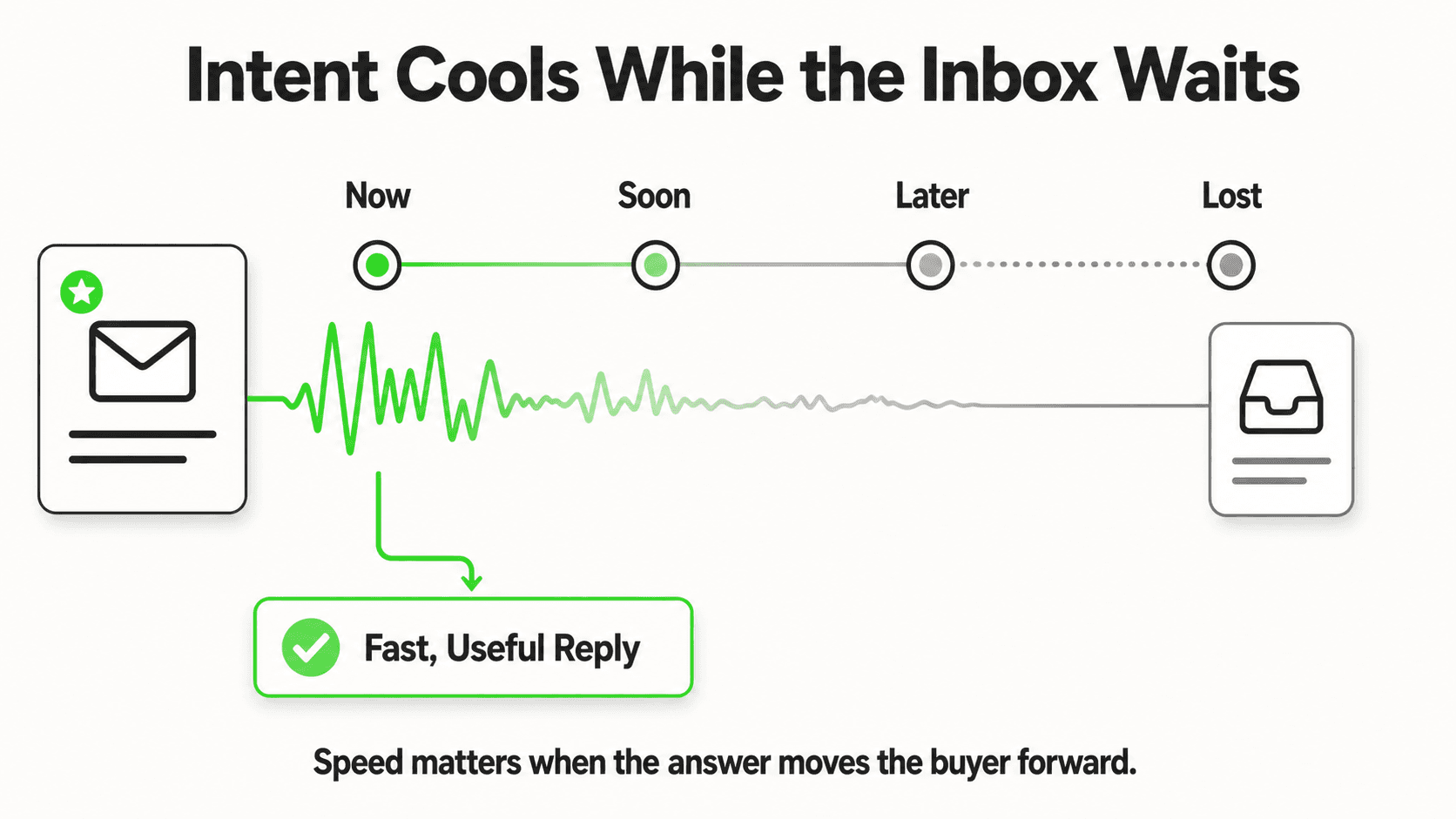
That's not a worst-case scenario we made up to scare you. According to Hyperleap AI's first-party deployment data, 35% of resort inquiries arrive outside standard business hours. And the people sending them aren't waiting around for morning. Beach resorts have it worse than city hotels here — your guests are spread across wildly different time zones, booking months out, comparing three or four destinations at once, and increasingly reaching out on Instagram DM or WhatsApp instead of email.
Then the economics kick in. OTA commissions at premium beach destinations — Bali, the Maldives, Phuket, Cancun, Costa del Sol — run 15–25% of room revenue, per Skift Research (2024). Every inquiry your team misses at 11 PM either becomes an OTA booking (expensive) or a competitor's booking (worse).
An AI chatbot built for beach resorts fixes both problems at once. It picks up every inquiry the second it lands, qualifies the guest, and holds your brand voice steady whether it's 8 AM or 2 AM — in English, Mandarin, Arabic, or Russian.
Who This Guide Is For
This guide is for general managers, revenue managers, and marketing teams at independent and boutique beach resorts in destinations like Bali, Phuket, Maldives, Cancun, Miami Beach, and Costa del Sol. If your property relies on OTA channels and struggles to convert after-hours inquiries into direct bookings, this guide will show you a practical path forward.
What Is an AI Chatbot for Beach Resorts?
It's a conversational AI agent trained on your property's specifics — room types, package deals, policies, activities, local attractions, transfer options, seasonal pricing — and deployed wherever your guests actually message you: website chat widget, WhatsApp Business, Instagram DM, Facebook Messenger.
Old-school rule-based chatbots answer a fixed menu of questions and nothing else. A modern AI resort chatbot reads natural language in multiple languages, keeps track of context across a conversation, and hands off to your team when something needs a human — wedding planning, VIP requests, a medical concern.
For beach resorts specifically, four things matter more than anywhere else:
- Multi-language capability. Bali pulls in Indonesian, Australian, Chinese, and Japanese guests. The Maldives draws Arabic, Russian, and European visitors. Cancun sees Americans, Canadians, Latin American travelers. One chatbot has to speak to all of them, fluently.
- Seasonal context awareness. The chatbot needs to know July–August is peak Bali season and adjust its availability messaging and early-booking push accordingly.
- OTA-displacement logic. Trained to surface direct-booking advantages — best rate guarantee, complimentary transfers, room upgrades — right at the moment the guest is deciding.
- After-hours capture. Answers the inquiries that would otherwise sit untouched until morning, by which point plenty of guests have booked somewhere else.
Why Beach Resorts Struggle More Than Other Hotels
Beach resorts aren't just hotels with a better view. The business model creates operational pressure that standard hospitality software was never built to handle.
The Global Time Zone Problem
A resort in Bali (UTC+8) serves guests planning from London (UTC+0), New York (UTC-5), Dubai (UTC+4). Front desk closes at 10 PM Bali time? That's 2 PM in London, 9 AM in New York — peak planning hours for your most valuable long-haul guests. The inquiry landing at 11 PM Bali time isn't some late-night impulse. It's a business-hours query from a market you badly want to win.
Phuket has the same problem with European winter travelers. Cancun sees peak inquiry traffic from US time zones running 1–3 hours behind Mexican Central time. Maldives resorts deal with Gulf and Eastern European guests whose schedules line up with nothing about the property's operating hours.
Peak Season Demand Spikes
During peak season — July–August in Bali and the Mediterranean, December–April in the Maldives, Christmas and spring break in Cancun — inquiry volume can jump 3–5x over shoulder months. Teams that handle off-peak fine become the bottleneck. Responses slow down, follow-ups get missed, bookings slide to OTAs that nobody had time to stop.
Per the World Travel & Tourism Council (2025), peak-season occupancy at premium beach destinations can hit 92–98%. But conversion from inquiry to direct booking drops off hard once response time crosses four hours — a bar most understaffed reservation desks can't clear consistently during peak.
Multi-Language Guest Expectations
Bali pulled in over 5 million international visitors in 2024, per Indonesia's Ministry of Tourism (2025) — Australians, Chinese, Indian, Japanese, South Korean, British, and Southeast Asian travelers all in the mix. Cancun's Riviera Maya corridor welcomed visitors from over 60 countries, according to the Quintana Roo Tourism Board (2024). Every one of those markets carries its own language preference, its own communication norms, its own way of deciding to book.
A Chinese guest asking about airport transfers wants a different tone and level of detail than an Australian guest asking the same thing. Doing this manually, at scale, isn't realistic for most teams. It's exactly the kind of consistency an AI chatbot trained on multi-language content handles well.
OTA Commission Pressure
Booking.com, Expedia, Agoda — the major OTAs charge beach resorts 15–25% of room revenue, per Skift Research (2024). On a $400/night beachfront villa, that's $60–$100 in commission per night. Over a 7-night stay: $420–$700 gone, compared to what a direct reservation would have kept.
Resorts with strong direct-booking strategies consistently outperform their competitive set on RevPAR. A chatbot that catches after-hours inquiries and converts them before the guest lands on Booking.com is one of the highest-ROI tools an independent property can deploy.
7 Ways Beach Resorts Use AI Chatbots to Drive Direct Bookings
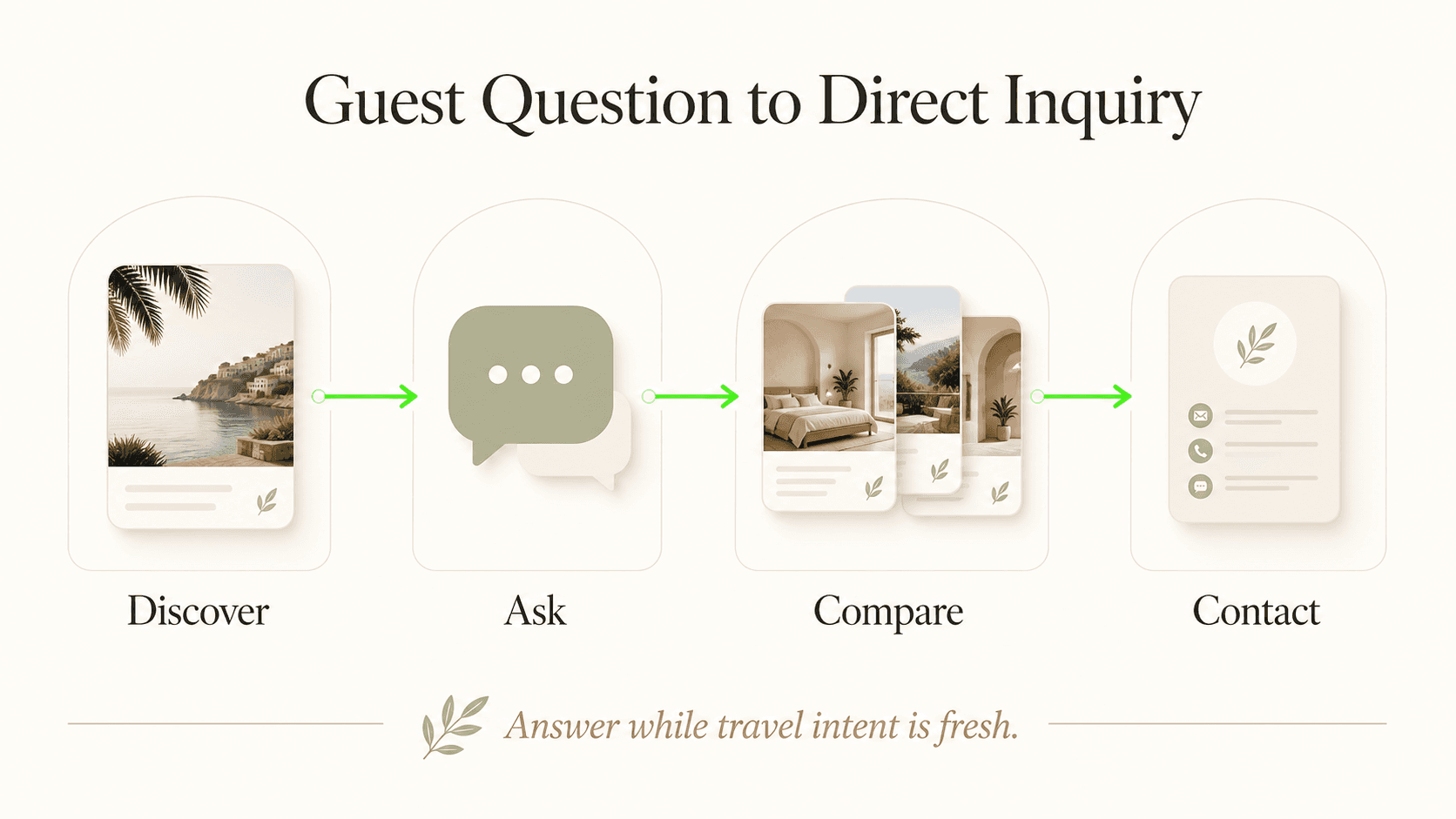
7 Core Capabilities Beach Resorts Deploy
1. After-Hours Inquiry Capture Across Global Time Zones
Your reservations team clocks out. Your chatbot doesn't. This isn't a nice-to-have — it's the core revenue capability for any beach resort with an international guest base.
What this looks like in practice: A potential Maldives guest in Moscow sends an Instagram DM at 11 PM Moscow time about water villa availability for their September anniversary. The chatbot answers instantly, confirms availability, walks through seaplane versus speedboat transfer options, drops a direct booking link with the best available rate, and captures the guest's contact info with consent. All while your team in Malé is asleep.
Real-world impact: In Hyperleap AI's deployment with Jungle Lodges (Karnataka, India), 35% of all inquiries arrived after business hours. The AI captured and qualified every one, contributing to 3,300+ leads in 90 days. Beach resorts with similar after-hours patterns tend to see comparably outsized returns from staying available round the clock.
Why it works: Guests in research mode don't wait. Salesforce's State of Connected Customer (2024) found 83% of consumers expect an immediate response when they contact a business. For a leisure booking involving real money, a fast, informative reply builds trust. Silence does the opposite.
Key features:
- Simultaneous deployment on website chat, WhatsApp, Instagram DM, Facebook Messenger
- Consistent brand voice and accurate information across all channels
- Automatic lead capture with guest name, contact details, travel dates, and room preferences
2. Multi-Language Guest Communication
A resort chatbot that only speaks English is leaving money on the table. Your biggest demand markets are full of travelers who are far more comfortable in Mandarin, Arabic, Russian, Spanish, or Japanese than English.
What this looks like in practice: A Chinese couple planning their Bali honeymoon messages about villa options in Mandarin on WhatsApp. The chatbot replies fluently, describes the romantic villa package, covers the private pool and spa services, and gently surfaces the direct-booking advantage — 10% off the OTA rate, complimentary airport transfer. No staff involved, no delay.
Real-world impact: Resorts in Bali report Chinese and Australian guests among their largest booking segments by room nights and revenue. The Maldives has seen fast growth in Arabic-speaking Gulf guests, especially from Saudi Arabia and the UAE, as air connectivity has expanded. On the Riviera Maya, Cancun's US Spanish-speaking market is one of the fastest-growing booking segments.
Why it works: Language is the first trust signal in any conversation. A guest replied to in their own language is far more likely to keep talking, share their preferences, and book. Multi-language chatbots also remove the staffing headache of keeping multilingual reservations coverage around the clock.
Key features:
- Automatic language detection and response in the guest's language
- Trained on culturally appropriate communication styles per source market
- Handles mixed-language queries gracefully (many guests switch between English and their native language mid-conversation)
3. Direct Booking Incentive Promotion
The best moment to pitch a direct booking is while the guest is asking questions — not after they've already booked on Booking.com. A chatbot with smart direct-booking logic drops the right incentive at exactly the right point in the conversation.
What this looks like in practice: A Miami Beach boutique resort guest asks about standard room pricing. The chatbot quotes the rate, then adds: "Our direct rate includes complimentary breakfast for two and guaranteed early check-in. Booking.com doesn't include either. Want to lock in the direct rate?" One line, delivered consistently across every channel, and the direct-to-OTA ratio starts to shift.
Why it works: Most guests have no idea there's a price or value gap between booking direct and booking through an OTA. The moment they're already talking to your property is the highest-intent, lowest-resistance moment to tell them. A chatbot that delivers this message every time — politely, accurately, without pushing too hard — turns every inquiry into a shot at a direct booking.
Key features:
- Configured with your direct booking advantages (best rate, complimentary add-ons, room upgrades, flexible cancellation)
- Provides booking link directly in the chat conversation
- Tracks conversion from chatbot conversation to direct booking
4. Seasonal Package Promotion and Upselling
Beach resorts live and die by yield management. A chatbot configured with current seasonal promotions, package offers, and availability calendars upsells consistently, in every conversation, without staff needing to memorize whatever offer is running this month.
What this looks like in practice: A couple asks about Phuket accommodation in November — low season. The chatbot surfaces the property's November value package: room plus daily breakfast, longtail boat sunset cruise included, 30% below peak pricing. It explains why November is actually a good time to visit (fewer crowds, quieter beaches, still outside monsoon), handles the hesitation about off-peak travel, and closes the booking.
Real-world impact: Shoulder-season conversion is one of the highest-leverage revenue levers a beach resort has. Per Phocuswire (2024), resorts that proactively pitch shoulder-season packages with real value storytelling see meaningful gains in low-season occupancy without cutting rates across the board.
Why it works: Seasonal packages don't sell themselves — a guest browsing in November has no idea there's a special offer unless someone tells them. A chatbot configured with current packages surfaces that information right when the guest is weighing their options.
Key features:
- Seasonal package library updated as offers change
- Smart matching of guest travel dates to relevant packages
- Complimentary offer stacking (e.g., "Book 7 nights and the fifth night is complimentary")
5. Pre-Arrival Concierge and Activity Booking
The relationship doesn't end when the booking confirmation email goes out. Beach resort guests have real pre-arrival needs — activity reservations, dietary preferences, equipment rentals, spa bookings, transport logistics. Handling this 24/7 keeps guests happy and takes weight off pre-arrival staff.
What this looks like in practice: A Costa del Sol villa guest, booked eight weeks out, sends a WhatsApp message asking to pre-book snorkeling, request a high chair for a toddler, and confirm the gluten-free breakfast option exists. The chatbot handles all three, logs them against the reservation, and sends a confirmation summary. No staff member has to dig up the booking.
Why it works: Pre-arrival touchpoints are strong predictors of overall guest satisfaction. Guests who feel looked after before they even arrive tend to leave better reviews, spend more on property, and come back. Medallia (2024) found hotels that handle pre-arrival requests efficiently score noticeably higher on post-stay satisfaction.
Key features:
- Integration with your booking confirmation system via webhooks (Pro and Max)
- Activity and dining availability information kept current
- Pre-arrival preference capture routed to the relevant department
6. In-Stay Guest Services and Issue Routing
During the stay, guests would often rather text than call the front desk or walk to the lobby. A chatbot handles the routine stuff instantly and routes anything real to the right staff member right away.
What this looks like in practice: A Maldives water villa guest messages at 9 PM for extra towels, a late checkout extension to 1 PM, and the villa WiFi password. The chatbot confirms the towel request (routed to housekeeping via webhook), checks checkout availability, sends the WiFi credentials — three tasks handled without waking a front desk agent.
Why it works: Response speed during the stay shows up directly in review scores. TripAdvisor and Google review patterns consistently flag response time and staff availability as satisfaction drivers. At a premium resort charging $500+ a night, guests expect fast answers. A chatbot handling routine requests immediately, any hour, kills the most common source of small friction.
Key features:
- Housekeeping and maintenance request routing via webhooks (Pro and Max)
- Checkout extension requests flagged to front desk with context
- Information queries answered from property knowledge base (WiFi, pool hours, restaurant menus)
7. Post-Stay Review and Feedback Collection
The conversation shouldn't stop at checkout. A chatbot can trigger personalized post-stay outreach on WhatsApp or Instagram to request reviews, capture feedback, and invite return bookings — automatically, no staff follow-up required.
What this looks like in practice: Twenty-four hours after checkout, a guest who stayed at a Cancun beachfront resort gets a WhatsApp message: "Hi Maria, we hope you had a wonderful stay. We'd love to know how your experience was." The chatbot collects the feedback. Happy guests get invited to leave a TripAdvisor or Google review with a direct link. Anyone who signals dissatisfaction triggers an immediate notification to the guest relations manager.
Why it works: Review velocity drives a beach resort's OTA ranking and direct-booking conversion more than almost anything else. Properties that keep reviews flowing consistently beat their competitive set on visibility and click-through. Manual post-stay follow-up needs dedicated staff time — and that's exactly the kind of task that slips during peak season. Automating it removes the dependency entirely.
Key features:
- Automated post-stay trigger (configurable delay: 24–48 hours after checkout)
- Sentiment detection to route happy guests to review platforms and unhappy guests to staff
- Return booking offer delivered to satisfied guests at peak intent moment
Stop Losing After-Hours Bookings to OTAs
Hyperleap AI deploys across your website, WhatsApp, Instagram DM, and Facebook Messenger—capturing every inquiry the moment it arrives, in any language, at any hour.
Start Free TrialReal Results: What Beach Resorts Are Achieving
Captured Revenue from After-Hours Inquiries
The fastest, most measurable win beach resorts see after deploying a chatbot is simple: inquiries that used to go unanswered until morning now get converted.
In Hyperleap AI's deployment with Jungle Lodges — a multi-property resort group in Karnataka, India — the system captured 3,300+ leads in 90 days, 35% of them arriving outside business hours. Jungle Lodges is an eco-resort, not a beachfront property, but the inquiry volume and after-hours pattern map directly onto international beach resorts juggling multiple time zones.
For resorts with average daily rates of $300–$600 a night — where one captured booking means $2,100–$4,200 in direct revenue over a 7-night stay — this capability alone tends to pay for itself fast.
Reduced OTA Commission Dependency
Direct booking rates tend to climb once a resort's chatbot is actively pushing direct-booking advantages at the moment of inquiry. Deliver "book direct and save" consistently, on every channel, every hour, and a meaningful share of bookings shifts from OTA to direct over 3–6 months.
The math adds up quickly: shifting OTA share down by even 10 percentage points on a 100-room resort with a $400 ADR recovers roughly $150,000 a year in commission costs, assuming 70% occupancy and a 20% average OTA commission (illustrative calculation; results vary by property).
Improved Guest Satisfaction Scores
Faster responses to pre-arrival and in-stay requests translate pretty reliably into higher review scores. Properties answering within minutes instead of hours get guests who arrive better prepared, with preferences already on file, more confident in the property before they've even checked in. Less friction on arrival, better sense of being taken care of.
Staff Workload Reduction During Peak Season
During peak season, reservation teams at busy resorts field hundreds of nearly identical questions: "What's included in the package?" "Is airport transfer included?" "Can I check in early?" A chatbot handles all of it without staff involvement — freeing reservations agents for the complex stuff: VIP handling, group bookings, and upselling suite categories, where a human actually moves the needle.
Implementation Roadmap for Beach Resorts
Phase 1: Foundation (Days 1–7)
Setup starts with knowledge base construction. You'll be feeding the chatbot:
- Room type descriptions, photos, and differentiators
- Seasonal package details and pricing
- Included amenities and chargeable extras
- Activities list with pricing and booking requirements
- Transfer options (airport to property, inter-island, excursions)
- Policies (cancellation, check-in/checkout, children, pets)
- FAQs from your reservations team
Most properties get through this in a working week. Then the chatbot gets tested against real inquiry scenarios, in every language you plan to support, before it goes live.
Phase 2: Channel Deployment (Days 8–14)
Deploy on your highest-traffic channels first. For most international beach resorts, that order is:
- Website chat widget — Captures guests already on your site who are in high-intent research mode
- WhatsApp Business — Essential for resorts serving Asian, Middle Eastern, and Indian Ocean market guests
- Instagram DM — Increasingly the first point of contact for younger leisure travelers
- Facebook Messenger — Important for North American and European markets
Phase 3: Optimization (Days 15–30)
After two weeks live, dig into the conversation logs and look for:
- Common questions the chatbot is not answering confidently (expand the knowledge base)
- Inquiry topics that frequently escalate to staff (improve chatbot responses for these)
- Language patterns from specific source markets (refine language-specific responses)
- Drop-off points in conversations (simplify the flow to booking link delivery)
Phase 4: Revenue Integration (Day 30+)
Once the chatbot is reliably handling inquiries, layer in the revenue capabilities:
- Direct booking link delivery with best-rate messaging
- Seasonal package promotion logic
- Post-stay review collection triggers
- Pre-arrival preference capture connected to your PMS via webhooks
What About Property Management System Integration?
Hyperleap AI connects to your existing systems via REST API and webhooks, allowing real-time data flow for lead capture, guest preferences, and service requests. For PMS-specific native integrations, consult your PMS vendor's API documentation—Hyperleap's webhook architecture (Pro and Max) supports custom connectivity with most modern PMS platforms.
Data Sources
- Hyperleap AI Jungle Lodges deployment case study (2024)
- Skift Research, "OTA Commission Rates at Independent Hotels and Resorts" (2024)
- Salesforce, State of the Connected Customer (2024)
- Indonesia Ministry of Tourism, International Visitor Statistics (2025)
- Quintana Roo Tourism Board, International Arrivals Report (2024)
- World Travel & Tourism Council, Beach Destination Occupancy Analysis (2025)
- Phocuswire, Shoulder Season Revenue Optimization (2024)
- Medallia, Pre-Arrival Guest Experience Study (2024)
The Competitive Advantage Starts Tonight
Resorts that deploy AI chatbots aren't just patching an operational gap — they're building a structural revenue edge. Every night your AI is answering and your competitor's reservations team is asleep, you're picking up guests they're dropping. Every direct booking your chatbot closes is commission revenue that stays on your books instead of Booking.com's.
The beach resort market doesn't have room for slow responders. Guests looking at Bali, Phuket, Cancun, or the Maldives have dozens of properties competing for that one booking. The properties that answer first, in the guest's own language, with a real reason to book direct, win a disproportionate share of the high-value stays.
None of this is hard to deploy, and the return shows up fast — often within the first month. The real question isn't whether beach resorts need this. It's which properties move first.
Learn more about the full hospitality agent capabilities or explore how hotels capture more after-hours revenue.
Further Reading
Authoritative external sources used and recommended for further research on this topic:
- Skift hospitality research
- Phocuswright travel and hospitality data
- STR / CoStar hotel performance benchmarks
Frequently Asked Questions
Can an AI chatbot handle the complex inquiries that luxury beach resort guests typically ask?
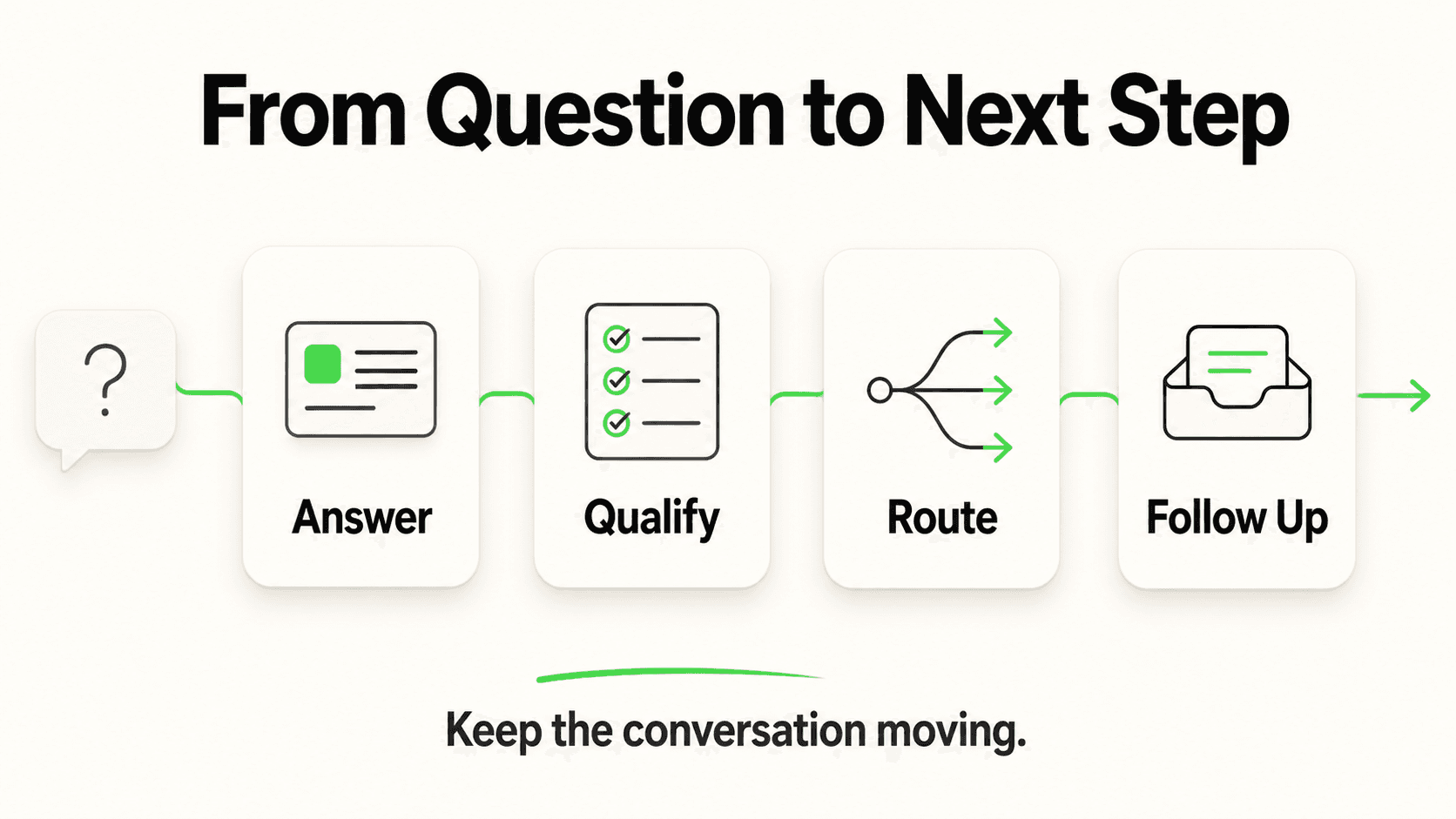
Yes — modern AI chatbots are a different animal from the rule-based systems of five years ago. Trained on comprehensive property knowledge (room-by-room details, package nuances, activity specifics, local area info), a well-configured chatbot handles the vast majority of pre-booking inquiries accurately and conversationally. For the genuinely complex requests — wedding planning, multi-villa group bookings, medical requirements — the chatbot recognizes the situation and hands off to a specialist on your team with full conversation context attached. The goal isn't replacing human judgment on hard cases. It's making sure your humans only handle the cases that actually need them.
Will a chatbot work for guests who prefer speaking with a person?
Yes. The chatbot is built to complement your team, not replace it. On Hyperleap AI's Pro and Max plans, guests who ask to speak with someone get handed off immediately, full conversation history attached, so they never have to repeat themselves. Most guests, in practice, are perfectly happy chatting with a bot for routine stuff — especially after hours, when they already know staff aren't around anyway. It removes the "no response until morning" experience without taking away the human option for guests who want it.
How long does it take to set up a beach resort AI chatbot?
Most resorts go live in 5–7 working days for the core setup. The main input needed from your side is a solid knowledge base — existing FAQ docs, room descriptions, package details, policy documents. Hyperleap AI's guided setup structures that into the chatbot's knowledge base. Connecting channels (website, WhatsApp, Instagram, Facebook) is straightforward and quick, whether your web team handles it or Hyperleap's setup support does. See the full hospitality agent details here.
How does the chatbot handle multi-language guests without mistranslating important information?
The chatbot is trained directly on content in the languages you configure — it's not running real-time translation of English text. That distinction matters. Translation produces awkward, sometimes inaccurate phrasing; natively trained multi-language content reads naturally and stays accurate. For your key languages — Mandarin, Arabic, Russian, Spanish, French, whichever represents real source markets — we recommend providing native-language versions of your core property information at setup. Lower-volume languages can default to English with a polite note.
What channels do guests use most at beach resorts, and does the chatbot cover all of them?
Depends heavily on the source market. Australian, European, and North American guests tend to reach out via website chat or Instagram DM. Asian guests — China, India, Southeast Asia especially — lean hard toward WhatsApp. Middle Eastern guests split between WhatsApp and Instagram DM. Hyperleap AI covers all four primary channels: website chat widget, WhatsApp Business, Instagram DM, Facebook Messenger. That multi-channel spread means you catch the inquiry wherever the guest chooses to send it. See WhatsApp automation for hotels and resorts for the WhatsApp-specific breakdown.
Does the chatbot replace my reservations team or make some of them redundant?
No. It handles the high-volume, repetitive stuff — availability, package details, pricing, policies, activity info — and frees your reservations team for the work that actually needs a person: revenue optimization, VIP handling, group bookings, the relationship conversations that turn a one-time guest into a repeat one. At most properties, the chatbot cuts down significantly on the time agents spend answering the same FAQ over and over, without touching headcount. This is about productivity and revenue capture, not replacement. See ways hotels use AI to increase direct bookings for more.
What does a beach resort AI chatbot cost, and how does it compare to the revenue it generates?
Hyperleap AI plans start at $40/month (Plus), with a 7-day free trial. For a resort that picks up even one or two incremental direct bookings a month that would've otherwise gone to an OTA, the commission savings alone usually cover the subscription several times over. After-hours capture — recovering leads that would've simply vanished — is upside on top of that. Full pricing and plan details are on the pricing page.
Ready to Capture Every Beach Resort Inquiry?
Hyperleap AI deploys in days, works across all your guest channels, and pays for itself with the first direct booking it captures after hours.
Start Your Free TrialIndustry Solutions
See how AI chatbots work for these industries:
Related Articles

AI Chatbot for All-Inclusive Resorts (2026)
All-inclusive resorts use AI chatbots to upsell upgrades, answer package questions, and boost direct bookings over OTA channels.

AI Chatbot for Luxury Hotels: Service at Scale
Luxury city hotels use AI chatbots to deliver personalized concierge experiences at scale, handle VIP inquiries, and maintain white-glove service 24/7.

AI Chatbot for Golf Resorts: Tee Time Guide
Golf resorts use AI chatbots to handle tee time inquiries, membership questions, and high-net-worth guest service without response delays.

AI Chatbot for Serviced Apartments (2026 Guide)
Serviced apartments use AI chatbots to handle extended-stay inquiries, corporate account questions, and self-check-in coordination 24/7.