Dealing with Complaining Customers: An Actionable Playbook
Turn customer complaints into loyalty. Our guide for dealing with complaining customers offers a step-by-step playbook with scripts, tools, and automation.

The complaint lands at the worst time. You're already juggling orders, staff questions, and a dozen half-finished tasks, then a message comes in with all caps, a refund demand, or a threat to leave a bad review.
That moment feels personal, even when it isn't. For small businesses, dealing with complaining customers can drain time, morale, and focus fast.
But the complaint itself usually isn't the primary problem. The fundamental issue is not having a system. When every issue depends on memory, mood, or whoever happens to answer first, small frustrations turn into expensive messes. When complaints move through a clear workflow, they become useful. You spot broken handoffs, unclear policies, product gaps, and training issues before they spread.
That's the playbook. Stay human in the conversation, then get operational behind the scenes.
Table of Contents
- Why Every Customer Complaint Is a Hidden Opportunity
- The Immediate Response Framework for De-escalation
- Building Your Complaint Resolution Engine with Hyperleap
- Defining Resolution Pathways and Escalation Rules
- Closing the Loop and Learning from Feedback
- Your Playbook for Turning Critics into Fans
Why Every Customer Complaint Is a Hidden Opportunity
Most owners treat a complaint like proof something has gone wrong. That's true, but it's incomplete. A complaint is also one of the few times a customer gives you a direct look at what's broken before disappearing.

The uncomfortable reality is that most unhappy customers never say anything. Independent customer-service research reports that only 1 in 26 unhappy customers complains, while 96% of unhappy customers do not complain and 91% of those silent customers leave. The same research also notes that 13% of unsatisfied customers tell more than 20 people about a bad experience, which is why complaint handling affects both retention and reputation in a very real way, as summarized in these customer service complaint figures.
The complaint you hear represents customers you don't hear
That's the first mindset shift in dealing with complaining customers. The angry email is not the whole problem. It's the visible part of a larger pattern.
If one customer says your delivery updates were confusing, your returns page was unclear, or your front desk gave conflicting answers, there's a good chance others hit the same friction and left unheard. Complaints expose process failures that normal sales reports won't show.
Practical rule: Treat each complaint like a free audit of one part of your business.
A complaint gives you three chances at once
You get a chance to fix the immediate issue. You get a chance to show the customer how your business behaves under pressure. And you get a chance to prevent the same problem from hitting the next ten customers.
That's why mature complaint handling feels less emotional and more operational. Good teams don't ask, “How do we get through this message?” They ask:
- What failed first: Was it product quality, communication, billing, timing, or expectations?
- What promise was broken: Did the customer hear one thing and experience another?
- What needs to change: A policy, a script, a knowledge article, a training note, or a routing rule?
Loyalty often gets decided after the mistake
Plenty of businesses are friendly when things go smoothly. Customers notice the difference when something goes wrong and the business still responds clearly, respectfully, and fast.
Complaint handling is a trust test. If you answer defensively, hide behind policy, or make the customer repeat the story three times, trust drops. If you acknowledge the issue, explain what happens next, and close the loop, the interaction often ends stronger than it started.
A resolved complaint can become proof that your business is reliable when it matters.
That's the opportunity. Not the complaint itself. The system you build around it.
The Immediate Response Framework for De-escalation
The first response decides whether the complaint cools down or spreads. Most escalations happen because a business answers the emotion without diagnosing the issue, or jumps to a fix before understanding what went wrong.
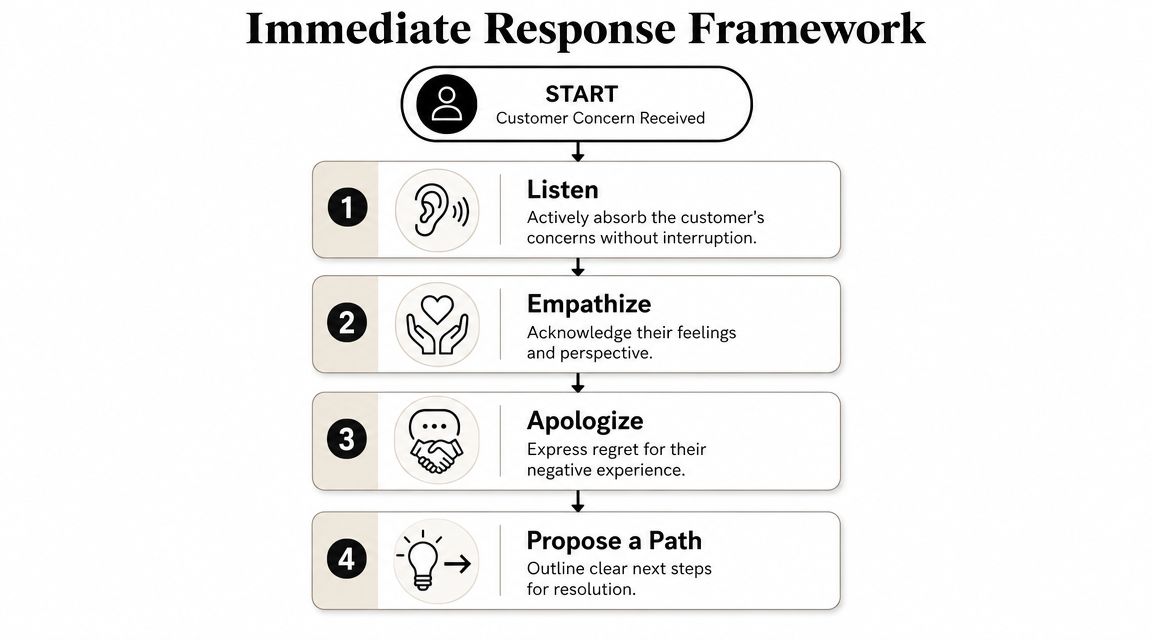
A practical complaint-handling model starts with five actions: listen to identify the precise cause, acknowledge the issue and apologize if needed, show willingness to resolve it, provide a specific solution immediately when possible, and thank the customer for their business, as outlined in this five-step complaint resolution model.
Start with diagnosis, not defense
Customers rarely describe the root cause cleanly. They describe the impact on their day. “Your service is terrible” might mean they were charged twice, had to wait too long, or got transferred between channels without context.
That's why the first job is to slow the interaction down without sounding slow.
Use questions that narrow the issue:
- For timing issues: “Can you tell me when this started and what you expected to happen?”
- For order or billing issues: “Let me confirm the item, date, and the charge you're referring to.”
- For service complaints: “I want to understand the exact point where the experience went off track.”
This keeps you focused on facts without dismissing the customer's frustration.
Use the L E A R N response pattern
I like a simple version teams can remember under stress: Listen, Empathize, Apologize, Redirect, Next step.
Listen
Don't interrupt. Don't defend policy yet. Don't correct small details while they're still explaining the problem.
Useful line: “I'm listening. Walk me through what happened from your side.”
Empathize
You're acknowledging impact, not performing sympathy. Keep it plain.
Useful line: “I can see why that would be frustrating.”
Apologize
You can apologize for the experience even when the facts are still being checked.
Useful line: “I'm sorry this has been frustrating, and I appreciate you flagging it.”
Redirect
Move from heat to problem-solving. At this stage, many teams either sound robotic or overpromise.
Useful line: “Let me confirm the details so I can point this to the right fix.”
Next step
End the first response with a concrete action, not a vague assurance.
Useful lines:
- “I'm checking this now and will update you today.”
- “I'm escalating this to the billing lead and you'll hear from us next.”
- “I can resolve this here, and the next step is replacing the item.”
When customers know what happens next, tension usually drops fast.
Channel scripts that sound human
Different channels need different pacing, but the structure stays the same.
Thanks for flagging this. I'm sorry you had this experience. I'm reviewing the details now so I can give you a clear answer instead of a generic one. I'll come back with the next step shortly.
Live chat
I can help with this. I'm sorry this has been frustrating. Let me confirm a couple of details so I can route it correctly and get you the fastest resolution.
Phone
I'm sorry this happened. I want to make sure I understand the exact issue before I suggest a fix. Can you walk me through what happened from the start?
A weak first response sounds polished but empty. A strong one shows attention, reduces repetition, and creates forward motion. That's what de-escalation really is.
Building Your Complaint Resolution Engine with Hyperleap
Human skill matters most in tense moments. But if the workflow behind the scenes is messy, even a good agent will struggle. Complaints get lost, context disappears across channels, and follow-up becomes dependent on memory.
That's where automation helps. The goal isn't to replace people. It's to make sure the right information is collected early, the right cases move to the right person, and nobody has to restart the conversation from zero.
What the bot should do first
A complaint bot should not try to “win” the interaction. Its first job is intake.
For small teams, that means the bot should capture:
- Identity details: Name, order reference, appointment date, or account email
- Contact accuracy: Verified contact details matter, especially when follow-up or refunds are involved
- Issue category: Billing, delivery, service quality, damaged item, staff conduct, technical issue
- Short description: A plain-language summary in the customer's own words
- Urgency signals: Mentions of refund, legal, discrimination, fraud, chargeback, cancellation, or safety
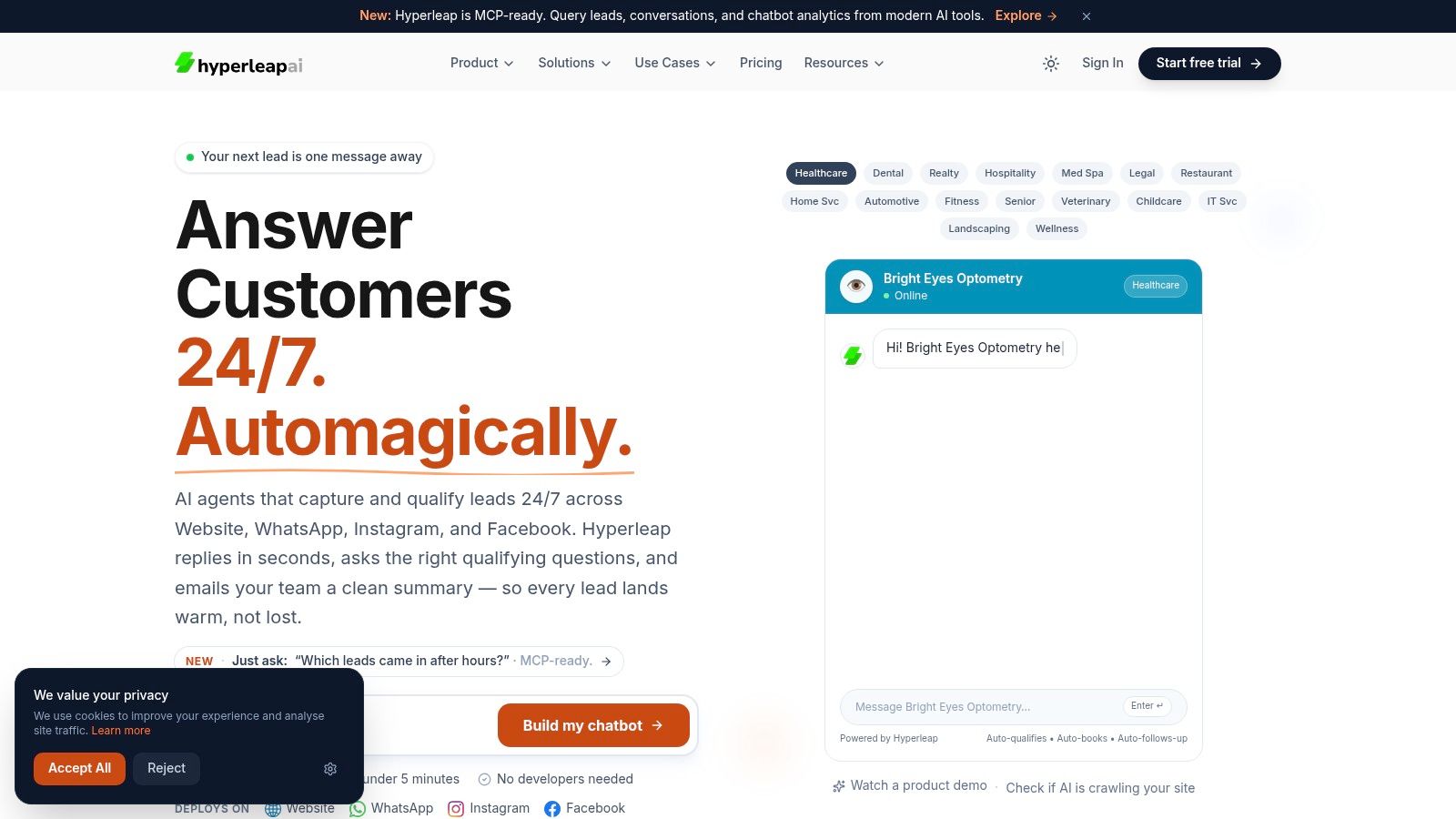
A tool like Hyperleap's conversational AI for customer service can support that workflow across website chat and messaging channels while keeping the intake structured. In practice, that means a bot can gather the basics, use OTP-verified contact capture, and pass a cleaner case into a human queue instead of dropping a vague “customer upset” message into someone's inbox.
Route by risk, not by arrival order
Most SMBs route complaints in the order they appear. That's easy, but it's not smart. A pricing question and a chargeback threat shouldn't sit in the same line with the same priority.
Build routing rules around risk:
- High priority: Legal language, refund disputes, safety issues, abusive conduct claims, payment failures
- Needs specialist review: Technical bugs, account access issues, policy exceptions, service failures involving multiple teams
- Frontline resolvable: Delayed replies, missing information, simple replacement requests, clarification complaints
You can also set keyword triggers so certain complaints bypass the standard queue and go straight to a manager. That reduces response lag on the cases most likely to escalate publicly.
Keep context in one place
The biggest complaint-handling failure I see in smaller companies is fragmented history. The customer messages on Instagram, follows up on WhatsApp, then emails support. Each team member sees one fragment and asks the same questions again.
A unified inbox changes that. When conversation history sits in one thread, the next person can pick up with context instead of making the customer repeat themselves. That matters even more when the first response came from automation and the second needs human judgment.
After you've mapped the workflow, it helps to see a live example of chatbot handling and handoff in action.
The practical setup is simple. Let automation classify, capture, summarize, and route. Let humans investigate exceptions, negotiate remedies, and handle emotion. That combination is what makes dealing with complaining customers manageable without hiring a large support team.
Defining Resolution Pathways and Escalation Rules
Once the complaint is triaged, the next question is straightforward. What outcome fits this problem, and who has authority to offer it?
A lot of businesses stay vague here. They tell staff to “use judgment,” then punish inconsistency later. That's how you get one customer receiving a replacement in ten minutes while another gets three emails and no decision.
Choose the remedy that fits the failure
Not every complaint calls for the same fix. Matching the remedy to the failure keeps your process fair and predictable.
- Refund: Best when the service failed completely, the product can't be corrected quickly, or trust is already broken.
- Replacement: Best when the issue is isolated and the customer still wants the item or service.
- Store credit or account credit: Useful when the customer is likely to continue the relationship and the issue was real but limited.
- Discount on a future purchase: Works when the complaint involved inconvenience rather than total failure.
- Explanation plus corrective action: Sometimes the right answer is not compensation. It's a clear explanation, a correction, and confirmation the problem won't repeat.
The key is to define what frontline staff can approve on their own and what needs review. If every complaint requires owner approval, resolution slows down and customers feel the hesitation.
Sample Complaint Escalation Matrix
| Issue Type | First Response Action | Escalation Trigger | Escalate To |
|---|---|---|---|
| Late delivery or missed update | Acknowledge, verify order details, provide current status | Repeated delays, public complaint, refund demand | Operations lead |
| Billing dispute | Confirm invoice or charge details, pause assumptions | Chargeback threat, unclear records, disputed refund policy | Finance or owner |
| Damaged or incorrect item | Request key details, offer replacement path if policy allows | Pattern of repeat errors, high-value order, fraud concern | Fulfillment manager |
| Staff behavior complaint | Listen fully, document specifics, avoid arguing facts in the moment | Safety concern, discrimination allegation, repeated staff issue | Manager or HR lead |
| Technical or account-access issue | Capture error details and impact | Security concern, repeated failure, customer blocked from service | Technical specialist |
| Abusive interaction from customer | Warn once, document language, keep tone neutral | Threats, harassment, refusal to de-escalate | Manager, then end interaction if needed |
If your team uses AI chat with human escalation, define the handoff clearly. A good reference point is this explanation of when to use human handoff in customer conversations.
Handling abusive mistaken or no-win complaints
Many guides often fall short here. They tell you to stay calm and apologize, but stop short of giving decision rules for situations that can't be solved cleanly.
Available guidance often misses boundary-setting, deciding when to stop the interaction, or how to respond without admitting fault where facts are unclear, which is a real operational gap in no-win cases, as noted in this guide on handling customer complaints.
Use a practical standard:
If the complaint is mistaken Acknowledge the frustration, state the facts clearly, and show the evidence without sounding smug.
Example:
I understand why this felt confusing. I've checked the record, and here's what we can confirm. The charge was for the plan selected on that date. I can walk you through the details and the options available from here.
If the complaint is unsolvable Be honest early. Don't drag the customer through false hope.
Example:
I've reviewed this fully. We can't provide the outcome you requested, but I can explain why, document your feedback, and outline the options still open to you.
If the customer becomes abusive Protect the employee first. You can be courteous and firm at the same time.
Example:
I want to help resolve this, but I can't continue the conversation if the language stays abusive. If you'd like to continue, I'm happy to focus on the issue itself.
Document these cases carefully. Some complaints should lead to a remedy. Others should lead to a boundary, a record, and a clean exit.
Closing the Loop and Learning from Feedback
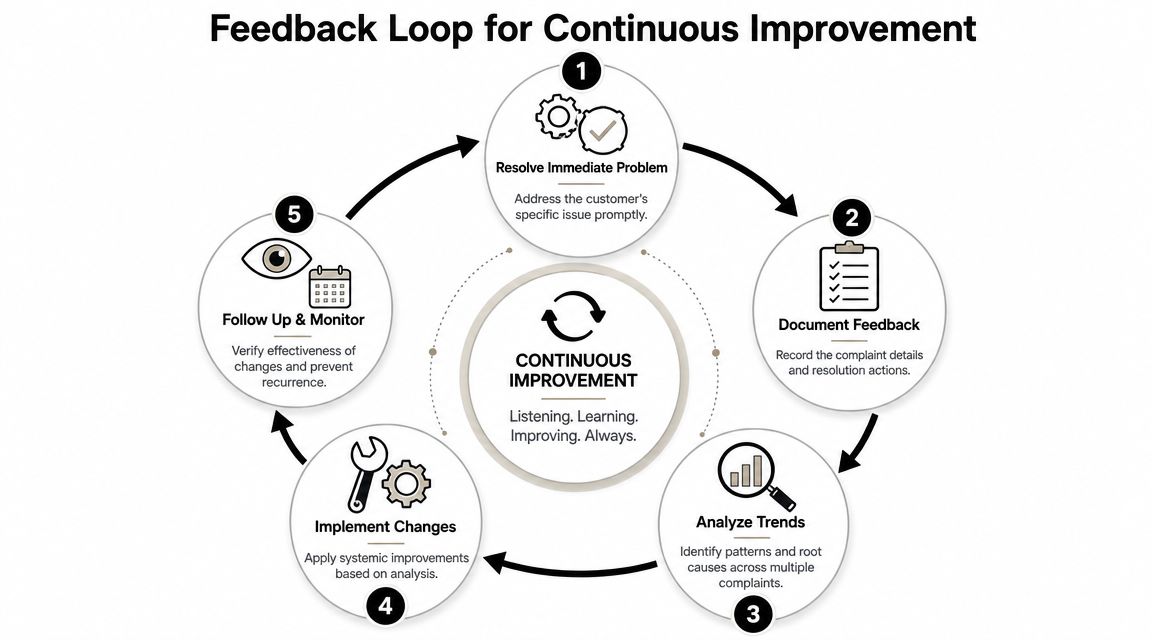
A complaint isn't finished when the refund is sent or the replacement goes out. It's finished when the customer knows the matter is closed, understands what happened, and doesn't need to chase you again.
That final part is where a lot of businesses lose the goodwill they just rebuilt.
Follow up after the fix
A short follow-up message does two things. It confirms the customer received the resolution, and it signals that your business doesn't disappear once the hard part is over.
Keep it brief:
- After a replacement: “Checking that the replacement arrived and everything is now in order.”
- After a service recovery: “Following up to confirm the issue was resolved from your side.”
- After a delayed case: “Thanks again for your patience. I wanted to make sure the final outcome matched what we promised.”
Closure matters. Customers remember whether they had to ask twice.
Track operational metrics that change behavior
Complaint handling shouldn't be judged only by whether an interaction felt polite. Industry guidance recommends managing it with operational metrics such as average handle time, cost per resolution, and post-resolution feedback, as discussed in this overview of complaint-handling KPIs.
Those measures are useful because they expose different problems:
- Average handle time: Shows where cases drag because staff lack authority, information, or routing clarity
- Cost per resolution: Shows whether a complaint type is consuming more effort than it should
- Post-resolution feedback: Shows whether the customer felt the issue was settled
If you want a practical KPI framework for a small team, this guide on customer service KPIs is a useful companion to your complaint workflow.
Turn complaint logs into prevention work
At this stage, complaint handling stops being reactive. Review complaint logs regularly and sort them by recurring theme. Don't just store transcripts. Tag them.
Look for patterns such as:
- Expectation gaps: Customers misunderstood delivery timing, pricing, or what was included
- Process failures: Messages were missed, routed late, or answered inconsistently
- Product or service defects: The same issue appears across different customers
- Training gaps: One team member or channel keeps triggering confusion
When your platform logs conversations and exports them cleanly, you can review complaints in batches instead of relying on memory. That makes it easier to update scripts, improve self-service answers, revise policies, or send proactive notices before the same issue creates a fresh wave of complaints.
The strongest complaint programs don't just resolve individual cases. They remove the causes.
Your Playbook for Turning Critics into Fans
Dealing with complaining customers gets easier when you stop treating each case like a unique emergency. Most complaints follow a pattern. A promise was unclear, a handoff failed, a process broke, or someone felt ignored longer than they should have.
The businesses that handle this well usually do the same few things consistently. They invite complaints instead of hiding from them. They give full attention, listen respectfully, agree that a problem exists, apologize, resolve the issue, and thank the customer. That seven-step approach is recommended in this guide to superior customer performance.
That sequence works because it balances respect with action. It doesn't leave the customer guessing, and it doesn't leave your team improvising every response from scratch.
A solid playbook has four parts:
- A calm first response: Diagnose before you defend.
- A workable system: Use automation to collect details, route correctly, and preserve context.
- Clear authority lines: Decide who can offer what, and when escalation is required.
- A learning loop: Review complaint patterns and fix the causes, not just the symptoms.
If you build those four parts, complaints stop dominating the day. They become manageable inputs. Some customers will still be difficult. Some cases will still be messy. But your team won't be guessing, and your customers won't feel abandoned.
That's the shift that matters. You're no longer just reacting to unhappy people. You're running a process that protects trust.
If you want a practical way to support this process without building a large support team, Hyperleap AI can help structure intake, capture verified contact details, route complaints across channels, and keep conversation history in one place so your team can respond with context instead of starting over.