Feature Prioritization Playbook for Product Teams
Master feature prioritization with a practical playbook covering scoring frameworks, stakeholder workshops, data gathering, and roadmap planning for SMBs.
You've got the backlog open in one tab, Slack is pinging in another, and the requests all sound urgent. Sales wants the chatbot to do everything customers ask for, support wants fewer repetitive questions, operations wants cleaner handoffs, and leadership wants something visible before the next review. That's usually the moment product teams realize the job isn't finding ideas. It's deciding, with limited time and limited evidence, what's worth building first.
Table of Contents
- Why Feature Prioritization Is the Real Product Job
- The Four Dimensions That Drive Every Prioritization Decision
- Comparing the Frameworks Small Teams Can Actually Run
- When Customer Requests Conflict With Behavioral Data
- Running a Prioritization Workshop That Stays on Track
- Turning Scores Into a Quarterly Roadmap
- Your One-Page Prioritization Checklist
Why Feature Prioritization Is the Real Product Job
A new product lead often inherits a backlog that already looks finished on paper. There are 50 chatbot requests, half written by customers, a quarter by internal teams, and the rest by whoever was closest to the last meeting. The list might include multilingual support, a new calendar integration, smarter lead capture, a knowledge base refresh, and a dozen small fixes that all seem reasonable.
That backlog is not the problem. The problem is that no one has a repeatable way to decide which requests deserve engineering time, configuration time, or attention from the people who know the business best. Feature prioritization is the bottleneck because it sits between vague demand and shipped value. If the team can't sort trade-offs cleanly, the roadmap becomes a compromise document instead of a plan.
Small businesses feel this especially hard. Every hour spent on a chatbot tweak competes with lead capture, booking flow quality, support deflection, and the business's next revenue conversation. Multi-location teams feel it too, because one change can ripple through location-specific workflows, staff handoffs, and customer expectations. That's why prioritization isn't a side task after strategy, it is strategy in practice.
There's a reason decision frameworks matter here. If you want a useful overview of the broader discipline, the top frameworks for decisions article from Rite NRG is a good companion read because it frames prioritization as a decision system, not a preference vote. The same mindset also applies inside product work. When teams use a clear scoring model, they stop arguing about vibes and start comparing trade-offs.
Practical rule: if a request can't be explained as a customer outcome, a business outcome, or a clear dependency, it probably doesn't belong at the top of the backlog.
For teams using a feature-rich chatbot platform, it also helps to anchor the backlog against the product itself. A product page like Hyperleap AI features is useful as a reference point when you're comparing what's already possible against what the team is asking for next. The point isn't to build more, it's to choose better.
The playbook is simple enough to run this quarter, even with a small team and little research bandwidth. Score the ideas, force-rank them, discuss the trade-offs in a room, and lock the roadmap long enough to ship something real.
The Four Dimensions That Drive Every Prioritization Decision
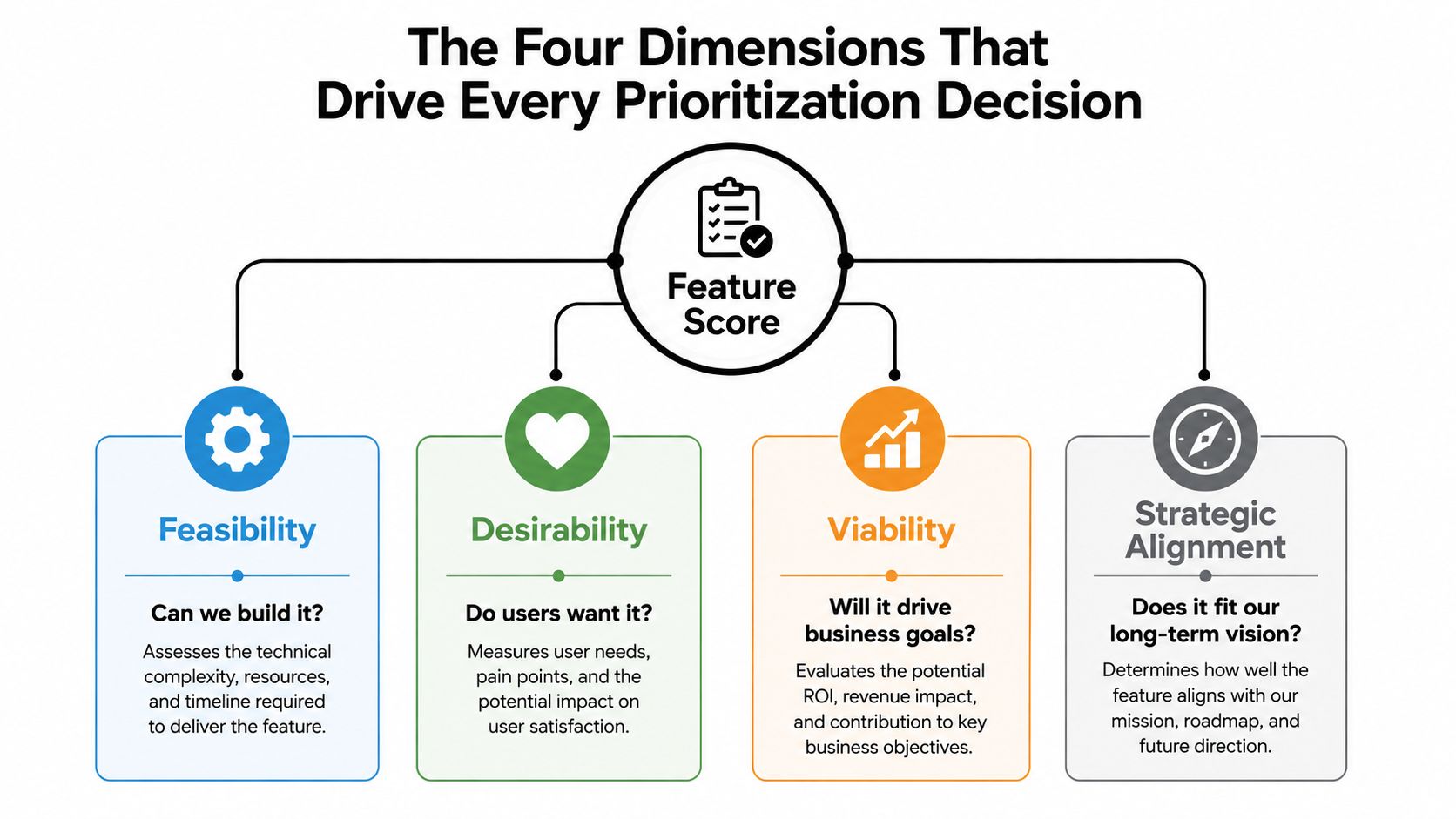
A good scoring sheet doesn't start with opinions, it starts with shared criteria. For small teams, the most workable starting point is feasibility, desirability, viability, and strategic alignment. The first three are common in product work, and the fourth keeps the team from polishing features that look busy but don't move the business where it needs to go.
Feasibility and desirability
Feasibility asks whether the team can build the thing with the people, tools, and integrations available. A multilingual chatbot sounds attractive, but the score changes fast if the team has to validate translations, adjust knowledge sources by language, and keep responses consistent across locations. Desirability asks whether users want it enough to matter. OTP-verified lead capture, for example, may be less flashy than a voice interface, but it can solve a very concrete problem if the team is tired of junk leads and unqualified contacts.
A numeric scale works best when the team defines what each number means before scoring starts. Don't let one person use “5” for technically simple and another use it for mildly annoying. The same scale has to mean the same thing in every row.
Viability and strategic alignment
Viability is where product teams check whether the feature supports the business, not just the user. A Calendly integration for a hotel group with five locations might be viable if it drives more direct bookings or reduces front-desk friction. A feature can be desirable and feasible, but still fail this test if it doesn't help the business in a visible way.
Strategic alignment is the least glamorous criterion and often the most neglected at smaller companies. Teams get busy and start scoring whatever is loudest. Alignment keeps the roadmap connected to the actual direction of the company, especially when a feature sounds useful but belongs to a different phase of growth.
If a feature helps one team feel productive but doesn't fit the product direction, it's not a top priority. It's a distraction with good branding.
Use a simple rubric like this:
- Feasibility: can we build and maintain it with current capacity?
- Desirability: do users ask for it, use it, or clearly benefit from it?
- Viability: does it support revenue, retention, or operational value?
- Strategic alignment: does it fit where the business is trying to go?
That's enough structure to make scoring honest without turning the process into a consulting deck.
Comparing the Frameworks Small Teams Can Actually Run
A five-person product team doesn't need the most advanced framework on earth. It needs a model that can survive a busy afternoon, a messy backlog, and one or two forceful opinions in the room. That's why the right answer is usually the framework your team will use consistently.
Frameworks at a glance
| Framework | Setup time | Best for | Main risk |
|---|---|---|---|
| RICE | Moderate | Teams with enough confidence to estimate reach, impact, confidence, and effort | Can feel heavier than the team's available data |
| MoSCoW | Low | Quick stakeholder alignment and rough categorization | Too many items drift into the “must” bucket |
| Weighted scoring | Moderate to high | Teams that need explicit criteria like strategic alignment and risk | The weights can become a debate of their own |
| Value versus effort | Low | Small teams that need a fast first pass | Loud stakeholders can dominate the conversation |
RICE brings structure, but it asks for more estimation discipline than many early-stage teams can comfortably support. If you don't know whether a feature will touch a few users or a lot of users, the score can look precise without being reliable. MoSCoW is easier to explain across the company, which is why it often works in sales, marketing, and operations-heavy environments, but it can collapse under category inflation if nobody enforces the boundaries.
Weighted scoring is the cleanest option when the backlog includes strategic trade-offs, risk, and dependency concerns. That's the model to use when simple “high value, low effort” thinking stops being enough. The technical setup for trust with Gmail guide from Mailwarm is a useful reminder that trust systems work best when the mechanics are explicit, and prioritization is the same way. If the scoring rules are vague, the output won't be trusted.
Value versus effort is still the best starting point when the team needs speed. It's fast, visual, and easy to explain. The trade-off is that it doesn't naturally protect against political pressure, so it works best when the group already shares a decent amount of context.
Default recommendation: start with value versus effort for speed, move to weighted scoring once the roadmap has real dependencies or strategic tension.
If you're unsure which model to use, choose the one that makes the next decision easier. Don't choose the one that looks smartest on a whiteboard.
When Customer Requests Conflict With Behavioral Data
This is the messiest kind of prioritization, because the signals don't agree. Customers say they want one feature, support tickets point to a different pain, and the usage data suggests the issue sits somewhere else entirely. That's where a team needs a method, not a debate.
Reframe requests as outcomes
The most useful move is to translate a requested feature into the outcome the customer is really trying to achieve. A dental clinic chain may ask for a flashy voice feature, but the actual outcome is faster appointment booking. Once the outcome is clear, different features can compete for the same job. A calendar integration, a simpler intake flow, or a better mobile handoff may solve the same need with less risk.
That approach matters because the loudest request is rarely the only valid path. When a team maps several features to the same outcome, it can test the actual demand instead of just collecting preferences. The recent guidance shared in Tony Ulwick's post on LinkedIn makes this exact point, and the idea is especially useful for SMBs with limited research bandwidth.
Handle the conflict without surrendering to it
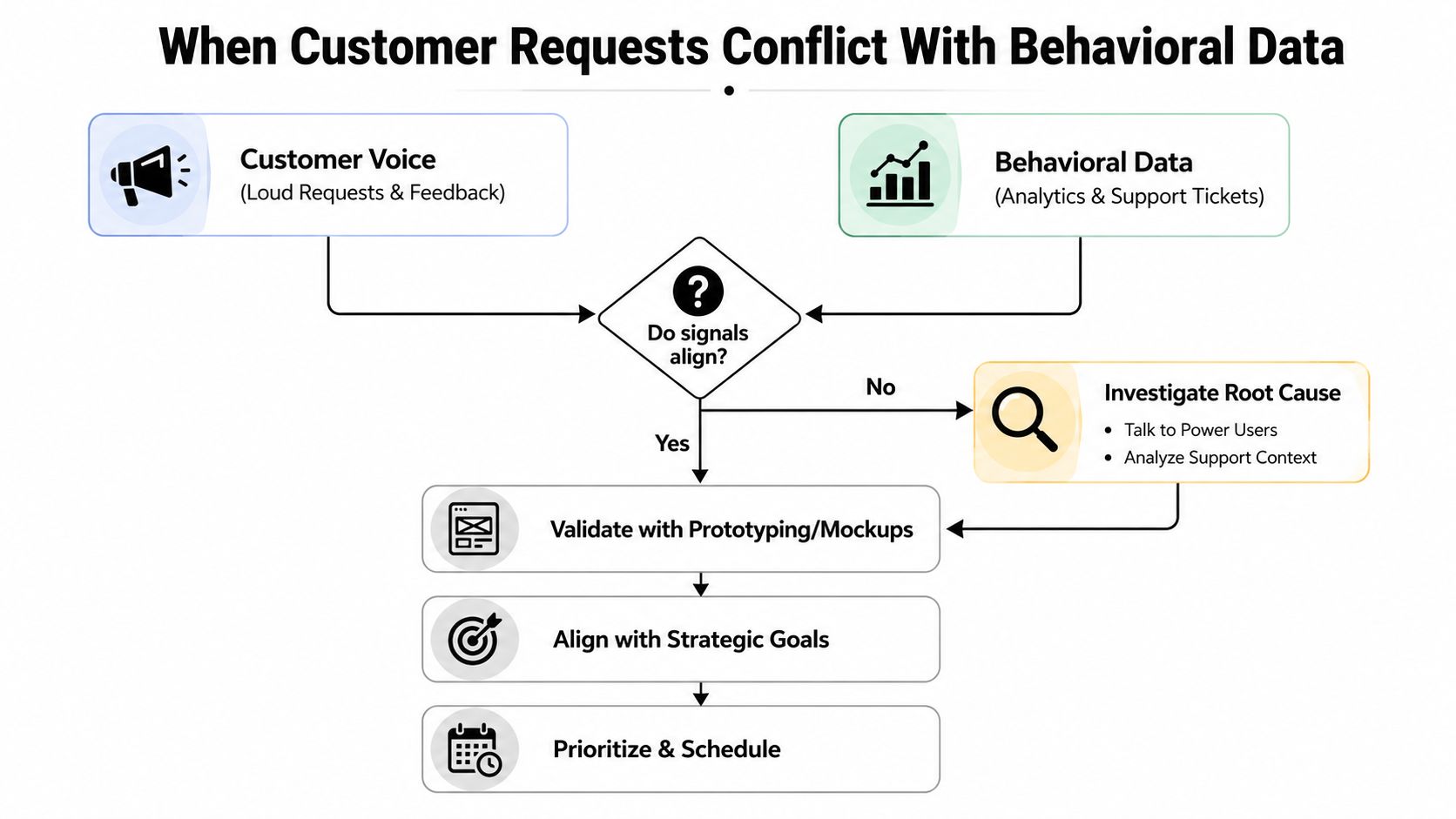
Behavioral data and customer requests don't always conflict because one side is wrong. Sometimes they point to different layers of the problem. Usage data might show where people drop off, while interviews reveal why they expected a different flow. The job is to investigate the root cause before deciding.
Internal stakeholders can be attached to a specific request, so keep the discussion on outcomes and evidence. Ask what problem the feature solves, what behavior proves that problem exists, and what simpler alternative might deliver the same result. If the conversation keeps drifting back to the original idea, pull it back to the outcome and the business goal.
A practical sequence works well:
- Name the requested feature.
- Translate it into the customer outcome.
- Check behavioral data and support context.
- Compare multiple features against the same outcome.
- Validate with a lightweight prototype or mockup.
- Score the strongest options against strategic goals.
That sequence keeps the team from rewarding confidence alone.
When teams are managing customer communication across channels, this matters even more. A chatbot request might look like a messaging feature on the surface, but the underlying problem could be intake quality, booking friction, or response latency. If you build the surface request without checking the outcome, you can spend a sprint solving the wrong layer of the problem.
Running a Prioritization Workshop That Stays on Track
A prioritization workshop doesn't fail because people lack opinions. It fails because everyone brings a different mental model and no one agrees on how to resolve conflicts. The fix is a tight agenda, a short pre-read, and a facilitator who treats scoring as the source of truth.
A 90-minute agenda that works
Start with a trimmed backlog, not a giant wishlist. Fifteen items is already enough to surface hard trade-offs, and it keeps the room from getting lost in minutiae. The one-pager should include the scoring rubric, the goal of the meeting, and the candidate features already filtered for relevance.
For the meeting itself, keep the flow disciplined:
- Pre-work: send the agenda, rubric, and data packet ahead of time.
- Opening: state the decision you need and the rules for discussion.
- Silent scoring: let everyone score independently before anyone argues.
- Outlier review: discuss only the items where scores diverge.
- Re-rank: sort the backlog from highest to lowest score.
- Commit: agree which items are now, next, and later.
- Close: assign owners and set the review cadence.
The biggest facilitation mistake is letting the room drift into unscored opinions. Ban words like “obvious” and “everyone wants” unless someone can show the evidence behind them. If a stakeholder pushes a pet idea, ask them to place it against the scoring rubric instead of defending it from memory.
Facilitation rule: disagreements belong in the scoring sheet first, not in a long argument at the end of the meeting.
A follow-up email matters too. Send the ranked list, note the top trade-offs, and confirm that changes after the workshop require new evidence, not just more enthusiasm. That keeps the team from reopening decisions every time a new request arrives.
For distributed teams or operators with multiple departments in the room, the workshop is also a politics reset. People often leave more aligned when they've seen the same table, the same scores, and the same reasons for the final order.
Turning Scores Into a Quarterly Roadmap
A scored backlog is useful, but only if it turns into a roadmap the team can execute. The cleanest structure is now, next, later. It's simple enough for stakeholders to understand, and it gives the team room to sequence work without pretending every feature belongs in the next sprint.
Start by mapping dependencies before you lock the roadmap. A multi-location knowledge base update may need to land before location-specific overlays can propagate cleanly. If the order is wrong, the team spends time reworking content rules later. That's why dependency mapping belongs in the roadmap stage, not just the scoring stage.
A feasibility flag helps too, especially for risk-heavy items. If a feature has uncertain technical effort, mark it visibly so it doesn't drift into the top tier because the score looked attractive in a spreadsheet. The weighted model from the earlier section is useful here because it gives you a place to capture that reality without pretending risk doesn't exist.
For a three-location hotel group, a workable quarterly roadmap might look like this:
- Now: OTP-verified lead capture, because it tightens intake and protects the lead pipeline.
- Next: brochure sharing and richer property-specific content, because those support booking conversations.
- Later: unified inbox expansion across WhatsApp, Instagram, and Facebook if the current team can't support the operational load yet.
The point is sequencing, not promising everything at once. A roadmap should show how the team gets from current state to the next meaningful outcome without hiding blockers.
If your team needs a reusable way to express that structure, the Hyperleap AI roadmap page is a helpful reference point for thinking about how feature sets evolve over time. Use it as a planning mirror, not as a template to copy blindly.
Re-run prioritization each quarter, even if the backlog hasn't exploded. New evidence changes the score, and stale items should lose priority if they stop earning their place. That habit keeps the roadmap honest.
Your One-Page Prioritization Checklist
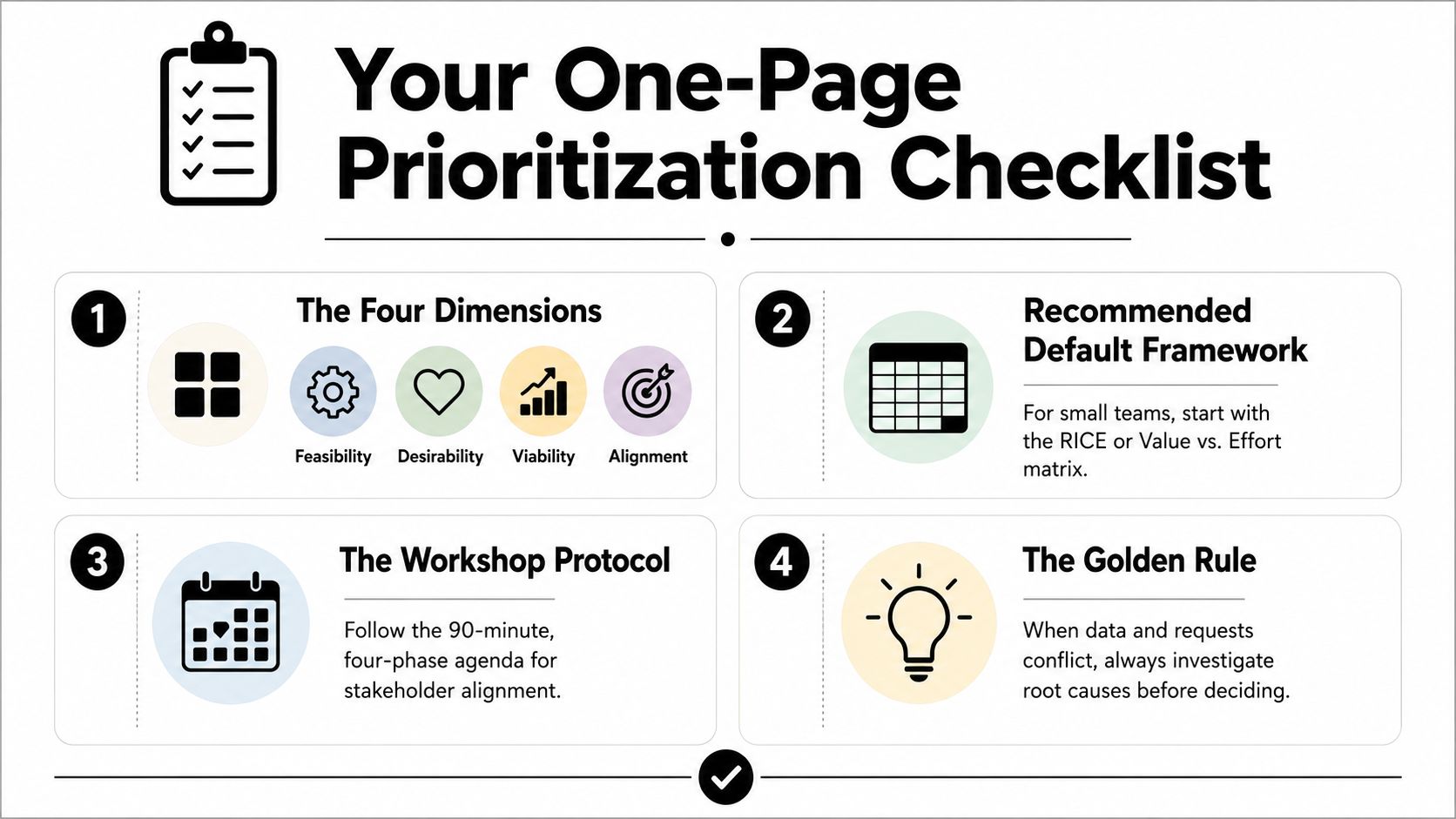
Use this as a printout, a Notion page, or the first screen in your planning tool. It's the shortest version of the full process, and it's enough to run a serious prioritization cycle next week.
- Define the four dimensions. Score feasibility, desirability, viability, and strategic alignment on the same scale.
- Pick the default framework. Start with value versus effort or RICE, then move to weighted scoring when the backlog gets more complex.
- Reframe the request. Turn every feature ask into a customer outcome before comparing options.
- Run the workshop. Pre-read, silent score, discuss outliers, rank, commit.
- Lock the roadmap shape. Put the highest-ranked items into now, the next cluster into next, and the rest into later.
- Protect the decision. Don't reopen the list unless new evidence changes the score.
- Review quarterly. Treat prioritization like a recurring operating habit, not a one-time meeting.
The common mistakes are easy to spot once you know what to watch for. Scoring without a defined scale creates fake precision. Skipping outcome reframing makes the team overvalue the loudest request. Letting stakeholders reopen the list after the workshop destroys trust in the system.
If you need a reusable starting point for your next planning cycle, the Hyperleap AI templates page can help you standardize the process without reinventing the same workshop every quarter. Use the checklist, run the session, and force the backlog to answer one question, what gets the next unit of attention?
If your team needs a practical way to capture requests, score them consistently, and turn the result into a roadmap without another spreadsheet mess, try Hyperleap AI and make your next prioritization cycle easier to run.