Industry Specific Solutions: A Guide for SMB Growth
Discover how industry specific solutions automate support, capture qualified leads, and ensure compliance. A practical guide for SMBs in any sector.
You're probably dealing with this already. A prospect asks your chatbot a simple question about insurance, appointment prep, pet policies, school district boundaries, or whether a listing allows FHA financing. The bot replies with a polished but useless answer. Your team steps in, the customer waits, and the lead goes cold.
That's the problem with generic software. It can sound competent while missing the details that win business. For an SMB, that gap isn't a minor annoyance. It affects booked appointments, staff workload, compliance exposure, and whether a lead was worth capturing in the first place.
More businesses are moving toward specialized software for exactly that reason. The broader IT solutions market was valued at USD 1.2 trillion in 2023 and is projected to reach USD 2.1 trillion by 2030, with cloud-based solutions accounting for 45% of revenue according to Gitnux's industry solutions market summary. That matters because SMBs no longer need custom development to get a tool that fits how their business runs.
Table of Contents
- Your Business Is Not Generic Why Is Your Software
- What Exactly Are Industry Specific Solutions
- The Hidden Costs of Using Generic Tools
- Key Features of a Powerful Industry Solution
- Industry Specific Solutions in Action
- How to Evaluate and Implement Your First Solution
- The Future Is Tailored Not Generic
Your Business Is Not Generic Why Is Your Software
A generic chatbot usually fails in a predictable way. It handles basic hours and location questions, then collapses when a buyer asks something tied to your actual business model. A dental clinic needs screening and scheduling logic. A property team needs listing context and lead qualification. A hotel group needs location-specific answers, not a vague brand statement.

That mismatch creates a false sense of automation. On paper, you have a bot. In practice, your front desk, leasing staff, or sales coordinator still has to rescue conversations. The software becomes a filter that lets simple requests through and sends the expensive ones back to humans.
Where the frustration shows up first
For most SMBs, the pain appears in familiar places:
- Lead capture breaks down: The bot collects names and numbers but doesn't separate serious buyers from junk inquiries.
- Staff rework piles up: Employees correct answers, chase missing details, and re-enter information into calendars or CRMs.
- Customer trust slips: Prospects can tell when a tool doesn't understand the basics of your field.
Practical rule: If your team has to “translate” what the bot should have understood, you don't have automation. You have extra admin work.
Industry specific solutions solve a narrower problem much better. They're built around how a sector talks, what customers ask before buying, which compliance constraints matter, and what needs to happen next in the workflow. That makes them far more useful than a general tool with a few templates bolted on.
SMB owners often think specialized software is only for large companies. That used to be true more often than not. It isn't anymore. Cloud delivery and no-code setup have made customized tools far more accessible, which is why a business can now choose software that fits its operations instead of reshaping operations around software.
What Exactly Are Industry Specific Solutions
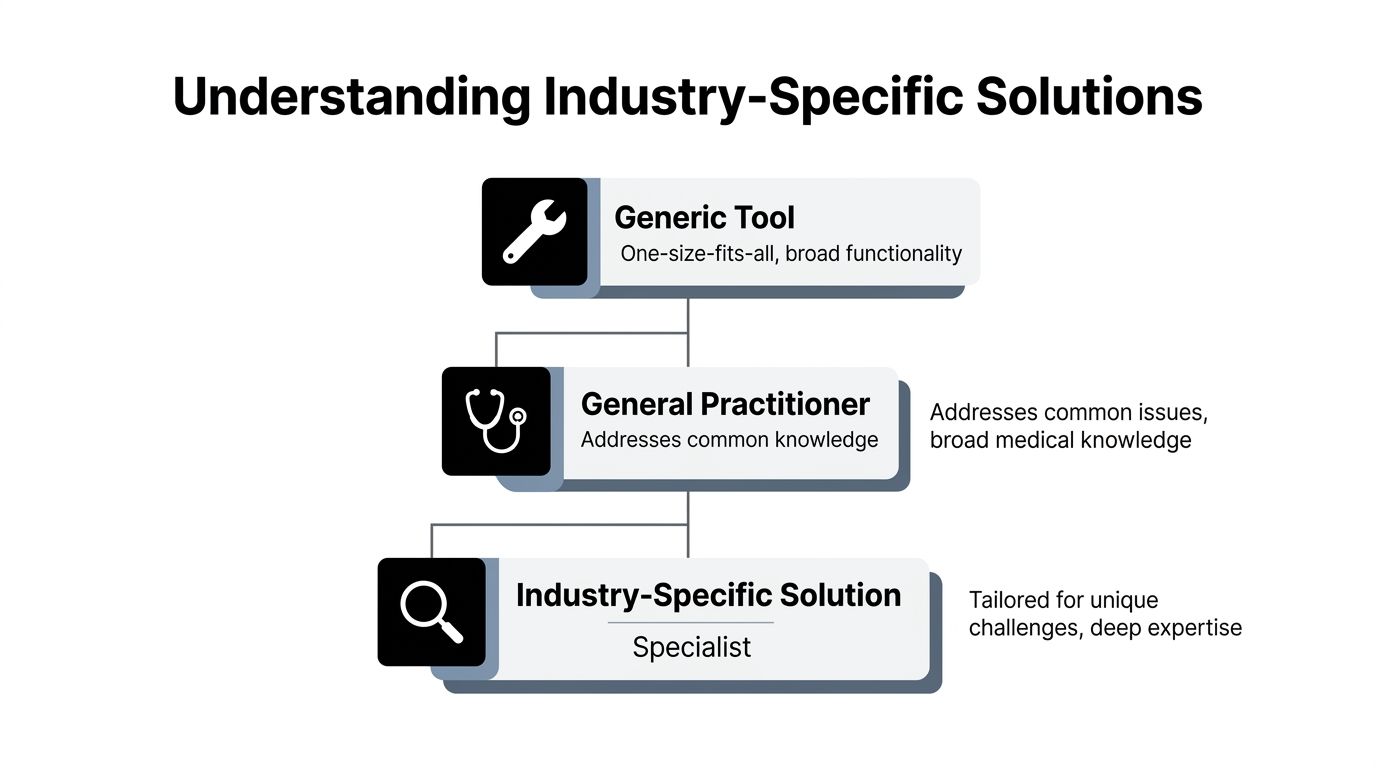
A simple way to think about industry specific solutions is this. A generic tool is like a general practitioner. Helpful for common issues. Broad knowledge. Good starting point.
A true industry-specific solution is the specialist surgeon. You bring in the specialist when the details matter, the consequences are significant, and a broad answer isn't good enough.
The specialist beats the generalist
This isn't just a branding distinction. Domain-specific AI models outperform general ones, with benchmarked accuracy improvements of up to 25.6 percentage points, because they're trained on curated, industry-relevant data that reduces errors and hallucinations in specialized work, as outlined in God of Prompt's review of domain-specific model benchmarks.
That performance gap matters most when customers ask questions that carry risk. In healthcare, one wrong answer can create privacy problems or confusion before an appointment. In real estate, an inaccurate answer about a property, financing path, or next step can derail a qualified lead. In legal or financial contexts, vague answers can damage trust immediately.
What makes a solution industry specific
A real industry-specific system usually has four traits:
| Element | What it means in practice |
|---|---|
| Industry language | It understands the terms your staff and customers actually use |
| Workflow fit | It supports the steps that move a lead to booking, intake, quote, or sale |
| Knowledge grounding | It answers from your approved materials instead of improvising |
| Operational constraints | It accounts for the rules, expectations, and edge cases in your field |
That last point gets overlooked. Many tools claim they support an industry because they include canned prompts or a starter template. That's not the same as being built around the decisions your business makes every day.
Healthcare is a good example. A practice doesn't just need a “chatbot.” It needs a system that understands appointment types, pre-visit instructions, intake friction, and communication standards. If you want a practical outside reference on how this plays out in patient-facing operations, this guide to patient communication and engagement is useful because it reflects the practical communication demands clinics face.
The same logic applies outside healthcare. A local service company needs qualification and booking. A brokerage needs listing-aware inquiry handling. A multi-location brand needs one core system with local differences managed cleanly. If you're exploring how conversational tools fit broader operations, this overview of an AI agent for business is a helpful place to frame the bigger picture.
The best industry specific solutions don't try to know everything. They focus on knowing your business context well enough to be trusted.
The Hidden Costs of Using Generic Tools
Most owners evaluate software by subscription price. That's reasonable, but it misses the more expensive question. What does the wrong tool cost after it goes live?
Generic tools often look affordable because the visible fee is low. The hidden costs show up in poor lead quality, compliance uncertainty, and constant staff intervention.
Bad leads waste more than ad spend
Basic bots are often too eager to collect contact details and too weak to verify them. That creates a messy pipeline where staff spend time chasing people who never intended to buy, booked with fake details, or came through spam-heavy channels.
The numbers are hard to ignore. 41% of SMBs in service sectors lose over $12,000 annually to unverified contacts from basic bots, and 59% of WhatsApp and Instagram leads from unverified bots are spam, according to Invoke Media's analysis of underserved growth gaps in AI lead generation.
That loss isn't just marketing waste. It hits payroll. Someone on your team follows up. Someone updates the CRM. Someone tries to confirm the booking. The fake lead moves through several paid human steps before anyone realizes it was junk.
Compliance gaps are operational risks
In regulated industries, generic software creates a different kind of problem. It gives broad answers without handling location-specific rules cleanly. For multi-location businesses, that can become a serious blocker.
- Jurisdictional differences matter: Consent language, data handling, and intake flow can vary by location.
- Healthcare is especially sensitive: Teams need clarity on how customer data is collected, stored, and routed.
- Real estate has its own exposure: Location-specific disclosures and communication practices can't be treated as optional details.
A tool that “mostly works” is often the most dangerous one. It creates confidence before it creates control.
Workarounds become your real system
The last hidden cost is operational drag. This is what happens when staff build manual patches around software that never really fit in the first place.
You see it in small behaviors:
- Front desk staff double-check every booking request
- Sales teams rewrite chatbot answers before sending them
- Managers maintain separate documents to correct the bot
- Marketing teams babysit Instagram and WhatsApp because the bot can't qualify properly
At that point, the generic tool isn't reducing labor. It's redistributing labor into invisible tasks that don't show up on a software invoice.
That's why experienced operators stop asking whether a tool has AI. They ask whether it can reduce wasted conversations, cut avoidable risk, and handle the specific demands of the business without turning employees into full-time exception managers.
Key Features of a Powerful Industry Solution
The right solution doesn't win on clever copy. It wins when your staff uses it without creating a side process to fix it. That means evaluating features based on business outcomes, not feature count.
What to look for before you buy
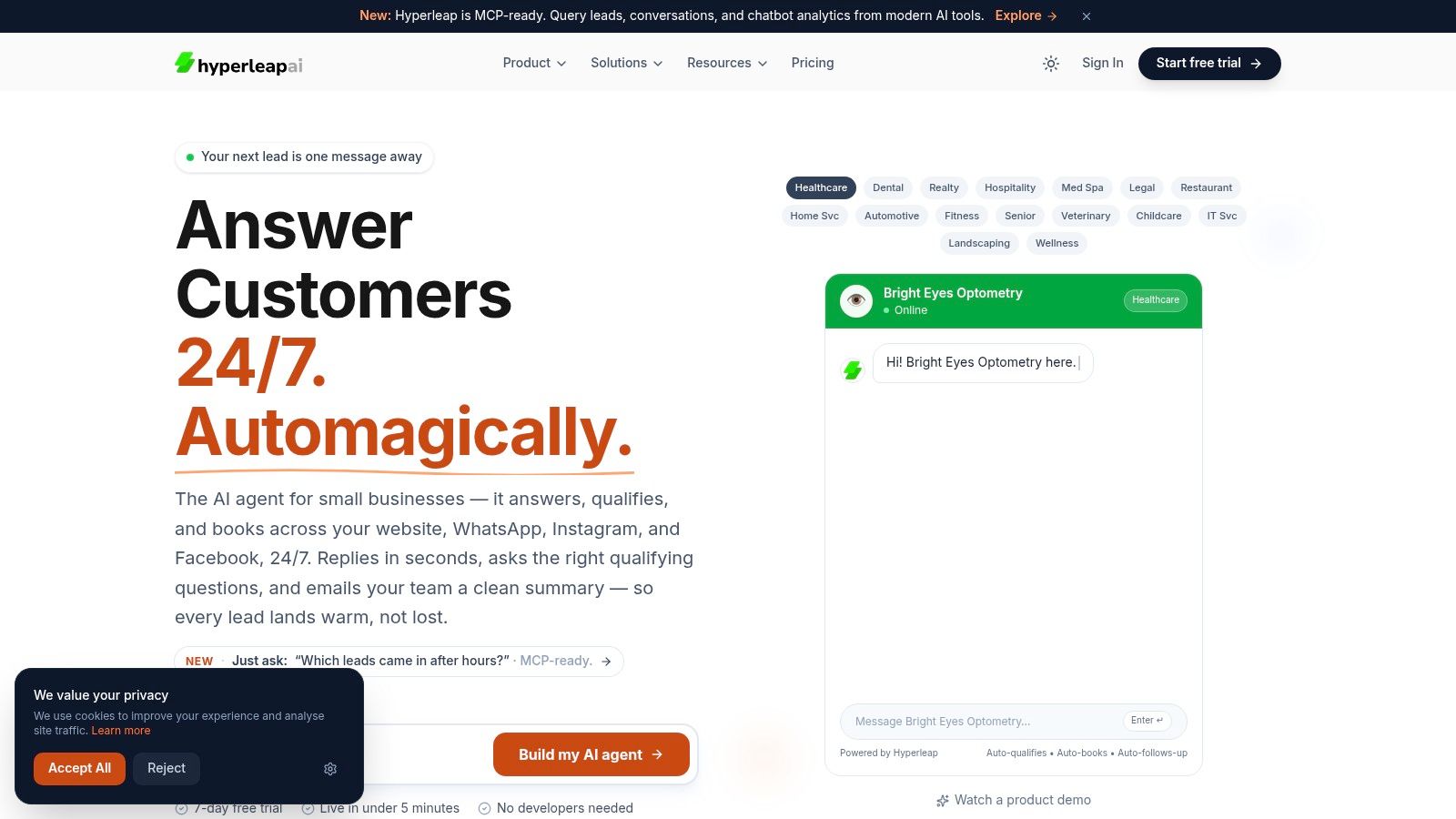
Start with the foundation. A strong industry-specific platform should let you launch from a template that already matches your type of business. That cuts setup time and reduces the number of decisions your team has to make before going live.
Then check how the system answers questions. The best tools are grounded in your own approved content, such as your website, uploaded documents, service descriptions, FAQs, policies, and brochures. If the system improvises too freely, you'll spend your time reviewing damage instead of scaling service.
A useful buyer checklist looks like this:
- Pre-built industry setup: The starting point should reflect your customer journey, not an empty chatbot shell.
- Grounded responses: Answers should come from your business knowledge, not generic internet-style guesswork.
- Lead verification: For service businesses and social channels, verification should be built in, not treated as an add-on.
- Booking logic: The handoff to Calendly, Cal.com, or another booking flow should happen at the right point in the conversation.
- Shared inbox visibility: Your team should be able to see conversation history and pick up where the bot left off.
What that looks like in practice is easier to understand when you can see the operational flow:
Channel coverage matters less than consistency
A lot of buyers get distracted by channel lists. Website chat, WhatsApp, Instagram, Facebook. Those matter, but the core issue is whether the experience is consistent across them.
If your website gives accurate answers and your Instagram bot gives vague ones, you don't have a multi-channel system. You have multiple versions of your brand creating different levels of trust.
Look for a platform that keeps the same business knowledge, tone, and qualification logic across channels. That matters even more for multi-location teams, where central control and local variation have to work together.
For a practical feature reference, review a platform's core capabilities for AI chat, inboxes, lead capture, and booking flows. The important thing isn't the marketing label. It's whether the product supports verified lead capture, knowledge-based responses, and clean handoff to humans when needed.
Buy for the exception cases, not the demo. Demos handle easy questions. Real operations depend on what happens when the customer asks something specific.
Industry Specific Solutions in Action
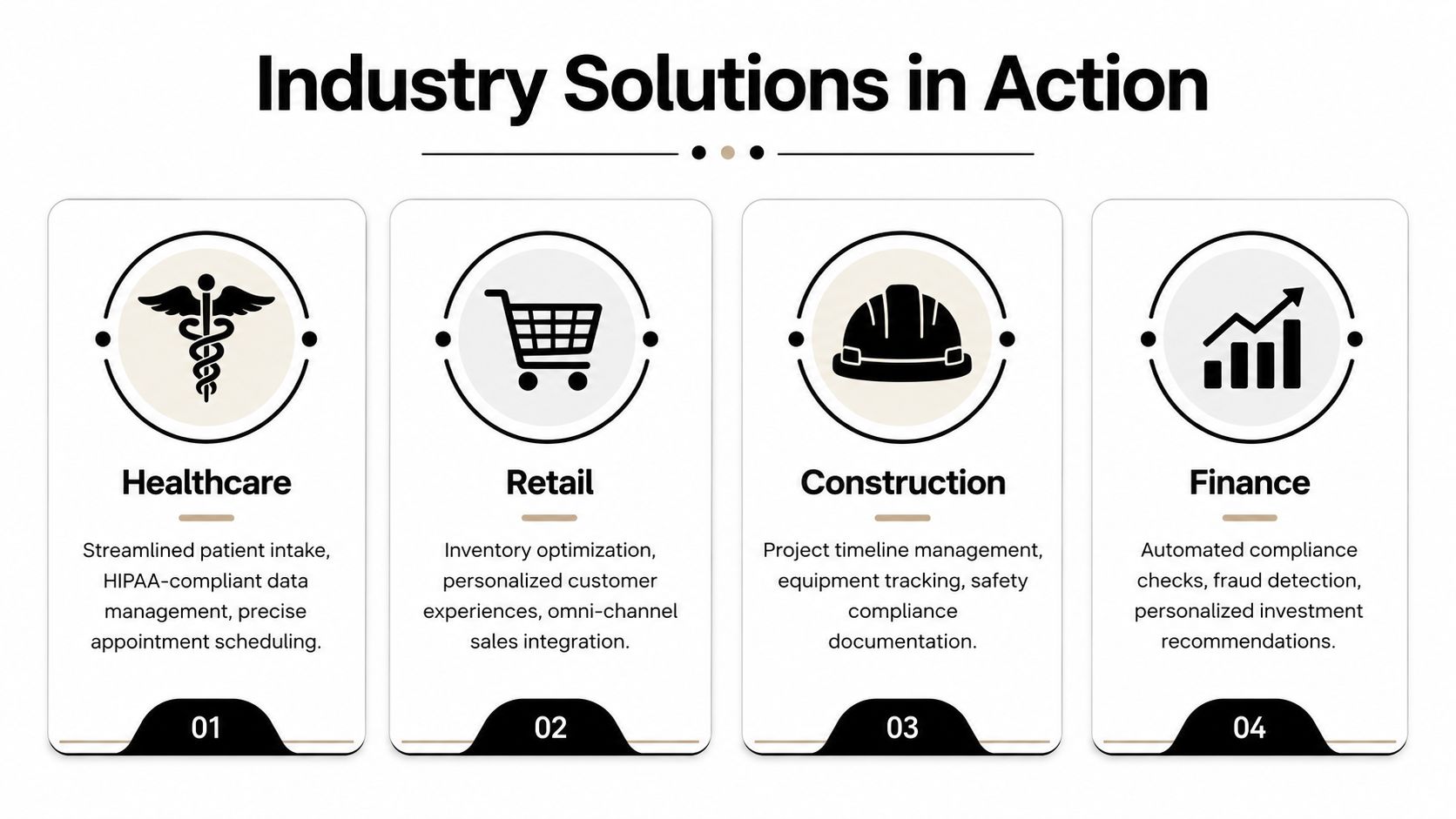
The fastest way to judge these tools is to stop thinking in features and start thinking in operating scenarios. What matters is how the system behaves when a real customer asks a real question that would otherwise pull your team into manual work.
Healthcare and med spas
A med spa often needs to answer treatment questions, capture booking intent, and avoid sloppy handling of sensitive information. A generic bot can greet visitors and list hours. It usually struggles once the customer asks whether a service fits their concern, what preparation is required, or how to choose between options.
This is where specialization matters. 73% of multi-location SMBs report jurisdictional rule differences as their primary barrier to AI adoption, and 68% of healthcare clinics have rejected AI tools due to uncertainty over local data-handling rules, according to Done With You's analysis of underserved AI adoption barriers.
A better setup uses location-aware rules, approved clinic knowledge, and a clear path to scheduling. The bot doesn't try to act like a clinician. It does the operational job well. It answers common service questions, routes prospects to the right appointment path, and keeps communication inside approved guardrails.
Real estate and multi-location service brands
Real estate teams face a different version of the same problem. Buyers ask about neighborhoods, financing readiness, next-step scheduling, property fit, and response times. A generic chatbot tends to provide broad, pleasant language without moving the inquiry forward.
A stronger model qualifies the lead while the conversation is still active. It asks the right follow-up questions, keeps responses tied to actual listings or office rules, and routes serious buyers to the right agent or calendar. For teams refining that process, MakeAutomation's real estate lead framework is a useful reference because it focuses on turning raw inquiries into structured next steps.
For multi-location service brands, the issue is consistency. One company may have several offices, each with different hours, staff, and service details. Industry-specific systems handle that by combining a shared knowledge base with local overlays. Customers get answers that match the location they're contacting, not a generic brand statement that applies to none of them.
Agencies managing many conversations at once
Agencies have their own operational headache. They're not just serving one business. They're handling many client conversations across channels, often with different offers, campaigns, and response standards.
What helps here isn't a flashy bot personality. It's control. Agencies need one place to monitor conversations, review handoffs, export records, and keep each client's knowledge separate. They also need a response system that works across web chat and messaging channels without forcing account managers to jump between tabs all day.
If you want to see how vendors present these applied use cases, browse some industry chatbot case studies for service businesses and multi-channel teams. The useful lesson isn't the brand story. It's the operational pattern. The winning setups reduce manual sorting, preserve answer quality, and make handoff obvious when a human should take over.
How to Evaluate and Implement Your First Solution
A lot of SMB owners overcomplicate this step. You don't need to become an AI evaluator. You need a short list of questions that expose whether the tool will hold up in your business.
Questions to ask before signing
Ask the vendor how the system handles your industry knowledge. If the answer is mostly about prompts, be careful. Prompts matter, but they don't replace grounded content and workflow fit.
Then ask how they test reliability. For industry-specific AI, key performance indicators such as domain-shift delta and latency tails (P95/P99) matter because they reveal how performance changes on new data and during peak loads. Ignoring those measures can lead to performance decay and poor customer experience, especially in regulated industries, as explained in Chatbench's guide to AI benchmark KPIs.
If that language sounds technical, translate it into plain business terms:
- Can it keep answering well when customer questions vary from the examples?
- Does it stay fast when many people message at once?
- Can the vendor explain how they monitor failures and edge cases?
- Will your team know when to step in?
Ask vendors to show how the system handles a messy, real customer question from your business, not a polished demo script.
A simple rollout plan
Implementation doesn't need to be heavy if the platform is built for SMB use. In most cases, a clean rollout follows four steps.
Choose the closest-fit template
Start with a setup designed for your industry or use case. Don't build from a blank slate unless you have a strong reason.Upload the business knowledge
Add the pages, documents, FAQs, brochures, and policies the assistant should rely on. Clean source material matters more than fancy phrasing.Connect your channels
Turn on the website widget first, then add messaging channels like WhatsApp or Instagram once the core behavior is stable.Go live with supervision
Have a staff member review early conversations, tighten weak answers, and confirm the booking or lead handoff works the way your team expects.
The mistake to avoid is trying to automate every edge case on day one. Start with the questions you answer every day, the leads you want to qualify better, and the handoffs that waste the most staff time right now.
The Future Is Tailored Not Generic
Generic tools had an obvious appeal. They were easy to buy, easy to test, and broad enough to look useful in almost any business. But broad capability isn't the same as operational fit.
For SMBs, the key decision is no longer whether to automate. It's whether the system reduces risk while improving customer handling. Industry specific solutions do that better because they match the language, workflows, and constraints of the business using them. They help cut fake-lead waste, lower compliance uncertainty, and reduce the daily cleanup work that generic tools push back onto your staff.
The businesses that gain an edge won't be the ones with the most software. They'll be the ones whose systems answer better, qualify faster, and route customers cleanly without creating more manual work behind the scenes.
If your current tool needs constant correction, that's your answer. Stop forcing generic software to act like a specialist. Choose something built for the way your business works.
If you want a practical way to put this into action, Hyperleap AI gives SMBs an all-in-one chatbot platform designed for lead capture, appointment booking, and customer support across website, WhatsApp, Instagram, and Facebook. It's built for fast no-code setup, grounded answers from your own business knowledge, OTP-verified lead capture, and unified inbox management so your team can scale service without adding more manual work.