Natural Language Query Explained for SMBs and Chatbots
Learn what a natural language query is, how it works, and how SMBs can use it for chatbots, lead capture, and 24/7 customer support in 2026.
A natural language query is a request in everyday language that a system turns into a structured action. In a dental clinic, that might mean a patient types, “Can I book a cleaning next Tuesday after 5?” and the chatbot checks the schedule, finds a slot, and confirms the appointment.
That same pattern now shows up in support inboxes, booking flows, and analytics dashboards. The reason it matters is simple, people don't want to learn software syntax just to get an answer or complete a task, they want to ask naturally and move on.
Table of Contents
- What a Natural Language Query Actually Is
- The Pipeline Behind Every Natural Language Query
- Intent Detection, Entity Extraction, and Semantic Search Explained
- Real-World Examples for SMBs and Chatbots
- Why NLQ Still Fails in Real Business Settings
- Architecture and Implementation Options That Actually Work
- Best Practices, KPIs, and How to Measure NLQ Success
- Frequently Asked Questions About Natural Language Query
What a Natural Language Query Actually Is
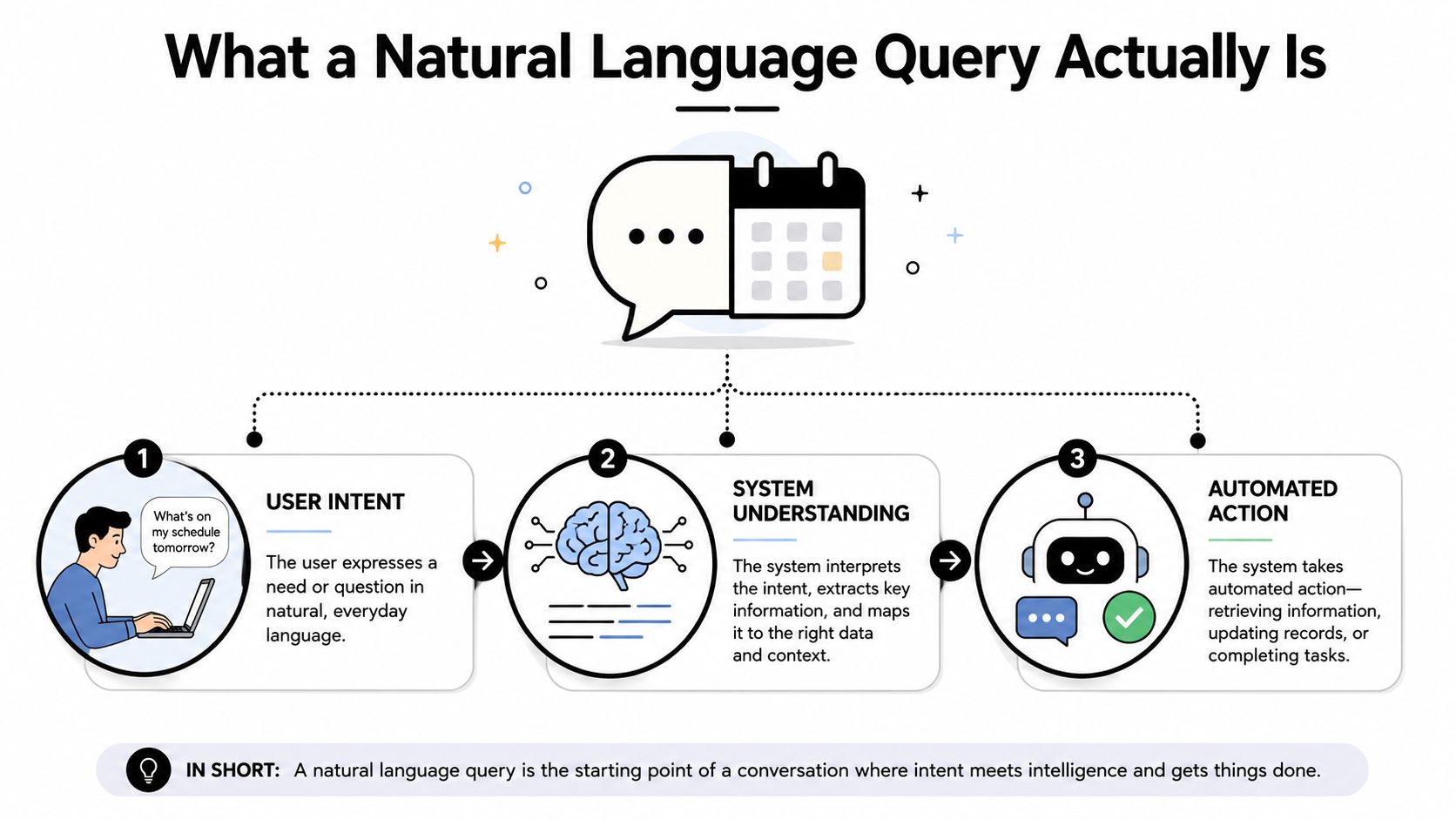
A natural language query is the bridge between a human sentence and a machine action. The customer doesn't see the SQL, the API call, or the database lookup, they just ask in plain language and the system figures out what to do.
In a small clinic, that can feel almost invisible. A receptionist used to answer the phone, check the calendar, and confirm the visit. Now a chatbot can do the same work from a message like “I need a cleaning next Tuesday after 5,” which is why this interface is so useful for SMBs that live on appointments and fast replies.
NLQ and keyword search are not the same thing
Keyword search matches words. Natural language query tries to understand meaning. If someone searches “sea view room Friday night,” keyword search looks for those terms, while NLQ is trying to identify the intent, the stay dates, the property, and the room type, then trigger the right action or answer.
That distinction matters because NLQ sits at the intersection of natural language processing and data access. For a plain-language refresher on the broader field, ThirstySprout's guide to natural language processing is a helpful companion, and Hyperleap's own glossary entry on natural language processing places the term in a product context.
Practical rule: If the system only matches words, you've built search. If it can map a sentence to a structured action or answer, you're in NLQ territory.
Where NLQ shows up in real products
The phrase now covers a lot of ground. In analytics, NLQ can turn a business question into a SQL query. In support, it can retrieve the right knowledge-base answer. In operations, it can call a booking or CRM API.
That's why the term feels broader than it did a few years ago. It's no longer just a dashboard feature, it's becoming a user interface pattern for any system that needs to understand customers, staff, or internal teams. The important thing is to remember the output is structured, even when the input sounds casual.
The Pipeline Behind Every Natural Language Query
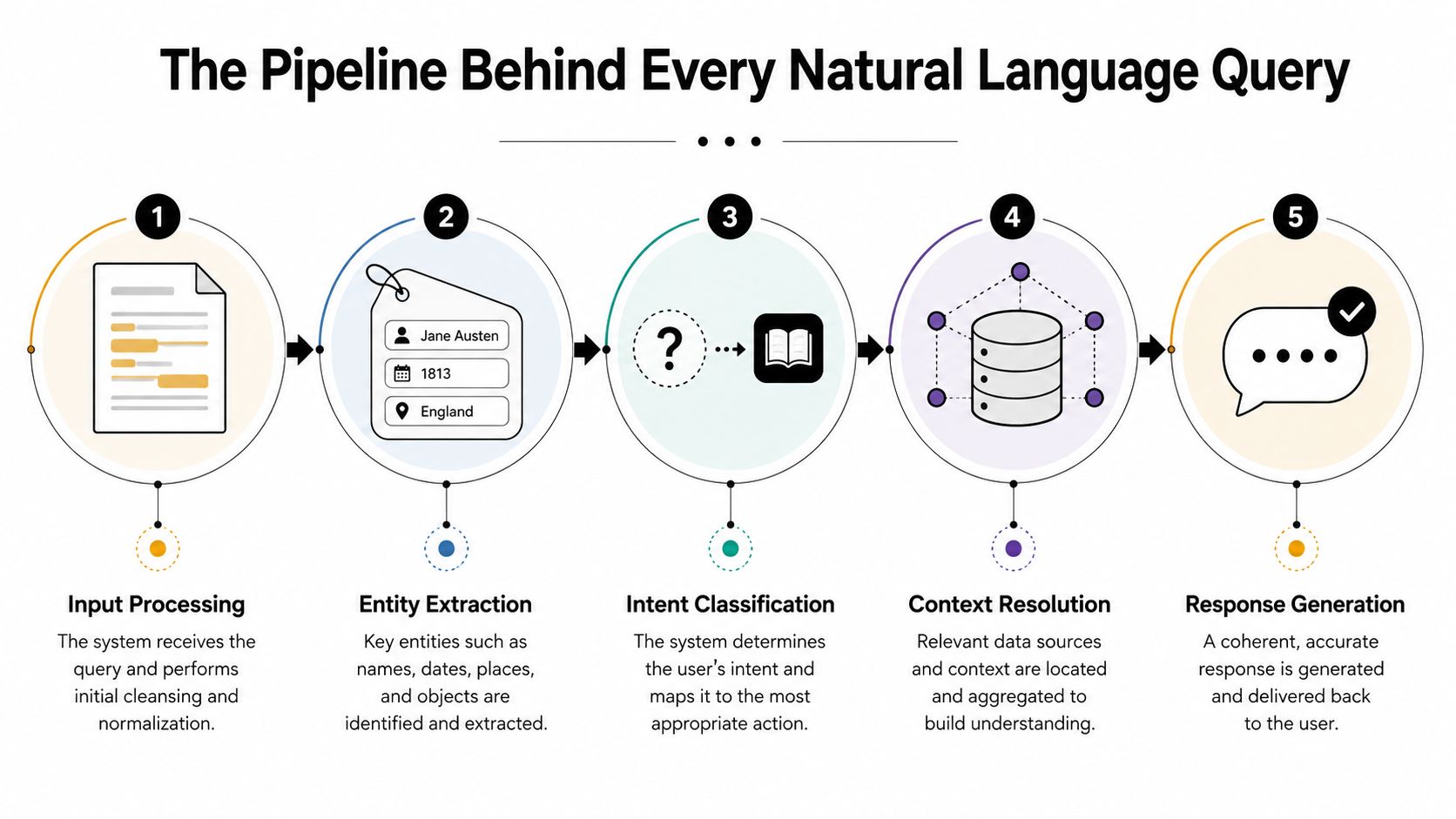
A serious NLQ system usually isn't one big model call. It's a pipeline that trims ambiguity step by step before the system commits to an action or answer.
From raw text to structured meaning
The first stage is preprocessing. The system tokenizes the text, lemmatizes words, tags parts of speech, and parses syntax so it can tell whether “next Tuesday after 5” is a time window and not just a random phrase. After that comes entity recognition, which pulls out things like dates, product names, locations, or account IDs.
Then the system maps those pieces to a schema. In a clinic example, “cleaning” might map to a service record, “Tuesday” becomes a date field, and “after 5” becomes a scheduling constraint. Only then does the system generate a structured query, run it, and postprocess the result into a human-friendly answer.
This is why pipeline design matters. A single-pass text-to-query approach can sound elegant in a demo, but it leaves fewer checkpoints for catching errors early. The multi-stage flow described in the NLQ technical overview helps explain why correctness and explainability improve when each step narrows the interpretation before execution.
A good NLQ stack should make it obvious where the system is unsure. If every step is hidden, debugging becomes guesswork.
Why the staging matters for SMBs
Small businesses don't need academic elegance, they need fewer wrong replies. A booking flow that misreads a date is a lost appointment. A support bot that grabs the wrong policy answer creates a follow-up loop for staff.
For teams evaluating vendors, the pipeline is a sanity check. Ask where the system does parsing, where it extracts entities, where it maps to schema, and where it validates the output. If a vendor can't explain those layers, the product may be doing more guesswork than it admits.
A useful reference point for the retrieval side of that architecture is Hyperleap's RAG pipeline guide, which shows how grounding steps fit into a broader system rather than sitting on top of a black box.
Intent Detection, Entity Extraction, and Semantic Search Explained
Three pieces do most of the interpretive work in a natural language query stack. They're easy to confuse, but each one solves a different problem.
Intent detection tells you the job
Intent detection answers the question, “What does the user want to do?” In a hotel chatbot, the same visitor might want to book a room, cancel a stay, ask about parking, or escalate to staff. Those are different intents, even if the wording sounds similar.
A real estate chatbot sees the same pattern. “Show me 3BHK in Bandra under 3 crore with parking” isn't a support question. It's a search-and-filter request with a very specific action behind it. If the intent classifier gets that wrong, everything downstream starts from the wrong assumption.
Entity extraction turns speech into slots
Entity extraction pulls the details out of the sentence. Dates, places, budgets, sizes, and product names are all entities or slots the system needs to capture. In the hotel example, “Friday” and “two nights” matter just as much as the desire to book.
Many business conversations break. A customer may say “sometime next week,” and a receptionist can ask a follow-up. A weak bot may guess. Good entity extraction reduces that gap by extracting the facts the system can act on and flagging the rest for clarification.
Semantic search handles the messy middle
Semantic search and embeddings help when the wording changes but the meaning stays the same. Someone might say “I want to slim down before summer,” and a wellness chatbot should still recognize a weight-management or fitness-related request if the knowledge base supports it.
That's the key advantage over keyword matching. Keywords are brittle when customers use slang, partial descriptions, or indirect phrasing. Semantic search gives the system a better chance to connect intent to meaning, especially when the product catalog or support content uses different language than the customer does.
To see how this connects to knowledge-base design, Hyperleap's AI chatbot knowledge base best practices page is a practical companion, because the search layer is only as good as the content it can retrieve.
Real-World Examples for SMBs and Chatbots
The clearest way to understand NLQ is to watch it work in a business setting. The moment feels ordinary to the customer, but it removes a lot of friction behind the scenes.
A hotel guest gets an answer without waiting for staff
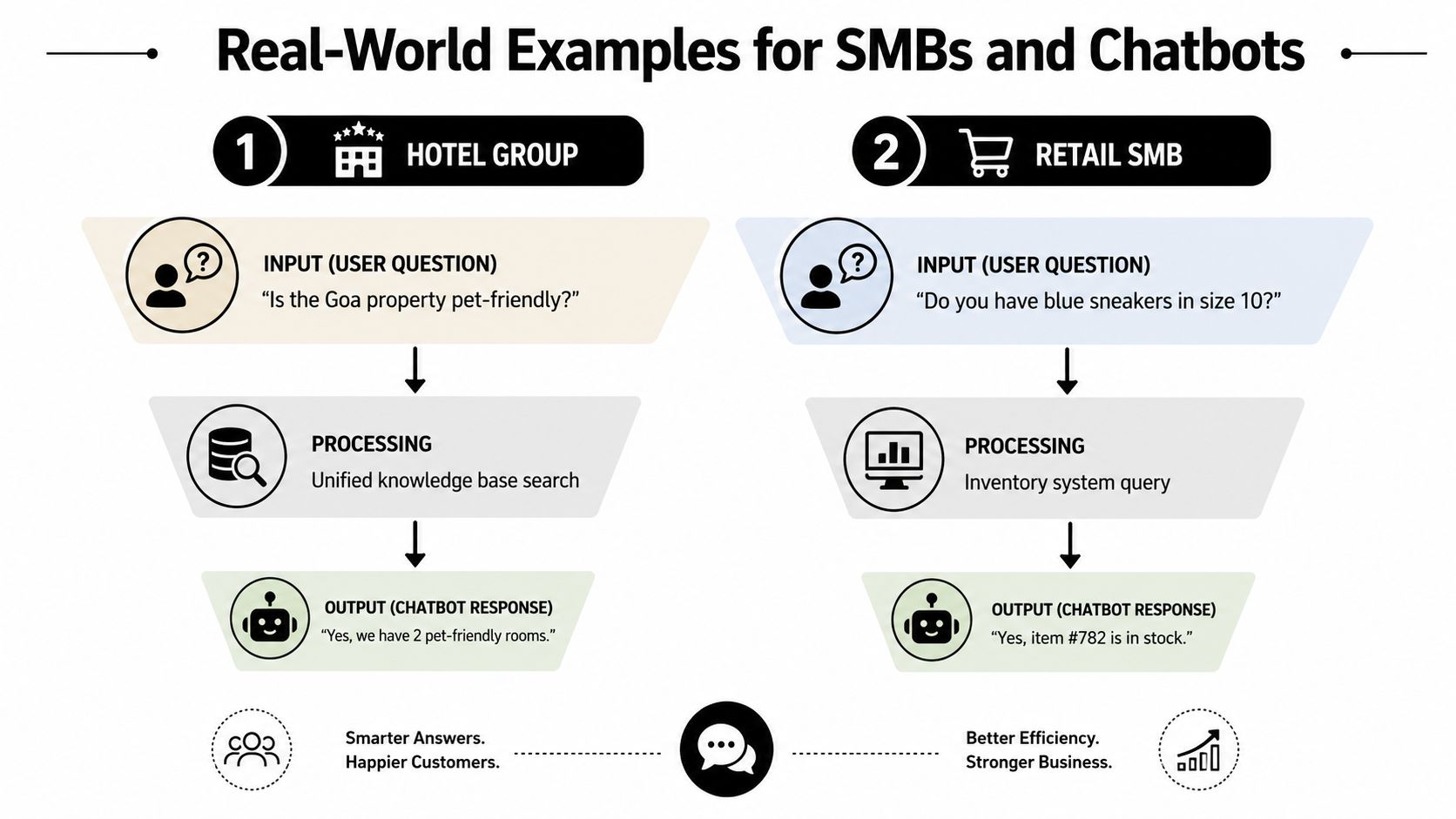
A multi-location hotel group can unify its property information so a guest on WhatsApp asks, “Is the Goa property pet-friendly in December?” and gets a location-specific answer. The chatbot doesn't need a front-desk employee to cross-check every property policy manually.
That matters because guests don't always ask during business hours. The support flow still needs to work at night, on weekends, and across channels. In a good deployment, the same question can behave consistently on the website, WhatsApp, Instagram, or Facebook, as long as the underlying knowledge base is current.
A real estate lead gets captured before the chat goes cold
A real estate team has a different goal. A prospect types, “Show me 2BHK flats in Andheri under 1.5 cr,” and the bot doesn't just answer, it captures the lead, verifies the contact, and hands the conversation to the sales workflow.
That's where platform design starts to matter more than the model itself. If the system can route the lead to Calendly or Cal.com at the right moment, send an instant email summary, and keep the conversation tied to a unified inbox, the chatbot stops being a novelty and starts acting like a sales assistant.
The business value here is less about “AI” and more about continuity. Staff don't have to retype context from one channel to another. The customer doesn't have to repeat the same question twice. And the business gets a structured trail instead of scattered messages.
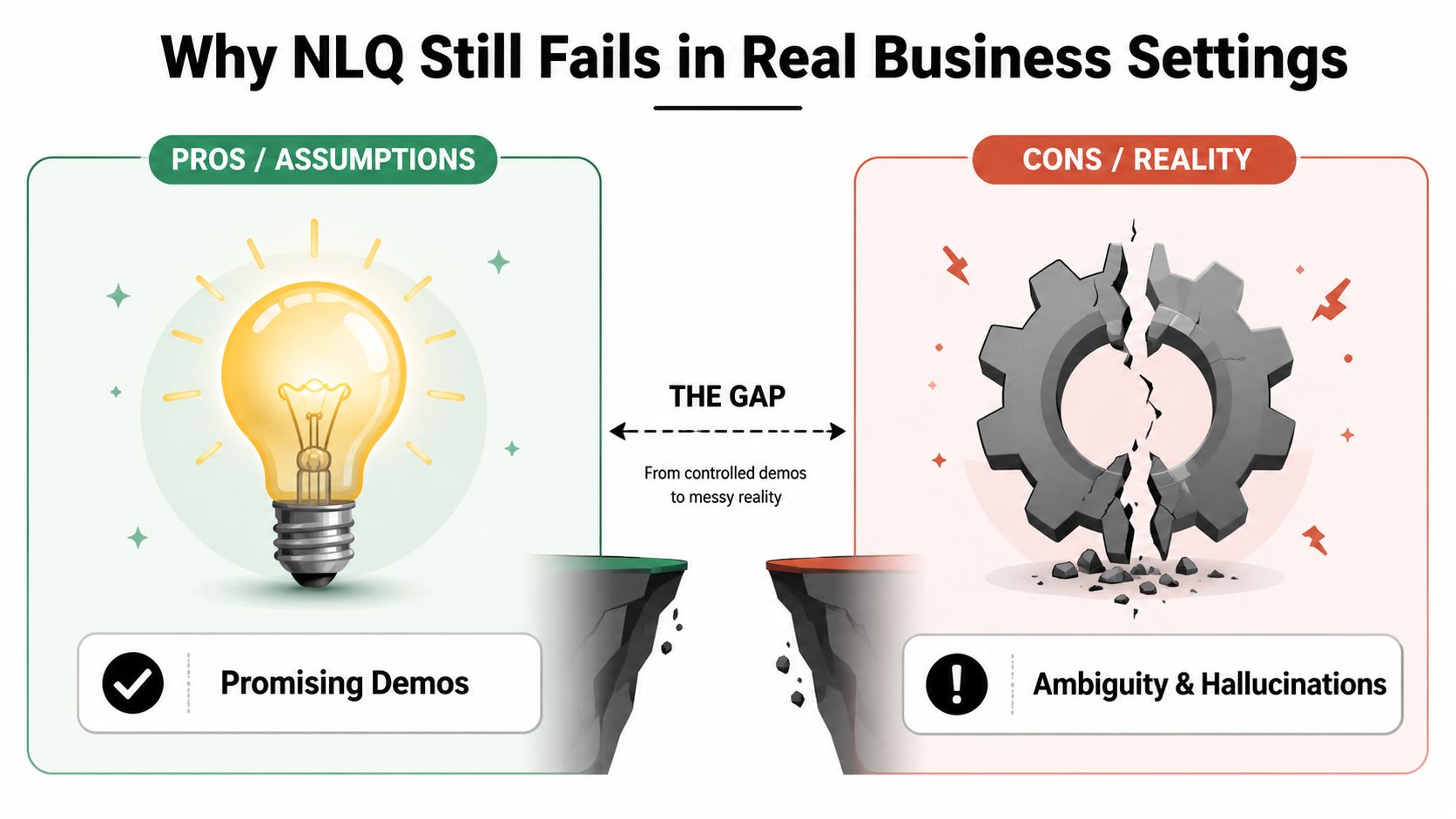
Why NLQ Still Fails in Real Business Settings
A polished demo can make NLQ look finished. Production usually exposes the gaps.
A support bot may answer a simple product question correctly, then stumble on a follow-up that uses a shorter phrase, a regional term, or a synonym the data model does not recognize. A BI assistant can do the same thing with reports, where the user's wording sounds ordinary but the underlying table names and joins do not match that wording at all.
The failure modes are familiar
Ambiguity is the first problem. Customers do not always state exactly what they mean, and the system has to choose between asking a follow-up or making a risky assumption. Schema mismatch is the second problem, where the user's wording does not line up with the way the data is modeled.
Hallucination is the third problem. The model invents a field, a filter, or a business fact that does not exist. Inconsistent definitions are the fourth. “Active customer” can mean one thing to sales and something else to support, so the same query can be parsed correctly and still produce the wrong business answer.
A 2025 literature review on NL-to-QL conversion points to schema generalization, ambiguity resolution, and hallucinated outputs as persistent problems. The core issue is not that LLMs cannot produce fluent language, it is that they can sound certain while missing the exact structure a business depends on.
Why grounding changes the result
Raw data models become especially risky when the system has no semantic context. In that setting, analysts at AtScale reported incorrect results on TPC-DS benchmarks more than 80% of the time, a warning sign for teams that assume prompt quality alone will fix the problem. The larger lesson is that NLQ needs governance, semantic layers, and retrieval grounding, not just a polished interface.
Business rule: If your data definitions live in people's heads, the bot will eventually reflect that confusion back at the customer.
Grounded systems reduce that risk. When responses stay tied to an uploaded knowledge base or an approved data layer, the model has less room to invent unsupported answers. Hyperleap AI is one example of that design choice in practice, because it keeps responses tied to customer-provided knowledge instead of letting the model freewheel across the internet or a loosely defined schema.
Architecture and Implementation Options That Actually Work
Once you know where NLQ fails, the build decision gets much clearer. The right architecture depends on whether you're answering internal analytics questions or running customer-facing support and booking flows.
Three paths, three different jobs
A DIY stack usually combines an LLM, a vector database, and a semantic layer. That gives your team the most control, but it also means you own retrieval, validation, monitoring, and the messy edge cases. It's the most flexible path, and also the most operationally demanding.
A packaged analytics NLQ tool is better when the goal is BI-style question answering. Those tools are built for dashboards, filters, and structured reporting, so they fit teams that mostly want to ask questions of internal data. A chatbot platform with NLQ baked into support flows is a different category, because the target is customer conversations, lead capture, and appointment booking rather than analyst workflows.
What should be non-negotiable
RAG is useful when the answer needs to stay grounded in proprietary content. Fine-tuning helps when your organization has repeatable query patterns or domain-specific language. A semantic layer becomes important when the business definitions need to stay consistent across teams, channels, and reports.
For SMBs, the shortest path is often the one that avoids stitching all of that together manually. One option is Hyperleap AI, which lets teams paste a website URL or upload documents, pick an industry template, and go live across website, WhatsApp, Instagram, and Facebook without building the plumbing from scratch. That doesn't remove the need for good content or clear definitions, but it does reduce the setup burden.
Don't buy the model first. Buy the workflow you need, then check whether the platform can ground answers, hand off edge cases, and keep a human review path available.
Best Practices, KPIs, and How to Measure NLQ Success
Launching NLQ is the easy part. Proving it works is what earns the next budget.
Measure what the business actually feels
Containment or deflection rate tells you how many questions the bot resolves without help. Qualified leads captured matters when the chatbot is part of sales, especially if the system uses OTP verification to filter out fake contacts. Resolution time, CSAT after chat, time-to-booking, and fallback-to-human rate each tell a different part of the story.
If you're using Hyperleap AI, the operational features make those measurements easier to inspect. Instant email summaries help with follow-up, the unified inbox keeps conversation history in one place, and CSV or Excel export gives managers something they can review without chasing screenshots. The point isn't to collect more dashboards, it's to see whether the bot is saving time and creating cleaner handoffs.
| KPI | What it measures | What good looks like in 30 days | How Hyperleap AI surfaces it |
|---|---|---|---|
| Containment rate | How often the bot resolves the conversation without human help | Fewer routine handoffs | Unified inbox and conversation history |
| Qualified leads captured | How many contacts are real and usable | More verified inbound leads | OTP-verified lead capture and email summaries |
| Resolution time | How quickly customers get an answer | Shorter waiting time | Chat transcripts and follow-up logs |
| CSAT after a chat | How customers feel about the interaction | Clearer, smoother conversations | Conversation history for review |
| Time-to-booking | How fast a visitor books after asking | Faster appointment conversion | Routing to Calendly or Cal.com |
| Fallback-to-human rate | How often the bot escalates | Lower for routine questions, steady for edge cases | Human handoff through the inbox |
Operational habits that keep NLQ honest
Keep one source of truth. Update the knowledge base when policy changes. Route unclear cases to a human instead of forcing an answer. Review transcripts weekly so you can spot recurring confusion before it spreads.
If a team treats the bot like a static FAQ page, it will drift. If the team treats it like a living interface tied to reporting and handoff rules, it gets more reliable with use.
Frequently Asked Questions About Natural Language Query
Is NLQ the same as keyword search?
No. Keyword search matches terms, while NLQ tries to understand intent and map it to an action or structured answer.
Is NLQ just a large language model?
No. An LLM may power part of the experience, but NLQ usually also needs schema mapping, retrieval, validation, and business rules.
Can an SMB deploy NLQ without a developer?
Yes. Many chatbot platforms and analytics tools now offer no-code setup, template-based flows, and document grounding so a non-technical team can launch faster.
Which businesses see the fastest payoff?
Teams that handle repeated questions or booking requests, especially clinics, hotels, real estate groups, agencies, and local service brands, usually feel the benefit first.
Natural language query isn't a future concept anymore, it's the interface layer that customers now expect. The teams that win in 2026 will ground it in real data, measure it with real KPIs, and keep humans in the loop where the model still has blind spots.
If you're ready to turn customer questions into booked appointments, verified leads, and faster support replies, take a look at Hyperleap AI.