AI Assistant for Ecommerce: Maximize Sales & Support
Boost sales, capture leads, & automate support with an AI assistant for ecommerce. This 2026 guide for SMBs covers Shopify, WordPress, & more.
The strongest signal that AI in retail has moved from experiment to requirement is this: the global AI shopping assistant market is projected to grow from USD 3.42 billion in 2024 to USD 37.45 billion by 2034, and 76% of consumers now explicitly want AI-powered help during buying decisions, according to Precedence Research's AI shopping assistant market analysis.
For a small or mid-sized ecommerce business, that matters for a simple reason. Customers ask questions after hours, compare products across tabs, message on Instagram instead of email, and expect a useful answer right away. If nobody responds, the sale often disappears. If your team does respond manually, support starts eating the time you need for merchandising, marketing, and fulfillment.
That's why the practical value of an AI assistant for ecommerce isn't just chat on a website. For SMBs, the bigger win is operational. A grounded assistant can answer real product and policy questions, collect qualified leads, verify contact details, route people to booking links, and keep conversations moving across channels without forcing you to hire a round-the-clock team.
Table of Contents
- The New Reality of Online Retail
- What Exactly Is an AI Assistant for Ecommerce
- Core Features That Drive Business Growth
- Practical AI Use Cases for SMB Ecommerce
- A No-Code Guide to Implementation and Integration
- Measuring Success and Ensuring Security
- Your SMB Implementation Checklist and Final Thoughts
The New Reality of Online Retail
Small ecommerce teams used to treat AI as something for enterprise brands with giant catalogs and dedicated support departments. That's no longer realistic. Buyers now expect guided shopping, quick answers, and personalized interactions as part of a normal retail experience. If your store still relies on a contact form and a delayed email reply, you're competing at a speed disadvantage.
The pressure shows up in ordinary places. A visitor lands on a product page at night and wants to know whether sizing runs small. Another shopper asks on WhatsApp if same-day pickup is available. A third wants to know whether your med spa package includes a consultation before booking. None of these are complex questions, but every unanswered message creates friction.
For SMBs, that's where an AI assistant starts to pay off. It gives buyers an immediate path forward and gives the business a way to capture intent before it goes cold.
Practical rule: If customers regularly ask the same pre-sale questions, you don't have a staffing problem first. You have a response system problem.
The broader commerce backdrop matters too. Sales patterns keep shifting across channels, devices, and customer expectations, which is why staying current on broader buying behavior helps. The Market With Boost report on ecommerce sales trends is a useful companion read if you want context on where demand is moving beyond your own store analytics.
Why SMBs should care now
Most guides frame AI assistants as digital sales clerks for large retailers. That misses the day-to-day reality of smaller operators. A growing brand often needs help with:
- Lead capture: Not every conversation ends in a direct checkout. Some need follow-up.
- Appointment flow: Service-driven sellers need bookings, not just carts.
- Channel coverage: Customers message wherever they feel like it.
- Support deflection: Routine policy and product questions shouldn't consume your team.
That makes an AI assistant for ecommerce less about novelty and more about coverage. It fills the gap between customer expectations and small-team capacity.
What Exactly Is an AI Assistant for Ecommerce
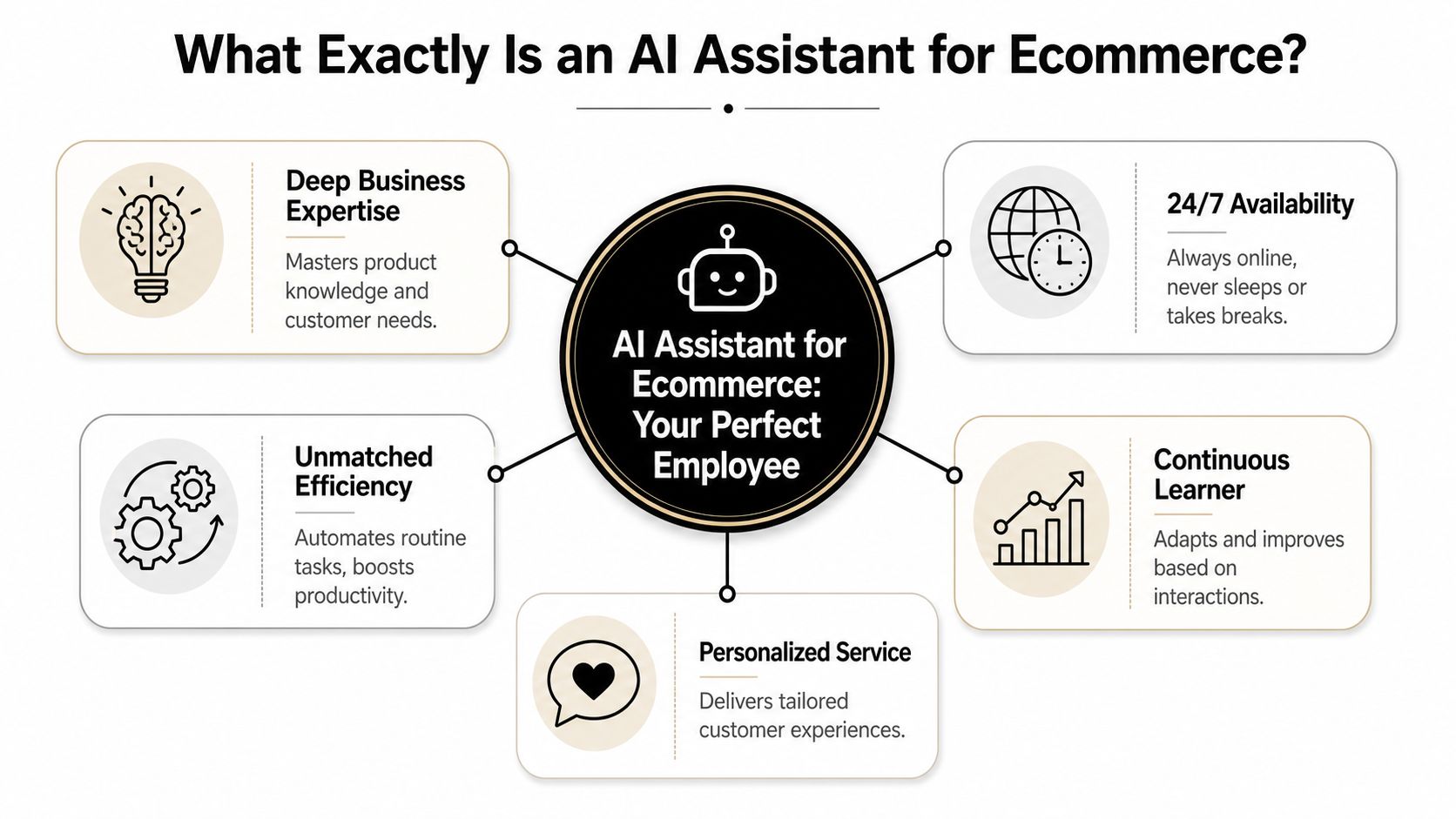
A modern AI assistant for ecommerce is closer to a trained digital staff member than an old-school chatbot. It should know your products, policies, shipping rules, returns process, and common objections. It should answer naturally, stay on brand, and hand off cleanly when a human needs to step in.
A better way to think about the tool
The easiest mental model is this: you're hiring the perfect frontline employee.
This employee never sleeps, answers instantly, can communicate with customers in many languages, and doesn't forget your return policy halfway through a conversation. But there's one condition. It has to be trained on your business, not on generic internet knowledge.
That's the difference between a useful assistant and a frustrating one. Older bots relied on rigid decision trees. They worked only if a customer used the exact phrasing you expected. General-purpose AI has the opposite problem. It sounds flexible, but if it isn't grounded in your store data, it can answer confidently and still be wrong.
Grounded knowledge versus guesswork
A grounded assistant uses approved business inputs such as your website pages, uploaded FAQs, policy documents, catalog data, brochures, and help content. The system then answers from that source material instead of improvising. That matters because ecommerce questions often depend on exact details:
| Situation | What a weak bot does | What a grounded assistant should do |
|---|---|---|
| Shipping policy question | Gives a vague answer | Pulls your stated shipping rules |
| Product compatibility question | Guesses based on similar items | Uses your product specs and documentation |
| Return request | Pushes a generic help article | Explains the actual return steps you support |
| Appointment inquiry | Tells users to contact support | Collects details and routes to booking |
A lot of sellers on marketplaces are discovering the same thing from another angle. Catalog accuracy, workflow automation, and human review all have to work together. If you sell on Amazon too, this guide on AI automation for Amazon brands does a good job of separating tasks AI can handle from the ones that still need a person.
A chatbot becomes an assistant when it can answer with context, act within rules, and know when not to guess.
For SMBs, that distinction is huge. You don't need a flashy conversational layer that talks a lot. You need one that captures demand, gives correct answers, and moves people toward checkout or booking.
Core Features That Drive Business Growth
The commercial case for AI gets much easier once you stop evaluating it as a widget and start judging it by business outcomes. The useful question isn't “Does it have AI?” It's “Does it convert more visitors, reduce manual support load, and improve lead quality?”
Sales support that doesn't clock out
The most direct proof point is conversion. According to Envive's roundup of AI shopping assistant ROI statistics, 12.3% of shoppers who engage with AI-powered chat complete a purchase, compared with 3.1% of those who do not, which amounts to a 4X conversion lift. The same source notes that these agents can resolve 93% of customer questions without human intervention.
That doesn't mean every store should expect the same result. It does mean the pattern is clear: when shoppers get answers in the moment, more of them move forward.
A strong assistant helps in the exact moments where buyers hesitate:
- Product uncertainty: sizing, materials, compatibility, ingredients, or warranty
- Policy questions: returns, delivery windows, exchanges, financing, pickup
- Decision support: comparing options without making the visitor search manually
If you want a broader primer on how modern chat tools fit into business workflows, this guide to what an AI chatbot is is worth reviewing before you choose a platform.
Lead quality matters more than chat volume
For SMBs, not every interaction should be optimized for immediate checkout. Some businesses need consultations, quotes, demos, fittings, or appointment slots. In those cases, the assistant should qualify intent before passing the lead along.
That's where many mainstream ecommerce tools fall short. They can recommend products, but they don't always validate contact details, summarize the conversation for staff, or route the customer into the next operational step.
The most useful feature set often includes:
- Verified lead capture: collect real phone or email details instead of low-intent submissions
- Booking handoff: send qualified prospects to Calendly or another scheduler
- Conversation summaries: give staff the transcript and key details right away
- Unified inbox workflows: keep website, WhatsApp, and social conversations in one place
Support automation only works when it stays grounded
There's also a less glamorous but important growth lever here. Every repetitive support exchange steals time from merchandising, campaign planning, supplier coordination, and fulfillment. Good automation gives that time back.
Catalog quality also affects performance. If you're trying to improve product discoverability on marketplaces as well as your own store, practical work on titles, bullets, and attribute completeness still matters. That's why merchants often pair chat automation with catalog cleanup work such as Amazon listing optimization.
What works: assistants trained on real product and policy data.
What fails: assistants asked to “sound smart” without access to current business information.
That trade-off is where many SMB implementations either become useful fast or slowly stall.
Practical AI Use Cases for SMB Ecommerce
The most effective deployments usually solve ordinary bottlenecks first. Not futuristic ones. Just the issues that keep showing up every week.
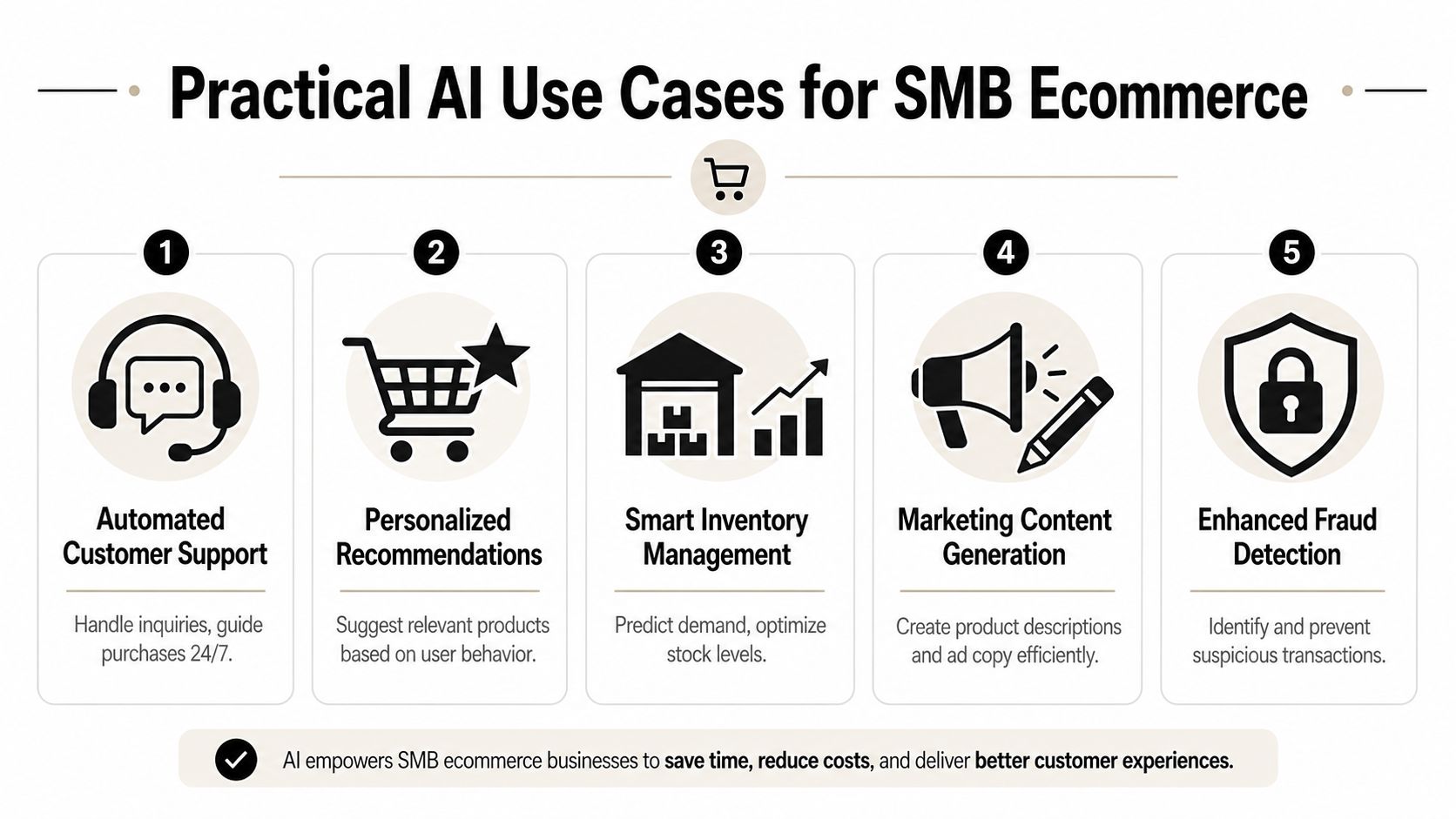
After-hours sales conversations
A visitor lands on your store at 10:30 p.m. and wants to know whether a supplement is vegan, whether a dress is lined, or whether a device works with a specific voltage. If they have to wait until morning, they may never come back.
A grounded assistant can answer from approved product and policy content, suggest the right item, and capture contact details if the person still needs follow-up.
Appointment booking for service-based commerce
In this regard, SMB-focused setups look very different from enterprise retail content.
A med spa, clinic, custom furniture studio, bridal boutique, or installer often needs the assistant to do more than answer pre-sale questions. It should gather a few qualifying details, identify the relevant service, and route the customer into a booking flow.
That same pattern works well on messaging channels. If bookings and customer conversations happen on mobile first, a WhatsApp chatbot for ecommerce can handle intake, FAQs, and appointment routing without forcing users back to email.
Cart recovery and pre-purchase hesitation
Some buyers don't need a hard sell. They need one useful answer at the right time.
A shopper pauses at checkout because shipping terms aren't clear. Another can't tell which bundle fits their use case. Another wants to confirm whether an item can arrive before an event. An AI assistant can step in with relevant guidance, rather than making the customer hunt through a policy page or abandon the cart.
Multi-channel support without inbox chaos
SMBs often lose leads because the conversation starts in one place and disappears into another. Someone comments on Instagram, then asks for details on WhatsApp, then visits the site later. If your team is jumping between tabs and DMs, context gets lost.
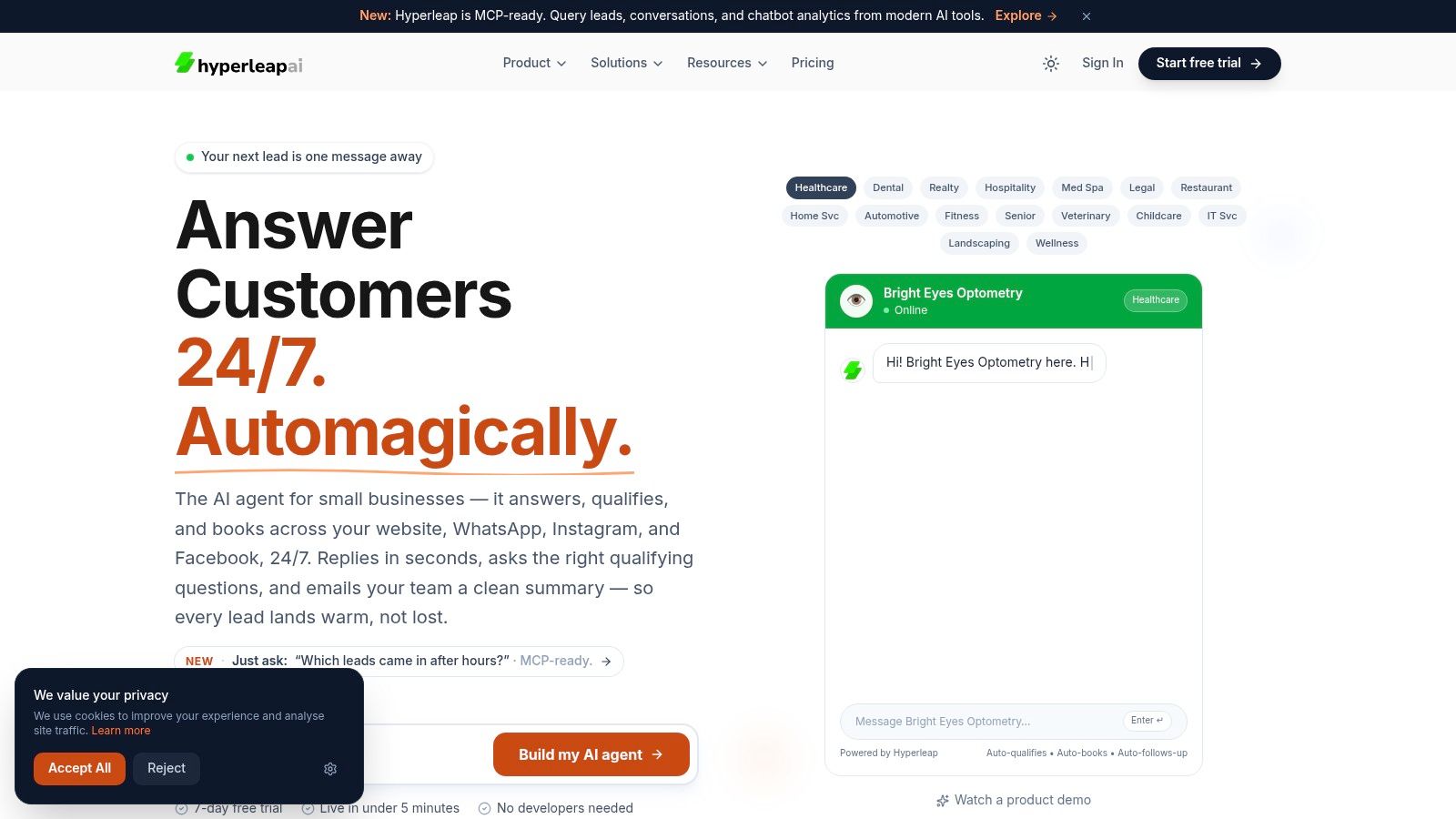
A well-configured assistant helps centralize those interactions and keeps the handoff clean. One option in this category is Hyperleap AI, which supports no-code deployment across website and messaging channels, grounded responses based on uploaded business content, OTP-verified lead capture, and routing to scheduling tools.
Use cases like these matter because they align AI with actual operating problems. The goal isn't to add chat for the sake of chat. It's to shorten response time, reduce drop-off, and keep qualified demand moving.
A No-Code Guide to Implementation and Integration
Most SMB owners don't need a custom AI build. They need a setup that's fast to launch, easy to maintain, and connected to the systems they already use.
Start with the simplest version that can answer real customer questions correctly.
Start with your knowledge base
The first step is collecting the content your assistant should trust. For most stores, that includes:
- Core website pages: product pages, FAQs, shipping, returns, warranty, contact
- Uploaded documents: brochures, size guides, treatment guides, spec sheets
- Policy content: cancellations, exchanges, service limitations, booking rules
- Sales assets: comparison sheets, offer details, onboarding documents
Keep the content clean. Remove outdated policies, duplicate pages, and contradictory wording. If a human would be confused by your documentation, the assistant will be confused too.
Clean data beats clever prompting. Most bad ecommerce bot experiences start with messy source material.
Connect the store and channels
Once the knowledge layer is ready, connect the assistant to the places where conversations already happen. For many SMBs, that means the website first, then WhatsApp, Instagram, or Facebook.
If you run Shopify, use a direct integration rather than trying to force a generic widget into the store. A native setup like Shopify AI chatbot integration usually makes deployment and catalog syncing much simpler.
The technical process is often lighter than owners expect. In a no-code setup, you're usually doing some mix of:
- Pasting a site URL or uploading files
- Connecting the ecommerce platform or CMS
- Choosing channels where the assistant should appear
- Defining lead capture fields and routing rules
- Testing common customer questions before going live
A quick visual walkthrough helps if you want to see how these setups typically look in practice.
Structure your product data properly
This is the part many SMBs skip, and it directly affects how well AI can answer shopping questions.
According to Digital Applied's analysis of AI shopping assistant citation rates, retailers with the highest citation rates complete an average of 94% of available product attributes in structured formats. The reason is straightforward. AI systems need discrete details such as dimensions, materials, voltage, weight, or compatibility to match natural-language questions to the right product.
That means product detail pages should do more than sound persuasive. They should also expose the facts clearly.
A practical product data checklist looks like this:
| Page element | Weak version | Strong version |
|---|---|---|
| Specifications | Buried in paragraphs | Listed in scannable fields |
| Attributes | Missing or partial | Complete and consistent |
| Policies | Split across pages | Linked clearly from the PDP |
| Variant details | Ambiguous | Explicit by size, color, pack, or use case |
Test before you scale
Before rolling out across all channels, run a set of common buyer questions through the assistant. Focus on the questions that block sales:
- Pre-purchase questions: sizing, ingredients, compatibility, delivery timing
- Service questions: consultation steps, booking windows, rescheduling
- Policy questions: returns, cancellations, exchanges, payment options
If the assistant misses a question, don't just rewrite the prompt. Fix the source content or product data behind it.
Measuring Success and Ensuring Security
A lot of teams measure the wrong things after launch. They look at conversation count, impressions, or total messages handled. Those numbers can be interesting, but they don't tell you whether the assistant is helping the business.
The KPIs that actually matter
For SMB ecommerce, I'd focus on operational and revenue-linked metrics first:
- Lead capture quality: Are the contacts real and usable?
- Conversation-to-booking rate: Are service inquiries turning into appointments?
- Conversation-to-purchase rate: Are assisted shoppers moving forward?
- First-contact resolution: Are routine issues being solved in the chat?
- Escalation quality: When a human steps in, do they get enough context to act fast?
A second layer of review should look at answer quality. Watch for stale policy information, weak product matching, and moments when the assistant sounds confident without citing the right business context.
One of the smartest operational habits is recurring prompt testing. As noted in the earlier discussion of external AI visibility, teams should regularly test real customer questions across common assistants and channels to catch drift before it affects revenue.
Security and compliance need clear rules
Security isn't just an IT concern here. It affects trust, compliance, and channel reliability.
For SMBs, the practical checklist is simple:
- Use compliant integrations: especially for messaging channels like WhatsApp
- Limit data access: only expose the systems and fields the assistant needs
- Define handoff rules: sensitive or regulated questions should route to staff
- Review retention settings: know what conversation data is stored and why
- Keep policies current: privacy, returns, cancellations, and consent language should match what the assistant says
If an assistant can message customers, capture personal data, and influence purchases, it needs governance, not just setup.
That's especially important in healthcare-adjacent, wellness, and appointment-heavy businesses where intake details can become sensitive fast.
Your SMB Implementation Checklist and Final Thoughts
The biggest mistake SMBs make with AI is overcomplicating the first rollout. Keep it narrow. Solve one business problem well, then expand.
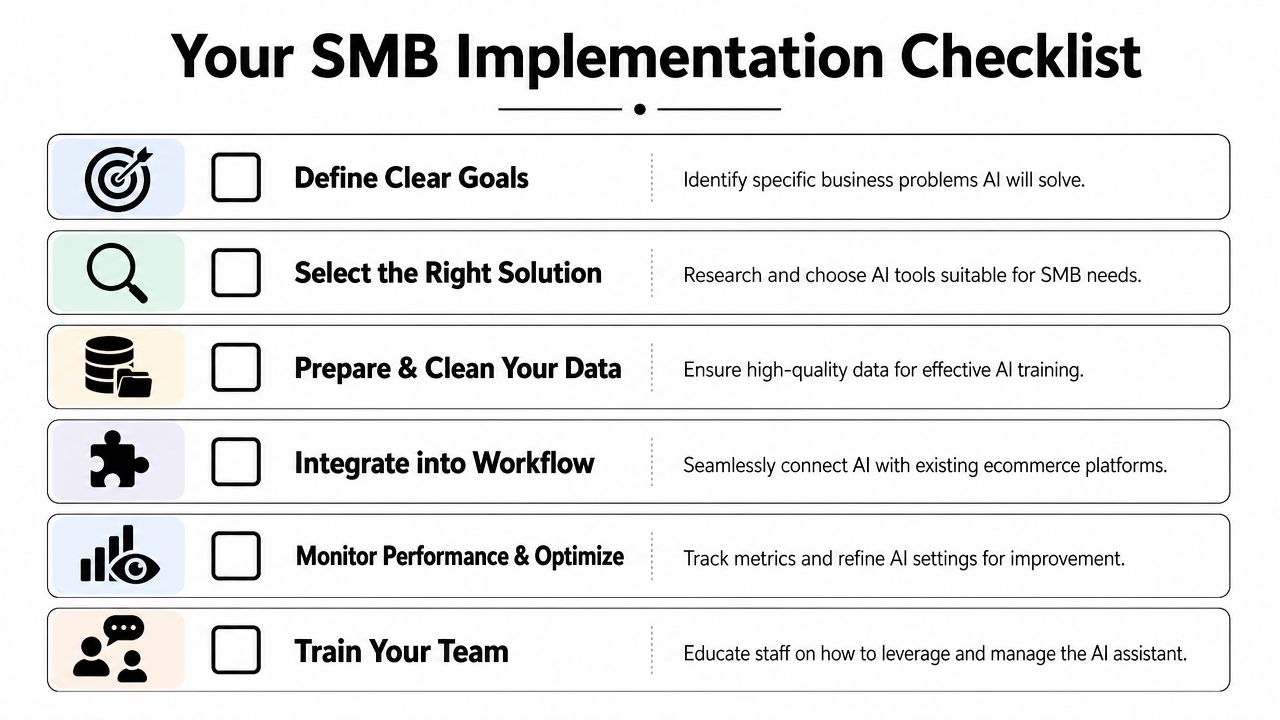
A practical checklist:
- Pick one primary goal: reduce support load, capture leads, increase bookings, or improve conversion on key product pages.
- Clean your source content: update FAQs, shipping rules, returns policy, and product details before training anything.
- Map the handoffs: decide when the assistant should collect details, when it should route to booking, and when a person should take over.
- Connect the right channels: start where customers already contact you, not where you wish they would.
- Test real questions: use actual customer language from chats, DMs, and support emails.
- Review weekly: tighten weak answers, remove outdated content, and watch for repeated escalation points.
There's also a strategic reason to move now. Most advice still targets large retailers, while SMBs need workflows built around lead capture, appointment routing, and integrated operations. That gap shows up in implementation outcomes too. According to Insider One's analysis of AI shopping assistants for SMBs, 60% of SMB chatbot implementations fail due to poor integration and a lack of focus on operational needs such as verified lead capture and appointment booking.
That's the lesson. An AI assistant for ecommerce works when it's tied to your actual sales process, not when it's added as decoration.
If you want a practical way to launch this without developers, Hyperleap AI is built for SMBs that need grounded answers, lead capture, appointment booking, and multi-channel messaging across website, WhatsApp, Instagram, and Facebook.