AI Chatbot Development Company: How to Choose the Right Partner
What AI chatbot development companies actually do, the three partner types, how to evaluate them, real costs, red flags, and where Hyperleap AI's Managed Setup fits.

TL;DR: An AI chatbot development company builds or deploys a customer-facing AI agent for your business — answering questions 24/7, qualifying leads, and routing conversations across the channels your customers already use. Three partner types exist: custom agencies (high cost, long timeline, you own the code), platforms with managed setup (fastest path to production, fraction of the cost), and self-serve platforms (DIY, lowest cost). Evaluate any partner on channel coverage, knowledge grounding, lead capture mechanics, pricing transparency, and post-launch support. Red flags include vague demos, per-conversation pricing with no cap, and promises of zero hallucinations.
Around year two of building Hyperleap AI, I started hearing a version of the same question from almost every SMB owner I spoke with:
"I know I need an AI chatbot. But how do I find the right company to build it — and how do I know I am not getting ripped off?"
It is a fair question. And the honest answer is messier than most vendors will admit. The phrase "AI chatbot development company" covers a wide range of providers — boutique dev shops charging $50,000 per project, offshore agencies selling templated bots dressed up as bespoke AI, and platforms like ours that combine self-serve tooling with an optional done-for-you service. These are very different things with very different outcomes.
This guide cuts through that. By the end, you should know what questions to ask, what a fair deal looks like, and which model fits your situation. If you are still working through whether to build custom or buy a platform solution, start with our companion post on AI chatbot development services — the build vs. buy question. This guide picks up from that decision and focuses on evaluating and choosing the right partner once you have landed on a direction.
What an AI Chatbot Development Company Actually Delivers
Before comparing vendors, be precise about what you are actually buying. "AI chatbot development" is a services label that can mean any of the following, depending on the provider:
Custom development. A team writes code, configures or fine-tunes a large language model, and builds a chatbot from scratch against your requirements. You own the IP. You also own the maintenance bill.
Platform deployment. A technical team takes an existing AI platform and configures, trains, and launches a bot on your behalf. Faster and cheaper than custom development, but you operate on the vendor's infrastructure.
Consulting and integration. Advisors help you select the right tools and connect your chatbot to existing systems via APIs and webhooks. They hand off and you run it.
Ongoing management. Retainer-based work to monitor, retrain, and improve your chatbot over time. Some agencies bundle this into the project price; most charge it separately.
What most businesses actually need is a bot that:
- Answers customer questions from your own documents — product descriptions, FAQs, pricing pages, policies, service guides
- Collects contact details through a lead capture form before the conversation begins, so every inquiry is a qualified lead with a real name, email, and phone number
- Works across the channels your customers use: Website chat, WhatsApp, Instagram DM, and Facebook Messenger
- Emails your team a clean conversation summary whenever a lead is captured or a handoff occurs
- Routes complex or sensitive conversations to a human without friction
That is the baseline. Anything beyond this is either a premium feature or a distraction, depending on your stage and use case.
The Three Types of AI Chatbot Development Partners
Most providers fall into one of three buckets. Understanding the difference saves you from apples-to-oranges comparisons when you are evaluating vendors.
Type 1: Custom AI Development Agency
A full-service agency — or an in-house engineering team — builds your chatbot from scratch or heavily customizes an LLM-based solution to your specifications.
Best for: Large enterprises with genuinely unique workflow requirements, complex integrations with proprietary legacy systems, or compliance environments that prohibit third-party SaaS infrastructure.
Not ideal for: SMBs and most mid-market companies. Custom development is slow (typically three to six months to a first launch), expensive, and shifts full maintenance responsibility onto you after handoff. A bot is not a one-time deliverable — it needs ongoing updates as your products, pricing, and policies change. Every update requires engineering time you now own.
Type 2: Platform with Managed Setup
A software platform — purpose-built for chatbot deployment — offers a done-for-you setup service where their team configures and launches your bot on the platform. You get the speed and economics of modern SaaS with the expertise of a specialist team handling the technical work.
Best for: SMBs and mid-market companies who want speed to value, predictable monthly pricing, and ongoing platform support without a long IT project. This is the most underrated option in the market — it delivers 90% of the outcome of custom development at a small fraction of the cost and timeline.
Tradeoff: You operate on the vendor's platform. If they raise prices or a feature you need is not on their roadmap, your options are constrained. Evaluate the vendor's roadmap and exit path before signing.
Type 3: Self-Serve Platform
You access a no-code or low-code platform and configure the bot yourself. No agency involvement, no managed setup fee. A well-designed platform gets you from signup to production in days.
Best for: Teams with technical confidence, clear use cases, and the internal bandwidth to own configuration and ongoing updates. Also ideal for testing AI before a larger commitment.
Tradeoff: You absorb the learning curve. The quality of the output depends heavily on how well you structure and maintain your knowledge base. If your team lacks bandwidth for that ongoing work, self-serve often stalls after the first launch.
Comparing the Three Models Side by Side
| Criteria | Custom Agency | Managed Setup Platform | Self-Serve Platform |
|---|---|---|---|
| Time to first launch | 3–6 months | 1–4 weeks | Days to 2 weeks |
| Typical upfront cost | $20,000–$100,000+ | $299–$2,000 one-time | $0–$500 setup |
| Ongoing cost | Maintenance retainer ($2,000–$10,000/mo) | Platform subscription ($40–$200/mo) | Platform subscription ($40–$200/mo) |
| IP and code ownership | You own the code | Platform-hosted | Platform-hosted |
| Customization ceiling | Unlimited | Platform limits apply | Platform limits apply |
| Maintenance responsibility | You (or a paid retainer) | Shared — platform updates automatically | Shared — platform updates automatically |
| Internal resource required | High (PM, QA, integrations) | Low (content review, feedback) | Medium (configuration, training, testing) |
| Best for | Enterprise with unique requirements | SMB/mid-market wanting speed | DIY-confident SMB |
For most businesses below $10M in annual revenue, custom development is neither necessary nor cost-effective. Platforms — with or without managed setup — deliver the outcome at a fraction of the cost and timeline.
How to Evaluate Any AI Chatbot Development Partner
Whether you are talking to an agency, a platform's solutions team, or reviewing a self-serve tool, run every candidate through these criteria before making a decision.
Channel coverage that matches where your customers are
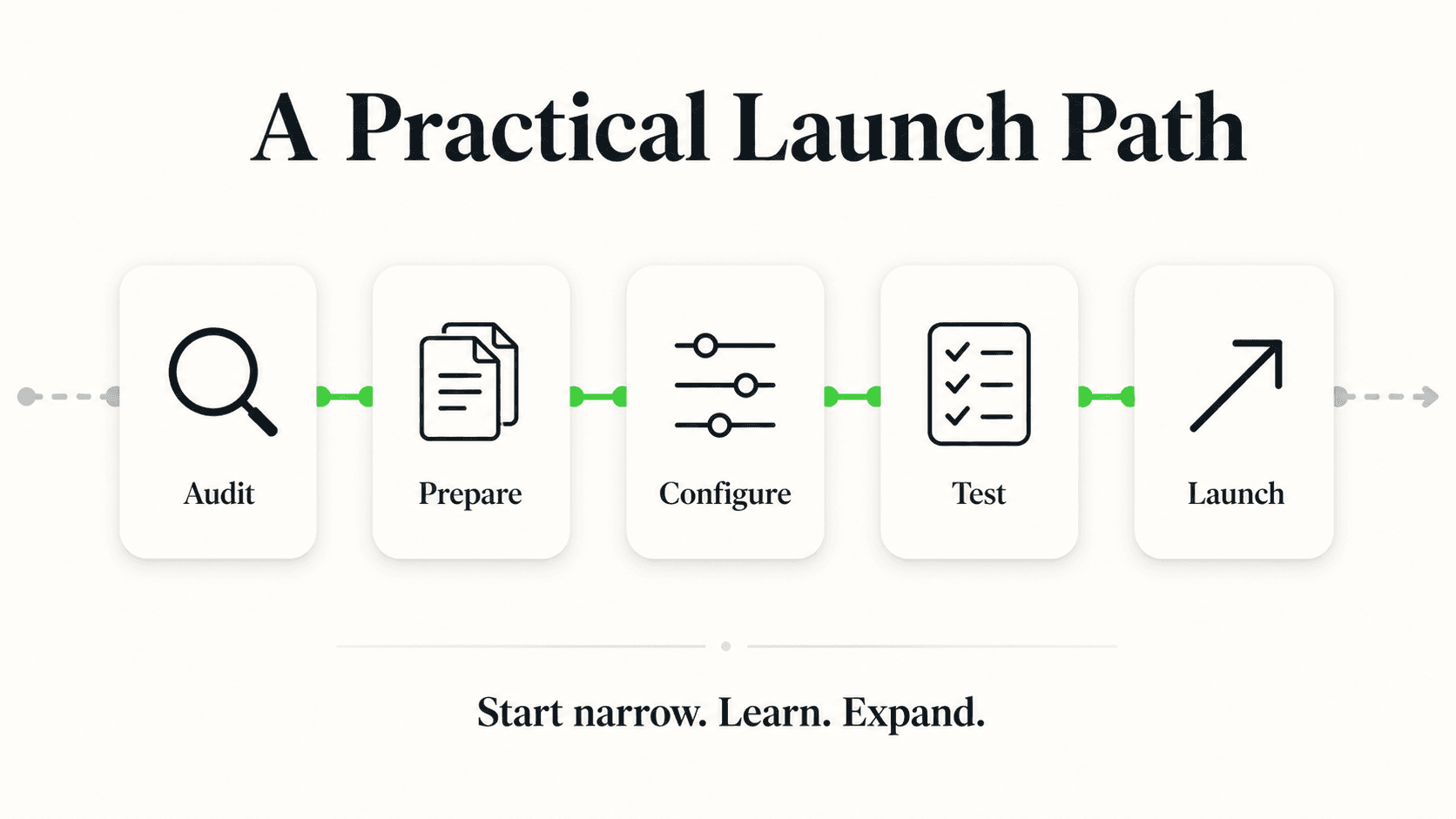
Ask exactly which channels the bot operates on and confirm these are live today — not roadmap features. The four channels that matter for most customer-facing deployments are Website chat widget, WhatsApp Business API, Instagram DM, and Facebook Messenger.
Channels frequently overpromised and underdelivered: SMS, voice, Telegram, Slack, email as a conversation channel. If a vendor marks any of these as available, ask for a live demo — not a screenshot — and confirm the integration is shipped, not planned.
Knowledge grounding and hallucination controls
Ask specifically how the bot answers questions. The only credible architecture for a customer-facing bot is Retrieval-Augmented Generation (RAG): the AI is constrained to answer from your uploaded knowledge base — product documentation, FAQs, pricing pages, policies — and only from those sources. When a question falls outside that content, a well-configured bot deflects and routes to a human.
No legitimate vendor claims zero hallucinations. No current AI system can guarantee this. The honest claim is that a well-configured, document-grounded bot substantially reduces the risk of incorrect answers. Ask every vendor: "What happens when a customer asks something outside the knowledge base?" The right answer is graceful deflection. The wrong answer is "the AI figures it out."
Lead capture mechanics
This one is non-negotiable and almost always gets glossed over in demos. Before the chatbot answers a single question, it should collect the visitor's name, email, and phone number through a structured pre-chat form. This ensures every conversation is tied to a real lead record — not an anonymous session you can never follow up on.
Ask: "Does the bot capture contact details before the conversation starts, or during it?" Many platforms collect lead information conversationally (mid-chat), which sounds elegant but produces messy, incomplete lead data that is hard to action. A pre-chat form is the correct mechanic for any business where lead generation matters.
Also ask: where does the lead data go? Can it sync to your CRM via REST API or webhooks? Does the platform email a clean summary to your sales team after each conversation?
The demo environment test
Ask the vendor to demonstrate the bot using your content — not their template. A legitimate platform can ingest a few pages from your website and produce a working demo in minutes. An agency should show you a bot deployed in a similar industry with comparable complexity.
If the demo only shows a generic scenario ("Hi, I am here to help — what can I assist you with today?"), you are looking at a template dressed up as bespoke AI. Push for a domain-specific demo with your actual products or services as the knowledge base.
Support model and iteration speed
Post-launch support matters as much as the initial build. Clarify before signing:
- Who do you contact when the bot gives a wrong answer?
- What is the process for retraining or updating the knowledge base?
- What is the typical response time?
- Is support included in the platform fee, or is it a separate retainer?
For a managed setup engagement specifically, you should be able to update the knowledge base yourself at any time via a self-serve interface. The vendor's team should be available for more complex reconfigurations — not for routine content updates.
Pricing model and total cost of ownership
AI chatbot pricing models vary widely. Watch for:
Per-conversation pricing with no cap. Dangerous at scale. A traffic surge doubles your bill with no warning. Always ask what the overage rate is and whether there is a hard cap.
Opaque usage definitions. "Unlimited messages" often excludes AI-generated responses and only covers human-sent messages. Clarify exactly what counts toward the billing unit.
Transparent AI response pricing with plan caps. The cleanest model. You know exactly what you get, what it costs at the margin, and can plan accordingly.
Calculate total cost of ownership across 12 months: platform fee × 12, plus any one-time setup fee, plus estimated internal hours at your team's loaded rate, plus expected overage at 1.5× your projected usage. Compare this number — not the headline monthly price — across your shortlist.
Always ask vendors for the full 12-month cost including overage rates before committing. A low monthly fee paired with aggressive per-response overage charges often costs more than a higher-tier plan with generous included responses and a clear cap.
Integration depth and realistic expectations
REST API and webhooks cover the vast majority of CRM, help desk, and business system integrations for most companies. Any serious platform ships these. For conversational AI in customer service scenarios, REST API plus webhooks handles real-world CRM sync without requiring a native connector.
Be skeptical of vendors claiming "native integrations" with dozens of specific platforms. Ask: is each integration shipped today, or on the roadmap? The difference between "we support HubSpot" (shipped) and "HubSpot is coming in Q3" (roadmap) is months of your time and potentially your entire deployment timeline.
For booking workflows, ask exactly which schedulers the platform books into natively and which it only links to. Hyperleap AI, for example, books natively with Calendly and Cal.com — reading live availability and creating the booking in the conversation — and shares your booking link for any other scheduling tool.
Your Pre-Commitment Evaluation Checklist
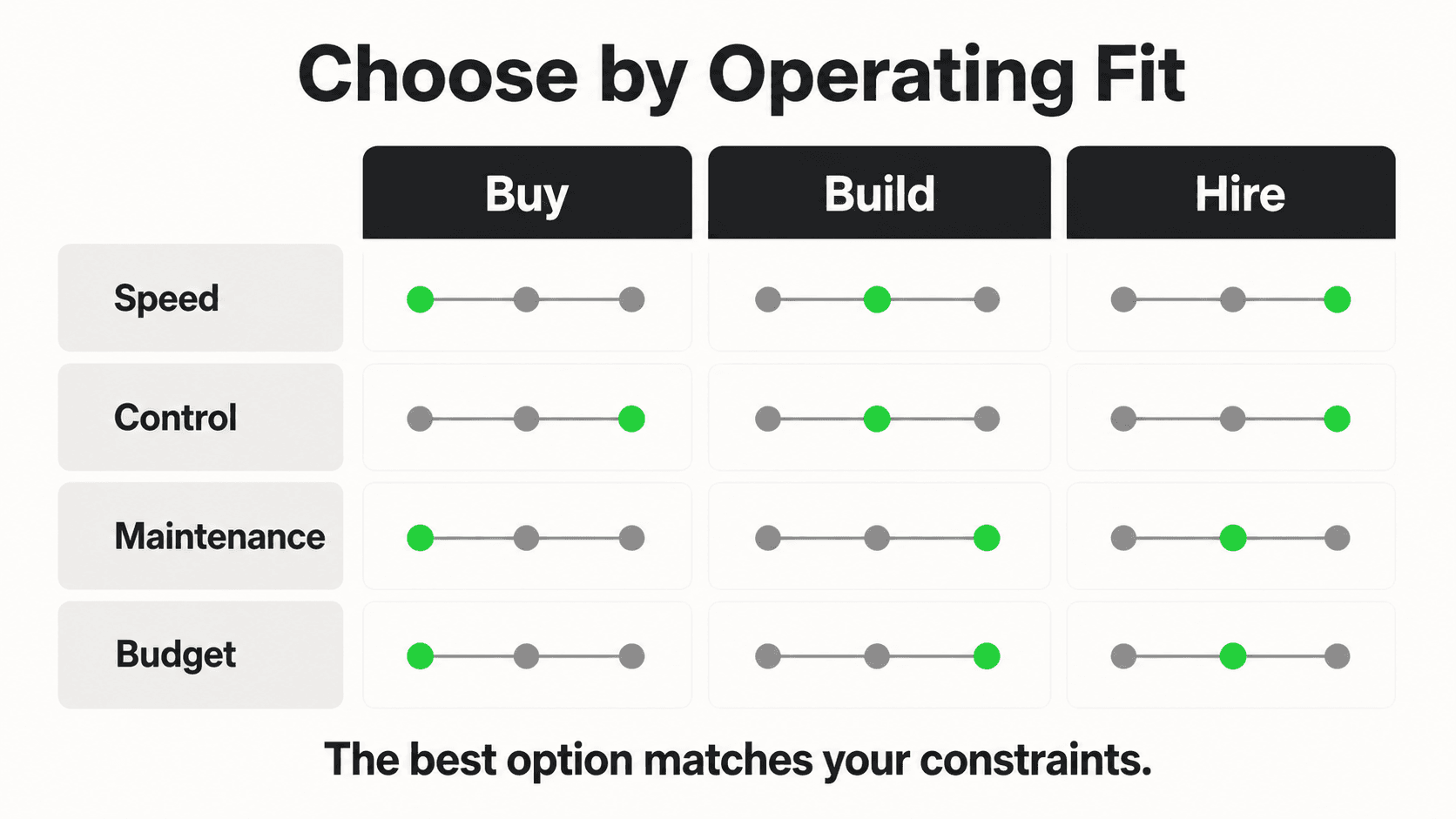
Before moving any vendor to finalist status, confirm these:
Eliminators — any "no" removes the vendor:
- RAG-based (document-grounded) AI, not a decision tree or pattern-matching engine
- Pre-chat lead capture form with contact details collected before the conversation
- Live on the specific channels you need on day one
- Clear pricing model — no uncapped per-conversation billing
- Demo using your content, not their template
- Defined post-launch support model with documented SLA
Differentiators — use to rank finalists:
- Self-serve knowledge base updates (no vendor ticket required for content changes)
- Lead summary email to your team after each conversation
- CRM sync via REST API and webhooks, documented and shipped
- Transparent roadmap with honest delivery timelines
- Clear data portability and exit path if you switch
Costs and Timelines: What to Budget
Here is what the market looks like as of 2026, broken down by engagement model.
Custom Development Agency
- Discovery and scoping: $5,000–$15,000 (sometimes folded into the project)
- Build phase: $30,000–$80,000 for a non-trivial customer service or lead qualification bot; more for complex deployments
- Timeline: Three to six months from kickoff to production launch
- Ongoing maintenance: $2,000–$8,000/month retainer, or a dedicated internal engineering resource
This is the right model for enterprises with genuinely unique requirements, regulatory constraints around SaaS hosting, or a legacy system integration landscape that off-the-shelf platforms cannot handle. It is the wrong model for almost everyone else.
Managed Setup with a Platform
- Platform subscription: $40–$200/month depending on the tier and usage requirements
- One-time managed setup fee: $299–$2,000 depending on knowledge base complexity and the number of channels
- Timeline: One to four weeks from kickoff to production launch
- Ongoing cost: Platform subscription only — no maintenance retainer
This is the fastest path to a production-quality AI agent for most SMBs. The setup fee pays for expert configuration, knowledge base ingestion, channel setup, lead form configuration, testing, and a documented handoff — without the project cycle of custom development.
Self-Serve Platform
- Platform subscription: $40–$200/month
- Setup: No external cost, but internal hours required. Budget 10–30 hours for an initial build, depending on knowledge base size and the number of channels you are configuring.
- Timeline: Days to two weeks
- Ongoing cost: Platform subscription plus internal maintenance time for knowledge base updates and bot tuning
If you have the internal bandwidth and want to control every configuration decision, self-serve is a viable path. Our no-code chatbot builder is built for this model — non-technical users can upload knowledge documents, configure lead capture forms, and launch across channels without writing code.
Red Flags That Signal the Wrong Partner
After speaking with many businesses that had prior bad chatbot experiences before finding Hyperleap, these are the patterns that appear most consistently.
They promise zero hallucinations.
No current AI system can guarantee this. The correct claim is that a well-configured, document-grounded bot substantially reduces incorrect responses — not that it eliminates them. Any vendor promising zero hallucinations either does not understand the technology or is misrepresenting it.
The demo uses their content, not yours.
A real platform with competent knowledge ingestion can demo with your website content in minutes. If a vendor insists on showing only their template bot — or offers a generic "Hello, how can I help?" demo with no domain-specific knowledge — they may be masking limitations in how the system handles real business content.
Per-conversation pricing with no cap.
This model transfers pricing risk entirely to you. A viral post, a seasonal spike, or a misconfigured widget can produce an invoice you never budgeted for. Insist on per-seat or per-response plans with a defined cap and clear overage rate — or flat monthly pricing with predictable scaling tiers.
"We integrate with everything."
Specific, documented integrations are credible. A blanket claim of universal compatibility is a red flag. Ask for the specific integration method for each tool in your stack (native connector, Zapier, REST API, webhooks), whether it is shipped today, and where you can find documentation.
Vague on post-launch support.
If a vendor cannot clearly explain what happens when your bot gives a wrong answer — who you call, what the response time is, how quickly a knowledge base update takes effect — you will be managing support on your own when problems arise. Problems always arise.
It is a decision tree disguised as AI.
Flow-based chatbots built on if/then logic and button menus are not AI in the meaningful sense. They cannot handle open-ended customer questions, break unpredictably on unexpected inputs, and require constant manual updates as your offerings evolve. Verify that the underlying technology is LLM-based with genuine language understanding. Ask the vendor to show what happens when a user asks a question that is not in the flow — the answer is revealing.
Where Hyperleap AI Fits in This Landscape
Hyperleap AI is an AI agent platform — not a custom development agency. Our AI agents answer customer questions 24/7 across Website, WhatsApp, Instagram DM, and Facebook Messenger, grounded in your business's own knowledge. Every conversation begins with a lead capture form, ensuring contact details are collected before the AI engages. At the end of each conversation, your team receives a clean email summary with the visitor's details and conversation context.
We operate in the middle of the market: above pure self-serve tools in terms of sophistication and available support, far below custom development in cost and timeline.
Self-serve plans
Three paid plans. No free plan. All plans include a 7-day free trial (credit card required). After cancellation or trial expiry without subscribing, access is restricted.
- Plus ($40/month): 1 chatbot, 3,000 AI responses, 4 channels per chatbot, 10 team members, 5 workspaces
- Pro ($100/month): 2 chatbots, 12,000 AI responses, 8 channels (4 per chatbot), white-label branding, 50 team members, 10 workspaces
- Max ($200/month): 5 chatbots, 30,000 AI responses, 20 channels (4 per chatbot), 100 team members, 25 workspaces
All three plans support the full channel set — Website, WhatsApp, Instagram DM, and Facebook Messenger. On Pro and Max the Hyperleap badge comes off the widget; see white-label chatbots that match your brand for what that changes on the page.
Managed Setup (add-on, not included)
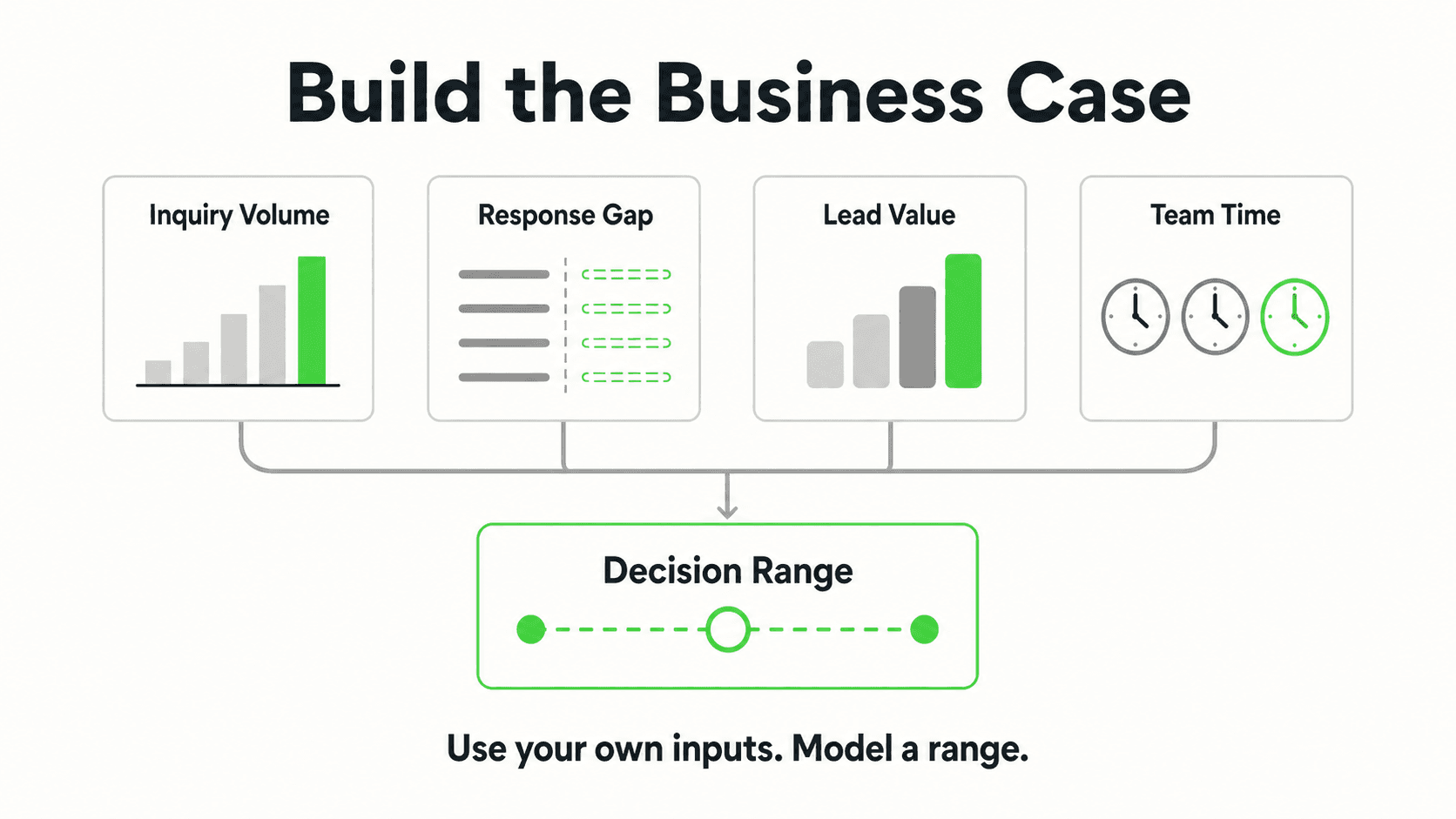
$299 Free. Our team configures and launches your AI agent: knowledge base ingestion, channel setup, lead form configuration, conversation flow setup, testing, and a full handoff. You review and approve at each stage; we handle the technical build. Timeline is typically one to four weeks depending on the size of your knowledge base and the number of channels being configured.
Managed Setup is an optional add-on to any plan. It is not included in the base subscription.
Additional add-ons (not included in base plans)
- Suite ($99 one-time, available on Plus/Pro/Max): AI Tools, AI Assistants, Prompts API, and Personas API
- OTP Verification (usage-based from $100 recharge, Pro/Max only): Phone number verification for chatbot login flows
- Multi-variant (locations, courses, etc) ($40/month + 2× credits per request, Pro/Max only): Multi-location knowledge management for franchise and multi-site businesses
- Credit Packs ($12 per 1,000 credits, all plans): Top up AI responses beyond your plan's monthly allocation
For businesses researching AI agents across their specific industry — real estate, healthcare, hospitality, retail, and more — the platform includes industry-specific knowledge structures and conversation patterns tuned to each vertical's common customer questions.
Frequently Asked Questions
What is the difference between an AI chatbot development company and a chatbot platform?
A chatbot development company in the agency model builds custom software to your specifications — you engage them as a vendor, they deliver a project, and you maintain what they built. A chatbot platform is software you subscribe to and configure yourself (self-serve) or with the platform team's assistance (managed setup). Platforms are faster to launch and cheaper to maintain; custom development offers more flexibility but at significantly higher cost and complexity. Most SMBs are better served by a platform with a managed setup option than by a custom development engagement.
How long does it take to launch an AI chatbot for my business?
It depends on the model. A self-serve platform can be live in a few days if your knowledge base is organized and your channel accounts are connected. A managed setup engagement typically takes one to four weeks from kickoff to production launch, covering knowledge ingestion, channel configuration, lead form setup, testing, and handoff. Custom development from an agency runs three to six months for a non-trivial deployment. If time to value matters — and it usually does — start with a platform.
What does an AI chatbot for my business realistically cost?
Self-serve platforms run $40–$200/month. Managed setup add-ons from reputable platforms start around $299 one-time. Custom agency development starts around $20,000–$30,000 for a basic customer service or lead qualification bot and can exceed $100,000 for complex deployments. Factor ongoing costs into your comparison: maintenance retainers for custom builds versus platform subscriptions for SaaS models. For most SMBs, a platform subscription plus a one-time managed setup fee represents the best balance of cost, speed, and ongoing quality.
How do AI chatbot companies prevent the bot from making things up?
The correct architecture is Retrieval-Augmented Generation (RAG): the AI is constrained to answer only from your uploaded knowledge base — product documentation, FAQs, policies, pricing pages. When a question falls outside that content, a well-configured bot deflects and routes to a human rather than improvising. No vendor can guarantee zero hallucinations — no current AI system makes that guarantee credibly. The honest claim is that document-grounded responses substantially reduce the risk of incorrect answers. Always ask vendors to demonstrate what the bot does when you ask something outside its knowledge base. That response tells you more about the system's safety design than any marketing claim.
Do I need technical staff to deploy an AI chatbot on a platform?
For self-serve platforms designed with non-technical users in mind, no dedicated engineering resource is required for basic deployment. Tasks like uploading documents, connecting channels (WhatsApp Business API requires a Meta Business account setup), configuring a lead capture form, and testing conversation flows are manageable without a developer. If you want to sync lead data to your CRM or custom system via REST API or webhooks, some technical literacy helps — or you can use a Zapier-style middleware for lighter integrations. For managed setup engagements, the platform's team handles all technical configuration — your role is providing content, reviewing the output, and approving before launch.
Choosing an AI chatbot development partner is a question of fit — your timeline, technical resources, budget, and how much configuration work you want to own versus outsource. If you are still upstream on the build vs. buy decision, our post on AI chatbot development services covers that question in depth.
If you have cleared that decision and want to see what a Managed Setup engagement looks like in practice — or want to start a trial and configure it yourself — explore our plans and pricing.
Related Articles

AI Chatbot Development Services: Build vs Buy for Small Businesses
Should you hire an agency to build a custom AI chatbot, or use a platform? This guide breaks down costs, timelines, and the honest decision framework for SMBs.
Real Estate Lead Handoff: The Agent-Ready Checklist
Use a real estate lead handoff checklist to preserve buyer intent, property context, unanswered questions and the next action without inventing certainty.

Tenant Maintenance Requests: A Clear Intake Template
Collect clearer non-emergency tenant maintenance requests with description prompts, contact boundaries and a practical property-team handoff.

Wedding Venue Tour Enquiries: A Question Pack
Prepare better wedding venue tours with questions on date flexibility, guest range, event shape and priorities, plus a copy-ready host handoff.