How Many Languages Does ChatGPT Support?
OpenAI doesn't publish an official language count for ChatGPT. Here's what's known, and why it matters less than you'd think for a business chatbot.
TL;DR: OpenAI has not published one official number for how many languages ChatGPT supports. What's actually known: GPT-class models are trained on multilingual data and can converse in dozens of languages, with the strongest quality in widely-spoken languages (Spanish, French, Mandarin, Arabic, Hindi, and similar) and weaker, less reliable quality in low-resource languages. ChatGPT's own interface has been localized into a growing set of languages over time — a separate thing from how many languages the underlying model can converse in. That distinction matters more once you're picking a chatbot for your own business: a general assistant supporting a language and your business answering customers correctly in that language are two different problems. Hyperleap AI supports 100+ languages with automatic detection, translating from your own documents so answers stay accurate across website, WhatsApp, Instagram DM, and Facebook Messenger.
How many languages does ChatGPT support?
There isn't a single confirmed number to give you here, and any article that states one precisely is guessing. OpenAI does not publish an official supported-language count for ChatGPT on its help center or in its product documentation.
Here's what is actually known, and can be stated without inventing a figure:
- GPT-class models are trained on multilingual text. The training data spans a large number of languages, which is why ChatGPT can hold a conversation in Spanish, French, German, Mandarin, Japanese, Arabic, Hindi, Portuguese, and many others without any special setup.
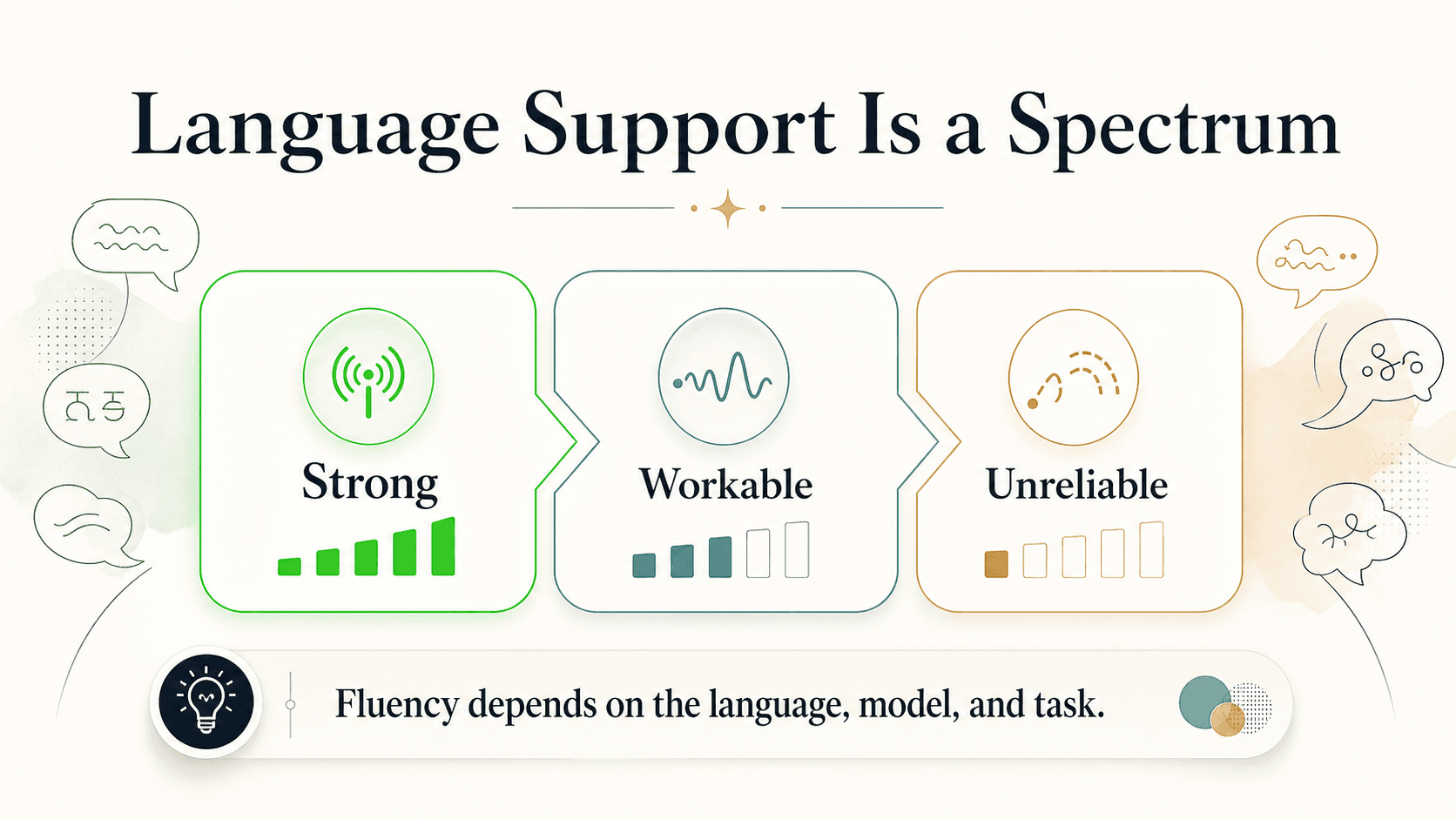
- Quality is uneven across languages. Widely-spoken languages with abundant training data tend to get fluent, accurate responses. Low-resource languages — ones with comparatively little text available online — get weaker, less reliable output. This is a general property of large language models, not a ChatGPT-specific limitation.
- The ChatGPT interface itself has been localized into a growing set of languages over time, separate from the model's conversational range. Interface localization (menus, buttons, settings) and conversational language ability are two different things that often get conflated in "how many languages" claims.
If you need the current, authoritative word on this, OpenAI's help center is the source — not a third-party blog post, including this one, that states a specific count.
Why the honest answer is "it depends"
Language-model language support isn't a checklist feature with a fixed count, for a few reasons:
- It's a spectrum, not a binary. A model doesn't "support" or "not support" a language the way software supports a file format. It performs somewhere on a range from fluent to broken, and that range shifts as models are retrained on newer data.
- The count changes with every model update. Even if OpenAI published a number for one model version, the next release could shift it — more languages, better quality in existing ones, or both.
- "Supported" means different things to different people. Can it produce grammatically correct sentences? Can it use idioms correctly? Can it apply industry-specific terminology accurately? Each is a different bar, and a single number can't answer all three.
This is why credible sources hedge rather than assert a precise figure — and why you should be skeptical of any claim that gives you an exact number without a citation.
General assistant languages vs. business chatbot languages
Here's the pivot that actually matters if you're evaluating a chatbot for your business rather than satisfying curiosity about ChatGPT.
ChatGPT is a general-purpose assistant. It answers from its training data and whatever you paste into the chat window in that session. It has no persistent knowledge of your business, your pricing, your policies, or your product catalog. Ask it about your return policy in French, and it will either say it doesn't know or — worse — generate a plausible-sounding answer that isn't actually your return policy.
A business chatbot has a different job. It needs to answer real customers, in their language, from your actual documents — your FAQ, your pricing sheet, your service menu — not from general internet knowledge. That's a materially different requirement, and "does the underlying model understand this language" is only the first of several things that have to work correctly:
| What a general assistant does | What a business chatbot needs to do |
|---|---|
| Converses fluently in a language it was trained on | Detects the customer's language automatically, with no dropdown or language picker |
| Draws on general training data | Answers from your own documents, translated accurately into the customer's language |
| Lives in one interface (chat.openai.com or the app) | Shows up on the channels your customers actually use — your site, WhatsApp, Instagram DM, Facebook Messenger |
| Has no persistent context between customers | Gives every customer the same accurate answer, in whatever language they use, every time |
| No handoff mechanism | Routes to a human on your team when a question needs one |
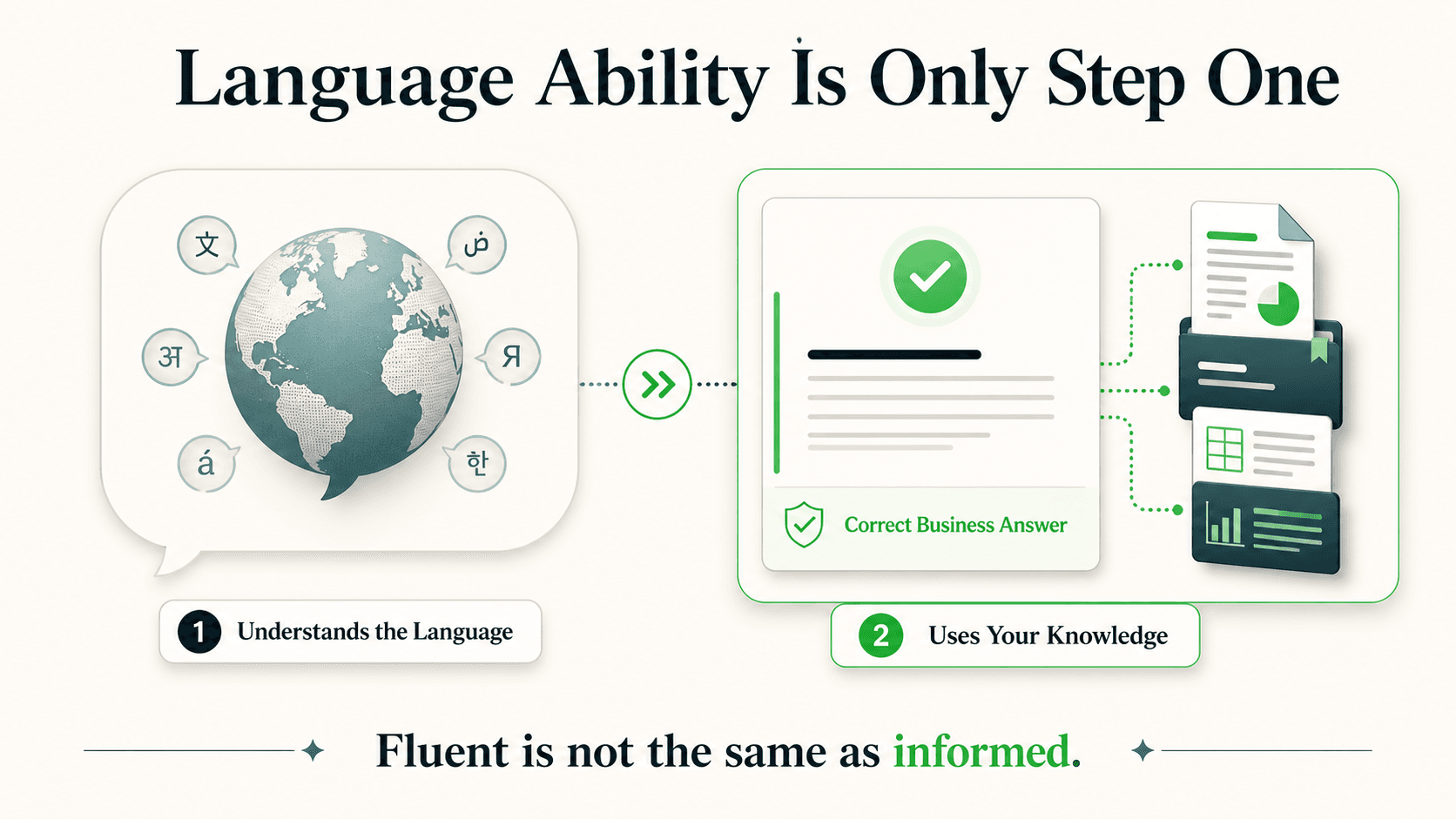
A model "supporting" Portuguese in the abstract doesn't tell you whether a Portuguese-speaking customer who messages your business at 11 PM gets the correct hours, the correct price, and the correct answer about your actual policies. Those are the questions worth asking when you're comparing chatbot platforms, and they're covered in more depth in our guide on multi-language AI chatbots for diverse customers.
What to check when choosing a multilingual business chatbot
If the real goal is serving customers in their language — not settling a trivia question about ChatGPT — here's what to verify before you commit to a platform:
- Automatic language detection. The customer shouldn't have to pick a language from a menu. The chatbot should detect it from the first message and respond in kind, including mid-conversation switches.
- Document-grounded answers, not general knowledge. The chatbot should answer from your uploaded FAQs, pricing, and policies — translated accurately — not from whatever the underlying model happens to know about your industry in general.
- Consistency across languages. A customer asking in Spanish should get the same substantive answer as a customer asking in English. If the chatbot's accuracy visibly drops in non-English languages, that's a real problem, not a minor gap.
- Coverage across the channels your customers actually use. Website chat matters, but WhatsApp, Instagram DM, and Facebook Messenger are often where non-English-speaking customers already are. A chatbot that's multilingual on your website but absent from WhatsApp misses a large share of the inquiries.
- A human handoff for anything sensitive or complex. No matter how many languages a chatbot handles, some questions — clinical, legal, or highly specific — should route to a person, in every language, not just English.
How Hyperleap AI handles multilingual customers
Hyperleap AI is built around this distinction between general language capability and business-chatbot reliability. It supports 100+ languages, with automatic language detection built in — a customer who messages in Arabic, Tagalog, or German gets a response in that language without any setup on your end.
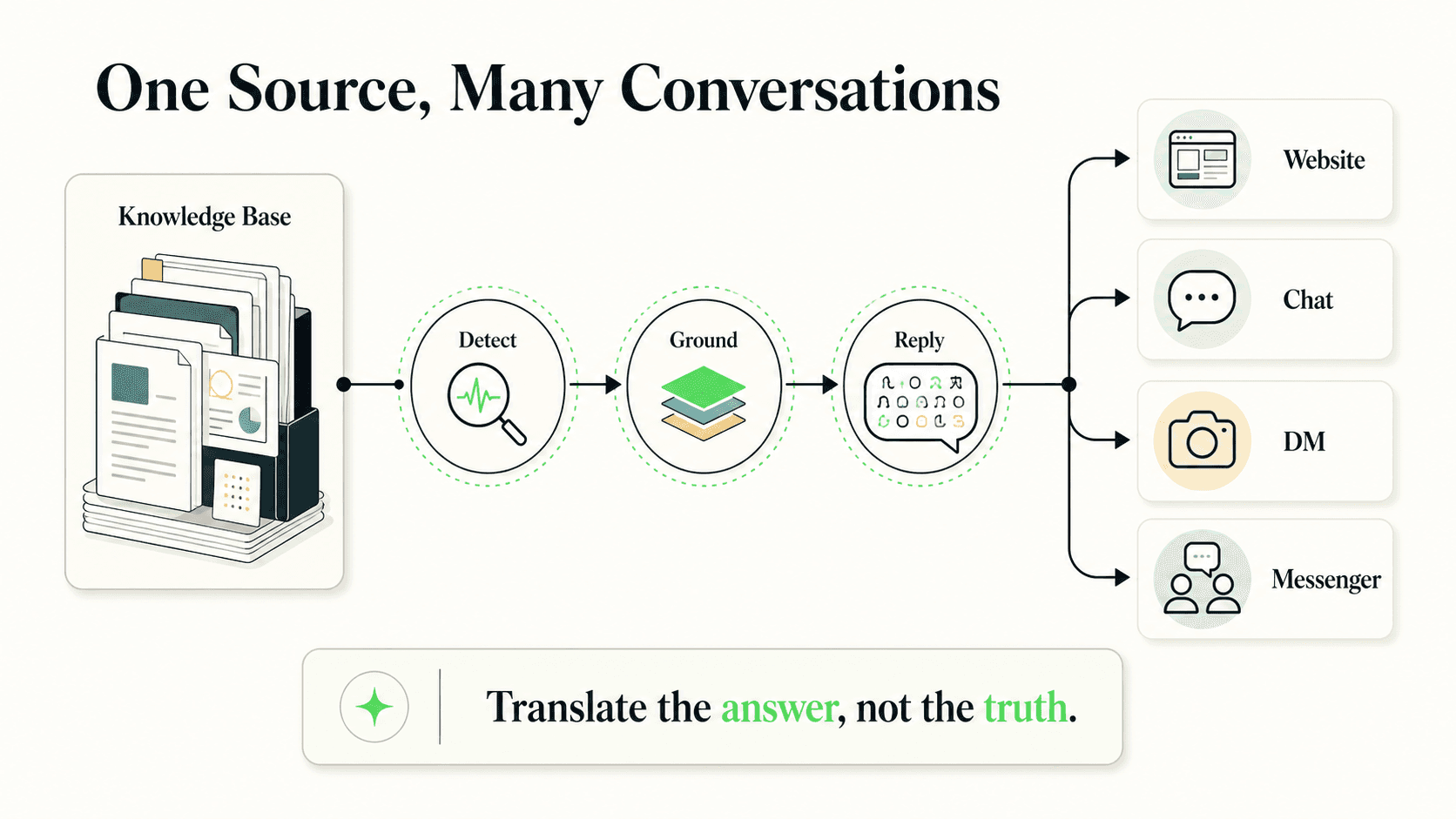
The key difference from a general assistant: every answer is document-grounded. You upload your knowledge base — FAQs, pricing, policies, service details — once, in whatever language you maintain it in, and Hyperleap translates and answers from that content across languages, rather than improvising from general training data. That's the same grounding principle covered in our guide on building a strong AI chatbot knowledge base.
That single multilingual, document-grounded agent runs across the channels your customers are actually messaging you on: your website chat widget, WhatsApp Business API, Instagram DM, and Facebook Messenger — the same four channels covered in our channels overview. It's one setup, one knowledge base, and consistent answers regardless of which channel or language a customer uses, which is the core idea behind the AI front desk model for SMBs. When a question needs a human — a complex complaint, a sensitive medical or legal matter — it hands off to your team rather than guessing in any language.
If you want to see how this compares to building a general assistant integration yourself, our guide on choosing an AI chatbot platform walks through the tradeoffs, and multi-channel deployment strategy covers running one agent across every channel at once. Plans start at $40/mo with a 7-day free trial; see pricing for the full breakdown.
FAQ
How many languages does ChatGPT support?
OpenAI doesn't publish an official count. GPT-class models are trained on multilingual data and can converse in dozens of languages, with strong quality in widely-spoken languages and weaker quality in low-resource ones. For the current, authoritative answer, check OpenAI's help center directly rather than relying on a specific number from a third-party source.
Is ChatGPT's language support the same as a business chatbot's language support?
No. ChatGPT is a general-purpose assistant answering from training data and session context, with no persistent knowledge of your business. A business chatbot needs to detect the customer's language, answer from your actual documents (translated accurately), and stay consistent across every channel you operate on. A model "knowing" a language doesn't guarantee a business chatbot built on it will answer your customers correctly in that language.
Which languages does Hyperleap AI support?
Hyperleap AI supports 100+ languages with automatic detection — customers get a response in their language without selecting it from a menu. Answers are grounded in your own uploaded documents rather than general knowledge, and the same multilingual agent runs across your website, WhatsApp, Instagram DM, and Facebook Messenger.
Do I need to translate my FAQ or knowledge base into every language my customers speak?
No. You upload your documents once, in your primary language, and the chatbot translates and answers from that content in whatever language the customer uses. This is covered in more detail in our guide on multi-language AI chatbots.
Serve Every Customer in Their Language
Deploy one AI chatbot that detects your customer's language and answers from your own documents — across website, WhatsApp, Instagram, and Messenger.
Get StartedRelated Articles

Multi-Language AI Chatbots: Serve Customers in Any Language
How multi-language AI chatbots help businesses serve diverse customers in their preferred language — without hiring multilingual staff.

How to Add an AI Chatbot to Squarespace (Step by Step)
Step-by-step guide to adding an AI chatbot to Squarespace via Code Injection, plus plan requirements, troubleshooting, and a pre-launch checklist.

AI Chatbot for Real Estate: Capture Leads 24/7
An AI chatbot for real estate qualifies buyers and sellers around the clock, capturing leads before agents ever pick up the phone.

AI Chatbot for SaaS Companies: Cut Support Load, Speed Onboarding, and Keep Customers in 2026
How SaaS teams use an AI chatbot to deflect repetitive how-to questions, activate trial users, qualify demos, and support a global customer base — without adding headcount or risking wrong answers.