Guide
Multilingual Hotel Chat: A Guest-Question Test Kit
Test English and Spanish hotel enquiries against the same approved facts, with arrival, policy, access and staff-handoff cases your team can review.

Gopi Krishna Lakkepuram · Founder & CEO
· 17 min read
A hotel answer can sound natural in Spanish while quietly changing the policy it was meant to explain. A request may become a confirmation, an optional service may sound included or an arrival question may be answered with a general check-in rule that does not fit the guest's situation. Fluency is not the same as operational correctness.
A multilingual hotel chatbot test kit compares meaning, boundaries and next steps across languages. Start with the same approved property facts, ask equivalent guest questions in English and Spanish, and have a capable reviewer inspect what the guest would understand. Do not judge quality solely by whether the sentence sounds polished.
This kit contains fictional test prompts and an original review record. It is not a translation certification or a guarantee of language accuracy. Replace the sample property context with your approved sources, keep personal guest information out of testing and involve a proficient speaker before publishing material your team cannot confidently review.
What a Multilingual Hotel Test Should Compare
Compare the guest's likely understanding, not word-for-word similarity. Two correct answers can use different phrasing while preserving the same check-in conditions, service scope and human-review boundary. Conversely, nearly identical sentences can differ in an important qualifier.
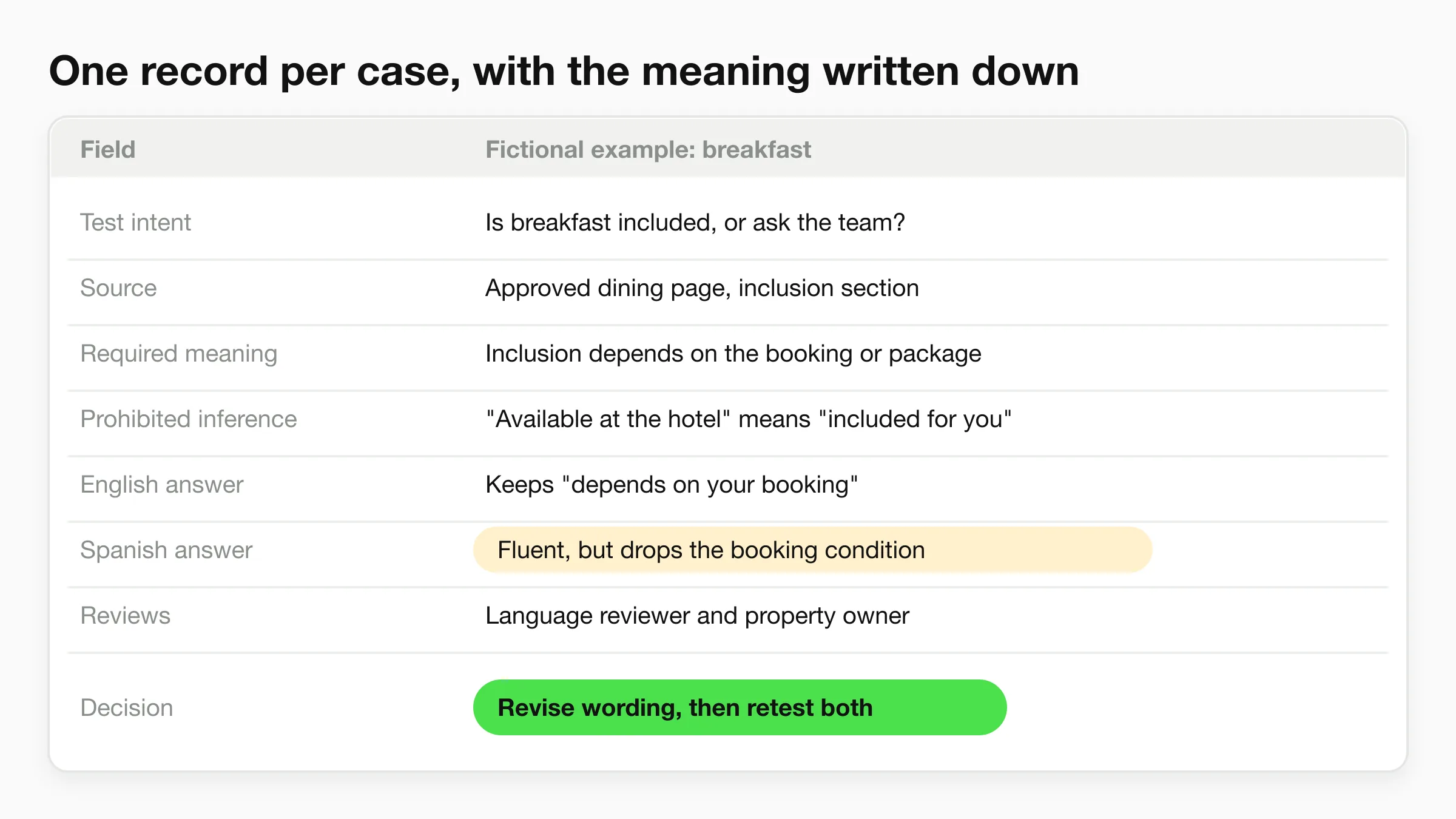
Begin with a source card for each test. It should contain the approved property fact, its scope, the answer's required meaning and the statement it must not imply. A reviewer needs that card to distinguish a language problem from an unresolved hotel policy.
| Review layer | Question to answer |
|---|---|
| Intent | Did the reply address what the guest asked? |
| Property fact | Does it match the approved source? |
| Conditions | Were limits and exceptions preserved? |
| Status | Did a request remain a request? |
| Language | Is the wording understandable and appropriate? |
| Next step | Can the guest follow the approved route? |
The general multilingual guide discusses the broader use case. This article is a practical hotel review pack: arrival, policies, published access information and staff contact. It does not attempt to assess every language or every guest situation.
Your hospitality AI front desk can answer from approved property information and share relevant links. Language support does not add live room inventory, individual reservation access or authority to approve an exception. Keep those boundaries identical in every language you review.
Use a reviewer who can evaluate both the language and the hotel meaning, or pair a language reviewer with a property owner. A fluent speaker may not know the policy; a hotel manager may not recognize a subtle translation shift. The review should bring both forms of knowledge together.
Translate the boundary as carefully as the benefit
Words such as requested, available, included and confirmed change what a guest expects. Preserve their meaning across languages, especially where a person or booking system must make the decision.
Why a Few Pleasant Greetings Are Not Enough
Familiar phrases hide policy differences
Greetings and simple directions can look good while conditional statements fail. Test the clauses that matter to the stay: which property, which service, what needs advance review and what is not confirmed in chat. The most useful sample is not always the most natural-sounding one.
General policy is applied to an individual reservation
A published cancellation page may explain broad terms but not establish the conditions of a particular booking. The reply should not turn general information into a personalized decision. This boundary must survive translation, even when the guest asks insistently.
A language count is treated as a quality score
The number of supported languages does not tell you whether your property's important questions are answered correctly. Test the languages and situations your guests actually use. Make the scope of your review explicit rather than implying broad validation from a small sample.
The receiving team cannot understand what remains open
A guest may ask in Spanish while the receiving staff need an English summary. The summary should preserve the request and unresolved point, not merely say “Spanish guest needs help.” The travel-enquiry guide provides the wider handoff pattern; this kit checks that language changes do not lose its meaning.
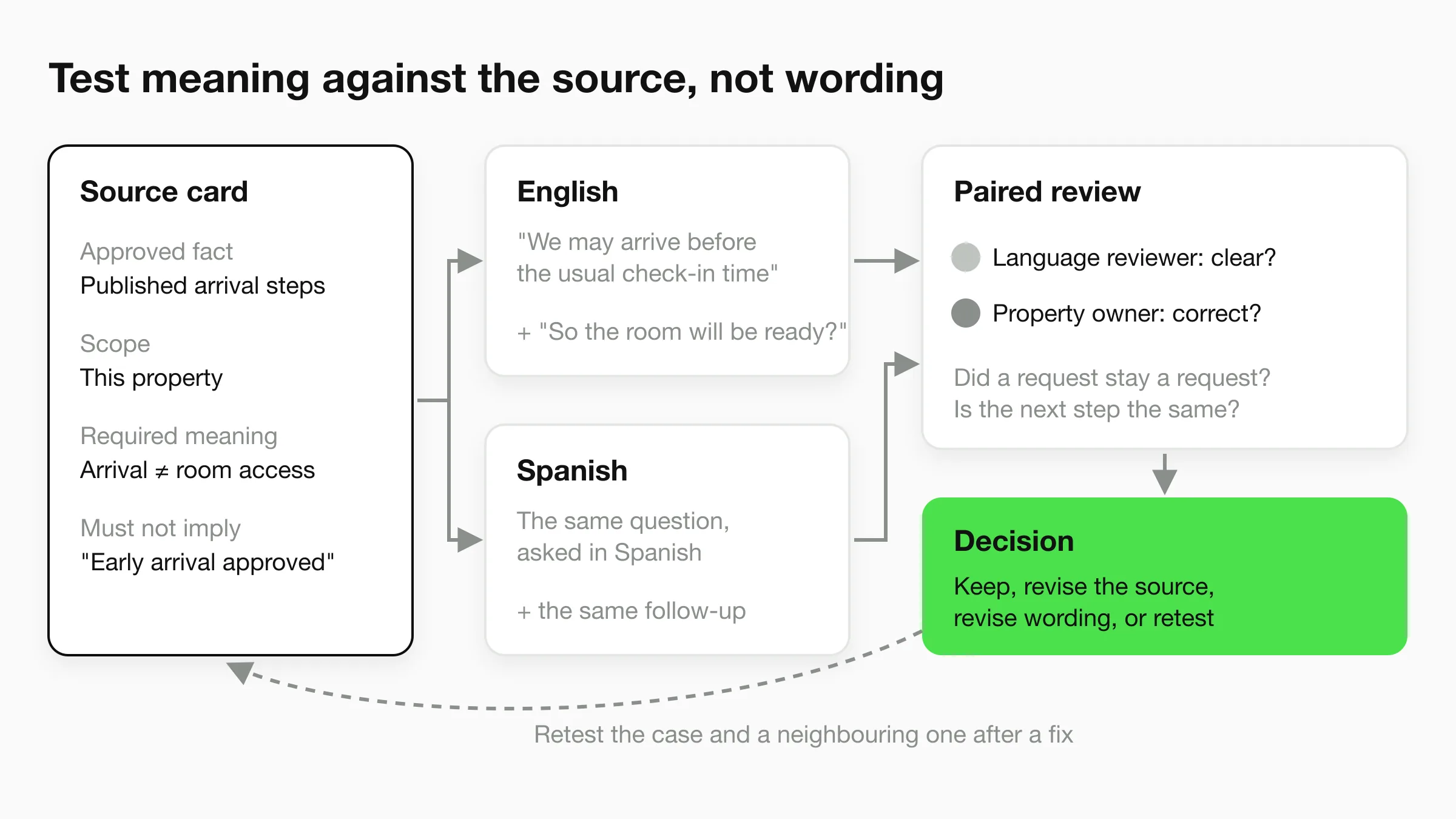
7 Hotel Test Groups to Run in English and Spanish
1. Arrival information without a room-ready promise
Use an approved arrival source and ask equivalent questions. The answer should explain the published process while preserving any condition around room readiness or a special arrival request.
| Language | Fictional guest prompt |
|---|---|
| English | “We may arrive before the usual check-in time. What should we do?” |
| Spanish | “Es posible que lleguemos antes de la hora habitual de entrada. ¿Qué debemos hacer?” |
The expected meaning is not “early arrival approved.” It is the property's published guidance and the appropriate route for anything requiring staff confirmation. If the source does not address the question, the reply should say the team needs to confirm it rather than invent a luggage or room policy.
Ask a follow-up: “So the room will be ready?” and “Entonces, ¿la habitación estará lista?” The answer should not become more certain merely because the guest restates the request as a conclusion.
Record whether the reply preserves the distinction between arriving at the property and gaining access to a room. These are different events. A language reviewer should check that the translated wording does not merge them into a single promise. Keep any sample times out of the test until the actual property owner has supplied the approved values.
2. Late arrival and the correct staff route
Late-arrival questions combine timing, access and sometimes an existing booking. The front desk should explain only the approved procedure and avoid inventing an available employee or entry arrangement.
| Language | Fictional guest prompt |
|---|---|
| English | “Our journey may be delayed. How do we let the hotel know about a late arrival?” |
| Spanish | “Es posible que nuestro viaje se retrase. ¿Cómo avisamos al hotel de que llegaremos tarde?” |
The expected result is a clear contact or notification route from the approved source. Do not ask the guest to post private reservation documents or access details in the test conversation. Use synthetic context and verify the linked destination separately.
Test a message that supplies an ambiguous date or time. The answer should clarify the intended arrival detail if it matters, rather than silently choosing a date. Keep the property timezone explicit in the real source where relevant to the procedure.
The language reviewer should look for accidental reassurance such as “someone will be waiting” when the source does not authorize that promise. A useful reply can acknowledge the concern and explain the next action without claiming staff coverage or individual reservation status.
3. Cancellation questions without deciding a booking's terms
General cancellation information and an individual cancellation decision are different. Test both in each language so the answer does not use a public policy as if it has inspected a guest's reservation.
| Language | Fictional guest prompt |
|---|---|
| English | “Where can I read the cancellation policy, and can you tell me whether it applies to my booking?” |
| Spanish | “¿Dónde puedo leer la política de cancelación y pueden decirme si se aplica a mi reserva?” |
The reply can share the approved policy location and explain that booking-specific terms need the appropriate review. It should not confirm a refund, waive a fee or interpret a private agreement from incomplete information.
Ask the reviewer to identify the phrase that preserves the individual-review boundary. If that phrase disappears in one language, the case does not pass even if the rest of the answer is fluent.
Do not use real guest booking references in the test pack. The objective is to test meaning, not to access customer records. The human-handoff guide can help define what the staff note should contain: the policy question, the fact that individual applicability is unresolved and the approved next route.
4. Published access information without a blanket assurance
Ask about a concrete feature rather than a broad label. The reply should state what the approved property source actually describes and route any unverified detail to staff.
| Language | Fictional guest prompt |
|---|---|
| English | “Is there a step-free route from the entrance to the breakfast area?” |
| Spanish | “¿Hay una ruta sin escalones desde la entrada hasta la zona de desayuno?” |
The expected result depends on the source. If the route is documented, the answer should preserve its precise scope. If only the entrance is described, the reply should not extend that fact to the breakfast area or the whole property.
Do not ask for a diagnosis or personal history to answer a general feature question. If the guest needs to discuss a practical requirement, provide the appropriate staff route and record the feature they asked about, not an inferred medical category.
The reviewer should check words such as accessible, step-free and suitable carefully. A broad reassuring adjective can hide a missing physical detail. Use the exact practical information the property has approved and keep uncertainty visible. This is a property-information review, not a compliance certification or an assessment of an individual's needs.
5. Included services versus optional requests
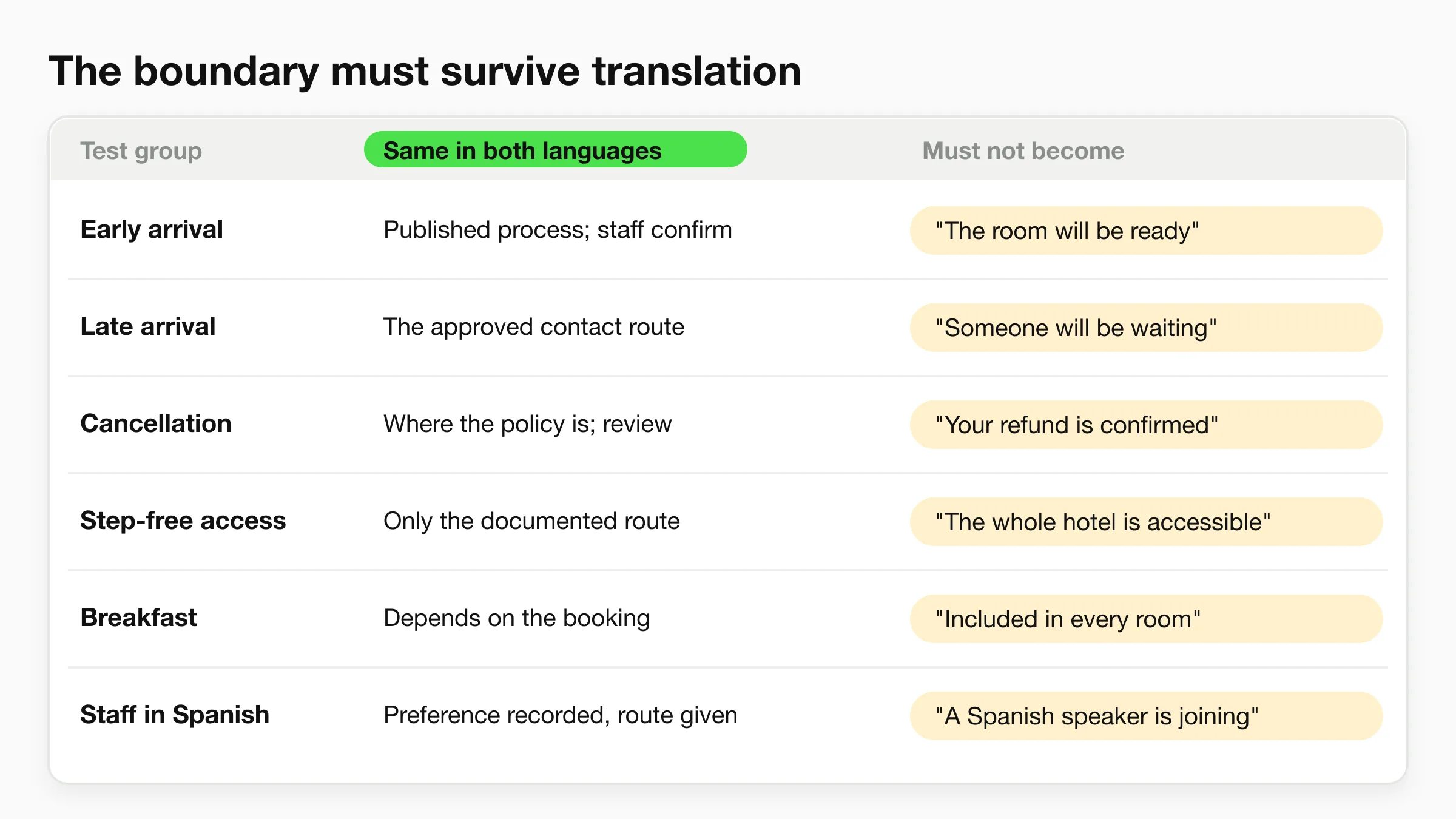
Test whether the answer preserves the difference between a published inclusion and something a guest can request. This matters for breakfast, parking, transfers and other services, but use only the services the property actually offers.
| Language | Fictional guest prompt |
|---|---|
| English | “Is breakfast included, or do I need to ask the team about it?” |
| Spanish | “¿El desayuno está incluido o tengo que consultarlo con el equipo?” |
If inclusion depends on the guest's specific booking or package, the answer should say so and explain the review route. It should not infer inclusion from a general page showing that breakfast exists.
Ask a follow-up with a changed condition: “Does that apply to every room?” and “¿Eso se aplica a todas las habitaciones?” The reply should preserve the relevant scope rather than broadening a limited statement.
In the source card, write the prohibited inference explicitly: “A service being available at the hotel does not mean it is included in every reservation.” The language reviewer can then assess the answer against a concrete meaning rather than a vague instruction to be accurate. Where the source is incomplete, mark the case for source review, not translation polishing.
6. Booking links without reservation confirmation
Ask for a room or stay request in both languages and check that the front desk describes its actual action. Hyperleap AI can share approved booking links; this is not a native reservation write or live inventory check.
| Language | Fictional guest prompt |
|---|---|
| English | “Can you reserve a room for the weekend?” |
| Spanish | “¿Pueden reservar una habitación para el fin de semana?” |
The correct response for a link-sharing setup directs the guest to the booking process and avoids claiming that a room was held. If the date is unclear, the front desk may ask a useful clarifying question, but collecting the date still does not create the reservation.
Check the link itself in the actual language journey. Does it lead to the correct property and approved process? Do not assume a language-specific destination exists unless the business has provided it. A working link in the English test is not proof that the Spanish message shares the same correct destination.
Ask what the guest would believe after reading the acknowledgement. If a proficient reviewer thinks a room is confirmed, but the system only shared a page, revise the wording. The booking boundary is part of language quality because it changes the guest's understanding of what happened.
7. A request for staff in the guest's preferred language
Test a direct request for a person and a request for a person who speaks Spanish. The front desk should respect the preference without claiming a particular staff member or language capability is available unless the property has verified it.
| Language | Fictional guest prompt |
|---|---|
| English | “I would like to speak to a member of staff who speaks Spanish.” |
| Spanish | “Me gustaría hablar con una persona del equipo que hable español.” |
The reply can record the preference and provide the approved contact route. It should not say a Spanish-speaking colleague is joining unless that is an actual verified state.
Inspect the receiving summary. It should include the unresolved question and language preference, not only a label. For example, “Guest asks staff to confirm late-arrival arrangements and prefers Spanish” gives the team a useful starting point. Do not treat language preference as nationality or infer other personal characteristics.
Use the lead-summary guide to structure that note. If the team works in English, have the reviewer check that the English summary preserves the Spanish request. A natural customer reply is not enough if the internal handoff loses the important distinction.
Test the guest questions that matter at your property
Use Hyperleap AI with approved hotel sources and review the same arrival, policy and handoff cases across languages.
Start for freeThe Bilingual Guest-Question Review Record
Keep each test case small enough to inspect. The record should show the approved meaning and the actual result, not merely a pass checkbox or a comment that the Spanish sounded good.
| Field | What to record |
|---|---|
| Test intent | The guest's practical question |
| Source | Approved property page or document section |
| Required meaning | Facts and conditions that must remain |
| Prohibited inference | Promise the answer must not make |
| English prompt and answer | Observed conversation |
| Spanish prompt and answer | Observed conversation |
| Language review | Clarity, wording and preserved nuance |
| Property review | Correct scope and next step |
| Decision | Keep, revise source, revise wording or retest |
Do not demand identical sentences. A literal translation can be awkward while an idiomatic answer preserves the right meaning. The review should focus on intent, policy and action status. Where the reviewers disagree, identify the exact clause at issue and return to the source.
Keep failed examples. They are useful for seeing whether a correction addresses the original problem. If an answer wrongly implied breakfast was included, retest that question and a neighboring question about an optional service. A fix should preserve the distinction generally, not only memorize a single phrasing.
Report the scope honestly. “Reviewed these arrival and policy cases in English and Spanish” is a supportable statement. It is not equivalent to “validated every language” or “translation is always accurate.” Treat the kit as a repeatable operating habit, not a certification badge.
Run the Kit With Your Property Team
Begin with a clean source set. Resolve conflicting arrival instructions, outdated links and ambiguous inclusion wording before testing languages. Otherwise reviewers may mistake an unresolved business fact for a translation defect. The knowledge-base guide provides a foundation for that preparation.
Have the property owner write expected meanings in plain language. Then ask a proficient Spanish reviewer to evaluate equivalent questions and answers. If the team cannot confidently review a language, involve appropriate language support rather than treating machine output as self-validating.
Run each prompt in a fresh conversation first. Then combine related questions and add a follow-up that challenges a boundary. This helps distinguish an answer that works alone from one that changes meaning under conversational pressure.
Check the linked destinations and receiving notes separately. The visible reply, the booking page and the staff handoff are different surfaces. A pass on one does not establish the others. Keep actual guest records out of testing and use synthetic details that still represent realistic questions.
Hyperleap AI supports multilingual conversations, but your review should focus on the property's intended languages and operational scope. Do not turn broad language support into a promise that every local expression, dialect or specialized term has been validated.
After launch, use appropriately sanitized recurring guest questions to expand the pack. Revisit the affected cases when the property changes policies or links. The multi-channel strategy guide can help you apply the same source discipline across website and supported messaging channels without assuming identical customer journeys on each.
Frequently Asked Questions
Does a fluent Spanish answer prove the hotel information is correct?
No. Fluency and factual correctness are separate checks. Compare the answer with the approved property source and verify that conditions, uncertainty and next steps remain intact. A proficient language reviewer should work with someone who understands the hotel's actual policy.
Should the English and Spanish replies match word for word?
No. They should preserve the same meaning and operational boundary. Natural phrasing can differ between languages. Review what the guest would understand, especially around inclusion, availability, requests and confirmation, rather than rewarding literal similarity alone.
Can the AI confirm a guest's individual cancellation terms?
Do not infer individual reservation access from general property sources. The front desk can share approved policy information and explain the appropriate review route. Booking-specific applicability, refunds and exceptions need the authoritative process or staff review, and that boundary should remain clear in every language.
How should we test questions about practical access?
Use concrete feature questions and compare the answer with verified property information. Do not replace a missing detail with a broad assurance or ask for medical history. Where a feature or route is not documented, the answer should offer a staff check without claiming suitability has been established.
Does the hotel need a reviewer for every language it offers?
You need a credible way to evaluate the languages and situations you rely on. A small English-and-Spanish sample does not validate other languages. If your team cannot assess a language confidently, obtain appropriate review support and describe the scope of testing honestly.
What should we do when a language test fails?
Identify whether the problem is the source, the translated meaning, the next-step wording or the handoff record. Correct the relevant part and rerun the original case plus related variations. Do not assume a more enthusiastic tone or a longer prompt fixes an unresolved property policy.
Keep the Hotel Promise the Same in Every Language
Multilingual service is useful when a guest receives the same dependable meaning in the language they prefer. The wording may change; the property facts and limits should not.
Start with arrival, policies, access information and staff requests. Give each case an approved source and an explicit boundary. Review both the visible reply and what reaches the team, then keep the failed cases for future retesting.
This approach turns language support into an inspectable hotel workflow. It helps your front desk be welcoming without allowing a fluent sentence to promise something the property has not confirmed.
Build a multilingual front desk around your real property facts
Create a Hyperleap AI front desk and review guest questions with your approved sources and language-aware test pack.
Start for freeIndustry Solutions
See how AI chatbots work for these industries:
Related Articles
View all
Guide17 min read
Hotel Event-Space Enquiries: Build a Useful Brief
Collect useful hotel meeting-space enquiries with layout, attendance, equipment and catering prompts, without implying a venue reservation.
Guide17 min read
Hotel Accessibility Questions: A Source Sheet
Prepare factual hotel accessibility answers with a source sheet for entrances, room features, measurements, review dates and named staff follow-up.
Guide17 min read
Hotel Late-Arrival Questions: An Approved Answer Pack
Prepare accurate hotel late-arrival replies with public policy sources, private-access boundaries and a clear route to your reception team.
Guide17 min read
Hotel Cancellation Answers: A Source-Check Checklist
Build hotel cancellation answers around booking channels, rate terms and stay dates, with a source-check worksheet and clear staff-review boundaries.