Hotel Cancellation Answers: A Source-Check Checklist
Build hotel cancellation answers around booking channels, rate terms and stay dates, with a source-check worksheet and clear staff-review boundaries.

“Can I cancel without a charge?” sounds like a simple hotel question. The answer may depend on the rate the guest selected, where the reservation was made, the terms attached to that booking and the relevant dates. A polished answer from the wrong policy can be worse than admitting that a member of the reservations team needs to check.
A hotel cancellation policy answer checklist gives your AI front desk a safer job: explain approved general information, identify the context needed for a booking-specific question and direct the guest to the correct review process. It does not turn the conversation into a reservation-management system.
This guide provides a policy provenance matrix, practical response scripts and a review routine for independent hotels and small groups. The examples are illustrative. They are not legal interpretations, actual guest records or promises about any property's cancellation terms. Replace the sample wording with terms your hotel has approved, and have the responsible team handle disputes, exceptions and decisions about money.
What Makes a Cancellation Answer Reliable?
A reliable cancellation answer connects the statement to the right source and explains the limits of that statement. “Some bookings have a cancellation deadline” is general information. “Your reservation can be cancelled today without a charge” is a booking-specific determination. The second statement needs evidence that a public policy page alone may not provide.
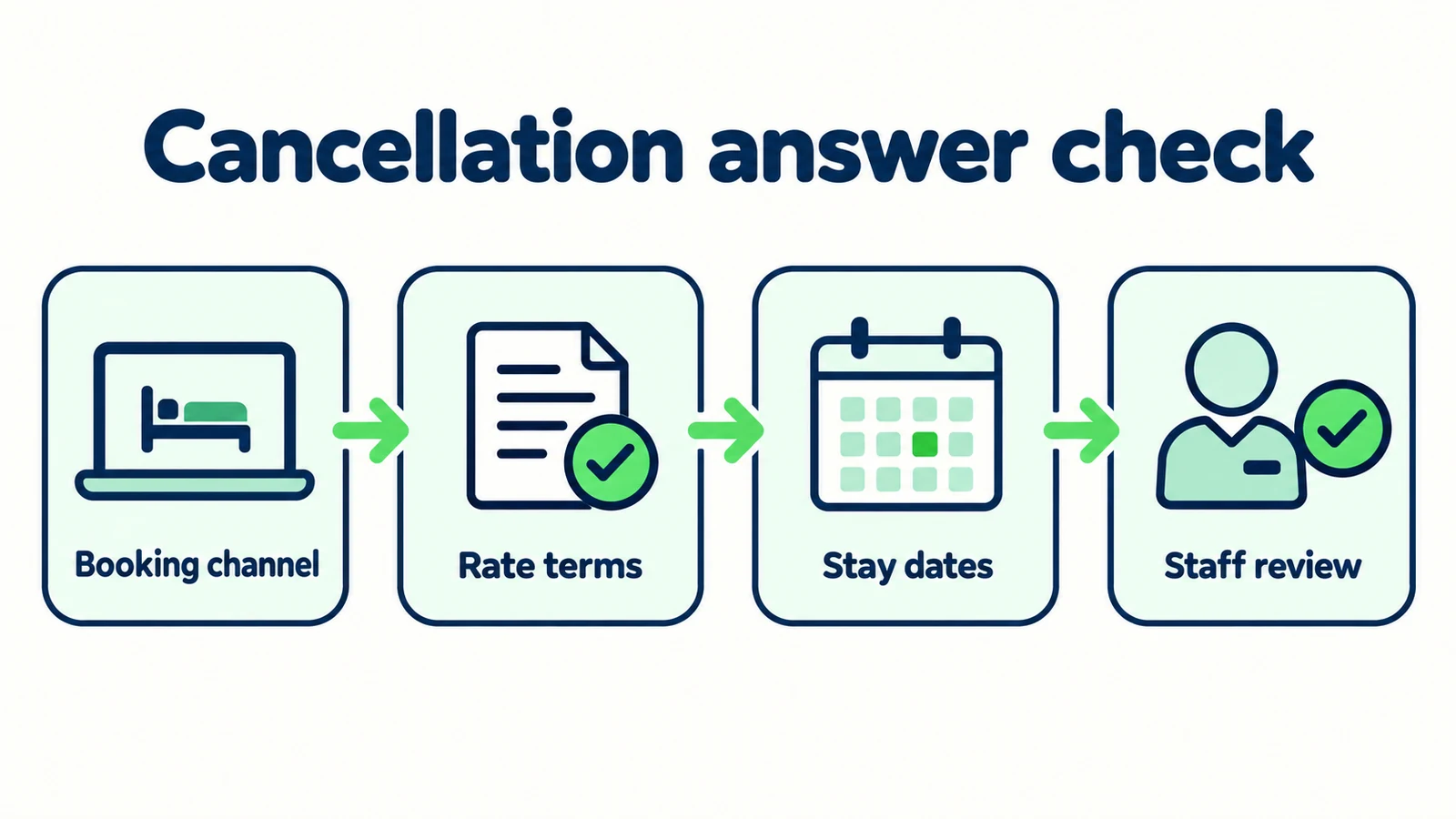
Think of the source check as a small chain. First identify the property. Then establish whether the person is asking before booking or about an existing reservation. Next distinguish the booking channel and rate terms. Finally, decide whether the available information supports an explanation or whether the reservations team must review the booking.
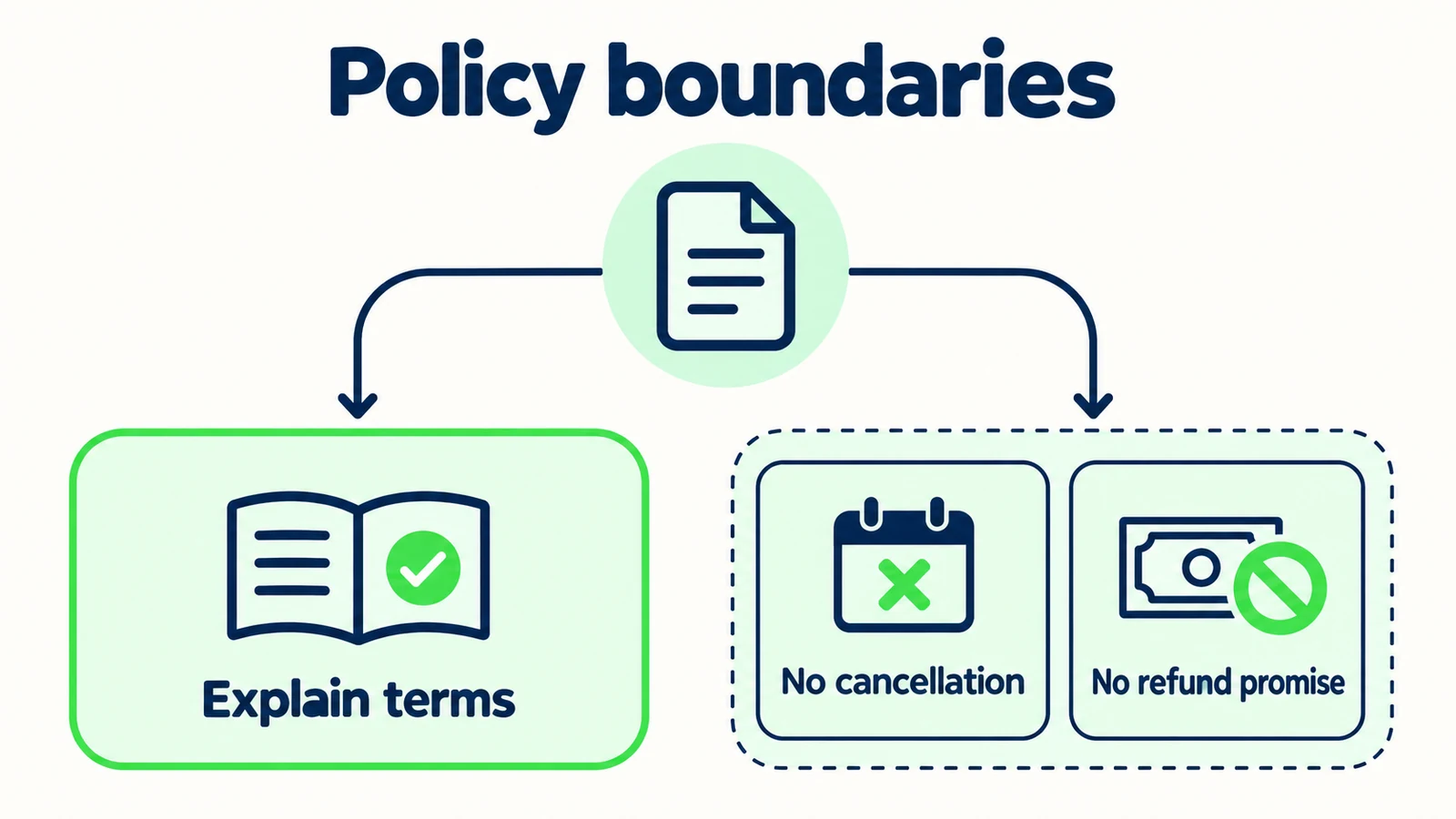
For an AI front desk for hotels, the useful starting point is approved knowledge: your public policies, relevant explanatory documents and clearly named contact or booking links. The front desk can answer questions from those materials and collect an enquiry. It should not claim to retrieve a guest's reservation, cancel it, waive a charge or approve a refund unless a separately verified authorized system and process actually performs that action. This article makes no such product claim.
The hotel enquiry-to-booking guide covers the broader journey. Here, the focus is narrower: preventing a general cancellation explanation from becoming an unsupported commercial promise. That distinction is useful even when a person writes the reply manually.
An explanation is not a cancellation
Make the boundary explicit. A conversation can explain approved information or collect a review request. It does not mean a reservation has been changed, cancelled or refunded. The guest should use the hotel's authorized booking-management process for those actions.
Why the Wrong Policy Reaches the Right Guest
A hotel-wide statement hides rate-specific conditions
A short FAQ may describe a common policy while individual offers carry different conditions. If the source says “see the terms of your selected rate,” that qualification belongs in the answer. Removing it to make a response shorter changes the meaning. The AI should not fill the missing detail with whichever policy sounds most customer-friendly.
Booking channels are treated as interchangeable
A guest may have booked directly, through a travel adviser or through a booking platform. The appropriate place to manage the reservation can differ. Your approved source should identify the route for each relevant channel without assuming that the hotel can complete every action inside its own chat. Avoid guessing the channel from the guest's language or the page they happen to be viewing.
A current public page is mistaken for historical booking terms
The latest website wording does not necessarily describe what was attached to an earlier reservation. Conversely, an old brochure may be obsolete for a new enquiry. A source's date matters, but recency alone does not establish which terms apply. Where the relationship is unclear, record the uncertainty and ask the owner of the policy to resolve it.
Helpful reassurance becomes a financial commitment
Phrases such as “that should be fine” or “you will get your money back” can sound like decisions. Replace them with a precise description of what is known and what still needs review. A considerate response can acknowledge disruption without promising an exception. The guest needs clarity, not a confident guess.
7 Checks Before Explaining a Cancellation Policy
1. Separate general research from an existing-booking request
Ask which task the guest is trying to complete. Someone comparing hotels needs a clear explanation of the published terms for the offer they are considering. Someone with an existing booking needs the correct management or review route. Those are different conversations, and combining them produces unnecessary questions.
Illustrative script:
“Are you checking the cancellation terms before booking, or do you have an existing reservation you would like the team to review?”
If the guest is researching, provide the relevant approved policy link and explain any stated limits. Do not require a booking reference for a general question. If the guest has a reservation, explain how to reach the authorized process before collecting details that may not be needed in chat.
Keep the purpose visible in the handoff. “General rate-policy question” should not become “cancellation request.” A person asking whether cancellation is possible has not necessarily instructed anyone to cancel. Similarly, a complaint about a fee is not consent to change a reservation. Recording the exact request protects the guest's intention and gives staff a better starting point.
2. Confirm the property and booking channel
Names can be ambiguous in a hotel group, and a customer may move between a group website and an individual property's page. Confirm the location when it is not already clear. Then ask where the booking was made, using plain choices rather than a list of internal distribution codes.
Illustrative script:
“Which hotel is the reservation for, and was it booked directly with the hotel or through another booking service?”
Do not suggest that naming a channel grants access to its booking records. The information identifies the appropriate guidance; it does not establish authentication or retrieval. If the guest does not remember, direct them to their booking confirmation to find the provider, without requesting the full document in an open conversation.
Maintain a short approved channel-routing sheet. It might say that direct bookings use the hotel's booking-management link, while another channel has its own process. The wording and destination must come from your hotel team. Avoid generic instructions that could conflict with a particular booking arrangement. The boutique hotel guide provides the wider service context; this check is about getting one sensitive answer to the right place.
3. Identify the terms without interpreting missing details
The booking confirmation or selected rate's terms may contain the relevant cancellation conditions. The front desk can direct a guest to those terms and explain approved general language. It should not invent the rate type from a room category, price or promotional label.
Illustrative script:
“The cancellation terms can depend on the rate selected. Please check the conditions on your booking confirmation. If they are unclear, the reservations team can review the question through the hotel's approved contact route.”
When a guest quotes a short clause, preserve it as customer-provided information rather than treating it as verified policy. A summary can say, “Guest reports that their confirmation describes the rate as flexible; applicability needs review.” That is more accurate than recording “free cancellation confirmed.”
Do not ask the guest to paste payment details, identity documents or an entire confirmation containing unnecessary personal information. If staff need a booking reference, use the process they have approved and collect only what is appropriate for that route. General knowledge and individual booking evidence belong in different categories. The AI's fluent explanation should not blur that distinction.
4. Keep dates, deadlines and time zones explicit
A cancellation question can involve the booking date, arrival date, deadline date and the time zone used by the policy. Those dates serve different purposes. If a source mentions a deadline without enough context to apply it, do not manufacture a precise cutoff.
Illustrative script:
“Please use the deadline and time zone stated in your booking terms. I can explain the hotel's published policy, but the team needs to review your reservation before confirming how it applies.”
Avoid doing deadline arithmetic unless the approved workflow and complete facts support it. Even a seemingly simple phrase such as “the day before arrival” can be ambiguous when the guest is in another time zone or quotes only part of the condition. A referral with a clear reason is preferable to a calculated answer that omits a qualification.
For pre-booking questions, link directly to the relevant terms where possible. For existing bookings, the handoff should distinguish the guest's reported arrival date from a verified date. Keep relative phrases such as “tomorrow” in the original context, and ask for a calendar date if staff need one. Never silently convert an uncertain date into a fixed commitment.
5. Explain charges without promising a refund
A published policy may describe a cancellation charge, deposit treatment or refund process. Explain only the portions supported by the approved source, and keep a general process explanation separate from a decision about the guest's money.
Illustrative script:
“The published terms describe how cancellation charges are handled for that offer. The reservations team will need to check your booking before confirming any amount or refund eligibility.”
If the guest describes exceptional circumstances, acknowledge the request without determining the outcome. “I understand you would like an exception reviewed” is useful. “The hotel will waive the charge” is not supported unless an authorized person has actually made that decision and the response is delivered through the proper process.
Do not calculate a refund from a public room price. The relevant amount may depend on booking-specific information unavailable to the front desk. Do not ask for bank or card details as part of an initial enquiry. Any subsequent financial process should remain with the hotel's authorized team and systems. Hyperleap AI does not process end-user payments, and this workflow does not add that capability.
6. Name the next action without claiming it happened
The end of the response should tell the guest what they can do next. This could be opening an approved booking-management link, contacting the reservations team or submitting an enquiry through a configured route. A clear next step is more useful than a vague “someone will sort it out.”
Illustrative script:
“You can use the booking-management link in your confirmation to view the available options. If you need the hotel team to review a question, please use the reservations contact route below. This chat has not changed your booking.”
Only say a request has been sent after the relevant delivery actually succeeded. If the process merely collected information, describe that state accurately. Do not promise a callback time unless the hotel has explicitly approved and can support that commitment.
The human-handoff guide explains the general design. For cancellation enquiries, add one specific check: can the guest tell whether they received information, submitted a review request or completed a reservation action elsewhere? If those states are indistinguishable, rewrite the closing message before launch.
7. Preserve evidence and retest after policy changes
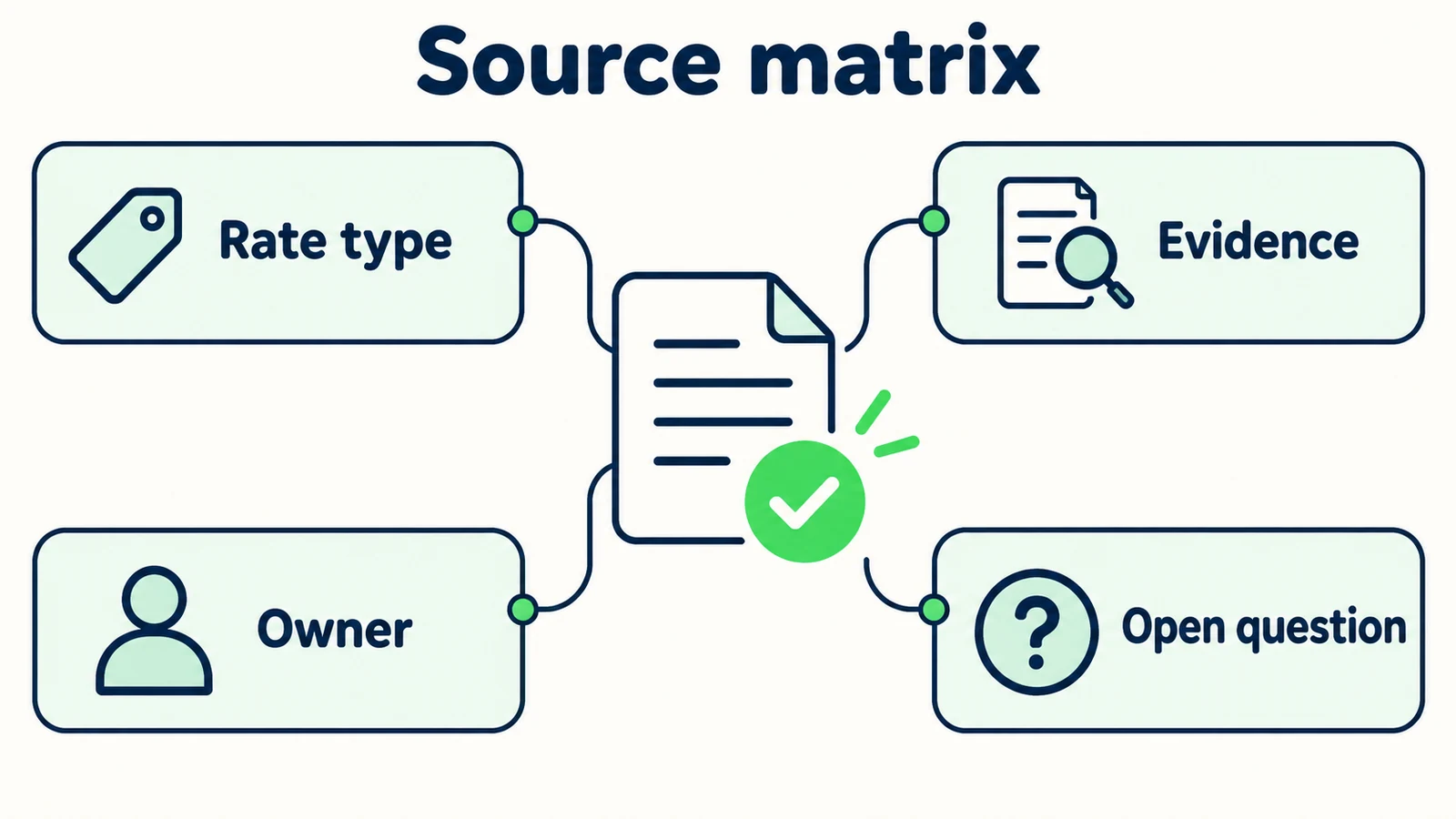
Store a small editorial record for each approved answer: the question it covers, the supporting source, the responsible owner and the last review decision. This is a team-maintained record, not a claim that the product automatically assigns policy precedence or approves changes.
When a policy changes, review the related public page, attached document and answer examples together. Updating one source while leaving a contradictory PDF attached can leave the front desk with competing information. The knowledge-base maintenance guide covers broader source organization; your cancellation register should focus on applicability and exceptions.
Retest the ordinary question and the difficult variants. Try an unknown channel, an unclear rate, a guest asking for a refund amount and a request to cancel immediately. A passing result explains the approved facts, asks a useful clarification when needed and avoids performing or promising an unsupported action.
Keep failed examples. They show which source or instruction needs work and help a different reviewer understand why the final wording was chosen. Deleting inconvenient tests makes the record look cleaner while removing the most useful evidence for the next policy update.
Make policy answers easier to review
Use approved hotel information for routine answers and keep booking-specific decisions with your team.
Start for freeA Policy Provenance Matrix Your Team Can Use
The matrix below is an illustrative worksheet, not a hotel's actual policy. Replace the example categories with your own sources and approved routing rules. Keep sensitive reservation details out of the shared editorial sheet.
| Question category | Evidence to check | What the answer may do | What still needs a person |
|---|---|---|---|
| Before booking, direct offer | Current terms for the selected offer | Explain the published conditions and link to them | Clarify an ambiguous or unpublished exception |
| Existing direct reservation | Booking terms through an authorized review process | Explain the general route for checking the reservation | Decide how terms apply to this booking |
| Booking through another service | Approved channel guidance | Identify the appropriate management or contact route | Resolve booking-specific or disputed conditions |
| Guest requests an exception | Guest's stated request and relevant policy | Acknowledge the request and explain review steps | Approve or decline the exception |
| Guest asks for refund amount | Authorized booking and payment records | Explain where to request a review | Determine eligibility, amount and processing status |
| Source documents disagree | Both source versions and owner decision | State that the detail needs confirmation | Resolve the conflict and approve replacement wording |
Add columns for property, policy owner, source location, review date and open issue. A row is usable when someone else can find the evidence and understand its scope without asking the original author to explain it.
Review the matrix against a synthetic conversation. For example: “I booked through another service and your website says cancellation is flexible.” A good response acknowledges the question, identifies the booking-specific terms and directs the guest to the approved route. It does not declare the website universally applicable or dismiss the customer's concern.
The benefit is observable in the record itself: fewer unsupported statements, clearer open questions and a more focused handoff. If you measure staff effort, compare similar enquiry types and keep unresolved cases visible. Do not call every short conversation a successful cancellation or a saved booking.
How to Introduce the Checklist at Your Hotel
Start with the sources your reservations team already trusts. Ask the policy owner to identify the current public explanation, the relevant rate-term destinations and the contact routes for direct and other-channel bookings. Do not begin by asking the AI to infer a unified policy from every document you can find.
Next, write a small approved answer pack. Include a general pre-booking explanation, an existing-booking response, an unknown-channel clarification and an exception-review message. Each should state what is known, what is not known and what the guest can do next. Keep the answer short enough to read on a phone, with the detailed terms available through a link.
Configure the front desk with the approved sources and boundaries. Hyperleap AI supports document-grounded answers, website chat and supported messaging channels, plus lead capture and emailed conversation summaries. Its source citations are visible in conversation logs for review, not as customer-facing citations inside the chat. The AI front desk overview explains the wider product role.
Run a review with someone who handles real reservations, using fictional data. Have them challenge an answer with missing dates, conflicting wording and pressure for an immediate refund decision. Record the result and correct the source or instruction before expanding the topic.
Finally, assign ownership of future changes. A new offer, revised cancellation page or altered contact route should trigger a review of the answer pack. This need not be a large project: the objective is to know who checks the change and where the evidence lives. For platform costs and trial terms, use the current pricing page, rather than embedding assumptions into your hotel's policy documentation.
Frequently Asked Questions
Can an AI front desk cancel a hotel reservation?
This workflow does not cancel reservations. It explains approved information and directs guests to the hotel's authorized booking-management or staff-review process. The final response should make clear that discussing cancellation has not changed the booking.
Should the AI quote the hotel's general cancellation policy?
Yes, when the policy is current, approved and relevant to the question. It should preserve rate-specific and channel-specific qualifications. For an existing booking, a general website explanation should not be presented as a decision about that reservation.
What if the guest's confirmation differs from the website?
Treat the disagreement as a review issue rather than choosing whichever source appears newer. Record the guest's concern without requesting unnecessary personal information, then direct them to the authorized team. The policy owner should separately resolve any contradictory public knowledge.
Can the reply promise a refund or fee waiver?
Not without an actual authorized decision. The front desk can explain a published process and acknowledge a request for review. Eligibility, amounts, exceptions and processing status belong with the hotel's responsible team and systems.
Which details belong in an initial handoff?
Include the property, question, reported booking channel, relevant uncertainty and the next action requested. Collect a booking reference only through the hotel's approved process when needed. Do not request card details, identity documents or a full confirmation for a general policy enquiry.
How often should cancellation answers be reviewed?
Review them when an offer, policy, source document or contact route changes, and when conversation review reveals confusion. Use the same difficult test questions after each meaningful edit. A calendar reminder alone does not prove the answer still matches the applicable source.
Give Guests Clarity Without Inventing a Decision
A good cancellation answer helps a guest understand where they stand without pretending that a general conversation has resolved their reservation. The important work is the source check: which property, which channel, which terms and which facts are actually known.
Use the matrix to make those distinctions visible. Keep exceptions with the person authorized to decide them, preserve uncertainty in the handoff and state the next step plainly. Your team can then spend its attention on the booking-specific question instead of correcting an unsupported promise.
Hyperleap AI can provide an AI front desk grounded in your approved hotel information. The strongest deployment is one in which routine explanations are useful and the boundary around reservation changes is easy for every guest to understand.
Build a clearer hotel front desk
Answer routine policy questions from your approved sources and give staff a better-prepared enquiry to review.
Start for freeIndustry Solutions
See how AI chatbots work for these industries:
Related Articles

Hotel Late-Arrival Questions: An Approved Answer Pack
Prepare accurate hotel late-arrival replies with public policy sources, private-access boundaries and a clear route to your reception team.

Conflicting AI Sources: An Owner Review Workflow
Resolve conflicting chatbot knowledge with a source register, named decision owner, approved replacement and repeatable tests for the disputed answer.

Hotel Group Enquiry Scripts: From Question to Handoff
Use practical hotel group enquiry scripts to gather dates, room needs and event context, then hand a clear brief to your reservations team.

Booking Links vs Integrations: What AI Can Actually Do
Separate sharing a booking link from checking availability, creating a reservation and confirming it with this practical AI front desk buyer checklist.