Conflicting AI Sources: An Owner Review Workflow
Resolve conflicting chatbot knowledge with a source register, named decision owner, approved replacement and repeatable tests for the disputed answer.

Your website says one thing. An attached brochure says another. The AI front desk produces an answer that sounds reasonable, but your team cannot agree which source it should have used. Asking the model to “be more accurate” does not resolve the business disagreement underneath the response.
Conflicting chatbot knowledge sources need an owner review workflow. Identify the disputed fact, find the person authorized to decide it, replace or clarify the source material and repeat the questions that exposed the problem. The outcome is not just a nicer answer. It is a documented decision about what customers should be told.
This guide gives small teams a conflict register, practical review rules and a retest pack. All policy examples are illustrative. The register is a team-maintained worksheet, not a built-in source-precedence feature. It is designed for ordinary business information such as service scope, opening hours, published package details and enquiry routes—not for asking an AI to decide legal, financial or clinical questions.
What Is a Knowledge Conflict?
A knowledge conflict exists when two relevant pieces of information support incompatible answers to the same customer question. A brochure says a service is offered on weekends; the current service page says weekdays only. A location guide lists one entrance; a revised visitor sheet names another. Both documents may look official, but they cannot both be used without understanding their scope.
Not every difference is a conflict. A general policy may have a clearly described exception. Two properties may have different check-in instructions. A business may serve one area for one service and another area for a different service. These are distinctions to preserve, not inconsistencies to erase.
The first review question is therefore not “Which document wins?” It is “Are these statements about the same thing, for the same customer situation and period?” That question prevents a well-meaning cleanup from removing useful detail.
Document-grounded systems use attached knowledge to support answers. They do not settle the underlying ownership of your business policies. A RAG-based AI front desk can work from the sources you provide, but a person still needs to decide what the sources should say. The knowledge-base best-practices guide covers organization and writing; this article focuses on the moment when sources disagree.
A decision must come before a replacement
Do not remove the older-looking source merely because it is older. It may contain an approved exception or historical condition. Establish scope and authority first, then update the customer-facing knowledge deliberately.
Why Conflicts Survive Ordinary Content Cleanup
A document date is mistaken for business authority
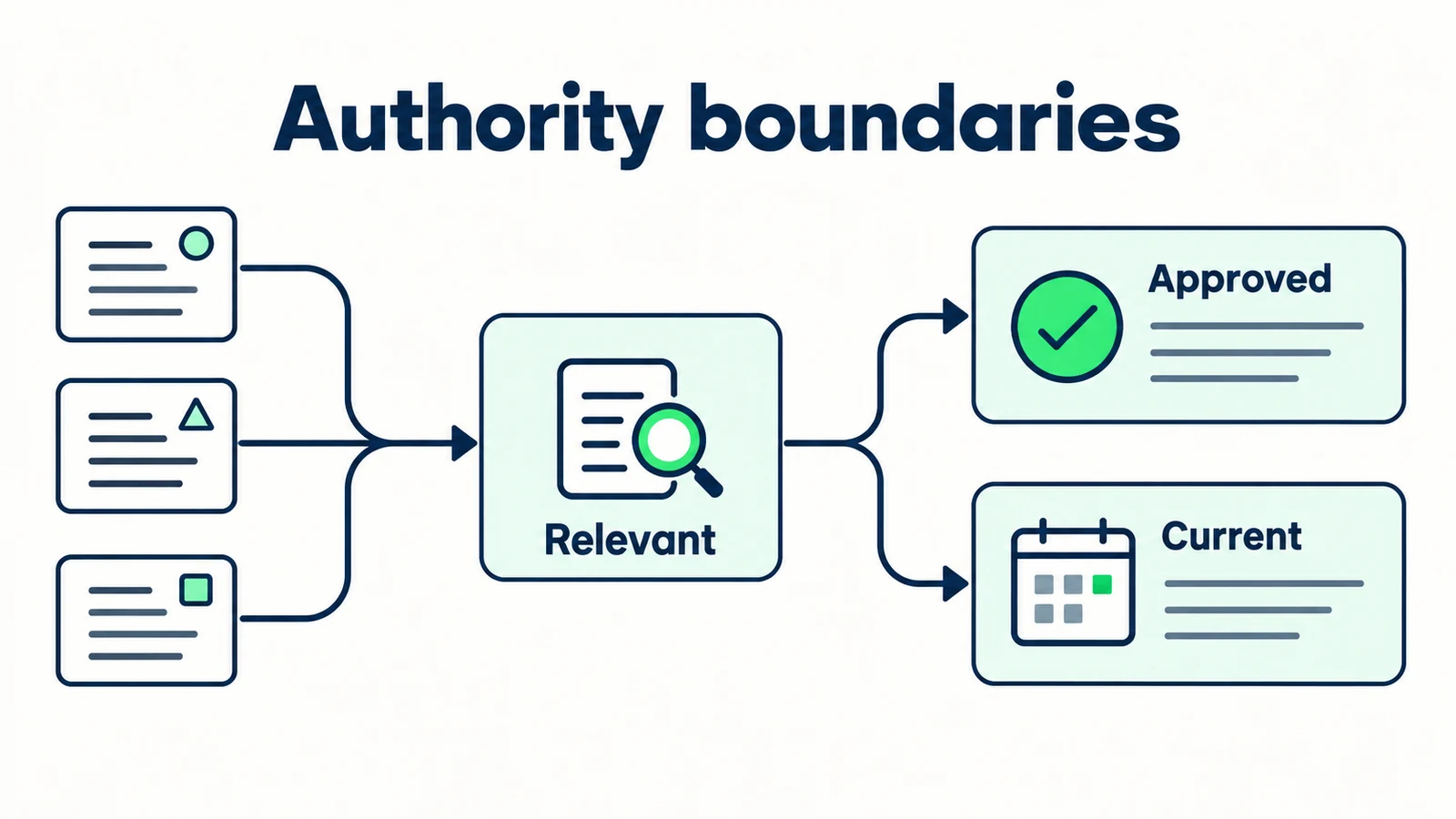
A freshly uploaded file can contain old wording. A long-standing policy can remain valid. File creation dates, upload dates and policy effective dates are different facts. If your team treats the newest file as automatically correct, it may replace an approved rule with an unreviewed draft.
Different owners maintain different surfaces
Marketing edits the website, operations maintains a service sheet and a manager sends a revised PDF to staff. Each change may make sense locally, while the combined knowledge set becomes contradictory. The issue is not simply that someone forgot to “train the AI.” The business needs a shared decision record for customer-facing facts.
Exceptions are separated from their conditions
A shortened answer may keep an attractive benefit and drop the condition that makes it true. “Collection available” may originally have meant collection from a particular branch during stated hours. If the qualification disappears, a source becomes misleading even though every remaining word was copied correctly.
A prompt tries to repair an unresolved policy
Instructions such as “always prefer the website” can conceal disagreement without resolving it. The website might be the wrong source for a specialist service or a location-specific exception. Broad precedence rules also become hard to maintain when the organization changes. Use an owner decision and clearer sources before reaching for increasingly complicated instructions.
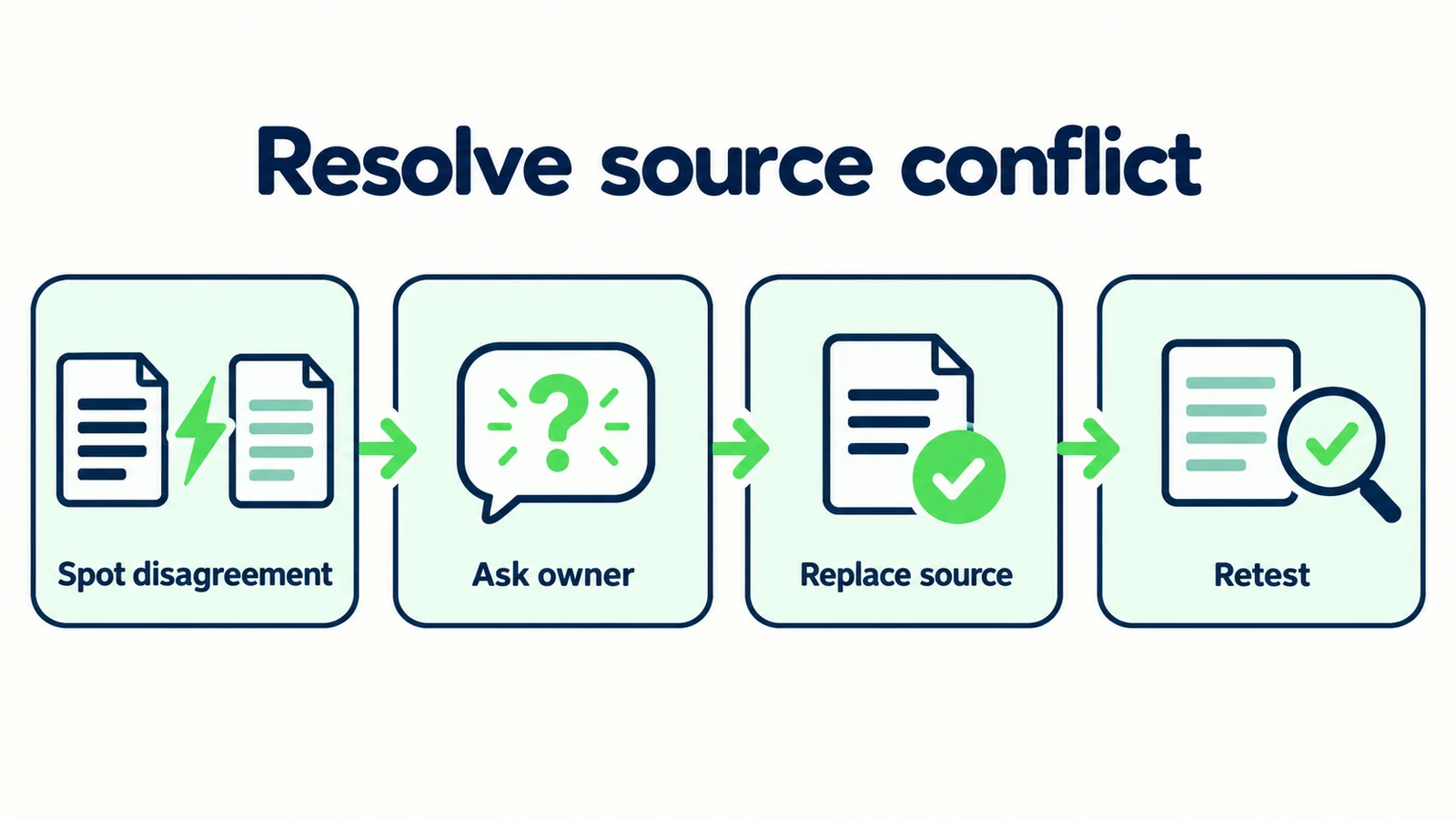
7 Steps to Resolve a Disputed Answer
1. Capture the exact question and competing statements
Begin with the customer question, not a vague complaint that the AI is wrong. Record the words used, the answer produced and the two statements that appear to conflict. Keep enough surrounding context to understand the conditions attached to each statement.
Illustrative record:
Question: “Can you collect equipment on Saturday?” Website: “Collections are available on weekdays.” Attached brochure: “Weekend collection can be arranged for selected service contracts.”
This is not necessarily a contradiction. The brochure may describe a limited contractual option while the website describes general availability. Without the condition, a reviewer could mistakenly remove a valid exception or advertise it to everyone.
Use links or document identifiers so the reviewer can locate the evidence. Avoid copying unnecessary customer personal information into the editorial register. A synthetic version of the question is often enough to reproduce the issue. If the conversation contains private details, keep the source record in the appropriate restricted system and include only the relevant wording in the knowledge review.
The goal is an issue another person can inspect without relying on your memory. “Wrong weekend answer” is not enough; the question and conflicting evidence are the working material.
2. Check whether the sources describe the same scope
Compare service, location, customer type, effective period and stated exceptions. A difference across any of these dimensions may explain the answer. Write the distinction plainly instead of treating it as an internal code only one manager understands.
For example, “delivery available” and “delivery unavailable” may both be correct if they refer to different service areas. The revised source should then explain the area boundary and what to do when the customer's location is unclear. It should not average the two statements into “delivery may be available everywhere.”
Create a short scope note: “General weekday service; contractual exceptions require staff review.” That note can guide the final answer and the test cases. It also reveals whether the AI needs a clarification question before answering.
If scope still cannot be established, keep the issue unresolved. Do not use the length, polish or apparent confidence of a document as a substitute for authority. A glossy brochure and a plain operations sheet can each be wrong. The next step is to identify the person who can confirm the intended policy, not to ask the model which document looks more trustworthy.
3. Assign the business decision to a named owner
The decision owner is the person authorized to confirm the fact, not necessarily the person uploading files. A service manager may own coverage areas, a hotel manager may own property information and a commercial owner may approve published package conditions.
Ask a specific question: “Which statement should a new customer receive for this service and location?” Include the evidence and the unresolved condition. Avoid forwarding a whole transcript with “please advise”; that recreates the same information burden the front desk is supposed to reduce.
The owner can approve one source, explain a scoped distinction or state that the topic requires individual review. Each is a valid outcome. A review does not have to produce a universal automated answer. Some business decisions depend on facts the customer has not supplied or on a person exercising judgment.
Record the decision in language a future reviewer can understand. “Use version B” is fragile when files are renamed. “For new weekday collection enquiries, use the published service page; weekend contract requests go to the service coordinator” preserves the meaning. This is an operating practice your team adopts, not a claim that Hyperleap automatically assigns policy owners.
4. Write one approved answer with its conditions attached
Once the decision is clear, draft the smallest answer that remains accurate. Include the qualifying condition next to the fact it qualifies. Do not place an important exception in a distant note that disappears when the answer is summarized.
Illustrative approved wording:
“Standard collections are available on weekdays in the published service area. If you are asking about a weekend arrangement under an existing service contract, the team will need to review your request.”
This wording is useful because it explains the general rule and preserves the exception without granting it. It also suggests a sensible clarification: is the customer asking about a new standard service or an existing arrangement?
Keep commercial promises out of the answer unless the owner approved them. “The team will review” is different from “the team will approve.” Similarly, do not turn an internal target into a customer response deadline. The human-handoff guide explains how to describe a next step without implying an action has already happened.
Have the owner approve the actual customer-facing sentence, not just the abstract policy. Reviewers often agree on the rule but notice problems only when they see how the rule sounds in conversation.
5. Repair the knowledge set, not only one reply
Find every active source that repeats the disputed fact. The website, attached PDF and answer pack may each need attention. If the obsolete statement remains available, the next conversation can reproduce the same disagreement even after a prompt was edited.
Use the platform's supported source-management process to replace, remove or clarify the material deliberately. Verify the resulting knowledge state. Do not claim that editing a source website automatically updates every attached copy unless you have checked the actual refresh process you use.
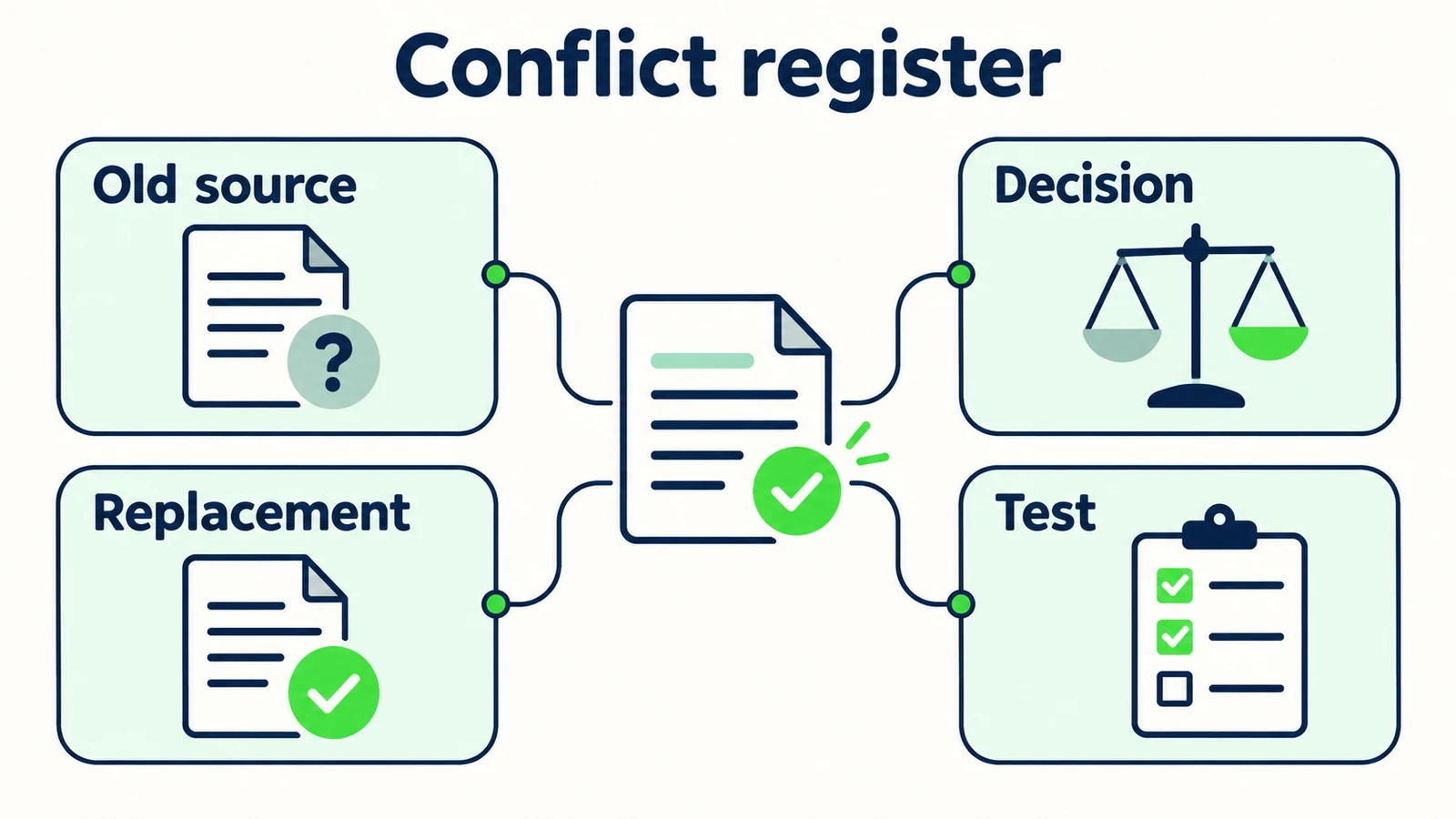
Keep a recoverable record of what changed and why. The editorial log can store the old source identifier, replacement source and owner decision without retaining an unnecessary duplicate inside the active knowledge set. Historical evidence belongs in your controlled record, not in the material from which current customer answers should be drawn.
For an AI front desk, clear sources are easier to maintain than layers of exceptions hidden in a prompt. This does not mean instructions are unimportant. They should define behavior—ask when the location is unclear, avoid guessing and use the approved handoff route—while the knowledge documents explain the actual business facts.
6. Retest the disputed question and nearby variations
A single successful reply is useful evidence, but it is not enough to close the issue. Ask the original question again, then change the phrasing, omit a key condition and test the exception. The answer should preserve the intended boundary across those variations.
For the collection example, test “Are you open for Saturday pickup?”, “I have a service contract” and “Can you make an exception for me?” A good result may answer the general rule, ask a clarification or refer to the team. The desired behavior depends on the approved policy, not on whether every response contains identical words.
Record both answer quality and next-step accuracy. Did the response point to the correct route? Did it invent an approval? Did it describe the customer as eligible without evidence? The accuracy evaluation guide provides broader context for assessing answers; this retest is specifically about a known conflict.
If the system still produces the old statement, investigate the remaining sources and configuration. Do not mark the issue resolved because the latest response was more polite. Closing a conflict requires evidence that the problematic assertion and its nearby variants are handled as intended.
7. Close the record with a future review trigger
An issue is ready to close when the owner decision, source change and retest evidence are all present. Add the condition that should reopen it: a new service area, changed opening hours, revised contract wording or another contradictory answer.
This is more useful than a generic “review later” note. A trigger connects maintenance to the business event that could make the answer wrong again. Someone updating a brochure can see that the collection policy has an existing decision record and should not be changed in isolation.
Use simple statuses such as open, awaiting owner, source updated, retest needed and closed. These are worksheet conventions, not product features. Avoid presenting a closed status as proof that all possible questions are correct. It means the specific issue met the review criteria you recorded.
Periodically look for repeated causes across closed issues. If the same brochure repeatedly conflicts with the website, change the publishing process for that brochure. If staff keep discovering undocumented exceptions, improve the policy source. The long-term benefit comes from reducing the source of disagreement, not from becoming faster at repairing the same answer indefinitely.
Give your front desk clearer knowledge
Use approved sources for routine answers, then review uncertain cases with your team.
Start for freeA Conflict Register With Useful Evidence
Keep the register small enough that people will use it. A shared document can work; the important part is the meaning of each field. The following rows are synthetic examples, not evidence from customer deployments.
| Issue | Competing evidence | Owner decision needed | Replacement or clarification | Retest |
|---|---|---|---|---|
| Weekend collection | Website says weekdays; brochure mentions contract exception | Does the exception still apply, and to whom? | State standard rule and review route together | New customer, contract holder, unknown status |
| Hotel entrance | Older guide names side entrance; current page names main entrance | Which route is currently approved? | Replace obsolete directions after confirmation | Arrival question, alternate entrance request |
| Service area | General page names a region; service sheet lists a smaller area | Does this service have a narrower scope? | Add service-specific area wording | Inside, outside and unclear location |
| Package contents | Sales sheet lists an item missing from current offer | Is the item included in this offer? | Owner-approved inclusion statement | General package question and item-specific question |
Alongside these fields, record the source locations, reviewer, decision date and open questions. Do not score an issue by how embarrassing it looks. Prioritize based on the practical consequence of a wrong answer and how likely the question is to arise in your own conversations.
Separate a corrected fact from a completed customer follow-up. Fixing tomorrow's answer does not notify the person who received yesterday's incorrect information. If a real customer needs a correction, assign that task through your normal service process. The knowledge register should reference the follow-up responsibility without becoming a second customer database.
You can observe improvement by reviewing repeat incidents and the amount of clarification staff need. Do not manufacture a universal accuracy percentage from a small collection of selected tests. Keep the evidence attached to the questions actually reviewed.
Put the Workflow Into an Ordinary Workweek
Choose one person to collect suspected conflicts and identify the decision owner. That coordinator does not need to know every policy. Their job is to make the issue inspectable and ensure it reaches someone who can decide it.
Start with a narrow topic that causes repeated interruptions. A home-services front desk, for example, might begin with service areas and quote conditions. A hotel might begin with property directions and published amenities. This gives the team a manageable first set of sources and tests.
Hyperleap AI provides document-grounded responses, attached knowledge sources and conversation logs. Source citations in those logs can help reviewers see which attached material an answer drew on; they are not visible citations in the customer's chat. Use the evidence as a starting point for review, not as proof that the cited document is the correct policy.
Make a safe fallback available while an important conflict is unresolved. It should explain that the detail needs confirmation and give an approved next step. Do not leave an unsupported answer active simply because the replacement paragraph is waiting for a stylistic edit.
After updating the sources, have a second person run the retest if practical. Someone who did not write the new wording is more likely to ask the question differently. Keep the failed and passing results in the same record so future editors can understand the change.
Finally, connect source maintenance to ordinary publishing. When a service page, brochure or package changes, the owner should check its related answer records. The conversation review guide helps identify recurring questions; this workflow turns a specific disagreement into an approved source change.
Frequently Asked Questions
Should the newest source always take priority?
No. Recency is useful context, but it does not establish authority or applicability. Check the policy's effective period, service scope and responsible owner before deciding which statement should support the answer.
Can a prompt resolve conflicting knowledge by itself?
A prompt can describe behavior, such as asking for a location or avoiding guesses. It cannot make an unresolved business policy true. Resolve the underlying disagreement with the authorized owner and repair the sources before relying on a broad precedence instruction.
Is every difference between documents a conflict?
No. Different services, properties, customer arrangements or effective periods may have different valid rules. The review should preserve those distinctions and make their conditions clearer, rather than forcing all information into one universal answer.
Does Hyperleap automatically approve source precedence?
This guide describes a manual team review workflow, not an automatic approval or precedence feature. Your team decides which policy is authoritative and updates the sources accordingly. Conversation-log evidence can support that review.
What should customers hear while a conflict is unresolved?
They should receive the facts that are supported, a clear statement of the uncertain detail and an approved next step. Avoid choosing the most reassuring answer without evidence. Do not promise an exception or response deadline your team has not authorized.
When is it reasonable to close a conflict record?
Close it when the owner decision is documented, the active sources reflect that decision and the disputed question plus relevant variations have been retested. Record what future change should reopen the issue. Closure applies to the reviewed conflict, not every possible answer.
Clear Sources Make Better Conversations Possible
When two documents disagree, the most useful question is not which model can sound more certain. It is who owns the fact and what customers should actually be told. That decision belongs to the business.
A compact conflict register makes the work visible: evidence, scope, owner, approved wording, source repair and retest. Each step removes a different kind of uncertainty. Together they give your front desk a more dependable knowledge set and give staff a record they can maintain without reconstructing old conversations.
Begin with one disputed answer. Resolve it properly, preserve the test and connect the next policy update to that record. The aim is not a perfect-looking library. It is customer information your team can explain and stand behind.
Build from knowledge your team approves
Create an AI front desk for routine customer questions, with source-grounded answers and clear routes for uncertainty.
Start for freeIndustry Solutions
See how AI chatbots work for these industries:
Related Articles

Hotel Cancellation Answers: A Source-Check Checklist
Build hotel cancellation answers around booking channels, rate terms and stay dates, with a source-check worksheet and clear staff-review boundaries.

Keep AI Answers Current When Hours and Prices Change
Use a knowledge source checklist to update hours, prices and policies, retire stale copies and retest AI answers before customers rely on them.

AI Front Desk Holiday Hours and Escalation Playbook
Prepare holiday hours, honest response windows and clear escalation contacts with a practical AI front desk source sheet and review checklist.

Quote or Estimate? AI Front Desk Reply Templates
Use clear quote-versus-estimate replies, scope questions and approval checks so your AI front desk does not promise a price your team has not agreed.