Guide
Agency Client Knowledge Workshop: A Working Agenda
Run a focused client knowledge workshop with a question-led agenda, source request checklist, decision log and approval record for an AI front desk.

Gopi Krishna Lakkepuram · Founder & CEO
· 16 min read
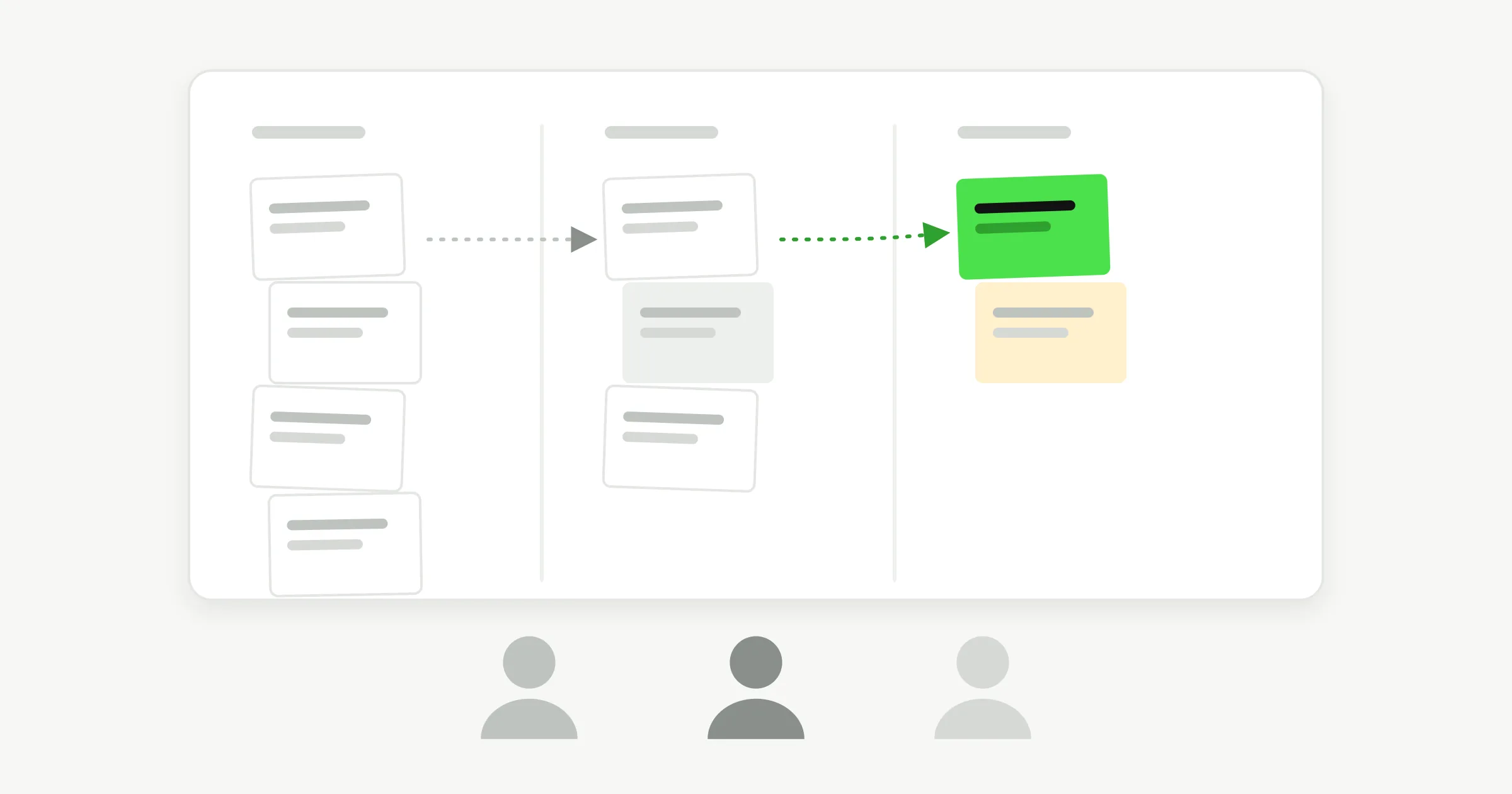
“Send us everything the AI should know” sounds efficient until the client sends a folder of brochures, old proposals and internal notes. The agency still does not know which facts are current, which exceptions apply or who can approve an answer. More documents have created more interpretation work.
A client knowledge workshop starts with customer questions instead. It identifies the questions the front desk should answer, the sources that support those answers, the decisions that need an owner and the topics that should remain with staff. The deliverable is an approved knowledge pack, not a transcript of a broad brainstorming call.
This guide provides a working agenda, source request list and decision worksheet for agencies. It is an original operational template, not a report of interviews or measured client outcomes. Use it before configuration or when a deployment's sources have become difficult to maintain. The workshop collects business knowledge; launch acceptance and technical handover remain separate reviews.
What Is a Client Knowledge Workshop?
A client knowledge workshop is a structured conversation that turns the business's everyday customer questions into usable, approved source material. It brings together the person who hears the questions, the person who owns the relevant policy and the agency member preparing the AI front desk.
It is not an exercise in teaching the client how a language model works. The client needs to explain their business in concrete terms: what they offer, where the service applies, which facts change and what staff must confirm. The agency translates that into sources and behavior instructions without inventing policy.
It is also not a launch sign-off. A workshop can produce approved information before the interface is built. The later acceptance review checks whether the deployed front desk uses that information appropriately and whether its next steps work. Keeping those stages separate avoids treating a good discovery conversation as proof of a finished product.
The build-versus-buy guide helps frame the overall engagement. The knowledge-base best-practices guide covers source writing and organization. This article supplies the missing middle: a practical way to obtain the client's facts and decisions without asking the agency to guess.
Bring questions, not just files
Ask the client to bring examples of the questions staff answer repeatedly and the approved material they use. Remove personal customer details from workshop examples. A concrete question reveals missing knowledge more quickly than a folder tour.
Why Discovery Calls Produce Unusable Knowledge
The conversation follows the organization chart
Each department describes what it does, but nobody works through the customer's actual question. The result may be a thorough company overview with little guidance on service areas, conditions or next steps. A question-led agenda keeps the workshop connected to the front desk's job.
Staff knowledge is captured without its conditions
An experienced employee says “we can usually do that,” and the note becomes “we offer that.” The original statement may depend on capacity, location or manager approval. The facilitator should ask what makes the answer true and what requires individual review before turning it into a source.
Decisions are confused with suggestions
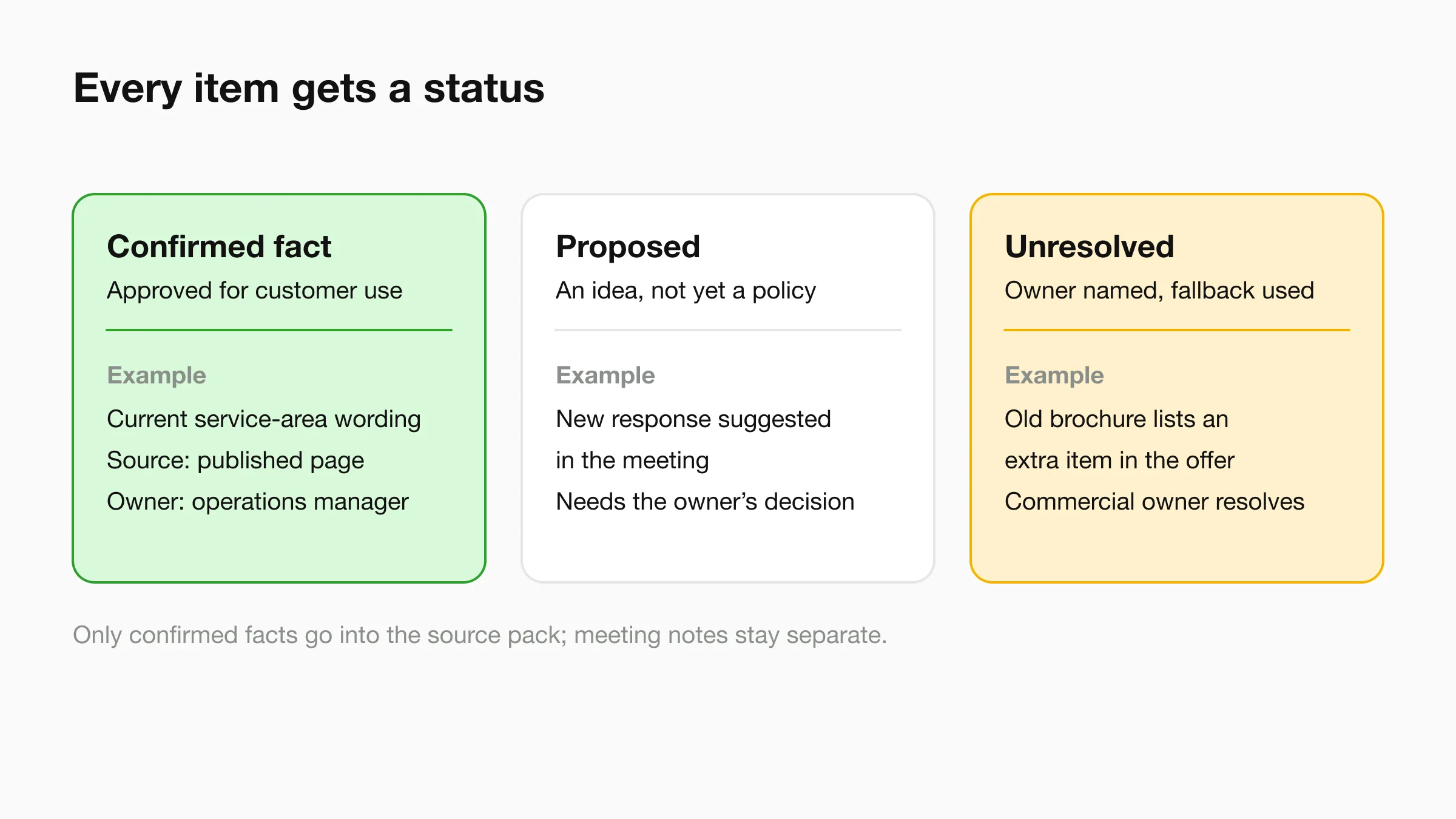
A meeting participant proposes a new response policy, and the agency records it as approved. Ideas are useful, but they need a different status from current facts. The worksheet should identify whether an item is confirmed, proposed or unresolved and who can decide it.
The agency asks for too much at once
A request for every document and every possible exception can stall a small-business client. Start with the first customer workflow. Build a usable source pack for it, then expand deliberately. The objective is not an encyclopedic archive; it is clear information for the questions the initial front desk will handle.
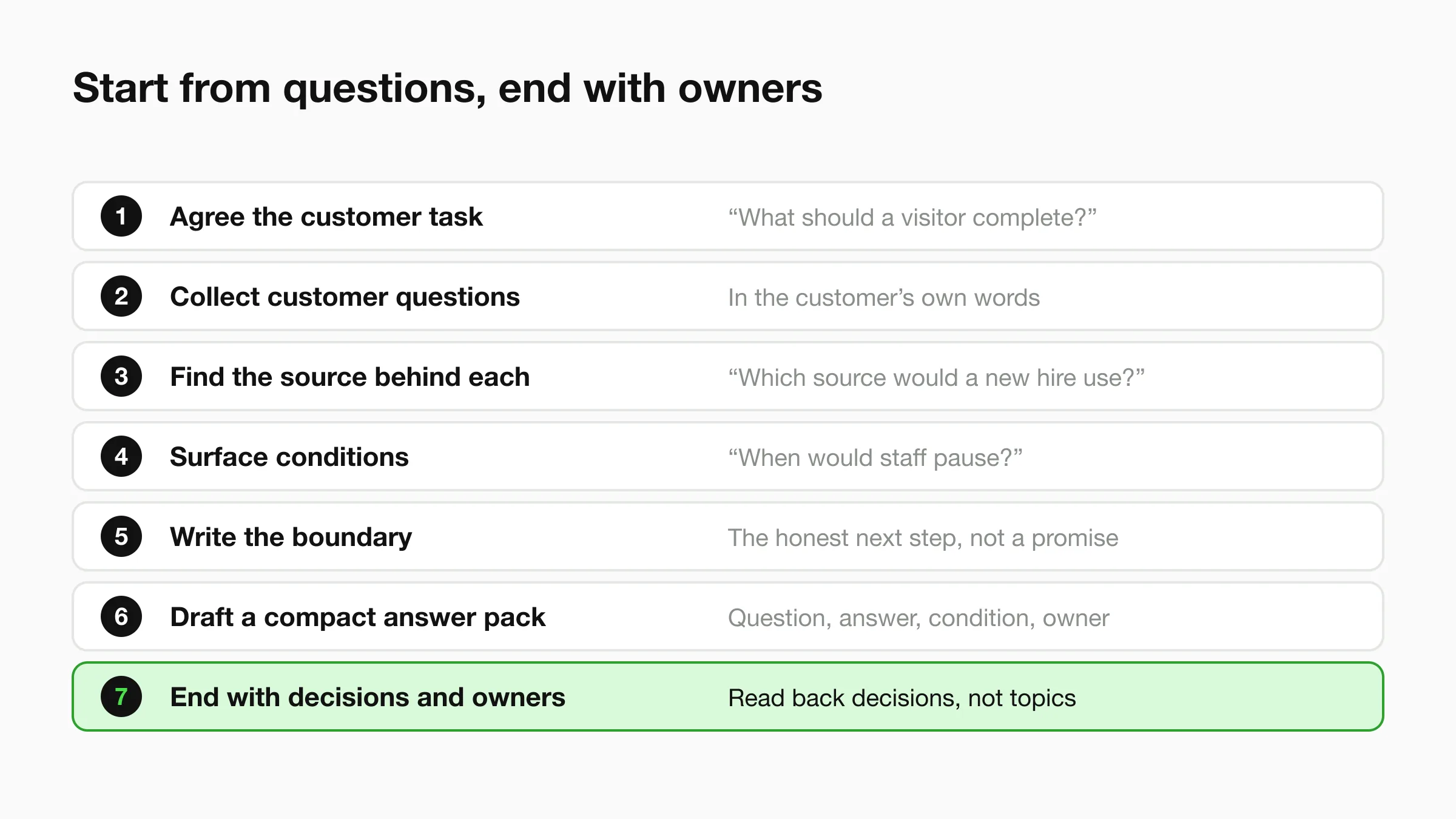
7 Agenda Blocks for a Productive Knowledge Workshop
1. Agree the customer task before reviewing documents
Open with the customer journey the first deployment will support. Ask the client to describe what a visitor is trying to accomplish and where staff are interrupted today. Keep the language concrete: finding service information, understanding a process or leaving an enquiry.
Facilitator prompt:
“When a visitor opens the front desk, what useful task should they be able to complete before a person needs to step in?”
Write one initial scope statement. For a home-services business, it might be explaining approved service information and collecting a request for team review. It should not quietly include diagnosis, quotations or confirmed appointments if those actions are not supported.
Ask what the front desk should not attempt. This is not a pessimistic discussion; it prevents the workshop from creating an inflated expectation. A clear boundary helps the agency choose which sources and examples matter.
Finish the block with a shared definition of success for the knowledge work: the client can point to approved answers and identify the owner of uncertain topics. Leave software performance claims and revenue predictions out of this exercise. The immediate deliverable is evidence-backed content.
2. Collect customer questions in the customer's language
Ask staff for the wording people actually use, without including personal information. “Do you come out to our area?” may be more useful than the internal label “geographic coverage.” Keep both if needed: the customer's wording for testing and the topic label for organization.
Facilitator prompt:
“What question do you answer repeatedly, and what does the person usually mean when they ask it?”
Separate questions that look similar but require different information. “Can I book?” might mean a customer wants a link, wants availability confirmed or wants to understand the process. The workshop should identify these branches instead of writing one vague answer for all of them.
Capture unclear questions too. They reveal where the front desk should ask a clarification. A useful knowledge pack includes not only facts but also the missing detail needed to select the right fact, such as the property, service or location.
Do not manufacture a demand ranking from the workshop. If the client has reliable conversation counts, use them with their scope. Otherwise call the list staff-selected priorities. A remembered question is useful qualitative input, but it is not evidence of a measured market trend.
3. Find the source behind each answer
For each priority question, ask where the approved answer lives. It may be a public page, a current document or a fact the owner needs to write down. Record the actual location and the person responsible for it.
Facilitator prompt:
“If a new employee needed to answer this tomorrow, which source should they use, and who would confirm that it is still correct?”
Distinguish a source from a reference. An old proposal may show how the business once described a service, but it may not be approved for general customer use. A competitor page can inspire a question but cannot establish the client's policy. The agency should not treat every supplied file as authoritative.
When two sources disagree, record the disagreement and move it to the decision list. Do not spend the entire workshop debating wording if the authorized owner is absent. Identify what must be resolved and who will do it.
For an AI front desk, clear attached knowledge supports more focused answers. It does not eliminate the need for source ownership. The workshop's value is making that ownership visible before the configuration turns an ambiguous document into a confident customer response.
4. Surface conditions, exceptions and changeable facts
Ask what would make the usual answer wrong. This question often reveals the most important knowledge: location limits, offer conditions, approval requirements or a fact that changes with the season. Keep the condition attached to the answer it qualifies.
Facilitator prompt:
“When would a staff member pause before giving this answer, and what would they need to check?”
Use a practical example. If the client says “we offer collection,” ask whether that applies to every service, location and customer arrangement. If it does not, write the scope plainly. Do not convert “sometimes, after review” into a universal feature because it makes the source shorter.
Identify volatile facts separately from stable explanations. A description of how to submit an enquiry may remain useful for a long time, while opening hours or an offer's effective period may change. Name the event that should trigger review, not just an arbitrary future date.
The conversation analysis guide can later help find missed conditions in real use. During the workshop, the facilitator's job is to make known exceptions explicit without inventing a rule for every hypothetical situation.
5. Write the boundary and the human next step
For every topic the front desk cannot resolve, decide what it should say and where the customer can go next. A vague “contact support” may be inadequate if the client has separate teams for reservations, service enquiries and billing questions.
Facilitator prompt:
“If the answer is not in the approved material, what can we honestly tell the customer, and which actual route should they use?”
Record the real process. If the front desk can collect an enquiry and the team reviews it later, say that. Do not invent an instant transfer, callback or response deadline to make the flow look complete. If a booking link is shared, distinguish it from a confirmed booking.
The human-handoff guide offers useful wording patterns. Have the client approve the final sentence, including any promise about what happens next. A small change from “you can contact” to “we have contacted” changes the implied state of the workflow.
Also define what should not be collected. An initial enquiry rarely needs every document the business may require later. Keep sensitive records in the appropriate authorized process and ask only for the details needed to move this conversation forward.
6. Turn the discussion into a compact answer pack
Before ending the workshop, show the client a draft of at least one answer in the format you intend to use. This reveals whether the agency and client understood the same policy. It is easier to correct a sentence in context than to discover the disagreement after launch.
Use a simple structure: customer question, approved answer, conditions, source, owner and fallback. Keep each answer focused on one topic. A long document mixing company history, service scope and exceptions can be harder to review than a small set of clearly labeled sections.
Illustrative answer-pack entry:
Question: “Do you serve this area?” Answer: use the current published area description. Condition: boundary locations require team confirmation. Source: approved service-area page. Owner: operations manager. Fallback: collect the location and explain the review route.
This is an editorial template, not a claim of a native platform approval form. The lead qualification guide can help distinguish an answer from a useful follow-up question. Do not add a long intake questionnaire to every entry simply because the system can ask questions.
Mark drafts as drafts. A polished paragraph should not be treated as approved merely because the agency wrote it during the meeting.
7. End with decisions, owners and the next review
Close the workshop by reading back the decisions, not by summarizing every topic discussed. Confirm which sources are approved, which answers need changes and who owns each unresolved item. The client should leave knowing exactly what is needed next.
Assign an owner and a clear deliverable to each open item. “Send information” is vague. “Operations manager to confirm the published service-area boundary and approve the customer-facing sentence” is actionable. A due date can be part of the engagement, but do not present an internal target as a customer promise.
Keep the approval record separate from the meeting notes. Notes can contain brainstorms, tentative statements and discarded ideas. The source pack should contain only the material approved for its stated purpose. This separation helps prevent an unreviewed suggestion from becoming active knowledge.
Agree how the client will report changes after launch. The implementation checklist provides the later deployment context. Your workshop output should feed that process with clear facts and owners, while acceptance tests verify the actual behavior of the configured front desk.
Build from the client's approved knowledge
Give your AI front desk clear business facts, useful boundaries and a real route to the team.
Start for freeA Workshop Worksheet and Source Request List
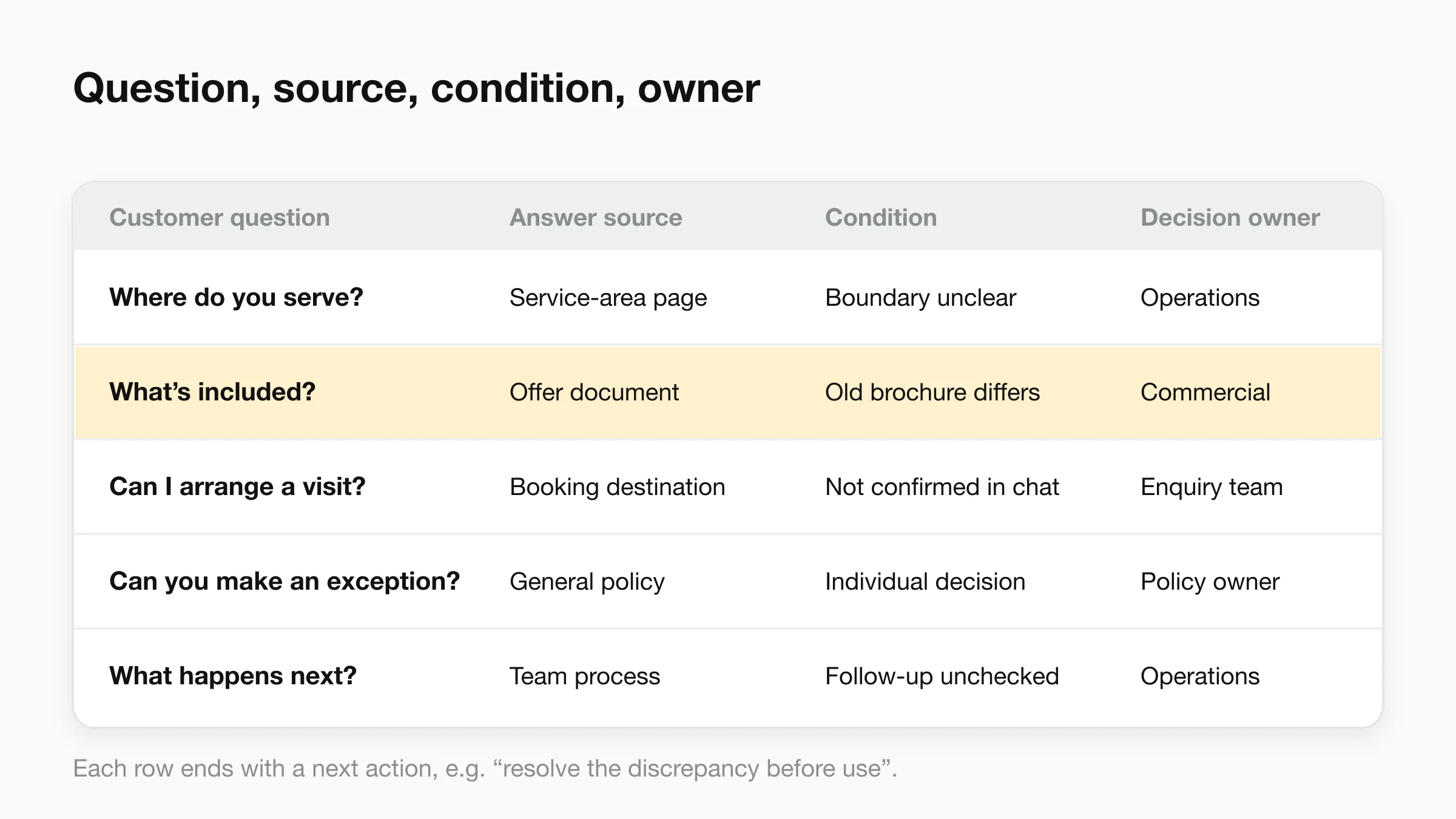
Use the following worksheet during the conversation. It is designed to expose missing decisions, not to make every row look complete before the meeting ends.
| Customer question | Current answer source | Condition or uncertainty | Decision owner | Next action |
|---|---|---|---|---|
| Where do you provide this service? | Published service-area page | Boundary locations unclear | Operations owner | Approve clarification and review route |
| What is included in this offer? | Current offer document | Old brochure lists an extra item | Commercial owner | Resolve discrepancy before use |
| Can I arrange a visit? | Approved booking destination | Availability is not confirmed in chat | Enquiry team owner | Approve link and expectation wording |
| Can you make an exception? | General policy | Individual decision required | Authorized policy owner | Write a review-request response |
| What happens after I leave details? | Actual team process | Recipient and follow-up ownership need checking | Operations owner | Verify handoff during acceptance testing |
Before the workshop, request a focused set of material: the current service pages, relevant policy documents, approved contact or booking destinations and examples of recurring questions with personal details removed. Ask the client to identify known obsolete files rather than silently mixing them into the pack.
Do not request credentials, customer identity documents or unrestricted exports simply to prepare content. If the engagement genuinely needs access to a system, handle that through the proper account and permission process, separately from the knowledge worksheet.
Afterward, send a concise decision record. Include approved sources, proposed wording awaiting review, open questions and named owners. Preserve the distinction between a fact the client confirmed and an interpretation the agency still needs checked. That distinction is the workshop's most important quality control.
Facilitate the Session Without Turning It Into a Lecture
Prepare by reading the client's public website and identifying obvious questions, not by writing a full policy on their behalf. Bring a short agenda and a few examples of ambiguous wording. The client should spend the meeting making business decisions, not watching a presentation about AI terminology.
Keep the people in the room aligned with the task. Someone who hears customer questions provides context; someone who owns the policy approves facts. If those are different people, make both roles visible. A marketing contact may coordinate the session without having authority to approve every operational exception.
Use plain language throughout. Ask “What should a customer hear?” rather than “What is your retrieval strategy?” Technical implementation details can be discussed separately with the appropriate contact. The AI front desk category is easiest to explain through customer tasks and team responsibilities.
When a disagreement appears, capture it and identify the owner. Do not pressure the meeting to invent a consensus just to finish the agenda. An explicit unresolved item is a useful output because it prevents the agency from quietly guessing later.
Hyperleap AI can use website and document sources for customer-facing answers. The workshop does not create automatic approval, source precedence or policy-writing features. It supplies the reviewed knowledge and boundaries that your team configures and tests. For plan details, consult the current pricing page, and keep platform terms separate from the agency's own service agreement.
Frequently Asked Questions
Who should attend a client knowledge workshop?
Include someone who understands recurring customer questions and someone authorized to approve the relevant business facts. The agency facilitator prepares the material and captures decisions. One person may hold several roles in a small business, but the responsibilities should still be explicit.
Should we ask for every company document first?
No. Start with the sources relevant to the initial customer workflow and ask the client to identify obsolete or internal-only material. A large unreviewed folder can create conflicting answers rather than useful knowledge. Expand the pack when there is a clear reason.
What if the client cannot answer a policy question?
Record it as unresolved and identify the person who can decide. Do not let the agency or AI invent the policy. The front desk can use an approved fallback for that topic until the business provides a confirmed answer.
Is a workshop the same as launch acceptance?
No. The workshop produces approved knowledge and decisions. Acceptance testing checks whether the deployed front desk uses that knowledge appropriately and whether its links, forms and handoffs work. Both are useful, but they provide different evidence.
Can the meeting transcript become the knowledge base?
Not without review. A transcript can contain tentative ideas, contradictions and information not intended for customers. Convert it into a focused answer pack and have the appropriate owners approve the source facts and wording before use.
How should the agency measure a successful workshop?
Look for approved sources, clear conditions, named owners and specific next actions. The immediate result is a usable knowledge pack, not a guaranteed revenue or efficiency outcome. Customer and team outcomes can be measured separately after a tested deployment is in use.
Leave With Knowledge the Client Can Stand Behind
A useful client knowledge workshop does not try to extract everything the business knows. It identifies the information needed for a specific customer task and makes the authority behind each answer visible.
Start from real question shapes, preserve the conditions that make an answer true and separate confirmed facts from proposals. Give unresolved issues an owner. Then turn the decisions into a compact source pack that can be reviewed, configured and tested.
That process gives an agency a stronger foundation than a folder of documents and an instruction to make the AI helpful. The front desk's confidence should come from approved knowledge, while uncertainty should lead to a clear next step rather than an invented policy.
Turn approved knowledge into a useful front desk
Answer routine customer questions from the client's sources and keep policy decisions with the people who own them.
Start for freeIndustry Solutions
See how AI chatbots work for these industries:
Related Articles
View all
Guide16 min read
Agency AI Front Desk: A Client Launch Checklist
Launch a client's AI front desk with an evidence-based checklist for source approval, branding, access, acceptance tests, ownership and handover.
Guide17 min read
Hotel Accessibility Questions: A Source Sheet
Prepare factual hotel accessibility answers with a source sheet for entrances, room features, measurements, review dates and named staff follow-up.
Guide17 min read
Conflicting AI Sources: An Owner Review Workflow
Resolve conflicting chatbot knowledge with a source register, named decision owner, approved replacement and repeatable tests for the disputed answer.
Guide17 min read
Hotel Cancellation Answers: A Source-Check Checklist
Build hotel cancellation answers around booking channels, rate terms and stay dates, with a source-check worksheet and clear staff-review boundaries.