Guide
Turn Unanswered Customer Questions Into Better Sources
Use an unanswered-question review log to separate missing facts from unclear requests, approve source changes and retest the answer before closing the issue.

Gopi Krishna Lakkepuram · Founder & CEO
· 16 min read
An AI front desk says it cannot answer a customer's question. A team member supplies the missing information, the customer moves on and the same gap appears in another conversation later. The individual enquiry was handled, but the knowledge source did not improve.
An unanswered-question review log connects those two jobs. It records what the customer asked, why the front desk could not answer, which source or instruction needs attention and what happened when the question was tested again. It turns a vague instruction to “review chats” into a small, repeatable maintenance process.
This guide provides an original annotation rubric, working log and edit-retest sequence. The examples are synthetic. The log is a team-maintained artifact, not a claim of an automatic learning or approval feature. It also does not assume that every unanswered question should receive an automated answer. Some questions appropriately remain with a person, and a successful review can confirm that boundary rather than expand the AI's role.
What Does a No-Answer Review Log Do?
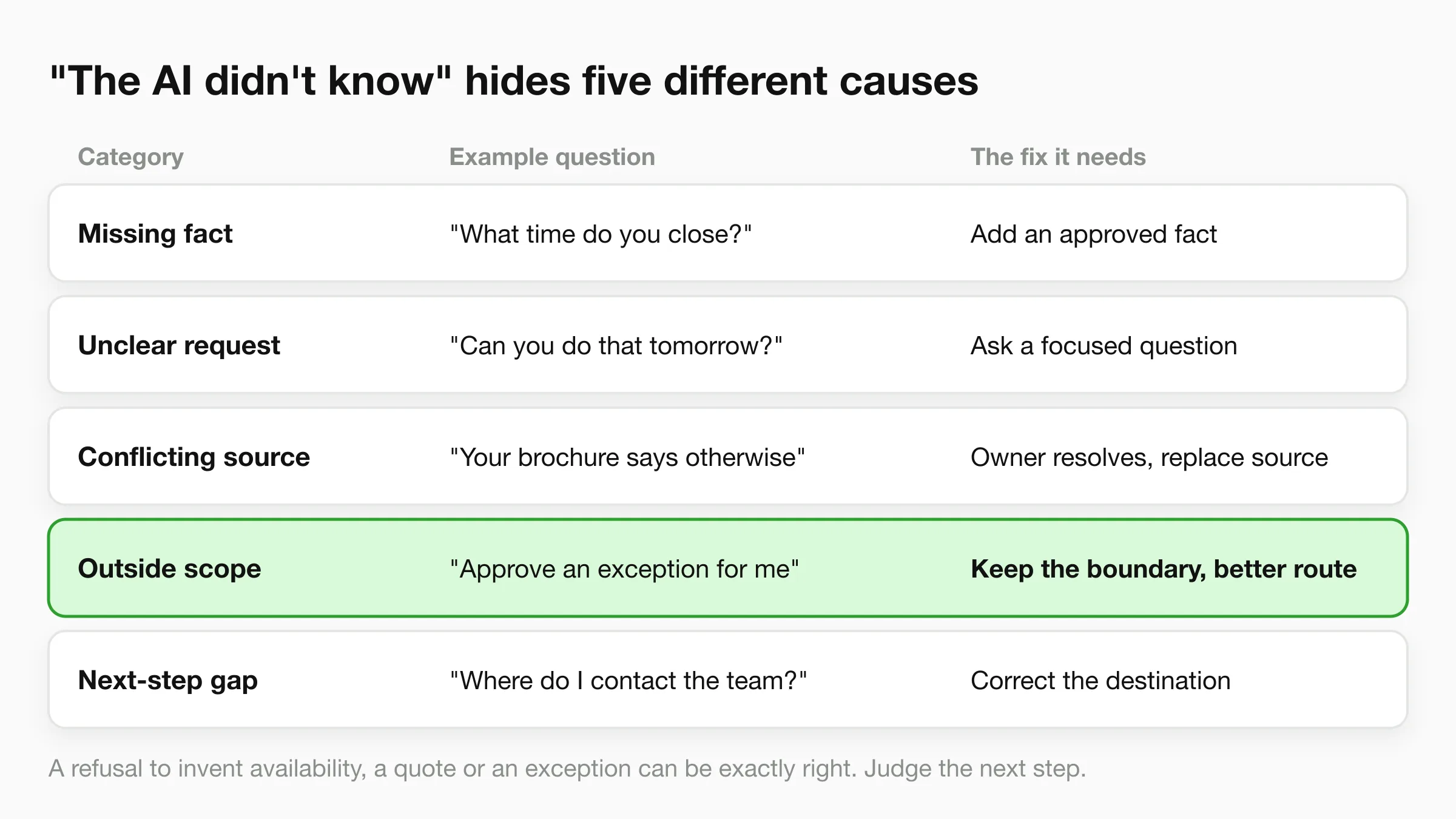
A no-answer review log tracks questions that did not receive a useful supported answer. It helps the team distinguish a missing fact from an unclear question, conflicting information, an out-of-scope request or a broken next step. Those problems require different fixes.
For example, “What time do you close?” may reveal missing opening hours. “Can you do this?” may need a clarification about the service. “Can you approve an exception?” may correctly require a person. Treating all three as knowledge gaps would lead the team to add unnecessary content or invent a decision the front desk should not make.
The log should preserve enough evidence to reproduce the issue without becoming a second customer database. Keep personal details out of the editorial record where they are not needed. A paraphrased or synthetic question can often carry the lesson, with an appropriate internal reference to the original conversation when review requires it.
A document-grounded front desk benefits from clear sources, but the business still owns the information and approval process. The conversation analysis guide covers broader patterns, while the knowledge-base guide covers source structure. This article focuses on the small maintenance unit between them: one unanswered question, one diagnosis of the gap and one verified change.
Not every no-answer is a failure
A refusal to invent availability, a quotation or an exception can be the correct behavior. Review whether the response gave the customer a useful next step, not simply whether it contained a confident answer.
Why Conversation Review Often Fails to Improve Sources
Everything is labeled “the AI did not know”
That label hides the cause. The fact may exist but be ambiguous, the customer may not have identified the location or the request may be outside the approved scope. Without classification, the team may add another document when it actually needs a clarification question or a better handoff message.
Staff repair the conversation but not the knowledge
A person can answer the customer and still leave the underlying source unchanged. That may be appropriate for a one-off exception, but a recurring public fact belongs in an approved source. The log should distinguish individual follow-up from reusable knowledge maintenance.
New answers are added without approval
A reviewer writes a plausible answer based on memory and uploads it. The immediate gap disappears, but the business has introduced an unverified policy. A maintenance workflow needs an owner decision when the fact is not already supported, especially for prices, service boundaries and customer promises.
The issue closes when an edit is made
Editing a document does not prove that the front desk now handles the question correctly. The updated source may not be active, another document may conflict or the wording may still be unclear. Retesting is the evidence that connects the change to the intended customer behavior.
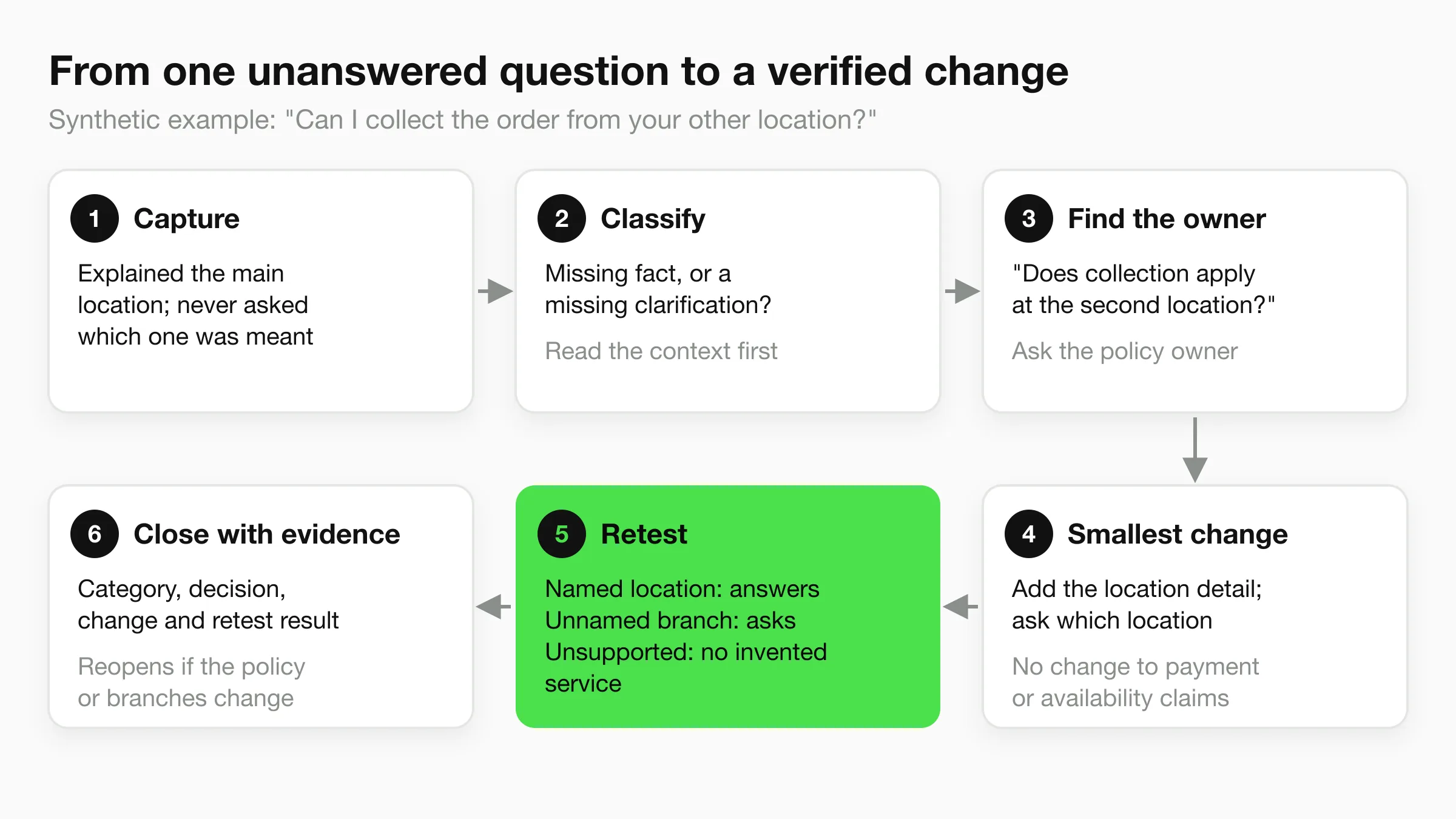
7 Steps From an Unanswered Question to a Reviewed Change
1. Capture the question and the observed response
Record the actual question shape and the answer that prompted review. Avoid a summary such as “bad response” that forces the next person to reconstruct what happened. Include the relevant topic and the point at which the conversation stopped helping the customer.
Illustrative entry:
Customer question: “Can I collect the order from your other location?” Observed response: explains the main location but does not ask which location the customer means. Review question: missing branch information or missing clarification?
That entry is specific enough to investigate. It does not assume the business offers collection everywhere or that the front desk should know the intended branch from context.
Separate what the system said from the reviewer's interpretation. Quoting the relevant sentence can be useful, but remove unnecessary personal information and retain the original conversation under the appropriate access controls. Do not paste entire customer histories into a broadly shared editorial document.
If staff already answered the customer, record that follow-up separately. The knowledge issue may still be open. A completed service conversation and a corrected reusable source are different outcomes, even when one person handles both.
2. Classify the reason the answer was not useful
Use a small set of categories that leads to action. Missing fact means approved information is absent. Unclear request means the front desk needs a question before it can choose the right answer. Conflicting source means the available material disagrees. Outside scope means a person or another system must decide.
Add a next-step failure category for cases where the answer's limit was appropriate but the customer was not given a useful route. “I cannot help” may be factually cautious and still leave the visitor stranded. The fix could be better fallback wording rather than more knowledge.
Do not classify from a single sentence in isolation if the conversation context matters. The customer may have corrected the location or declined a proposed next step. Read enough to understand the task, then write the category with a brief reason.
For a hospitality front desk, an unknown amenity detail and a request for live room availability are different cases. The first may need a verified source update. The second may need a clear booking or staff-review route. Classification prevents the team from trying to solve both by attaching a broader hotel brochure.
3. Find the source or owner needed for a decision
Search the approved knowledge set for the relevant fact. If the information exists, inspect whether the wording, scope or surrounding context could explain the answer. If it does not exist, identify who can confirm it.
Hyperleap AI's conversation logs can show source citations indicating which attached sources an answer drew on. These citations support review; they do not prove the source itself is current or authoritative. They are a log feature, not citations displayed in the customer's chat.
Ask the owner a focused question. “Does collection apply at the second location, and what should a customer be told?” is more useful than “please improve this answer.” Include the evidence and any apparent contradiction.
If the answer depends on individual circumstances, the owner may decide that the front desk should not give a universal response. Record the approved boundary and next step. A review does not have to end by adding more automation. Sometimes the right correction is to make uncertainty clearer and direct the customer to the responsible team.
Keep the approval trail concise but meaningful. The future reviewer should understand who confirmed the fact and what conditions apply without relying on a private conversation that nobody can find.
4. Choose the smallest change that addresses the cause
Match the edit to the classification. A missing public fact may need a new source paragraph. An ambiguous location may need a clarification instruction. A conflicting policy may require removing or replacing obsolete material after owner approval. A poor fallback may need a clearer next-step sentence.
Avoid rewriting the whole prompt because one answer failed. Large unrelated changes make it harder to understand what fixed the problem and can affect questions that were already working. A focused edit supports a focused retest.
Illustrative change note:
“Added approved collection information for the named location and an instruction to ask which location when the customer has not identified it. No change to payment, availability or order-status claims.”
That note describes both the change and its limits. It helps another reviewer know which adjacent questions might need testing.
Do not upload a customer's private exception as a general policy. If staff arranged something unusual for one person, keep it in that customer process unless the business explicitly approves a broader rule. The source should explain what future customers can be told, not preserve every historical accommodation as an available offer.
5. Retest the original question and a meaningful variation
Ask the question that exposed the issue and at least one variation that tests the same boundary. Change wording, omit the location or introduce the relevant exception. The objective is to see whether the approved behavior holds, not to collect identical sentences.
For the collection example, test a named location, an unnamed “other branch” and a request outside the published process. A useful result explains the approved fact when known, asks a clarification when needed and avoids inventing a service for an unsupported case.
Record the observed answer and compare it with the expected behavior. If the response is still wrong, keep the issue open. Investigate whether the source change is active, whether another source conflicts or whether the instruction remains ambiguous.
The AI accuracy guide provides wider evaluation context. This maintenance retest is narrower: it verifies a specific change against a known issue. Do not turn a few selected passing questions into a general accuracy percentage or a promise about every future conversation.
Check the next step as well as the answer. A correct explanation followed by the wrong contact link still leaves the customer with a broken task.
6. Close the issue with evidence, not a reassuring label
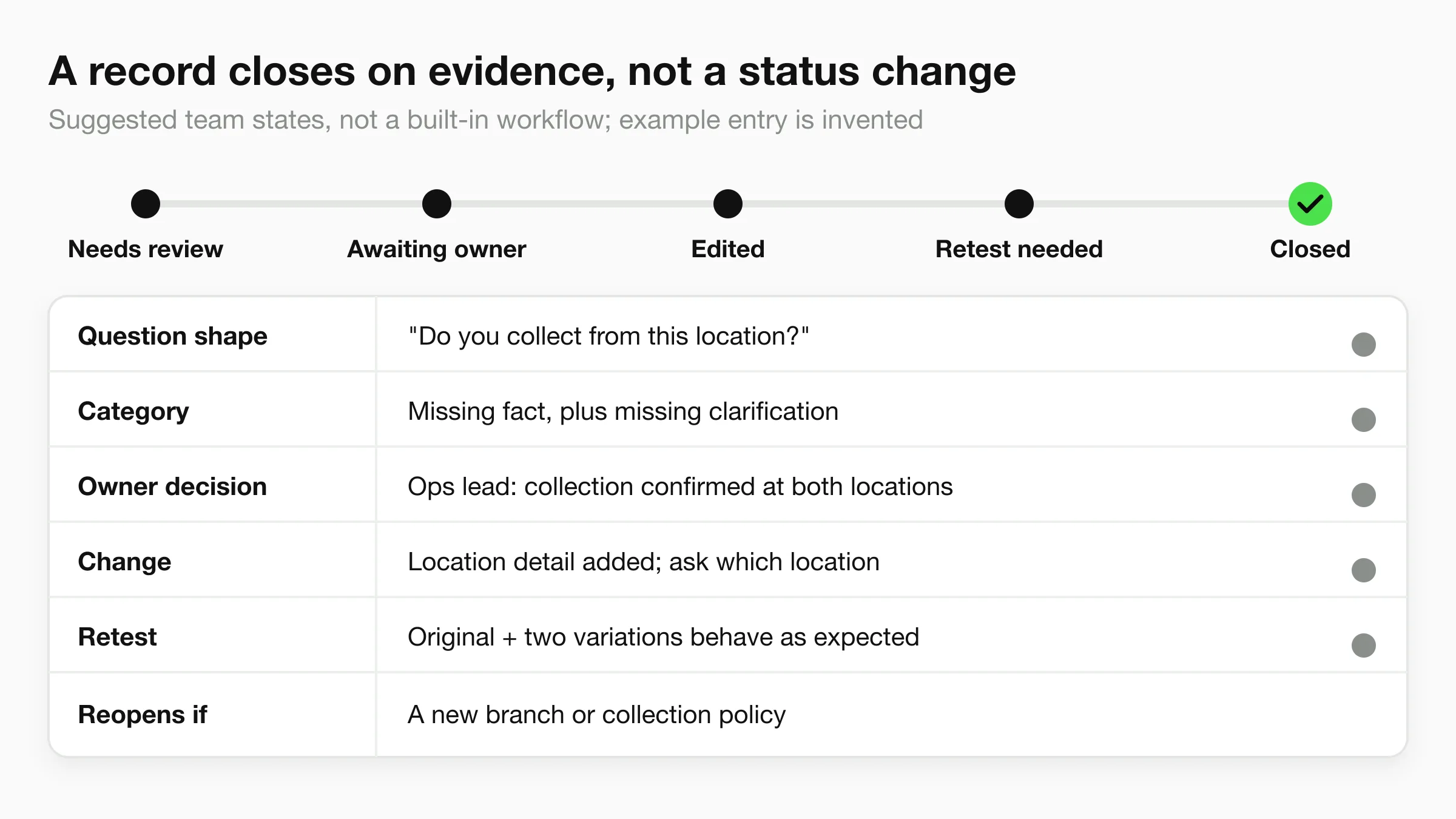
A closed record should show the classification, owner decision, source or instruction change and retest result. It should also state whether any individual customer follow-up remains separate. This makes closure an inspectable decision rather than a visual status change.
Use simple states your team understands: needs review, awaiting owner, edited, retest needed and closed. These are worksheet conventions, not a claim that the platform provides this exact workflow. Choose a tool your team will actually maintain.
Some issues close with “boundary confirmed; fallback improved.” That can be a successful result. If the customer asked the AI to approve a refund or confirm live inventory, the goal is not necessarily to make it answer yes. The goal is a supported explanation and an appropriate route.
Keep a short note about what would reopen the issue. A new branch, changed collection policy or different contact route may invalidate the answer. The note links the record to future business changes and helps prevent the same uncertainty from returning under a slightly different question.
7. Review patterns without hiding the uncomfortable cases
Look across the log for repeated causes. If multiple questions lack service-area information, improve that source. If customers repeatedly ask an ambiguous question, revise the clarification. If staff constantly override a policy, ask the owner whether the published explanation is incomplete.
Keep the categories separate when measuring work. A missing fact, an appropriate out-of-scope response and a delivery failure are not interchangeable “unanswered chats.” A combined count can hide whether the problem is knowledge, wording or operations.
Use your own evidence and its scope. You can count reviewed issues or repeat incidents, but do not infer a universal customer satisfaction result from the log. A decline in recorded issues may mean fewer conversations were reviewed, not necessarily a better front desk.
The lead-summary guide can help preserve customer context when a person needs to follow up. Keep that service record distinct from the editorial learning. The maintenance loop should improve future answers without turning every customer conversation into material copied across shared documents.
Give unanswered questions a useful next step
Use approved knowledge for routine answers and review the gaps that your team can actually resolve.
Start for freeA Weekly Review Log You Can Copy
The following examples are invented to demonstrate the rubric. They are not observations from a customer deployment.
| Question shape | Category | Evidence or decision needed | Change | Retest expectation |
|---|---|---|---|---|
| “Do you collect from this location?” | Missing fact or scope | Approved location policy | Add confirmed location detail | Answer known location; clarify unknown one |
| “Can you do that tomorrow?” | Unclear request | Which service and next step the customer means | Ask a focused clarification | Do not infer service or availability |
| “Your brochure says something else” | Conflicting source | Policy owner resolves the discrepancy | Replace or scope the source | Preserve the approved condition |
| “Approve an exception for me” | Outside scope | Authorized decision route | Improve fallback wording | Explain review process without approval promise |
| “Where do I contact the team?” | Next-step gap | Current approved destination | Correct contact source | Link opens the intended route |
Add columns for reviewer, source location, owner, status and evidence. Keep the row short enough to scan, with supporting details linked from the proper system. A useful log should make the next action obvious without requiring a meeting to interpret every entry.
At the review, choose issues based on their consequence and recurrence in your own evidence. Do not prioritize only the easiest edits because they make the completed count look good. An unresolved policy affecting a sensitive promise may deserve attention before several minor wording improvements.
Review closed rows occasionally by repeating the recorded question. This can reveal that a later source update reintroduced the problem. The point is not to create an endless audit burden, but to preserve the value of work the team already did.
Make Maintenance Small Enough to Continue
Choose a reviewer and a regular opportunity to inspect the log. The schedule should fit the business's conversation volume and risk, rather than a universal rule copied from another company. Important errors should not wait for a routine meeting if they can mislead customers now.
Start with a manageable sample and record how it was chosen. A sample of only successful conversations will miss the questions this workflow is meant to find. A sample of only complaints will not describe the whole customer experience. Be honest about the selection.
Create a short source-change procedure: owner approval, targeted edit, confirmation that the intended source is active and retest. The implementation checklist offers broader operating context, while the human-handoff guide helps with cases that should remain with staff.
Hyperleap AI provides document-grounded answers, conversation history and source citations in logs. It does not automatically convert every staff correction into approved business policy. Your team remains responsible for deciding what becomes reusable knowledge and for testing the result.
Keep the review focused on reducing repeated uncertainty. If the log becomes a long list nobody acts on, simplify the fields and clarify ownership. A small number of fully resolved issues is more useful than a large backlog marked “AI improvement” with no source, decision or test attached.
Frequently Asked Questions
Should every unanswered question become new knowledge?
No. Some questions need clarification, some expose conflicting sources and some belong with a person or another system. Classify the cause before editing. An appropriate boundary with a useful next step can be the correct outcome.
Does Hyperleap automatically learn approved answers from staff replies?
This guide does not claim an automatic approval or learning workflow. Your team should review the fact, update the supported source or instruction deliberately and retest. A staff response to one customer may be an exception rather than a reusable policy.
What information should the editorial log retain?
Keep the question shape, observed response, classification, relevant evidence, owner and change history. Avoid copying unnecessary personal customer details into a shared document. Retain any needed original conversation reference under the appropriate access rules.
How do we distinguish missing knowledge from an unclear question?
Ask whether an approved answer exists once the customer's service, location or intent is known. If the answer exists but the context is missing, a clarification may be the fix. If the fact itself is absent or unapproved, source work is needed.
When can a reviewer mark an issue closed?
Close it after the decision, source or instruction change and relevant retest evidence are recorded. If the correct outcome is a human review route, verify that wording too. A document edit alone does not prove the customer task is now handled correctly.
Should we report one accuracy percentage from the log?
Not without a defined evaluation method and a clear explanation of the sample. The log is primarily a maintenance record. Counts of issue types, repeat incidents and completed retests can be useful without implying a universal performance benchmark.
Let Each Reviewed Gap Improve the Next Conversation
An unanswered question is useful evidence when it leads to a clear decision. The no-answer review log makes that path visible: capture the question, classify the gap, find the owner, make a targeted change and retest it.
Keep the boundary cases. A front desk that declines an unsupported decision and explains the next step may be doing exactly what the business needs. Improve that experience without pretending every question should become an automated answer.
Start with one repeated question your staff currently handle manually. If the answer belongs in approved knowledge, add it responsibly. If it belongs with a person, make that route clearer. Either way, the next conversation should benefit from the review rather than repeating the same uncertainty.
Build a front desk your team can improve
Ground answers in approved sources and use conversation evidence to guide careful, testable updates.
Start for freeIndustry Solutions
See how AI chatbots work for these industries:
Related Articles
View all
Guide17 min read
Conflicting AI Sources: An Owner Review Workflow
Resolve conflicting chatbot knowledge with a source register, named decision owner, approved replacement and repeatable tests for the disputed answer.
Guide16 min read
Agency Client Knowledge Workshop: A Working Agenda
Run a focused client knowledge workshop with a question-led agenda, source request checklist, decision log and approval record for an AI front desk.
Guide17 min read
Hotel Accessibility Questions: A Source Sheet
Prepare factual hotel accessibility answers with a source sheet for entrances, room features, measurements, review dates and named staff follow-up.
Guide17 min read
Hotel Cancellation Answers: A Source-Check Checklist
Build hotel cancellation answers around booking channels, rate terms and stay dates, with a source-check worksheet and clear staff-review boundaries.