Guide
Multiple Hotels, Different Policies: An Answer Matrix
Keep multi-property hotel answers accurate with a property-specific source matrix, clarification scripts and boundaries around shared brand information.

Gopi Krishna Lakkepuram · Founder & CEO
· 16 min read
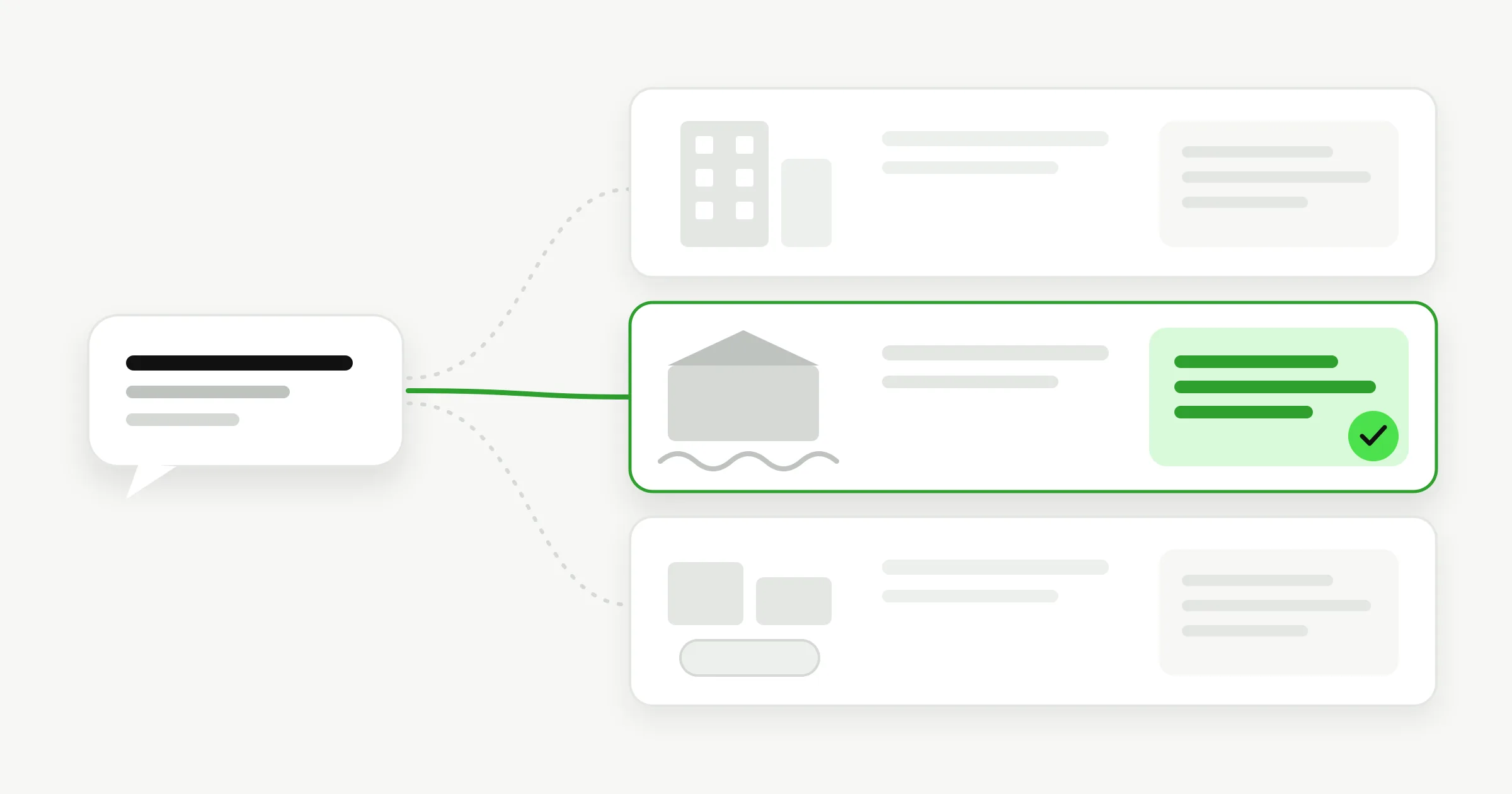
A guest asks, “Does your hotel have parking?” The business operates a city hotel, a coastal property and a small resort. The AI front desk finds a parking description in one brochure and answers yes. The sentence is supported somewhere in the source library, but it may be wrong for the hotel the guest means.
Multi-property hotel answers need a property boundary before they need more content. The front desk should know which hotel the question concerns, use information scoped to that property and avoid turning a shared brand statement into a local facility claim.
This guide provides an original property answer matrix, clarification scripts and a source review process. All hotel names and examples are illustrative. The matrix is a team-maintained knowledge artifact, not a claim that a platform automatically routes sources, checks live inventory or synchronizes hotel policies. Its purpose is to make the business's intended answer boundaries explicit and testable.
What Is a Property Answer Boundary?
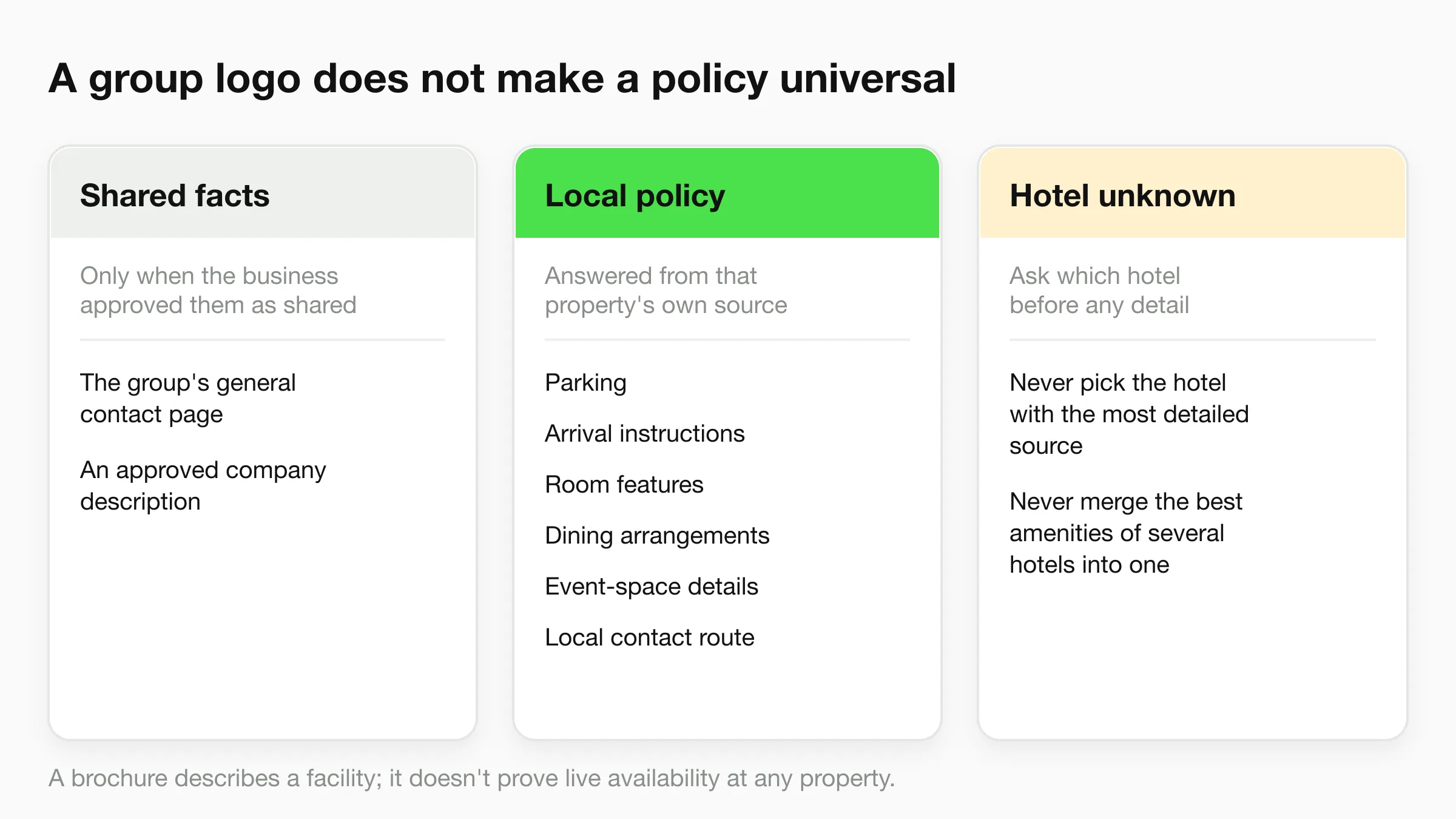
A property answer boundary defines which information applies to which hotel. It distinguishes facts shared across the group from property-specific policies, facilities, directions and contact routes. It also states what the front desk should do when the guest has not identified a property.
Some brand information may genuinely be shared: the group's general contact page or an approved description of the company. Other details often need local scope: parking, room features, arrival instructions, dining arrangements or event-space information. The team must decide the scope from its own sources, not from an assumption that properties under the same logo operate identically.
The boundary also applies across time. A property brochure can describe a facility without proving it is currently available or that it can be reserved for a requested date. Keep static information separate from live operational decisions.
An AI front desk for hospitality can answer from approved hotel knowledge and help collect an enquiry. The hotel enquiry-to-booking guide explains the wider journey, while the luxury hotel guide covers a particular service context. This article addresses a different failure mode: a correct fact attributed to the wrong property.
A group logo does not make a policy universal
Treat a fact as shared only when the business has approved it as shared. When a guest's property is unclear, ask. Do not choose a hotel based solely on whichever attached source produces the most detailed answer.
Why Cross-Property Answers Become Confusing
Hotel names have informal variations
Guests may use a shortened name, a neighborhood or “your downtown place.” Staff understand these references because they know the portfolio. A source library may not. Record approved aliases and ask a clarification when an informal name could refer to more than one property.
General pages contain local examples
A group website may feature a pool photograph from one hotel or describe a restaurant as an example. Without clear labeling, that material can look like a group-wide facility statement. The source should identify the property, and the front desk should preserve that attribution.
A conversation changes property halfway through
A guest begins with the city hotel and then asks about the resort. If the front desk keeps using the first hotel's context, later answers can be wrong even though the opening clarification was correct. Property selection is conversation context that must be rechecked when the customer changes it.
Staff use a single “hotel policy” document
A combined document can be useful, but only if its sections clearly identify local differences. A long list of policies without property labels invites accidental blending. More content is not the answer if the knowledge set does not explain where each fact belongs.
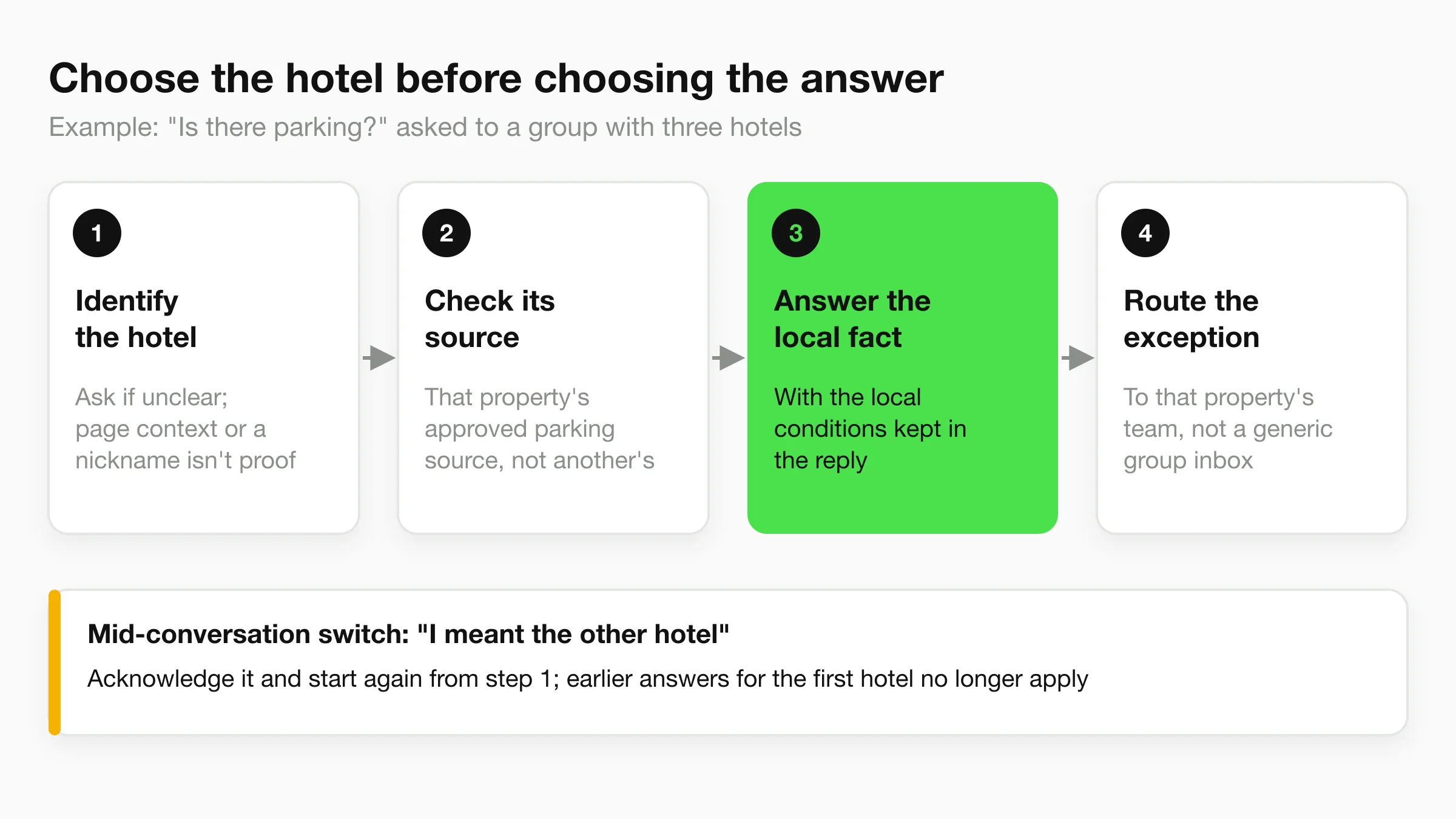
7 Rules for Property-Specific Hotel Answers
1. Give every property a stable customer-facing identity
Create a small identity list with the official name, location descriptor and approved common names for each hotel. Use the names consistently in sources and test questions. Avoid relying only on an internal code that a guest would not recognize.
Illustrative identity entry:
Official name: Harbor House Hotel. Location descriptor: waterfront property. Common reference requiring care: “Harbor hotel,” which could be confused with another similarly named business.
The example is fictional. Your actual list should reflect the names guests use and the distinctions your team needs to make. Do not claim ownership of every similar name or answer for a property outside your group.
If a customer provides an ambiguous reference, ask a short question that offers the relevant choices. “Do you mean the city property or the coastal property?” is more useful than requesting an internal property ID.
Keep the identity list separate from live availability or room allocation. Recognizing which hotel a guest means establishes context; it does not establish that a room, facility or service is available for their requested dates. The next source check still needs to happen.
2. Separate shared facts from local facts in the source inventory
Label each source as group-wide, property-specific or mixed. For a mixed source, identify the sections that describe each property. This is an editorial organization practice, not a claim of automatic platform routing.
A group-wide source might describe the company or a general enquiry process. A property-specific source might explain the entrance, parking arrangement or room categories for one hotel. A mixed brochure should clearly name the hotel beside each facility description.
Review question:
“Could a reader tell which property this paragraph describes if it were copied without the page heading?”
If not, rewrite the source so the attribution survives ordinary summarization. A statement such as “The garden pool is at the coastal property” carries its scope more clearly than “Our pool is open to guests” buried under a distant section title.
The knowledge-base guide explains broader source structure. For a hotel group, the additional requirement is that every local fact remains local when retrieved or summarized. Do not remove differences simply to make the brand copy sound more consistent.
3. Ask which hotel before answering a local question
When the guest has not identified a property and the answer depends on it, ask a focused clarification. Do not guess from the most recently uploaded brochure, the visitor's location or an unrelated earlier conversation.
Illustrative script:
“Which of our hotels are you asking about? Parking arrangements differ by property, so I want to point you to the right information.”
This explains why the question matters and keeps the interaction useful. Avoid asking the guest to provide dates, room preferences and contact details before answering a simple property-identification question.
If the person genuinely wants to compare hotels, acknowledge that intent. You can present approved property-specific facts side by side, with each hotel named. Do not merge the most attractive features into an imaginary group-wide offer.
Page context can help, but it should not override the customer's words. A visitor on one property page may be asking about another. If they correct the hotel name, use the correction and make it visible in the handoff. A short confirmation—“Understood, you mean the coastal property”—can prevent the next answer from continuing with the wrong context.
4. Preserve local conditions in the answer
Once the property is known, answer from the approved source and keep its conditions attached. If parking is described as limited or a facility has a stated access arrangement, do not shorten the answer until it becomes an unconditional yes.
Illustrative pattern:
“For the city property, the approved parking information says [verified local description]. If you need a particular arrangement confirmed, the hotel team can review that question.”
Replace the placeholder with the actual approved fact before use. If no source supports the detail, do not improvise. A hotel in the same group having parking does not answer the question for this property.
Keep facilities separate from availability. A hotel may have event space, but a source describing it does not prove it is available on the customer's date. A room category description does not confirm that category can be booked. The front desk can explain and collect an enquiry while staff or the authorized booking process confirms the decision.
This is especially important when the guest compares properties. Each comparison row should preserve its own limits, rather than treating a condition from one hotel as a disadvantage to hide or a feature to extend to the others.
5. Detect and acknowledge property changes in the conversation
Test how the front desk responds when a guest changes the hotel under discussion. A phrase such as “What about your resort instead?” should trigger a context change or clarification, not a continuation of the previous property's policy.
Illustrative script:
“Are you switching the enquiry to the resort? If so, I will use that property's information for the next questions.”
The confirmation is useful when the reference is ambiguous. If the guest names the new property clearly, acknowledge it without asking them to repeat the same information. Then review which earlier details still apply. Dates may remain the same, while parking questions or room preferences may need a different answer.
In the summary, record the final property and any unresolved comparison. “Customer is comparing the city hotel and resort” is different from “Customer selected the resort.” Do not treat a question about an alternative as a booking decision.
The lead-summary guide helps structure the handoff. For multi-property enquiries, add a clear property field and preserve whether the visitor is asking about one hotel, several options or an unidentified location. That distinction can save the receiving team from beginning the follow-up with the wrong assumptions.
6. Route unresolved details to the right property team
The next-step source should be property-specific where responsibilities differ. A guest asking the coastal hotel about an entrance detail should not be sent to a generic destination that leaves them to explain the entire context again.
Illustrative script:
“That detail needs confirmation from the team at the coastal property. I can share their approved contact route or collect the enquiry through the process available here.”
Use only the route your business has configured and verified. Do not claim an instant transfer, automatic assignment or a response deadline unless that behavior has been established separately. A property name in a message does not itself prove that the right recipient received it.
The human-handoff guide explains the broader expectation-setting rules. Your multi-property test should check the actual destination and the property context in the delivered record. A correct answer followed by a wrong-property notification is still an operational failure.
If the hotel is not yet identified, ask before sending a property-specific request. Where the business has a central enquiry team, describe that central route honestly and include the unresolved property choice for the team to review.
7. Retest the matrix after local changes
Assign a source owner for each property and identify changes that should trigger review: altered arrival instructions, a facility change, revised contact details or a new room description. A central editor can coordinate the work, but the local fact needs an authorized local confirmation.
Retest both the changed property and a neighboring property with a different policy. This catches accidental spillover: an update to the resort should not change the city hotel's answer. Include an ambiguous hotel name and a mid-conversation property switch in the test pack.
Keep evidence of the question, expected property scope and observed answer. A passing result is not merely a fluent sentence; it is a statement attached to the right hotel with the right conditions. Preserve failed examples so the next reviewer understands what the edit was intended to fix.
Do not call the matrix a live synchronization system. It is a maintenance artifact that your team updates alongside the supported source-management process. If a website or PDF changes, verify how that change reaches the active knowledge set rather than assuming every copy refreshes automatically.
The objective is a controlled local update that remains local, while shared information changes only when the group approves it as shared.
Give each hotel the right answer boundary
Use approved property information and ask a useful clarification before answering a location-specific question.
Start for freeA Property Answer Matrix Your Team Can Maintain
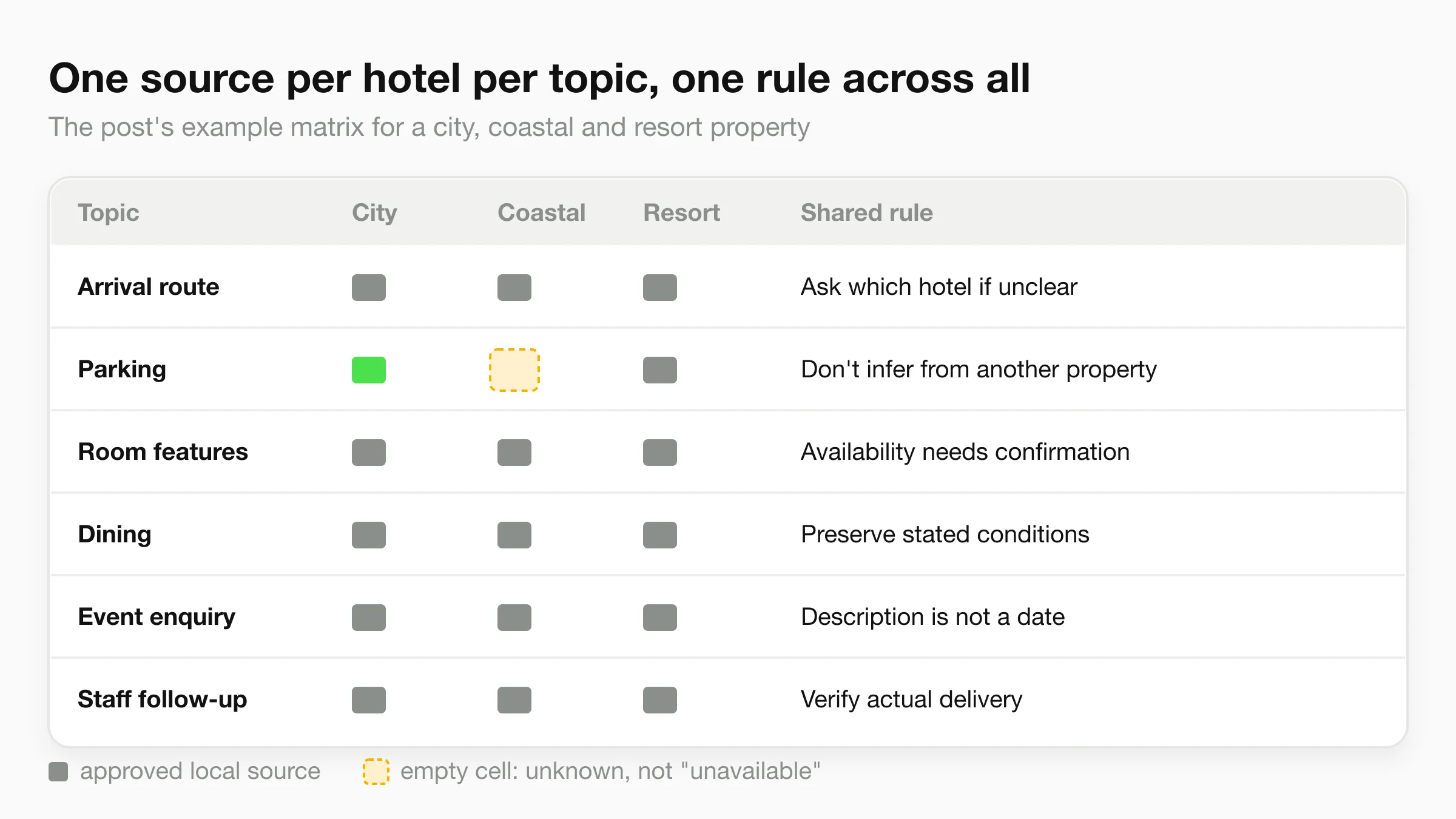
The matrix below uses fictional property labels and deliberately avoids inventing actual hotel policies. Fill each cell with a source reference or an explicit unknown, not a guessed yes or no.
| Topic | City property | Coastal property | Resort property | Shared rule |
|---|---|---|---|---|
| Arrival route | Approved local arrival source | Approved local arrival source | Approved local arrival source | Ask which hotel if unclear |
| Parking | Local description and conditions | Local description and conditions | Local description and conditions | Do not infer from another property |
| Room features | Category-specific source | Category-specific source | Category-specific source | Availability requires confirmation |
| Dining information | Current property source | Current property source | Current property source | Preserve stated conditions |
| Event enquiry | Local facility description and contact | Local facility description and contact | Local facility description and contact | A facility description is not a date confirmation |
| Staff follow-up | Approved recipient or contact route | Approved recipient or contact route | Approved recipient or contact route | Verify actual delivery separately |
Add source owners and review dates outside the customer-facing answer if that makes the sheet easier to use. The important part is traceability: a reviewer can find the local evidence and understand which statement the front desk may make.
Use an “unknown” cell when no approved fact exists. This is a useful operational signal, not an embarrassment to hide. It tells the editor which local detail needs verification and tells the front desk to offer staff confirmation.
Review comparison questions using the matrix. If a guest asks which property has a particular feature, answer only from the populated, approved cells. Do not infer that an empty cell means the feature is absent. Missing information and confirmed absence are different facts.
Start With the Topics Most Likely to Cross Boundaries
Choose a small set of local facts that guests frequently ask about in your own conversations. Parking, directions and room features are useful examples, but your actual priorities should come from your property teams. Do not claim a measured demand pattern if you only have staff observations.
Create the property identity list and label the relevant sources. Ask local owners to approve the facts and identify conditions. Then configure and test the front desk using the platform features available to you. This guide does not assume a native dynamic knowledge-routing mechanism.
Hyperleap AI supports document-grounded answers and conversations across website chat, WhatsApp, Instagram DM and Facebook Messenger. It also provides a unified inbox and source citations in conversation logs for review. Those capabilities do not prove that every property distinction has been configured correctly; the test pack must demonstrate the behavior you intend.
For broader product context, see the AI front desk overview. If you evaluate plan options or additional capabilities, use the current pricing page and verify the setup you need. Do not infer that a multi-property worksheet means every location-specific feature is included in a base plan.
Before launch, have a reviewer ask the same question for different hotels, compare two properties and change the property halfway through a conversation. Follow any resulting enquiry to its actual destination. That end-to-end evidence is more valuable than a demonstration containing only one clearly named hotel and one easy question.
Frequently Asked Questions
Should a hotel group use one shared policy document?
It can, if the document clearly separates shared facts from property-specific sections and preserves the conditions on each statement. A combined document without clear scope can encourage accidental blending. The source structure should make the correct property easy to identify.
What should the front desk do when the hotel is unclear?
Ask a focused clarification before answering a local question. Explain briefly that the information differs by property. Do not choose whichever hotel's source happens to contain the most detailed answer.
Can page context identify the property automatically?
Page context may be useful, but it should not override an explicit customer statement or correction. A visitor on one hotel's page may ask about another. Test the actual deployment and preserve a clarification path when the intended property remains uncertain.
Does an empty matrix cell mean a feature is unavailable?
No. It means the sheet does not contain an approved fact for that cell. Confirmed absence and missing information are different. Route the question to the responsible property team rather than inventing a yes or no answer.
Does this workflow check live room or facility availability?
No. It organizes approved information and enquiry boundaries. Current availability, room allocation and reservation decisions remain with the authorized booking process or hotel team. A source describing a facility does not confirm it for a requested date.
How should the team test a property policy update?
Repeat the changed property's question, a similar question for another property, an ambiguous hotel reference and a mid-conversation switch. Check that the updated fact remains correctly scoped. Verify any handoff destination separately from the answer itself.
Keep Local Facts Local
The hardest multi-property mistake is not always an invented fact. It can be a real fact delivered for the wrong hotel. A property answer matrix makes that risk visible by connecting each answer to a named location, source and owner.
Start with clear identities, ask when the hotel is uncertain and preserve the conditions on local information. Keep shared brand statements separate from facility and policy details. When the guest changes properties, let the conversation change with them.
An AI front desk can make a hotel group's knowledge easier to use, but the group must define which knowledge belongs where. That clarity gives guests more useful answers and gives property teams a handoff they can understand without correcting the context first.
Build a clearer front desk for your hotel group
Answer from approved property sources and keep local questions connected to the right hotel team.
Start for freeIndustry Solutions
See how AI chatbots work for these industries:
Related Articles
View all
Guide17 min read
Hotel Accessibility Questions: A Source Sheet
Prepare factual hotel accessibility answers with a source sheet for entrances, room features, measurements, review dates and named staff follow-up.
Guide17 min read
Hotel Cancellation Answers: A Source-Check Checklist
Build hotel cancellation answers around booking channels, rate terms and stay dates, with a source-check worksheet and clear staff-review boundaries.
Guide16 min read
Turn Unanswered Customer Questions Into Better Sources
Use an unanswered-question review log to separate missing facts from unclear requests, approve source changes and retest the answer before closing the issue.
Guide17 min read
Multilingual Hotel Chat: A Guest-Question Test Kit
Test English and Spanish hotel enquiries against the same approved facts, with arrival, policy, access and staff-handoff cases your team can review.