Hotel Late-Arrival Questions: An Approved Answer Pack
Prepare accurate hotel late-arrival replies with public policy sources, private-access boundaries and a clear route to your reception team.
A guest asks, “Our flight lands late. Will we still be able to check in?” Reception may be helping someone standing at the desk, while the guest needs enough information to plan the journey. A useful reply should explain the hotel's approved arrival process without suggesting that a particular reservation has been checked or an exception approved.
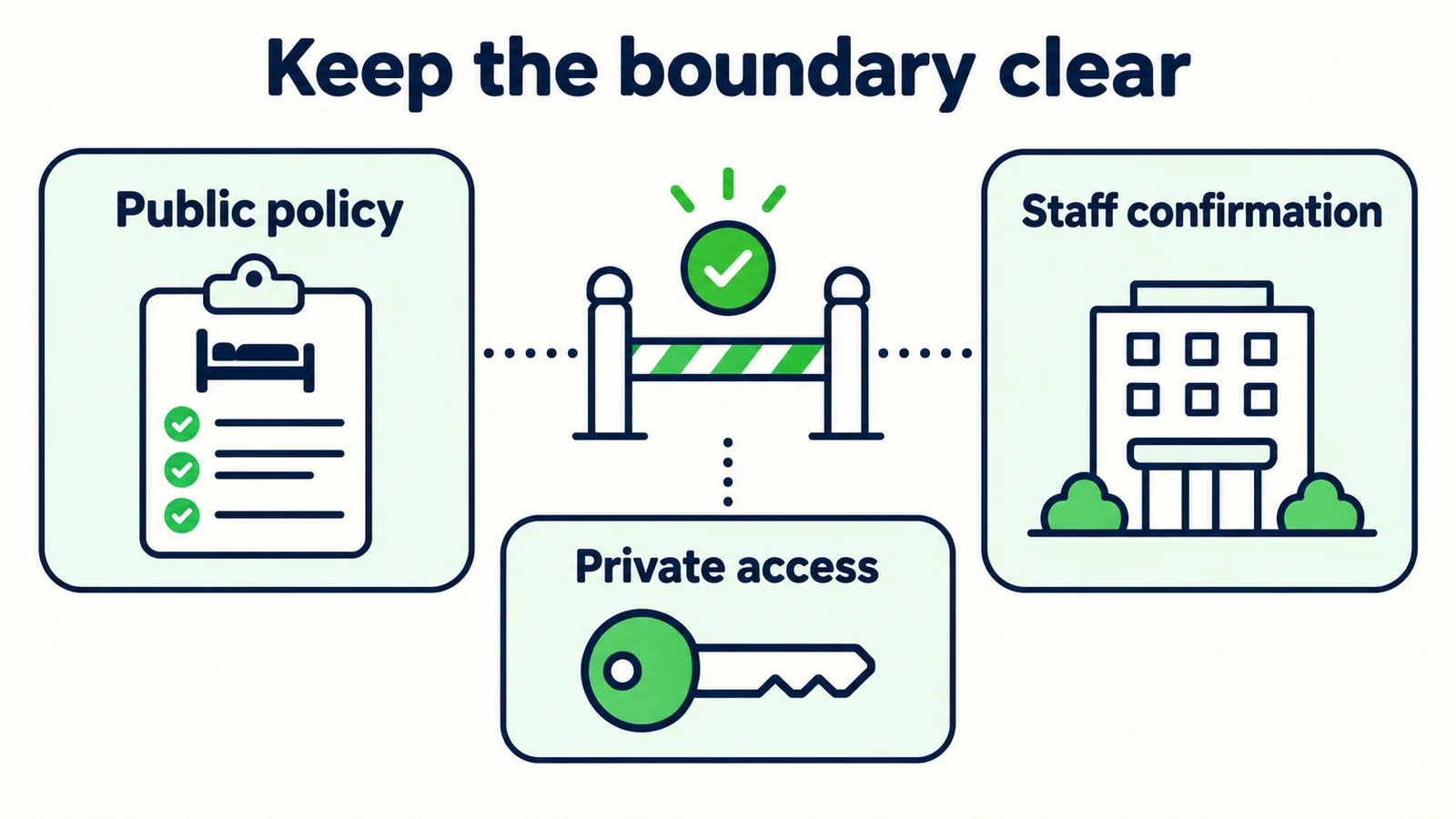
Late-arrival questions combine public information with private arrangements. Reception hours may be public. A guest's reservation status, identity documents and access codes are not. An AI front desk should help with the first category and direct the second through the hotel's authorized process. Blurring that distinction can turn a routine reassurance into a misleading or inappropriate disclosure.
This guide offers an original answer pack for hotel late check-in questions, luggage enquiries and arrival changes. All example hotels and conversations are fictional. Adapt the scripts to your property's actual procedures, and have the responsible reception manager approve them. The outcome is a clearer guest conversation, not automatic check-in, live reservation verification or a substitute for staff decisions.
What Can a Late-Arrival Answer Pack Cover?
The answer pack covers approved general information: published reception hours, how guests should notify the property about a late arrival, which public contact route to use and what general luggage information the hotel has authorized. It should also say where the conversation must stop and involve a person or a secure process.
Think of it as a public arrival guide with boundaries. The guide can explain that the hotel asks late-arriving guests to contact reception. It cannot conclude that a guest has completed that notification merely because they mentioned a time in a public chat. The guide can share a contact page. It cannot claim that a receptionist has accepted the guest's arrangement.
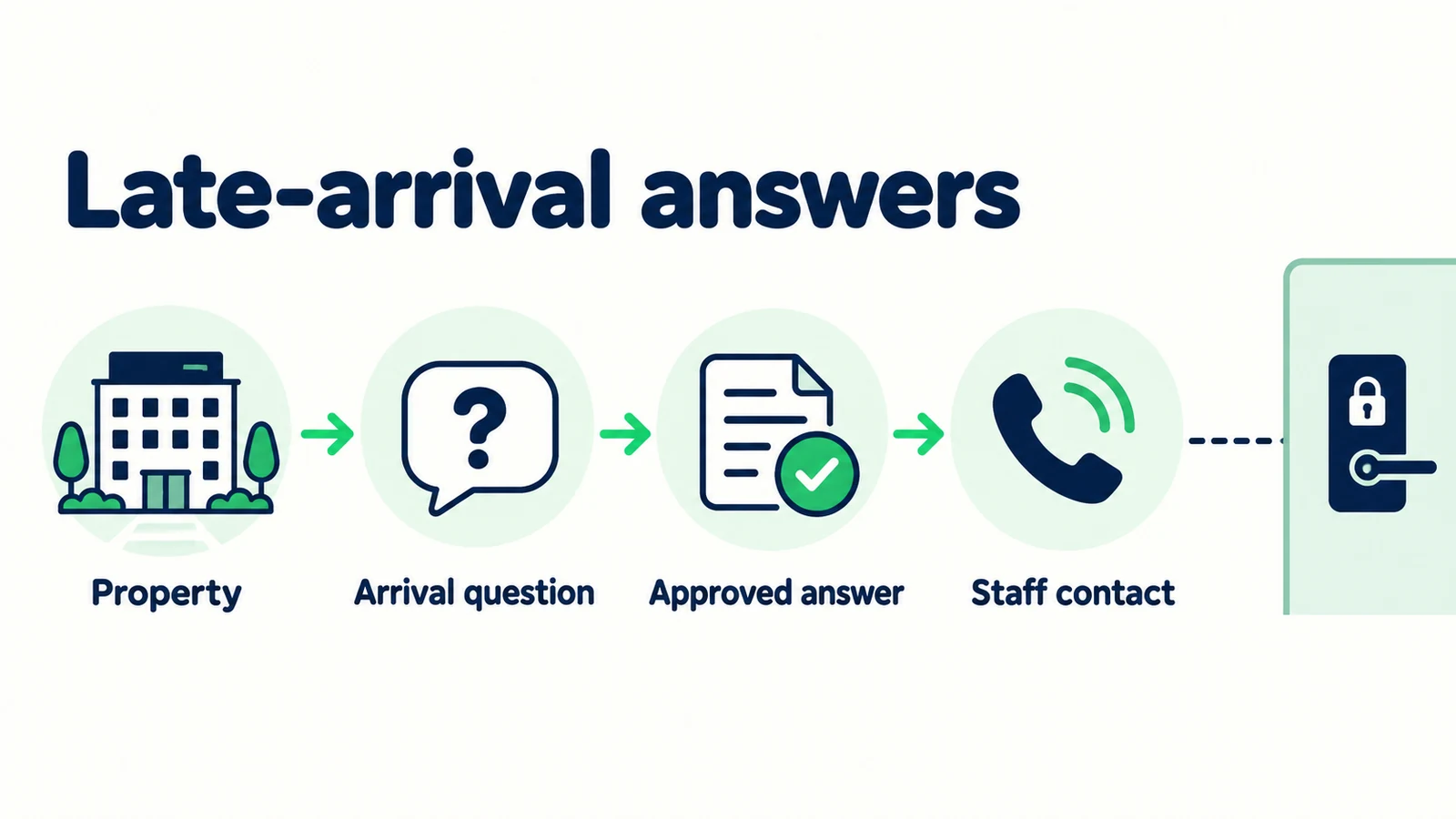
A hotel AI front desk is useful when reception is interrupted by repeated questions that already have approved answers. It can collect enquiry context and direct the guest to the next step. The relevant source is the hotel's current policy, not a general assumption about how hotels operate.
For independent properties, the boutique-hotel front desk guide explains the broader role of automated answers. This article focuses specifically on arrival wording and the source sheet behind it. A late-arrival request should not be treated as a new room enquiry, a booking confirmation or permission to disclose private entry instructions.
Your answer pack should identify the property, the policy owner and the effective version of each instruction. If a hotel has multiple buildings or locations, public arrival information may differ. Ask which property the guest means before applying a rule. A correct policy for the wrong building is still an incorrect answer.
Keep private arrival arrangements private
Do not put door codes, guest records, identity documents or room-access instructions into a public answer source. General arrival guidance is different from reservation-specific assistance. Use the hotel's authorized process for private details and staff confirmation.
Why Late-Arrival Replies Need Extra Care
The guest's time is not necessarily the arrival time
“My flight lands at eleven” does not say when the guest reaches the property. The answer should not silently convert a flight time into a hotel arrival commitment. Ask for an approximate arrival window only when that information is useful to the approved notification process, and preserve the guest's uncertainty.
A general policy sounds like a personal confirmation
“Late arrivals are possible under our published process” differs from “your late check-in is confirmed.” The latter implies that the reservation and arrangement have been reviewed. Use wording that makes the source of the answer clear without forcing the guest to decode a long disclaimer.
Helpful staff instructions contain information unsuitable for public chat
An internal reception checklist may mix public directions with private access procedures. Do not attach it wholesale as a knowledge source. Prepare a guest-facing version that contains only information approved for public answers. Keep private operational instructions in the systems and channels authorized for them.
A contact link is mistaken for a completed notification
Sharing a telephone number or contact page does not tell the hotel that a specific guest is arriving late. If the guest must contact reception, state that action directly. If a configured enquiry workflow delivers a note, verify the receiving side before saying the hotel received it. The human-handoff guide explains why that distinction matters.
These problems are less about hospitality tone than about authority. A warm answer still needs to identify which facts are public, which preferences came from the guest and which decisions belong to reception. That separation makes reassurance more credible, not less welcoming.
7 Replies to Prepare for Arrival Questions
1. Answer the general late-arrival question directly
Start with the approved policy and the action it requires. Do not invent a universal promise that guests can arrive at any hour. Different properties have different arrangements, and those arrangements may depend on advance contact.
Illustrative reply:
“Our published arrival information explains the late-arrival process for this property. Please contact reception through the approved arrival contact before relying on a late check-in arrangement. I can share that contact information, but I cannot confirm your reservation or approve the arrangement here.”
For a real deployment, replace the first sentence with the actual approved policy. If the hotel permits late arrival only after staff coordination, say that clearly. If the source does not answer the question, do not convert missing information into a favorable assumption.
Keep the answer proportionate. A guest asking about the general process does not need to provide a booking reference before receiving public instructions. Request reservation-specific details only through the authorized path when they are actually needed.
Review the phrase “check-in available” carefully. It may imply a staffed reception desk, self-service access or a prearranged process. Name the real arrangement in ordinary language rather than using an ambiguous label that different guests will interpret differently.
2. Clarify the property and the relevant local date
Before giving time-sensitive information, resolve which property and date the guest means. A hotel group can have several arrival policies, and an overnight journey can cross a calendar boundary. The answer should not assume that “tonight” means the same date for every participant.
Illustrative clarification:
“Which property are you staying at, and what local date do you expect to arrive there? An approximate arrival window is helpful if you already know it.”
Do not repeat questions the guest has already answered. If the conversation clearly identifies the property and date, acknowledge them. If the guest gives only a flight landing time, distinguish that from arrival at the hotel rather than estimating the transfer duration.
Your source sheet should use the property's local time zone for reception hours. If the visitor asks for a conversion and the workflow cannot reliably support it, keep the answer anchored to the local schedule and encourage them to check their travel details. Avoid confident calculations based on an unstated date or location.
The resulting record might say “guest expects to reach Harbor House late on the stated local date; exact time uncertain.” That is more useful than a precise invented arrival time. Reception can decide what further clarification its process requires.
3. Explain what arrival notification does and does not do
Guests may reasonably think that typing an arrival time into chat notifies the property. Your reply should describe the actual configured action. If the chat is only an information channel, say that the guest still needs to use the approved contact route.
Illustrative reply for an information-only path:
“Thanks for explaining your expected arrival. Please notify reception using the arrival contact shown here. This conversation does not by itself change your booking or confirm a late-arrival arrangement.”
If your configured process collects an enquiry and sends a summary, verify delivery and phrase the acknowledgement accordingly. Even then, receipt of a note does not prove staff approval. Keep “request received” and “arrangement confirmed” separate.
Use the lead-summary guide to structure the context: property, guest-reported local date, approximate window, unresolved question and chosen contact method. Avoid copying unnecessary personal data into a broadly distributed summary.
A good test is to ask the agent, after the information is collected, “So everything is sorted?” The answer should not agree merely to be polite. It should explain the remaining reception or booking-process step. That final turn is often where an otherwise careful conversation overstates completion.
4. Keep private access instructions behind the authorized process
A public AI front desk should not reveal entry codes, room details or private arrival instructions. A guest saying they have a booking is not enough to establish identity. Neither is knowing a name, date or booking-like reference.
Illustrative reply:
“Private access instructions are provided through the hotel's authorized guest process. I can't share door codes or reservation-specific details in this public conversation. Please use the approved reception contact for help with your arrival.”
Do not ask the guest to paste an identity document into chat as an improvised workaround. The property should define its own appropriate verification and communication process. The AI front desk can direct the guest there without pretending to perform that process itself.
Separate public directions from private access. A public street address, general entrance description or approved map link may be suitable. A code that opens a door is not equivalent to a map link. Review source documents for this mixture before attaching them.
If a guest volunteers private information, avoid repeating it in the reply or illustrative summary. Follow your organization's handling procedures. Better source design reduces the chance of asking for sensitive details that the public conversation does not need.
5. Answer luggage questions without promising storage capacity
Late arrivals often include luggage questions before or after a stay. The agent may explain a published luggage policy, but it should not promise space, acceptance of particular items or service outside approved hours unless the source and authorized process support that promise.
Illustrative reply:
“I can share the hotel's published luggage information. If your request falls outside those stated arrangements, reception needs to review it. The general policy does not confirm space or acceptance for a particular request.”
Replace the generic opening with the actual approved information. Do not make every simple question sound uncertain if the public policy clearly answers it. The useful distinction is between a known rule and an individual arrangement that still needs review.
Ask only the context needed to route the question. For example, “Is this before arrival or after departure?” may be useful. A detailed inventory of valuables generally is not needed for a public policy enquiry. Avoid making security or liability assurances that have not been approved.
This script belongs alongside the general arrival pack because guests often combine the questions. Answer both parts when supported, and name any unresolved part. A complete-looking reply that ignores the luggage question can create another avoidable interruption for reception.
6. Handle travel delays without changing the reservation
A guest whose plans change needs a calm next step. Acknowledge the change and direct them to the approved contact process. Do not interpret the delay as a cancellation, a date change or authorization to modify the booking.
Illustrative reply:
“I understand your arrival plans have changed. Please contact reception through the approved route with your updated arrival information. I can't change the reservation or confirm how the delay affects it in this chat.”
If the guest asks whether a fee or cancellation condition applies, answer only from the appropriate published source and route reservation-specific decisions to staff. A general policy summary is not a binding interpretation of their particular booking conditions.
Preserve the corrected arrival information rather than retaining both times as if they were separate guests. In the handoff note, use “updated expected arrival” and keep the remaining uncertainty. Do not forecast transportation delays or give confident travel-time advice that is outside the approved hotel information.
The hotel messaging guide discusses channels the front desk can cover. Regardless of channel, the underlying boundary remains the same: a conversational update is not evidence that a reservation system was changed or that the hotel accepted new arrangements.
7. Close with the exact next action and its owner
End by explaining what the guest should do or what the team will review through the verified workflow. The closing should not introduce a new promise of immediate staff attention. If no response window has been approved, do not invent one.
Illustrative closing:
“The remaining step is to contact reception using the approved arrival route so the team can review your late-arrival request. Keep your reservation details for that authorized conversation. A private access arrangement has not been confirmed here.”
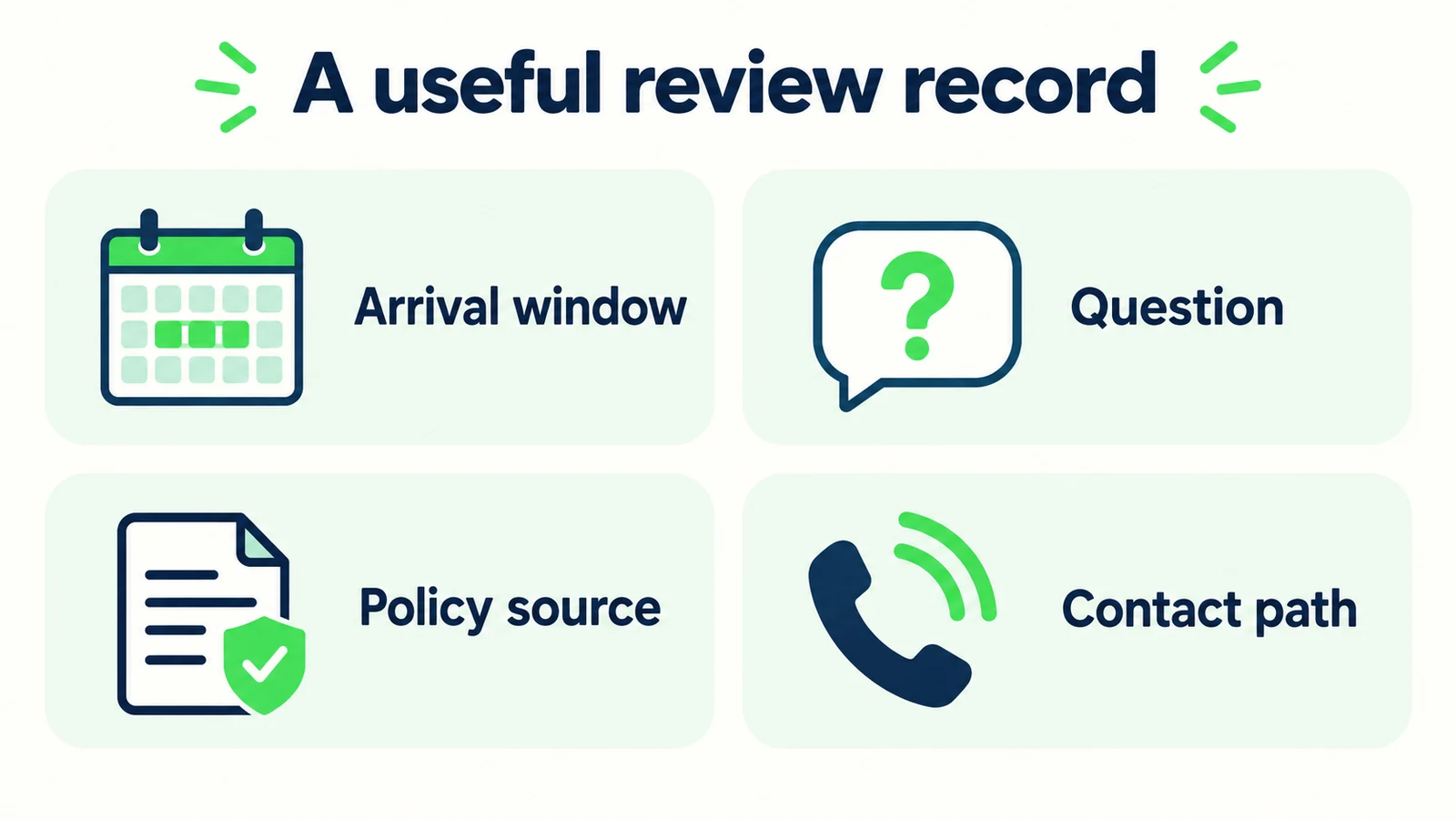
For a configured enquiry path, the internal record can contain the following:
| Field | What belongs in it |
|---|---|
| Property | The hotel or building identified by the guest |
| Local date | The customer's stated arrival date |
| Arrival window | Approximate, with uncertainty preserved |
| Question | What reception needs to answer |
| Public information shared | The policy or approved contact route |
| Remaining action | Reception review or guest contact step |
These are proposed review fields, not a dedicated reservation feature. Check the record against the conversation before relying on it. The receiving person should understand whether they are handling general information, a changed arrival request or a private-access question that requires the authorized guest process.
Give guests a clear arrival path
Answer approved hotel questions and make the next reception step easier to understand.
Start for freeJudge the Answer by the Expectation It Creates
The quality of a late-arrival reply is not just whether it sounds welcoming. Ask what a reasonable guest would believe after reading it. Would they think reception had approved their arrival? Would they believe a door code had been issued? Would they assume an existing booking was changed? If those actions did not happen, the wording needs correction.
Compare fictional endings. “You're all set for your late arrival” is reassuring but ambiguous. “Here is the approved reception contact; the team needs to review your late-arrival arrangement” is less decorative and more useful. It tells the guest what remains to be done.
Review whether the response answers the public part of the question before routing the private part. Sending every visitor to reception without sharing available policy defeats the purpose of an AI front desk. Conversely, answering beyond the source merely moves work into a later correction. The useful middle is an accurate public answer plus a clear boundary.
Measure that behavior in a defined sample of your own conversations. Record wrong-property answers, omitted date clarifications, unsupported confirmations and unnecessary requests for private information. Do not turn the absence of a follow-up message into evidence that the guest arrived successfully or that a booking was retained.
Prepare the Source Sheet and Run a Reception Review
Ask the reception manager to approve a public source sheet before configuring the answer pack. It should include property identity, reception hours, the late-arrival process, public contact destinations, luggage information and the rules for private assistance. Mark any question that the published source does not resolve.
Keep the sheet separate from internal access procedures. The knowledge-base guide helps with source ownership, but a property reviewer still needs to decide what is suitable for public use. A detailed source is not automatically an appropriate source.
Run fictional conversations about a planned late arrival, an uncertain flight time, a wrong property, a request for an access code, a luggage exception and a delay affecting an existing stay. Check both the first answer and the closing acknowledgement. Have reception confirm that the suggested contact route is real and that the resulting note would be useful.
Hyperleap AI can answer from approved information, collect enquiry details and share links. It does not provide live hotel inventory, private reservation access or automatic check-in through these scripts. Its quick-start path can be live in under five minutes, with this reception review as additional tuning. Consult the current plans and begin with the repeated arrival question your team can safely answer from a clear public source.
Frequently Asked Questions
Can the AI confirm a guest's late check-in?
Not through these public-information scripts. The AI can explain an approved process and help route the enquiry. A reservation-specific late-arrival arrangement needs confirmation through the hotel's authorized process. Avoid wording that turns a general policy answer into approval for an individual guest.
Should the hotel upload its complete reception manual?
Not without separating information approved for public answers from private operational material. Internal manuals may contain access instructions, personal contacts or guest-handling details unsuitable for open chat. Prepare a public arrival source and keep private procedures in their authorized systems.
What if a guest asks for a door code?
Direct them to the hotel's authorized guest process. Do not reveal a code or improvise identity verification using a name, address or booking reference in public chat. The front desk should explain the route clearly without asking for identity documents as a workaround.
Can the agent handle a flight delay?
It can acknowledge the guest's updated information and explain the approved contact step. It should not change a reservation, estimate the hotel's acceptance of the delay or promise that an arrangement remains valid. Staff or the authorized booking process must handle those decisions.
Is luggage storage a safe question to answer?
Published general luggage information can be shared when approved. Individual exceptions, capacity and acceptance of particular items may need staff review. Do not turn a general policy into a promise of space or make security and liability assurances that the source does not support.
How often should the answer pack be reviewed?
Review it when reception hours, contact destinations, property access arrangements or published policies change. Assign an owner and retest affected questions. A scheduled review can help, but the important trigger is a real change in the information guests rely on.
Reassurance Works Best When It Is Specific
A guest planning a late arrival does not need the AI front desk to sound capable of everything. They need the public policy, the correct property context and a real next step for any private arrangement. Keeping those elements separate protects both guest expectations and reception's ability to make authorized decisions.
Begin with one approved arrival source and a handful of realistic questions. Remove private details, test the final acknowledgement and confirm the receiving contact path. The result is a useful front desk conversation that reduces repeated explanation while leaving reservation and access decisions where they belong.
Make hotel arrival questions easier to answer
Build a front desk around approved guest information and clear reception handoffs.
Start for freeIndustry Solutions
See how AI chatbots work for these industries:
Related Articles
Hotel Cancellation Answers: A Source-Check Checklist
Build hotel cancellation answers around booking channels, rate terms and stay dates, with a source-check worksheet and clear staff-review boundaries.
Hotel Group Enquiry Scripts: From Question to Handoff
Use practical hotel group enquiry scripts to gather dates, room needs and event context, then hand a clear brief to your reservations team.

When Customers Ask for a Person: Reply Examples
Use respectful replies for customers who ask for a person, with clear availability wording, honest handoff status and a practical copy-review pack.

Real Estate Lead Handoff: The Agent-Ready Checklist
Use a real estate lead handoff checklist to preserve buyer intent, property context, unanswered questions and the next action without inventing certainty.