How to Handle Travel Booking Inquiries With AI Chat?
The pattern: instant answers from your content, qualifying questions on dates and budget, a booking link or lead capture, then a human for multi-leg trips.

TL;DR: Handle travel booking inquiries with AI chat in four steps — (1) answer instantly from the package and itinerary content you've uploaded, (2) ask qualifying questions on dates, party size, and budget, (3) surface your booking link or capture the lead through a form, and (4) route multi-leg or highly customized requests to a human. The AI works from your own content and never touches a GDS, never books travel on your behalf, and never processes payment.
How to Handle Travel Booking Inquiries With AI Chat?
A traveler messages your agency's chat widget at 10:40 PM asking about a 7-night Bali package for two adults in November. There's no one at the desk. If the reply comes the next morning, that traveler has already messaged two other agencies and booked with whichever answered first.
The fix isn't a bigger night-shift team. It's the same AI front desk pattern a good travel consultant already runs on a call, applied to chat: answer what's answerable immediately, ask the two or three questions that actually shape a quote, get the inquiry into a booking flow or your lead pipeline, and pass anything genuinely complex to a person — without ever touching a reservation system or a payment.
The Pattern in One Diagram
| Step | What Happens | Who's Involved |
|---|---|---|
| 1. Instant answer | AI answers from your uploaded packages, itineraries, and FAQs | AI only |
| 2. Qualifying questions | AI asks dates, party size, budget, destination preferences | AI only |
| 3. Booking link or lead capture | AI shares your booking link, or captures contact details through a lead form | AI + traveler |
| 4. Route to a human | Multi-leg, highly customized, or ambiguous requests go to your team | AI hands off, human closes |
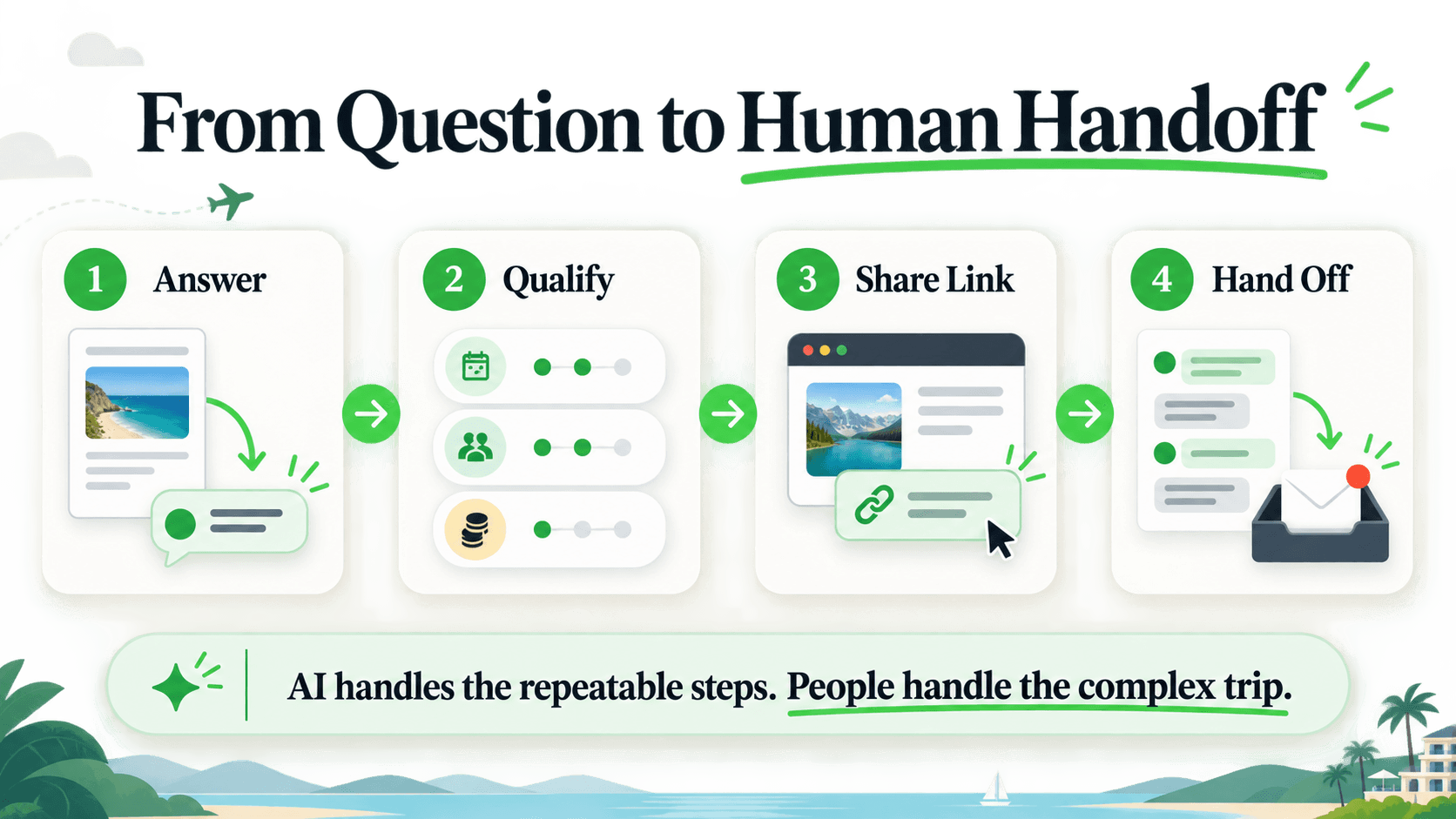
Each step maps to a real failure mode: skip step 1 and the AI feels scripted; skip step 2 and your team gets a name with no context; skip step 3 and a warm inquiry evaporates; skip step 4 and the AI tries to improvise a multi-city itinerary it has no business inventing.
Step 1: Answer Instantly From Your Own Content
The traveler's first message is rarely a booking request. It's a research question: "Do you have Bali packages?" "What's included in the 10-day Japan itinerary?" "Is October a good time for the Maldives?"
An AI chat agent for travel answers these the same way a knowledgeable agent would — by pulling from what your agency has already documented: package pages, itinerary PDFs, destination guides, visa-requirement notes, and FAQs. You upload this content once; the AI answers from it every time a traveler asks, at any hour.
This is document-grounded, not improvised. If a traveler asks about a package you haven't uploaded details for, the honest answer is "let me connect you with our team" — not a guess dressed up as a confident itinerary. Grounding the AI in your own travel package details and destination information is what keeps early answers accurate instead of just fast.
Example: a family asks "What's included in your Costa Rica adventure package?" The AI answers from the uploaded package sheet — accommodation tier, activities included, what's extra — instead of a vague "our packages are fully customizable." Specific answers keep the traveler in the conversation instead of bouncing to a competitor's site to find the details themselves.
Step 2: Ask the Questions That Actually Shape a Quote
Once the initial question is answered, the conversation needs to move toward something your team can act on. A good travel agent doesn't launch into a full itinerary pitch before knowing basics — they ask, and the AI does the same, gathering:
- Travel dates — even a rough window ("early November") is enough to start
- Party size — two adults, a family of four, a group booking
- Budget range — general tier (budget, mid-range, luxury) rather than an exact figure
- Destination or trip type preferences — beach, adventure, multi-city, honeymoon
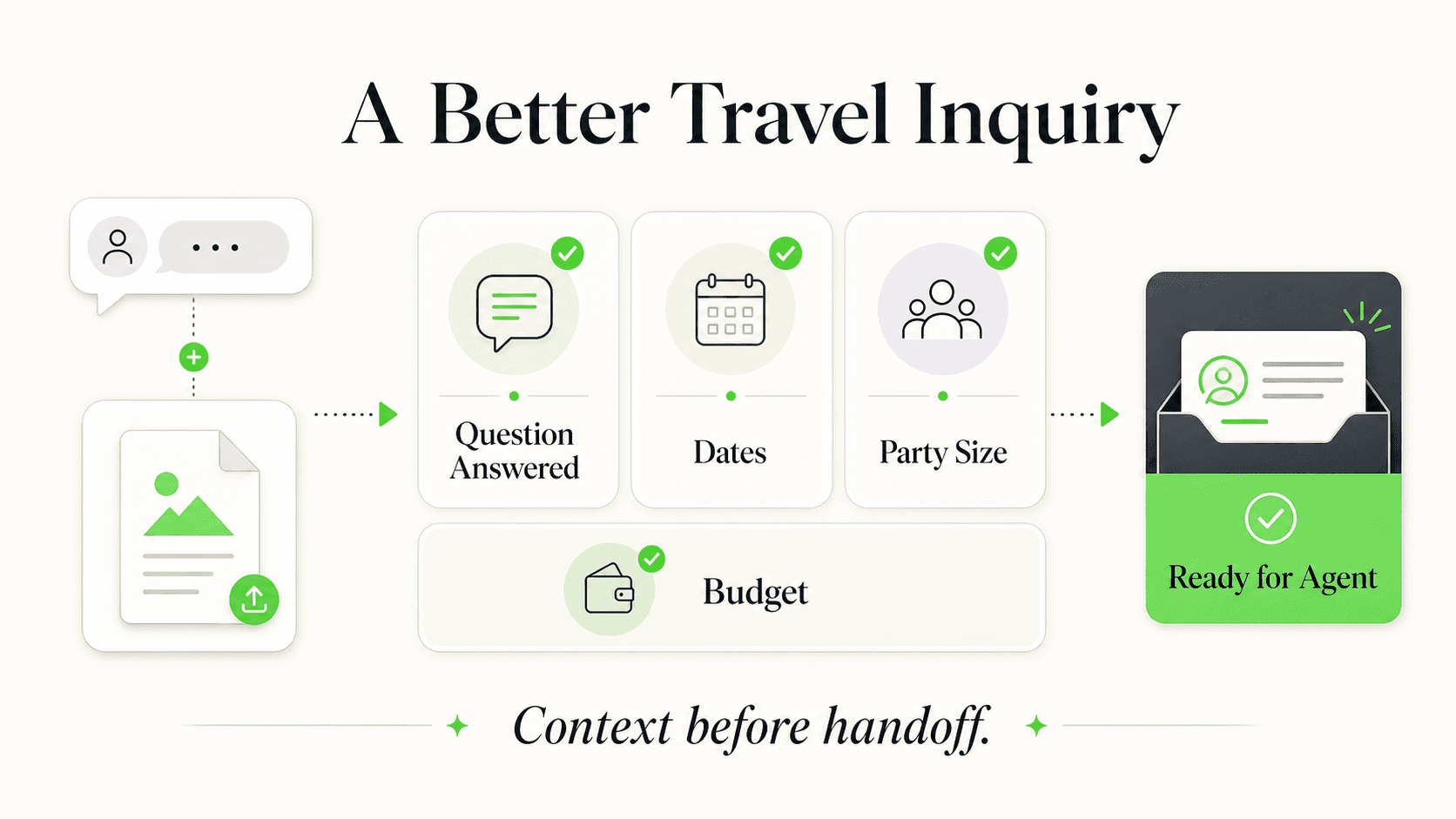
These aren't asked as a rigid form-in-disguise — the AI works them into the conversation naturally, in whatever order the traveler's messages make sense. Someone who leads with "we're a family of 5" doesn't get re-asked party size five messages later.
Example: a traveler asks about Peru. The AI answers the destination question, then asks "What dates are you considering, and roughly how many travelers?" By the time your agent picks up the conversation, they already know they're quoting for a family of four in April, not starting from a blank slate — this is what separates a chatbot that answers trivia from one that shortens your sales cycle.
Step 3: Get to a Booking Link or a Captured Lead
Once the traveler has shared their trip basics, the conversation needs a next step that doesn't depend on a human being awake. Most agencies use both of the following, depending on the inquiry.
Booking a call or sharing your booking link. If consultations run through Calendly or Cal.com, the AI can offer open times and book the planning call right in the chat when the traveler says "I'd like to move forward." For a package booking page or any other tool, it shares the link. Either way, it never holds or confirms a travel reservation itself — trips still book through your existing flow.
Lead capture through a form. For inquiries that need a human agent to build a custom quote — most multi-destination or highly customized trips — the AI collects contact details (name, email or phone, trip basics) before or during the conversation. Even if the traveler drops off mid-conversation, your team has a name, a way to reach them, and the trip context already gathered in step 2 — a warm lead by morning, not a chat log no one reviews.
Step 4: Route Complex, Multi-Leg Requests to a Person
This is the boundary that matters most, and it's worth being direct about it: the AI does not have GDS, Amadeus, or Sabre integration. It cannot check live seat availability, price a multi-carrier fare, or hold a reservation. Nothing in this pattern claims otherwise.
When a traveler describes something genuinely complex — "fly into Tokyo, train to Kyoto, fly out of Osaka, with a stopover in Seoul" — the right move is not a fabricated itinerary. It's recognizing the request has moved past what your content and qualifying questions can responsibly answer, and routing it to a human with the trip details already captured. The same applies to:
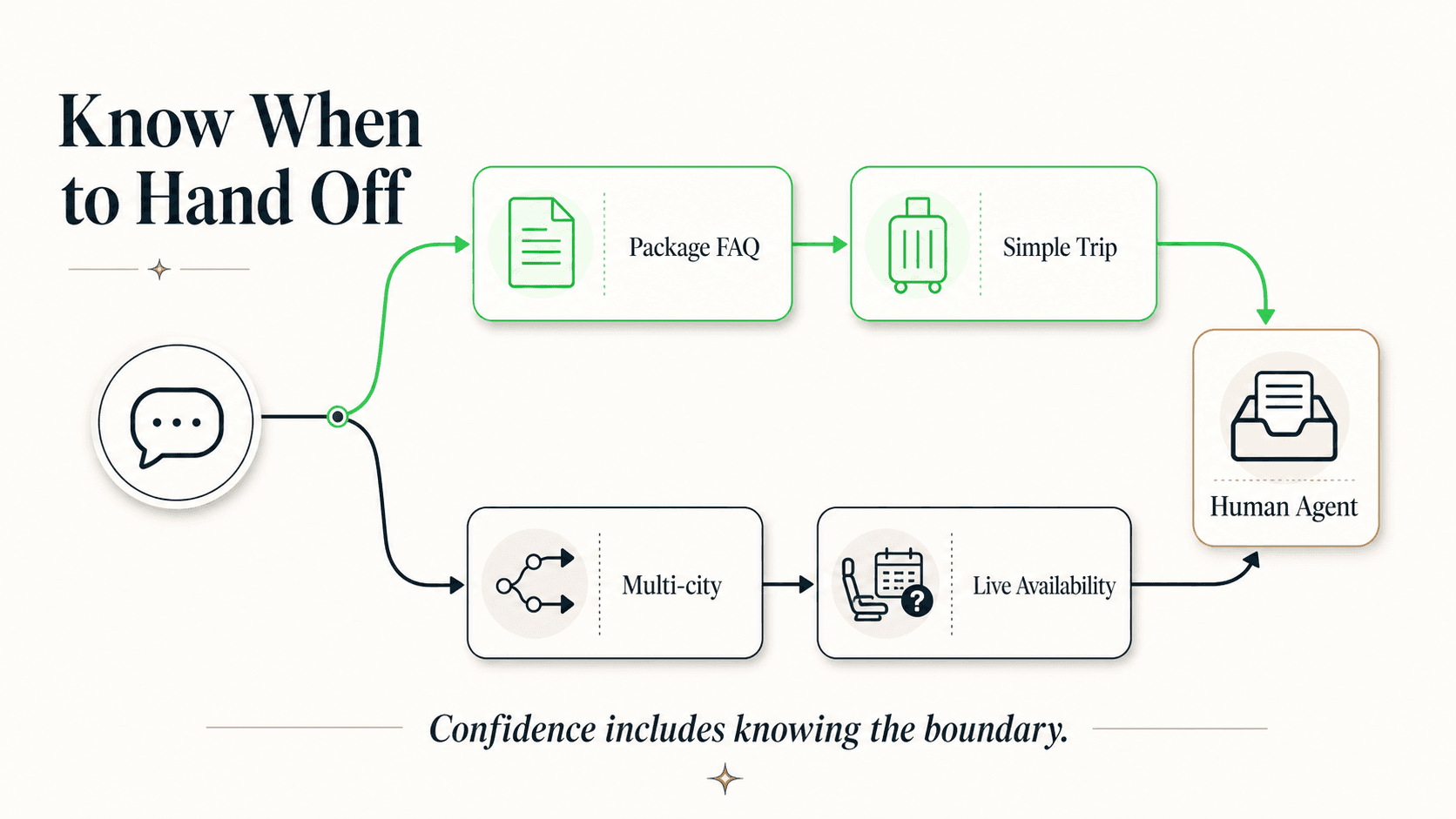
- Multi-city or multi-country itineraries with interdependent logistics
- Group bookings with mixed preferences across travelers
- Anything requiring real-time fare or availability checks
- Complaints, disputes, or post-booking changes
A well-configured AI agent treats "I don't have enough information to answer this responsibly" as a valid outcome, not a failure — the handoff arrives with full context already gathered, a faster start than a cold inquiry.
The AI answers from the content you supply and captures leads. It does not connect to a GDS or airline reservation system, does not book or hold reservations, and does not process payment — those happen through your existing booking flow and your team.
Multilingual Inquiries: The Same Pattern, Any Language
International travelers research trips in their own language, and a chat widget that only replies in English is invisible to a meaningful share of them — a traveler in Brazil asking about a Patagonia trek in Portuguese should get the same quality of answer as an English speaker on your website.
Hyperleap AI detects the language a traveler is writing in and responds in 100+ languages automatically, with no separate configuration per language and no need to translate your package content. The four-step pattern runs identically regardless of language. For agencies with international clientele, this is often the difference between capturing an inquiry and never knowing it existed — a traveler who can't get a clear answer in their own language typically closes the tab and messages the next agency.
Where This Runs
The same pattern works across every channel a traveler might reach you on: your website chat widget, WhatsApp Business (see how WhatsApp automation tools compare), Instagram DM, and Facebook Messenger — one dashboard, one knowledge base, one lead inbox. A traveler who messages your Instagram account at midnight gets the same answers and lead capture as one on your website at 2 PM. Configure it once and it runs consistently across channels — the same conversational AI for customer service layer that runs for hospitality businesses, just grounded in your own package content.
Setting it up looks like onboarding a team member, not deploying software: upload existing package content, decide what the AI should ask before handing off a lead, connect your booking link, and test it against real inquiries before going live. For agencies that want the AI built for them, Managed Setup ($299 Free) has the Hyperleap team do the build.
This pattern beats a generic FAQ bot, which stops at step 1 and never knows when to hand off, and a bare contact form, which skips straight to lead capture with none of the trip context steps 1 and 2 gather. A travel agency chatbot that only does FAQ is table stakes; an AI agent that answers, qualifies, and routes is doing a different job. For the fuller breakdown of inquiry types, see the companion guide on AI chatbots for travel agency itinerary inquiries.
Frequently Asked Questions
Can AI chat handle a multi-leg or multi-city travel booking inquiry?
The AI can capture the full trip context — dates, party size, preferences — for a multi-leg request, but it does not have GDS, Amadeus, or Sabre integration, so it cannot check live multi-carrier availability or build a bookable itinerary itself. The right pattern is to gather the details and route the conversation to a human agent who can build it.
Does the AI book the trip or take payment?
No. The AI can book a consultation call in the chat through Calendly or Cal.com, or share your existing booking link when a traveler is ready to move forward, or captures contact details through a lead form so your team can follow up. It does not hold, confirm, or write reservations, and does not process payment — those happen through your existing systems and your team.
What if a traveler asks about a package I haven't uploaded content for?
The AI answers only from the content you've provided — package sheets, itinerary documents, destination guides, FAQs. If a question falls outside that content, the honest response is to say so and route the traveler to your team, rather than improvising a plausible-sounding but unverified answer.
Does this work for travelers writing in a language other than English?
Yes. The AI detects the language a traveler is writing in and responds in 100+ languages automatically, across website chat, WhatsApp, Instagram DM, and Facebook Messenger. The same four-step pattern runs the same way regardless of language.
Industry Solutions
See how AI chatbots work for these industries:
Related Articles

AI Chatbot for Travel Agencies: Itinerary Inquiries at Scale
Travel agencies field hundreds of itinerary questions, availability requests, and package inquiries every week. Here is how AI chatbots handle them 24/7.

Wedding Venue Tour Enquiries: A Question Pack
Prepare better wedding venue tours with questions on date flexibility, guest range, event shape and priorities, plus a copy-ready host handoff.

Conflicting AI Sources: An Owner Review Workflow
Resolve conflicting chatbot knowledge with a source register, named decision owner, approved replacement and repeatable tests for the disputed answer.

AI Front Desk Holiday Hours and Escalation Playbook
Prepare holiday hours, honest response windows and clear escalation contacts with a practical AI front desk source sheet and review checklist.