Guide
Insurance Enquiries: A General-Question Routing Matrix
Separate general agency information from personal coverage and claims questions with an insurance enquiry routing matrix and safe first-contact examples.

Gopi Krishna Lakkepuram · Founder & CEO
· 17 min read
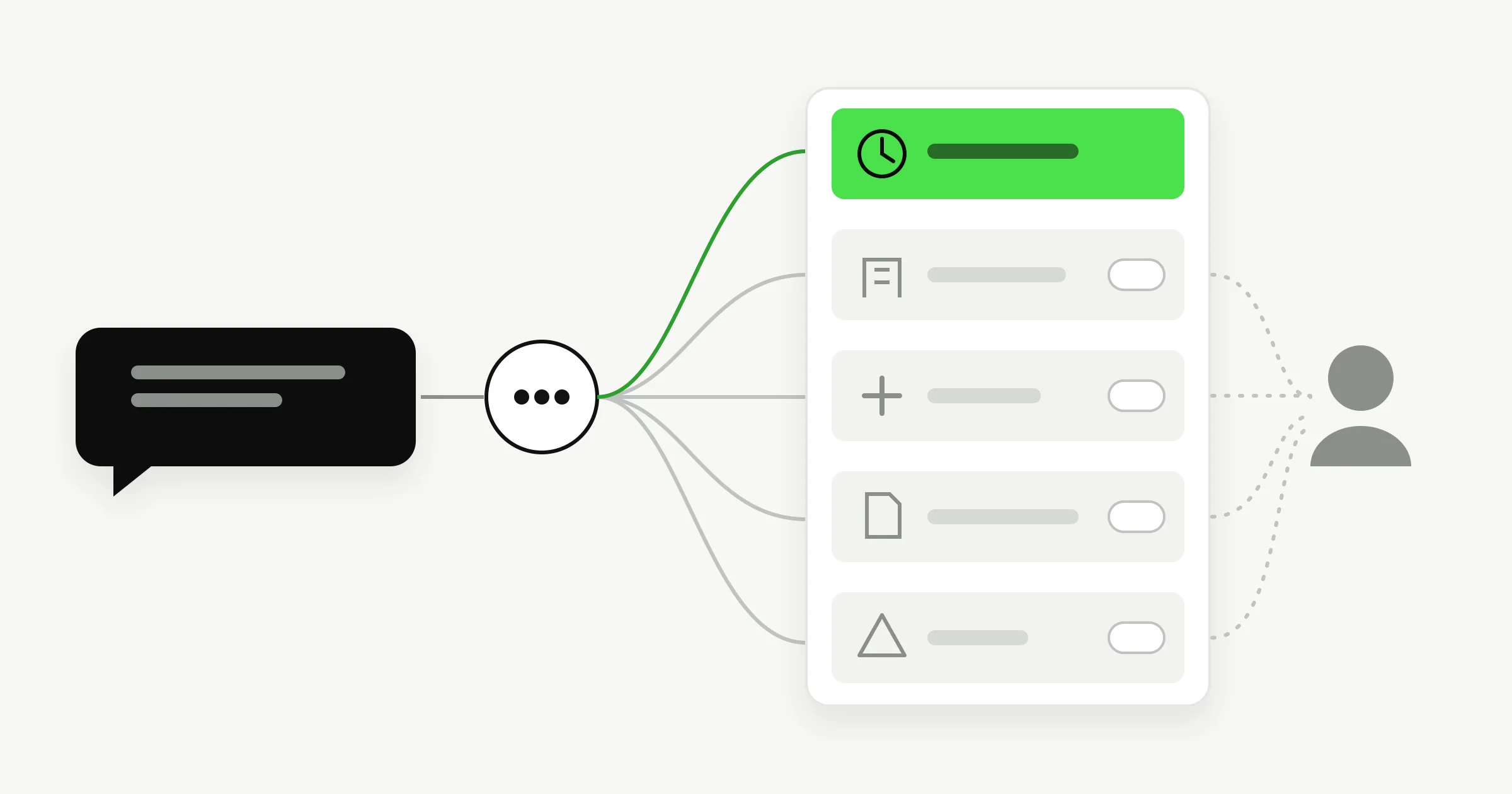
An insurance agency receives questions that look similar on the surface but require different responses. “When is your office open?” is a public-information question. “Does my policy cover this?” asks for an individual decision. A front desk that treats both as ordinary FAQs can create expectations the agency has not reviewed.
The right first-contact workflow routes the question before attempting an answer. It explains approved agency information, identifies the general subject of an enquiry and provides the appropriate route for personal coverage, claims or policy-service requests. It does not infer a decision from a product description or collect a private dossier in chat.
This guide provides an operational routing matrix and illustrative wording for an AI front desk. It is not insurance, legal or compliance advice. Your agency must have the appropriate responsible professionals approve its wording, information-handling practices and contact routes for the jurisdictions and services it actually covers.
What the Routing Matrix Is Designed to Decide
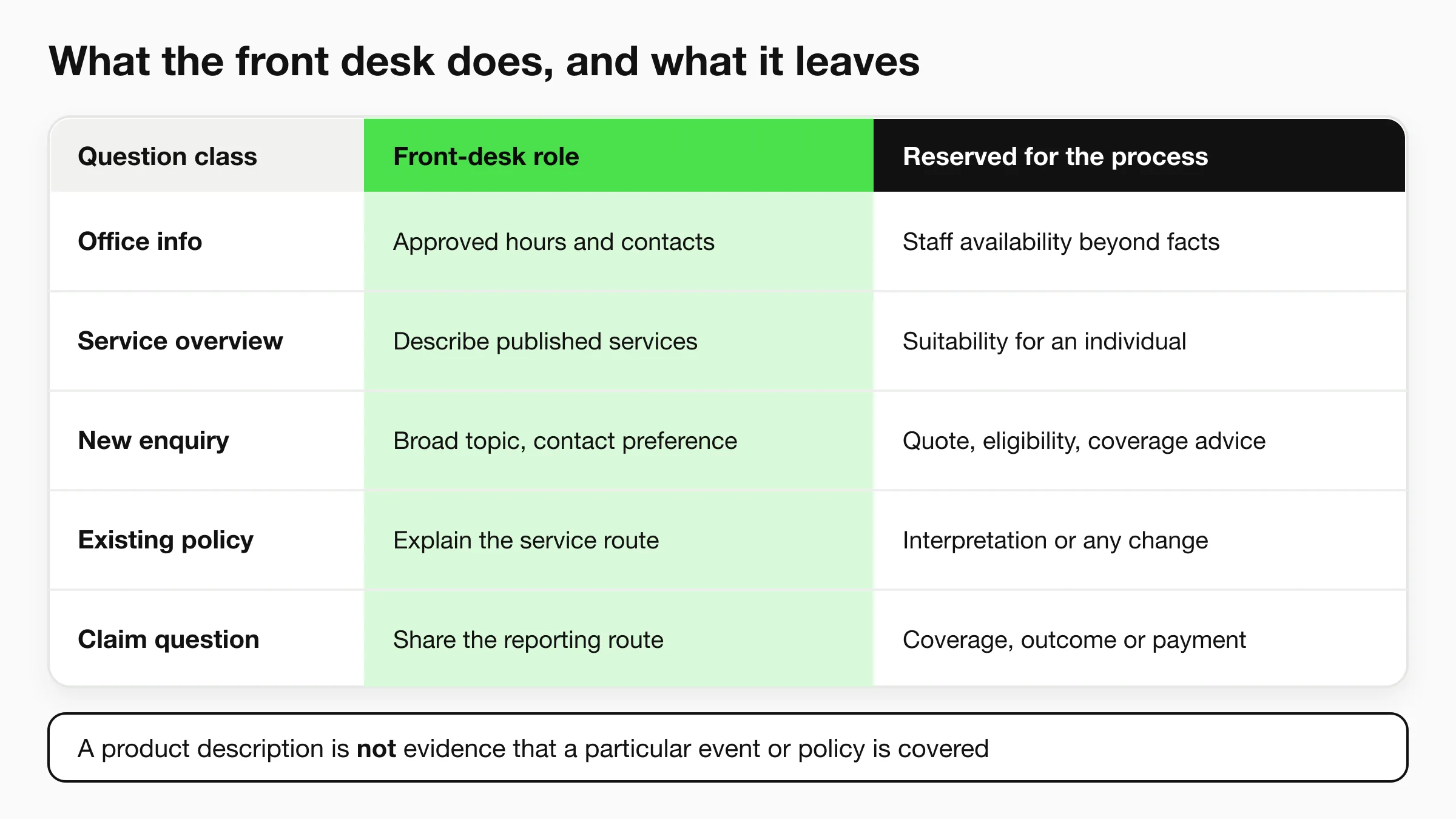
The matrix decides the next communication step, not the answer to an insurance decision. It distinguishes public agency facts, general service descriptions, new-enquiry context and questions that require an authorized person or established service process.
For public information, the front desk can answer from approved sources. For an individual policy or claim, it should avoid interpretation and direct the person to the approved route. For a new enquiry, it can collect a broad topic and preferred contact method without recommending coverage or promising a quotation.
| Question class | Front-desk role | Decision reserved for the appropriate process |
|---|---|---|
| Office information | Share approved hours and contact routes | Staff availability beyond published facts |
| Service overview | Describe the agency's published services | Suitability for an individual |
| New enquiry | Identify broad topic and contact preference | Quote, eligibility or coverage recommendation |
| Existing policy | Explain the approved service route | Policy interpretation or change |
| Claim question | Share the approved reporting/contact route | Coverage, claim outcome or payment |
Your insurance AI front desk should make these boundaries understandable to the customer. It can be helpful without offering advice. “Here is the team's approved route for that question” is useful when it leads somewhere real and preserves the issue the person needs reviewed.
The insurance front-desk overview discusses the broader workflow. This article focuses on an initial classification and copy artifact. Do not treat its generic categories as proof of regulatory compliance or as a substitute for your agency's approved procedures.
General information does not answer an individual coverage question
A description of a product or service is not evidence that a particular event, person or policy is covered. Route personal decisions to the appropriate authorized process without guessing, reassuring or interpreting private terms.
Why General Enquiries Cross the Boundary So Easily
The customer asks in ordinary language
People do not label their messages as policy interpretation or service requests. “Can you help with my car?” might mean a new enquiry, an existing-policy question or a claim. Ask a simple clarifying question before choosing a path, and do not infer the answer from a single keyword.
Product language sounds like a personal promise
A public description may explain the type of insurance an agency discusses. Repeating it in response to “am I covered?” can sound like an individual assurance. The front desk must separate what the agency offers from what a particular policy provides.
Completeness becomes unnecessary data collection
An intake form can grow until it asks for private financial, health or policy details before a person has explained why they are needed. Keep the first contact narrow. The appropriate later process can request necessary information through the agency's approved route.
Acknowledgement sounds like a service action
“Your request is noted” is not the same as a policy change, a filed claim or an approved quotation. The quote-intake guide covers the broader collection process; the boundary here is that a conversation record does not establish a completed insurance transaction.
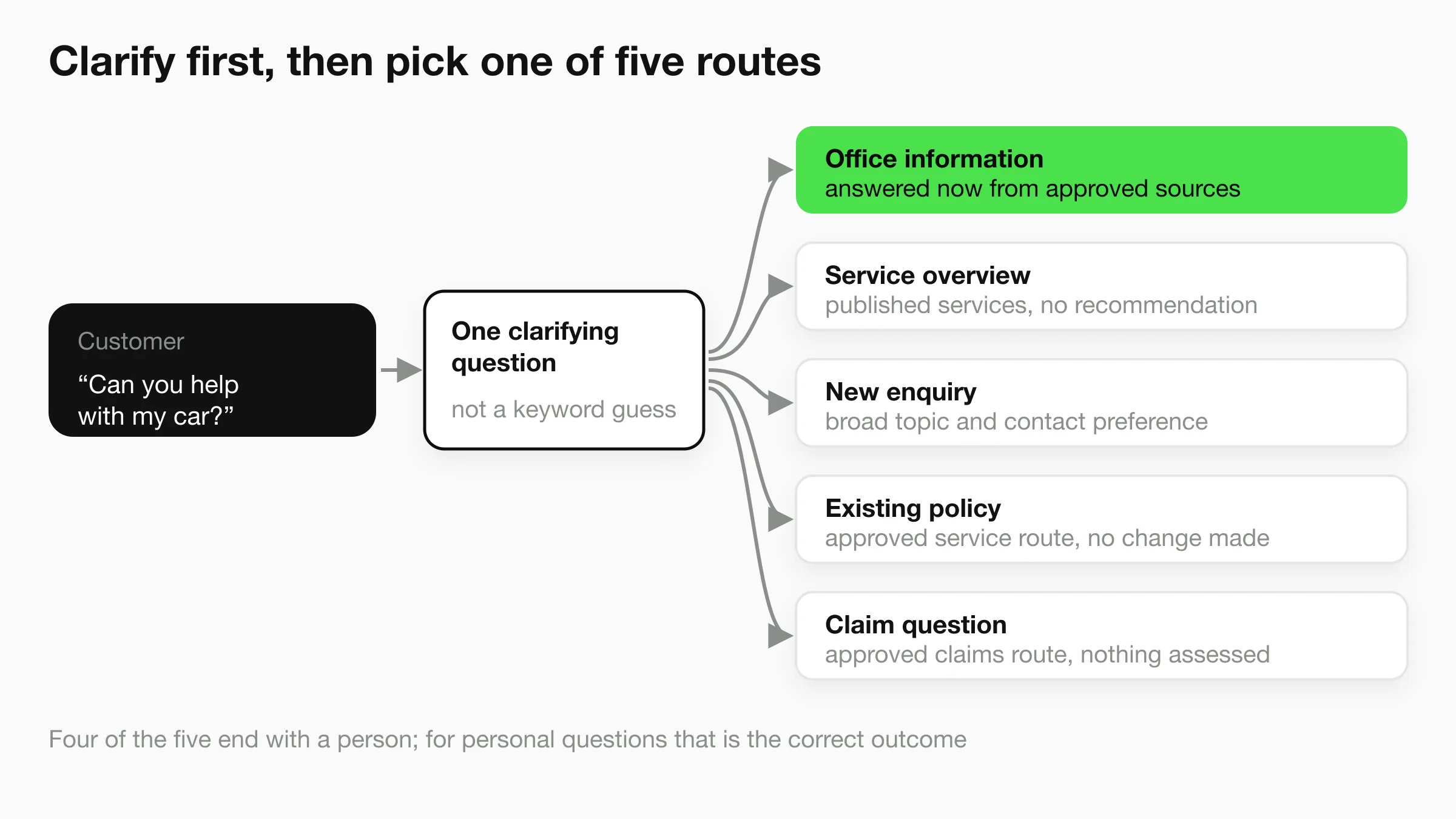
7 Routes for Common First-Contact Questions
1. Answer office and contact questions from current sources
Hours, office locations and approved contact routes are good examples of bounded public information. The answer should be direct and current. Do not add a promise about a particular staff member's availability unless that information is verified.
Customer: “How can I reach the agency team?”
Front desk: “The approved contact options are listed here. If you tell me the general topic, I can help identify the relevant route.”
The topic question should be optional when the customer simply wants contact details. Do not require personal information to answer a public office question. If the agency publishes separate service and new-enquiry routes, explain the distinction in ordinary language.
Check seasonal closures and outdated office details in the source set. A current website page can coexist with an old brochure. Resolve those contradictions rather than expecting the AI to determine which source is authoritative.
The note for a public-information conversation may not need a lead record at all. If the customer does not ask for follow-up, avoid turning a simple request into a data-collection exercise. Helpfulness includes letting a person obtain the information they came for and leave.
2. Describe services without recommending a personal solution
The front desk can explain which services the agency publicly offers, using approved wording. It should not turn that description into a recommendation about what the customer should buy or how much coverage they need.
Customer: “Do you deal with business insurance enquiries?”
Front desk: “The agency's published services include business insurance enquiries. The team can discuss your circumstances through the approved contact route.”
Only use the first sentence if the source actually supports it. Do not infer a line of business because the agency handles another related service. If the scope is unclear, say the team needs to confirm whether it can help.
Avoid comparative promises such as “this is the best cover for you” or “you do not need anything else.” Those are not general service descriptions. A person can explain the relevant options through the agency's authorized process.
Keep the customer-facing difference clear: “we discuss this type of enquiry” does not mean “this product is suitable for you.” The AI front-desk overview provides the general operating model—routine information and useful routing, with decisions left to people who have the authority and context to make them.
3. Collect a broad new-enquiry topic
For a new enquiry, begin with the broad subject and what the customer wants to discuss. Avoid a long risk questionnaire in the first chat unless the agency has specifically approved and designed that process. This template deliberately keeps collection narrow.
Customer: “I would like someone to talk to me about options.”
Front desk: “What is the general subject of the enquiry, and would you like the team to contact you? Please keep personal policy, health and financial details out of this general chat.”
Use a warning like the second sentence where it fits the agency's approved experience, not as a substitute for real information-handling controls. The key editorial principle is to avoid requesting sensitive detail simply to make the record look complete.
Record “new enquiry about business insurance” or another customer-stated topic. Do not invent eligibility, risk level or a recommended product. If the person asks for a quotation, describe the approved next step as a quote enquiry, not a quote issued.
The lead-qualification guide can help you test whether each question changes the next action. In this context, broad routing and contact preference often provide enough for the first handoff; deeper information belongs in the agency's own approved process.
4. Route individual coverage questions without interpretation
When the person asks whether a situation is covered, keep the answer focused on the review route. Do not provide a likely outcome based on a general product description, a brief event account or an incomplete policy excerpt.
Customer: “Would my policy cover what happened?”
Front desk: “That needs review through the appropriate policy or claims process. I can share the agency's approved contact route, but I cannot determine your individual coverage in this conversation.”
Avoid adding “usually,” “probably” or “you should be fine.” Those phrases can imply the very decision the message says it cannot make. A boundary is not preserved if the next sentence speculates about the outcome.
Do not ask the person to paste their full policy or private event details into a general chat to improve the answer. The appropriate reviewer can request necessary information through the approved process.
The internal note should preserve the question without deciding it: “Customer asks whether an event is covered; individual review needed.” It should not say “covered loss” or “claim accepted.” This is a communication classification, not an insurance determination, and the wording should remain that modest.
5. Direct claims questions to the approved process
A claim-related message may ask how to contact someone, how to report an event or what is happening with an existing matter. Use the agency's approved contact instructions and avoid claiming that a claim has been filed, updated or decided through the front-desk chat.
Customer: “I need help with a claim.”
Front desk: “I can help you find the approved claims contact route. Are you looking for reporting instructions or help reaching the team about an existing matter?”
Ask only enough to select the route. Do not investigate the event, evaluate responsibility or predict payment. If the situation requires urgent assistance, follow the agency's approved instructions for such messages; do not improvise emergency or claims guidance from general content.
For an existing matter, do not imply live status access unless an actual verified connection provides it. The front desk can say where to obtain a status update without pretending it has checked the record.
Keep any reference collection within the agency's approved process. This article does not establish which identifiers should be collected or retained. The operational lesson is to avoid expanding a public first-contact conversation into a private claims file without the appropriate design and authority.
6. Separate policy-service requests from completed changes
Customers may ask to change a contact detail, update a policy or cancel an arrangement. A front desk can identify the request and explain the proper service route. It must not state that the change took effect merely because the customer described it in chat.
Customer: “Can you update my policy?”
Front desk: “The team needs to handle policy changes through the approved service process. I can share that route. Please do not treat this conversation as confirmation that a change has been made.”
Use wording your agency approves for the relevant request type. Some changes may have important consequences, so keep the front desk out of interpretation and advice. Do not suggest that a requested effective date has been accepted.
In the summary, write “requests policy-service contact” or the relevant bounded description. Do not mark the work complete. A notification sent to the team is still not evidence that the underlying policy record changed.
The human-handoff guide helps define ownership after the message. Make sure the team can distinguish a general question from a request that needs action in another system. The front desk's contribution is clarity, not implied transaction authority.
7. Preserve the unresolved question in the handoff
The receiving person needs the customer's question, not an AI-generated conclusion. Use a short summary that identifies the broad topic, the contact preference and the decision still needed. Avoid unnecessary private detail.
Illustrative note: “Customer wants to speak with the agency about an existing-policy question. Individual coverage applicability is unresolved. Approved contact route shared; no policy decision or change made in chat.”
If the customer asked for a particular person or role, record that as a request rather than an assignment. If they supplied a preferred contact time, label it a preference rather than a confirmed appointment.
Only describe delivery as completed when the workflow verifies it. The lead-summary guide explains the difference between useful context and a raw transcript. For insurance enquiries, that context should be especially careful about distinguishing the customer's account from a professional conclusion.
Ask the receiving team whether the note enables the right next action. If they must correct the summary's assumptions before helping the customer, revise the template. The goal is a bounded, useful handoff—not a complete assessment performed by the front desk.
Keep routine questions and personal decisions separate
Use Hyperleap AI for approved agency information and clear enquiry routing, with individual decisions left to your authorized process.
Start for freeA Routing Matrix Your Agency Can Approve
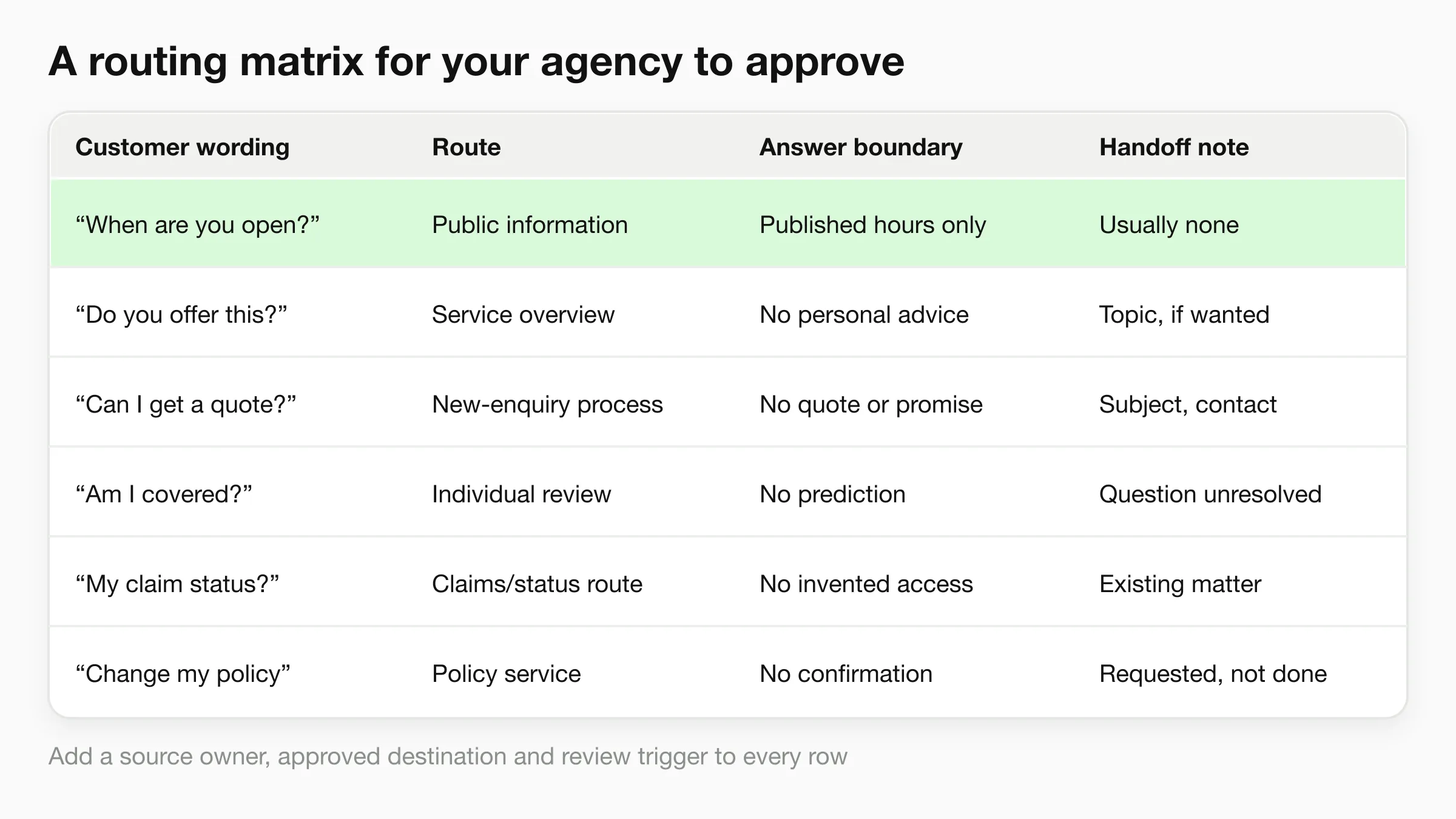
Give the responsible agency reviewer this worksheet and ask them to approve the routes and wording for the actual business. Do not deploy generic contact destinations or assume that another agency's process fits yours.
| Customer wording | Route | Answer boundary | Handoff note |
|---|---|---|---|
| “When are you open?” | Public information | Current published hours only | Usually no follow-up needed |
| “Do you offer this service?” | Approved service overview | No personal recommendation | Topic if further contact requested |
| “Can I get a quote?” | New-enquiry process | No quote or eligibility promise | Broad subject and contact choice |
| “Am I covered?” | Authorized individual review | No interpretation or prediction | Coverage question unresolved |
| “What is happening with my claim?” | Approved claims/status route | No invented record access | Existing-matter contact request |
| “Please change my policy” | Policy-service process | No change confirmation | Requested action, not completed action |
Add the source owner, approved destination and review trigger for each row. A changed office route or service procedure should prompt a retest. If the source is ambiguous, mark the row for owner review rather than writing a more confident message.
Evaluate the matrix through observed behavior. Can the front desk answer office questions without collecting unnecessary data? Does it keep individual decisions with the appropriate process? Does the team receive the unresolved question accurately? These are practical operating checks, not evidence of regulatory compliance or a guarantee of safe behavior in every situation.
Avoid treating fewer human contacts as the universal goal. For a personal coverage or claims question, a clear human route may be exactly the correct outcome. The useful distinction is between avoidable repetition and necessary professional review.
Test the Boundaries Before Customers Use Them
Start with approved public agency information and current contact routes. Keep personal policy documents and customer records out of the general source set for this workflow. Have the responsible agency professionals decide what information can be collected and how requests should be handled.
Create synthetic test conversations for each route. Include an ambiguous message, a direct coverage question, an existing-policy change request and a person who only wants office details. Test a follow-up that pressures the AI for a likely answer. It should not replace the boundary with speculation to keep the conversation moving.
Review every acknowledgement for transaction language. Words such as filed, changed, approved or confirmed require evidence of the underlying action. A collected enquiry is not that evidence. Check the receiving note as well as the visible reply.
Hyperleap AI can answer from approved sources, collect enquiry details and support team follow-up through its shipped capabilities. Do not infer a native insurance agency management system connection or individualized policy access. Any additional connection requires its own evaluation and verification.
Use the knowledge-base maintenance guide to manage approved public facts. A stale contact page can undermine an otherwise careful routing message. Keep the source owner and review trigger visible so changes reach the front desk.
After launch, inspect appropriately sanitized examples with the responsible team. Look for unnecessary data requests, unsupported reassurance and summaries that convert questions into conclusions. Correct the specific source or instruction and rerun the relevant cases. Do not call the workflow compliant based solely on a passed sample or a well-written disclaimer.
Frequently Asked Questions
What insurance questions can an AI front desk answer directly?
In this workflow, it answers approved public agency information such as office details, contact routes and general service descriptions. It does not determine individual coverage, suitability, claim outcomes or policy changes. Your agency's responsible professionals should approve the actual scope and wording for its services and jurisdictions.
Can it tell a customer whether an event is covered?
Not from the general first-contact information described here. The question needs the appropriate authorized review. The front desk should provide the approved route without predicting an outcome or treating a product description as evidence about an individual policy.
Should it collect policy documents in a general chat?
This template does not ask for private policy documents or detailed personal records. The agency should use its approved process for any information genuinely needed later. Keep the initial conversation focused on the broad topic and the right contact path rather than building an unnecessary private dossier.
Does sending an enquiry mean a claim or policy change is complete?
No. A message or notification is not the underlying insurance action. The customer-facing acknowledgement and internal note should state what actually happened and leave the decision or change with the authoritative process. Do not use completion language without evidence.
Does this matrix establish regulatory compliance?
No. It is an operational communication worksheet, not legal or compliance advice. Requirements depend on the agency's actual activities and jurisdictions. Appropriate professionals need to review the wording, collection practices and workflow; a generic template or disclaimer does not establish compliance.
How should the agency measure whether routing is useful?
Review whether public questions receive clear answers, personal decisions reach the right process and staff receive accurate unresolved questions. Inspect unnecessary data collection and unsupported promises. Do not treat a lower handoff count as automatically better when human review is the correct destination.
Let the Front Desk Clarify, Not Decide
An insurance front desk is useful when it makes the next step easier to understand. It should not turn a general description into a personal recommendation or make a conversation sound like a completed policy action.
Build the route map around real customer questions, approved agency information and authorized contact processes. Keep sensitive collection out of the first-contact template unless separately designed and approved. Preserve uncertainty in both the customer reply and staff note.
That gives your team a clearer starting point while leaving consequential decisions where they belong: with the appropriate people and systems, using the right context.
Build a bounded agency enquiry flow
Create a Hyperleap AI front desk for public information and useful first-contact context, with clear routes to your team.
Start for freeIndustry Solutions
See how AI chatbots work for these industries:
Related Articles
View all
Guide18 min read
When Customers Ask for a Person: Reply Examples
Use respectful replies for customers who ask for a person, with clear availability wording, honest handoff status and a practical copy-review pack.
Guide16 min read
Turn Unanswered Customer Questions Into Better Sources
Use an unanswered-question review log to separate missing facts from unclear requests, approve source changes and retest the answer before closing the issue.
Guide17 min read
Repair-Status Enquiries: Scripts for Auto Shops
Handle repair-status questions with honest replies, minimum useful context and a clear service-team handoff, without inventing completion times.
Guide17 min read
Multilingual Hotel Chat: A Guest-Question Test Kit
Test English and Spanish hotel enquiries against the same approved facts, with arrival, policy, access and staff-handoff cases your team can review.