Guide
Repair-Status Enquiries: Scripts for Auto Shops
Handle repair-status questions with honest replies, minimum useful context and a clear service-team handoff, without inventing completion times.

Gopi Krishna Lakkepuram · Founder & CEO
· 17 min read
“Is my car ready?” interrupts a service adviser for a good reason: the customer is trying to plan the rest of their day. They may need transport, a collection arrangement or simply an honest update. A quick automated answer helps only if it describes what the system actually knows. “Nearly finished” is worse than no answer when nobody checked the repair record.
A safe auto repair status enquiry response acknowledges the request, explains the information boundary and collects enough context for the service team to continue. It does not invent workshop progress, read a dealer-management system that is not connected or turn the customer's preferred collection time into a promise.
This guide provides an original reply pack and review record for that narrow task. The conversations are fictional, not customer case studies. They are designed for an AI front desk that can answer approved general questions and collect enquiries, while authorized staff retain responsibility for private repair information, estimates and release decisions. Adapt them to your shop's actual contact process before using them.
What Can a Repair-Status Request Script Do?
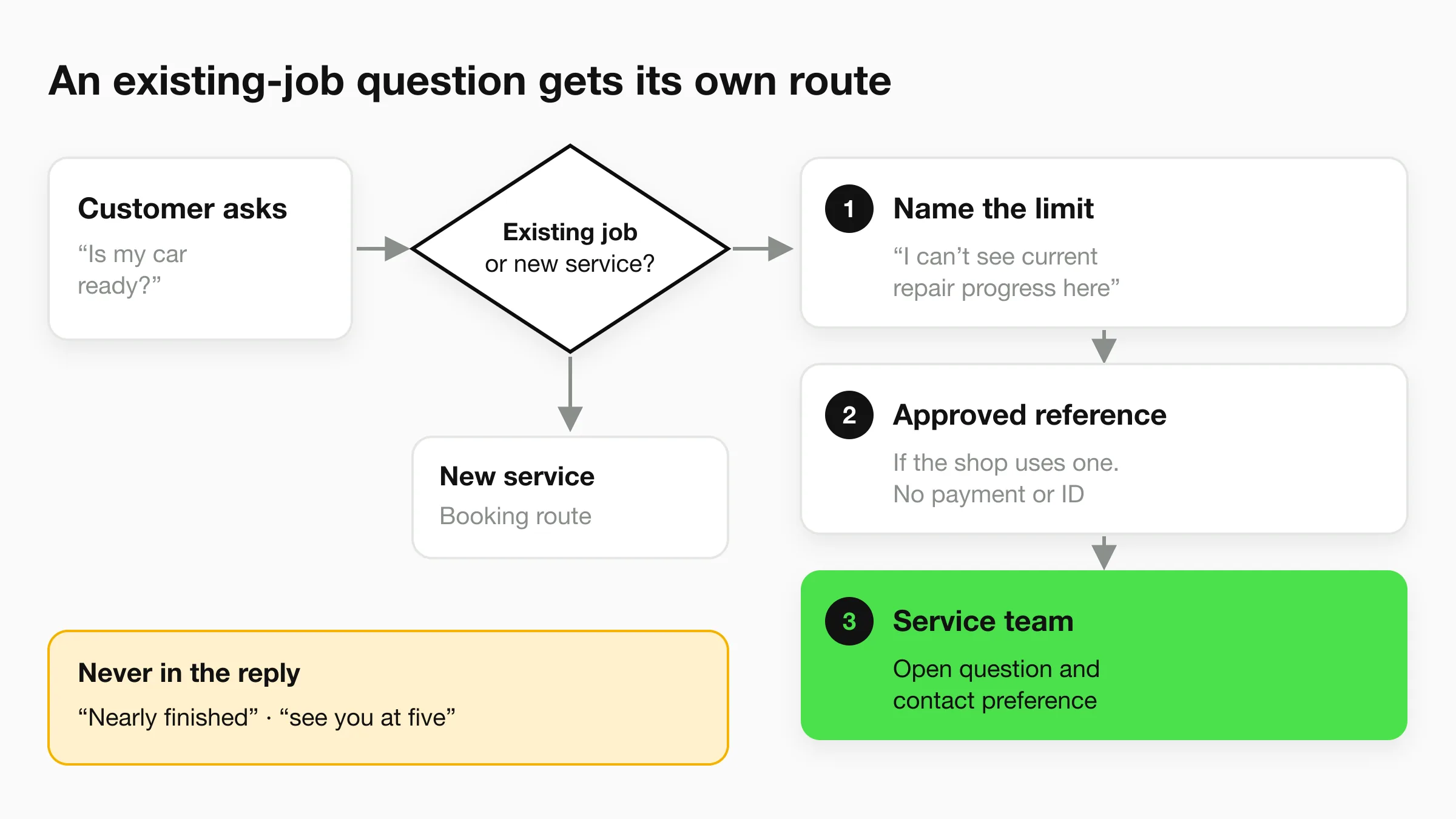
A request script can make the first exchange clear and useful. It can distinguish a question about an existing job from a new service enquiry, explain that staff need to check the repair record and collect the customer's chosen contact route. Those actions are different from providing the status itself.
The distinction matters because the customer may reasonably assume that a branded assistant can see the shop's systems. Make the boundary plain at the moment it becomes relevant. A short “I can't see your repair's current progress here” is more helpful than an elaborate answer that never admits the missing information.
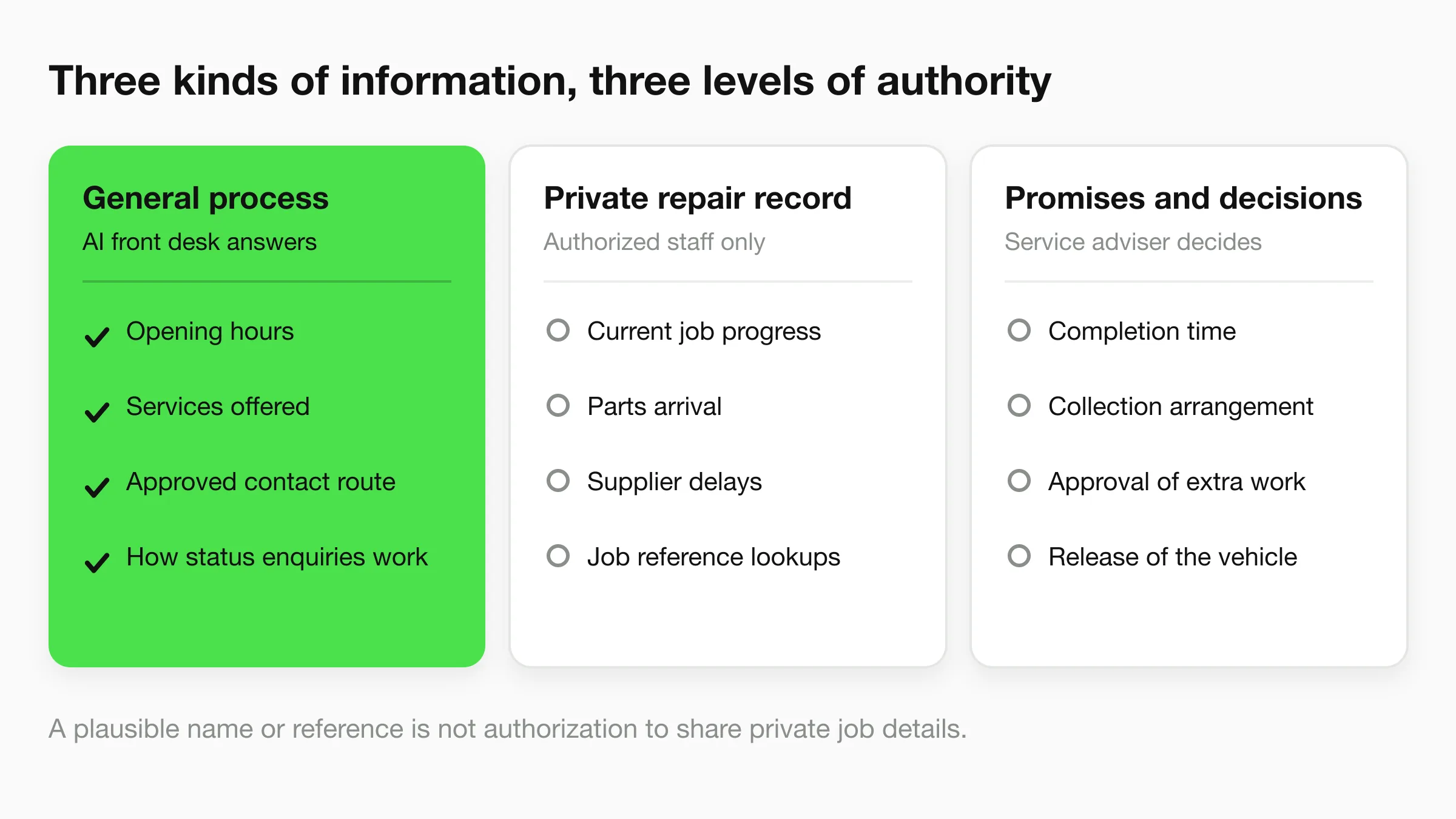
An AI front desk for automotive businesses can answer published questions about opening hours, services and the approved contact process. It can help prepare a status enquiry for people who have authorized access to the job record. Do not imply a native connection to a workshop or dealer-management system unless a separately verified implementation actually exists.
This article is distinct from the auto-shop appointment enquiry guide. A person asking for a new service slot needs a different next step from an existing customer asking about work underway. Sending both to the same booking page can add confusion and may create a duplicate enquiry.
The minimum useful record is the request, the approved job reference if appropriate, the customer's contact preference and what staff need to answer. It should not include payment details, identity documents or an unnecessary history of the vehicle. The service team can decide what verification or clarification is needed through the shop's authorized process.
A status request is not a repair update
These scripts do not read live repair records, confirm parts delivery, approve additional work, determine whether a vehicle is safe or release a vehicle for collection. An authorized service-team member must verify those decisions and communicate them through the shop's approved process.
Why Status Replies Create Accidental Promises
General turnaround information becomes a specific forecast
A website may describe how a routine service usually proceeds. That does not establish when a particular vehicle will be ready. Do not combine a customer's drop-off time with a general duration to manufacture a completion estimate. Staff need to review the actual job and any changes affecting it.
A familiar name is treated as identity verification
A person who knows a customer's name or vehicle description is not automatically authorized to receive private job information. The AI front desk should not disclose repair details merely because the conversation contains a plausible reference. Use the shop's established process for verifying and answering individual requests.
A collection preference sounds like an agreed arrangement
“I need it by five” is important context, but it is not a commitment from the shop. Preserve that preference for staff without replying “see you at five.” The acknowledgement should distinguish what the customer wants from what someone authorized has confirmed.
An enquiry disappears into a generic lead summary
“Customer interested in car repair” loses the crucial fact that the vehicle is already with the shop and the customer needs an update. The lead-summary guide explains why a usable handoff names the actual unresolved question. In this workflow, that question is often progress or collection, not a new sales opportunity.
These errors are avoidable without making the reply cold. Acknowledge the inconvenience, explain the boundary and offer the real next step. Accuracy and empathy work together when the answer does not pretend that reassurance is evidence.
7 Replies for Common Repair-Status Conversations
1. Recognize an existing-job question immediately
Begin by identifying the task. If the customer says the vehicle is already in the workshop, do not launch a new-booking questionnaire. Acknowledge that they want an update and explain who can provide it.
Illustrative reply:
“You are asking for an update on a vehicle already with the shop. I can't see the current repair progress here, but I can explain the approved service-team contact route or help collect a status enquiry for review.”
Offer enquiry collection only if the configured process actually supports it. Otherwise share the approved contact route directly. A fictional promise to pass something along is not more helpful than an honest explanation of the available path.
If the request is ambiguous, ask a simple clarification: “Is this about a vehicle already with us or a new service enquiry?” That question changes the next action. Asking for a complete vehicle history before resolving that distinction does not.
The auto-body estimate enquiry guide covers a different stage of the relationship. Keep estimate requests, new bookings and existing-job status enquiries distinct so the receiving person can act without reconstructing the customer's intent.
2. Ask for the approved reference, not an identity dossier
Your shop should decide what reference is appropriate for an initial status enquiry. It might be a job reference already supplied through its process. The AI should not invent a verification requirement or request payment information to make the conversation appear secure.
Illustrative prompt:
“If your service paperwork includes a job reference that the shop asks you to use for enquiries, you can provide it through the approved contact process. Please do not share payment details or identity documents in this chat.”
If the workflow permits reference collection in chat, name the exact permitted field in the configured instructions. Do not assume that every number the customer provides should be repeated in a broadly distributed summary. Keep collection proportionate to the receiving team's actual need.
If the customer has no reference, explain the supported alternative. The service team may have another way to locate the request, but the AI should not claim it has found the record itself. “The team can advise what it needs to locate the job” is different from “I found your repair.”
Record missing information explicitly. A handoff that says “reference not supplied” is more honest than an invented identifier or a guessed link to another customer's record. The purpose is to help staff continue safely, not to force every field to look complete.
3. Handle “Will it be ready today?” without guessing
The customer is asking for a decision-relevant time, not a generic description of your service. Explain that the actual completion forecast needs an authorized update. Do not substitute a typical turnaround, an old estimate or a comforting phrase.
Illustrative reply:
“I can't confirm today's completion time from this conversation. The service team needs to check the current job information. I can include that you need to plan collection today when the request is passed through the approved process.”
If the customer says a staff member previously gave an estimate, preserve that as their report: “Customer says an earlier estimate mentioned today.” Do not endorse it as current or contradict it without evidence. The team needs to review what was communicated and what has changed.
Avoid phrases such as “should be ready,” “almost done” or “just waiting for a final check” unless an authorized, current source actually establishes them for that job. Those details sound specific and can lead the customer to make transport arrangements.
The helpful part is a focused request: the team knows the customer needs a current collection expectation. The AI's restraint does not prevent useful service; it prevents an invented answer from becoming another issue the adviser must resolve later.
4. Record a collection preference without confirming collection
A customer may explain that they can reach the shop only during a particular window. That is valuable context. Capture it as a preference and keep it separate from the shop's opening hours, the vehicle's readiness and any authorized collection arrangement.
Illustrative prompt:
“What collection window are you hoping for? I can record it as your preference for the service team to review. That does not confirm the vehicle is ready or that collection has been arranged.”
If the public source answers opening-hours questions, share those hours accurately. Do not imply that an open reception desk means a particular vehicle can be released. If special collection arrangements exist, explain only the approved general process and route the individual request to staff.
Do not share key-storage details, private access instructions or payment assumptions through a public conversation. Those are not ordinary opening-hours facts. The shop must use its authorized process for any private arrangement.
In the handoff, write “customer prefers a late-afternoon collection if staff confirm readiness.” That wording is concise and preserves the condition. “Collection scheduled late afternoon” would remove the very decision the customer is asking the team to make.
5. Separate an update request from approval for more work
A status conversation may turn into a question about additional work or cost. The assistant should not treat a vague “go ahead” as sufficient authorization or tell the customer that work has been approved through a process that does not support it.
Illustrative reply:
“Questions about additional work or a revised estimate need the service team's authorized approval process. I can help you reach that process, but this chat does not approve work or confirm a price change.”
Keep the conversation useful by preserving the customer's question. “Customer asks why an additional item appears in the estimate” is a clear next action. “Customer approved the additional repair” is not justified unless the authorized process actually recorded that decision.
Similarly, do not claim that parts have arrived, a supplier delay is resolved or a warranty decision has been made. Those are job-specific facts the general answer source cannot establish. If the customer supplies such information, label it as their report for staff to review.
The broader AI front desk role is to reduce repeated explanation and prepare useful context. It does not require the assistant to imitate the authority of a service adviser. A clean route to the right person is an appropriate completed task for this interaction.
6. Respond to frustration without inventing progress
A frustrated customer may ask the same question several times because the earlier reply did not give them a usable next step. Acknowledge that they need a real update, then explain the specific contact or review route. Avoid repeating a generic apology followed by another unsupported estimate.
Illustrative reply:
“I understand you need a current answer to plan your day. I can't verify workshop progress here, and I don't want to give you an invented completion time. The next step is the approved service-team contact route so someone with the job information can respond.”
Do not make the customer re-enter details already present in the conversation unless the receiving process genuinely requires them. Preserve the unresolved question and any stated urgency as customer context, without deciding technical priority or promising immediate action.
If the shop has an approved response window, explain it accurately. If not, do not add “right away” simply to calm the conversation. A second broken expectation can be more frustrating than a clear limitation at the start.
Use the human-handoff guidance to review the transfer language. The test is whether the customer knows what will happen next, who can answer and what has not yet been confirmed—not whether the reply contains enough reassuring adjectives.
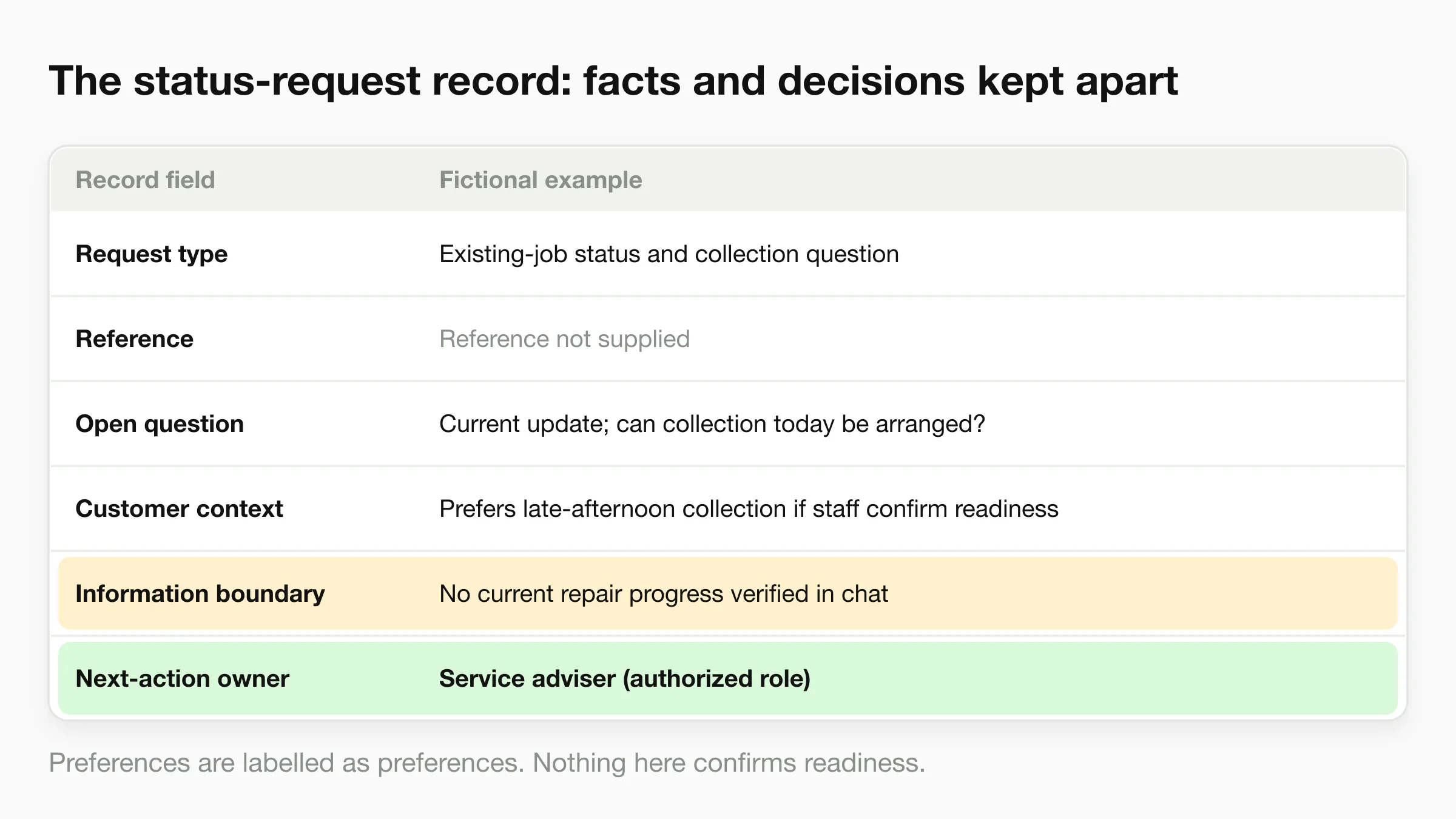
7. Send a request record that keeps facts and decisions apart
The receiving adviser needs a concise account of the request, not an AI-created repair narrative. Include the customer's stated reference through the approved process, the question they need answered, any contact preference and any timing concern they actually expressed.
| Record field | What to preserve |
|---|---|
| Request type | Existing-job status, collection question or estimate query |
| Reference | Approved customer-supplied reference, if available |
| Open question | The actual answer the customer needs |
| Customer context | Preferred collection or reply window, labeled as a preference |
| Information boundary | No current repair progress verified in chat |
| Next-action owner | The authorized service-team role |
Illustrative acknowledgement:
“The enquiry asks for a current repair update and whether collection today can be arranged. Your preferred reply method is recorded for review. The repair status and collection arrangement still need the service team's confirmation.”
Only say that a request was delivered when the configured workflow actually completed that action. If the customer must use a contact page themselves, say so instead. These worksheet fields are suggested team practices, not native job-management or automatic assignment controls.
Check the note against the conversation before considering the handoff complete. It should not contain a diagnosis, a readiness claim, a price approval or a deadline that no authorized person supplied.
Give status enquiries an honest next step
Answer approved shop questions and prepare clearer requests for the service team.
Start for freeWhat Better Status Handling Looks Like
The immediate improvement is not that the AI knows more about the repair. It is that the customer understands the boundary and the adviser receives a usable question. Staff should not have to undo a false completion promise before providing the actual update.
Compare two fictional summaries. “Customer wants car back; ready later” invents a status. “Customer requests a current update and hopes to collect late afternoon; readiness not verified; service adviser review needed” preserves the task. The second is more useful even though it contains less apparent certainty.
Review whether customers are being sent to the correct route. A new-booking link is not an adequate answer to every existing-job question. If staff repeatedly receive duplicate bookings from people seeking updates, the routing language needs attention. If the conversation asks for excessive details, reduce the intake to what the adviser uses.
Measure the process through your own evidence: unsupported promises found, unclear references, repeated clarification and whether the received note matches the customer's request. Do not infer repair speed, satisfaction or retained revenue from a completed chat alone. Those outcomes require their own records and a defensible measurement method.
Prepare the Reply Pack With Your Service Advisers
Ask the people who answer status questions to approve the source and contact route. Document which general information may be shared publicly, which reference is appropriate and how the customer should reach authorized help. Resolve contradictions between website instructions and actual workshop practice before testing the scripts.
Keep private job records out of the general answer source. The knowledge-base maintenance guide helps organize approved business information, but attaching more documents is not a substitute for authorization. A public process guide and a customer repair record serve different purposes.
Test a straightforward status request, a customer without a reference, an earlier promised time, a collection preference, a question about extra work and a frustrated repeat enquiry. Ask the reviewer what each reply would lead the customer to believe. Check the receiving note as well as the visible answer.
Hyperleap AI can answer from approved sources, collect enquiry context and provide team summaries. It does not provide native repair-system status access through this reply pack. Its quick-start path can be live in under five minutes; service-adviser review is additional tuning. Review the current plans, then begin with a narrow, accurate status-request route your staff can genuinely support.
Frequently Asked Questions
Can Hyperleap AI read the workshop's live repair status?
Do not assume a native workshop or dealer-management connection. These scripts explicitly do not provide live job access. The assistant can explain approved general information and collect a status enquiry. A separately implemented connection would need its own verification before making job-specific claims.
Can the assistant repeat an estimated completion time?
Only when an authorized, current source supports that information for the particular job and the process permits it. A general turnaround statement or a customer's recollection is not the same evidence. Without that support, ask the service team for a current update.
Should a registration number be treated as verification?
No single customer-supplied reference should be casually treated as proof of authorization. Follow the shop's established process for private information. The public front desk should not disclose repair details merely because someone knows a plausible vehicle or job reference.
What if the customer needs the vehicle by a specific time?
Record the time as the customer's preference or constraint and route it to the service team. Do not convert it into a completion promise. Staff must review current progress and confirm any collection arrangement through the authorized process.
Can the chat approve additional work or payment?
This workflow does not approve repairs or process end-user payments. Questions about extra work, revised estimates and authorization belong in the shop's established process. Preserve the customer's question without claiming that a commercial decision has been made.
How should an angry status enquiry be handled?
Acknowledge the need for a real update and provide the actual service-team route. Preserve useful context without making the customer repeat everything. Avoid invented progress, immediate-response promises or collection assurances that the assistant cannot verify.
Be Helpful About the Request, Honest About the Status
An AI front desk does not need to guess workshop progress to make a status enquiry easier. It can identify the task, collect the minimum useful context and explain the next authorized step. That removes avoidable repetition while keeping repair decisions with the people who have the evidence.
Start with a clear boundary and a contact process your service advisers accept. Test the closing message as carefully as the first reply. The customer should leave knowing how to get a real update, not believing that a fluent automated response has confirmed something the workshop has not checked.
Prepare clearer enquiries for your service team
Build an AI front desk around approved shop information and practical human handoffs.
Start for freeIndustry Solutions
See how AI chatbots work for these industries:
Related Articles
View all
Guide17 min read
AI Answer Tone: A Small-Business Review Rubric
Review AI front desk answers for directness, respectful uncertainty, plain language and useful next steps with an original before-and-after rubric.

Guide17 min read
Ask for Contact Details Without Blocking the Answer
Use practical contact-request scripts that explain the purpose, respect customer choice and keep useful answers separate from lead capture.
Guide18 min read
When Customers Ask for a Person: Reply Examples
Use respectful replies for customers who ask for a person, with clear availability wording, honest handoff status and a practical copy-review pack.

Guide17 min read
Tenant Maintenance Requests: A Clear Intake Template
Collect clearer non-emergency tenant maintenance requests with description prompts, contact boundaries and a practical property-team handoff.