When Customers Ask for a Person: Reply Examples
Use respectful replies for customers who ask for a person, with clear availability wording, honest handoff status and a practical copy-review pack.

“I want to speak to a person” is a complete request. The customer may be frustrated, dealing with an unusual situation or simply prefer a human conversation. A helpful AI front desk should not make them prove that preference by repeating the problem or navigating a persuasion script.
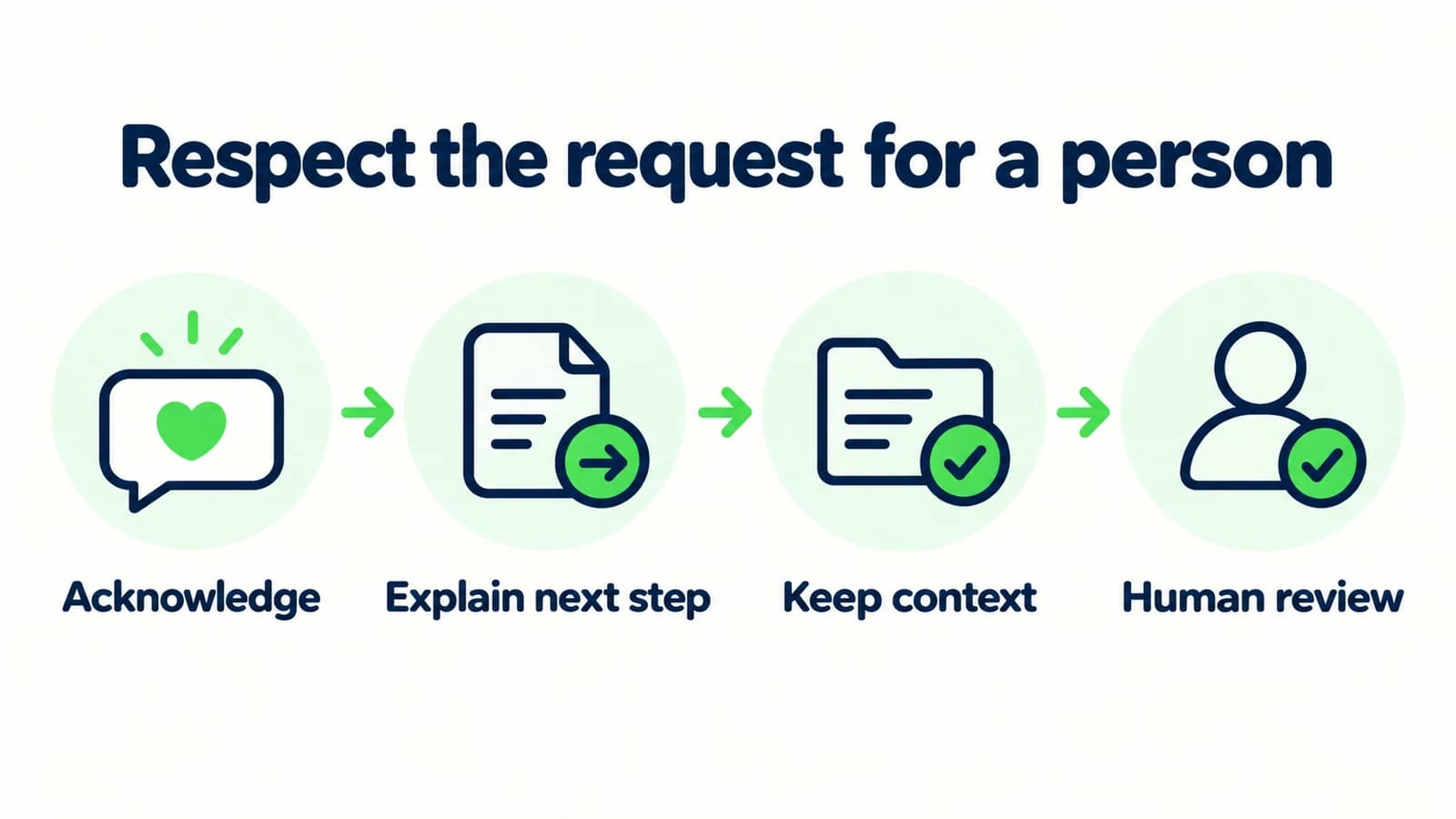
The best chatbot talk-to-human response acknowledges the request, explains the real next step and preserves useful context. It does not pretend a staff member is online, claim a transfer happened when only a note was collected or keep asking sales questions after the customer has asked to stop.
This guide is a copy pack for those moments. It focuses on the words a customer sees and the status those words imply. The broader handoff guide covers routing design; here you will find illustrative messages, a review rubric and a handoff note that keep the conversation honest when a person needs to take over.
What a Respectful Human-Request Reply Must Do
A respectful reply recognizes the customer's preference without arguing, tells them what action is actually available and asks only for information needed to support that action. It can be warm and brief at the same time.
Begin with the request: “You would like to speak with the team.” Then describe the next step that your business can genuinely provide. That might be an approved contact route, a message for later review or an actual human response through a configured process. Do not use those states interchangeably.
An AI front desk can answer general questions and collect useful context, but its ability to hold a conversation does not establish staff availability. A named employee, a promised response time or the phrase “connecting you now” all communicate facts that need evidence.
| Wording | What the customer may reasonably understand |
|---|---|
| “Here is how to contact the team” | A contact route is being provided |
| “I can prepare a message for review” | A request can be collected |
| “Your request was sent” | Delivery occurred and was verified |
| “A colleague is joining” | A person is actually available and joining |
| “They will reply by…” | The business has authorized that commitment |
The wording should fit the state, not the state you hope will happen next. This distinction protects the customer's expectations and helps the receiving team understand what has already been said.
The tone should also respect a change of preference. Someone who first accepts AI help can later ask for a person. Do not treat the earlier conversation as permission to continue an unwanted automated sequence. Carry the relevant context forward and stop gathering information that no longer serves the next step.
The examples are message patterns, not delivery proof
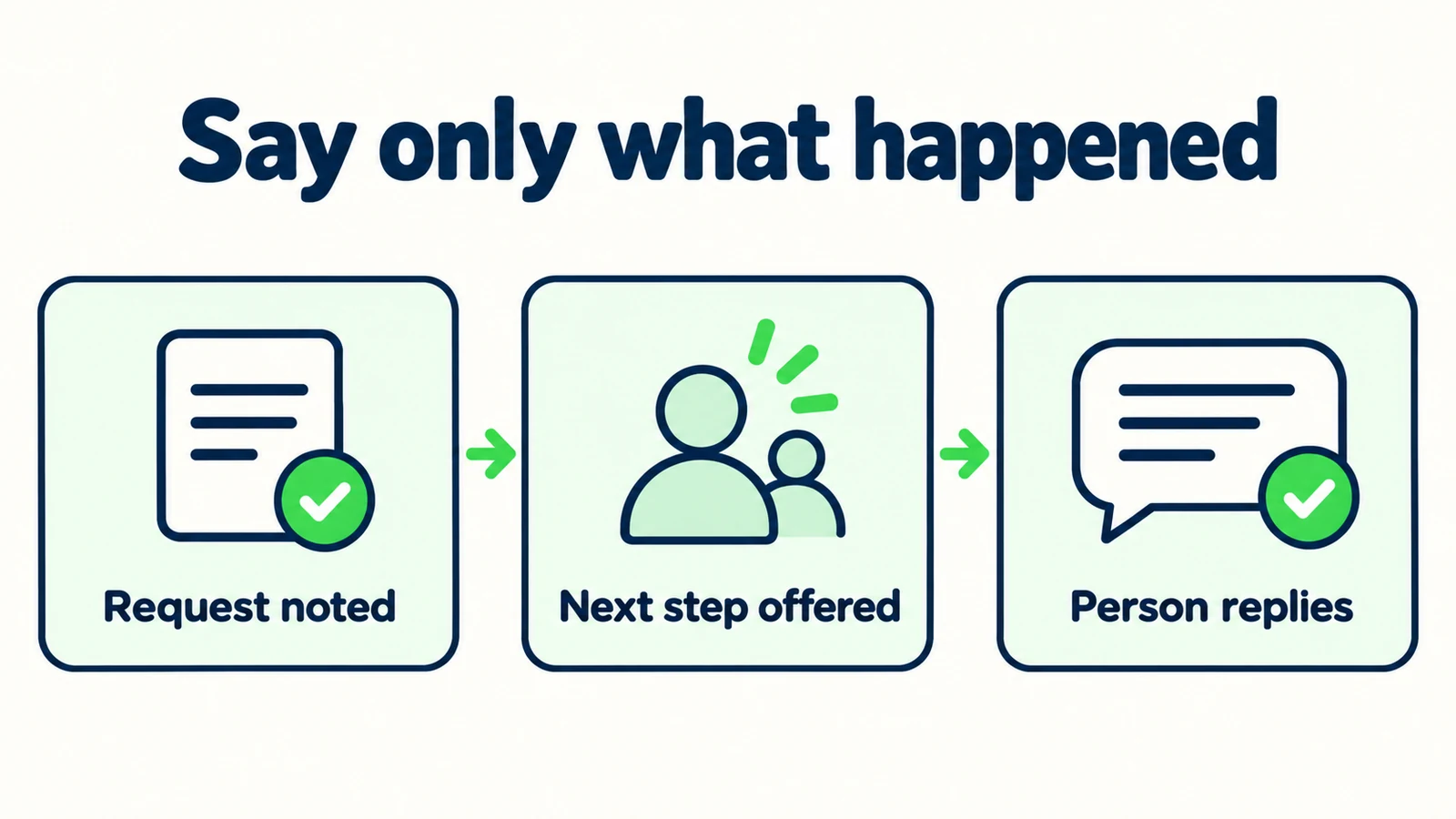
Use a sentence claiming delivery, staff availability or a response deadline only when your actual workflow verifies it. A generated acknowledgement by itself does not prove that a person received or accepted the request.
Why Handoff Copy Can Make Frustration Worse
The answer tries to win an argument
“I can help with most issues, please try again” may be intended as reassurance, but it ignores the request. Offering optional help is different from withholding the human path. If assistance remains available, present it after the real next step and make it genuinely optional.
The message promises an invisible transfer
A typing animation or confident sentence does not mean anyone has joined. “Transferring now” creates a waiting state for the customer. If the actual process is an email summary for later review, describe that process accurately instead of borrowing live-chat language.
The customer is asked to start over
Requiring a complete retelling can make the front desk feel like an obstacle. Use the context already present when it is relevant and reliable. Ask for a missing contact method or a short correction, not the entire story. The lead-summary guide explains how to preserve the unresolved question rather than merely copying the transcript.
Availability is confused with willingness
“Nobody can help you” is both discouraging and often inaccurate. The team may be unavailable in the current channel or outside its stated coverage hours. Explain the supported route and the business's approved expectations. Do not invent a time because a specific answer feels more reassuring.
7 Message Patterns for Human Requests
1. A direct request with no explanation
When the customer says “person,” “human please” or “can I speak to the team,” acknowledge the preference without requiring a reason. A brief statement is enough. The next sentence should describe the supported route.
Customer: “Can I talk to a person?”
Front desk: “Yes, I can help you find the right contact route. The team can be reached through the contact option below. If you want to leave a message for review instead, I can help collect it.”
Adapt the wording to your actual workflow. Do not say “yes” if the sentence implies an immediate connection that is not available. “You would like a person. Here is the team's contact route” can be clearer where the only supported action is sharing details.
Do not insert a qualification gate such as “first tell me your budget” unless that information is genuinely required for the chosen route. A human request is not an opportunity to finish a lead form that the customer no longer wants to complete.
The test is simple: could the customer identify the next action after reading the message once? If not, shorten the explanation and make the contact route visible. Use a real approved link, not an invented department or generic instruction to “reach out.”
2. A frustrated customer who has already explained the problem
Recognize the friction without claiming feelings or taking responsibility for facts you cannot verify. “You have already explained the issue” is often more useful than a long apology. Summarize the unresolved point in the customer's terms and offer the human path.
Customer: “I already told you this. I need a person.”
Front desk: “You have already explained that the service details do not match what you expected. I will not ask you to repeat that here. The next step is the team's review route; would you like me to include that unresolved question in the message?”
Use a verified action in the final version. If a summary cannot actually be sent from the conversation, offer the contact route and a short summary the customer can use. Do not promise to carry context automatically when the receiving process does not support it.
Avoid repeated apologies that delay the next step. Avoid “calm down,” “as I said” or any wording that judges the customer's tone. A boundary can remain clear without becoming confrontational. If the customer declines further questions, respect that choice and provide the available route.
3. A request when the team is not currently available
Describe availability using the business's approved information. If coverage hours are published, state them accurately and distinguish the contact route from a promised response deadline. Opening hours alone do not guarantee that every request will be resolved immediately when the office opens.
Customer: “Can someone answer now?”
Front desk: “I cannot confirm that a team member is available in this conversation right now. You can use the approved contact route, or leave a message for review. I can explain the published contact hours if that helps.”
Where the system genuinely knows that a live team is unavailable, more direct wording may be appropriate. The key is not to imply knowledge of staff presence that you do not have. Avoid invented queue positions, countdowns and named employees.
If the business has a real response commitment, use the approved wording and its conditions. If it does not, say what the customer can do next without filling the gap with “soon” or “shortly.” Those words can sound like a promise even when the writer intended only friendliness.
A hospitality front desk and a home-services front desk may have very different urgent-contact arrangements. Configure each from the actual business process rather than copying a generic availability message across industries.
4. A customer who does not want to share contact information
Explain why a contact method is requested and let the customer choose another available route. Do not imply that ordinary public information requires personal details. Do not keep repeating the same request after the customer declines.
Customer: “I don't want to give my phone number.”
Front desk: “That is fine. A contact method is only needed if you want the team to follow up on this request. You can use the approved contact route yourself, or choose another supported contact method if you prefer.”
Only offer alternatives the business actually supports. An email address for follow-up does not make email a supported AI conversation channel. Keep the distinction between the customer's chosen contact method and the channels the product covers.
If the person is already on a messaging channel, do not assume their visible profile provides verified identity or permission for unrelated outreach. Collect only the context needed for the request and follow the business's approved information-handling process.
The customer-service practice guide provides a broader review framework. In this message pack, the immediate copy check is whether the reason for asking is clear and whether declining leaves the customer with an understandable next step.
5. A customer asking for a particular person or role
Capture the request without claiming that the named person is available or responsible. The customer may know an employee from an earlier interaction, or may ask for “the manager” without knowing who handles the issue. Preserve the request and explain the approved route.
Customer: “I need to speak to the venue manager.”
Front desk: “I can note that you would like the venue manager to review this. I cannot confirm their availability here. What is the short question you want included, if it is not already in this conversation?”
If the relevant question is already present, summarize it instead of asking again. Do not expose staff schedules, private contact details or internal assignments unless the business has approved them for public use.
If the requested person no longer handles that role, use the current approved information and offer the appropriate team route. Avoid improvising a replacement based on an old source. A name in a brochure is not evidence of current availability.
Record the difference between “customer requested manager” and “manager assigned.” These are not equivalent statuses. The receiving team can decide who should respond. The copy should not create an assignment that the operating process has not accepted.
6. A human request after an uncertain or disputed answer
When the customer challenges an answer and asks for a person, do not continue defending the generated response. Preserve the disputed point for review. If the source conflict is visible, acknowledge that the team needs to confirm it.
Customer: “That policy is different from the document I received. Please get someone.”
Front desk: “The difference needs the team's review. I can include that the policy in this answer does not match the document you received. Please use the approved contact route for any private documents rather than pasting them into this chat.”
Do not ask for sensitive evidence in a general conversation merely to make the note feel complete. A brief description of the discrepancy can be enough to route the issue. The team can request necessary material through its appropriate process.
Avoid stating that the customer is right or wrong when the authoritative information is unresolved. “Needs review” is a meaningful status. It tells the receiving person not to treat the earlier answer as settled.
This pattern is especially important for prices, cancellation conditions and service commitments. A fluent explanation should not become more certain under challenge. Test both polite disagreement and repeated frustration so the human path remains available in either case.
7. An acknowledgement after the next step was actually taken
Once a real action occurs, describe that action precisely. If a request was successfully delivered, say it was sent for review. If only a link was provided, say that the customer can continue there. If a person joins, identify the transition in the way your actual channel supports.
Verified delivery example: “Your request has been sent for the team's review. It includes the unresolved question about the service scope and your chosen contact method.”
Link-only example: “Here is the team's contact page. This chat has not confirmed a staff response or a callback time.”
Do not use the first example unless delivery is verified. A backend notification failure should not be hidden by an optimistic acknowledgement. Your team should define the fallback when an action cannot be completed, and the customer should receive a usable alternative.
Keep the final acknowledgement short. Repeating the whole conversation can bury the next step and may unnecessarily expose personal information on a shared screen. Confirm the essential unresolved question and the status, then stop.
The multi-channel guide explains how channels fit together. The same state discipline applies across them: moving from a website to a messaging app does not automatically mean a human has accepted ownership.
Make human requests easy to understand
Build a Hyperleap AI front desk with clear boundaries, approved contact routes and useful context for your team.
Start for freeA Copy Review Card for Handoff Messages
Review handoff copy by its meaning, not merely its tone. A friendly message can still misstate delivery or make it difficult to reach a person. Use this card for each message pattern in your configuration.
| Check | Review question |
|---|---|
| Recognition | Does it acknowledge the request for a person? |
| Choice | Is further AI assistance optional? |
| Status | Does it describe only an action that occurred? |
| Availability | Is any staff-presence claim verified? |
| Timing | Is a deadline actually authorized? |
| Context | Does the unresolved question travel accurately? |
| Data request | Is each requested detail necessary for the next step? |
| Exit route | Can the customer act without repeating a loop? |
Test a short message as well as a long one. “Human” may contain no explanation, but the intent is clear. Test a customer who changes language, one who asks for a named person and one who says they do not want further questions. The front desk should not require identical wording to recognize the preference.
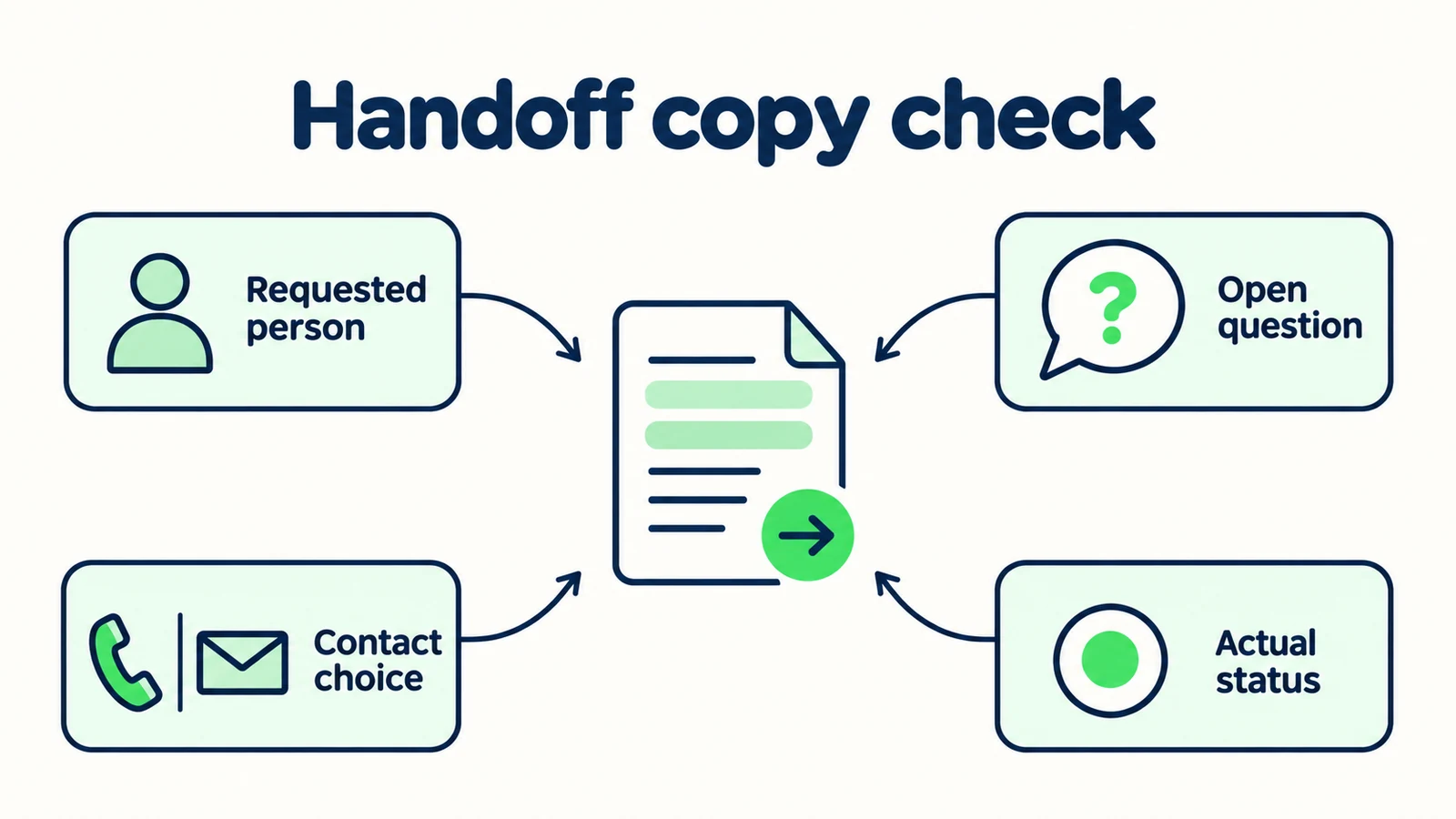
Review the receiving record too. A summary that says “customer unhappy” is less useful than “customer requested a person to review a discrepancy between the published package and their understanding.” Keep observations separate from interpretations. Do not diagnose mood or label a customer difficult.
Useful outcomes include fewer repeated explanations and clearer ownership of unresolved questions, but measure those through your own records. A handoff count alone cannot tell you whether the experience improved. Some handoffs are exactly what the customer wanted, and some apparently completed automated conversations may have ended in frustration.
Put the Messages Into a Real Operating Process
First, inventory the actions the business can actually support. List approved contact routes, message-delivery paths and any verified human-response behavior. Separate current capability from a planned integration. Do not write the ideal experience into copy before the underlying process exists.
Next, choose an owner for unresolved requests. Hyperleap AI's unified inbox gives the team a place to see conversations across supported channels, and conversation summaries can support follow-up. That does not by itself establish shift coverage, automatic assignment or a response commitment. Those remain operating decisions unless you have implemented and verified the relevant workflow.
Write the short customer messages after those responsibilities are clear. A message should not need to explain internal architecture. “The team will review your request through this route” is enough when accurate. Technical delivery details belong in internal documentation, not in the customer's path to help.
Run end-to-end tests using synthetic enquiries. Check that a direct person request does not lead into another qualification sequence. Check that the receiving note contains the unresolved question. Check the fallback when no staff member is available or a delivery action fails. Record the observed state before approving the corresponding wording.
Then ask a colleague who did not write the messages to read them. What do they think has happened? When do they think someone will reply? If their interpretation is stronger than the real process, revise the copy. This simple reading test catches many accidental promises.
Keep the messages current as team coverage or contact routes change. The support-template collection can supply broader examples, but every borrowed line still needs to fit your actual business. A useful template is a starting point, not authority to claim an action.
Frequently Asked Questions
Should the AI ask why a customer wants a person?
Not as a condition of providing the human route. A customer can prefer a person without explaining why. If a short topic helps route the request, ask optionally and use context already available. Do not turn the question into a barrier or require the customer to repeat the whole issue.
Can it offer to keep helping while the customer waits?
Yes, if the offer is genuinely optional and does not hide the approved next step. The customer should not have to accept more automated assistance to reach a person. Avoid saying someone is waiting or joining unless that state is verified.
What should it say when the team is unavailable?
State the approved availability information and provide a real contact or message route. Do not invent a callback time, queue position or staff member. If the business has no authorized response deadline, describe the next action without implying one through words such as immediately or shortly.
Does a unified inbox mean a human handoff is complete?
No. Visibility in an inbox and a person accepting responsibility are different things. Your operating process needs an owner and a way to review unresolved requests. Customer-facing copy should distinguish a collected request, verified delivery and an actual human response.
Should a handoff summary describe the customer's mood?
Prefer observable facts and the unresolved question. “Requested a person after disputing the package scope” is more useful than a subjective label such as difficult or angry. Include relevant customer wording when necessary, but avoid unnecessary personal details or assumptions about intent.
How do we verify a handoff message is honest?
Compare each verb in the message with evidence from the actual workflow. If the message says sent, verify delivery; if it says assigned, verify acceptance; if it promises a deadline, confirm the business authorized it. Test both normal and failed paths before approving the wording.
Make the Human Path a Real Choice
The right reply to a person request is not a clever way to keep the customer talking to AI. It is a clear acknowledgement, an honest next step and enough context to avoid a restart.
Review the messages your front desk uses today. Look for verbs that imply an action, words that imply a deadline and questions that keep the customer in a loop. Replace each unsupported promise with the real route your team can provide.
An AI front desk can handle routine questions while respecting the moment a person is needed. That balance is practical: the customer retains a choice, and your team receives a clearer account of what still needs attention.
Build a front desk that knows when to involve people
Use Hyperleap AI for everyday answers while keeping your team's review path clear and accessible.
Start for freeIndustry Solutions
See how AI chatbots work for these industries:
Related Articles

Tenant Maintenance Requests: A Clear Intake Template
Collect clearer non-emergency tenant maintenance requests with description prompts, contact boundaries and a practical property-team handoff.

AI Front Desk Holiday Hours and Escalation Playbook
Prepare holiday hours, honest response windows and clear escalation contacts with a practical AI front desk source sheet and review checklist.

AI Front Desk Welcome Messages: Examples That Help
Write useful AI front desk welcome messages with practical examples, clear capability boundaries and a checklist for your website greeting.

Unified Inbox Rules for Small Customer-Facing Teams
Give shared customer conversations clear ownership with practical unified inbox rules, handoff notes and a review checklist for small teams.