AI Answer Tone: A Small-Business Review Rubric
Review AI front desk answers for directness, respectful uncertainty, plain language and useful next steps with an original before-and-after rubric.

An AI answer can be accurate and still feel unhelpful. It may begin with a paragraph of enthusiasm before answering a simple hours question, use jargon the customer does not understand or apologize so often that the actual next step disappears. The opposite problem is an answer that sounds wonderfully confident while implying more certainty than your business can support.
Useful chatbot tone-of-voice guidelines address both problems. They define how an answer should behave: direct about known facts, respectful about uncertainty, clear about choices and precise about what happens next. “Friendly and professional” is a starting preference, not a review method.
This guide provides an original editorial rubric with illustrative before-and-after examples. It is a human review process, not a claim that a product automatically scores tone or approves every reply. Use it to examine real answer samples against approved sources, then turn the findings into better instructions and source material.
Tone Is How the Answer Helps, Not Just Its Personality
Tone is the effect of wording, order and emphasis on the reader. A cheerful greeting is only one part of it. An answer that respects the customer's time, explains uncertainty and offers a useful next action will often feel more considerate than one full of positive adjectives.
Begin by separating factual review from editorial review. The source determines whether a claim is allowed. The rubric determines whether the approved meaning is expressed clearly. A tone edit must not add a promise, remove an important condition or soften a boundary until it becomes misleading.
The customer-service best-practice guide covers the wider operating discipline. This article focuses on the line-by-line decisions an owner or reviewer can make without becoming a professional copywriter.
| Editorial dimension | What to look for |
|---|---|
| Directness | The customer's question is answered early |
| Plain language | Ordinary words replace unnecessary jargon |
| Respect | The customer is not blamed or patronized |
| Honest certainty | Facts, preferences and unknowns stay distinct |
| Useful brevity | Detail serves the task rather than filling space |
| Next step | The action and its status are understandable |
| Context | The reply uses relevant information already supplied |
Your AI front desk should sound like a helpful part of the business, not a marketing brochure responding to every sentence. A visitor asking where to park does not need a brand manifesto. Someone disputing an answer does not need a playful catchphrase. Good tone responds to the moment while preserving the same factual standards.
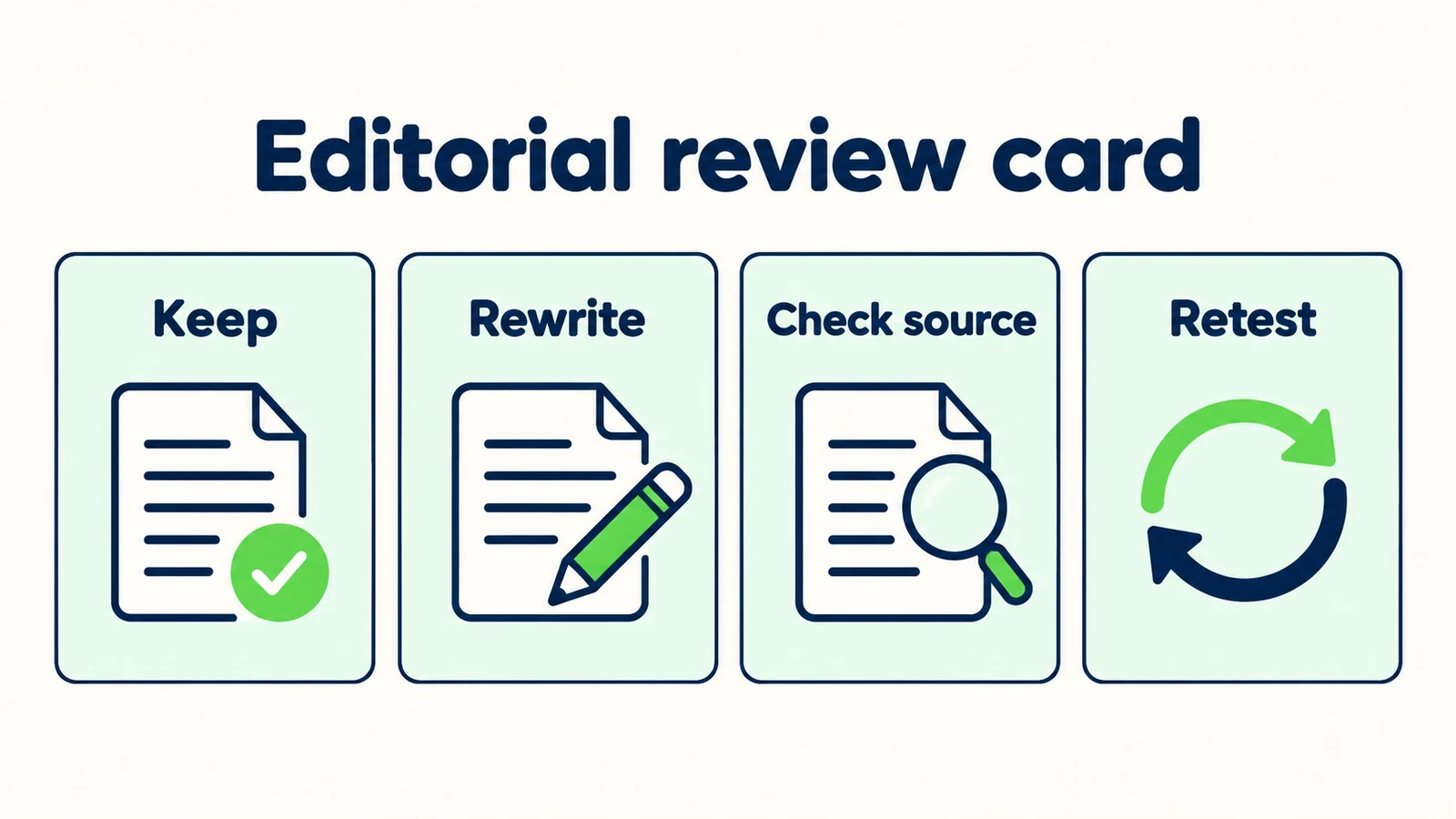
The rubric uses descriptive decisions rather than a universal numerical score. “Keep,” “rewrite” and “check source” tell a small team what to do. A high average score can conceal a single serious promise; a concrete review note makes that issue harder to miss.
Check meaning before polish
If an answer is unsupported, do not fix it by making it sound more cautious while leaving the same claim intact. Resolve the source or narrow the answer first, then review the wording.
Why “Friendly and Professional” Produces Inconsistent Answers
Reviewers mean different things by friendly
One person wants warmth and another wants speed. Without examples, they may keep rewriting the same sentence in opposite directions. Agree on observable behavior: acknowledge the request, answer it directly and avoid unnecessary ceremony.
Brand language overwhelms the task
A phrase that works in a campaign may feel strange in a support exchange. The front desk should not insert slogans into a complaint or a practical access question. Use brand personality lightly, with the customer's task taking priority.
Uncertainty is hidden to sound helpful
“Absolutely, we can arrange that” feels reassuring but may imply availability, approval or a capability the business has not confirmed. A respectful answer can say what is known and what needs a person. Confidence should come from clarity, not from removing qualifications.
A long answer is mistaken for a thorough answer
Length is useful only when it carries needed information. Repeating the question, praising it, listing generic benefits and adding an unrelated invitation can make a simple reply harder to use. The support-template collection offers starting patterns, but each needs editing for the actual situation.
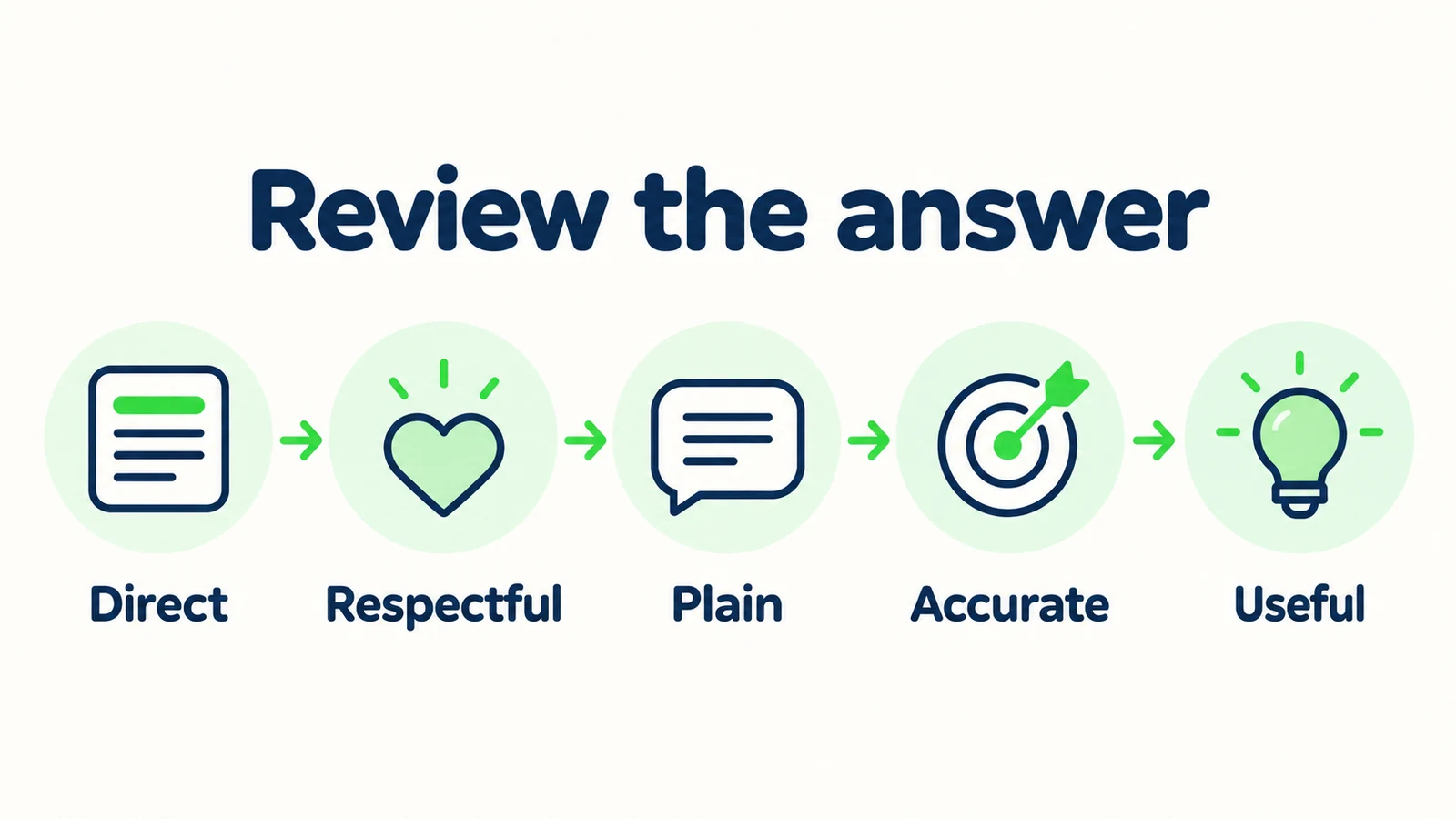
7 Editorial Checks for Customer-Facing AI Answers
1. Put the usable answer before the ceremony
Read the opening sentence and ask whether it helps the customer act. A simple factual question usually deserves a simple factual opening. Warmth can come through a natural sentence rather than an introductory paragraph.
Before: “Thank you so much for your wonderful question. We are always delighted to help customers learn more about our convenient opening arrangements.”
After: “The published reception hours are listed below. Are you asking about reception or an existing appointment?”
The after version still needs the actual approved hours in a real reply. Its purpose is to show the order: answer or clarify first, rather than spending the first screen on enthusiasm. Do not add a clarifying question if the customer's meaning is already clear.
Use this review note: “Move the answer to the opening; remove praise that does not help.” That instruction is more actionable than “make it punchier.” It also transfers across topics without forcing every reply into identical wording.
For a hotel front desk, the opening might state the published check-in policy. For a home-services front desk, it might identify whether a service is within the approved scope. The principle is the same even when the business facts differ.
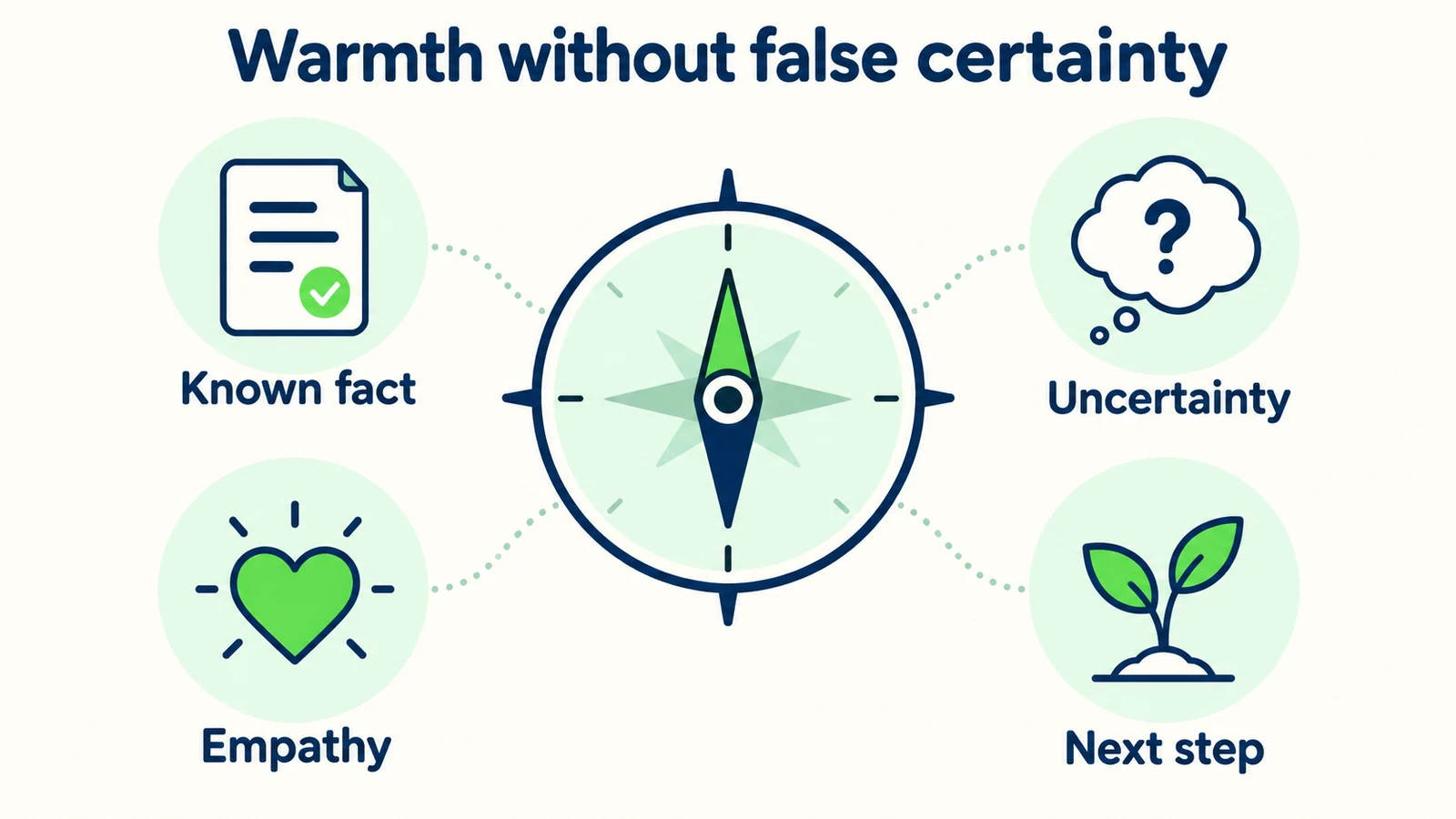
2. Preserve the level of certainty
Look for words that upgrade a request into a commitment: confirmed, guaranteed, arranged, approved or booked. Then ask what evidence supports the action. The edit should make the status clearer, not merely replace one confident word with another.
Before: “Perfect, your Friday visit is all sorted.”
After: “Friday is your preferred day. The next step is the booking page, where you can complete the appointment process.”
If the front desk cannot check availability, do not imply that Friday is offered by the business. If the linked process only submits a request, describe that accurately too. Tone review must follow the actual workflow.
Use a two-part note: “Known: customer prefers Friday. Unknown: availability and confirmation.” This makes the edit grounded in evidence rather than taste. A reviewer can then judge whether the revised answer preserves both facts.
Avoid turning uncertainty into a wall of disclaimers. “The team needs to confirm that detail” is often enough. Follow it with the real next step. A concise boundary can feel more helpful than a long apology because it tells the customer what to do with the uncertainty.
3. Replace internal terms with the customer's task
Customers should not need to understand your software architecture to ask a business question. Replace internal process terms with the action they describe, unless the customer is specifically asking for technical detail.
Before: “Your payload will be routed to the appropriate escalation workflow for downstream processing.”
After: “The team needs to review your request. Here is the approved contact route.”
The second sentence must match the actual process. Do not simplify “a request can be collected” into “the team has received it.” Plain language is not permission to skip a state distinction.
Create a short translation list for recurring internal words. “Lead qualification” can become “a few questions to understand what you need.” “Source conflict” can become “the available information does not agree.” “Escalation” can become “a person needs to review this.”
Keep specialist language when it is genuinely useful to the reader and explain it briefly. An IT buyer may want technical detail; a property guest usually does not. The review question is not “is this word technical?” but “does this reader need the term to understand the next step?”
4. Show respect without inventing emotion
Acknowledge the situation the customer described. Avoid claiming to know exactly how they feel, diagnosing their mood or making them responsible for the system's confusion.
Before: “You seem confused. Please provide the correct information.”
After: “I may be missing one detail. Are you asking about a new request or an existing booking?”
The revised question identifies the missing distinction and leaves room for the customer to answer. It does not imply blame. If the customer already supplied that detail, use it rather than asking again.
For a complaint, factual acknowledgement can be stronger than exaggerated empathy. “You expected the package to include the additional item” is grounded in the message. “I completely understand your frustration” may be generic and adds little if the next step is still unclear.
Avoid diminutives, patronizing reassurance and instructions such as “calm down.” Keep the tone steady when the customer is brief or annoyed. The human-handoff guide is especially relevant when the person asks to stop automated assistance; respectful tone includes honoring that preference, not just wording the refusal pleasantly.
5. Make brevity serve comprehension
Remove repetition, but keep conditions that affect the customer's decision. A shorter answer is not better if it drops the difference between a starting price and a final quotation, or between a general policy and a booking-specific exception.
Before: “Our pricing is flexible and designed around you, so there are many possible options depending on a range of factors that our experienced team would be very happy to explore.”
After: “The price depends on the service scope. Tell me which service you need, and I can help prepare a request for the team.”
The revised answer identifies the dependency and the next question. If a published price guide exists, it can be shared with its conditions. If none exists, do not add a range merely to make the answer feel complete.
Use short paragraphs for different jobs: answer, qualification or next step. Avoid a long bullet list when one question will do. On a phone, the customer should be able to find the action without scrolling past a repeated explanation.
The review note should identify what was removed and why. “Deleted generic benefits; kept the scope condition” is more useful than “cut by half.” A word-count target can encourage indiscriminate trimming; a task-based edit preserves meaning.
6. Make the next step specific and honest
“Let us know if you need anything” is polite but may not help someone with an unresolved request. Tell the customer which action is available and what remains to be done. Do not imply that an internal process has started when the reply merely offers it.
Before: “Our team will take care of everything shortly.”
After: “The team needs to review the additional request. You can send it through the contact page, or provide a contact method if you want to use the follow-up process offered here.”
Only offer the follow-up process if it exists in the actual configuration. Replace generic examples with the approved business route before publishing. A link should be current and relevant, not a vague homepage destination.
Ask a reviewer what they believe has happened after reading the answer. If they think a person has already accepted the task, but only an enquiry was collected, the wording needs work. This interpretation test is often more revealing than checking whether the answer contains a banned phrase.
Use the lead-summary guide to keep the internal next action equally precise. Customer copy and staff notes should describe the same state, even when they use different levels of detail.
7. Use the context without overinterpreting it
A good reply acknowledges relevant information already supplied. A poor one asks the same question again or invents a conclusion from a small clue. Review both failures together: ignoring context and overreading context.
Customer: “We are flexible on dates, but the venue needs an indoor option.”
Before: “What is your exact date and why do you need an indoor venue?”
After: “I will keep the date flexibility in mind. Are you asking about the published indoor spaces, or would you like the team to discuss which option suits your event?”
The after example uses the stated preference without inferring a reason. It still needs the approved venue information if the customer wants a factual answer. Do not treat the script as a substitute for the source.
Record which context the reply used and whether it was stated or inferred. If the summary says the customer is ready to buy because they asked about price, flag that as interpretation rather than fact.
The qualification guide helps define relevant context. Tone improves when the front desk asks fewer unnecessary questions and carries the useful answers forward accurately. It should feel attentive because it is responding to the conversation, not because it repeatedly says it is listening.
Give your front desk a clearer voice
Use Hyperleap AI with approved sources, practical answer boundaries and examples your team has reviewed.
Start for freeThe Keep, Rewrite or Check-Source Rubric
Use a simple decision for each reviewed answer. Do not average away a serious issue. A message can be concise and respectful while still requiring a source correction.
| Decision | When to use it | Required note |
|---|---|---|
| Keep | Meaning and wording fit the task | Why this is a useful example |
| Rewrite | Approved meaning is clear but expression is poor | Specific wording behavior to change |
| Check source | Fact, scope or authority is uncertain | Which owner or source must resolve it |
| Retest | A correction has been made | Customer prompt and expected meaning |
Add a short evidence card beneath the decision: customer question, governing source, original answer, revised answer and reviewer. Preserve the specific defect. “Too salesy” is less useful than “adds an unrelated trial invitation before answering the cancellation question.”
Review a mixed sample rather than only polished demonstrations. Include an ordinary factual question, a missing-detail question, a price enquiry, a complaint, a human request and a question outside the approved knowledge. These are categories for your editorial exercise, not a claim of complete coverage.
When reviewers disagree, return to the customer's task. Does the wording help them understand the answer and the next step? Does it preserve the business's actual certainty? If both versions do, the difference may simply be preference. Choose a house style and move on rather than turning every sentence into a prolonged debate.
Track recurring defects in your own review log. Repeated jargon may suggest an instruction problem; repeated uncertainty may reveal missing source information. Do not assume every tone issue is solved by a stronger personality prompt.
Turn the Rubric Into Better Instructions
Choose a small set of representative answers and review them with the person who handles customer enquiries. Start with the actual task and source, then apply the editorial checks. Keep sensitive customer details out of shared training examples and use synthetic replacements where appropriate.
Write a short style instruction based on observed defects. For example: “Answer the question in the opening sentence when the source supports it. Keep conditions that affect the decision. Ask one useful clarifying question when needed. Do not claim an action happened unless the workflow confirms it.” This is more operational than a long list of personality adjectives.
Add a few approved examples that show different situations. Include a clear factual answer and a respectful boundary. If all examples are cheerful sales enquiries, the front desk has little guidance for a disputed policy or a request for a person.
Keep factual corrections in the source set, not just the tone prompt. If two documents disagree, asking the AI to sound confident or concise will not resolve the business decision. Use the knowledge-base guide to maintain the approved information separately from voice instructions.
Retest the original questions and variations after editing. Review whether the changed instruction improved one case while making another too terse, repetitive or cautious. The aim is consistent helpfulness, not a single canned response for every situation.
Hyperleap AI provides the source-grounded front-desk conversation and configurable behavior. This rubric is the human editorial layer around it. It does not promise automatic approval, perfect consistency or a universal tone score. Keep an owner for the examples and revisit them when services, policies or customer expectations change.
Frequently Asked Questions
What tone should an AI front desk use?
Use a tone that answers the customer's question directly, respects their choices and describes uncertainty honestly. The exact level of warmth can fit your business, but friendliness should not add promises or bury the next step. Practical behavior is easier to review than broad personality adjectives alone.
Should every answer be short?
No. It should be as concise as the task allows without dropping important conditions. A simple hours question may need little explanation, while a policy question may require scope and an exception route. Remove repetition and generic promotion before removing information the customer needs to decide what to do.
How do we make an uncertain answer sound confident?
Make the boundary clear rather than disguising uncertainty. State what is known, what needs review and the available next step. A calm, direct answer can feel dependable without pretending the business has confirmed a detail it has not checked.
Is tone review the same as checking accuracy?
No. Accuracy and authority depend on the approved source and actual workflow. Tone review checks how that meaning is expressed. If a fact is unsupported, resolve the source or narrow the answer before polishing the wording. A pleasant version of a false claim remains a problem.
Does Hyperleap AI automatically apply this scoring rubric?
This is a suggested human review process, not a native scoring or approval feature claim. Your team can keep the decisions in a shared record and use the findings to improve sources and behavior instructions. Verify product capabilities separately from the operating practices described here.
How can a small team review answers without creating lots of work?
Start with recurring enquiry types and known problem answers. Use a simple keep, rewrite or check-source decision with one specific reason. Reuse approved examples and retest meaningful changes. The goal is to identify patterns worth fixing, not to debate every stylistic variation in every conversation.
Make Helpful the Standard, Not Enthusiastic
The most useful AI answer is not necessarily the warmest, longest or most confident. It is the answer that meets the customer's task, preserves the truth and makes the next step understandable.
Use the rubric to identify concrete defects: the answer arrives too late, an unknown becomes a promise, jargon hides the action or a repeated question ignores context. Fix the source when the meaning is uncertain and the wording when the meaning is already approved.
Over time, your examples can become a small, practical voice guide grounded in real enquiries. That is a stronger foundation than asking the front desk to sound friendly and hoping every reader means the same thing.
Build answers your team would be comfortable sending
Create a Hyperleap AI front desk and tune its responses with approved information and clear editorial examples.
Start for freeIndustry Solutions
See how AI chatbots work for these industries:
Related Articles

Ask for Contact Details Without Blocking the Answer
Use practical contact-request scripts that explain the purpose, respect customer choice and keep useful answers separate from lead capture.

When Customers Ask for a Person: Reply Examples
Use respectful replies for customers who ask for a person, with clear availability wording, honest handoff status and a practical copy-review pack.

Tenant Maintenance Requests: A Clear Intake Template
Collect clearer non-emergency tenant maintenance requests with description prompts, contact boundaries and a practical property-team handoff.

AI Front Desk Holiday Hours and Escalation Playbook
Prepare holiday hours, honest response windows and clear escalation contacts with a practical AI front desk source sheet and review checklist.