AI Chatbot for Travel Agencies: Itinerary Inquiries at Scale
Travel agencies field hundreds of itinerary questions, availability requests, and package inquiries every week. Here is how AI chatbots handle them 24/7.

TL;DR: A family planning their first international trip doesn't send one inquiry and wait a week. They message three agencies, and the first to reply with a coherent itinerary outline wins the booking. An AI chatbot for travel agencies answers destination questions, shares itinerary options, and captures lead details 24/7 — so your agents are spending their time on customization and closing, not playing catch-up on overnight inquiries.
AI Chatbot for Travel Agencies: Itinerary Inquiries at Scale
Travel planning is an emotionally driven process. A couple researching their honeymoon, a family coordinating a multi-generational trip, a corporate travel manager comparing business travel packages — they're all doing their research outside your agency's business hours, on evenings and weekends, when their excitement is highest and their decision-making is most active.
If your agency's website has a contact form that routes to an inbox that gets reviewed Monday morning, you're losing those inquiries to agencies that respond the same night. According to research by InsideSales, leads contacted within five minutes of inquiry are dramatically more likely to convert than those reached hours later. For travel agencies where average booking values run into thousands of dollars, even one recovered booking per week changes the annual P&L.
An AI chatbot for travel agencies doesn't close the deal — your agents do that. But it makes sure every inquiry gets an intelligent, immediate response instead of disappearing into a contact form queue.
What Travel Agency Inquiries Actually Look Like
Understanding the shape of your inquiry volume is the first step to configuring a chatbot that adds value rather than friction.
Travel agency inquiries typically fall into four categories:
| Inquiry Type | Examples | What the Client Needs |
|---|---|---|
| Destination research | "Is Bali good in August?" "Best places for families in Europe?" | Quick, confident answers + next step |
| Package/itinerary questions | "Do you offer 10-day Japan itineraries?" "What's included in your Maldives package?" | Specific package details + pricing range |
| Availability and pricing | "Do you have availability for 2 adults in October?" "What does a week in Peru cost?" | Prompt to capture travel dates + budget |
| Booking process | "How do I book?" "What's your cancellation policy?" "Do you charge a planning fee?" | Clear process explanation + contact capture |
The first three categories are all conversations your chatbot can handle effectively. The fourth is pure FAQ — no human should be spending time answering "how do I book with you?" at 11 PM.
Who This Guide Is For
This guide is written for independent travel agency owners and small agency teams (2–15 agents) who want to capture more inquiries without adding administrative staff. The principles apply equally to specialty travel agencies (adventure, luxury, family, corporate) and general travel consultants.
Why Travel Agencies Lose Inquiries Before the First Conversation
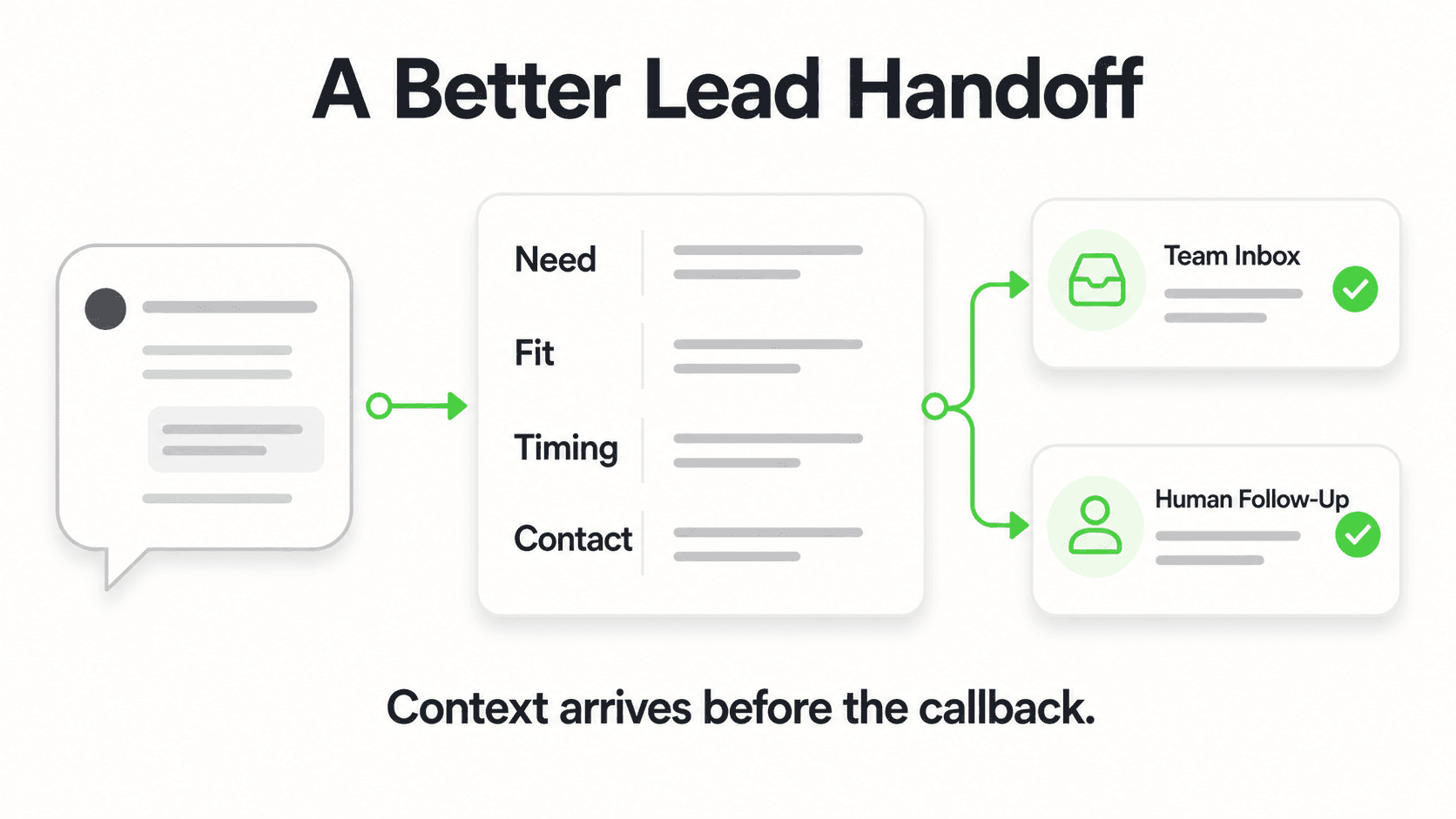
The gap between an inquiry and a booking is longer in travel than in most service businesses — trips require planning, customization, and trust. But the window for capturing that inquiry is just as short.
The research phase happens at night. Travel decisions are made during the planning phase, which typically happens evenings and weekends when clients are relaxed and thinking about their next trip. This is exactly when your agency isn't staffed.
Comparison shopping is the norm. Clients rarely send one inquiry to one agency. They message three or four, get responses from whoever is first, and narrow their list from there. An agency that responds in 30 seconds at 9 PM beats an agency with a better itinerary that responds at 9 AM the next morning — not because the itinerary is worse, but because the relationship window has already opened elsewhere.
High-value clients have high expectations. The couple booking a $15,000 honeymoon itinerary has a certain level of service expectation. An immediate, warm, knowledgeable response — even from an AI — signals that your agency is organized and responsive. Silence signals the opposite.
Repetitive questions consume agent time. "Do you cover Southeast Asia?" "What's the difference between your Bali packages?" "What does a 12-day itinerary to Japan cost?" Your best agents should be building custom proposals, not answering the same seven questions every day. A chatbot handles the FAQ volume so agents can focus on high-value customization.
5 Ways a Travel Agency Chatbot Creates Value
1. Captures Inquiry Details Before Your Team Logs On
When a potential client messages your website or Instagram DM at 8 PM asking about a Tuscany honeymoon, they're in peak planning mode. Your chatbot greets them immediately, asks about travel dates, number of travelers, approximate budget range, and any specific interests (wine tours, cooking classes, coastal drives).
By 8:05 PM, you have a qualified lead with complete trip details — dates, budget, interests — ready for an agent to build a preliminary proposal first thing in the morning. The client gets an immediate acknowledgment and a clear next step. Without the chatbot, they get silence.
2. Answers Destination and Itinerary Questions Accurately
Train your chatbot on your destination expertise — the regions you specialize in, the types of trips you build, the vendors and properties you work with. When a client asks "Is your Japan itinerary good for solo travelers?" or "Do you have family-friendly options in Costa Rica?", the chatbot can give a substantive, accurate answer drawn from your documented knowledge base.
This is the difference between a generic "contact us and we'll let you know" response and the kind of immediate, confident answer that builds trust. Clients who receive specific, useful information in the first interaction are more likely to continue the conversation with your agents.
3. Handles Repetitive FAQ Volume
Your agency has a set of questions it answers hundreds of times per year:
- What does your planning fee cover?
- Do you work with solo travelers / groups / corporate accounts?
- How far in advance should I book an international trip?
- What's your cancellation and change policy?
- Do you handle travel insurance?
- What destinations do you specialize in?
Document the answers once, train the chatbot, and it handles these questions automatically — 24/7, on every channel you deploy it. Your agents stop answering the same FAQ for the hundredth time and start spending that reclaimed hour on itinerary building.
4. Routes Inquiries to the Right Agent or Queue
Not all travel inquiries belong in the same queue. A corporate travel account inquiry has different priority and handling than a leisure honeymoon inquiry. A last-minute urgent booking has different routing than a trip being planned 18 months out.
Configure your chatbot to ask one or two routing questions at the start of every conversation — travel type (leisure/corporate/group), timeline, and destination region — and route the lead to the right agent or inbox. Your team gets pre-sorted inquiries rather than a flat pile of undifferentiated messages.
5. Shares Your Consultation Booking Link
After capturing initial inquiry details, the chatbot's most valuable next step is moving the client toward a real conversation with an agent. It does this by sharing your consultation scheduling link: "Our travel consultant would love to put together a custom itinerary for you — here's a link to book a 20-minute call."
This removes the email back-and-forth of "when are you available?" and turns an inquiry into a scheduled discovery call. The client's interest converts to a calendar event while the motivation is high, not after two days of missed email exchanges.
Capture Every Travel Inquiry After Hours
Deploy a chatbot that answers destination questions, captures trip details, and schedules consultations 24/7 — so your agents wake up to qualified leads, not missed inquiries.
See How It WorksSetting Up Your Travel Agency Chatbot: A Practical Guide
For the step-by-step conversation flow — instant answer, qualifying questions, booking link or lead capture, human handoff — see how to handle travel booking inquiries with AI chat.
Step 1: Build Your Knowledge Base
Your knowledge base is the foundation of your chatbot's responses. For a travel agency, it should cover:
- Destination expertise: Which regions and countries you specialize in, what types of trips (luxury, adventure, cultural, family, honeymoon, etc.) you build in each
- Package overview: General descriptions and pricing ranges for your common itineraries — no need to publish exact prices, but "Bali 7-night packages typically start around $X per person" sets useful expectations
- Process documentation: How a client engages with your agency, what the planning fee covers, typical timeline from inquiry to booking, what's included vs. what clients book independently
- FAQ answers: Every question your agents answer more than once per week belongs in the knowledge base
Keep the knowledge base updated as your offerings and pricing evolve. A chatbot trained on stale information gives wrong answers — building and maintaining accuracy is an ongoing commitment, not a one-time task.
Step 2: Configure Your Intake Flow
Your intake flow is the structured set of questions the chatbot asks to qualify an inquiry. For travel agencies, a good intake collects:
- Travel destination or region (or is this flexible?)
- Travel dates or approximate timeframe
- Number of travelers and composition (adults, children, ages)
- Budget range (broad brackets work: "under $5K", "$5K–$15K", "$15K+")
- Any specific interests or must-haves
Five questions is the right depth. Fewer misses important qualification data; more creates friction and drops completion rates.
Step 3: Deploy on Your Highest-Traffic Channels
Start with your website widget — that's where research-phase traffic lands from Google searches and referrals. If you're active on Instagram (common for visually-driven travel agencies), connecting Instagram DM allows you to capture inquiries from your content and ads. WhatsApp is valuable if you have a client base that prefers messaging.
See the multi-channel AI chatbot strategy guide for how to prioritize channels based on where your clients actually come from.
Step 4: Set Up Escalation Paths
Define which inquiry types should escalate immediately to a live agent rather than being handled by the chatbot:
- Existing booking changes or cancellations (requires access to booking records)
- Complaints or service recovery situations
- Time-sensitive urgent bookings (traveling within 72 hours)
- Large group or corporate account inquiries where relationship matters from the first contact
Everything else the chatbot handles. These defined escalation paths prevent the chatbot from frustrating clients who need human judgment while freeing agents from routine qualification work.
The ROI Framework for Travel Agencies
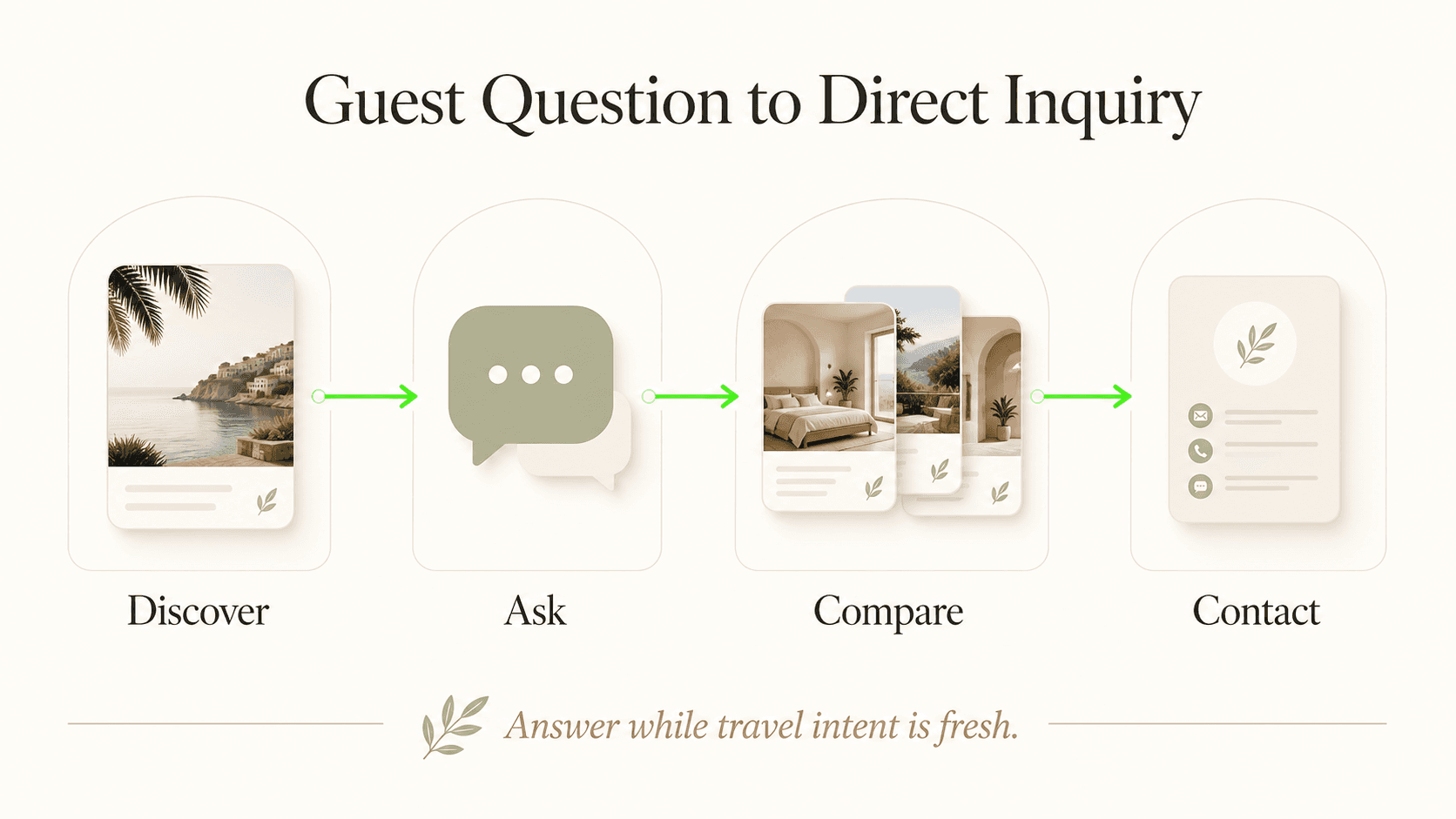
The clearest ROI calculation for a travel agency chatbot focuses on recovered after-hours inquiries:
Illustrative scenario: A boutique travel agency receives 15 inquiries per week. Industry patterns suggest a meaningful portion of these arrive outside business hours — evenings and weekends when clients are most actively planning. Assume 6 after-hours inquiries per week are currently going unanswered until the next business day.
If even 3 of those 6 per week convert to bookings at an average value of $4,000, that's $12,000 in incremental weekly revenue — or roughly $48,000 per month from what was previously lost business.
Against a $40–$100/month chatbot subscription, the math is straightforward. The specific numbers will vary for every agency, but the framework is the same: what is the value of inquiries that currently go unanswered, and what fraction would you need to recover to justify the cost?
Frequently Asked Questions
Will a chatbot undermine the personal touch that distinguishes a boutique travel agency?
No, when configured correctly. The chatbot handles the information and logistics layer — destination FAQs, package overviews, intake collection — and routes clients to your agents for the relationship layer. Most clients actually appreciate getting an immediate, useful response at 9 PM rather than waiting until the next business day. The handoff from chatbot to agent can be warm and seamless if the chatbot gathers the right intake information upfront.
Can the chatbot actually describe itineraries to clients?
Yes, with proper training. Train the chatbot on your documented itinerary descriptions — overview, highlights, what's included, typical pricing ranges. It can describe a 10-day Japan itinerary or a Patagonia trekking trip accurately from your knowledge base. For custom itinerary building and specific pricing, the chatbot routes to your agents, which is the appropriate division of labor.
What channels should a travel agency deploy on first?
Start with your website widget, which captures traffic from Google searches and direct visits. If you generate leads through Instagram — common for visually-driven travel brands — add Instagram DM. WhatsApp is valuable if your client communication already happens there. Facebook Messenger can be added if you run Facebook ads. See the full multi-channel strategy guide for deployment sequencing.
Does the chatbot replace travel consultants?
No. Travel consultants provide expertise, customization, and relationship that are central to the agency value proposition. The chatbot handles volume at the top of the funnel — first response, FAQ handling, intake collection — so consultants can focus on building proposals, managing bookings, and maintaining client relationships. The goal is to make consultants more productive, not to replace them.
How does the chatbot handle pricing questions without committing to a quote?
Train the chatbot to provide ranges with explicit caveats: "Our Bali packages typically start around $X per person for 7 nights depending on accommodation level and inclusions — your consultant will put together a custom quote based on your specific dates and preferences." This is honest, useful, and keeps the detailed conversation with your agents where it belongs.
How much does it cost?
Hyperleap AI plans start at $40/month (Plus plan) with a 7-day free trial. Credit card required. The pricing page has full plan details. For a travel agency where one recovered inquiry can represent thousands of dollars in commission, the subscription cost is covered by a fraction of a single additional booking.
Can I use this for Instagram DM inquiries from my travel content?
Yes. Hyperleap AI supports Instagram DM as a channel. Travel agencies with active Instagram presence often receive significant inquiry volume through DM — followers asking about trips they've seen on your feed or stories. Connecting Instagram DM to your chatbot means those inquiries get an immediate response rather than waiting hours for a manual reply.
The Inquiry That Gets Answered First Becomes the Booking
Travel planning is competitive. Your clients are doing their research, comparing agencies, and building their shortlist — and they're doing it at 8 PM on a Tuesday while you're not at your desk.
An AI chatbot for your travel agency ensures that every inquiry — whether it arrives at noon or midnight, on your website or your Instagram DM — gets an intelligent, immediate response. It captures trip details, answers destination questions from your knowledge base, and routes the right inquiries to the right agents.
Your consultants still do the work that matters: building itineraries, managing vendor relationships, and closing bookings. The chatbot makes sure they have a full pipeline of qualified, pre-briefed inquiries to work with every morning, rather than a pile of overnight messages that may or may not still be engaged.
Explore how hospitality and travel businesses use AI to handle inquiry volume at scale, and see the AI chatbot statistics for 2026 for broader context on how AI is changing customer response expectations.
Can the chatbot book travel directly?
It captures itinerary inquiries — destination, dates, party size, preferences — and hands the booking-ready lead to your agents. Hyperleap does not have native GDS or OTA API integrations; booking happens in your existing booking platform.
Does it work in multiple languages for international clients?
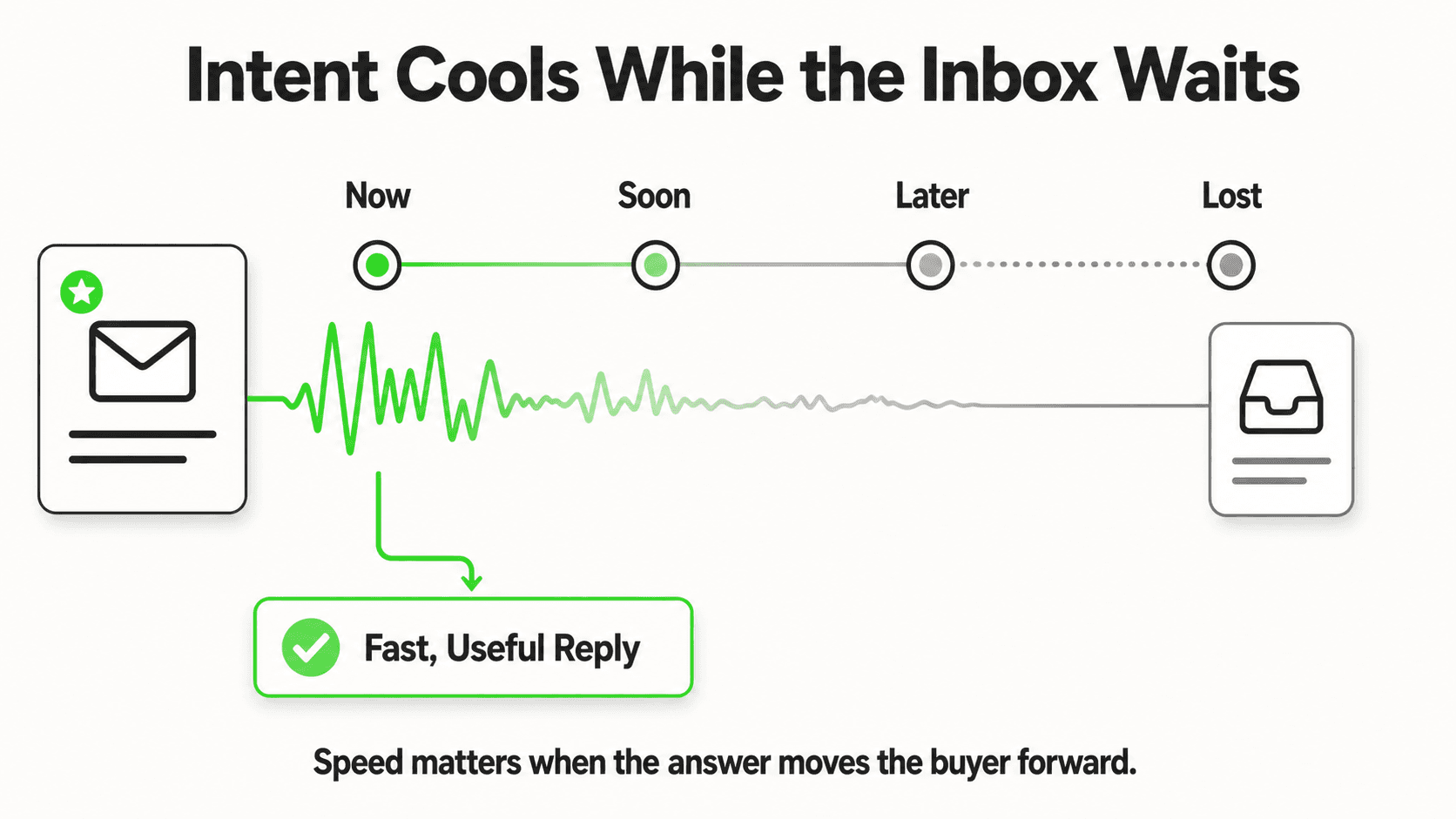
Yes. Hyperleap supports 100+ languages, so a client browsing your Spain itineraries in Spanish and another asking about Japan in English get equally fluent responses from the same deployment.
How long does it take to set up an AI chatbot with Hyperleap?
Most SMBs go live in 3–5 days for self-serve setup. With Managed Setup ($299 Free, available on every plan), Hyperleap builds the bot for you on your content and channels. A 7-day free trial is included on every plan.
Further Reading
Authoritative external sources used and recommended for further research on this topic:
Turn After-Hours Inquiries Into Booked Trips
Hyperleap AI responds to travel inquiries 24/7, captures trip details, and routes consultations — so your agents wake up to a full pipeline.
Start Free TrialRelated Articles

How to Handle Travel Booking Inquiries With AI Chat?
The pattern: instant answers from your content, qualifying questions on dates and budget, a booking link or lead capture, then a human for multi-leg trips.
AI Receptionist for Landscaping Businesses
An AI receptionist for landscaping businesses answers quote and service questions 24/7, qualifies property details, and shares your booking link.
AI Receptionist for Roofing Companies: Never Miss a Lead
An AI receptionist for roofing companies answers storm-damage and estimate questions 24/7, qualifies homeowners, and routes leads to your team.

AI Chatbot for Moving Companies: Win the Quote Race
A chatbot for moving companies qualifies quote requests instantly — origin, destination, home size, date — so you respond before rival estimates land.