AI Receptionist for HVAC: Handle Summer Call Surges
How an AI receptionist for HVAC companies covers seasonal call surges, qualifies emergency vs. maintenance requests, and books jobs 24/7.

TL;DR
- The first heat wave of summer doesn't just spike call volume — it can push it 3-4x above a normal week, and most HVAC front offices are staffed for the average week, not the peak one.
- Home service businesses miss an estimated 27% of inbound calls, and 85% of callers who hit voicemail never call back — they call the next HVAC company on the list (Source: Invoca, via industry research cited by Dialzara).
- With HVAC leads costing $45-$85 from paid channels (Source: LocaliQ), every call that rolls to voicemail during a no-cool emergency is ad spend thrown away.
- An AI receptionist for HVAC is a chat-based system — website, WhatsApp, Instagram DM, Facebook Messenger — that answers instantly, separates true no-heat/no-cool emergencies from routine maintenance-plan questions, and collects the details your dispatcher needs. It does not answer phone calls today; voice is on Hyperleap's roadmap, not a current capability.
- It's designed to work alongside your existing phone line and answering service, not replace them — most HVAC companies that adopt one keep phone coverage for callers and add the AI receptionist to catch the growing share of homeowners who research and message online first.
Your phones are already ringing off the hook. It's the first real heat wave of the season, the forecast says triple digits through the weekend, and every AC unit that's been quietly struggling since May decides to quit at once. Call volume doesn't creep up — it jumps 3-4x almost overnight, and it stays there for days. Your office manager, who normally handles the morning's dispatch schedule and maybe fifteen calls, is now fielding sixty, and half of them are hitting voicemail because there simply aren't enough hands to answer. Somewhere in that overflow is a homeowner with no AC and two toddlers, ready to book the first company that picks up — and a maintenance-plan customer with a simple filter question who just wants five minutes of someone's time. Neither gets it today.
That gap between "our phones can handle a normal Tuesday" and "our phones cannot handle the first heat wave of the year" is where HVAC companies lose the most valuable jobs of the season. This guide covers how an AI receptionist for HVAC companies closes that gap — not by replacing your phone team, but by catching the chat, web, and social inquiries your office can't get to during a surge, qualifying them correctly, and handing your dispatcher a job that's ready to book. For the full product walkthrough across industries, see our complete AI receptionist guide.
What Is an AI Receptionist for HVAC Companies?
An AI receptionist for HVAC companies is software that answers customer inquiries automatically on your website chat widget, WhatsApp Business, Instagram DM, and Facebook Messenger, using a large language model grounded in your own service documentation to ask the right qualifying questions and route each inquiry to the right outcome. It is not a phone system — it's the chat layer that runs alongside one.
That distinction matters more for HVAC than almost any other trade, because HVAC demand is genuinely phone-heavy: an elderly homeowner with no heat in January is far more likely to call than to open a chat widget. An honest AI receptionist for HVAC doesn't pretend to solve that problem. What it solves is the growing share of HVAC inquiries that already start online — a homeowner Googling "AC not cooling" at midnight, someone comparing three companies' reviews before reaching out, a maintenance-plan customer messaging on Facebook because it's easier than being on hold. For a direct breakdown of when chat coverage fits and when a live phone answering service still wins, see our comparison of AI receptionists vs. answering services.
What an AI receptionist for HVAC actually does:
- Answers instantly across web chat, WhatsApp, Instagram DM, and Facebook Messenger — no hold music, no "please leave a message"
- Asks HVAC-specific qualifying questions (system type, symptom, is there any cooling/heating at all, property type) before a human ever sees the conversation
- Separates true emergencies (no heat, no cool, gas smell, water leak from the unit) from routine requests (maintenance-plan renewal, filter questions, quote for a new install) using routing logic — never a clinical or safety judgment call
- Gates every conversation behind a lead form that collects name, phone number, and address before the back-and-forth starts, so your dispatcher has a real, callable lead even if the customer never replies again
- Runs 24/7 without adding a night shift, at a flat monthly software price starting at $40/month
Who this guide is for
This is written for HVAC company owners, office managers, and dispatchers who are watching their front office get overwhelmed during seasonal surges — and want a way to catch chat, web, and social inquiries without adding headcount for two peak months a year. If your leads are almost entirely inbound phone calls today, read the "chat-first, not phone-first" section closely before assuming an AI receptionist replaces your phone coverage.
Why HVAC Companies Miss Calls During Seasonal Surges
HVAC call volume isn't steady — it's a baseline with two enormous, predictable spikes: the first real heat wave of summer and the first hard freeze of winter. Staffing for the peak means paying for idle capacity most of the year; staffing for the average means getting buried exactly when the highest-value jobs come in.
The first heat wave overwhelms a front office built for an average week
A front office sized for 15-20 calls a day doesn't scale to 60-80 overnight just because the temperature did. Most HVAC companies don't add seasonal front-office staff — hiring, training, and then laying off a receptionist for two months a year rarely pencils out. The result is a front office that's structurally under-resourced for exactly the days when demand (and job value) peaks hardest.
Missed calls have a real, quantifiable cost
Home service businesses miss an estimated 27% of inbound calls on average, and some sources put the miss rate as high as 62% during peak periods (Source: Invoca; cited via Medium/Jack Graham). Worse, 85% of callers who reach voicemail never call back — they simply call the next HVAC company on their search results page (Source: Invoca, via Dialzara). During a heat wave, "the next HVAC company" is one search away and just as desperate for the job as you are.
Paid lead cost makes every missed inquiry worse
HVAC companies commonly pay $45-$85 per lead through Google Ads and local service ads (Source: LocaliQ). A missed call during a surge isn't just a lost job — if that inquiry came from paid search, it's ad spend you already paid for, wasted the moment it rolled to voicemail. Cost per lead has also risen for the majority of home service businesses year-over-year, which raises the stakes on every missed inquiry further (Source: LocaliQ).
Maintenance-plan customers get crowded out by emergencies
During a surge, the loudest calls — no cooling, no heat, a burst line — understandably get priority. But that means routine maintenance-plan renewals, filter questions, and new-install quote requests sit unanswered for days, quietly eroding the recurring-revenue relationships that keep a business stable in the off-season. Those customers rarely complain loudly; they just don't renew next year.
The compounding problem
Surge periods don't just cost you the calls you miss during the surge — they also cost you the maintenance-plan and routine customers who get deprioritized while your team fights fires. An AI receptionist can hold both queues open at once: emergencies routed fast, routine requests answered without waiting for the surge to pass.
7 Ways an AI Receptionist Handles HVAC Call Surges
1. Seasonal surge coverage without seasonal hiring
What this looks like in practice: The first 95-degree day of the year hits, and inbound chat volume on your website triples. Instead of a queue building up behind your one office manager, the AI receptionist answers every conversation the moment it starts — the hundredth chat of the day gets the same instant response as the first.
Real-world impact: Because pricing is a flat monthly plan rather than per-agent or per-minute, capacity during a surge doesn't cost more than a normal week — you're not paying overtime or a temp agency for two months of the year.
Why it works: The bottleneck in a phone-and-email front office is human attention, which is finite. A chat-based AI receptionist has no queue limit; every homeowner gets answered at the same moment they reach out, whether it's the 3rd inquiry of the day or the 80th.
2. Separating emergencies from routine maintenance requests
What this looks like in practice: A homeowner messages "my AC stopped completely, it's 98 degrees inside." The AI receptionist asks two or three targeted follow-ups — is there any airflow, is the thermostat display on, when did it stop — and flags the conversation as urgent. A different customer messages "when's my next maintenance visit" and gets a routine scheduling response, no urgency flag, no dispatcher interruption.
Real-world impact: Your dispatcher's attention goes to the calls that actually need it first, instead of scrolling through a mixed queue of emergencies and filter questions to find the ones that matter.
Why it works: The AI is routing based on symptom keywords and structured questions you define — not making a clinical or safety determination. It escalates ambiguous or high-risk situations (gas smell, active water damage) to a human immediately rather than guessing.
3. HVAC-specific qualification questions before a human gets involved
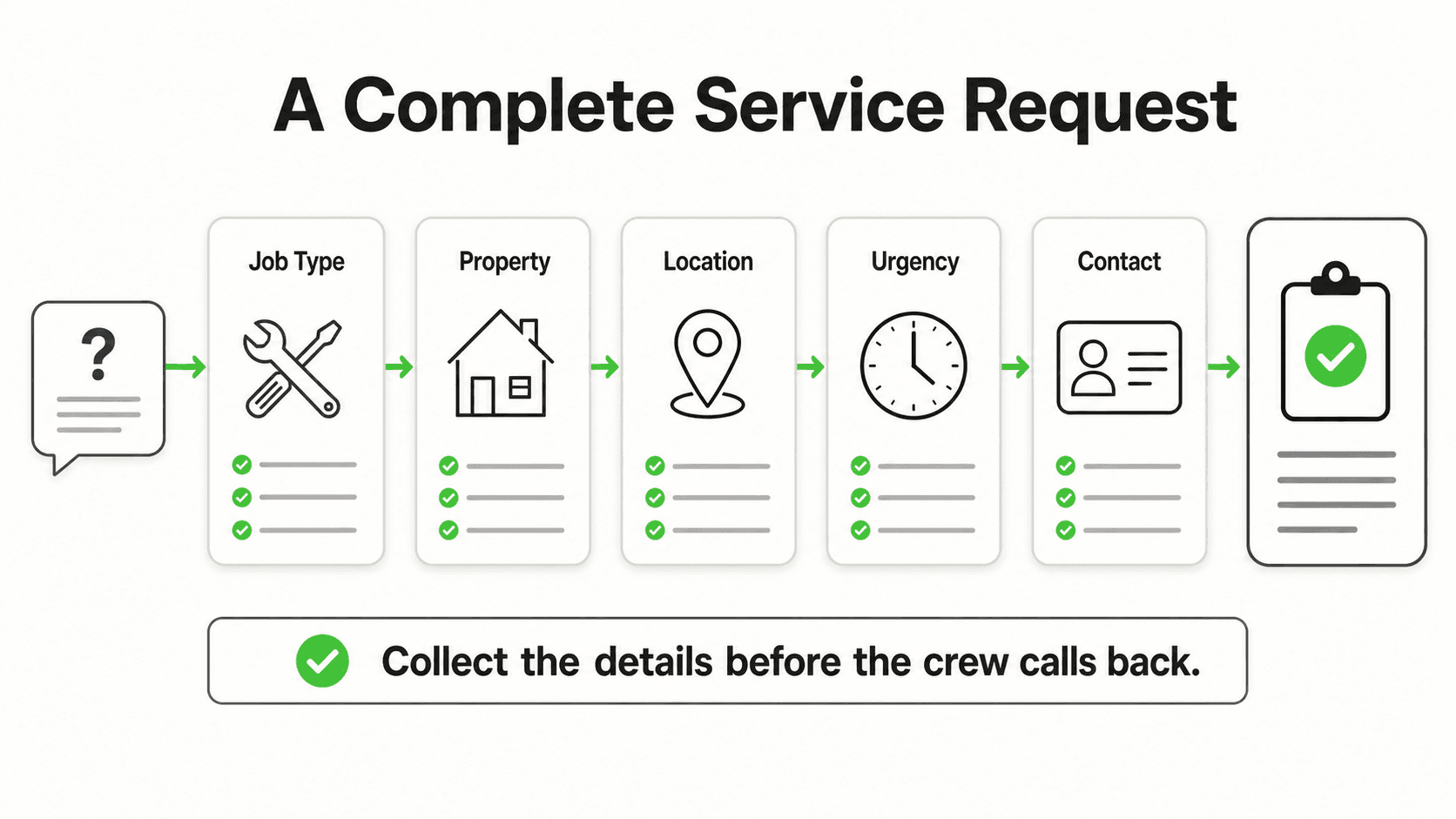
What this looks like in practice: Before your team ever sees the conversation, the AI has already asked: system type (central air, mini-split, heat pump), age of unit if known, symptom description, whether it's a rental or owned property, and preferred contact method. Your dispatcher opens a lead that's ready to schedule, not a blank "call me" message.
Real-world impact: Technicians show up better prepared, and your office spends less time on the back-and-forth "what kind of system do you have?" phone tag that used to happen before a truck could even be scheduled.
Key qualifying questions worth building into your AI receptionist's script:
- Is the system completely off, or running but not cooling/heating effectively?
- What type of system (central, ductless mini-split, heat pump, packaged unit)?
- Is this a new issue or a recurring one?
- Property type — owned home, rental, or commercial space?
- Do you have an active maintenance plan with us?
4. After-hours dispatch routing for true emergencies
What this looks like in practice: A pipe from the AC unit bursts at 11 p.m. and starts leaking into a finished basement. The AI receptionist recognizes the urgency, collects the address and a callback number through the lead form, and immediately notifies your on-call technician via your existing notification workflow — while also letting the customer know someone is being contacted right now.
Real-world impact: The customer isn't left wondering if anyone saw their message. Your on-call tech gets a structured, qualified lead instead of a garbled voicemail transcript to decode at 6 a.m.
Why it works: Leads contacted within five minutes convert dramatically better than those reached after 30 minutes, according to lead response research from InsideSales — after-hours emergencies are exactly the moment that speed matters most.
5. Maintenance-plan inquiries handled without competing for dispatcher attention
What this looks like in practice: A maintenance-plan customer messages asking to move their fall tune-up appointment. Because it's not flagged as urgent, the AI receptionist handles the scheduling conversation directly and shares your booking link — without pulling a dispatcher away from an active no-cool emergency.
Real-world impact: Recurring maintenance-plan revenue, which is often the most stable part of an HVAC business, doesn't get quietly neglected every time an emergency surge hits.
Why it works: Splitting "urgent" from "routine" at the point of first contact means your team's limited attention flows to the calls that actually need a human judgment call, while low-stakes scheduling handles itself.
6. Multi-channel capture for how homeowners actually search
What this looks like in practice: One customer messages through your website chat widget after finding you on Google. Another sends a Facebook Messenger DM after seeing a neighbor's recommendation in a local group. A third opens WhatsApp because that's the app they already use for everything. All three get the same instant, qualified response — because the AI receptionist runs on all four channels: website, WhatsApp Business, Instagram DM, and Facebook Messenger.
Real-world impact: You stop losing leads simply because they showed up on the "wrong" channel for your current staffing — every channel gets covered at once, not just whichever one someone happens to be checking.
Why it works: Homeowners don't research HVAC companies on a single platform. Covering the channels where they actually reach out, instead of just the phone line, catches demand that a phone-only setup misses entirely.
7. Lead handoff your office can act on immediately
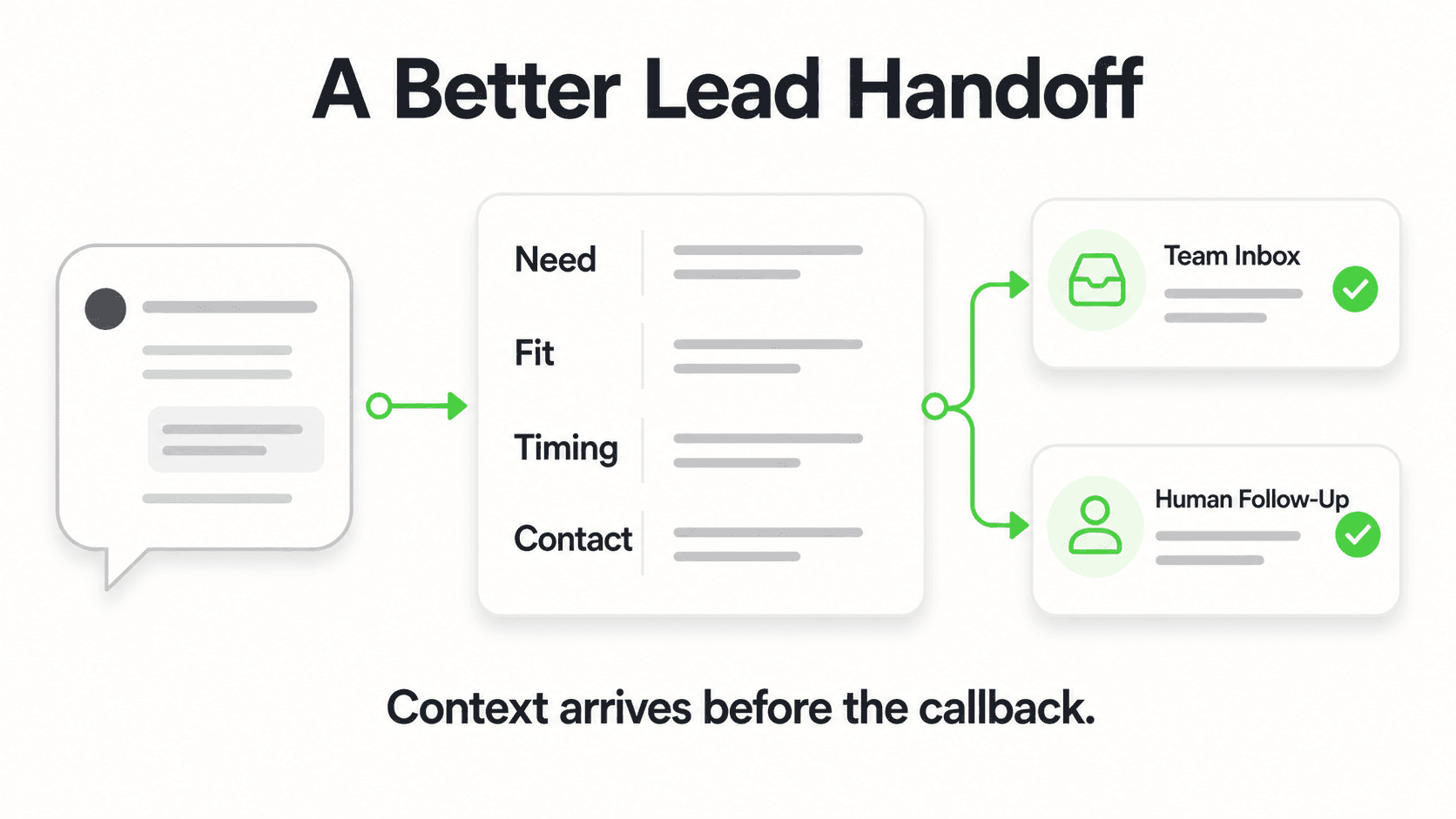
What this looks like in practice: Every qualified conversation lands as a structured lead — name, phone, address, symptom, urgency level — pushed to your team via notification and available as a one-click CSV export. Your office manager doesn't have to reconstruct the conversation from scratch; the details are already there.
Real-world impact: The time between "customer reaches out" and "job appears on the schedule" shrinks, because the qualifying work already happened before a human touched the lead.
Why it works: A structured handoff, not just a transcript dump, is what actually saves your dispatcher time. Combined with REST API and webhook connectivity into whatever system you already use to track jobs, leads don't sit in a chat inbox waiting to be manually copied somewhere else.
See how it handles a no-cool emergency
Chat with Hyperleap's demo AI receptionist and watch it separate an emergency from a routine maintenance question in real time.
Try the DemoReal Results: What HVAC Companies Can Expect
Fewer wasted leads during peak season
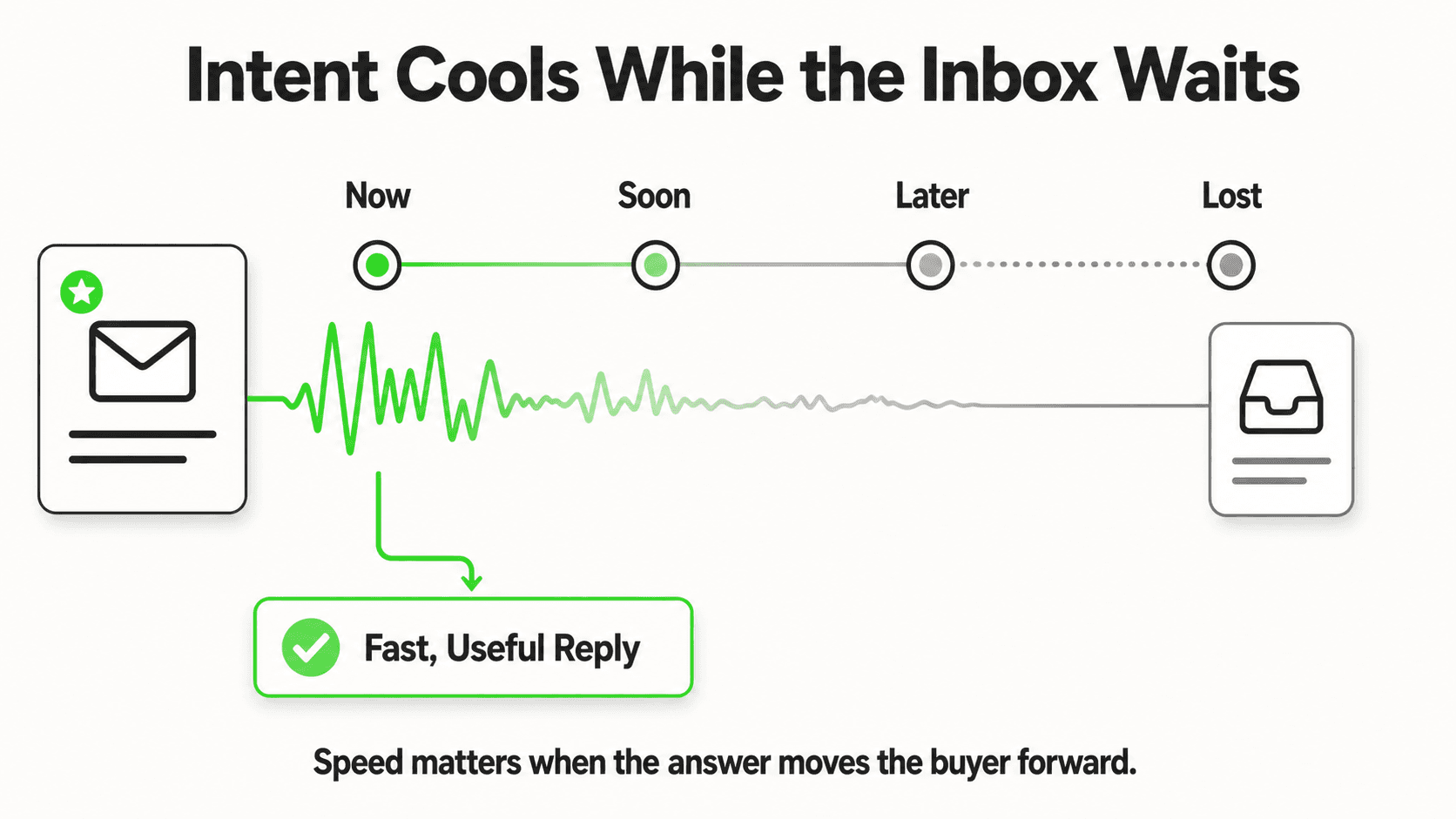
When 27% of calls go unanswered and 85% of those callers move on to the next company, the math for a business paying $45-$85 per lead is straightforward: every missed inquiry during a surge is money already spent and then thrown away. An AI receptionist doesn't need to catch every one of those to pay for itself — capturing even a handful of additional jobs a month, at typical HVAC service-call values, covers the cost of the software many times over.
Faster response on the calls your office can't get to
Homeowners who message during a surge and get an instant, relevant response — instead of silence — are more likely to still be there when your team follows up, rather than having already booked with a competitor. Speed to first response is one of the most consistently cited factors in home-services lead conversion; see our deeper breakdown of how response time affects conversion rates by industry.
More recurring maintenance-plan revenue retained
Because routine maintenance-plan questions get handled instead of buried behind emergency calls, fewer plan customers quietly churn during the two months a year your office is under the most strain. That recurring revenue is typically more valuable long-term than any single emergency call, precisely because it's predictable.
A front office that scales without seasonal hiring
Instead of hiring, training, and eventually letting go of seasonal front-office staff, an AI receptionist absorbs the volume spike as part of a flat monthly plan. Your office manager spends the surge managing dispatch and exceptions, not drowning in a chat queue.
Implementation Roadmap for HVAC Companies
Getting an AI receptionist live before your next seasonal surge doesn't require a technical team. Here's a realistic path:
Phase 1 — Before the surge (1-2 weeks)
- Upload your existing service documentation: service area, pricing ranges, maintenance-plan details, financing options, and common FAQs
- Define your qualifying questions for emergency vs. routine requests (system type, symptom, urgency indicators)
- Connect your website chat widget and at least one messaging channel (WhatsApp Business is a natural fit for HVAC, given how many homeowners already use it)
- Test the emergency-routing flow with a few realistic scenarios before going live
Phase 2 — First surge cycle (30-45 days)
- Monitor which questions the AI escalates to your team vs. handles independently, and refine the qualifying question set based on real conversations
- Compare call-plus-chat capture rates against last year's surge period, if you have that data
- Adjust urgency-routing keywords based on what customers actually type (not just what you expected)
Phase 3 — Steady state (ongoing)
- Keep documentation current as pricing, service areas, or maintenance-plan terms change — the AI only answers as well as the source content it's grounded in
- Review the lead export regularly to confirm handoff quality matches what your dispatcher needs
- Reassess before the next seasonal peak (the opposite surge — heating season if you started with cooling, or vice versa) to confirm the qualifying flow still fits
Start before the surge, not during it
The best time to set up seasonal-surge coverage is the slow season before it, not the week the first heat wave hits. Give yourself time to test the emergency-routing logic with real conversations before the volume spikes.
For a broader cost comparison against hiring a seasonal or full-time receptionist, see AI chatbot vs. hiring a receptionist: cost comparison and our dedicated breakdown of AI receptionist pricing.
Frequently Asked Questions
Does an AI receptionist for HVAC answer phone calls?
No. Hyperleap's AI receptionist is chat-based — it answers on your website chat widget, WhatsApp Business, Instagram DM, and Facebook Messenger. Voice/phone support is on the roadmap, not a current capability. Most HVAC companies run it alongside their existing phone line or answering service to cover the messaging channels a phone system can't.
Will an AI receptionist replace my dispatcher or answering service?
No. It's designed to handle the volume your team can't get to — particularly during seasonal surges — and hand off qualified, structured leads for a human to act on. Emergencies and anything ambiguous still route to your team; the AI doesn't make dispatch decisions on its own.
How does it tell an emergency from a routine maintenance question?
It asks structured qualifying questions (is there any cooling/heating at all, symptom description, urgency indicators like gas smell or active water leaks) and routes based on the answers using logic your business defines — not a clinical or safety assessment. Ambiguous or high-risk situations are escalated to a human immediately rather than resolved automatically.
How much does an AI receptionist for HVAC companies cost?
Hyperleap AI Agents start at $40/month (Plus plan), with higher tiers at $100/month (Pro) and $200/month (Max) for more responses, chatbots, and team members. All plans include a 7-day free trial; a credit card is required to start the trial, and there is no free plan. See the full AI receptionist pricing breakdown for what's included at each tier.
Can it handle the volume spike during the first heat wave of summer?
Yes — because pricing is based on a flat monthly plan rather than per-agent staffing, the AI receptionist answers every conversation instantly regardless of volume, up to your plan's monthly response limit. There's no queue buildup the way there is with a fixed number of human staff.
Does it connect to the CRM or dispatch software we already use?
Hyperleap AI Agents offer a REST API and webhooks (lead created, new message, reply, conversation started) for connecting to whatever system you use to track jobs — this is API-based connectivity, not a pre-built native integration for specific dispatch platforms. For scheduling, connect Calendly or Cal.com and the AI books appointments directly in the conversation from your live availability; other scheduling tools are shared as a booking link.
What if a homeowner asks something the AI doesn't know?
It's designed to answer from your uploaded business documents using document-grounded responses, which minimizes made-up answers — but it isn't perfect, and anything it can't confidently answer gets escalated to your team rather than guessed at.
The Surge Season Doesn't Have to Break Your Front Office
Every HVAC company deals with the same structural problem: demand that triples overnight during the first real heat wave or hard freeze, hitting a front office sized for an ordinary week. Hiring seasonal staff rarely makes financial sense for a two-month spike, and a phone-only setup misses the growing share of homeowners who research and message online before ever picking up the phone.
An AI receptionist doesn't solve every part of that problem — it doesn't answer phone calls, and it isn't a substitute for a dispatcher who can make judgment calls on genuinely ambiguous situations. What it does solve is the chat, web, and social volume that currently goes unanswered while your team is buried, separating true no-heat/no-cool emergencies from routine maintenance-plan questions so both get handled instead of one crowding out the other.
If your front office has ever looked at the queue on the first 95-degree day of the year and felt the dread of knowing some of those homeowners are going to give up and call someone else, that's the exact gap this closes.
Ready for your next seasonal surge?
See how Hyperleap's AI receptionist qualifies HVAC emergencies and captures maintenance-plan leads across web, WhatsApp, Instagram, and Messenger — 24/7.
Start Free TrialIndustry Solutions
See how AI chatbots work for these industries:
Related Articles
AI Receptionist for Landscaping Businesses
An AI receptionist for landscaping businesses answers quote and service questions 24/7, qualifies property details, and shares your booking link.
AI Receptionist for Roofing Companies: Never Miss a Lead
An AI receptionist for roofing companies answers storm-damage and estimate questions 24/7, qualifies homeowners, and routes leads to your team.
Chatbot for Landscaping Business: Quotes & Crews 24/7
A chatbot for landscaping businesses captures quote requests with property details and screens service areas while your crew is on the mower.
AI Chatbot for HVAC Companies: Capture Service Calls 24/7
How AI chatbots capture HVAC leads after hours, qualify emergency jobs, and book service calls before competitors respond.