Chatbot for Landscaping Business: Quotes & Crews 24/7
A chatbot for landscaping businesses captures quote requests with property details and screens service areas while your crew is on the mower.
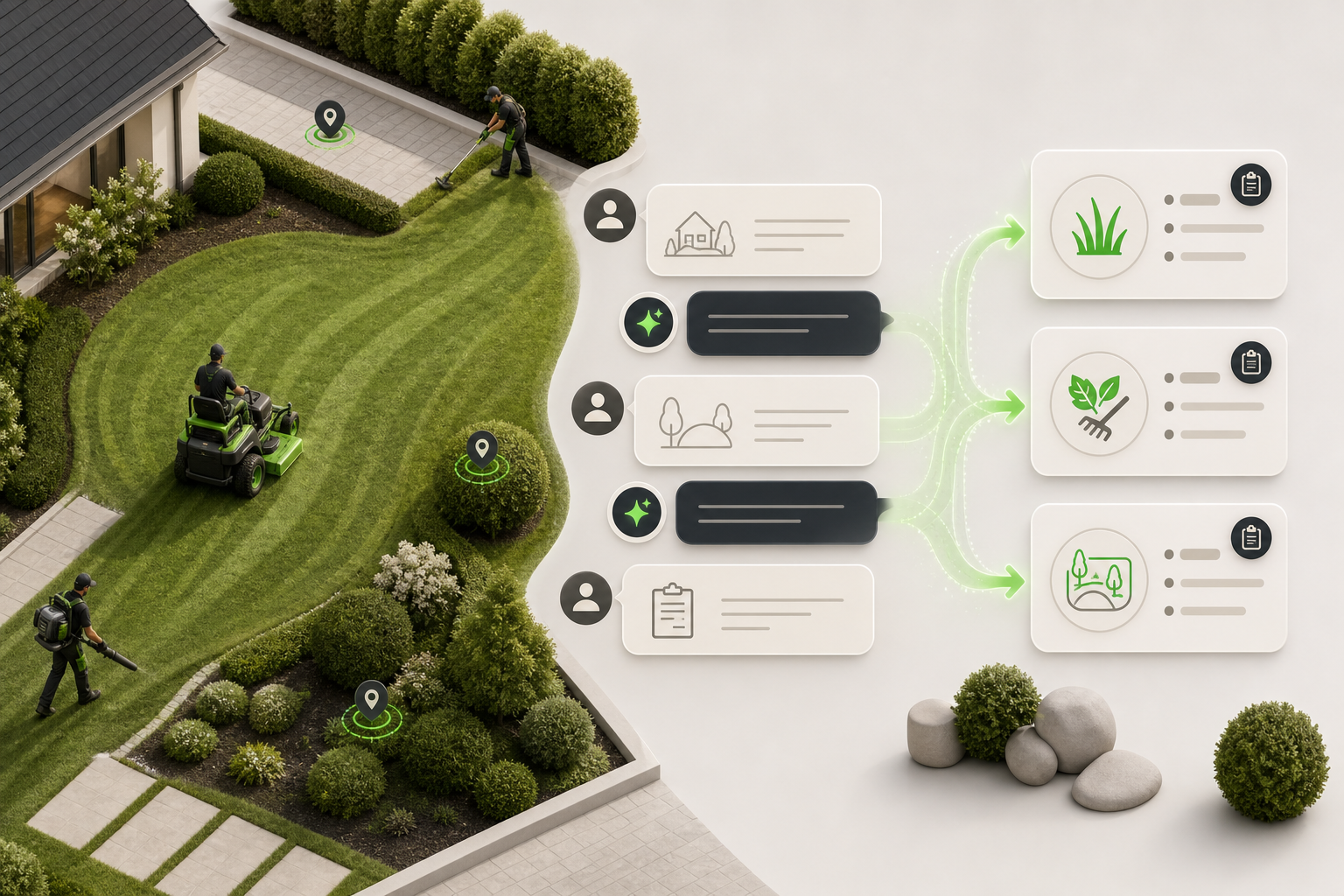
TL;DR: A chatbot for landscaping businesses answers quote requests, seasonal-service questions, and property-size details while the owner is on a mower, not at a desk. Home service businesses miss an average of 27% of inbound calls (Source: Invoca), and every missed call during the spring rush or a storm-cleanup surge is a job that goes to whichever crew answers first. An AI chatbot captures the request, screens the service area and property size, distinguishes a one-time cleanup from a recurring maintenance contract, and hands your team a qualified, contact-ready lead — through a lead-capture form that gates the conversation before it even starts. Pricing starts at $40/month with a 7-day free trial (card required).
Chatbot for Landscaping Businesses: Quotes and Crews, Not Missed Calls
You can't run a mower and answer the phone at the same time. That's the entire problem with landscaping as a business — the busiest weeks of the year (spring green-up, fall cleanup, the first frost warning that triggers a wave of "can you still get to my yard") are exactly when your crew is heads-down in the field and least available to pick up a call. Home service businesses miss an average of 27% of inbound calls, and some studies put the miss rate as high as 62% (Source: Invoca; Source: Medium/Jack Graham). For landscaping, where the season is short and every week of good weather counts, a missed call isn't a minor inconvenience — it's a job that goes to the crew down the street who happened to text back first.
An AI chatbot for landscaping businesses solves the timing problem without pulling anyone off a mower. It sits on your website, WhatsApp, Instagram, and Facebook Messenger, answers the quote and scheduling questions a homeowner would otherwise call about, and hands your team a lead that's already screened for service area, property size, and job type — ready to confirm, not chase.
What a Homeowner Actually Needs When They Message a Landscaper
A homeowner requesting a quote isn't thinking about your crew schedule — they're thinking about their overgrown yard, the leaves piling up before a family visit, or the sprinkler system that needs to come back online before summer. Understanding what they need in that moment is the difference between a chatbot that just collects names and one that actually converts.
They need to describe their property without a phone call. Most homeowners don't know their exact lot square footage, but they can estimate — "quarter acre," "big backyard," "small front strip plus a side yard." A chatbot that asks property-size and photo-context questions the way a estimator would gets close enough to a ballpark without requiring anyone to drive out first.
They need to know if you even service their area. Landscaping companies operate within a driving radius that changes by season — a crew that covers 15 miles for mowing might only travel 5 miles for snow removal because of drive-time economics. A quick zip code check up front saves your team from quoting jobs they can't actually take.
They need the right category, fast. "Can you mow my lawn every other week" is a completely different conversation than "I need storm damage cleaned up by Friday." A chatbot that routes these differently — recurring maintenance signup versus urgent one-off project — means your dispatcher isn't reading through a flat inbox trying to figure out which messages are time-sensitive.
They need a realistic timeline, not silence. During the spring rush, "we'll get back to you" loses to "we're currently booking 5-7 business days out for new mowing accounts, and same-week for cleanup requests — want me to check availability for your address?" Landscaping customers understand seasonal backlogs; what frustrates them is not knowing where they stand.
The Four Request Types Your Chatbot Should Distinguish
| Request Type | Example | Routing |
|---|---|---|
| Urgent one-off | Storm damage, tree down, pre-event cleanup | Same-week priority queue |
| Recurring maintenance signup | Weekly/biweekly mowing, seasonal contract | Route sizing crew, add to route planning |
| Seasonal project | Spring cleanup, fall leaf removal, mulch install | Seasonal booking window |
| Design/estimate only | Landscape redesign, irrigation install quote | Sales follow-up, site visit scheduling |
This routing gives whoever checks the lead inbox in the evening a clear priority order instead of a wall of undifferentiated messages to sort through by hand.
Who This Guide Is For
This guide is for landscaping and lawn care business owners with 2-25 employees who are missing quote requests during peak season because the owner or crew leads are in the field, not at a desk. Setup typically takes 3-5 days and requires no technical background.
Why Landscaping Businesses Lose Jobs They Never See
The most expensive missed lead in landscaping is invisible — the homeowner who visited your site during a Tuesday-afternoon mowing route, saw no way to get a quick answer, and messaged the next name on their Google search instead. You never see that lead in a spreadsheet. You just notice, months later, that your new-account growth has plateaued even though your reviews are good and your trucks are always busy.
Peak-season demand and peak-season availability move in opposite directions. Spring rush and the week after a major storm are when quote requests spike hardest — and they're also when every crew member is already scheduled solid, with nobody left to answer the phone between jobs. The two curves are inverted, and the gap between them is where leads disappear.
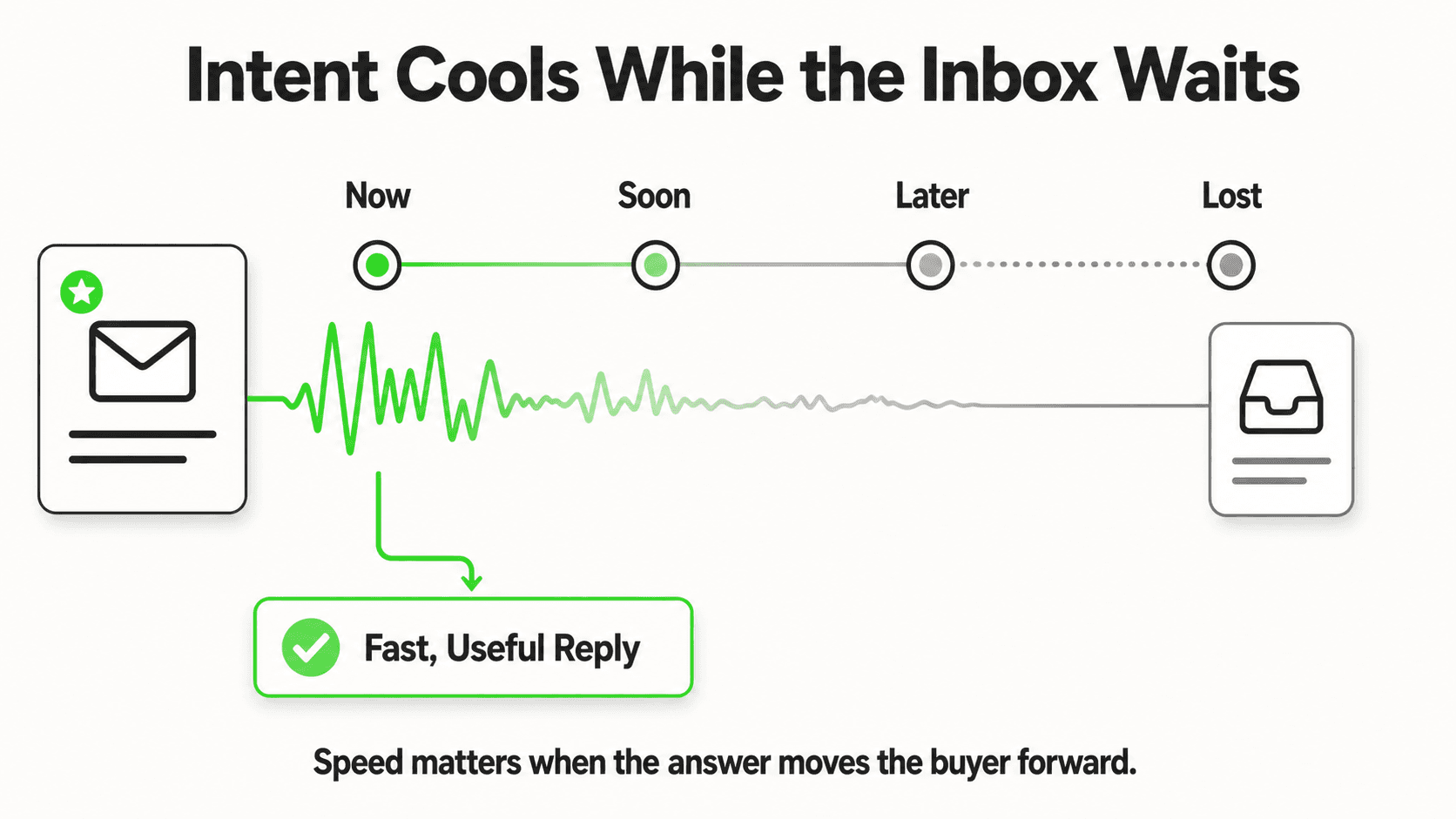
Landscaping is a "first responder wins" category, just like other home services. A homeowner comparing three landscaping companies for a spring cleanup rarely waits for a callback from all three before deciding — they book with whoever confirms availability first, because good weather windows are short and nobody wants their yard to be last on the list. Research on lead response broadly shows that speed to first contact strongly predicts which vendor wins the job (Source: InsideSales).
Cost per lead makes every missed inquiry worse. Home service cost-per-lead figures from LocaliQ and WebFX put trades like HVAC and plumbing between $35 and $95 per lead, and 69% of home service businesses report cost per lead rising year over year (Source: LocaliQ). Landscaping ad spend follows the same trend — every quote request that goes unanswered because nobody was near a phone is ad spend burned for nothing.
Intake calls eat into billable hours. Every "what's your address, what size is the lot, do you want weekly or biweekly, are there pets in the yard" phone call takes several minutes of an owner's or estimator's time — time that isn't spent mowing, planting, or driving to the next job. A chatbot handles that intake conversation automatically and delivers a complete lead record, so the human follow-up call becomes a confirmation, not a full interview.
Common Mistake
Many landscaping companies route every website visitor to a static "Request a Quote" form with no auto-response. The homeowner fills it in, hears nothing for a day or two while the crew is out mowing, and books with a competitor who replied same-day. A chatbot that confirms receipt instantly and gathers the property and job details keeps the conversation moving instead of going cold.
7 Ways a Chatbot Wins More Landscaping Jobs
1. Instant Quote Intake With Property Context
What this looks like in practice: A homeowner messages your website chat at 7 PM asking about biweekly mowing. The chatbot asks for an approximate lot size, whether it's front-and-back or front-only, and any relevant details (fenced yard, slope, gate access) — then returns a ballpark range based on your actual pricing tiers.
Real-world impact: Instead of waiting for a callback the next day, the homeowner gets a same-minute range and can decide to move forward while they're still motivated.
Why it works: Homeowners comparing landscapers are usually messaging more than one at once. Whoever answers the pricing question first, accurately, keeps the conversation going.
Key features:
- Trained on your actual pricing tiers and service menu
- Asks the same property-context questions your estimator would ask
- Works identically on website, WhatsApp, Instagram DM, and Facebook Messenger
2. Recurring Maintenance vs. One-Off Project Screening
What this looks like in practice: The chatbot's first branching question sorts a "can you come mow every other week" request from a "I need a one-time cleanup before I sell the house" request, and routes each down a different conversation path with different follow-up questions.
Real-world impact: Your route planner gets recurring signups pre-sorted by frequency, while one-off jobs land in a separate queue that doesn't get mixed into the weekly route schedule.
Why it works: Recurring maintenance accounts carry far more lifetime value than a single cleanup. Making the recurring signup path frictionless — instead of funneling everyone through the same generic form — increases how many new customers opt into an ongoing contract rather than a single visit.
Key features:
- Frequency options (weekly, biweekly, monthly, seasonal-only)
- Distinct question set for one-off vs. recurring requests
- Add-on capture (mulching, edging, fertilization) tied to the service type
3. Service Area and Season Verification
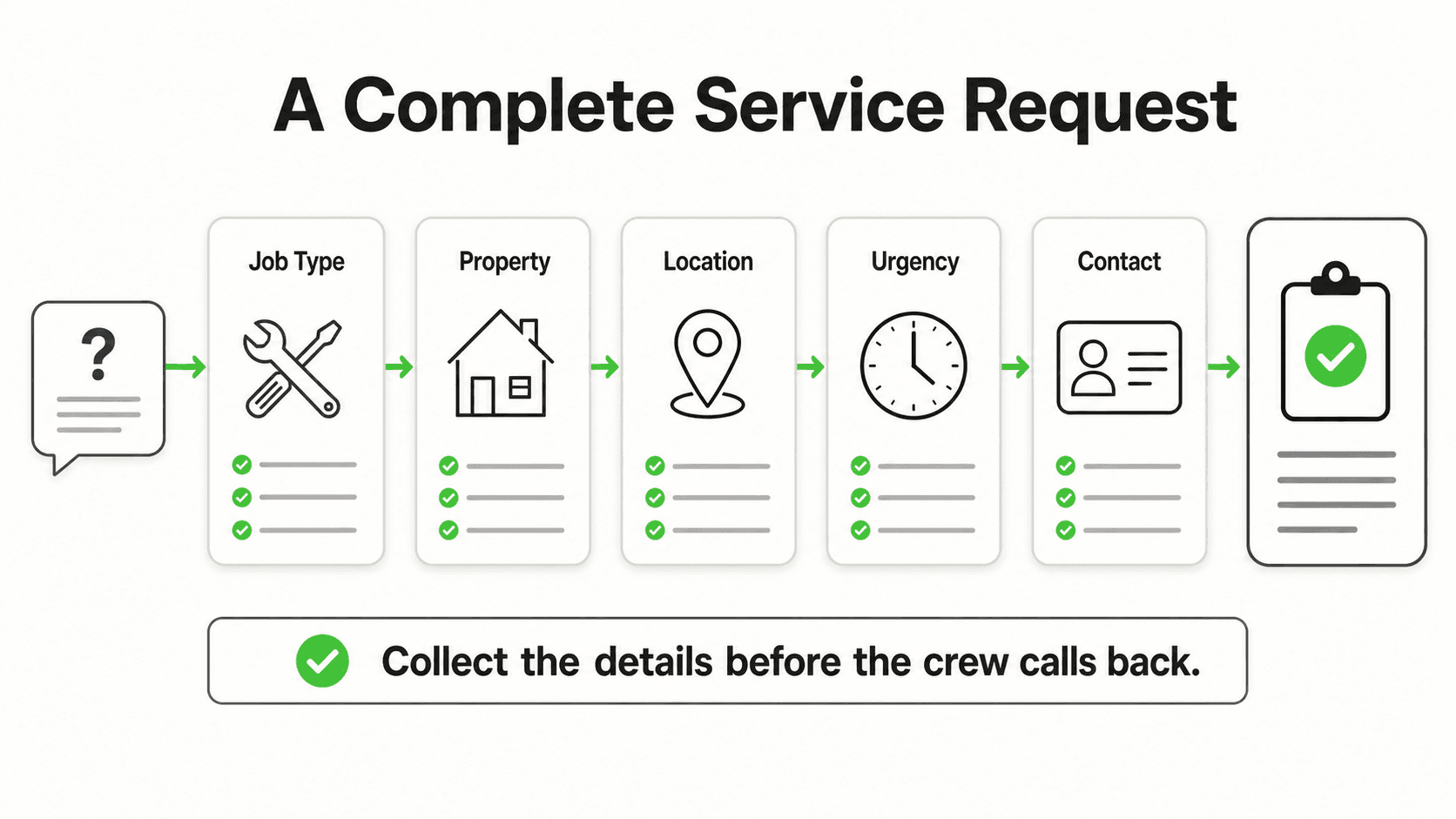
What this looks like in practice: Before collecting further details, the chatbot checks a zip code against your defined service area — which you can configure to shrink for snow removal or storm cleanup if your travel radius changes by season.
Real-world impact: Filters out-of-area leads automatically, so nobody wastes a callback confirming a job you were never going to be able to service.
Why it works: Landscaping companies typically work within a driving radius that's tighter for time-sensitive or heavy-equipment jobs than for routine mowing. Catching this before a quote goes out avoids the wasted round trip of quoting, scheduling, and then discovering the address is outside your zone.
Key features:
- Zip-code or address-based service area check
- Configurable radius by service type or season
- Graceful "outside our area" messaging with a referral option if you choose
4. Spring Rush and Storm-Cleanup Surge Handling
What this looks like in practice: When a storm knocks down branches across your service area, inbound messages spike within hours. The chatbot handles the volume instantly — capturing address, damage description, and urgency — instead of your phone ringing off the hook while your crew is already out clearing the first ten yards on the list.
Real-world impact: In Hyperleap's own Jungle Lodges hospitality deployment, 35% of all inquiries arrived after standard business hours — a pattern consistent with how service businesses generally experience demand spikes outside the normal workday. Storm cleanup and spring-rush landscaping inquiries follow a similar surge pattern, concentrated into short windows your team can't staff for around the clock.
Why it works: Surge demand is exactly when phone-only intake breaks down. A chatbot doesn't get overwhelmed by volume the way a single phone line does — every inquiry gets an immediate response and a spot in the queue, regardless of how many arrive in the same hour.
Key features:
- 24/7 availability with no added staffing cost
- Consistent response speed regardless of inquiry volume
- Urgency flagging for storm damage or safety-related requests
5. FAQ Handling Without Pulling Crew Off the Job
What this looks like in practice: "Do you bring your own equipment?" "Do you offer one-time cleanups or only contracts?" "What's included in a spring cleanup?" "Do you spray for weeds?" Train the chatbot on these answers once, and it handles them consistently, day or night, without anyone stepping off the mower to check a phone.
Real-world impact: Owners and crew leads get their time back for actual landscaping work instead of repeating the same five answers to every new caller.
Why it works: Most quote-stage questions from homeowners are close variations of the same handful of topics. A chatbot answers them instantly and consistently, and escalates anything genuinely unusual — a large commercial property, an unusual terrain situation — to your team.
Key features:
- Configurable FAQ knowledge base tied to your actual service menu
- Consistent answers across channels
- Automatic escalation for anything outside its knowledge base
6. Multi-Channel Presence Where Homeowners Actually Message
What this looks like in practice: A homeowner who sees your before/after photos on Instagram and DMs you gets the same accurate pricing and service-area answers as someone who visits your website chat widget or messages your Facebook Business page.
Real-world impact: Landscaping is a visual business — a lot of inbound interest starts on social media after someone sees a lawn transformation or a landscape design photo. A chatbot that only lives on your website misses that channel entirely.
Why it works: Consistency across channels means no lead falls through the cracks because it arrived on the "wrong" platform. Rich cards and swipeable carousels (service packages, before/after highlights) render with the same functionality across all four channels.
Key features:
- Website chat widget, WhatsApp Business API, Instagram DM, Facebook Messenger
- Same knowledge base and pricing logic across every channel
- Card and carousel support for showcasing before/after work
7. Qualified Lead Handoff Through a Contact-Detail Form
What this looks like in practice: Before the conversation starts, the AI presents a short contact-detail form — name, phone number, property address — that the prospect fills in. Only after that gate is the conversation unlocked. Every completed conversation your team reviews is tied to a real, reachable contact, not an anonymous chat log.
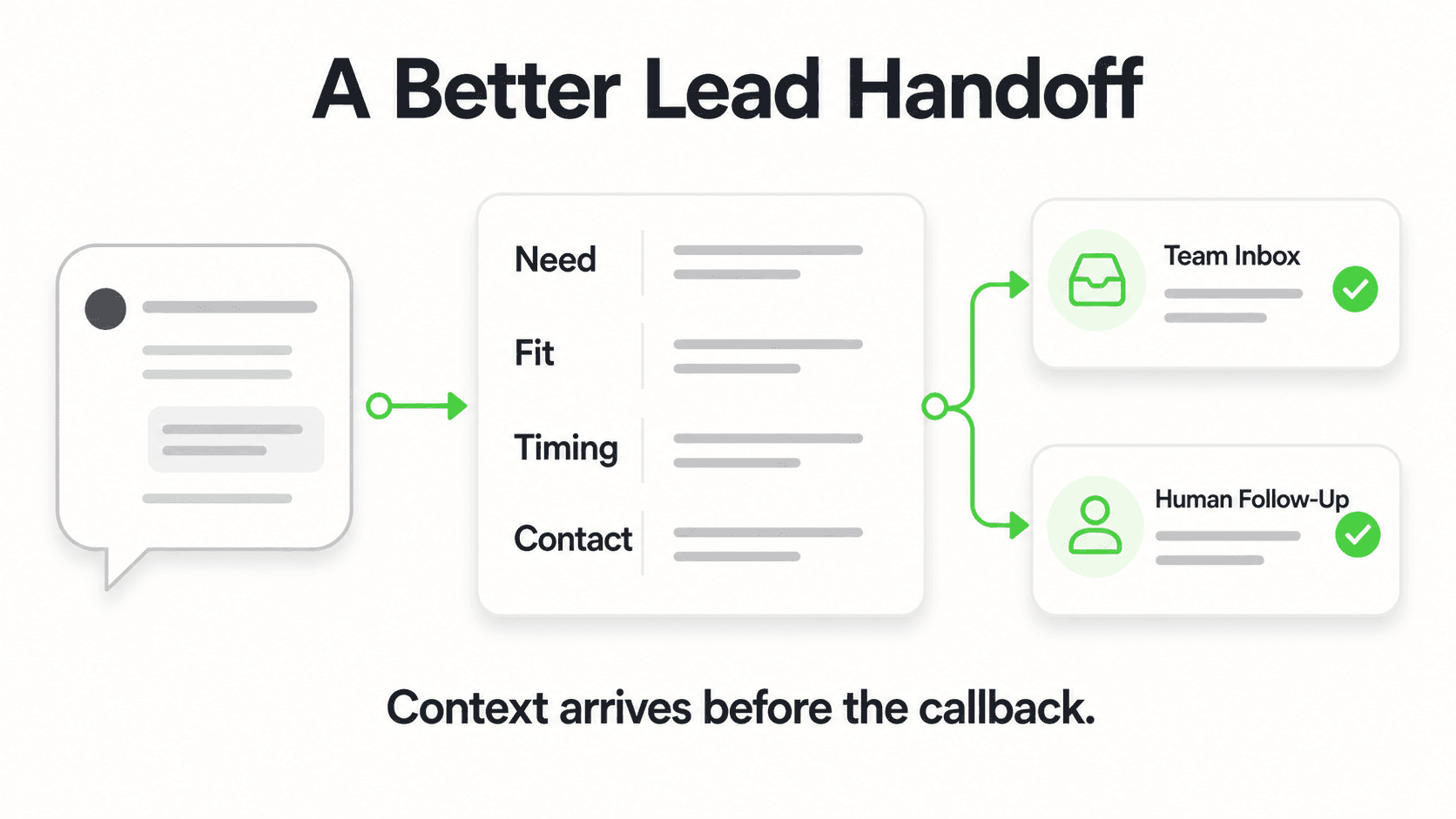
Real-world impact: Whoever checks leads in the evening after the crew wraps up opens a list of qualified contacts with job type, property details, and preferred timing already attached — ready to confirm and schedule, not chase down a phone number.
Why it works: A lead-capture form gating the conversation means you're not relying on a prospect voluntarily typing their contact details mid-chat. It's collected upfront, consistently, every time. Landscaping companies that add OTP-verified lead capture (a paid add-on on Pro and Max plans) can confirm a phone number in real time, which cuts down on fake numbers and no-show estimate visits.
Key features:
- Contact-detail form gates access to the chat (name, phone, address collected before conversation)
- Instant team notification when a new lead completes the flow
- One-click CSV export for follow-up or CRM upload
Booking in the chat
When a homeowner is ready to schedule an on-site estimate, connect Calendly or Cal.com and the AI offers real open slots from your live availability and books the estimate visit in the conversation — the homeowner gets the invite by email. (In-chat booking needs Calendly Standard or higher; with any other booking tool, the AI shares your booking link.)
Stop losing quote requests while your crew is on the job
Deploy an AI chatbot trained on your landscaping company's pricing, service area, and seasonal availability — across web, WhatsApp, Instagram, and Facebook.
Start Free TrialReal Results: What Landscaping Businesses Can Expect
Faster Response, More Booked Jobs
- Instant response to quote requests instead of next-day callbacks during peak season
- Consistent property-context questions asked every time, day or night
- Fewer leads lost to competitors who simply answered first during a surge
Time Saved for Owners and Crew Leads
- Fewer interruptions mid-job to answer repetitive pricing calls
- Recurring vs. one-off requests pre-sorted before they reach your route planner
- Storm-surge and spring-rush volume handled without anyone stepping off equipment
Better Lead Quality for Follow-Up
- Every lead arrives with name, phone number, property details, and job type already collected
- Out-of-area inquiries filtered out before they reach your scheduling team
- One-click CSV export makes it easy to load leads into your existing CRM or spreadsheet workflow
24/7
Quote & Booking Availability
4
Channels: Web, WhatsApp, IG, FB
27%
Avg. Missed Calls, Home Services (Invoca)
$40/mo
Starting Price, 7-Day Trial
Illustrative example, not a guarantee
The figures above combine third-party home-services research cited earlier in this article with a documented hospitality deployment. Results vary by market, crew capacity, and how quickly your team follows up on qualified leads — treat any ROI estimate as a starting point for your own math, not a promised outcome.
A Simple ROI Framework for Landscaping Companies
If you're currently missing even a handful of quote requests per week during peak season, the math is straightforward to run for your own business:
Missed inquiries per week × average job value × estimated close rate = weekly revenue at risk
For example, a landscaping company that misses 4 quote requests a week during spring rush, with an average new-account first-visit value of $180 and a conservative 25% close rate on inquiries that get a fast response, is leaving roughly $180/week — about $780/month — on the table before counting the lifetime value of a recurring mowing contract. Weighed against a $40/month starting plan, the question becomes less "can we afford this" and more "can we afford to keep missing these during the six weeks a year when demand actually peaks."
Implementation Roadmap for Landscaping Companies
Rolling out a chatbot doesn't require a technical team or weeks of setup. Here's a practical path built around how landscaping businesses actually operate.
Days 1-3: Load your knowledge base Upload your pricing tiers (by property size or service type), service area zip codes, seasonal service calendar (spring cleanup dates, fall leaf removal windows, snow contract terms if applicable), and answers to your most common questions (equipment, insurance, one-time vs. contract work). The more specific your source documents, the more accurate the chatbot's answers.
Days 4-5: Configure the lead-capture form and channels Set up the contact-detail fields you want collected before a chat begins (name, phone, property address is typical), then connect your website chat widget and any of WhatsApp, Instagram DM, or Facebook Messenger you actively use for customer inquiries.
Days 6-7: Test the conversation flow Run through common scenarios yourself — a biweekly mowing signup, a one-time storm cleanup request, an out-of-area zip code — to confirm the chatbot's answers match how your business actually operates before sending it live traffic.
Week 2 and beyond: Monitor and refine ahead of peak season Review the first batch of captured leads with whoever handles scheduling. Add any FAQ gaps you notice back into the knowledge base, and adjust the urgency routing before your next seasonal surge hits — spring green-up and fall cleanup are when the chatbot earns its keep the most.
Must-have features checklist for landscaping chatbots:
- Instant, accurate quote ranges tied to your real pricing and property-size questions
- Recurring maintenance vs. one-off project routing
- Service area verification, configurable by season
- Lead-capture form gating the conversation (contact details collected upfront)
- Multi-channel deployment (website, WhatsApp, Instagram, Facebook)
- In-chat booking (Calendly or Cal.com) or booking-link sharing for on-site estimate scheduling
- CSV export or REST API/webhook access for your existing CRM or spreadsheet workflow
For businesses juggling recurring appointments across a broader service menu, the same lead-capture and scheduling logic extends well beyond landscaping — see how home service businesses generally lose jobs to faster-responding rivals for the wider pattern, or explore the dedicated home services AI agent page if you offer adjacent services like cleaning or pest control alongside landscaping. This explainer on after-hours lead capture covers the underlying concept in more depth, and the AI chatbot ROI calculator walks through the math for your specific numbers.
For the receptionist-specific view — seasonal surges, recurring vs. one-off qualification, and booking-link handoff — see AI receptionist for landscaping businesses.
Frequently Asked Questions
Will a chatbot replace my estimator or office manager?
No. The chatbot handles the repetitive first-tier work — quote ranges, service area checks, and initial scheduling questions — and hands off a qualified, contact-ready lead to your team. Your estimator still confirms details, adjusts pricing after seeing the property, and builds the relationship; the AI just makes sure no inquiry sits unanswered while your crew is in the field.
How much does a chatbot for a landscaping business cost?
Hyperleap AI's plans start at $40/month (Plus plan), with a Pro plan at $100/month and a Max plan at $200/month for higher-volume businesses. Every plan includes a 7-day free trial (a credit card is required to start the trial). There is no free plan, and add-ons like OTP-verified lead capture or Multi-variant (locations, courses, etc) are priced separately.
Can the chatbot give an exact price, or just a ballpark estimate?
It depends on your pricing structure. If your pricing is based on clear inputs like lot size or service frequency, the chatbot can return a fairly precise range. If your pricing depends on an in-person walkthrough (common for landscape design, irrigation work, or heavily overgrown properties), the chatbot collects the details and sets expectations that a final quote requires a quick site visit.
How does it handle the seasonal surge during spring rush or after a storm?
The chatbot runs 24/7 and doesn't get overwhelmed by inquiry volume the way a single phone line does. During a surge — spring green-up, a storm cleanup wave, the first hard frost — every inquiry still gets an immediate response, gets asked the right property and urgency questions, and lands in your queue with a priority flag, instead of piling up as missed calls while your crew is already out on the first jobs of the day.
Does the chatbot integrate with my scheduling or route-planning software?
Hyperleap AI connects via REST API and webhooks (lead created, new message, conversation started), which lets you route captured leads into whatever scheduling or CRM system you use today. If you use Calendly or Cal.com, the AI connects natively: it reads live availability and books new appointments in the conversation. With any other booking tool, it shares your booking link. If you use dedicated route-planning or field-service software, treat that connection as an integration requirement to evaluate against your specific platform's API rather than assuming out-of-the-box support.
How long does it take to set up an AI chatbot for a landscaping company?
Most landscaping businesses can have a working chatbot live within a week: loading your pricing and seasonal-service documents takes a day or two, configuring the lead-capture form and channels takes another day, and testing common scenarios rounds out the first week. No coding or technical team is required — if you can write down your pricing and service calendar, you can train the AI.
What channels does the chatbot work on?
Hyperleap AI's chatbot deploys on your website chat widget, WhatsApp Business API, Instagram DM, and Facebook Messenger, with the same knowledge base and pricing logic across all four. SMS, voice, and email channels are on the product roadmap but not currently supported.
Can it distinguish between a recurring mowing customer and a one-time cleanup request?
Yes. You configure separate question flows for recurring maintenance signups (frequency, preferred day, add-ons) and one-off project requests (job description, urgency, timeline), and the chatbot routes each conversation down the right path based on what the homeowner describes.
Never Miss Another Quote Request During Peak Season
Landscaping businesses don't lose jobs because the work isn't good — they lose jobs because the homeowner never got a fast enough answer while your crew was three properties into the day's route. A chatbot for landscaping businesses closes that gap: instant quote ranges based on your real pricing, recurring-vs-one-off routing that keeps your route planner organized, and a contact-detail form that gates every conversation so your team never has to chase an anonymous chat log for a phone number.
The tools that used to be reserved for national lawn care franchises — 24/7 coverage, instant response, consistent pricing answers — are now available to a three-truck landscaping crew for $40/month. Compare that against a single missed recurring account during spring rush, and the math tends to answer itself. See the full pricing breakdown on the Hyperleap AI pricing page, or explore what an AI agent looks like for your specific service mix on the landscaping AI agent page.
Ready to stop losing quote requests to faster competitors?
Get an AI chatbot trained on your landscaping company's pricing, service area, and seasonal availability — live across web, WhatsApp, Instagram, and Facebook in about a week.
Get StartedIndustry Solutions
See how AI chatbots work for these industries:
Related Articles
AI Receptionist for Landscaping Businesses
An AI receptionist for landscaping businesses answers quote and service questions 24/7, qualifies property details, and shares your booking link.

AI Receptionist for HVAC: Handle Summer Call Surges
How an AI receptionist for HVAC companies covers seasonal call surges, qualifies emergency vs. maintenance requests, and books jobs 24/7.
AI Receptionist for Roofing Companies: Never Miss a Lead
An AI receptionist for roofing companies answers storm-damage and estimate questions 24/7, qualifies homeowners, and routes leads to your team.

AI Chatbot for Moving Companies: Win the Quote Race
A chatbot for moving companies qualifies quote requests instantly — origin, destination, home size, date — so you respond before rival estimates land.