AI Receptionist for Roofing Companies: Never Miss a Lead
An AI receptionist for roofing companies answers storm-damage and estimate questions 24/7, qualifies homeowners, and routes leads to your team.
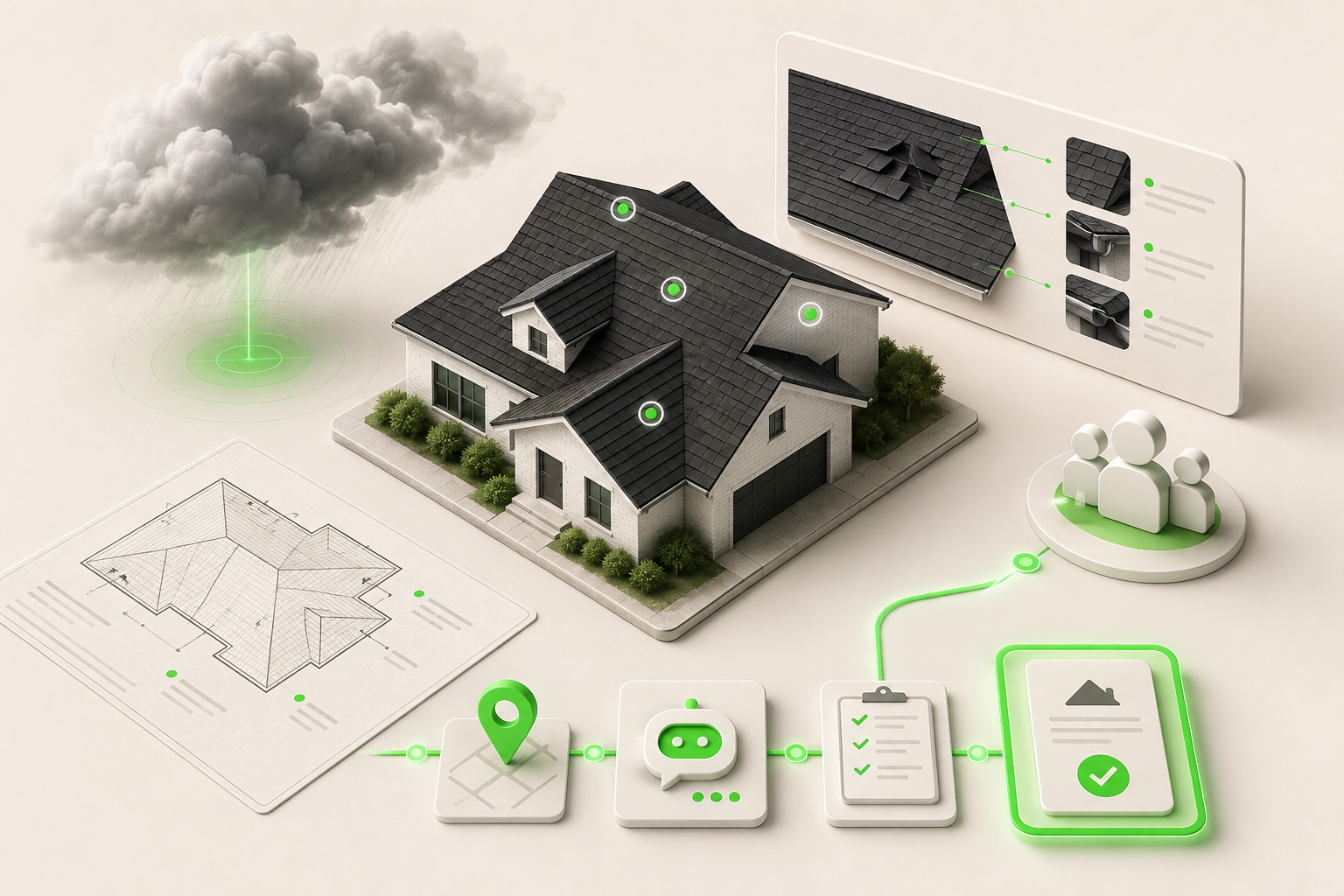
TL;DR: A hailstorm rolls through, and by morning your phone and inbox are flooded with homeowners asking the same five questions — do you handle insurance claims, how fast can you inspect, what's a fair price for a full replacement. An AI receptionist for roofing companies answers those questions the moment they arrive, on your website, WhatsApp, Instagram DM, and Facebook Messenger, asks the qualifying questions your estimator needs (repair or replacement, roof age, storm date, visible damage), and shares your booking link for the inspection. It is chat-first, not a phone system — voice is on Hyperleap's roadmap — so it works alongside your existing phone line, not instead of it. It doesn't handle insurance claims or judge damage severity; it routes those conversations to your team with the details already collected. Plans start at $40/month with a 7-day free trial (credit card required).
AI Receptionist for Roofing Companies: Never Miss a Lead
Storm season doesn't ease a roofing company into a busy week — it detonates one. A single hail event can generate more inbound inquiries in 48 hours than a normal month, and every one of those homeowners is doing the same thing: comparing roofers, reading reviews, and messaging whoever answers first. The roofing companies that win that surge aren't necessarily the ones with the best crew — they're the ones who responded before the homeowner moved on to the next name on the list. The rest of the time, the pain looks different but the cost is the same: the same handful of questions land on your office manager or on you personally, all day, every day — "do you do insurance work," "how much for a full tear-off," "are you licensed and insured" — pulling attention away from estimates, crew scheduling, and the actual work of running a roofing business.
An AI receptionist is the front-desk function that covers both problems: the predictable daily interruption and the unpredictable storm surge. This guide covers what a chat-based AI receptionist does for a roofing company specifically — how it handles storm-damage inquiries, what questions it should ask before a homeowner ever reaches your estimator, how it explains your own insurance-claims process without giving insurance advice, and how it fits alongside your phone line rather than replacing it. For the deeper walkthrough of how the underlying chatbot handles roofing-specific conversations, see our guide to AI chatbots for roofing companies; for the full deployment across the whole customer journey — from first message to review request — see the AI agents for roofing companies pillar page. This article is scoped narrowly to the receptionist function: answering, qualifying, and routing.
Chat-first, not phone-first
Hyperleap's AI receptionist works on your website chat widget, WhatsApp, Instagram DM, and Facebook Messenger. It does not answer phone calls today — voice is on the roadmap, not shipped. If most of your storm-surge inquiries arrive by phone, pair it with your existing phone setup rather than replacing it. See our AI receptionist vs. answering service comparison for how the two work together.
What Is an AI Receptionist for Roofing Companies?
An AI receptionist for roofing companies is a chat-based system that performs the front-desk job of answering inquiries, asking qualifying questions, and routing leads to the right person — running continuously, including the exact moment a storm rolls through and call volume spikes 3-5x overnight. It is not a phone system; it operates on the channels homeowners already use to research roofers outside of calling: your website chat widget, WhatsApp, Instagram DM, and Facebook Messenger.
For a roofing business, that front-desk function needs to do several things well:
- Answer instantly, especially during a surge. Storm season is when your team is least able to answer every inbound message and when the volume is highest.
- Separate repair from replacement, and routine from urgent. A homeowner with a few missing shingles is not the same conversation as one with active water intrusion.
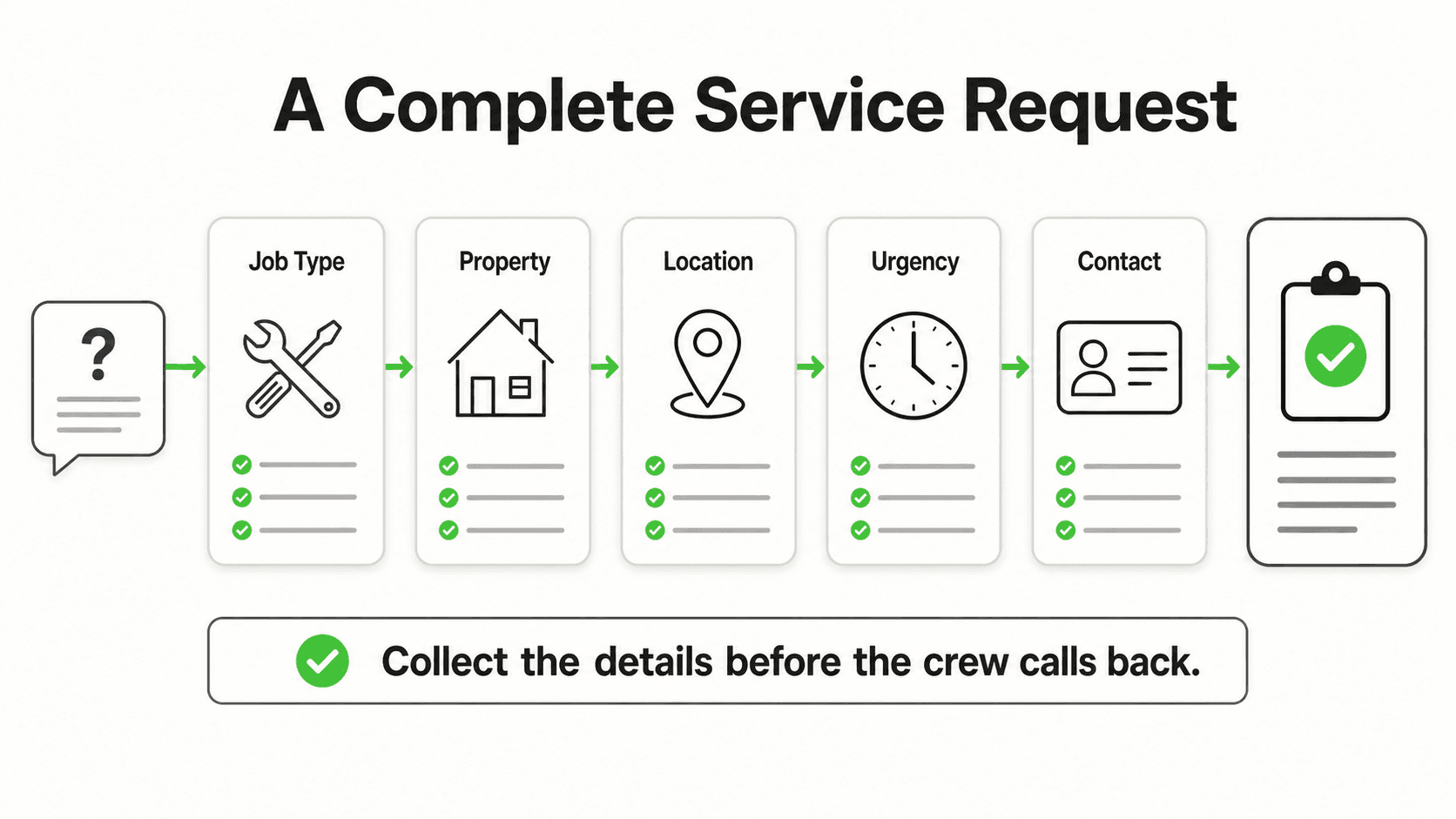
- Ask the questions your estimator actually needs. Roof age, approximate size, material, and what the homeowner can see from the ground.
- Explain your process, not make judgment calls. It can walk a homeowner through how your business handles insurance claims; it should never tell them whether their policy covers the damage or how bad the damage is.
This is different from a generic FAQ widget, which answers "what are your hours?" and stops. An AI receptionist is built to capture and qualify a lead end-to-end — closer to what a trained office manager does during a storm surge than what a static contact form does. If you want the deeper conversational detail — how it handles specific roofing material questions, warranty terms, or a multi-step estimate request — that lives in the AI chatbot for roofing companies guide.
Why Roofing Companies Lose Leads to Faster Competitors
The storm-surge overload
A hailstorm or major wind event doesn't raise inquiry volume gradually — it multiplies it almost overnight, and it hits every roofer in the affected area at once. Home service businesses across the board already miss a meaningful share of inbound contact during normal weeks; Invoca's research puts the industry-wide missed-call rate at 27%, and that's before a storm triples the volume a small office can handle. During a surge, the roofing companies that fall behind aren't understaffed compared to a normal week — they're understaffed compared to a week that only happens a few times a year, which is exactly why most never plan for it.
The interruption tax on estimators
Even without a storm, roofing is a business where the same questions land on the same few people constantly. An estimator on a ladder, a sales rep mid-inspection, an office manager juggling scheduling — none of them can drop what they're doing to answer "do you offer financing?" for the third time that day. Every interruption doesn't just cost the two minutes of the answer; it costs the re-focus time afterward, multiplied across a full day of fielding the same handful of questions.
The response-speed math
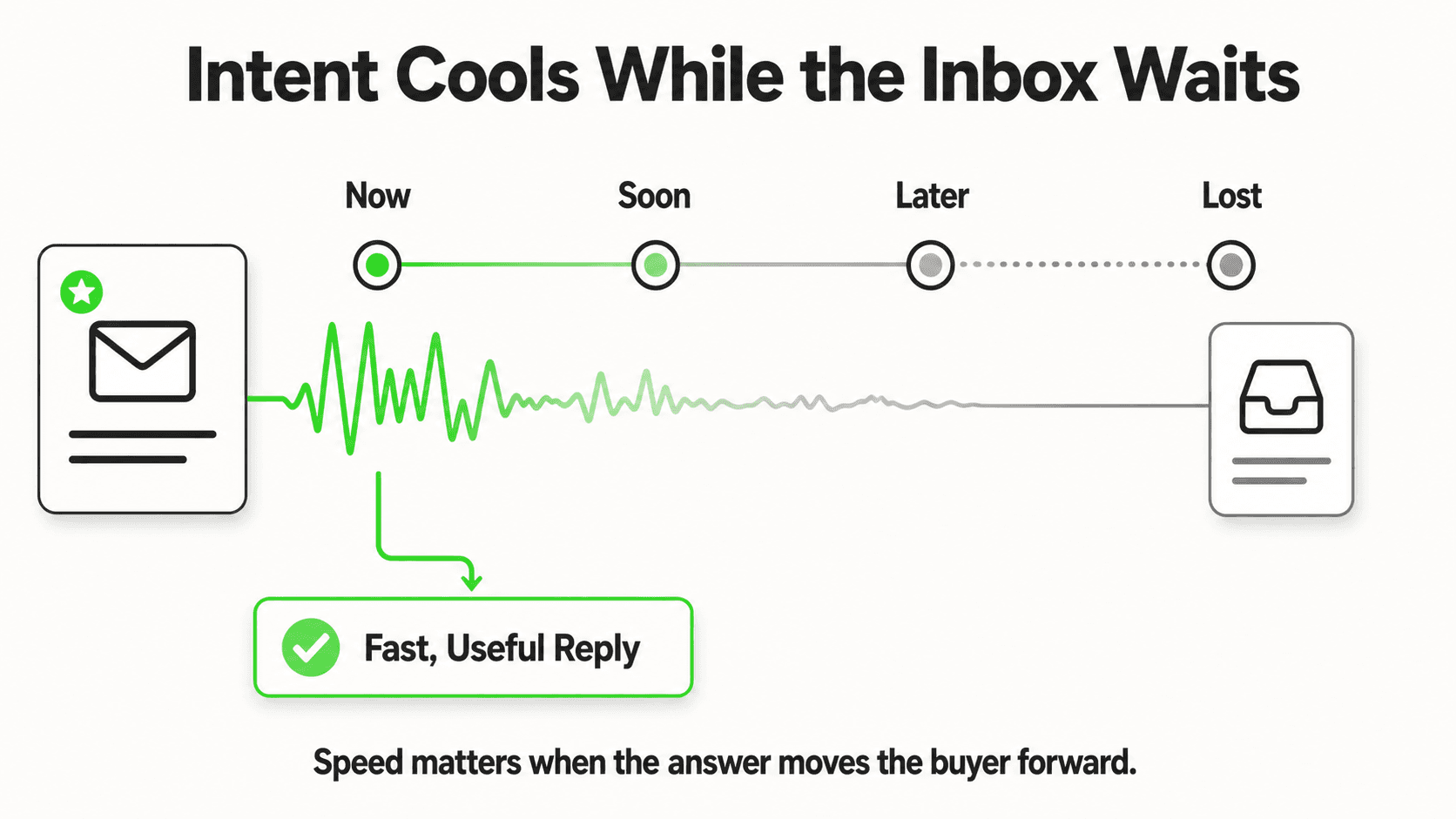
Once a homeowner sends a message, the clock is running against every competitor they also contacted. InsideSales research found leads contacted within 5 minutes are 100x more likely to convert than those reached after 30 minutes — and during a storm surge, homeowners are often messaging three or four roofers in the same afternoon, so the gap between "responded in minutes" and "responded tomorrow" is the entire outcome. Our related breakdown on why home service businesses lose jobs to slow response covers this dynamic across trades, including roofing, and our guide on how to capture emergency service calls 24/7 walks through the same tactics for other storm-exposed trades. For a broader look at what missed inquiries cost across business types, see what missed calls really cost your small business.
The math on one missed storm-damage lead
A full roof replacement typically runs from several thousand dollars into five figures depending on materials and size. If a roofing company misses even a handful of storm-surge leads a season to slow response, that's a meaningful multiple of a $40/month AI receptionist plan. Treat this as an illustrative comparison based on typical roofing job values, not a guaranteed outcome for your business — your numbers will differ.
7 Ways an AI Receptionist Handles the Roofing Front Desk
1. Answers instantly, including during a storm surge
What this looks like in practice: The morning after a hailstorm, dozens of homeowners message your website chat and Facebook page within hours. Instead of a slow trickle of callbacks over the next several days, each one gets an immediate response.
Real-world impact: No inbound message sits in a queue because your two-person office is overwhelmed — every homeowner who reaches out gets a reply the moment they send it.
Why it works: A chat-based system doesn't have a busy signal or a hold queue. It handles many simultaneous conversations across web, WhatsApp, Instagram DM, and Facebook Messenger without any of them waiting.
Key features:
- Coverage across Website, WhatsApp, Instagram DM, and Facebook Messenger
- No capacity ceiling during surge periods
- Responds in seconds, day or night
2. Qualifies repair vs. replacement before your estimator gets involved
What this looks like in practice: The AI asks the questions that separate a minor repair from a likely full replacement — roof age, visible damage type, whether there's active leaking — so your estimator arrives with context instead of starting cold.
Real-world impact: Estimators spend inspection time evaluating the roof, not re-asking questions the homeowner already answered.
Why it works: Document-grounded conversation flows mean the bot asks a consistent qualifying sequence every time, based on your own criteria for what counts as a repair job versus a replacement candidate.
Key features:
- Configurable qualification questions by job type
- Roof age, material, and damage-type intake
- Consistent triage regardless of who's asking or when
3. Explains your insurance-claims process — without giving insurance advice
What this looks like in practice: A homeowner asks "does insurance cover this?" The AI explains your business's own process — what to photograph, how your team documents damage for the adjuster, what homeowners can expect from you — pulled from your own content.
Real-world impact: Homeowners get a clear, consistent answer about what working with you looks like, without your team fielding the same explanation dozens of times during a surge.
Why it works: The AI answers only from what you've documented about your process. It routes questions about coverage, deductibles, or claim approval to the homeowner's insurer — it never assesses damage or predicts a claim outcome.
Key features:
- Explains your documented claims-assistance process
- Directs coverage and policy questions to the homeowner's insurer
- Never estimates claim payouts or damage severity
What the AI does not do with insurance
The AI receptionist explains your business's process for working with homeowners on insurance-related roofing jobs. It does not adjudicate claims, estimate what an insurer will pay, or advise on coverage — those decisions stay with the homeowner's insurance company and your licensed team.
4. Collects the details your estimator needs before the first call
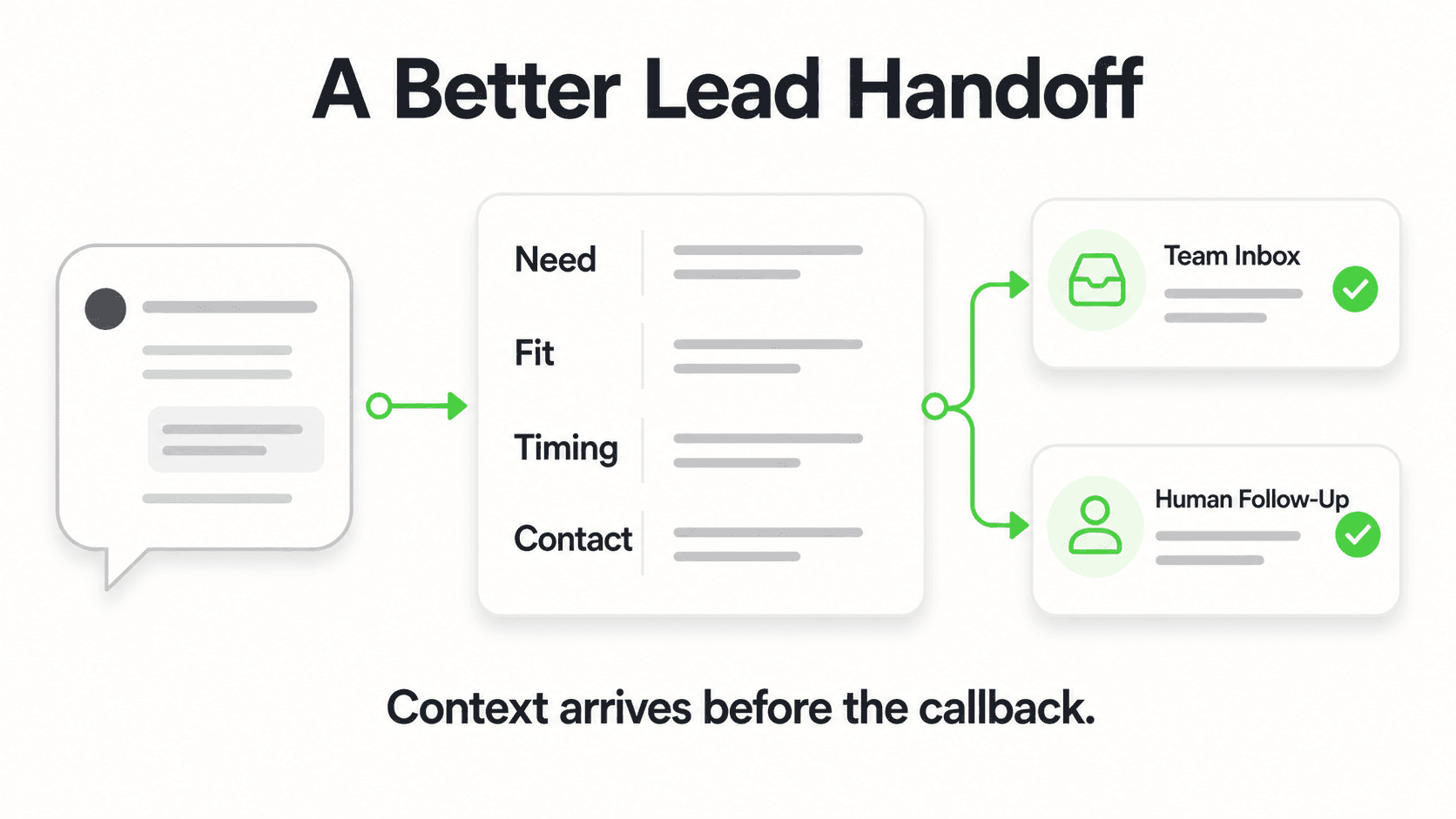
What this looks like in practice: Before a human ever picks up the thread, the AI has gathered address, approximate roof size or square footage, material preference, and what the homeowner can see — missing shingles, granule loss, a soft spot, an active leak.
Real-world impact: Your estimator or sales rep starts the conversation already knowing the shape of the job instead of re-collecting basic facts.
Why it works: A lead form gates the conversation — contact details are collected before the qualifying conversation continues — so every lead includes a name and phone number even if the chat ends early.
Key features:
- Structured intake fields (address, roof age, damage type)
- Contact details captured up front, before the detailed conversation
- Consistent intake format across every lead
5. Routes storm-damage and urgent leads to your team fast
What this looks like in practice: When a conversation includes signs of active leaking or urgent damage, the system notifies your team immediately — via the dashboard, email, or your CRM through webhooks — instead of the message waiting in a shared inbox.
Real-world impact: The gap between "homeowner messaged" and "your team saw it" shrinks from hours to seconds, closing the exact response-time gap tied to conversion.
Why it works: Automated routing removes the manual step where leads sit unassigned during a busy surge. CRM connectivity works via REST API and webhooks — an integration requirement to evaluate against your specific system, not a native, pre-built connection.
Key features:
- Instant notification on qualified urgent leads
- REST API and webhooks for CRM connectivity
- One-click export of captured leads for follow-up
6. Answers financing and pricing-range questions from your own content
What this looks like in practice: "Do you offer financing?" and "what's a ballpark for a full replacement?" are two of the most common questions a roofing office fields. The AI answers both from your documented financing options and price ranges.
Real-world impact: Homeowners doing early research get a real answer instead of a generic "contact us for pricing," without your team repeating the same explanation all day.
Why it works: The AI answers only from what you've uploaded — your financing partners' terms, your typical price ranges by material and roof size. It shares ranges, not binding quotes, and it doesn't process payments itself.
Key features:
- Answers financing FAQs from your own documented terms
- Shares price ranges, not calculated quotes
- Escalates anything outside its knowledge to your team
7. Meets homeowners where the yard sign sent them — social DMs
What this looks like in practice: A homeowner sees your crew's yard sign or a neighbor's referral, looks you up on Instagram or Facebook, and messages instead of calling. The AI receptionist covers those DMs exactly the same way it covers the website widget.
Real-world impact: Leads generated by yard signs, vehicle wraps, and social ads don't get lost because nobody was watching the inbox.
Why it works: Instagram DM and Facebook Messenger run on Meta's official Business APIs — Hyperleap AI is a Meta Technology Provider and Business Partner — so the same qualifying and routing logic applies wherever a homeowner chooses to reach out.
Key features:
- Native coverage on Instagram DM and Facebook Messenger
- Same triage and routing logic across every channel
- Every conversation lands in one inbox regardless of source
See how it handles a storm-surge morning
Set up an AI receptionist that answers, qualifies, and routes roofing leads across web, WhatsApp, and social DMs — starting at $40/month.
Start Free TrialReal Results: What Roofing Companies Are Achieving
Fewer leads lost during storm surges
- Every inbound message during a surge gets an immediate reply instead of joining a callback queue
- Storm-damage leads arrive with roof age, damage type, and address already collected
- Consistent qualification means estimators spend inspection time on the roof, not re-asking basics
Estimator and office-manager time reclaimed
- Routine FAQ volume (financing, pricing ranges, service area, licensing) is answered without a human touch
- Insurance-process questions get a consistent, documented answer instead of an ad hoc one each time
- Your team's attention goes to inspections and closing, not repeating the same five answers
Lower cost than adding seasonal staff
- Storm season is exactly when many roofing companies consider temporary phone or office help
- AI Agents plans start at $40/month (Plus), with a 7-day free trial (credit card required)
- No per-conversation cost the way temporary staffing or per-minute answering services bill
Illustrative example, not a guarantee
These are structural advantages an always-on chat receptionist provides during surge periods, not promised outcomes. Actual results depend on your storm exposure, service area, and how the AI receptionist is configured. Where a number appears above, it's sourced — Invoca and InsideSales research cited earlier — or clearly labeled as illustrative.
Implementation Roadmap for Roofing Companies
Getting an AI receptionist live for a roofing company is a matter of days:
Days 1-2: Upload your business knowledge. Service area, materials offered, financing terms, typical price ranges, licensing and insurance details, and your documented insurance-claims process.
Days 3-4: Configure qualification logic. Define the questions that separate repair from replacement work, and what counts as urgent (active leak, structural concern) versus routine (a few missing shingles after a windy week).
Day 5: Connect notification routing. Point urgent and qualified leads to wherever your team actually checks — email, dashboard, or CRM via webhook.
Days 6-7: Deploy across channels and test. Add the chat widget to your website, connect WhatsApp Business, Instagram, and Facebook Messenger, and run test conversations simulating a storm-damage inquiry and a routine pricing question.
Ongoing, especially before storm season: Review and refine. Check captured conversations for gaps in your knowledge base before the next major weather event, when volume will test the setup hardest.
Frequently Asked Questions
Does an AI receptionist for roofing companies answer phone calls?
No. Hyperleap's AI receptionist is chat-first — it operates on your website chat widget, WhatsApp, Instagram DM, and Facebook Messenger. It does not currently answer inbound phone calls; voice support is on the roadmap but not shipped. If most of your storm-surge demand arrives by phone, pair it with your existing phone setup.
Can it handle insurance-related roofing questions?
It explains your own documented process for working with homeowners on insurance-related jobs — what to photograph, how your team supports the claims process, what to expect. It does not assess damage severity, estimate claim payouts, or advise on policy coverage; those stay with the homeowner's insurer and your licensed team.
Can it tell a homeowner whether they need a repair or a full replacement?
It asks qualifying questions — roof age, visible damage, whether there's active leaking — and shares that information with your estimator so the inspection is well-informed. It does not make the repair-versus-replacement call itself; that judgment stays with a person who has seen the roof.
How does it handle a sudden spike in inquiries after a storm?
A chat-based system has no capacity ceiling the way a phone line does — it can hold many simultaneous conversations at once, which matters most during a storm surge when a small office is least able to keep up manually.
How much does an AI receptionist for roofing companies cost?
Hyperleap AI Agents plans start at $40/month (Plus), including one chatbot across four channels with 3,000 AI responses per month. Higher tiers (Pro at $100/month, Max at $200/month) add more chatbots, channels, and response volume. All plans include a 7-day free trial; a credit card is required to start. For more detail on pricing across the market, see our AI receptionist cost guide.
Can it schedule the inspection directly on my calendar?
Yes, if you schedule through Calendly or Cal.com. Connect either and the AI reads your live availability, offers real open times, and books the inspection in the conversation — the homeowner gets the calendar invite by email (in-chat booking needs Calendly Standard or higher). With any other scheduling tool, it shares your booking link instead. It does not sync with Google Calendar or Outlook directly — your existing booking tool stays the source of truth.
Does it work with my CRM or estimating software?
It connects via REST API and webhooks, so captured leads can flow into whatever system your team already uses. It does not offer native, pre-built integrations with specific roofing CRM or estimating platforms today — treat any such connection as an integration requirement to evaluate via the API, not an out-of-the-box feature.
The Roofing Front Desk That Handles Every Surge
Roofing is a business defined by two speeds: the slow, steady drip of the same daily questions, and the sudden flood after a storm. An AI receptionist covers both — answering instantly during a normal week so the same five questions stop landing on your estimator, and absorbing the 3-5x surge after a hailstorm without a capacity ceiling. It qualifies repair from replacement, explains your own insurance-claims process honestly, and gets a clean, structured lead to your team in seconds rather than hours.
It's not a phone system, and it doesn't pretend to be — pair it with your existing phone line if calls remain your primary channel, and let it own the chat, WhatsApp, and social volume where homeowners increasingly research and reach out first. For a roofing business that loses even a handful of leads a season to slow response, that gap is worth closing. See our pricing for plan details, or explore the full AI agents for home service businesses picture, including how the same front-desk approach applies to landscaping, plumbing, and HVAC companies.
Stop losing storm-damage leads to slow response
Give your roofing company 24/7 coverage across website, WhatsApp, and social DMs — qualifying and routing leads while your team is on the roof.
Get Started FreeIndustry Solutions
See how AI chatbots work for these industries:
Related Articles
AI Receptionist for Landscaping Businesses
An AI receptionist for landscaping businesses answers quote and service questions 24/7, qualifies property details, and shares your booking link.

AI Chatbot for Roofing Companies: Win the Storm Rush
A chatbot for roofing companies answers storm-surge leads instantly, collects damage photos, and routes insurance questions before competitors call back.

AI Receptionist for HVAC: Handle Summer Call Surges
How an AI receptionist for HVAC companies covers seasonal call surges, qualifies emergency vs. maintenance requests, and books jobs 24/7.

AI Chatbot for Moving Companies: Win the Quote Race
A chatbot for moving companies qualifies quote requests instantly — origin, destination, home size, date — so you respond before rival estimates land.